
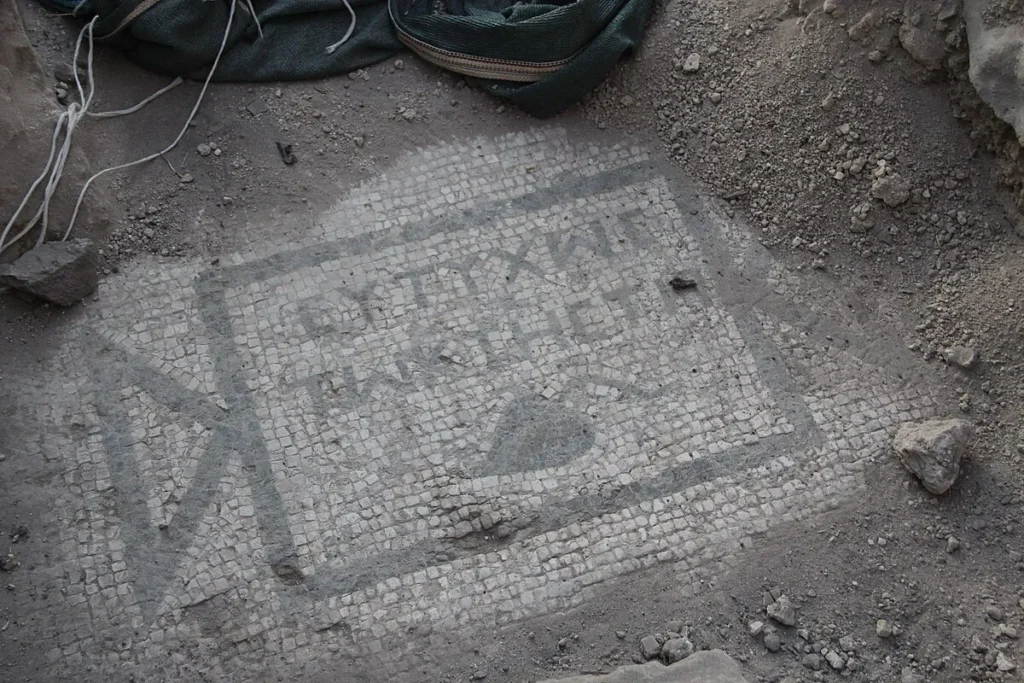
In 2024, archaeologists from the University of Haifa excavating the Byzantine city of Hippos above the Sea of Galilee announced a discovery that reframed a question historians had been asking for decades: what did institutional care for the elderly actually look like in the ancient world, and can we find the physical remains of it? The find was a mosaic medallion, small and carefully made, carrying a Greek blessing addressed to “the elders” and positioned at the entrance of a building embedded in a residential quarter of the city. The excavation team, led by Michael Eisenberg of the Zinman Institute of Archaeology at the University of Haifa, proposed that this building may represent what could be called the world’s oldest nursing home: the earliest physically excavated evidence for an institution dedicated to elder care. The claim is measured rather than sensational. It rests on the combination of the inscription’s specific address, the mosaic’s placement at a threshold rather than inside a church, the residential character of the surrounding architecture, and the date of the pavement to the late fourth or early fifth century CE. This post examines the find, the building, and what the wider historical record tells us about how Late Antique Christian communities actually cared for their elderly.
Hippos: the city on the ridge
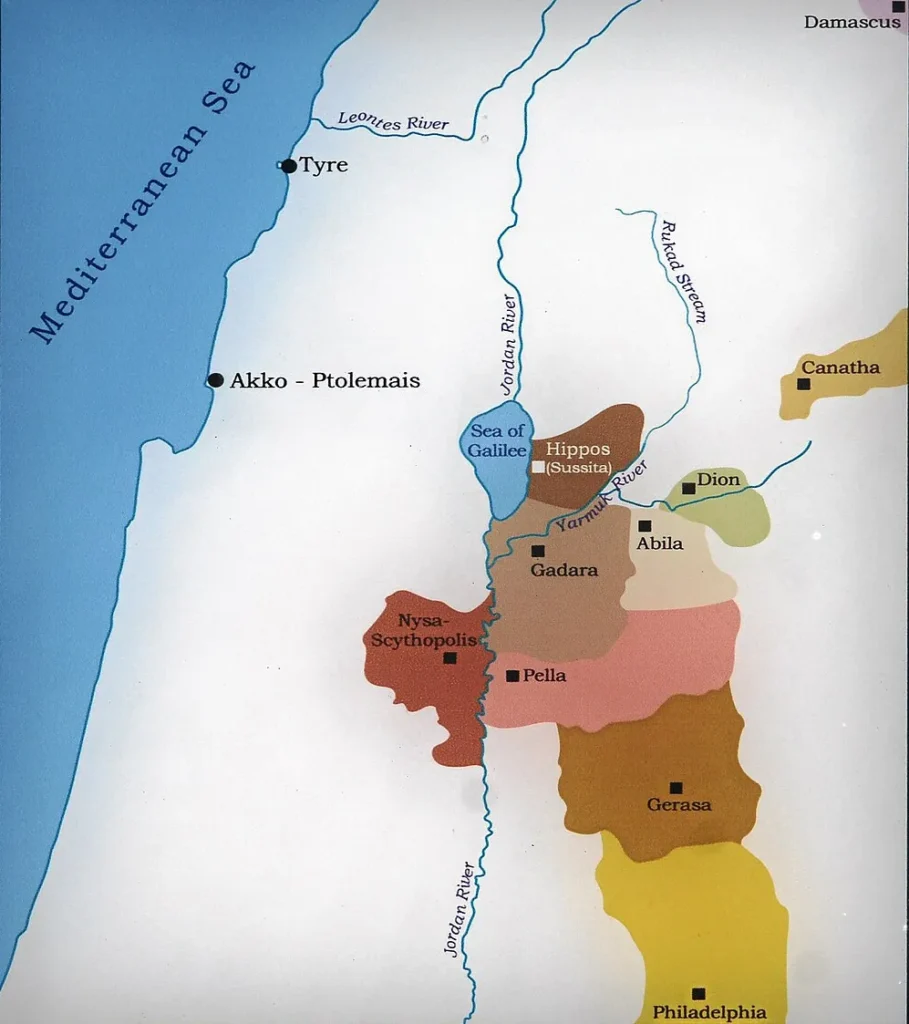
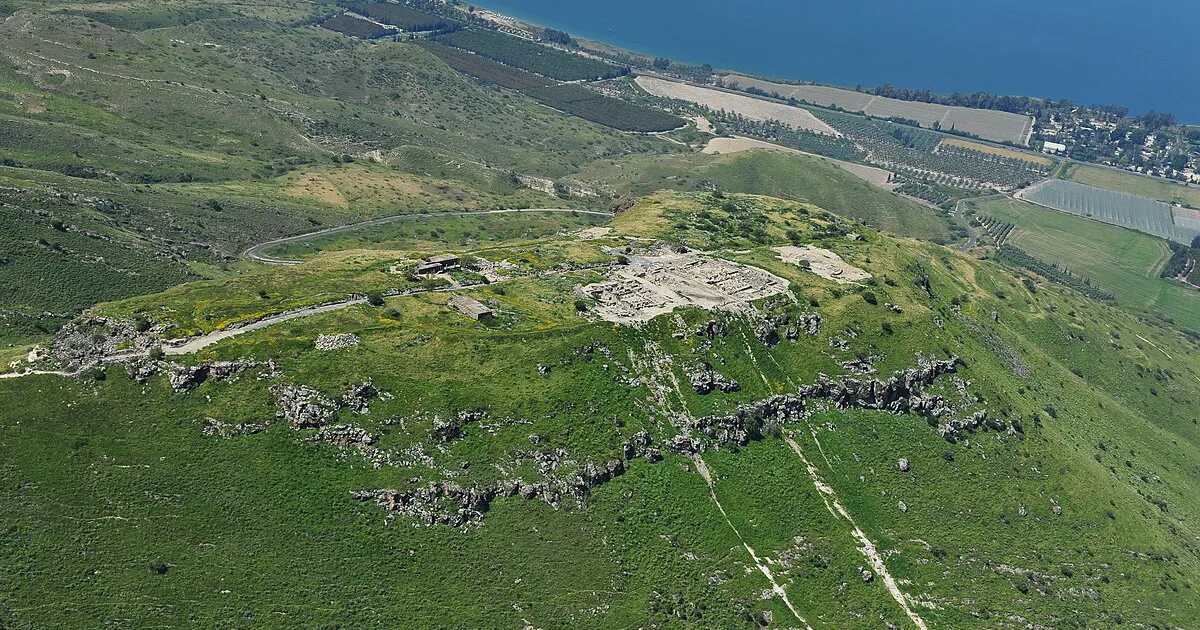
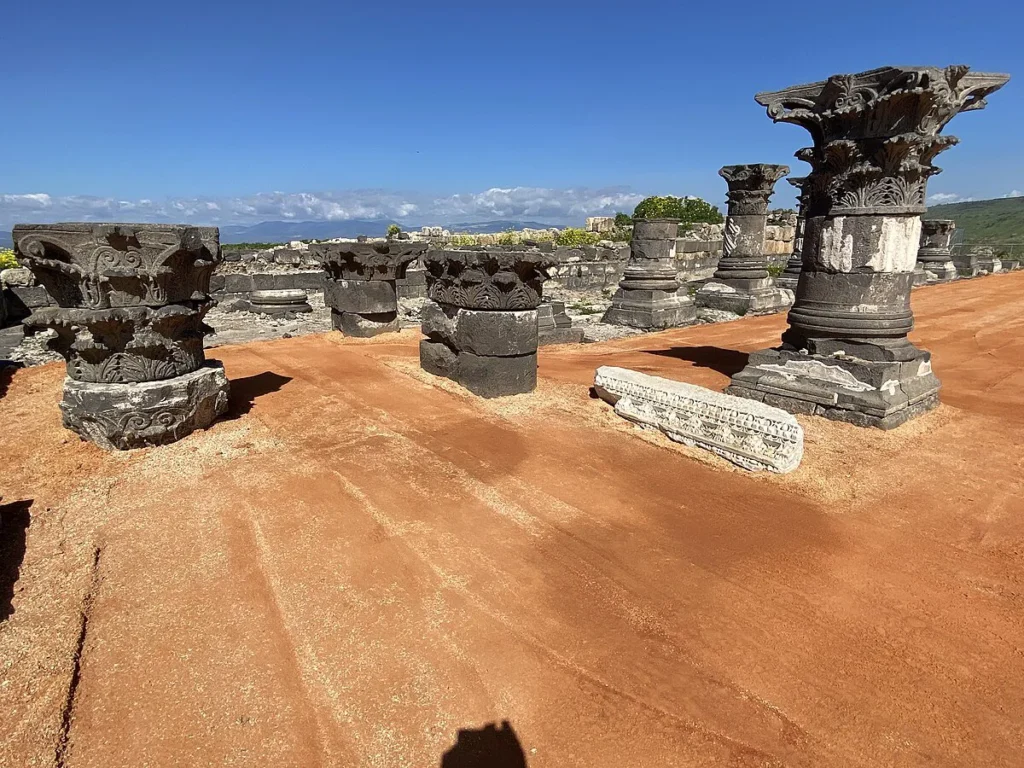
Hippos, known also by its Semitic name Sussita, occupies an isolated basalt plateau roughly 350 metres above the eastern shore of the Sea of Galilee, connected to the surrounding hills by a narrow saddle to the east. Founded as a Hellenistic settlement in the late third or early second century BCE, it became one of the cities of the Decapolis, the league of Greek-speaking urban centres scattered across the southern Levant, and developed under Roman administration into a fully equipped provincial city with a colonnaded main street, a forum, a basilica, bathhouses, and residential quarters filling the space between the major public monuments. By Late Antiquity it had acquired multiple churches, a bishop’s seat, and the charitable infrastructure that newly empowered Christian communities were building into the fabric of cities across the eastern Mediterranean.
The city was destroyed in the earthquake of 749 CE, one of the most destructive seismic events in the history of the Levant. The destruction was effectively instantaneous, which means the archaeological record at Hippos was sealed by catastrophe rather than gradually buried by later occupation. What excavators find was in use when the earthquake struck. Excavations led by the University of Haifa have been ongoing for over two decades and have produced a sequence of major finds (church mosaics, sculpture, and now the elder-care inscription) that make Hippos one of the most important Late Antique sites currently under excavation in the region.
What the mosaic says and where it was found
The medallion is a small oval of tesserae set in a pavement near the entrance of a building in a residential insula close to the main east-west street of the city. The Greek text carries a blessing equivalent to “Peace be with the elders.” The critical word is presbyteroi, which in the Greek of Late Antiquity carries two possible meanings: the literal and demographic, denoting older people as a group defined by age, and the ecclesiastical, denoting presbyters or priests within the Christian church. The excavation team’s argument for the demographic reading rests primarily on location. A blessing for clergy would most naturally appear in a church, a monastery, or an episcopal complex. This mosaic was found in a building embedded in a residential quarter and positioned at an entrance in a way that suggests it addressed people entering rather than officiants performing a function inside. Outside a specifically ecclesiastical context, presbyteroi defaults to its older, demographic meaning: these are elders, defined by their years, not their office.
The word for peace in the inscription is eirene, which in biblical Greek carries a meaning wider than simple quietness. It denotes wholeness, safety, and the comprehensive absence of threat: what the Hebrew shalom covers. As a threshold word, placed where people step over it on entry, eirene functions as a programme statement for the space beyond: this is a place where elders can expect safety and care. That framing is consistent with a care institution in a way it is not consistent with any other obvious alternative reading. The Times of Israel covered the announcement with photographs of the medallion in situ and a summary of the team’s interpretation, and represents the most accessible primary account of the discovery available in English.
Did the ancient world actually have nursing homes?
Care for elderly family members in the classical and biblical worlds was primarily a household obligation. Roman law imposed a duty on adult children to support aging parents. Jewish law interpreted the fifth commandment’s injunction to honour father and mother as requiring material provision as well as respect. Greek philosophical ethics treated the care of parents in old age as a standard example of piety. None of these systems envisioned the state or a religious institution providing for the elderly as a substitute for family care. The world’s oldest nursing home, if such a thing existed in institutional form, required a new kind of organisation to create it, and that organisation arrived in the fourth century CE.
What changed in Late Antiquity was the active involvement of Christian communities in institutionalised welfare provision on a scale that had no Roman precedent. The church, newly legal after Constantine’s Edict of Milan in 313 CE and soon richly endowed by imperial and aristocratic patronage, began building welfare infrastructure into the fabric of cities. Peter Brown of Princeton University, whose 2002 study Poverty and Leadership in the Later Roman Empire remains the most accessible scholarly account of this transformation, described the episcopal welfare system of Late Antiquity as an entirely new institutional landscape grafted onto existing urban fabric. The types of institution that appear in texts of this period include xenodochia for travellers, ptochotropheia for the poor, nosokomeia for the sick, orphanotropheia for orphans, and gerokomeia for the elderly. The textual evidence for institutions specifically for the elderly includes references in the letters of Basil of Caesarea from the 370s CE and in church council proceedings from the fifth and sixth centuries. Physical evidence, an excavated building that can be confidently identified as an elder-care institution, has until now been almost entirely absent from the archaeological record. That absence is precisely what makes the Hippos find significant.
Built out of a love for history, kept free from distractions.
Spoken Past is an independent project shaped by curiosity, care, and long hours of research. Reader support helps keep it maintained, carefully researched, and open to everyone.
Why the world’s oldest nursing home is so hard to find archaeologically
The near-total absence of physically identified elder-care institutions from the archaeological record of Late Antiquity is not an accident. Care buildings of all kinds are among the hardest ancient structures to identify, for several reasons. They were typically modest in scale and constructed from reused or locally available materials rather than the expensive marble and imported stone that characterised public monuments. They were built into existing urban fabric rather than on prominent sites, which means they were frequently adapted, rebuilt, subdivided, and obscured by subsequent use. They left few distinctive artefact assemblages: a care house might contain the same ceramics, lamps, and small finds as a private household or a small workshop. And the features that most clearly indicate care functions (wide corridors for assisted movement, built installations for washing and sanitation, food preparation areas scaled for communal use) are difficult to distinguish from the corresponding features of other communal building types without additional interpretive clues.
Andrew Crislip of Virginia Commonwealth University, whose 2005 study From Monastery to Hospital published by the University of Michigan Press examined the archaeology of Late Antique welfare institutions in detail, noted that the material signature of care is both subtle and easy to confuse with adjacent building types. A monastery and a hospice might use identical room configurations. A guild hall and a communal elder house might have comparable entrance features. What distinguishes them is the combination of epigraphic, iconographic, and contextual evidence, exactly the combination the Hippos team is working with. The inscription is the explicit clue. The architecture and the artefact assemblage in surrounding rooms, still being excavated, will either support or complicate what the inscription proposes.
What the birds mean: reading Late Antique mosaic iconography
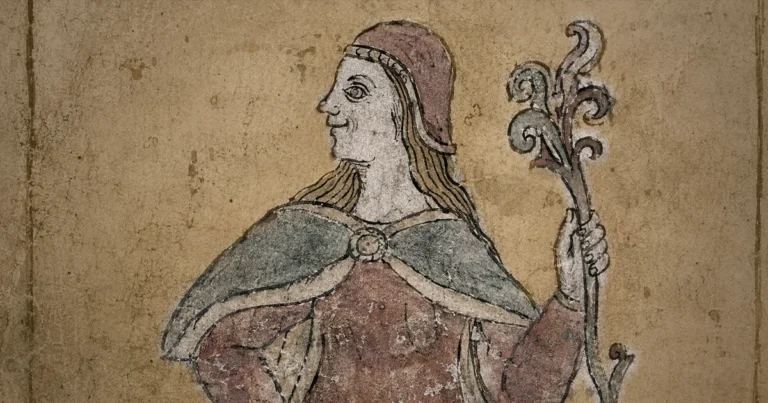
The medallion is flanked by birds, reported in some accounts as Egyptian geese, in others as generic waterfowl drinking from a chalice, rendered in the careful tessellation typical of late fourth or early fifth century CE floor mosaics in the Levant. Pairs of waterfowl symmetrically arranged around a central symbol carried well-established associations in Late Antique visual culture: ordered abundance, tamed nature, and the calm of provision. In a domestic or communal context they signalled hospitality and care. In a church context they would typically appear alongside explicitly Christian symbols — a cross, a chi-rho, or a christogram. Their appearance here without such accompaniment is consistent with the team’s argument that the building was a communal care institution rather than a specifically ecclesiastical space.
The craft quality of the medallion also matters. The tesserae are tightly set, the outlines clean, and the text panel well-proportioned within the oval frame. This is not a cheap or improvised floor but a commissioned work intended to be seen, read, and associated with the quality of what happened in the space it addressed. Investment in threshold mosaic in Late Antiquity was a statement of institutional seriousness: the equivalent of a sign above a door telling whoever approaches that something important happens beyond it, and that they deserve to know before they cross.
Hippos in the wider landscape of Late Antique Galilee
The Galilee and Golan region in Late Antiquity was one of the most intensively Christianised landscapes in the eastern Mediterranean. By the fifth and sixth centuries CE the area was dotted with villages each having at least one church, and the major cities, including Tiberias, Scythopolis, and Gadara, had episcopal sees with substantial buildings and documented charitable activities. This was also a region with a significant Jewish population and a smaller Samaritan community, all of which contributed to an environment in which religious institutions demonstrated their commitment to communal welfare in ways visible to all groups. The bishop of Hippos operated in this environment, and the charitable infrastructure of the city would have been part of the public face of the Christian community to its non-Christian neighbours.
An elder-care institution at Hippos would not be surprising as an institutional type. What is surprising, and what makes the find genuinely significant, is that it appears to be the earliest physically excavated example. The textual sources describe institutions for the elderly as a feature of Late Antique Christian charity from the mid-fourth century onward. If the Hippos building dates, as the mosaic’s style and context suggest, to the late fourth or early fifth century CE, then it would be among the earliest institutional realisations of that programme. Finding the physical building that corresponds to the types described in the texts is a different kind of knowledge from having the texts alone. It tells you where elder care was located in the city, how it was positioned relative to the streets that served it, what quality of investment it received, and what language it used to address its intended residents. These are questions that texts alone cannot answer.