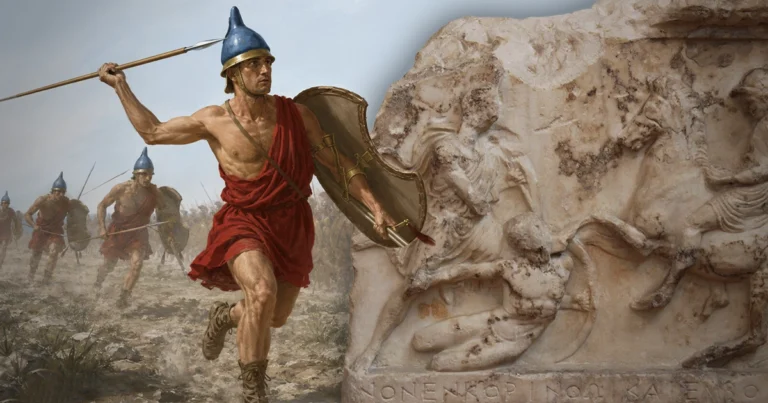

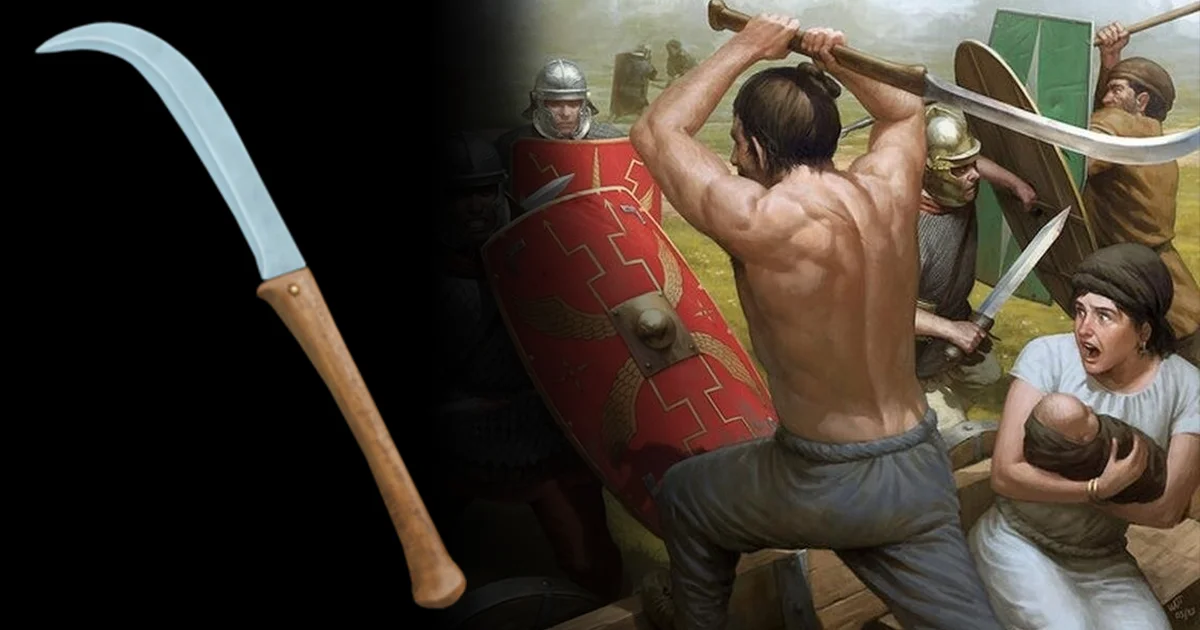
When Roman legionaries first encountered Dacian warriors wielding the falx in the late 1st century AD, they experienced something terrifying. This massive curved blade, swung with two hands, came crashing down over the tops of their shields and split helmets in half. It severed arms through armor that had protected Roman soldiers for generations. The falx didn’t just kill Romans—it rendered their entire defensive system obsolete. Within years, Rome was frantically redesigning armor that had remained largely unchanged for decades. This is the story of how one barbarian weapon forced the world’s greatest military power to completely rethink how it protected its soldiers.
What Made the Dacian Falx So Deadly
The Dacian falx was unlike anything Romans had faced before. This weapon featured a curved iron blade nearly three feet long attached to a wooden shaft of similar length. The blade curved inward like a sickle but was sharpened only on the inside edge, creating a devastating chopping and hooking motion.
Warriors wielded the falx with both hands, generating enormous force. The curved design meant the blade’s path followed an arc that came down from above and behind Roman shields. Traditional Roman scutum shields, designed to block straight thrusts and slashes, offered almost no protection against this overhead trajectory.

The two-handed falx could reach over six feet in total length. Archaeological evidence from Dacian sites shows these weapons varied in size, with some warriors using shorter one-handed versions called sica. But the truly terrifying weapon was the two-handed polearm version that Dacian warriors swung with full body force. According to scholarly analysis of Dacian military technology, this weapon represented sophisticated metallurgical knowledge and tactical innovation.
How the Falx Split Roman Helmets Open
Roman helmets before the Dacian wars featured relatively thin bronze or iron construction. The Coolus and Imperial Gallic helmet types that dominated the 1st century AD were designed to deflect slashing sword strikes and protect against arrows. They worked perfectly against traditional enemies.
But the falx attacked from a completely different angle. When a Dacian warrior swung the blade downward with both hands, the curved point concentrated enormous force on a small area of the helmet’s crown. Ancient sources and modern experimental archaeology demonstrate the falx could penetrate or split these helmets with a single blow.
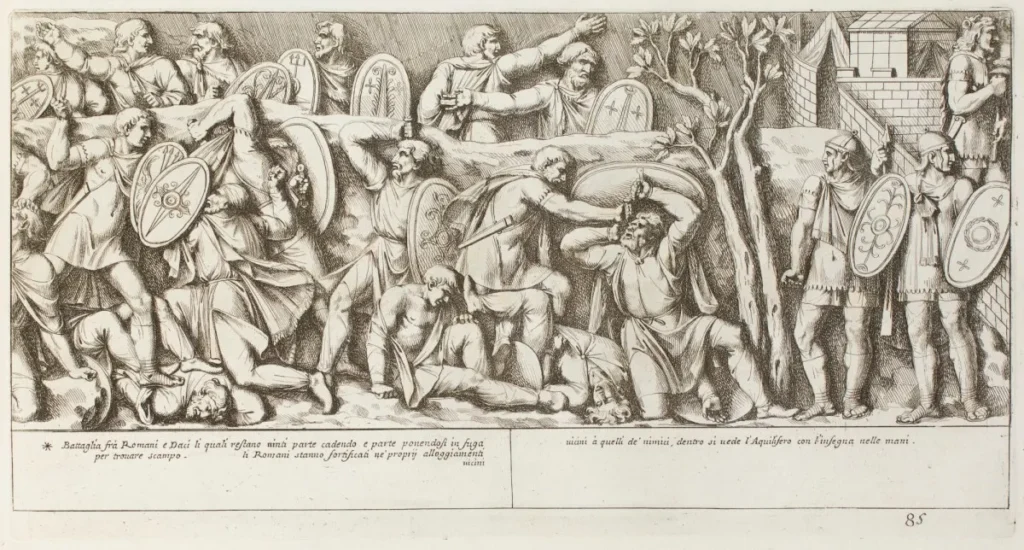
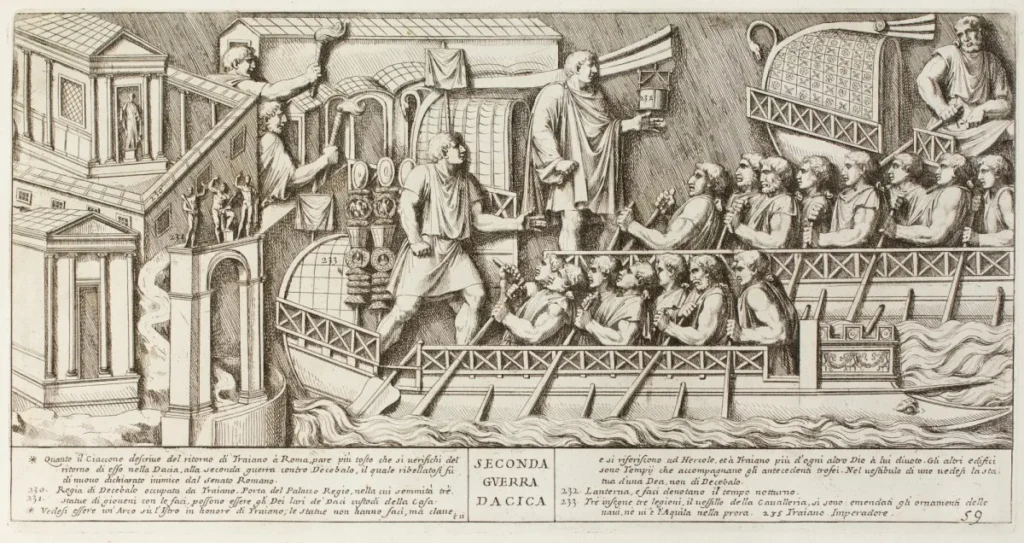
Trajan’s Column in Rome, erected around 113 AD to commemorate the Dacian wars, provides visual evidence of this problem. The spiral frieze shows Roman soldiers wearing reinforced helmets with additional iron crossbars over the crown—modifications that appeared specifically because of the falx. The Victoria & Albert Museum’s plaster cast of Trajan’s Column preserves these details, showing how Romans documented their armor adaptations.
The psychological impact was immense. Roman soldiers had fought Gauls, Germans, Parthians, and countless other enemies with confidence in their equipment. Suddenly facing warriors whose weapons could literally split their heads open through their helmets created genuine terror in the ranks.
The Emergency Armor Redesign
After Domitian’s disastrous first Dacian campaign in 86-88 AD, where Roman forces suffered humiliating defeats, military engineers went to work. They needed solutions fast. The lorica segmentata—the iconic segmented plate armor—already existed but now received critical modifications.
Romans added reinforced helmet crowns with iron crossbars running front-to-back and side-to-side. These cross-braces distributed the impact of falx strikes across the entire helmet rather than allowing penetration at a single point. Some helmets received additional iron plates riveted over the crown for extra protection.

Arm guards became standard issue for the first time. The manica—a segmented arm guard made of metal strips—protected the sword arm from the falx’s chopping blows. Previously only gladiators wore such protection, but the Dacian threat made them military necessities. Research on lorica segmentata evolution shows these modifications appearing rapidly between the two Dacian campaigns.
Greaves protecting the lower legs also became more common. The falx could hook over shield tops and strike downward at legs, so Romans added shin protection that had fallen out of use since the early Republic.
Trajan’s Strategic Solution Beyond Just Armor
When Trajan launched his first Dacian campaign in 101 AD, Roman soldiers wore this upgraded equipment. But Trajan understood armor alone wouldn’t win the war. He needed tactical innovations to neutralize the falx’s advantages.
Trajan emphasized close-quarters combat where the falx’s long reach became a liability. Once Romans got inside the weapon’s arc, Dacian warriors couldn’t effectively swing the unwieldy blade. Roman gladius swords excelled at this range.
The emperor also used engineering to control battlefield conditions. By building roads, bridges, and fortifications deep into Dacian territory, Romans could choose when and where to fight. Open terrain favored Roman formations and tactics over individual Dacian warriors with falxes.
Artillery and missile weapons reduced the need for close combat altogether. Ballistae and onagers pounded Dacian positions from range, while archers targeted warriors before they could close to falx range. Trajan’s military strategy as documented in ancient sources combined technological adaptation with tactical flexibility.
The Metallurgical Challenge of Stronger Helmets
Creating helmets that could withstand falx strikes required better metallurgy. Roman armorers had to work harder iron and use higher-quality steel for reinforcement bars. This wasn’t just about making helmets thicker—that would make them too heavy for soldiers to wear all day.
The solution involved differential hardening. Armorers created helmets with harder crowns that could resist penetration while keeping the sides slightly softer to absorb impact without cracking. This technique required precise temperature control during forging and quenching.
Cross-braces used a different approach. Made from high-carbon steel, these bars were extremely hard and designed to deflect rather than absorb blows. When a falx struck a cross-brace, the curved blade would slide off rather than biting into the metal.
Production challenges were enormous. Rome needed thousands of these upgraded helmets quickly. Imperial workshops in Italy and provincial armories across the empire worked overtime. Quality control became critical—a poorly made reinforcement bar could fail catastrophically in battle.
Built out of a love for history, kept free from distractions.
Spoken Past is an independent project shaped by curiosity, care, and long hours of research. Reader support helps keep it maintained, carefully researched, and open to everyone.
Why Dacians Couldn’t Exploit Their Advantage
Despite the falx’s devastating effectiveness, Dacians ultimately lost both wars to Rome. Several factors explain this paradox. First, not all Dacian warriors wielded falxes. The weapon required tremendous strength and skill. Many Dacian soldiers fought with spears, swords, and bows like other ancient armies.
Second, the falx made its wielder vulnerable. Using both hands for the weapon meant Dacian warriors carried smaller shields or no shields at all. Once Romans adapted their tactics and closed to gladius range, falx warriors were exposed.
Third, Rome’s industrial capacity vastly exceeded Dacia’s. While Dacian smiths produced excellent individual weapons, Rome’s state-sponsored armories produced standardized equipment by the thousands. Every Roman soldier received upgraded armor; not every Dacian warrior owned a falx.
Finally, the falx required specific tactical situations to excel. In open-field battles where Roman formations maintained cohesion, the weapon’s advantages diminished. Dacian successes often came in ambushes and mountain fighting where Roman discipline broke down.
How This Changed Roman Military Doctrine
The Dacian wars fundamentally altered how Rome thought about armor and weapons development. Before Dacia, Roman military equipment evolved slowly through gradual refinement. The falx crisis introduced the concept of rapid technological response to specific threats.
This established a precedent. When Rome later faced Parthian cataphracts or Germanic cavalry, military planners could point to the Dacian example. Enemy weapons technology demanded immediate counter-innovation, not gradual adaptation over decades.
The wars also validated the lorica segmentata design. Though it existed before Trajan, the Dacian campaigns proved its superiority for certain tactical situations. The armor’s modular construction allowed quick field modifications—adding reinforcement where needed without redesigning the entire system.
Helmet design became more sophisticated across the empire. Regional variations emerged as different provinces faced different threats, but the principle of reinforced crowns became standard. This design philosophy influenced Roman helmets for the next two centuries.
The Archaeological Evidence Today
Modern archaeology reveals the extent of Roman armor innovation during this period. Excavations at Dacian war sites have uncovered helmet fragments showing various reinforcement attempts. Some failed designs appear alongside successful modifications, documenting the experimental process.
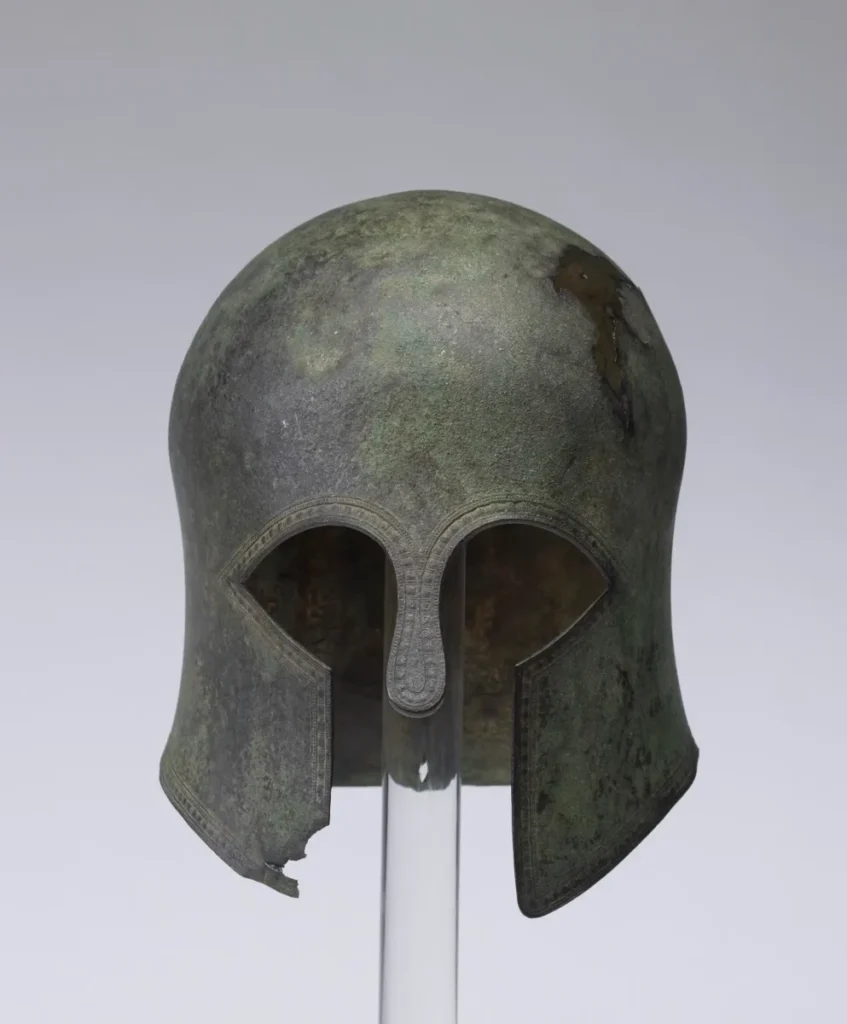
The Walters Art Museum’s armor collection includes Roman helmets from this era showing reinforcement techniques. Museum conservators can identify stress patterns in the metal revealing how these helmets performed in actual combat.
Trajan’s Column remains our most detailed visual source. The frieze’s 155 scenes include multiple depictions of Dacian warriors with falxes fighting Roman soldiers in upgraded armor. Scholars have identified at least seven different scenes specifically showing falx combat.
Dacian falx fragments discovered at archaeological sites show sophisticated metallurgy. Analysis reveals Dacian smiths used pattern-welding techniques and differential hardening similar to later Damascus steel. This wasn’t crude barbarian weaponry but highly refined military technology.
The Falx’s Legacy in Military History
The Dacian falx represents one of ancient warfare’s clearest examples of an asymmetric weapon forcing doctrinal change. Like the English longbow at Crécy or early firearms against medieval plate armor, the falx revealed vulnerabilities in supposedly invincible systems.
Roman military manuals after Trajan’s time discuss adapting tactics and equipment to enemy weapons. This intellectual framework—that military technology must evolve in response to threats—became a Roman principle that influenced Western military thought for centuries.
The weapon also demonstrates how “barbarian” peoples could innovate beyond “civilized” empires. Rome’s technological superiority wasn’t absolute. Dacian metallurgists and weapon designers created something Romans couldn’t initially counter, forcing the empire to learn and adapt.
Modern experimental archaeologists have recreated working falxes and tested them against replica Roman armor. Results confirm ancient accounts—the weapon could indeed split period-appropriate helmets and shear through armor. Rome’s emergency redesign was absolutely necessary for military survival.
FAQ
How heavy was the Dacian falx?
The two-handed Dacian falx typically weighed 4-6 pounds, with the blade accounting for most of the weight. This made it significantly heavier than a Roman gladius but lighter than many medieval two-handed swords, allowing warriors to swing it with devastating force while maintaining control.
Did Romans ever use the falx themselves?
There’s limited evidence Romans adopted the falx for their own forces. The weapon required specific training and fighting styles that conflicted with Roman tactical doctrine emphasizing formation discipline. Romans preferred developing armor to counter the falx rather than incorporating it into their own arsenal.
How long did Rome use the reinforced helmets?
Reinforced helmet designs introduced during the Dacian wars remained standard throughout the 2nd and early 3rd centuries AD. Even after Dacia became a Roman province, the design improvements persisted as Roman military engineers recognized their value against various weapons.
What happened to the Dacian falx after Rome conquered Dacia?
After Trajan’s final victory in 106 AD, falx production largely ceased as Dacia was integrated into the empire. The weapon appeared occasionally in gladiatorial contexts but disappeared from military use. Most surviving examples are archaeological fragments or artistic depictions.
Could the falx penetrate lorica segmentata body armor?
The falx could damage lorica segmentata but less effectively than helmets. The segmented plates dispersed impact better than solid helmet crowns. However, the falx could hook over the top of body armor and strike unprotected areas, which is why Romans added arm guards and greaves.