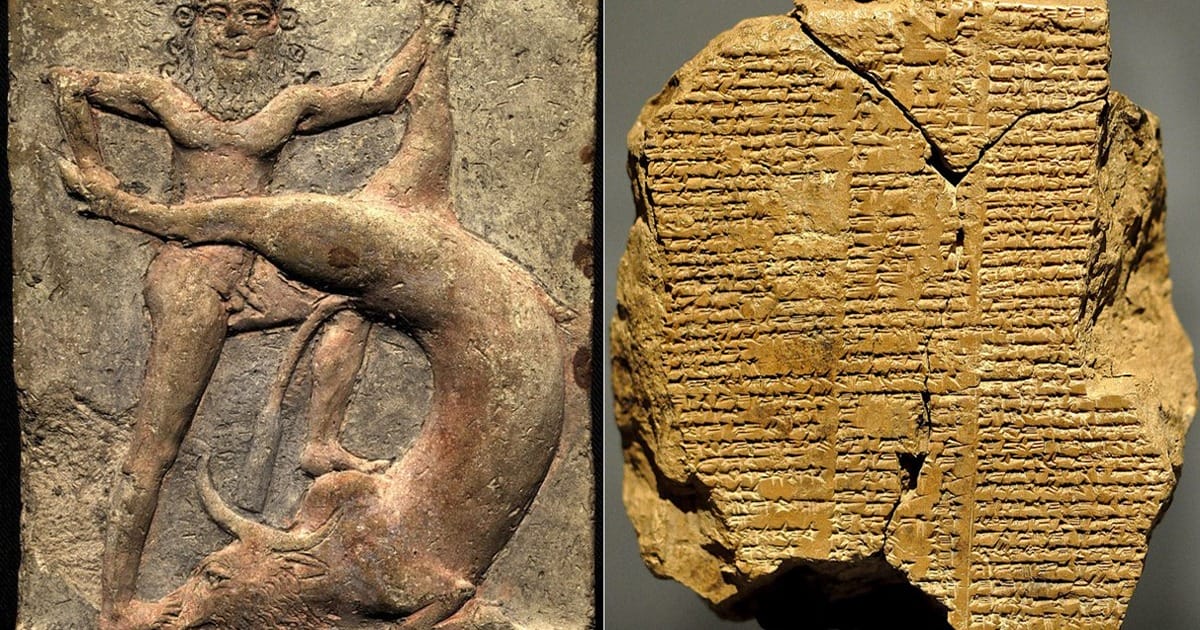
Among the twelve tablets that make up the Standard Babylonian version of the Epic of Gilgamesh, one stands apart from every other. Gilgamesh Tablet XII begins not with monsters, gods, or a journey to the ends of the earth, but with a king sitting in his city lamenting the loss of two small objects that have fallen through a crack in the ground. The text is almost certainly a later addition to the cycle, an Akkadian translation of an older Sumerian poem known as “Gilgamesh, Enkidu, and the Netherworld,” and many ancient copies treat it as an appendix rather than an integral chapter. Yet it contains some of the most precise and sobering descriptions of the Mesopotamian underworld in any surviving literature. It also poses a question that no amount of heroism can resolve: what exactly do you do when the thing you have lost is simply gone, and the only way to get it back is to go somewhere you cannot return from?
Why Gilgamesh Tablet XII Is Not Really Part of the Epic
To understand what Gilgamesh Tablet XII is, it helps to understand what it is not. The eleven tablets that precede it form a unified narrative arc, shaped by the scribe Sîn-lēqi-unninni, probably during the Middle Babylonian period around 1300 BCE, from older Akkadian and Sumerian source material. Andrew George, Professor of Babylonian at the School of Oriental and African Studies (SOAS) at the University of London, produced the most authoritative modern edition of the epic in 2003, and in his Penguin Classics translation he chose not to include Tablet XII as part of the main text, citing its inconsistency with the established narrative: Enkidu is alive in Tablet XII, despite having died in Tablet VII. George notes in his critical apparatus that Tablet XII is, at its core, a literal word-for-word Akkadian translation of the last portion of the Sumerian poem “Gilgamesh, Enkidu, and the Netherworld,” rather than the free adaptation that characterises the rest of the epic.
The dating of the Sumerian source poem is itself contested. Scholar Jeremy Black of Oxford maintained that precise dating was impossible given the available evidence. Alhena Gadotti, in her 2014 critical edition of “Gilgamesh, Enkidu, and the Netherworld” published by De Gruyter, argued that the poem dates to the Ur III Period, approximately 2100 to 2000 BCE, and was in fact the earliest of the Sumerian Gilgamesh compositions rather than the latest. Gadotti’s reading, which Bryn Mawr Classical Review described as a significant departure from previous scholarship, proposes that the poem served as the structural and thematic foundation on which the entire Sumerian Gilgamesh cycle was built. If she is correct, then what looks like an appendix to the Babylonian epic is actually the chronological root of the whole tradition.
The scribe responsible for placing this translation at the end of the Standard Babylonian cycle was almost certainly drawing on a well-established scribal curriculum. Cuneiform tablets from the Edubba, the Sumerian scribal school tradition, show that students in the early second millennium BCE copied both Sumerian compositions and their Akkadian translations as paired exercises. By including a translation of “Gilgamesh, Enkidu, and the Netherworld” as Tablet XII, the compiler of the Standard Babylonian version was preserving an old connection between the two literary traditions while acknowledging the prestige of the ancient Sumerian original.
The Huluppu Tree, the Pukku, and the Mekkû
The Sumerian source poem that underlies Gilgamesh Tablet XII opens with a cosmic prologue in which the gods divide the universe among themselves: An takes the sky, Enlil takes the earth, and Ereshkigal takes the underworld. From this cosmological foundation, the poem moves quickly to a specific and domestic story. A huluppu tree growing on the banks of the Euphrates is uprooted by the south wind and found by the goddess Inanna, who plants it in her garden at Uruk with the intention of using its wood to make herself a throne and a bed. The tree matures, but before Inanna can harvest it, three hostile beings move in: a serpent “who knows no charm” coils at its roots, the Anzu bird nests in its branches with its young, and a demon named Lilitu sets up residence in its trunk. Gilgamesh, acting as Inanna’s brother and champion, kills the serpent. The other creatures flee. Gilgamesh’s companions fell the tree and carve it into furniture for the goddess.
In gratitude, Inanna gives Gilgamesh objects made from the tree’s remaining wood. The Sumerian terms for these objects are ellag and ekidma, rendered in the Akkadian of Tablet XII as pukku and mekkû. What exactly these objects were is one of the most persistently debated questions in Gilgamesh scholarship. The drum-and-drumstick interpretation, which was standard for much of the twentieth century and appears in the widely-read Penguin Classics translation by Andrew George, rests on the fact that the objects are made by a goddess, connected to noise and rhythm, and associated with Gilgamesh’s authority over the young men of Uruk. The Sumerologist Samuel Noah Kramer argued for this reading as early as the 1940s.
George himself, however, now favours a different reading. In his 2003 critical edition from Oxford University Press, he translates pukku as a wooden ball and mekkû as a mallet or bat, treating the passage as describing a ball game of some kind, possibly played in the streets of Uruk. A third position, advanced in a 2012 article by Scheil in the Journal of Cuneiform Studies, proposes that the objects were a game board and gaming pieces. The text describes Gilgamesh playing with them in the town square while the young men of the city are compelled to participate until the widows and mothers complain to the gods about their exhausted sons. All three interpretations agree on function: these are objects through which Gilgamesh exercises a commanding, rhythmic authority over his people, and their loss to the underworld is therefore both personal and civic.
The Rules of the Great Below and How Enkidu Broke Them
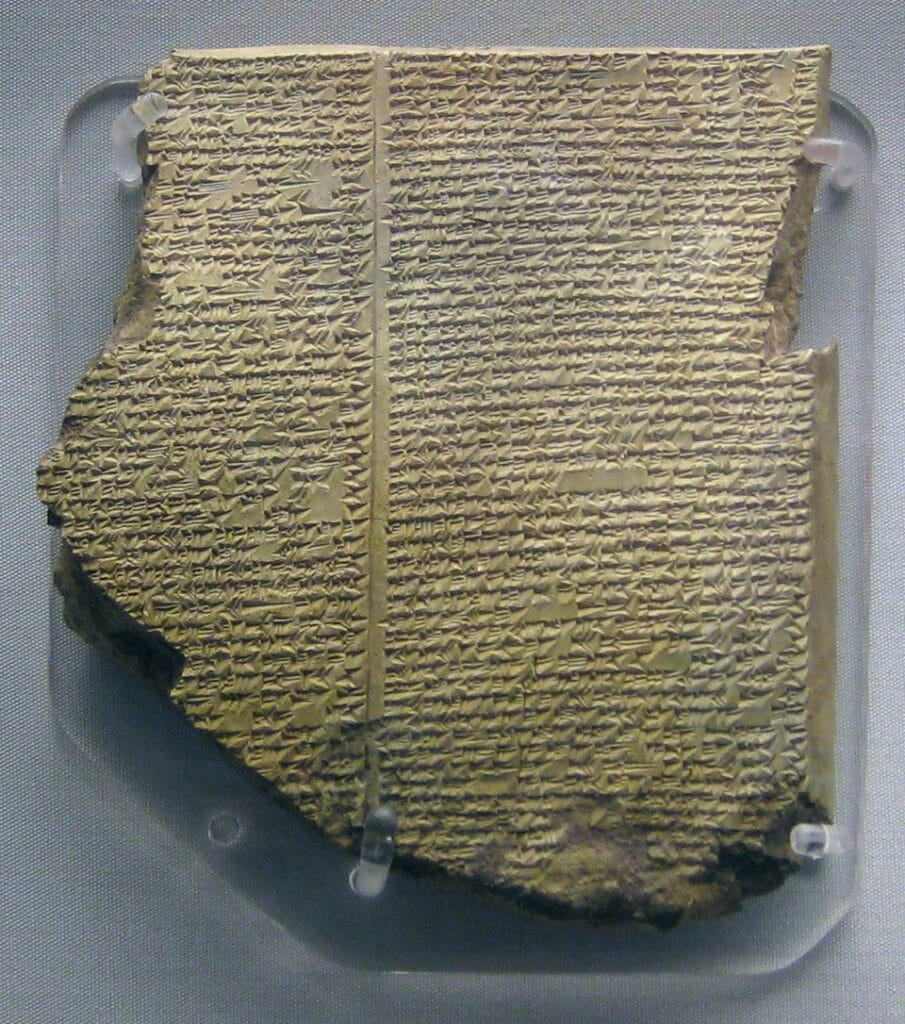
When the pukku and mekkû fall through a crack at the gate of the netherworld, Gilgamesh tries to reach them but cannot. He turns to Enkidu, who volunteers to descend and retrieve them. What follows is one of the most precise and practically-minded passages in all of ancient Near Eastern literature: Gilgamesh’s list of prohibitions for survival in the underworld. Do not put on clean garments. Do not anoint yourself with sweet oil, because the dead will recognize the scent of the living and surround you. Do not carry a weapon in your hand, because the dead will fear you and flee. Do not wear sandals. Do not kiss a wife you loved. Do not strike a wife you hated. Do not kiss a child you loved. Do not strike a child you hated. The noise of those actions, the emotional charge they carry, will mark you as a living intruder and attract the gatekeepers of Ereshkigal’s domain.
These prohibitions are not arbitrary taboos. They encode a specific Mesopotamian theology of the underworld as a place of complete inversion. The dead in Mesopotamian literature do not simply cease to exist; they continue in a grey, flattened state, eating clay and drinking dust, wearing feathers like birds, dwelling in a house where light never enters. The defining feature of their existence is the absence of everything that marks living human identity: clean clothing, fragrant oil, emotional relationships, physical authority. A living person who enters the underworld and behaves as a living person, touching loved ones, striking enemies, carrying weapons, smelling of cedar oil, shines with an identity the dead do not have. That visibility is fatal. The gatekeepers see you. Ereshkigal’s bureaucracy notes your presence. And then it keeps you.
Enkidu ignores every single instruction. He puts on clean garments. He anoints himself with oil. He carries his weapon. He embraces his wife. He kisses his son. He acts, in other words, exactly as a man of status and relationships would act in the world above. The netherworld holds him. He does not return. Only after Gilgamesh appeals to the gods, first to Enlil who refuses, then to Enki who agrees, does the sun god Utu open a crack in the earth through which Enkidu’s ghost, his gidim in Sumerian, can rise briefly to speak to Gilgamesh before descending again.
Built out of a love for history, kept free from distractions.
Spoken Past is an independent project shaped by curiosity, care, and long hours of research. Reader support helps keep it maintained, carefully researched, and open to everyone.
The Catalogue of Ghosts and What It Tells Us About Mesopotamian Death Beliefs
The final section of the poem, which corresponds to the closing lines of Gilgamesh Tablet XII in the Akkadian version, is known to scholars as the “Catalogue of Ghosts.” It takes the form of a dialogue: Gilgamesh asks Enkidu how different categories of the dead fare in the underworld, and Enkidu answers with stark, specific images. The pattern is consistent across the twelve or so figures Enkidu describes: the nature of your existence in the netherworld depends on how you died, how you were buried, how many descendants you left, and how regularly the living perform offerings on your behalf.
The man who died in battle and whose body was properly buried sits on a cushioned seat and drinks clean water. The man who fell in battle and whose body was never recovered drinks muddy water and eats scraps, restless and thirsting. The man with seven sons sits in a place of honour beside the gods. The man with no sons wanders alone. The stillborn child, who never drew a breath, plays with gold and silver in a region where the dead go to rest, a detail that is both startling and tender. The man whose corpse was thrown into the open field, unburied and forgotten, finds no rest at all: his ghost roams the steppe. These categories are not moral rankings. A man who died a hero is not there because he was virtuous. He is there because his death was honourable, his burial was performed, and his descendants maintain the rituals of commemoration.
Those rituals are the kispu, monthly offerings of food, water, and beer poured for dead ancestors at their graves or at household shrines. The kispu was a fundamental institution of Mesopotamian domestic religion, documented in administrative texts from Ur, Nippur, and Assur spanning more than a millennium. Its logic is straightforward: the dead continue to exist in a state that can be improved or degraded by the actions of the living above. Neglect your ancestors, and their condition in the netherworld deteriorates. Honour them regularly, and they dwell in relative comfort. Alhena Gadotti, in her 2014 De Gruyter analysis of this poem, argues that the Catalogue of Ghosts was not simply a literary device but a practical instruction text, teaching the reader and listener the precise conditions under which a soul could expect good treatment below, and therefore the precise obligations the living carried toward the dead.
The Ordered Underworld and Its Parallels Across the Ancient Near East
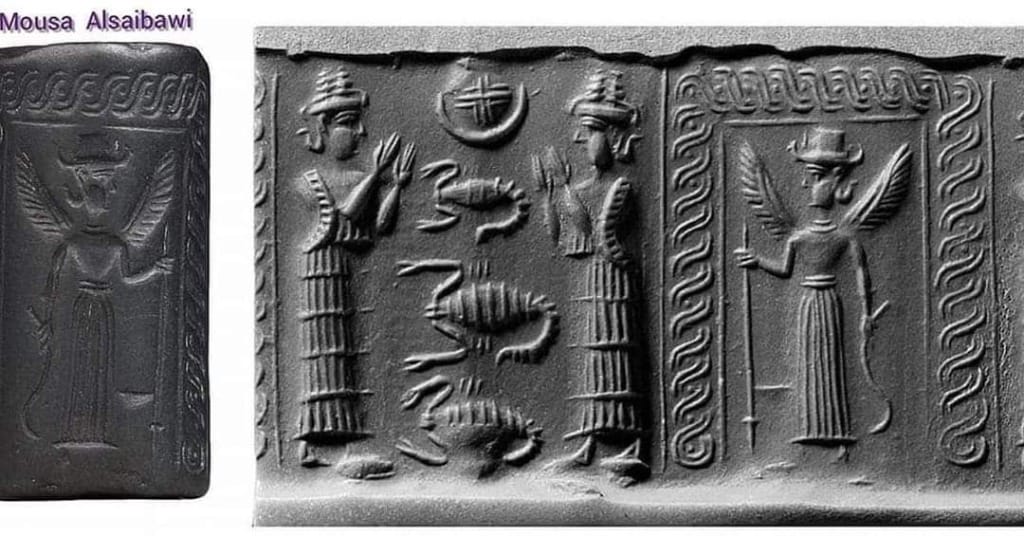
One feature of the Mesopotamian underworld that surprises modern readers is how orderly it is. The Great Below in these texts is not chaos. It is a city. Ereshkigal, “Lady of the Great Below,” reigns from a throne. Her vizier Namtar enforces decrees. The gatekeeper Neti controls the seven gates. The Anunnaki, seven judges of the dead, sit in assembly. There are administrative records. There are prescribed procedures. The dead have statuses, rights, and obligations. The entire system mirrors the bureaucratic city-state structure of the world above, with its kings, viziers, gatekeepers, and judgment assemblies. It is precisely this structural mirroring that makes the prohibitions Gilgamesh gives to Enkidu so logical: the netherworld operates by its own rules, and those rules are just as rigid as the rules of Uruk’s court. Violate the etiquette, and the system deals with you.
This orderly netherworld finds close parallels in other ancient Near Eastern descent myths. In “The Descent of Inanna,” the goddess passes through seven gates on her way to meet Ereshkigal, surrendering at each gate one emblem of her divine authority, from her crown to her lapis lazuli necklace to her robe, until she arrives stripped of every marker of rank. The point of this staged undressing is the same as the point of Gilgamesh’s prohibitions to Enkidu: the markers of life and status do not belong in the underworld. They must be left at the boundary. In the Akkadian “Myth of Nergal and Ereshkigal,” the god Nergal visits Ereshkigal’s court and is required to observe the same courtly protocols that would apply in the world above, including the crucial prohibition against sitting in the chair reserved for his host. Even a god who violates netherworld protocol faces consequences. The Living who enter unbidden do so at far greater risk.
The parallel with Greek descent mythology is worth noting. When Orpheus descends to retrieve Eurydice, the prohibition is different in form but identical in logic: he must not look back, must not assert the living man’s instinct to see and confirm and possess what he loves. When Odysseus visits the dead in Book XI of the Odyssey, he must restrain his companions from allowing the shades to drink too freely from the blood-filled trench, because doing so would give the dead the dangerous vitality of the living. In every case across the ancient Mediterranean and Near East, the boundary between the living and the dead is maintained not by a wall but by a code of behaviour, and crossing it requires a willingness to perform invisibility.
What Gilgamesh Tablet XII Adds to the Epic
The inclusion of Gilgamesh Tablet XII in the Standard Babylonian cycle raises a genuine interpretive question. By the end of Tablet XI, Gilgamesh has been to the edge of the world, survived every monster and divine obstacle the cosmos could produce, and returned to Uruk empty-handed: immortality is not available to human beings. That lesson, delivered by the flood survivor Utnapishtim, forms one of world literature’s earliest meditations on mortality. Why, then, does the compiler add a twelfth tablet in which Enkidu is inexplicably alive again and then immediately lost once more to the netherworld?
One answer lies in scribal tradition. The tablets of the Gilgamesh cycle were used in scribal schools as paired texts alongside their Sumerian antecedents. Placing the Akkadian translation of “Gilgamesh, Enkidu, and the Netherworld” at the end of the cycle was a gesture of scholarly homage, an acknowledgment of the Sumerian roots of the whole tradition. It also provided the cycle with a practical appendix: a compact description of the netherworld’s rules and the conditions of the dead that would have served readers as a reference guide to the theology that underpinned the cycle’s recurring theme of mortality.
Another answer is thematic. Gadotti, reviewing the poem’s structure, argues that the Catalogue of Ghosts functions as a direct instruction to Gilgamesh in his future role. Later Mesopotamian tradition, attested in texts from the city of Nippur, holds that Gilgamesh himself became a judge in the underworld after his death, a role comparable to that of Osiris in Egypt. The knowledge Enkidu brings back from the Great Below, the precise map of how the dead fare according to their burial, their descendants, and their commemorative rituals, is not just general information. It is professional preparation. Gilgamesh, the king who spent his living years trying to escape death, receives in Tablet XII the knowledge he will need to govern the realm he could not avoid.
The Text, the Scribes, and How It Reached Us
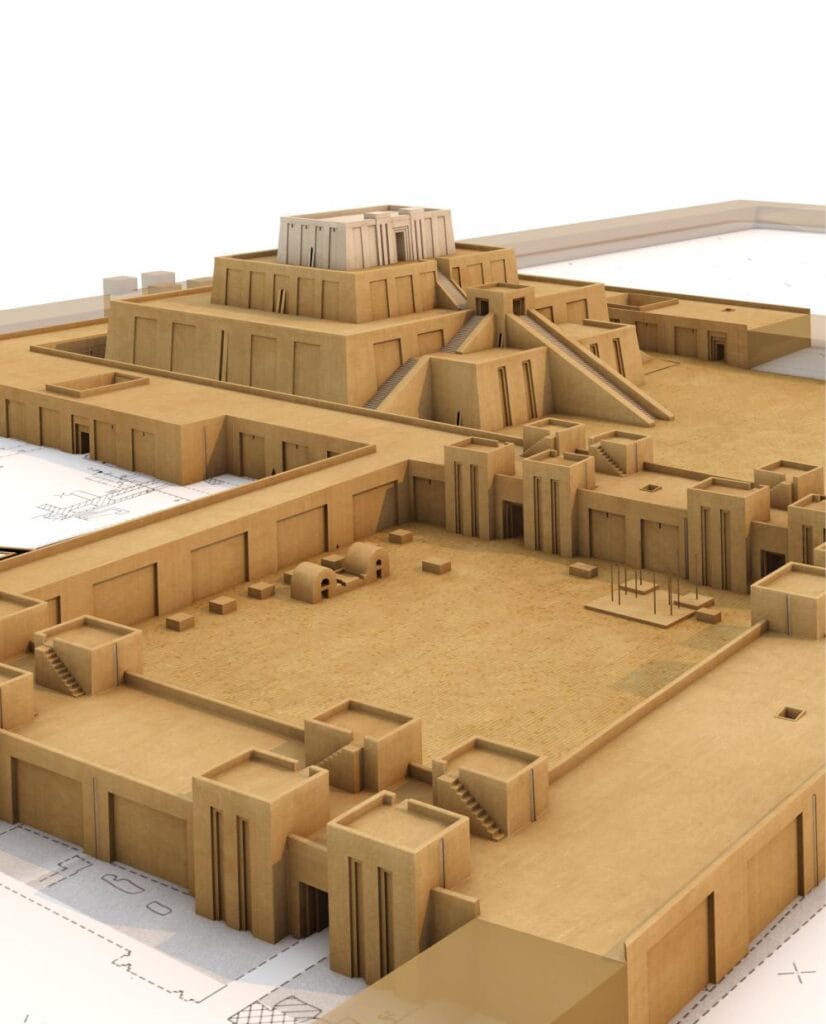
The physical survival of Gilgamesh Tablet XII depends on a network of clay tablets excavated across multiple sites over more than a century of Mesopotamian archaeology. The most important single cache is the library of the Assyrian king Ashurbanipal at Nineveh, modern-day Mosul in Iraq, excavated by Austen Henry Layard and Hormuzd Rassam for the British Museum between 1849 and 1854. The Nineveh tablets, now held in the British Museum’s collections under reference numbers in the K series, provide the fullest surviving version of the Standard Babylonian epic. Fragments of the Sumerian source poem “Gilgamesh, Enkidu, and the Netherworld” have been recovered from Nippur, Ur, Meturan, and other sites, with the oldest manuscripts dating to the Old Babylonian period of approximately 1900 to 1700 BCE.
The colophons, the administrative notations scribes added to the ends of tablets recording the tablet’s number in a series, the name of the copyist, and the first line of the work, are a remarkable source of information about how the Mesopotamian literary tradition was organized and transmitted. Several colophons on Gilgamesh tablets record the name Sîn-lēqi-unninni as the associated scholar, though whether this represents a single historical figure who composed or edited the standard version, or an honorific attribution to a prestigious scribal school, remains debated in current scholarship. What the colophons confirm is that the Babylonian tradition treated the Gilgamesh cycle as a stable, authoritative text, carefully numbered and titled, worth preserving in multiple copies across multiple centuries and cities.
The Electronic Text Corpus of Sumerian Literature (ETCSL), a project of the University of Oxford that digitized transliterations and translations of Sumerian literary texts, provides freely accessible versions of the source poems that underlie the Akkadian epic, including “Gilgamesh, Enkidu, and the Netherworld.” The project’s online edition remains one of the most useful resources for readers who want to compare the Sumerian original with the Akkadian Tablet XII and trace precisely how the translation reshaped the narrative. What emerges from that comparison is striking: the Akkadian version compresses the Sumerian substantially, removing the episode of the oppressive ball game with the young men and beginning instead with the objects already lost, which sharpens the narrative focus from a political satire about a tyrannical king into a personal meditation on irretrievable loss.
Sources: Andrew George, The Babylonian Gilgamesh Epic: Introduction, Critical Edition and Cuneiform Texts, 2 vols., Oxford University Press, 2003. Alhena Gadotti, Gilgamesh, Enkidu, and the Netherworld and the Sumerian Gilgamesh Cycle, De Gruyter, 2014, reviewed at Bryn Mawr Classical Review 2014. Electronic Text Corpus of Sumerian Literature, University of Oxford, “Gilgamesh, Enkidu and the Nether World,” t.1.8.1.4. Miriam Lichtheim, Ancient Egyptian Literature, Volume II, University of California Press, 1976. Joshua J. Mark, “Gilgamesh, Enkidu, and the Netherworld,” World History Encyclopedia, 2022. Andrew George (trans.), The Epic of Gilgamesh, Penguin Classics, 2003.