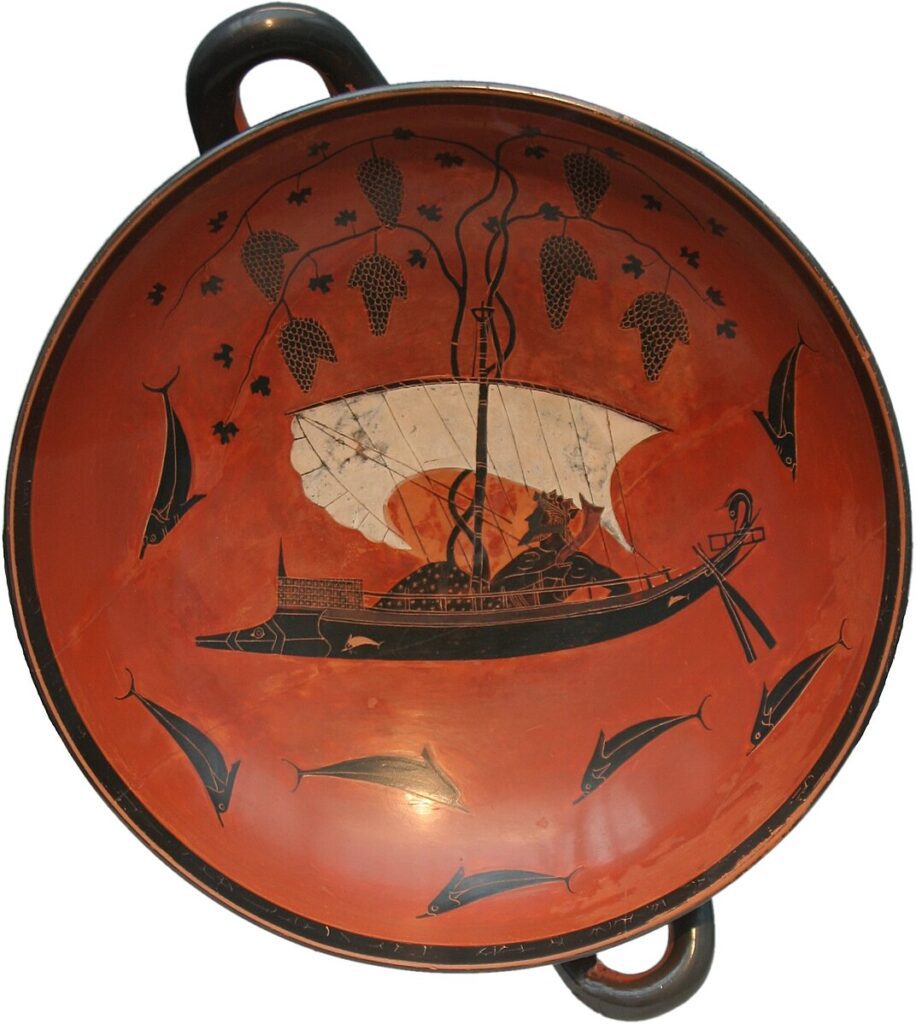
Around 530 BCE, the Athenian painter Exekias decorated the interior of a drinking cup with a single ship sailing through a sea of leaping dolphins. A vine grew from the mast. Grapes hung from the rigging. The figure in the boat was Dionysus. No label was needed. Any Greek drinker who tipped the cup to drink knew exactly what those dolphins meant: safe passage, divine abundance, the god of wine at home on the sea. Animals in Greek vase paintings worked like a compact visual language, one that painters built from centuries of shared associations between creatures, gods, social rituals, and civic life. Lions, owls, hares, panthers, deer, dolphins, serpents, and horses each carried meanings that painters deployed with precision. This article reads that language animal by animal and explains how vessel type, painting style, and context shaped what any given animal was doing on any given pot.
How Animals in Greek Vase Paintings Came to Mean What They Did
The symbolic vocabulary did not arrive fully formed. It accumulated across several centuries and absorbed influences from several directions. During the Orientalising period, roughly 725 to 625 BCE, Greek workshops began encountering Near Eastern textiles, ivories, and metalwork whose decorative programs were dense with animal friezes: lions attacking bulls, panthers stalking prey, sphinxes and griffins in heraldic pairs. Corinthian potters were the first to systematically adopt this language, filling the shoulders and bodies of their amphorae and oinochoai with bands of striding lions, boars, and water birds.
Athenian workshops inherited this vocabulary and then progressively loaded it with specifically Greek divine and ethical content. An owl was not just a nocturnal bird. It was Athena’s bird, the emblem of her city, and the image stamped on Athenian silver coins. A panther was not just a wild cat. It was the animal Dionysus rode, the creature that embodied the loosened restraint of wine. Each generation of painters refined these associations until a single animal in the right context could communicate something quite specific without a single word of inscription.
The shape and intended use of the vessel also determined which animals appeared and where. A kylix, the wide shallow drinking cup designed to be tipped toward the drinker’s face, invited interior scenes that revealed themselves as the wine level dropped. A krater, used to mix wine and water at a symposium, suited larger narrative scenes on its body. A lekythos, the narrow oil flask associated with funerary ritual, favored quieter, more loaded choices: owls, serpents, deer. Painters understood that their animals needed to suit the pot’s entire biography, where it would be used, by whom, and on what occasion.
Lions: Power, Prestige, and the Evil Eye
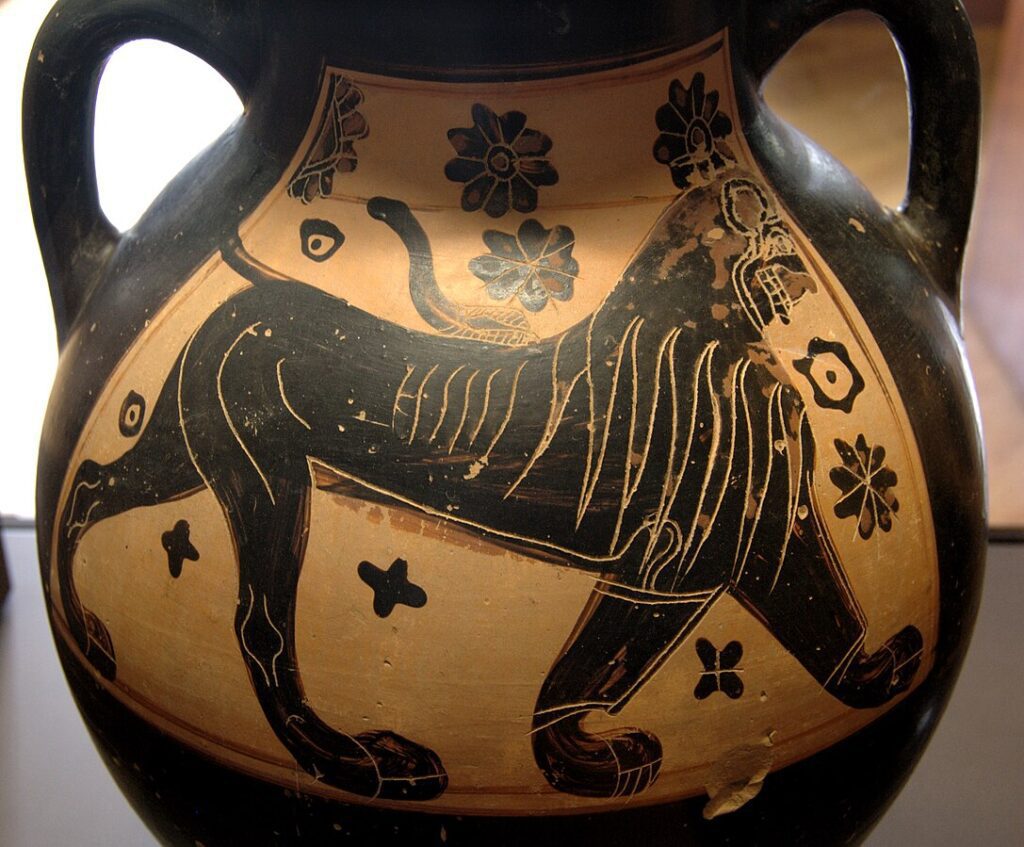
Lions had not lived in mainland Greece since the Bronze Age, but Greeks knew them from imported textiles, stories, and occasional sightings in Macedonia and Thrace. That distance made them more powerful as symbols, not less. With the Orientalising taste for animal friezes, lions prowled across amphora shoulders and plates in their hundreds. On sympotic pottery, a lion with its direct stare and bared teeth was thought to ward off the evil eye. On funerary amphorae, it guarded the contents of the tomb. The lion’s prestige was essentially portable: placing one on any object elevated that object’s status immediately.
Painters worked with a consistent formula, a triangular head, almond-shaped eye, and a mane cut into parallel incised tongues, because legibility mattered more than naturalism. In red-figure, later painters softened the mane and flicked individual locks with a thin brush, but the core formula held. Lions most often face bulls in the animal friezes inherited from the Orientalising period, a pairing that Greek audiences read as a meditation on strength and struggle, the shadow side of the feast that drinking cups were meant to accompany.
When Herakles wears the Nemean lion-skin in vase painting, the image makes a specific argument. The skin is not a trophy in a modern sense. The hero has absorbed the lion’s power into his own body. Painters who showed the paws tied across Herakles’ chest and the gaping jaw framing his own head were visualizing a transfer of qualities: the hero and the defeated beast become a single category, stronger than either alone.
Panthers and the Dionysiac Sphere
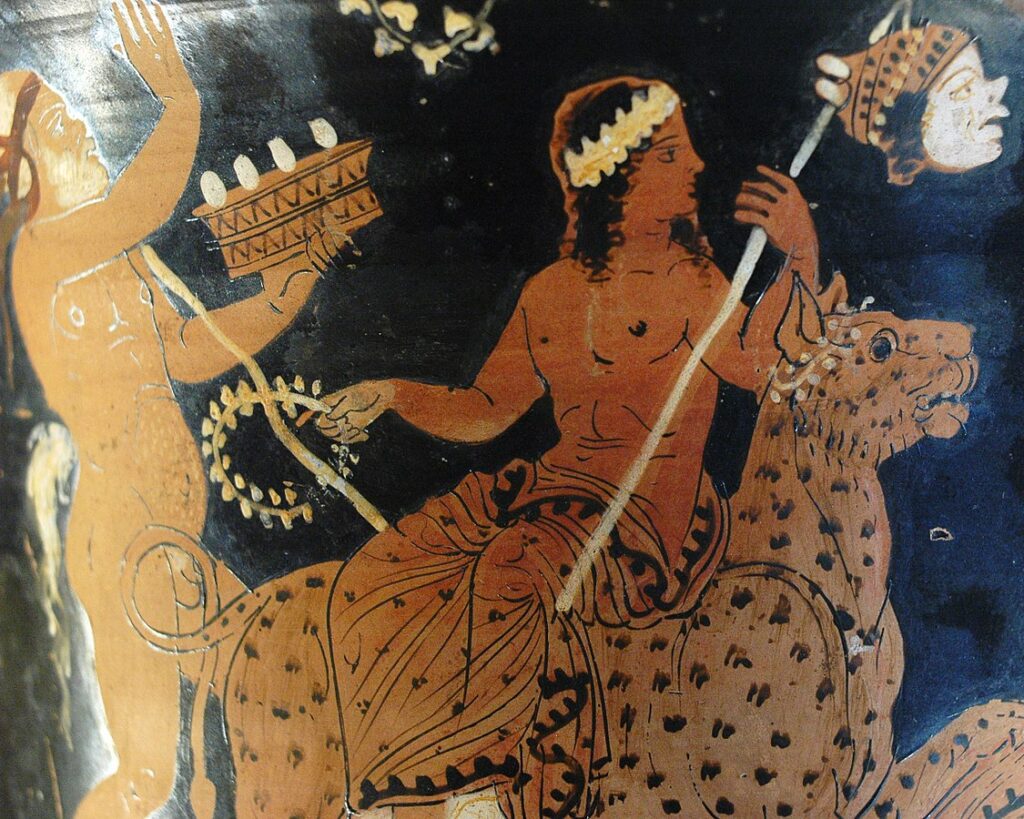
If the lion stands for contained, prestigious force, the panther stands for the opposite: loosened restraint, altered states, and the sweet danger of wine. Dionysus rides panthers, reclines on them, and is surrounded by maenads wearing spotted pelts in some of the most memorable scenes on Attic kraters. The animal signals the Dionysiac sphere as reliably as the thyrsus or the kantharos, the god’s distinctive wine cup, and painters placed it on kraters, the very vessels used to mix wine at a symposium, with a kind of visual irony: the agent of wildness sitting on the container of controlled social drinking.
In red-figure technique the panther’s spotted coat gave painters a specific opportunity. Thin diluted glaze applied as dots across the body’s surface made the spots shimmer differently from the surrounding clay, and under the torchlight of a night symposium that shimmer would have animated the animal in a way that suited its associations perfectly. This is not decorative coincidence. The best Athenian painters were acutely aware of the conditions under which their work would be seen.
The Owl of Athena: More Than Just a Bird
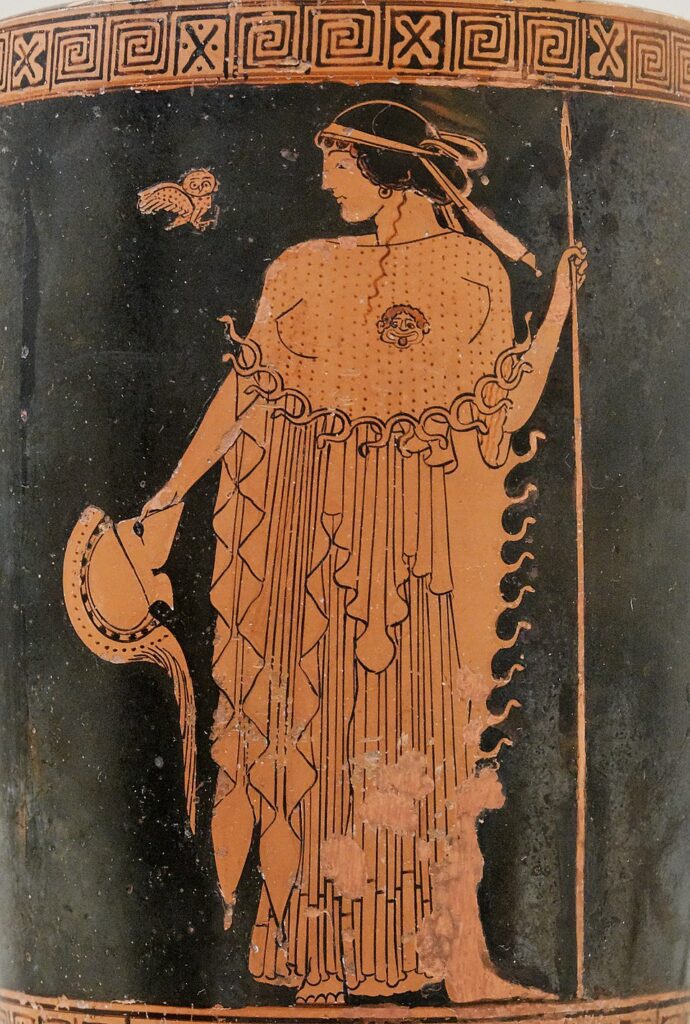
The owl is unusual in Greek vase painting for one specific technical reason: it is often shown in a frontal pose, looking directly out of the picture surface. Greek painters almost never used frontal views for animals. The profile dominated because it was dynamic and legible from a distance. The owl’s frontal stare was therefore a deliberate departure, and it carried the authority of something that looks back at you, that evaluates rather than simply being seen.
For Athenian painters and their buyers, the owl carried a second layer that no other Greek city could access in quite the same way. The Athenian tetradrachm, the city’s primary silver coin and one of the most widely circulated currencies in the ancient Mediterranean, bore an owl on its reverse from around 510 BCE onward. A single owl on a pot made in Athens could simultaneously invoke Athena’s wisdom, signal Athenian civic pride, and nod toward the commercial prosperity that Athenian silver made possible. Few images in the painter’s repertoire compressed that range of meaning so efficiently.
Enjoying Spoken Past?
I created Spoken Past to share my love of history. I research, write and develop everything myself, and I want my articles and basic guides to remain free for everyone.
If you enjoy my work, please consider supporting Spoken Past with a small donation.
Hares, Courtship, and the Aristocratic Hunt
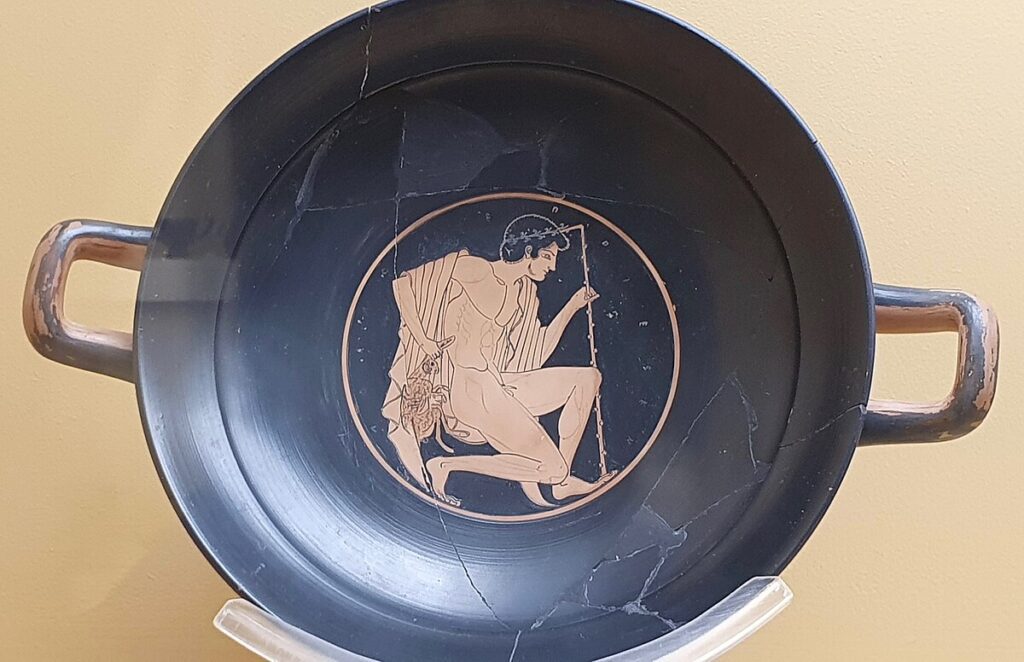
The hare in Greek vase painting moves through two distinct contexts connected by a shared logic of pursuit and capture. In hunting scenes it is quarry: painted mid-flight with long ears laid back and hindquarters bunched for a leap. The aristocratic hare hunt on horseback with trained dogs was an important social ritual in Archaic and Classical Greece, a training exercise in coordination and controlled aggression that civic life valued in young men. Painters who showed this on vessels used at symposia by those same young men were reflecting their world back to them.
At the symposium itself, the hare appears as a courtship gift, held out by an older male admirer toward a younger one in the characteristic gesture of pederastic pursuit in Athenian visual culture. The animal’s associations with speed, nervousness, and the thrill of the chase mapped directly onto the emotional dynamics that Greek courtship narratives relied on. A hare painted on the interior of a kylix became a private communication, visible only when the drinker tipped the cup, a joke between giver and recipient that the rest of the party could also read without the private context being spelled out.
Dolphins, the Exekias Kylix, and Safe Passage
The Exekias kylix in the Staatliche Antikensammlungen in Munich is the most elegant statement of what a dolphin could do in Greek vase painting. Seven dolphins arc in a ring around the ship of Dionysus, creating a visual rotation that mirrors the cup’s own rotation in the drinker’s hand and the wine’s swirling motion as the vessel tips. The choreography of image and object is perfectly unified. Dolphins were good omens for sailors, signs of safe landfall and divine favour, and on sympotic cups they linked three pleasures at once: wine, song, and the promise of returning home safely after a voyage.
Painters rendered dolphins with smooth outlines, a small dot for the eye, and a slightly arched back that suggested wet speed and friendly intelligence. The arc of their bodies in a ring around the ship creates the impression of movement even on a static surface. It is a remarkably economical design for something so rich in association.
The Boar Hunt, Deer, Horses, Serpents, and Swans
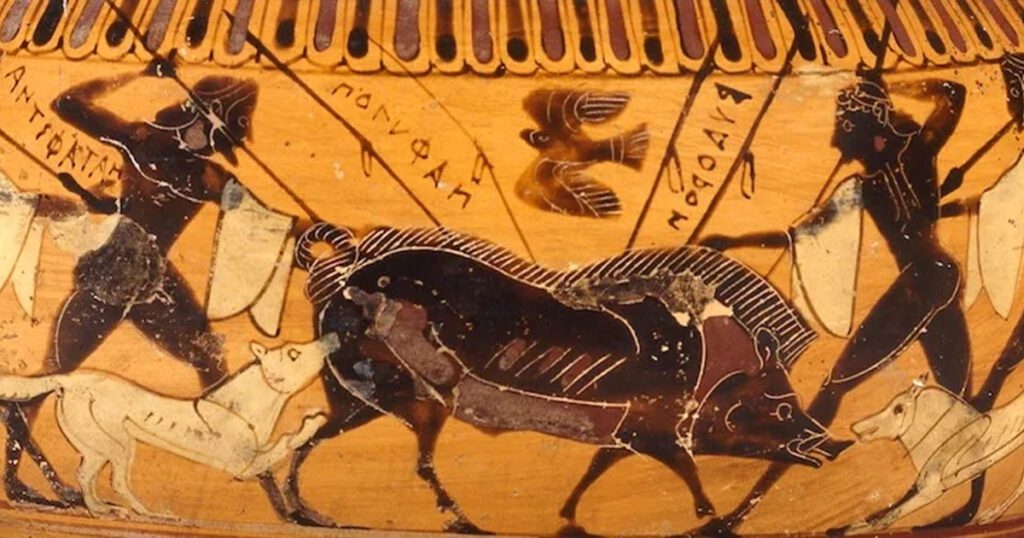
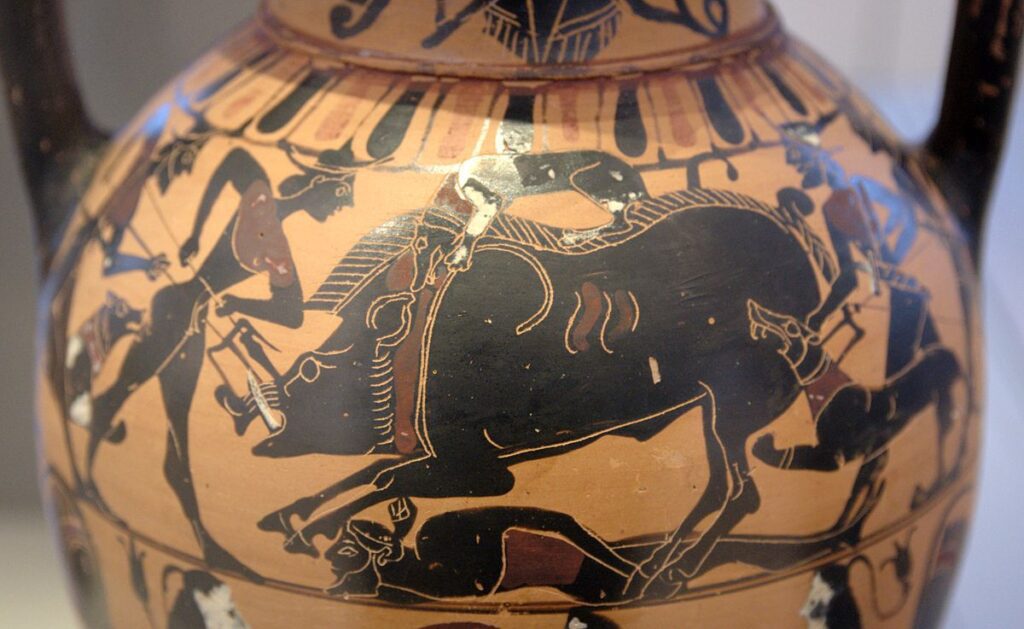
When a painter wanted a hunt to feel genuinely dangerous, he painted a boar. A boar hunt is nothing like a hare hunt: the animal turns and charges, and its tusks can kill. The Calydonian Boar Hunt, one of the most frequently painted mythological scenes in Greek pottery, involved a roster of major heroes and the huntress Atalanta, and still resulted in deaths among the hunting party. Painters who showed the boar bristling and facing its hunters head-on, with spears braced and feet planted in profile, were encoding a specific argument about glory: it only counts when the quarry could genuinely kill you.
Deer belong primarily to Artemis and to the ethical framework her domain enforced. The hunter who took only what was due from the hunt was a model of controlled masculine virtue; the hunter who exceeded that, or who stumbled into Artemis’s sacred space uninvited, faced catastrophe. Actaeon transformed into a stag and destroyed by his own hounds is the extreme statement of that principle. A deer near a divine figure in vase painting confirmed not just Artemis’s presence but the obligations her domain imposed on everyone nearby.
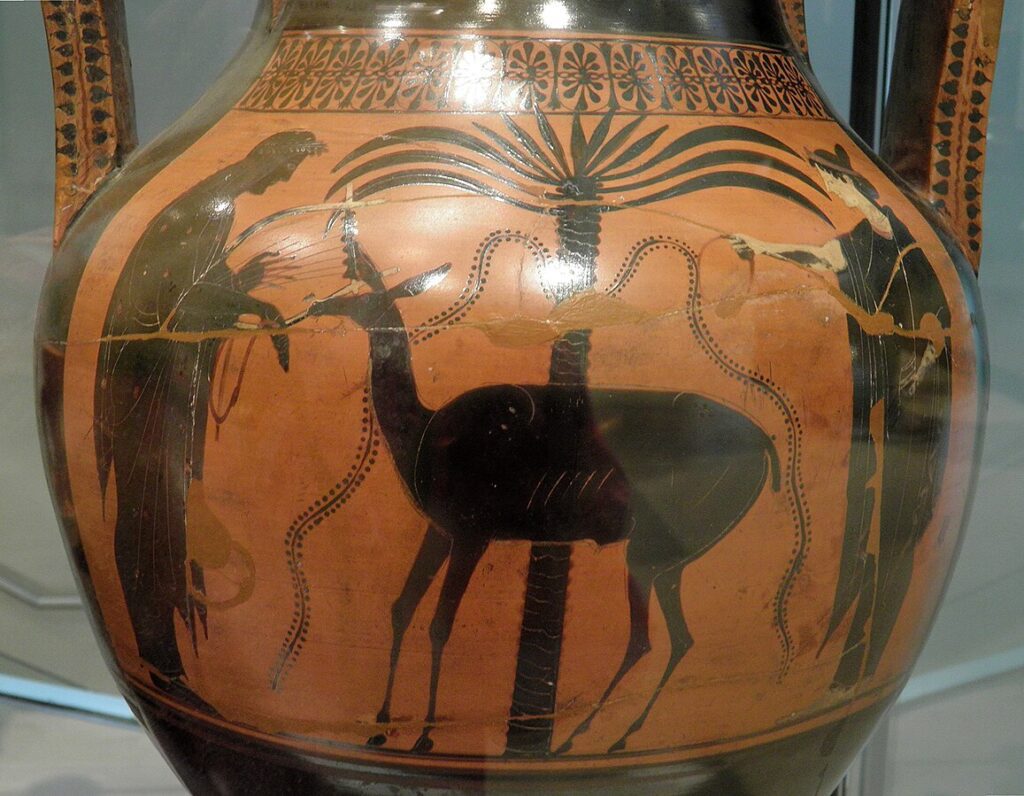
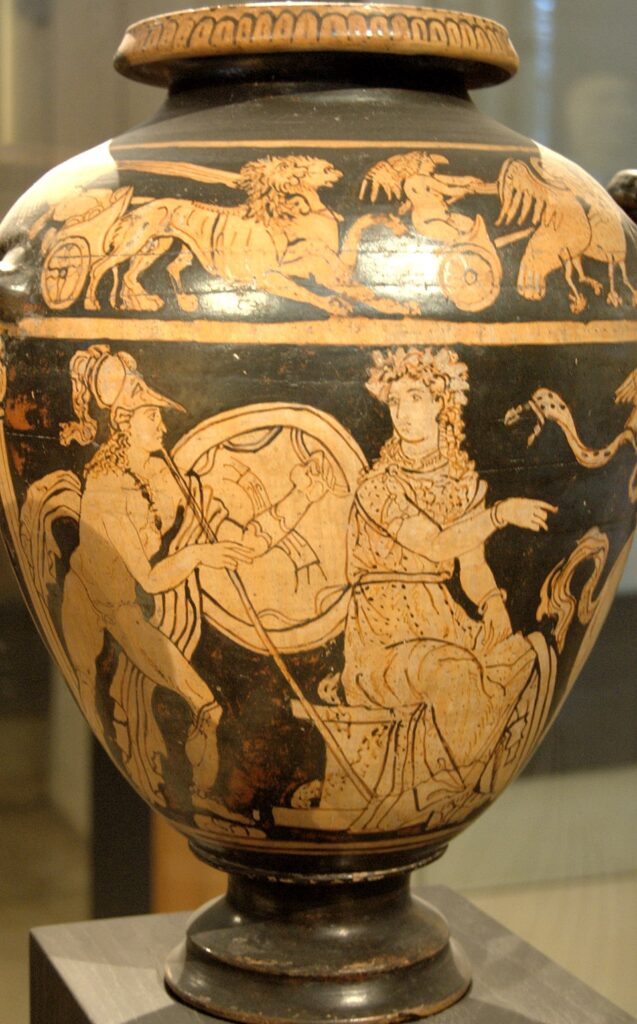
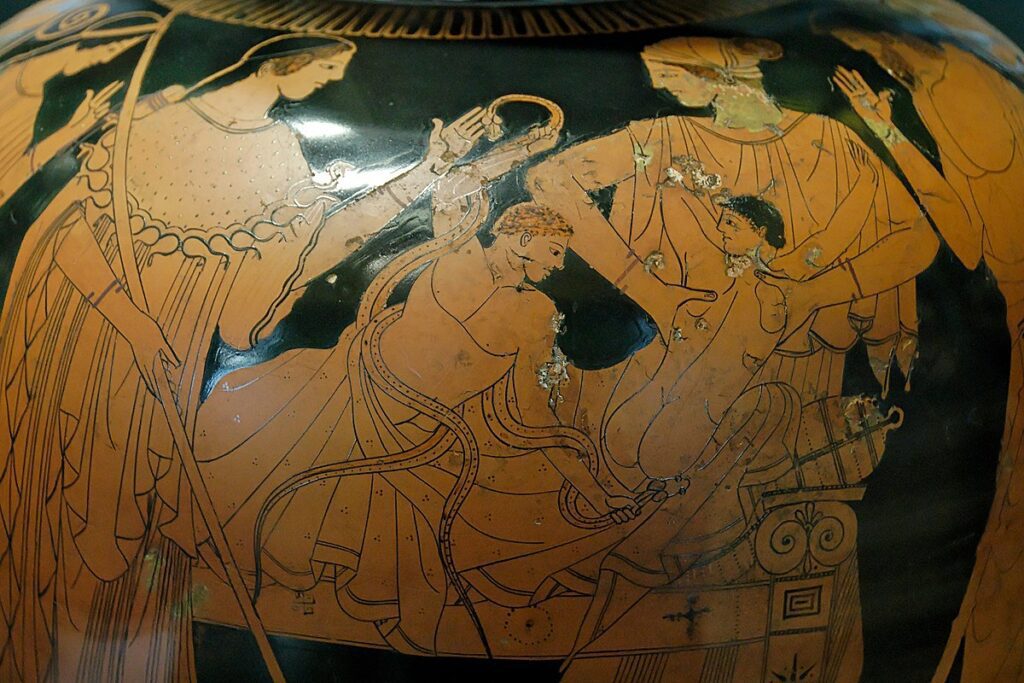
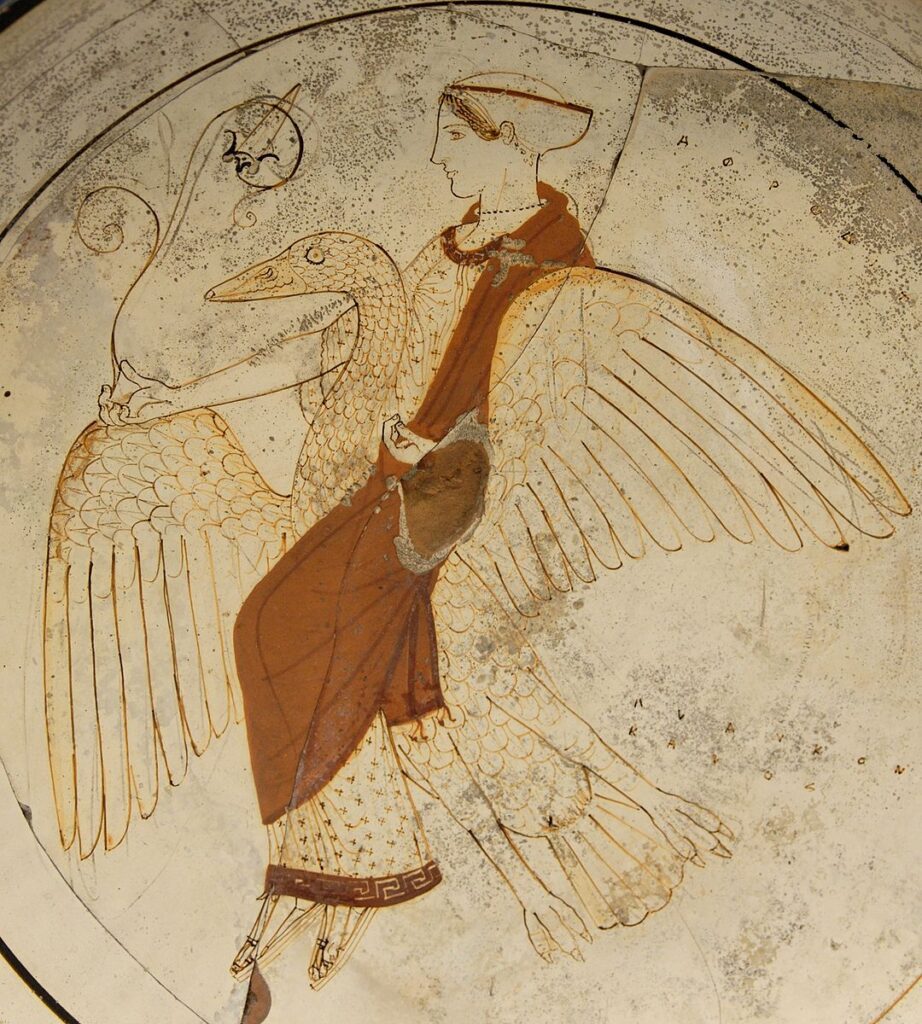
Horses were markers of wealth because the economics of horse ownership in ancient Greece made them unavoidable: maintaining a chariot team required land, stable staff, and surplus income that only a narrow segment of the population possessed. A chariot scene carried that economic reality with it whether the subject was mythological or civic. Serpents occupied a much wider symbolic range, associated simultaneously with the underworld through their habit of emerging from cracks in the earth, with healing through Asclepius, and with household protection as the spirit guarding storerooms and thresholds. The same snake that threatened on one kind of vessel offered protection on another. Swans appeared less often but with consistent associations: music, erotic beauty, and Aphrodite’s sphere, most completely stated in the Pistoxenos Painter’s white-ground cup in the British Museum, which shows Aphrodite carried across the water on a swan’s back while Eros hovers above.
Reading the Painter and Reading the Context
The same animal could say different things depending on what surrounded it. A lion facing a warrior on a symposium cup said something about shared courage. A lion on a funerary amphora guarded the grave. A serpent coiling near a domestic offering vessel signaled the household spirit. A serpent on a white-ground lekythos placed at a tomb marked the boundary between the living and the dead. Getting it right means reading the vessel shape, the scene’s other figures, the animal’s posture and placement, and knowing what kind of space the pot was made for.
Exekias, the greatest Athenian black-figure painter, used animals with a monumental clarity that made his scenes almost stop time. The Berlin Painter, working a generation later in red-figure, placed single figures against plain black grounds and used animals to define mood rather than narrative. Late red-figure workshops modeled fur and feather with thin glaze to make animals catch the light and move. The same visual language passed through the hands of very different temperaments, and each generation left a different mark on it.
Animals packed large ideas into small spaces on objects that moved from home to sanctuary to grave. They made divine presence legible at a glance. They carried ethical codes without a word of explanation. They gave everyday objects a protective charge that lasted as long as the clay. To read a Greek vase well, ask three things: which animal is present, how is it posed, and what shapes and stories surround it. The painters built a visual lexicon that still reads clearly today, creatures on clay that have never quite stopped moving.
Sources: John Boardman, Athenian Black Figure Vases (Thames and Hudson, 1974); John Boardman, Athenian Red Figure Vases: The Archaic Period (Thames and Hudson, 1975); Sheramy D. Bundrick, “Athenian Eye Cups in Context,” American Journal of Archaeology 119.3 (2015), pp. 295–341; Jeffrey Hurwit, The Art and Culture of Early Greece (Cornell University Press, 1985); Dietrich von Bothmer, Greek Vase Painting (Metropolitan Museum of Art, 1987).