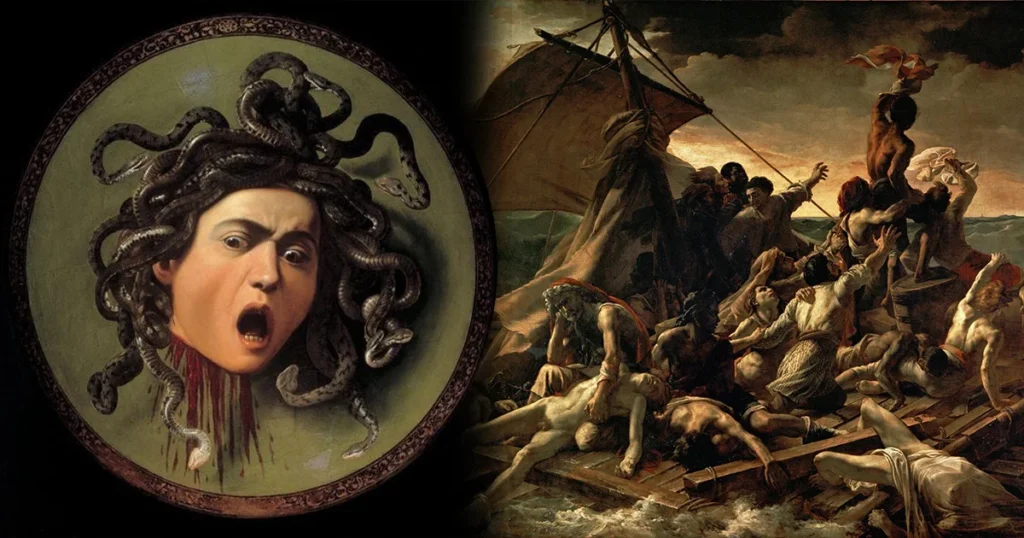
Medusa sits at the center of one of the most famous Greek myths, a clear story about a mortal Gorgon whose gaze turns onlookers to stone and whose severed head becomes a weapon that outlives her body. The plot is simple to follow from first to last step, and that clarity makes it a strong topic for readers and for search engines looking for exact answers.
What Medusa Is
Medusa is one of the Gorgons, a small group of monstrous sisters who live far from human cities and stand apart from the Olympian gods. In most classical accounts, Medusa alone is mortal, which means she can be killed while her sisters cannot. Her core power is a petrifying gaze that turns those who look directly at her into stone. Ancient writers and artists use that power to explain why heroes need clever tools and why brute force is not enough. The head with staring eyes and snakes for hair becomes a token that wards off danger when shown on shields and armor. That face also turns into a symbol on buildings and coins to keep harm away by scaring it off before it comes close.
Medusa’s image explains two ideas at once that matter in myth and art. First, a deadly power can be turned against itself if a hero knows how to avoid direct contact. Second, a frightful face can protect a home, a shrine, or a soldier when it stares outward from a surface that other eyes meet. That is why the head appears on the aegis, which is Athena’s protective cloak or shield in many stories. The head does not lose its force after death in these tales, which lets Perseus finish one dangerous task and then carry the same tool into the next. This carryover is a common myth device that shows how one win can help with a second problem. Medusa remains central because the head keeps acting long after her body is gone.
Origins and Family
The oldest Greek poems give short notes on Medusa’s place in the family of monsters. They list the Gorgons as sisters and place their parents among ancient sea beings. That early placement marks the Gorgons as older than most Olympian gods and helps explain their distance from human communities. Later writers add details about where they live and how they look, but the basic picture stays stable. Medusa is unique among her sisters because she can die, and that difference sets up the need for a hero to confront her. The sisters Stheno and Euryale remain dangerous after Medusa’s death, which keeps the wider world risky even after Perseus completes his task. The family frame helps explain why monsters spawn more monsters in Greek stories rather than ending with just one.
Some later sources give a human backstory and say Medusa was once a young woman. They explain that her change into a Gorgon came after a crisis in a temple of Athena. That story moves the focus from pure monstrosity to the way divine anger can transform a person. The shift adds pathos and raises questions about justice, but it does not change the basic function of the myth. The key facts still drive the plot. Medusa is deadly to look at. A hero must avoid that gaze. A god must lend a tool to make the plan work. The backstory mostly changes how readers feel about Medusa rather than what happens.
The Gorgon Head Powers
The head on its own is the most famous object in this myth. The eyes are wide and the mouth is open in a fixed cry, and the hair is a nest of snakes that does not stop moving. The face looks back at the viewer, which makes it useful as a warning on shields, armor, and temple fronts. Greeks treated such faces as apotropaic, which means they turn harm away just by being seen. The logic is simple. A frightening sign warns or scares a threat before it reaches the door. The head also explains why looking and seeing matters in a world of gods and monsters. Eyes carry risk both ways. If a human looks at a god the wrong way, the human suffers. If a monster’s eyes meet a human gaze, the human turns to stone. The solution must come from breaking the normal path of sight.
The head keeps its force after the body dies, which is rare in myth. That detail makes it a portable tool and a continuing danger. It also sets up a sequence of uses that fill the rest of the Perseus cycle. Once Perseus escapes the sisters, he uses the head to turn a sea monster to stone on a shore where a princess is chained. He later carries it into a crowded hall to stop attackers by freezing them in place. The same effect solves different problems because the danger in each case is visible and direct. Artists keep returning to this face because it controls the viewer’s eye in the same way it controls the eyes of figures inside the scene. A picture of Medusa can almost trap a viewer in a stare, which is the right kind of tension for a painting.
Perseus and the Beheading
Perseus wins because he never looks Medusa in the eye. The plan is concrete and easy to explain. Athena gives him a polished shield that reflects like a mirror, so he can see without meeting her gaze. Hermes lends a blade that can cut through her neck in a single strike. Other items help with the approach and the getaway, like winged sandals and a bag that safely holds the head. These tools are standard gear in the story, and each solves a clear problem in the chain. The mirrored shield solves the gaze. The blade solves the kill. The bag solves the risk of exposure after the strike. The sandals solve the pursuit by the sisters. The plan shows that cunning and the right tool can beat sheer terror.
Writers from the classical period give slightly different emphases, but they keep the same beats. A full poetic version tells how Perseus crosses seas, reaches the lair, and strikes without a glance while the Gorgon sleeps. A myth handbook gives a shorter checklist of steps that students could use to recall key points. A moral reading adds the idea that clever sight beats direct vision, which is why Athena, the goddess of strategy, stands behind the plan. Readers who want to compare versions can start with a smooth retelling in Ovid’s Metamorphoses. For a compact prose outline, Apollodorus’s brief account in the Library shows the same sequence of tools and tasks. For the roots of the Gorgon family and the early list of monsters, the Gorgons’ place in the Theogony sets the basic frame.
Enjoying Spoken Past?
I created Spoken Past to share my love of history. I research, write and develop everything myself, and I want my articles and basic guides to remain free for everyone.
If you enjoy my work, please consider supporting Spoken Past with a small donation.
Aftermath and Meaning
After the kill, Perseus still has to get home alive, and the head solves the next two problems on the way. On one beach, a sea monster rises to devour a girl chained to a rock, and the hero ends the threat by showing the head. On one island, hostile men crowd a hall to attack him, and the hero ends the threat by showing the head again. The same answer makes sense both times because the threat moves toward him on open ground. The head remains useful when Perseus reaches Athena, who places it on her aegis so that the face continues to ward off dangers in stories and statues. That handoff explains why the head appears with Athena in later art.
The meaning is not hidden. This is a story about careful seeing and controlled fear. A hero can face horror if he stops trying to look through it directly. A dangerous power can be turned into a tool that protects friends and cities if a wise ally helps. A symbol can hold a power in place long after the moment that created it has passed. Artists return to Medusa because the face does the same job for a viewer that it does inside the story. It arrests motion. It stops a rush. It holds a space. That is why a strong Medusa image still looks right on a shield in a museum and on a temple front in a photograph.
Sources and Texts
Poets and mythographers give the backbone of the story, and their differences help readers see what each period valued. Poets like Ovid invest in narrative and image, so the beheading and the sea rescue have vivid detail and steady pacing. Prose handbooks like Apollodorus keep details short and practical for study. Early epic like the Theogony cares about lists and lineages, which is why the Gorgons enter the record as part of a family set before they become part of a hero’s task. These source types work together rather than compete. Readers can use all three to get plot, context, and texture.
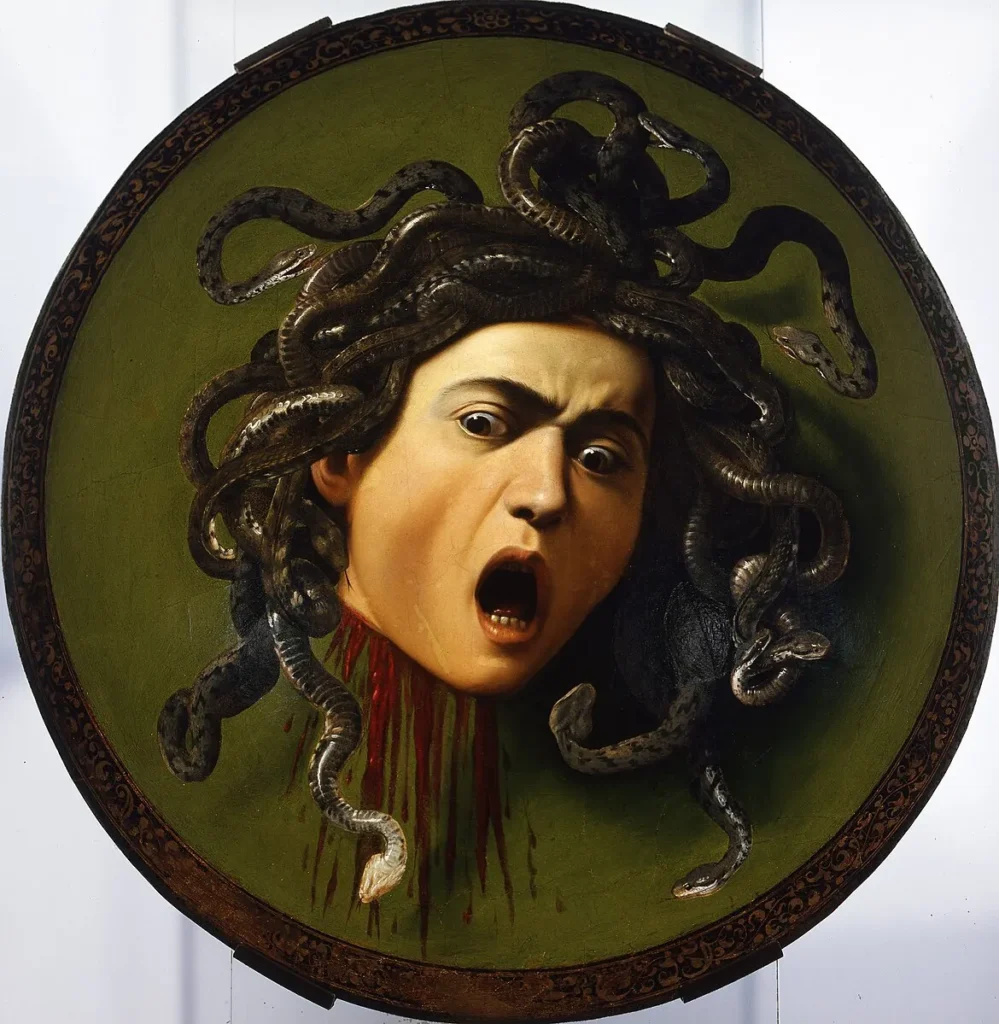
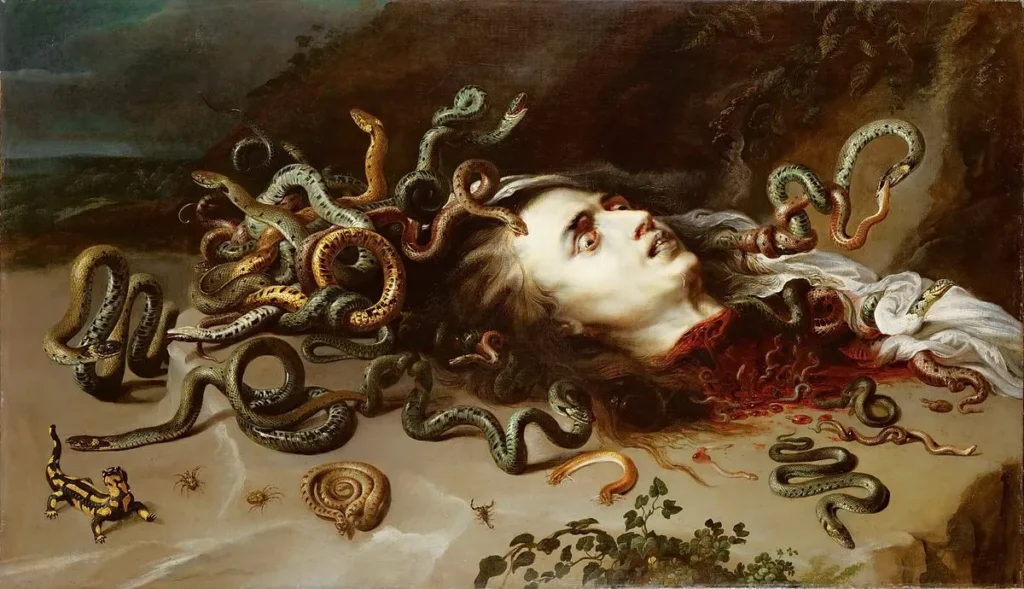
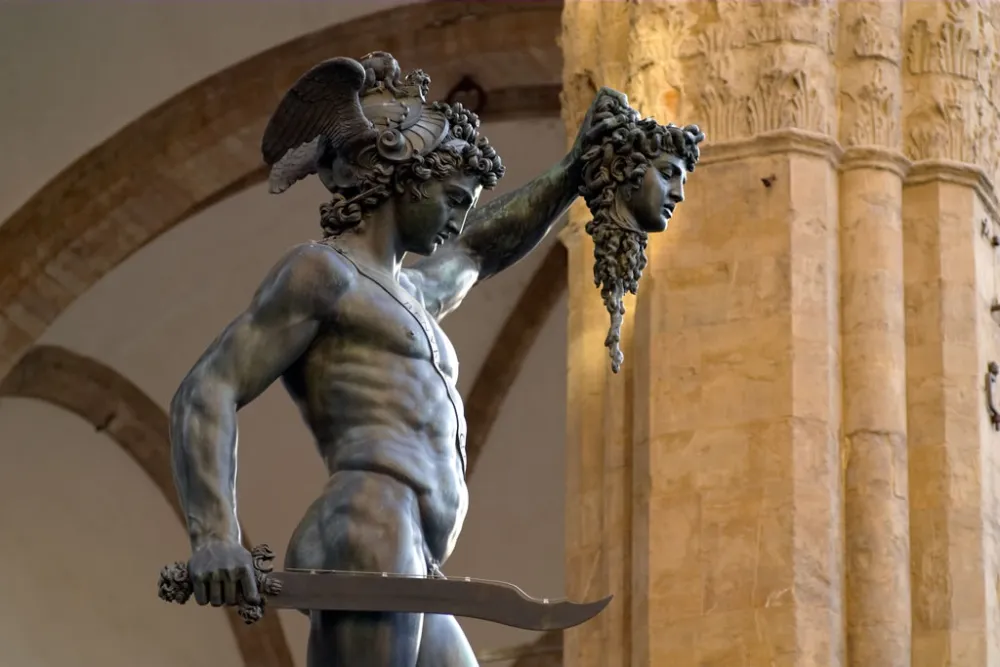
Museum records help with the visual side and show how painters and sculptors picked different moments to stage. Caravaggio puts the head on a round shield so the viewer meets the eyes at once without any background. Rubens paints the head as an object on a surface with snakes that still move and small creatures that creep in to feed. Cellini lifts the scene into the round by showing the hero’s arm high and the head dangling while blood drips onto the base. Each object page gives dates, materials, and locations that confirm what the eye already senses. The same myth supports a still life, a dramatic close-up, and a full figure group.
Frequently Asked Questions
Was Medusa always a monster?
Some later accounts say she was once a young woman and became a Gorgon after a crisis in a temple, but the earliest lists place her among monsters without a human past.
Why could Perseus look at Medusa through a shield?
The mirrored surface let him see her reflection and avoid direct eye contact, which is the only condition that triggers the petrifying effect in the story.
Why does Medusa’s head still work after death?
The myth treats the head as an object that holds the gaze’s power, so the severed head remains active as long as eyes and snakes are visible.
Did Athena really wear Medusa’s head?
Many stories say Athena placed the head on her aegis, and many artworks show an image of the head on her cloak or shield to mark protection.
Who are Medusa’s sisters?
Stheno and Euryale are the other Gorgons, and they remain immortal, which is why Perseus must flee after the beheading and cannot fight them.
Which ancient text tells the full story of the beheading?
Ovid’s Metamorphoses gives the richest retelling, while Apollodorus offers a compact outline that covers the tools and steps.
Where can a reader see Medusa in art?
Strong examples include Caravaggio’s round shield painting at the Uffizi, Rubens’s Head of Medusa in Vienna, and Cellini’s bronze in the Loggia dei Lanzi.
What does the Medusa face mean on buildings and shields?
It serves as an apotropaic sign, which means it is meant to turn harm away by frightening it before it comes near.
Further reading
- Theogony text overview for the Gorgons’ place in early Greek poetry, with a focus on lineages and monster lists: https://www.perseus.tufts.edu/hopper/text?doc=Perseus%3Atext%3A1999.01.0133%3Acard%3D270
This helps fix Medusa’s family context and early mentions. - Ovid Metamorphoses summary of Perseus and Medusa with narrative detail: https://www.theoi.com/Text/OvidMetamorphoses4.html
This offers a clear poetic retelling that shapes many later versions. - Uffizi object page for Caravaggio’s Medusa with images, date, and materials: https://www.uffizi.it/en/artworks/medusa
This provides a museum record for a canonical Medusa image.