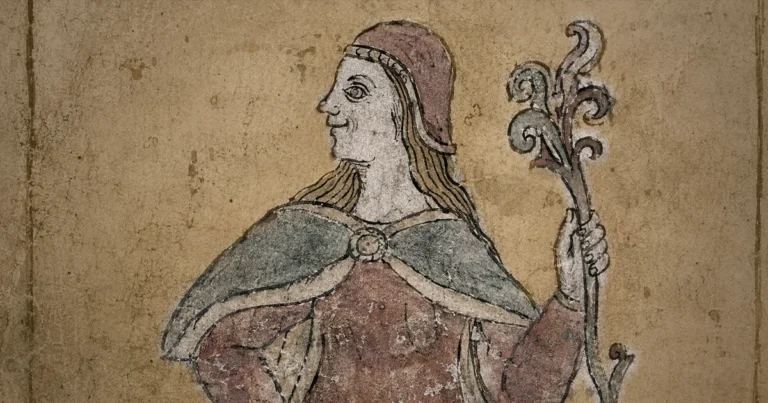

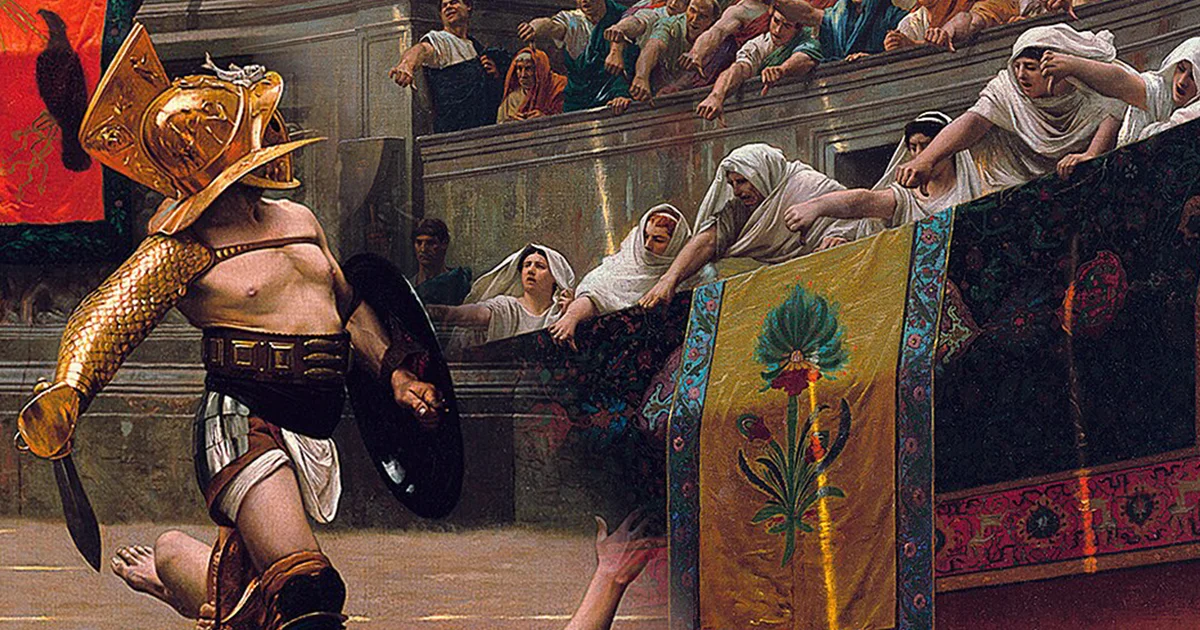
The image of a Roman crowd pointing thumbs down to condemn a defeated gladiator is one of history’s most recognizable symbols, yet it’s almost certainly wrong. Jean-Léon Gérôme’s 1872 painting Pollice Verso popularized this gesture worldwide, depicting bloodthirsty spectators including Vestal Virgins demanding death with downturned thumbs. The painting inspired the 2000 film Gladiator and cemented the thumbs down gesture in modern culture as a signal of disapproval or execution. But ancient Roman sources describe the gesture differently, and scholars now believe the actual pollice verso may have meant the opposite of what Gérôme portrayed.
The phrase pollice verso translates literally as “with turned thumb,” but ancient texts never specify which direction the thumb pointed. Roman writers used vague descriptions like “hostile thumb” or “turned thumb” without clarifying whether it pointed up, down, sideways, or was concealed in the fist. This ambiguity left room for interpretation, and Gérôme’s dramatic artistic vision filled that gap with a gesture that made visual sense to 19th century audiences but may have completely inverted the actual Roman practice.
What Pollice Verso Actually Meant in Rome
Ancient Roman sources provide frustratingly few details about the exact gesture used to condemn or spare gladiators. The poet Juvenal mentioned Vestals turning their thumbs to demand death, but he never described the direction. Pliny the Elder wrote of “pressing thumbs” as a gesture of approval, using the phrase pollices premere, which could mean thumb pointing down, thumb squeezed inside the palm, or thumb pressed against the hand from outside.
According to classical studies professor Anthony Corbeill, who extensively researched Roman gestures, a closed fist with the thumb wrapped inside likely signaled mercy, while a thumb protruding from the fist indicated death regardless of direction. The gesture mimicked the action of thrusting a sword, with the extended thumb representing the blade being driven to the hilt into the defeated gladiator’s body. The direction the thumb pointed mattered less than whether it was concealed or extended.
Quintilian referenced an infesto pollice gesture in his rhetoric manual, translating as “unfriendly thumb” or “hostile thumb,” but he mentioned it as an oratory gesture without connecting it to gladiatorial combat. Only later did the Anthology Latina use the same phrase in the context of arena battles, describing crowds waving hostile thumbs at defeated gladiators but still not clarifying the gesture’s appearance.
Martial wrote in his Liber Spectaculorum about spectators waving handkerchiefs or shouting to pardon defeated gladiators, suggesting multiple ways audiences communicated their wishes. The emperor typically made the final decision as patron of the games, though he often followed crowd sentiment for political reasons. When spectators pleaded for both fighters’ lives after an excellent match, emperors were expected to grant mercy as demonstration of imperial magnanimity.
How Gérôme’s Painting Changed History
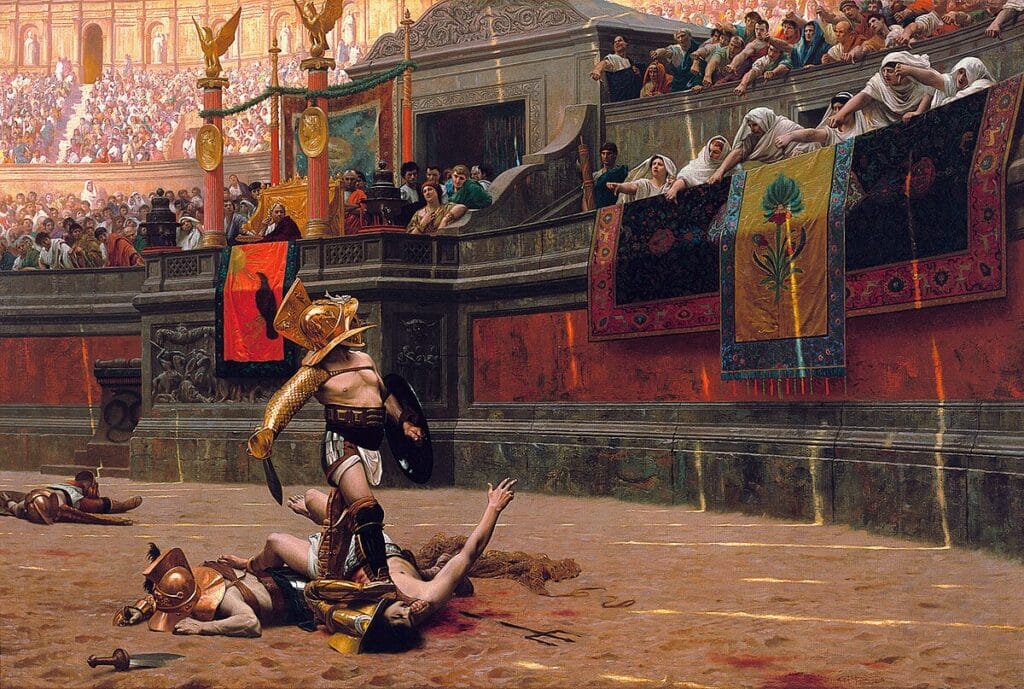
Jean-Léon Gérôme painted Pollice Verso in 1872 for American collector Alexander Turney Stewart, who displayed it prominently in his New York mansion. The painting depicts a victorious murmillo gladiator standing over a defeated retiarius who raises two fingers pleading for mercy while Vestal Virgins and spectators enthusiastically gesture thumbs down demanding execution. Gérôme’s composition places viewers at ground level in the Colosseum arena, forcing them to look up at the bloodthirsty crowd and feel the condemned gladiator’s perspective.
The painting became wildly popular through reproductions and photo engravings distributed by Adolphe Goupil, Gérôme’s dealer and father-in-law. These widely circulated images spread the thumbs down gesture throughout Europe and America, establishing it as historical fact in popular imagination. By the early 20th century, the gesture appeared in films, books, and illustrations about ancient Rome, always depicting downturned thumbs as the signal for death.
Gérôme based his architectural details on accurate drawings of the Colosseum and designed gladiator armor following examples excavated at Pompeii, though some inaccuracies exist in the murmillo’s equipment. His depiction of Vestal Virgins demanding blood may have been inspired by passages from Christian author Prudentius, who disapproved of arena carnage and wrote scathingly about priestesses attending gladiatorial games. Prudentius described a Vestal rising at each blow, calling the victorious gladiator her pet and signaling with her thumb that he should pierce his fallen opponent’s breast.
The painting immediately sparked controversy over its historical accuracy. A 26-page pamphlet published in 1879 titled “Pollice Verso: To the Lovers of Truth in Classic Art, This is Most Respectfully Addressed” compiled evidence for and against Gérôme’s depiction, including a letter from the artist dated December 8, 1878, defending his interpretation. Despite scholarly debate, the public embraced Gérôme’s dramatic vision, and the thumbs down gesture became permanently associated with Roman gladiatorial combat in popular culture.
Several years after completing the painting, Gérôme created a sculpture based on the central gladiator figures, revealing his belief that he was born to be a sculptor despite painting for fifty years before attempting three-dimensional work. Art critic Charles Blanc wrote that Gérôme’s sculpture was “at one and the same time like the reality and far superior to nature, substantial and ideal, palpable and divine”.
Evidence for the Real Thumbs Up Death Gesture
Modern scholars analyzing ancient sources increasingly conclude that Romans likely used the opposite gestures from those Gérôme depicted. Zoologist Desmond Morris, who extensively studied human gestures across cultures, emphasized that such signals are culturally determined and transmitted, meaning modern assumptions about “natural” gestures don’t apply to ancient practices.
The strongest evidence comes from Pliny’s phrase pollices premere, literally “pressing thumbs,” which he explicitly identified as a gesture of approval or mercy. If pressing or concealing thumbs meant sparing the gladiator, then extending or displaying thumbs logically signaled death. This interpretation aligns with the thumb representing a sword thrust, with the extended thumb mimicking a blade being driven into the victim’s body.
Roman philosopher Macrobius explained that the thumb derived its power from the Latin word polleo meaning “power,” making it the most significant digit for conveying judgment. Other ancient writers emphasized the thumb’s strength, size, and functionality compared to fingers adorned with rings. According to Fulgentius, the outstretched thumb possessed apotropaic properties like other protruding organs, capable of warding off evil, which may have made it symbolically appropriate for signaling death.
The phrase infesto pollice, meaning “hostile thumb,” appears in contexts suggesting an aggressive or threatening gesture rather than a passive downward point. An extended thumb jutting upward or outward would appear more hostile and threatening than a downward thumb, which might seem dismissive or merciful to Roman sensibilities. Cultural anthropologist Anthony Corbeill argues convincingly that modern people misinterpret ancient gestures by applying contemporary meanings that didn’t exist in Roman society.
No ancient iconographic sources clearly depict the gesture, leaving scholars dependent on ambiguous written descriptions. Roman mosaics and reliefs showing gladiatorial combat focus on the fighters themselves rather than spectator reactions. This absence of visual evidence means the true gesture may never be definitively proven, though textual analysis strongly suggests Gérôme reversed the actual Roman practice.
Built out of a love for history, kept free from distractions.
Spoken Past is an independent project shaped by curiosity, care, and long hours of research. Reader support helps keep it maintained, carefully researched, and open to everyone.
How Gladiator Combat Actually Worked
Gladiators were introduced to Rome in 264 BCE when the sons of Junius Brutus honored their father by matching three pairs of fighters. These munera or “gifts” evolved from funeral rites into massive public spectacles sponsored by politicians and emperors seeking popularity. By the Imperial period, gladiatorial games occurred frequently in amphitheaters throughout the Roman Empire, with the Colosseum in Rome serving as the most famous venue.
Gladiators trained in specialized schools called ludi under lanistae who owned and managed them. The trade in gladiators was empire-wide and subject to official supervision. Rome’s military conquests produced steady supplies of prisoner-soldiers who were redistributed to state mines, amphitheaters, or sold on the open market. After the Jewish Revolt, gladiator schools received an influx of Jewish prisoners, with those rejected for training sent directly to arenas as noxii, condemned criminals.
Different gladiator types were named after Rome’s enemies and fought with distinctive equipment. The Samnite, heavily armed and elegantly helmeted, was renamed secutor after Rome conquered Samnium. The bareheaded retiarius wore armor only on left arm and shoulder, using net, trident and dagger against the more heavily armored secutor. Other types included the Thracian, murmillo, hoplomachus, and various novelty fighters who battled from chariots, horseback, or wore specialized equipment.
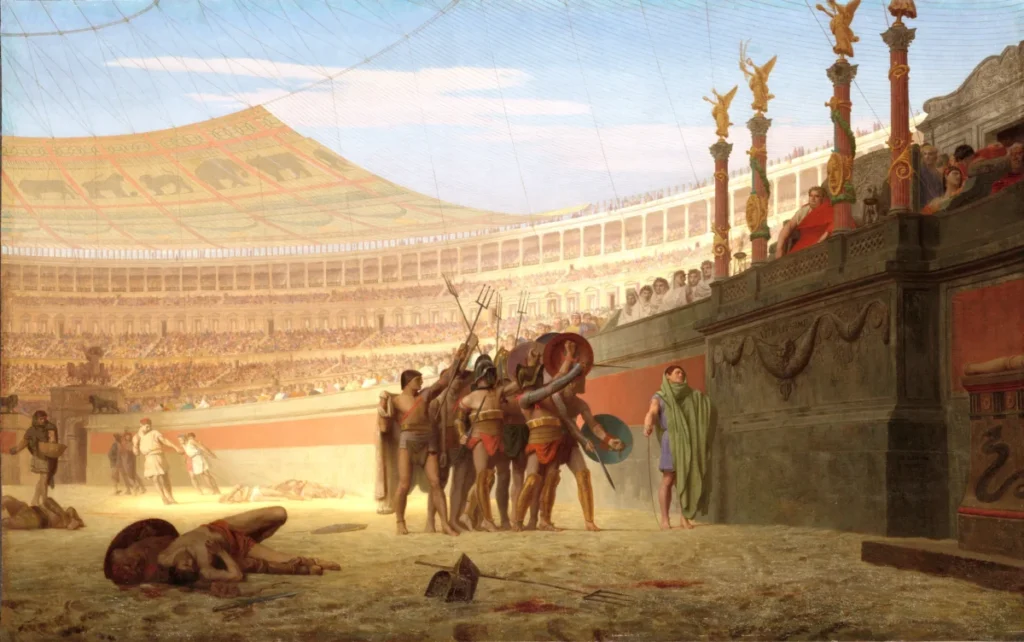
On game day, gladiators paraded ceremoniously around the arena before presenting themselves at the emperor’s podium. Condemned criminals exclaimed “Ave, imperator, morituri te salutant” (Hail emperor, we who are about to die salute you), though professional gladiators didn’t use this phrase. Preliminary events included bloodless duels between paegniarii fighting with wooden weapons before the lethal combat began.
When a gladiator fell, spectators shouted “Habet, Hoc habet!” (He’s had it!) and either “Mitte!” (Let him go!) or “Iugula!” (Kill him!). The wounded fighter would lay down his shield and raise his index finger, usually of the left hand, to plead for mercy from his opponent or the judge wielding a long staff. The crowd signified their decision by turning their thumbs in the pollice verso gesture, though as established, the exact motion remains debated.
Why Ancient Romans Attended Gladiator Games
Roman amphitheater spectacles served multiple social and political functions beyond entertainment. Emperors and wealthy politicians sponsored games to demonstrate generosity, maintain popularity, and reinforce social hierarchies. The arena provided one of few venues where Roman citizens could collectively express opinions, and emperors were expected to attend and heed crowd sentiment. Refusing to attend games or ignoring audience wishes was politically dangerous.
The games enacted power dynamics through symbolic violence. Defeated enemy soldiers who surrendered or allowed capture had been granted an unmerited gift of life in Roman military ethos. Training these men as gladiators gave them opportunity to redeem honor through combat, though most would ultimately die in the arena. This transformation of conquered enemies into public spectacle reinforced Roman supremacy and justified imperial expansion.
Gladiatorial combat also provided vicarious experience of military virtues for urban populations. Roman citizens who would never serve in legions could witness courage, skill, and endurance displayed by fighters whose fate they controlled. The crowd’s power to grant mercy or demand death created participatory drama where spectators exercised life-or-death authority typically reserved for military commanders and magistrates.
Religious elements infused the games with meaning beyond bloodsport. Munera originated as funeral offerings to honor the dead, and this sacrificial dimension persisted even as games became secular entertainment. Some Romans viewed gladiatorial death as religiously significant, with fallen fighters’ blood possessing purifying or consecrating properties. Christian authors like Prudentius condemned this “pagan” practice, describing Vestals attending games as perversion of religious purity.
The amphitheater also served as theater of justice where criminals faced execution as public spectacle. Noxii condemned for serious crimes were thrown to wild beasts or forced to fight without training or adequate weapons. These executions reinforced legal authority and deterred crime while providing gory entertainment that satisfied audience bloodlust before professional gladiators performed their skilled combat.
Frequently Asked Questions
Did Romans really use thumbs down to kill gladiators?
Probably not. Ancient sources describe pollice verso as a “turned thumb” but never specify direction. Modern scholars believe Romans likely extended thumbs upward or outward to signal death, mimicking a sword thrust, while concealing thumbs in a closed fist meant mercy. Jean-Léon Gérôme’s 1872 painting Pollice Verso popularized the downward thumb gesture, but this interpretation likely reverses the actual Roman practice.
What does pollice verso literally mean?
Pollice verso translates from Latin as “with turned thumb” or “with thumb turned”. The phrase appears in ancient texts describing gladiatorial combat but provides no details about which direction the thumb pointed. Variations like converso pollice and infesto pollice mean “twisted thumb” and “hostile thumb” respectively, but remain equally vague about the gesture’s appearance.
How did Gérôme’s painting influence modern culture?
Gérôme’s Pollice Verso became wildly popular through reproductions distributed worldwide, establishing thumbs down as the death signal in popular imagination. The painting directly inspired Ridley Scott’s 2000 film Gladiator, though the movie reversed the gesture showing thumbs up for death. Today, thumbs down universally signals disapproval or rejection because of Gérôme’s influential artistic interpretation.
Were all gladiators slaves?
No, though many were prisoners of war, criminals, or slaves. Some free men voluntarily became gladiators for money, fame, or social advancement. Successful gladiators could earn substantial income, gain celebrity status, and eventually win freedom. The trade in gladiators was empire-wide and regulated by officials who oversaw training schools and combat conditions.
Did emperors always decide gladiator fate?
As patron of games and most conspicuous spectator, the emperor made final decisions about gladiators’ fates. However, emperors were expected to heed crowd sentiment for political reasons. When spectators unanimously demanded mercy for fighters who performed well, wise emperors granted it to demonstrate magnanimity and maintain popularity. Ignoring the crowd risked political backlash.
Why did Vestal Virgins attend gladiator games?
Vestal Virgins, as prominent priestesses maintaining Rome’s sacred flame, held privileged seating at public spectacles including gladiatorial games. Their attendance demonstrated religious endorsement of state-sponsored entertainment. Christian author Prudentius condemned this practice, describing Vestals demanding death as perversion of their vowed purity, though his account may exaggerate for rhetorical effect.