Excavations at the Red Sea port of Berenike in Egypt, carried out since 1994 by teams from the University of Delaware and the University of Warsaw, have produced some of the most precise evidence for long-distance plant trade in antiquity. Among the charred organic remains recovered from the site’s first-century CE deposits are black peppercorns: not a handful but 7.5 kilograms of them, the largest find of ancient pepper ever recorded outside the Indian subcontinent, stored in a ceramic vessel that almost certainly arrived by ship from the Malabar Coast of south India. Those peppercorns are a proxy for an enormous network of human decisions about what to carry, how to carry it, and whom to sell it to on arrival. The movement of plants of the Silk Road, and of the broader Indian Ocean and overland trade corridors that connected Asia, Africa, Arabia, and the Mediterranean, was not a single dramatic transfer but a slow, cumulative process of stepwise adoption driven by value, ecology, and the knowledge of skilled cultivators. This post examines what archaeobotanists, geneticists, and historians can now say about which plants travelled, how we know, and why some species spread rapidly while others remained rare luxuries for centuries.
How Archaeobotanists Trace Plant Movement
The toolkit available to researchers studying ancient plant trade has expanded dramatically over the last two decades. The oldest and most direct evidence comes from macro-remains: charred seeds, pits, nutshells, and dried fruits recovered from hearths, storage pits, and middens. Charring preserves plant tissue for thousands of years by converting organic matter to carbon, and individual seeds can be identified to species under a light microscope. AMS radiocarbon dating then anchors them to calendar ranges with standard errors that have narrowed considerably since the 1990s. When a charred peppercorn appears in a securely stratified first-century deposit at a Red Sea port, that is as close to a direct trade record as archaeology can produce.
Micro-remains extend the picture considerably. Pollen, starch grains, and phytoliths, the microscopic silica bodies produced inside plant cells, survive in soils, in the plaster of walls, inside pottery, and in the dental calculus of ancient individuals long after the plants themselves have decomposed. Phytolith morphology is distinctive enough in many taxa that analysts can identify the genus or even species of plant from fragments a fraction of a millimetre in size. Residue analysis of pottery and amphorae uses gas chromatography and mass spectrometry to detect lipids, alkaloids, and terpenoids absorbed into ceramic walls during use: frankincense resin, sesame oil, and grape wine leave chemical signatures that survive millennia. Together, these techniques allow researchers to detect plants in assemblages where no seed survives, extending the reach of archaeobotany into contexts that earlier generations of scholars could not access.
Ancient DNA, or aDNA, extracted from seeds and desiccated plant tissue, has transformed the study of crop domestication and dispersal since reliable extraction protocols became available in the 2010s. For orchard crops in particular, whose domestication histories involve complex hybridisation events between cultivated lineages and wild relatives encountered during westward or eastward movement, genomic approaches have produced results that no amount of morphological analysis alone could deliver. Whole-genome resequencing of living apple cultivars, published by a team led by Zhangjun Fei of the Boyce Thompson Institute in the journal Nature Communications in 2017, demonstrated that the common apple descends from the wild species Malus sieversii in the Tien Shan Mountains on the border of Kazakhstan and northwestern China, with substantial secondary contributions from the European crabapple Malus sylvestris acquired as trees moved west along the Silk Road and their seeds cross-pollinated with local wild species.
Routes, Not a Road
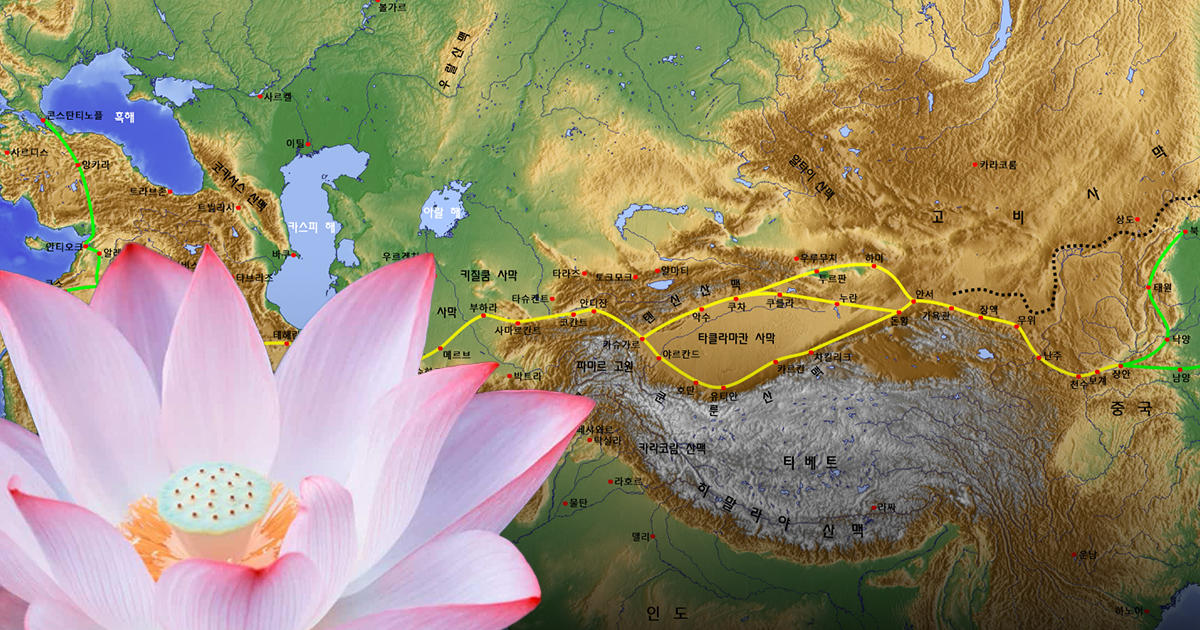
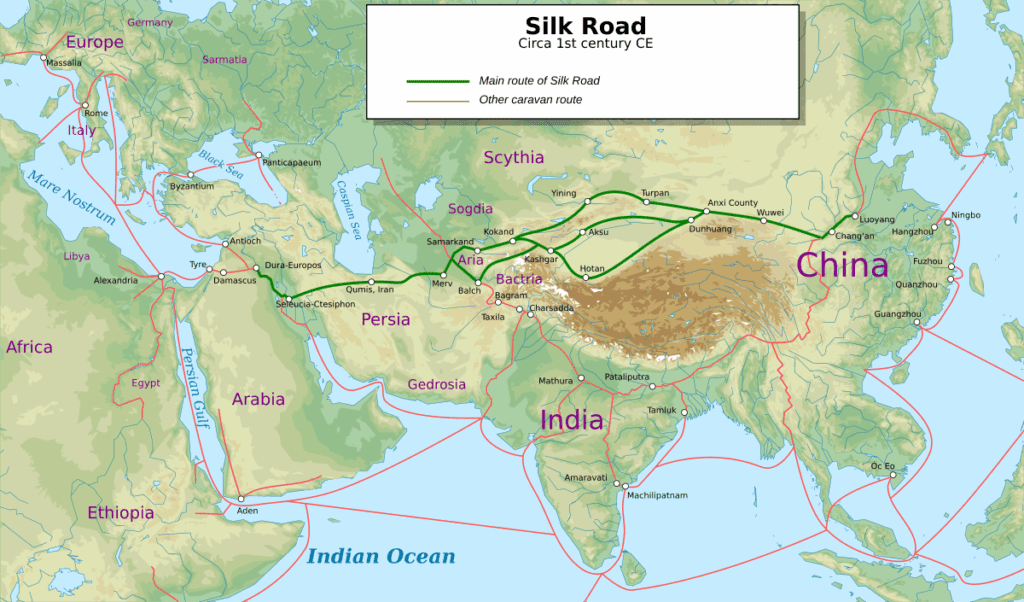
The term Silk Road, coined by the German geographer Ferdinand von Richthofen in 1877, is convenient and misleading in equal measure. There was no single road, no single direction of movement, and no continuous operation across the full span from China to the Mediterranean. What existed instead was an evolving family of overland and maritime corridors that shifted with political boundaries, seasonal weather, the availability of water, and the ambitions of the kingdoms and empires that controlled nodal points. Overland routes threaded the oases of the Tarim Basin westward through the Tien Shan passes into Sogdiana, roughly modern Uzbekistan and Tajikistan, and from there across the Iranian plateau toward Mesopotamia and Anatolia. Maritime lanes followed the monsoon system across the Arabian Sea and Bay of Bengal, linking Egyptian ports at Berenike and Myos Hormos to the trading centres of western India at Muziri, identified with the modern site of Pattanam, and Barygaza, modern Bharuch in Gujarat.
The distinction between overland and maritime routes matters enormously for plant trade. Ships could carry live cuttings in wet packing, bulky oil-bearing seeds in sealed amphorae, and large consignments of dried spice at lower cost per unit than any caravan. Caravans excelled at small, high-value, lightweight goods: dried spices, resins, and compact seeds that could survive weeks of desiccating mountain air without specialist care. Most crops did not traverse the full Eurasian span in a single transaction. Robert Spengler III of the Max Planck Institute for Evolutionary Anthropology, whose archaeobotanical research at medieval Central Asian sites including Tashbulak in the Malguzar mountains of Uzbekistan, published in PLoS ONE, has argued that fruit trees in particular moved stepwise through the oasis cities of Central Asia, accumulating in gardens around Samarkand, Bukhara, and Khiva before moving further west or east with the next generation of traders.
The Periplus of the Erythraean Sea, a Greek merchant’s sailing guide composed in the first century CE and one of the most important primary sources for Indian Ocean trade, lists the goods available at specific ports along the western Indian coast and the Horn of Africa. Pepper, spikenard, and sesame oil appear in western Indian ports. Ivory, tortoiseshell, and cinnamon-cassia appear on the East African and Arabian coasts. The document is not a complete inventory of everything traded; it is a practical guide for merchants deciding where to call and what capital to carry. Its silences are as informative as its lists.
Spices, Aromatics, and the Logic of High Value
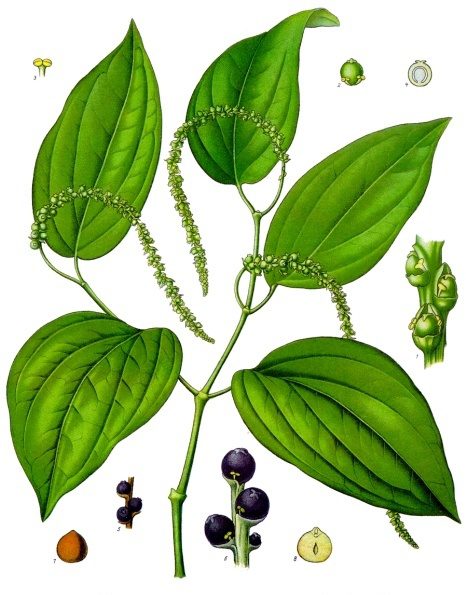
Black pepper, Piper nigrum, is the plant whose westward movement is best documented in both texts and the archaeological record. Native to the evergreen forests of the Malabar Coast in what is now Kerala, pepper produces berries that dry to a shelf-stable spice capable of surviving long sea voyages without specialist treatment. Roman-period trade texts, Egyptian customs receipts from the port of Muziri, and the Berenike peppercorn deposit together confirm that pepper was moving west in significant commercial quantities by the first century CE. Its value lay in multiple applications: as a flavouring that masked the taste of preserved meat, as a pharmacological agent with genuine antimicrobial properties documented in Dioscorides’ first-century De Materia Medica, and as a prestige good whose distant origin gave it a cultural cachet that local herbs could not match.
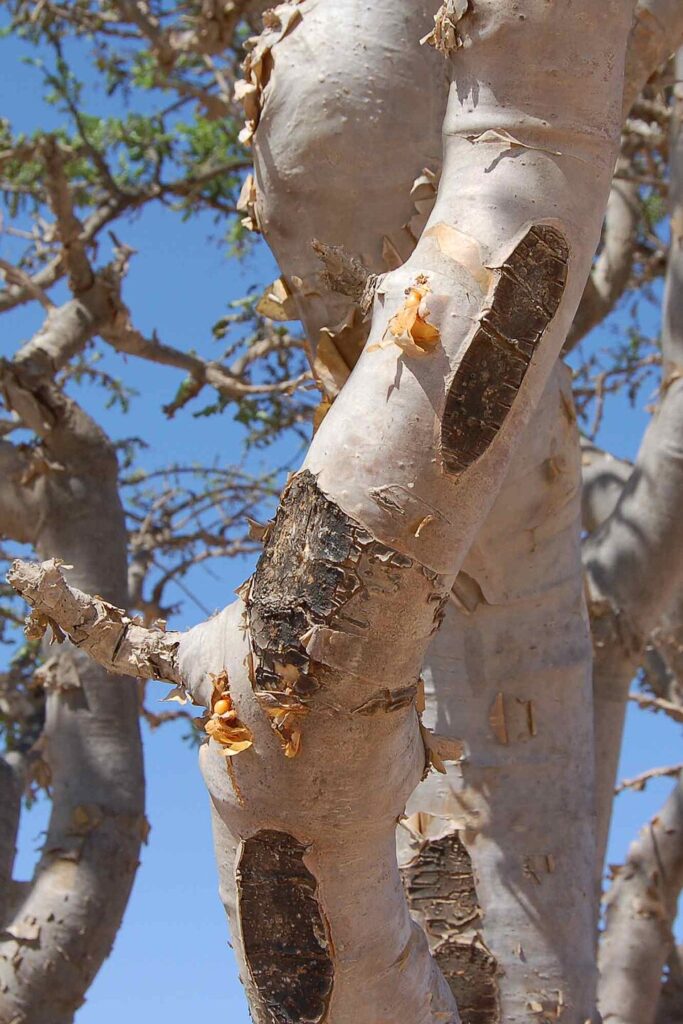
Frankincense and myrrh tell a different geographical story. Boswellia sacra, the tree that produces frankincense resin by bleeding a wound cut into its bark, grows in arid southern Arabia and the Horn of Africa, environments too hostile for most agricultural crops but ideal for a tree adapted to thin soils and extreme seasonal aridity. Myrrh comes from the similarly tough Commiphora genus in the same region. Both resins moved northward and westward along what ancient sources call the Incense Route: a network of caravan trails linking Dhofar in modern Oman and the Hadramawt region of Yemen to Nabataean trading centres at Petra and eventually to Mediterranean ports. The volume of the trade was considerable. Roman-period temple accounts and estate records indicate that frankincense was burned in enormous quantities in both civic ritual and domestic devotion. It crossed the full Mediterranean in dried, resin-lump form, which travels well and requires no cultivation knowledge at the destination end of the route.
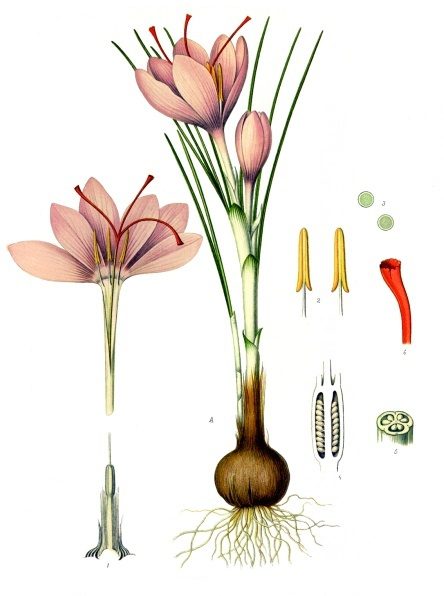
Saffron presents a more constrained case. Crocus sativus, the saffron crocus, is a sterile triploid that cannot reproduce from seed. Every new plant requires a corm, the underground bulb that must be divided by hand, dried carefully, and replanted in well-drained soil at the right season. This means that saffron dispersal was always slow, always dependent on human specialists who understood the agricultural calendar and the specific soil conditions the plant demands, and always subject to high failure rates in unsuitable environments. Its value as a yellow dye, a flavoring, and a medicine gave it sufficient economic incentive for those specialists to attempt new plantings in new regions, but the process was measured in decades rather than seasons.
Built out of a love for history, kept free from distractions.
Spoken Past is an independent project shaped by curiosity, care, and long hours of research. Reader support helps keep it maintained, carefully researched, and open to everyone.
Orchard Crops and the Plants of the Silk Road in Garden Culture
The story of the apple’s westward journey encapsulates the logic of orchard-crop dispersal along the Silk Road more vividly than any other species. A 2020 study by Xuepeng Sun and colleagues at the Boyce Thompson Institute, published in Nature Genetics, assembled phased diploid genomes for the cultivated apple and both its major wild progenitors, revealing that roughly 23 percent of the Gala apple genome is of hybrid origin, with large contributions from the European crabapple that were acquired after the cultivated apple moved west out of its Kazakhstani homeland. The mechanism was straightforward. Travellers ate apples and discarded the cores, seeds germinated in new locations, and resulting seedlings crossed with local wild crabapples. The hybrids that combined the large fruit size of Malus sieversii with the crisp texture and balanced acidity contributed by Malus sylvestris were the ones that humans selected and propagated. Every tree that resulted was a record of a specific stopping point on the Silk Road journey.
An 2025 Horticulture Research review by Christopher Gottschalk and colleagues at Cornell University, examining the conservation status of Malus sieversii and its genomic utility for modern breeding, confirms that wild populations of the ancestral apple now face serious habitat loss in the Tien Shan, threatened by overgrazing and agricultural encroachment. The same mountain forests that served as the apple’s genetic starting point for its Silk Road journey are under significant ecological pressure today. Peaches and apricots followed broadly comparable east-to-west trajectories, with archaeobotanical stone finds and genetic data converging to show movement out of East Asia through Central Asian corridors into Iranian, Anatolian, and eventually Mediterranean gardens during the first millennium BCE and CE.
The institutions that absorbed new orchard crops were rarely ordinary farms. Court gardens, known in Persian as pairidaeza, the origin of the English word paradise, functioned as living botanical collections where exotic species were trialled in controlled conditions with access to irrigation. Temple complexes and, later, monastery gardens served the same acclimatisation function while also distributing propagating material to pilgrims and traders who passed through. A new fruit arriving at the court of a Central Asian ruler would be planted, observed, grafted, and only released to wider cultivation once it had demonstrated reliable production under local conditions. That process could take a generation or more. It is why elite attestations of new species in texts frequently predate their appearance in the archaeological record of ordinary settlements by a century or longer.
What Actually Moved and How It Survived the Journey
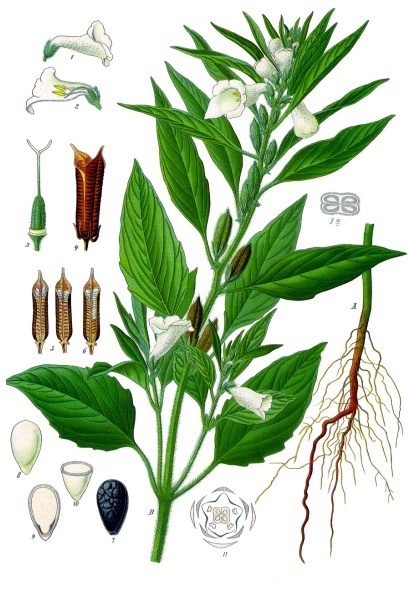
The physical form in which a plant could travel determined the speed, cost, and maximum distance of its dispersal almost as much as its economic value. Seeds of annual crops, cereals, pulses, oilseeds, and most spice-producing plants are compact, durable, and relatively easy to package. Sealed gourds, leather pouches, and clay-stoppered amphorae provided adequate moisture protection for journeys of several months. Sesame, whose oil content is high enough to inhibit microbial growth, could survive extended storage with minimal spoilage. Sesame seeds recovered from multiple Central Asian sites, studied as part of the broader archaeobotanical analysis of Bukhara published in Archaeological and Anthropological Sciences in 2023 by Mir-Makhamad and Spengler and their colleagues at the Max Planck Institute, confirm the oilseed’s presence in medieval Silk Road cities as both a traded commodity and a locally cultivated crop.
Cuttings and grafts presented entirely different logistical problems. A grape cutting must remain moist and must arrive at its destination within weeks, before the tissue desiccates and dies. Fig cuttings are similarly fragile. Citrus grafts require rootstock already established at the destination. All of this means that live vegetative material moved primarily by sea, where coastal cabotage between frequent ports minimised the time in transit, or by short overland legs between closely spaced oasis towns. The distribution of citrus in the ancient Mediterranean, traced by Dafna Langgut of Tel Aviv University through pollen and macro-remains at dozens of Mediterranean sites, shows the citron establishing itself as an elite garden plant in the Levant and Egypt during the first millennium BCE before the lemon and other citrus species arrived much later. The pattern is one of cautious, incremental advance rather than sudden arrival.
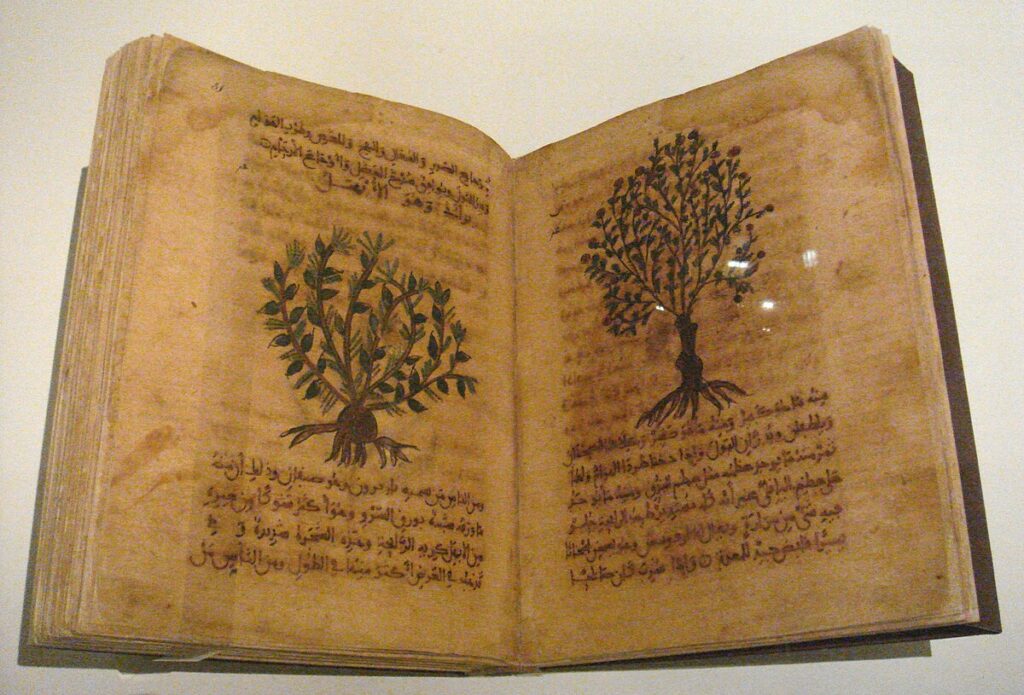
Knowledge transfer accompanied every physical transfer. The cultivation instructions for saffron, the grafting protocols for orchard crops, and the processing methods for sesame and linseed oil were embedded in the practical expertise of the traders, gardeners, and apothecaries who carried the plants. Theophrastus, writing his Enquiry into Plants in the fourth century BCE, records cultivation advice for several species that had arrived in the Greek world from eastern sources, including the Syrian cedar and various aromatic plants. Dioscorides, compiling his De Materia Medica in the first century CE, preserves instructions for identifying and preparing dozens of plants traded through the Indian Ocean and overland networks. These texts are not merely intellectual exercises. They are the written residue of practical knowledge that had been transmitted orally for generations before reaching literate form.
Why Some Plants Spread Fast and Others Almost Not at All
The fate of any plant entering a new environment depended on four interacting variables: ecological fit, economic competition from established local substitutes, the complexity of cultivation, and the social mechanisms through which new species were adopted and disseminated. Ecological fit was the baseline condition. No amount of economic incentive would establish a tropical spice in a climate where it would freeze in winter. The Mediterranean margins, with their mild winters and dry summers, were hospitable to a wider range of incoming species than the continental interiors, which is one reason why the archaeobotanical record of Mediterranean ports like Berenike and Myos Hormos shows a greater diversity of exotic plant remains than contemporary Central Asian sites at higher elevations.
Economic competition from local substitutes shaped adoption patterns in ways that the material record can rarely fully reveal. When a new spice arrived at a Mediterranean or Near Eastern market, local herbalists and pharmacists already had established plant preparations for most of the conditions that the incoming spice claimed to treat. Pepper had to outperform or out-symbolise those local preparations to justify its price premium. It managed to do both: its heat was genuinely distinctive, and its distant origin lent it an exotic authority that local herbs could not claim. Cloves and nutmeg, arriving in western Mediterranean contexts in very small quantities before the first millennium CE, remained rarefied precisely because no equivalent supply infrastructure existed to reduce their price to levels accessible beyond the elite. Their adoption curve was steep, slow, and socially constrained.
Rice illustrates the system-change problem. Oryza sativa requires either significant rainfall concentrated in the growing season or a managed irrigation system capable of flooding paddies at precise intervals. Introducing rice to a dry-farming agricultural landscape meant not just planting seeds but restructuring water management, labour calendars, and grain-processing equipment. The evidence reviewed in a 2021 study in The Rice Journal confirms that rice reached West Asia in archaeobotanical assemblages during the late first millennium BCE, typically in small quantities associated with elite consumption, and only spread to wider cultivation during the Islamic period when hydraulic engineering expanded significantly across the region. The plant could travel in a jar. The agricultural system required to grow it at scale took centuries to build.
Sources: Zhangjun Fei et al., “Genome re-sequencing reveals the history of apple,” Nature Communications 8 (2017), doi:10.1038/s41467-017-00336-7; Xuepeng Sun et al., “Phased diploid genome assemblies and pan-genomes provide insights into the genetic history of apple domestication,” Nature Genetics 52 (2020), doi:10.1038/s41588-020-00723-9; Laurence Cornille et al., “New insight into the history of domesticated apple,” PLoS Genetics 8 (2012), PMID 22589740; Christopher Gottschalk et al., “Malus sieversii: a historical, genetic, and conservational perspective,” Horticulture Research 12 (2025), doi:10.1093/hr/uhae244; Norberto Mir-Makhamad and Robert Spengler III et al., “Food globalization in southern Central Asia: archaeobotany at Bukhara,” Archaeological and Anthropological Sciences 15 (2023), doi:10.1007/s12520-023-01827-z; Robert Spengler III, “Arboreal crops on the medieval Silk Road,” PLoS ONE 13 (2018), doi:10.1371/journal.pone.0201409; Dioscorides, De Materia Medica (first century CE); Periplus of the Erythraean Sea (first century CE, trans. W.H. Schoff).