
Since the eighteenth century, the Parthenon has stood in Western cultural memory as the supreme expression of restrained, rational beauty: white marble, clear geometry, nothing superfluous. That image is wrong. Pigment analysis conducted on the Acropolis and in museum collections over the past four decades has established beyond scientific dispute that the Parthenon’s original colours included strong blues, reds, and blacks applied across its triglyphs, metopes, cornice mouldings, and sculptural friezes. The marble did not glow white in 447 BCE. It carried a chromatic programme designed to be legible across the breadth of the Agora below. This article explains what the current physical evidence actually shows, how it was recovered, and why the question of how vivid those original Parthenon colours were remains genuinely open even now.
Where the Idea of White Marble Came From
The association between classical architecture and white stone is not a fabrication. It is a misreading of genuinely observed conditions. When eighteenth-century architects and artists reached the Acropolis, they found pale marble. What they did not realise was that pigment disappears through a combination of photochemical degradation, weathering, soluble salt action, and, in many cases, the deliberate cleaning of excavated stone by early collectors who regarded patina as dirt. The white marble they saw was an end state, not an original state. Johann Joachim Winckelmann’s hugely influential 1764 work on Greek art enshrined the connection between whiteness, purity, and classical perfection into European aesthetic theory at precisely the moment when archaeological evidence for polychromy was beginning to surface, and the theory proved more durable than the evidence for two generations.
The challenge came from the French architect Jacques Ignace Hittorff, who excavated temples at Selinunte and Agrigento in Sicily in the 1820s and found vivid paint remains on Archaic architectural terracottas. His 1830 paper argued that polychromy was not an Archaic aberration later abandoned by sophisticated Classical architects, but a continuous and fundamental feature of Greek religious architecture. The reaction from the German scholarly establishment, led by Karl Ottfried Müller of Göttingen, was hostile. Müller accepted that paint had been used but argued for pale, almost transparent washes rather than the saturated reds and blues Hittorff claimed. That division between “strong polychromists” and “pale polychromists” persisted in the scholarship for over a century, with neither side possessing the analytical tools to settle it definitively.
The Physical Evidence: What Chemistry Has Found on the Stone
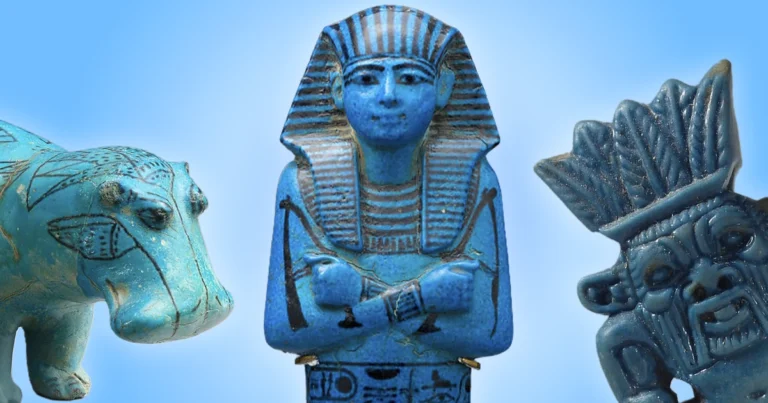
The shift from stylistic debate to physical chemistry began seriously in 1988, when Ian Jenkins and Andrew Middleton of the British Museum published systematic pigment analyses of Parthenon sculptures held in London. Using optical microscopy, scanning electron microscopy, and X-ray microanalysis, they identified Egyptian blue on the background of the frieze slabs and red ochre on isolated areas of moulding. These were not traces of later paint applied during the building’s centuries of use as a church and then a mosque. The stratigraphic position of the pigments, directly on the original carved marble surface under later encrustation layers, placed them at the time of the building’s construction in the 440s BCE.
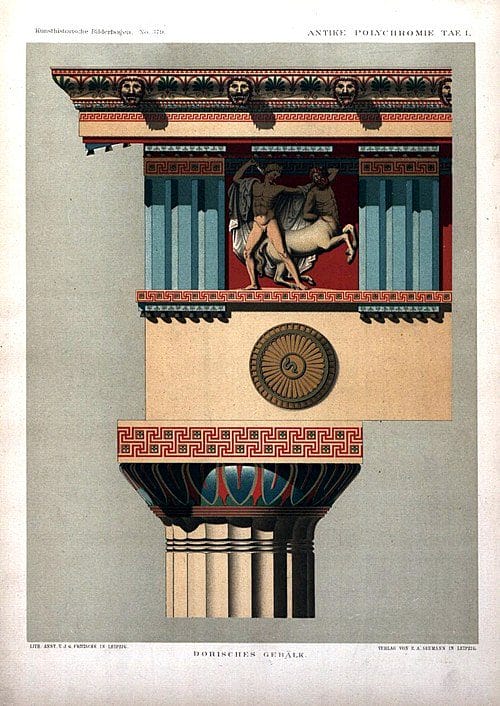
On the Acropolis itself, the decisive research has come from the scientific team of the Acropolis Restoration Service (YSMA), which gained access to the west entablature in 2011 when scaffolding already erected for structural consolidation work allowed close examination for the first time since the Balanos restoration campaigns of the early twentieth century. The YSMA programme, led by Sophia Sotiropoulou and published in a series of peer-reviewed studies between 2015 and 2024, combined X-ray fluorescence spectroscopy, micro-Raman spectroscopy, Fourier transform infrared spectroscopy, and visible-induced luminescence imaging across twenty-seven cornice blocks. The results were internally consistent and chemically unambiguous. The meander patterns incised into the cornice stone had been filled with two different blue pigments, azurite and Egyptian blue, placed in adjacent positions within the same decorative motif, against a red ochre background field. The binder was beeswax, applied through the encaustic technique.
That last finding — beeswax encaustic on open-air monument stonework — is the most technically specific result of the entire YSMA programme. It provides the first physical confirmation of what the Erechtheion building inscriptions had long implied. Inscription IG I³ 476 from the late fifth century BCE records payments to enkaustai, encaustic painters, at a rate of five oboli per completed foot of work, listing them as a separate skilled trade alongside sculptors and general wall painters. The cornice blocks have now supplied what the inscription left implicit: the actual organic binder matrix binding the pigment to the incised stone surface, surviving in microsample quantities that gas chromatography identified as predominantly beeswax fatty acid.
Why the Colours Were Placed Where They Were
Egyptian blue has an optical property that makes it structurally ideal for high-relief architectural ornament seen at distance. Its calcium copper silicate crystal structure scatters visible light in ways that produce a cool, saturated blue which retains its distinctness from warm stone even as particle concentration decreases through weathering. Azurite, the copper carbonate mineral, produces a deeper, somewhat warmer blue that shifts more readily toward green as it ages. Placed side by side within a single meander motif, as the YSMA analysis confirmed on the west cornice, the two blues would have produced a tonal differentiation between adjacent formal elements that kept the decorative band optically active under the intense Attic summer sun at the distance from which most viewers approached.
Red ochre on the meander background created a complementary colour relationship with the blue pigments. Complementary contrast, the mutual intensification of colours from opposite sides of the colour wheel, is particularly effective in direct sunlight, where additive optical mixing of adjacent hues can otherwise flatten distinctions. A meander band read against its original blue-on-red field from the foot of the Acropolis would have registered with the kind of visual clarity that the uncoloured marble, whatever its geometric precision, simply cannot deliver across that viewing distance.
Vinzenz Brinkmann of the Liebieghaus Skulpturensammlung in Frankfurt, whose methodological framework for the physical study of ancient sculptural polychromy was developed through his doctoral research at the Ludwig Maximilian University of Munich and published in successive volumes of the Circumlitio series, made this structural argument explicitly in his contribution to the 2010 volume. Brinkmann demonstrated through scale reconstructions that colour on Greek architectural stone guided the eye through large compositions at multiple viewing distances, marking transitions between architectural zones and between figure and ground. It was not applied as ornamental enrichment added after the fact. It was integral to the building’s communicative programme from design stage.
Built out of a love for history, kept free from distractions.
Spoken Past is an independent project shaped by curiosity, care, and long hours of research. Reader support helps keep it maintained, carefully researched, and open to everyone.
Egyptian Blue on the Frieze: What VIL Imaging Revealed
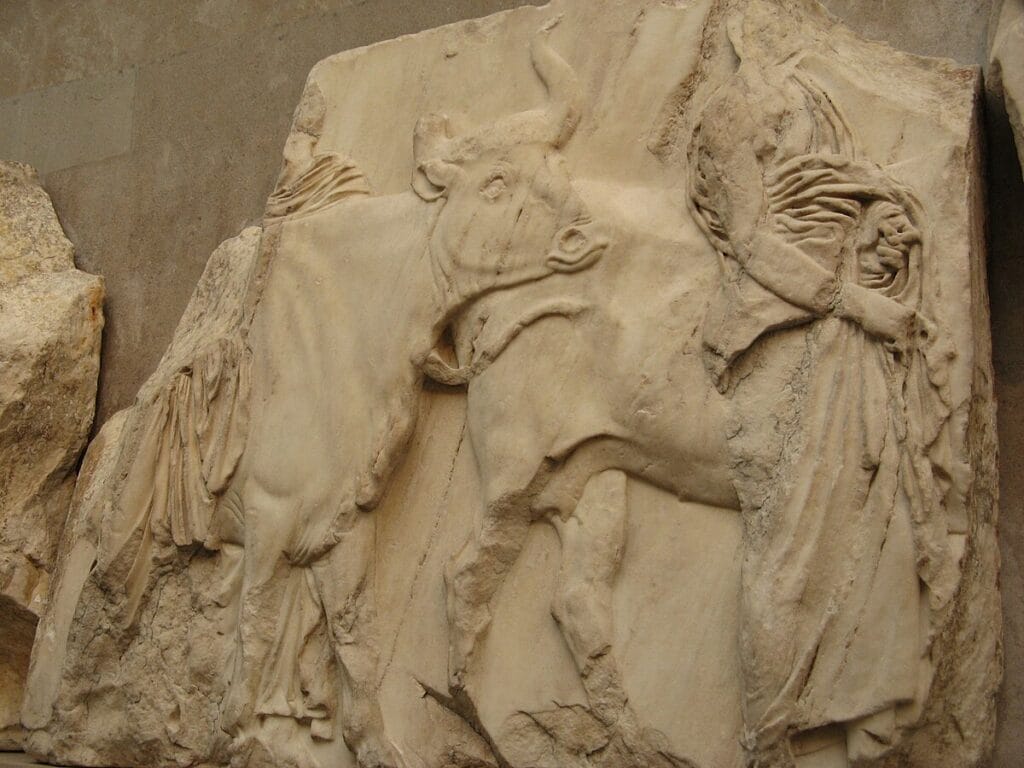
Visible-induced luminescence imaging has produced the most spatially detailed pigment data on the Parthenon’s sculptural surfaces. Egyptian blue absorbs visible light and re-emits it as near-infrared radiation, which registers on modified camera sensors as a bright glow even when the pigment has degraded to invisibility in ordinary light. The technique was applied systematically to the west frieze slabs during their 2012 and 2013 storage in the Acropolis Museum, when the slabs were removed from the building for the restoration of the western end. The results, published by the YSMA team in 2022 in the journal Heritage, identified Egyptian blue on the full extent of rider figure 17’s mantle on slab IX, on horse eyes across slabs VIII through X, and on scattered textile passages across multiple other slabs.
This is significant because it establishes the nature of the frieze’s background colouring through direct physical evidence rather than analogy with other monuments. Earlier scholarship inferred a blue frieze background from parallels at Bassae, Olympia, and other sites where paint survival was better. The VIL data on slab IX now confirms blue coverage on a figure whose mantle, if painted uniformly blue, would have merged with a blue background rather than standing out from it. This argues either for differentiated blue tones between figure and ground, or for the ground being a contrasting colour in at least some areas. The YSMA team’s position as of their 2022 publication is that the evidence is sufficient to confirm blue backgrounds were present but insufficient to specify the precise relationship between figure blues and ground blues across the full frieze without further analysis.
What the Reconstructions Get Right and What Remains Uncertain
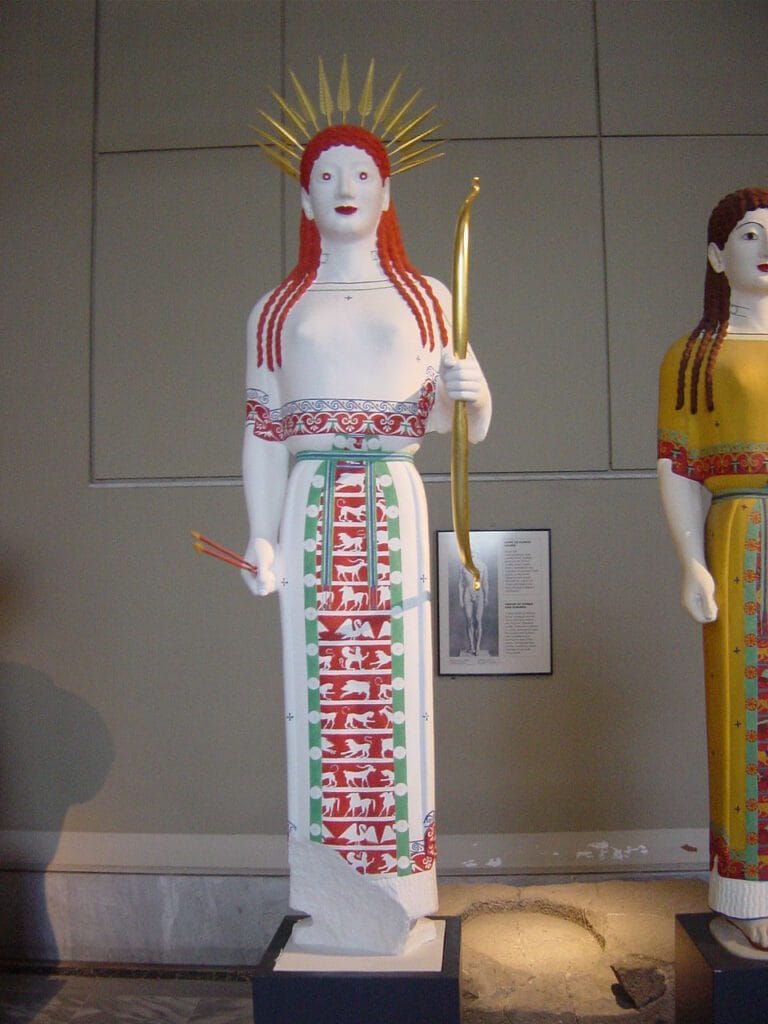
Brinkmann and his collaborator Ulrike Koch-Brinkmann have produced polychromy reconstructions of classical Greek sculpture in painted plaster casts exhibited in the touring “Gods in Color” show (2003 to 2015) and in the “Chroma: Ancient Sculpture in Color” exhibition at the Metropolitan Museum of Art in New York in 2022. Their method assigns pigments to specific surface areas based on direct analysis where available and on analogy with related monuments where it is not, and presents one well-reasoned reconstruction rather than a range of possibilities. The saturation of the resulting colours has attracted criticism from archaeologists who argue the reconstructions present freshly applied modern paint rather than the optically more complex result of ancient encaustic wax over white Pentelic marble under a ganosis finish.
That criticism has merit. Ganosis, the wax and olive oil surface treatment described by Pliny the Elder in Natural History XXXVI and attested in ancient building accounts, was applied over painted marble as a final step. Its optical effect depended on burnishing intensity: high-gloss ganosis produced a sealed, saturated surface; matte ganosis allowed light to penetrate into the wax and reflect from the marble beneath, creating a softer, more luminous impression. The white Pentelic marble of the Parthenon has a particular quality of internal light scattering that would have contributed to the visual result through the translucent wax matrix. A reconstruction painted in opaque modern pigments on plaster cannot reproduce this. Bente Kiilerich of the University of Bergen, in a careful methodological review in the Journal of Art Historiography in 2016, pressed this point with precision: the saturation shown in the Brinkmann reconstructions may be accurate for the pigment in isolation but overstates the visual effect of the finished surface as it would have appeared.
The YSMA programme’s formal position is that pigment identification and reconstruction are different levels of claim, with different degrees of certainty. The analytical results from the cornice blocks are chemically secure. The visual reconstruction of what those results would have looked like on the building is a separate exercise that requires additional assumptions about concentration, layer thickness, ganosis finish, and the condition of the marble at the time of painting. Good reconstructions mark this distinction explicitly. The ongoing YSMA programme, still active as of early 2026, will supply more data points that will allow successive iterations to become progressively more specific.
The Interior: Athena Parthenos and the Technology of Sacred Spectacle
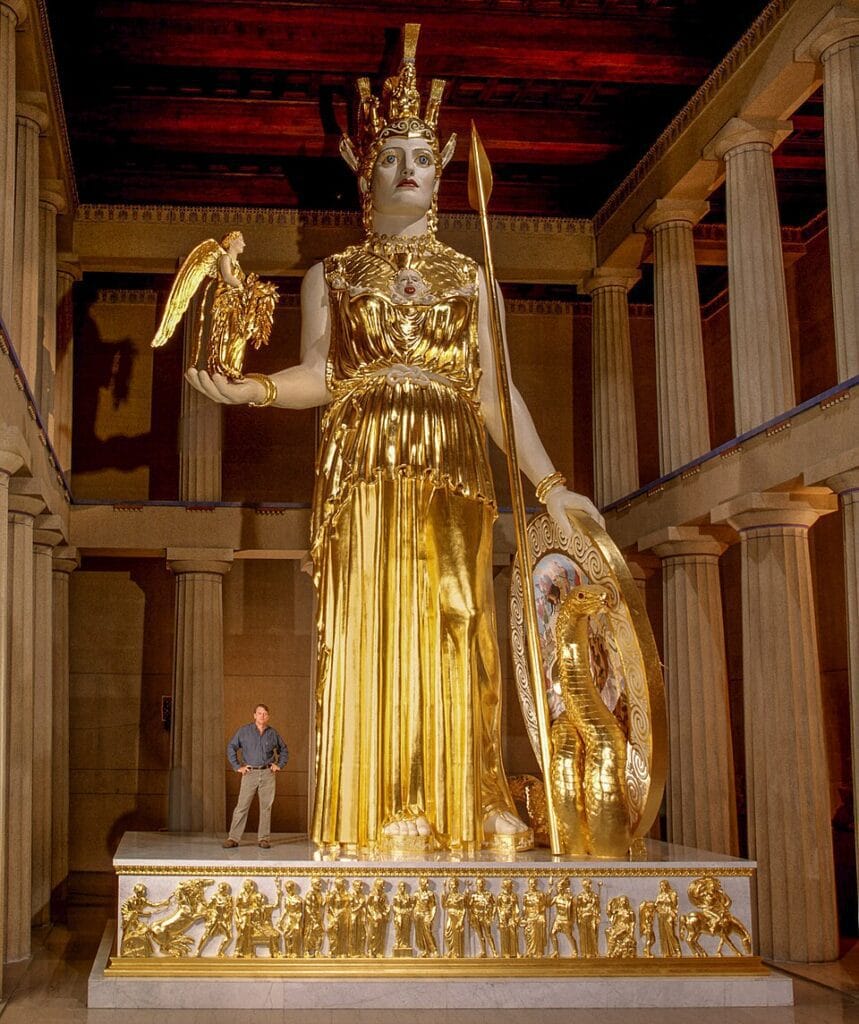
The question of the Parthenon’s colours extends inside the building to its most important contents. Athena Parthenos, the gold and ivory cult statue designed by Pheidias and installed in the cella around 438 BCE, was a chryselephantine construction: its flesh surfaces in ivory, its drapery, armour, and attributes in removable gold panels weighing, according to Thucydides’ calculation, approximately forty talents. Chryselephantine work was not painted. Its material contrast, warm ivory against hammered gold, against painted architectural backgrounds, was itself a chromatic programme. The interior walls of the cella behind and around Athena carried paint, as did the ceiling coffers, where traces of blue and red have been identified in analytical work carried out during earlier restorations.
Modern replicas of the Athena Parthenos, most notably the full-scale reconstruction installed in the Nashville Parthenon replica in 1990, give the clearest available sense of how the chryselephantine technique would have transformed the interior space. The gold surfaces reflected lamplight; the ivory absorbed and softened it. Against painted blue walls, the figure would have appeared to generate its own warmth. None of this required subtle naturalistic colour. It required the deliberate management of light through material contrast at a scale that corresponded to the civic ambitions of mid-fifth century Athens.
Why This Changes How We Think About Classical Greece
The recovery of the Parthenon’s original colour has consequences that extend beyond art history. The white-marble aesthetic that Winckelmann theorised became, in the nineteenth and early twentieth centuries, a visual vocabulary for civic authority: courthouses, banks, legislatures, and war memorials built in white stone or white-painted concrete across Europe and North America claimed continuity with a classical world that was imagined as rational, restrained, and pale. That image was always a selective construction. The actual fifth-century Acropolis was a complex polychrome environment with strong pigments applied at public scale, funded by the tribute of allied states, and designed to communicate Athenian power through visibility rather than restraint.
The archaeological and analytical work of the past four decades has dismantled the white-marble myth at the level of physical evidence rather than interpretive argument. The azurite and Egyptian blue still present in microscopic form in the incised meander channels of the west cornice blocks did not get there by accident. They were mixed, heated, applied, and sealed by specialist encaustic painters working on scaffolding in the 440s BCE. The building that Pericles and Pheidias completed was not the building that Johann Joachim Winckelmann imagined. It was something more complex, more deliberately spectacular, and considerably more colourful.
Sources: Sotiropoulou et al., “What were the colors of the Parthenon? Investigation of the entablature’s cornice blocks,” Journal of Archaeological Science, Elsevier, 2022. Sotiropoulou et al., “Architectural Polychromy on the Athenian Acropolis: An In Situ Non-Invasive Analytical Investigation,” Heritage, MDPI, 2022. Ian Jenkins and Andrew Middleton, “Paint on the Parthenon Sculptures,” Annual of the British School at Athens 83, 1988. Bente Kiilerich, “Towards a Polychrome History of Greek and Roman Sculpture,” Journal of Art Historiography 15, December 2016. Vinzenz Brinkmann and Raimund Wünsche, eds., Gods in Color: Painted Sculpture of Classical Antiquity, Stiftung Archäologie, 2007. Acropolis Restoration Service (YSMA), Current Research Programme.