
The most famous image from Bronze Age Crete shows a charging bull and three human figures arranged like a sentence in motion. One grasps the horns, one somersaults above the animal’s spine, and one lands behind with open arms. Later Greeks imagined a maze and a man-bull who devoured youths. The palace at Knossos is large enough to feel like a labyrinth if you do not know your way, and the bull is fierce enough in life and art to inspire fear. Yet the people in Minoan pictures are not victims in a monster’s arena. They are athletes and ritual performers in a culture that turned danger into dance, skill, and spectacle.
From monster tale to athlete’s art
The Minotaur story is a late memory that bends the past toward a hero’s triumph. In that version, a human body with a bull’s head stalks a maze while a foreign prince proves his worth by killing it. The Minoan pictures tell a different kind of story. There is no hybrid body. The human and the animal are distinct and in tense partnership. The central motif is not slaughter. It is passage. The leaper’s body moves from danger to control, from horns to back to ground. That is the structure of a ritualized feat.
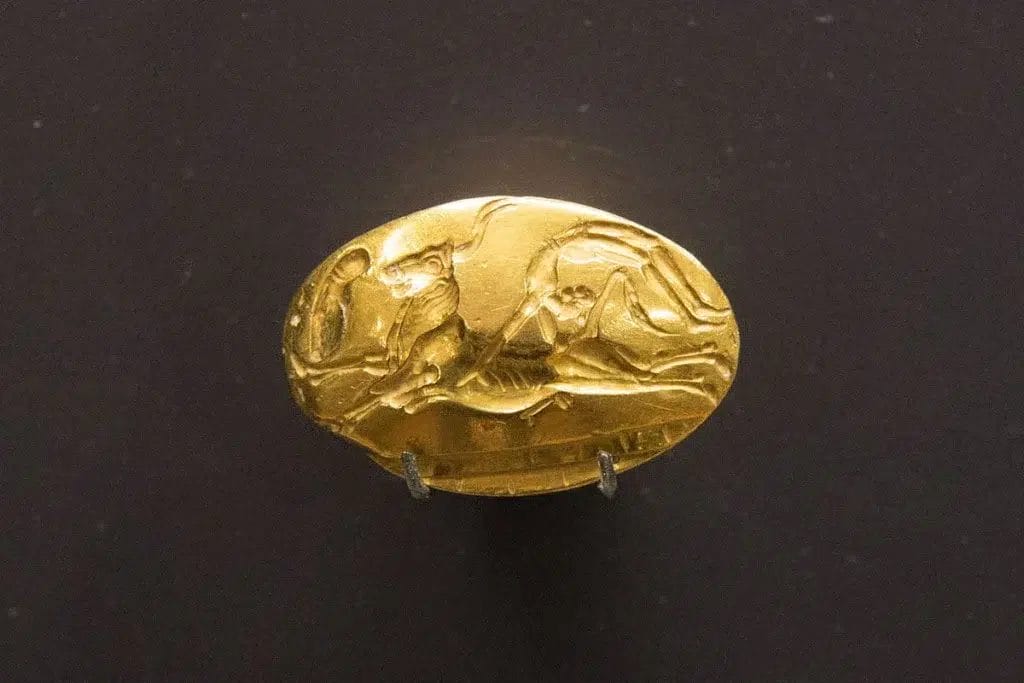
Minoan artists repeat this grammar across media. Frescoes in the palace at Knossos and fragments in the Heraklion Archaeological Museum show the same choreography. Gold signet rings miniaturize it with astonishing delicacy. Sealings and tiny stones cut for stamping echo the same curve of bull and the same human arc. The consistency is not an accident. It records a practice that was central enough to be worth learning, teaching, and reproducing for centuries.
What the frescoes actually show
The famous panel often called the Toreador Fresco is a composite of originals and careful restorations. Look closely at surviving fragments and you see bright fields, smooth plaster, and figures that follow Minoan painting conventions. Male skin is usually red-brown, female skin lighter. Hair is dark and sometimes falls in long coils. Waists are narrow. The bull is shown in flying gallop. Artists of the eastern Mediterranean used this device to depict speed. The legs are stretched far forward and back, not because bulls truly run like that but because the pose communicates motion and danger with clarity.
The three figures frame a sequence. At the front, hands on horns. In the center, the arc above the spine. At the rear, an awaiting partner ready to steady the landing or to celebrate it. Some panels simplify or vary the sequence. A single acrobat may appear on the back mid-vault. A partner may stand alone. A fragment may preserve only a forequarter and a human hand. The repetition of the core ideas is what matters. The bull has kinetic power. The leaper has timing and nerve. The partner has attention and care.
The people behind the paint
Who were the leapers. The pictures give a strong hint. Both male and female bodies appear in leaping scenes. Jewelry, hair, and narrow belts are not simple decoration. They are status signals. The people allowed into the arena of a sacred bull are not random thrill-seekers. They belong to households with training spaces and time. Leaping is not a single dare. It is the apex of practice in balance, vaults, and reading an animal’s momentum.
The athletes’ bodies are elastic more than bulky. They are acrobats. The back-arched central figure in the Knossos composition is not a wrestler. It is a tumbler. The forward figure bracing on the horns has thick forearms but a long waist and hips ready to whip. The rear figure, arms out, is positioned like a spotter in a modern gym. That last detail matters. Even in a sacred performance, there is teamwork and care.
How a leap can work in real time
To imagine bull leaping as a real act rather than a static picture, think in frames. The bull drops its head to hook or to toss. In that instant the horns point down and forward, not straight up. The leaper reaches and plants hands on the horn bases where the grip is strongest. As the bull raises its head again, the leaper uses that motion to begin a vault. Torso follows, hips rise, legs tuck and extend. The back becomes a bridge that a trained body can clear. The moment of highest risk is the first contact. Miss the angle and you meet horn, skull, or ground.
Could the movement also begin with a side vault onto the back without a horn plant. Some images and small objects suggest it. The key idea is the same. The human uses animal momentum instead of trying to cancel it. The landing is a second moment of risk. A controlled somersault lets the leaper spot the ground and use the partner’s forearms as a brake. A misjudged landing drops the leaper under hooves. The danger is real. The art does not deny it. It arranges it.
Bulls, arenas, and ritual space
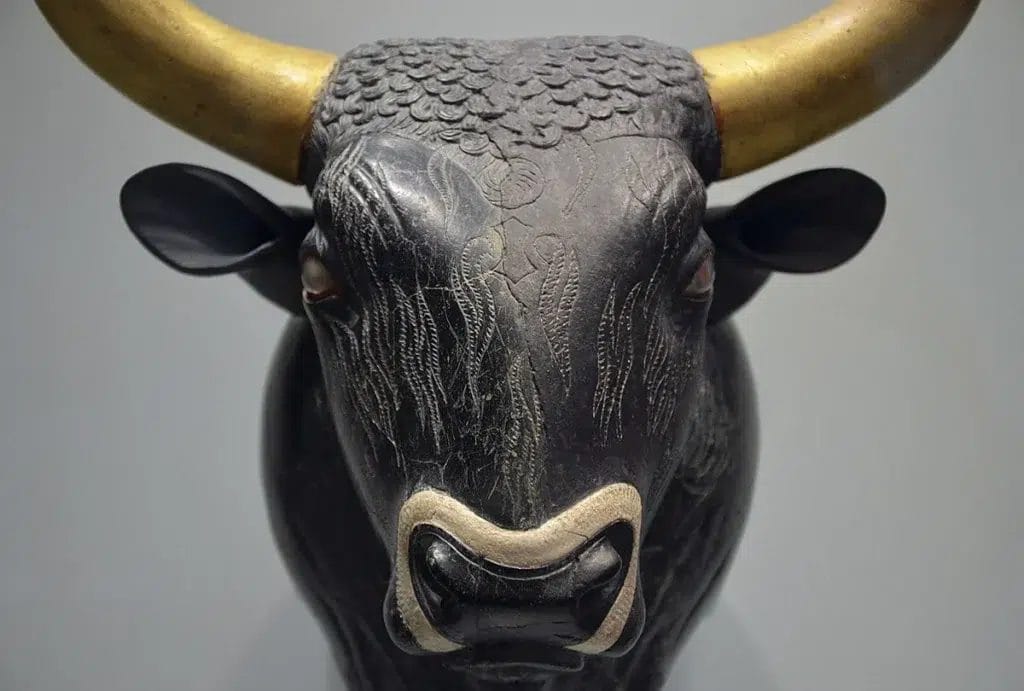
Knossos has broad courts where large audiences could have watched processions and performances. A long, stepped bench appears in a famous miniature fresco that scholars often call a grandstand. The palace roofs carry silhouettes called horns of consecration. In stone or in plaster they echo a bull’s profile and mark visually that the space belongs to a god or to a rite. Leaping in such a frame is not a tavern stunt. It is a sacred display tied to household identity and to seasonal celebrations. Libation vessels carved as bull heads survive with drilled channels for pouring. The same animal is present in symbol and in flesh. The combination tells you that a festival was as much ritual as sport.

What about the animal
A bull is not a prop. It is a living partner with its own force and fear. Minoan handlers knew cattle well. Herding, plowing, milking, and breeding are everyday work in Bronze Age Crete. The people who brought a bull into a court knew individuals by temperament. A hot young bull might be selected for show and then retired. A dangerous bull could be sacrificed and offered. The picture of the event in art shows no ropes, muzzles, or nose rings. That does not prove that control was never used, only that the artists wanted to present the act as clean human-animal skill without visible restraints.
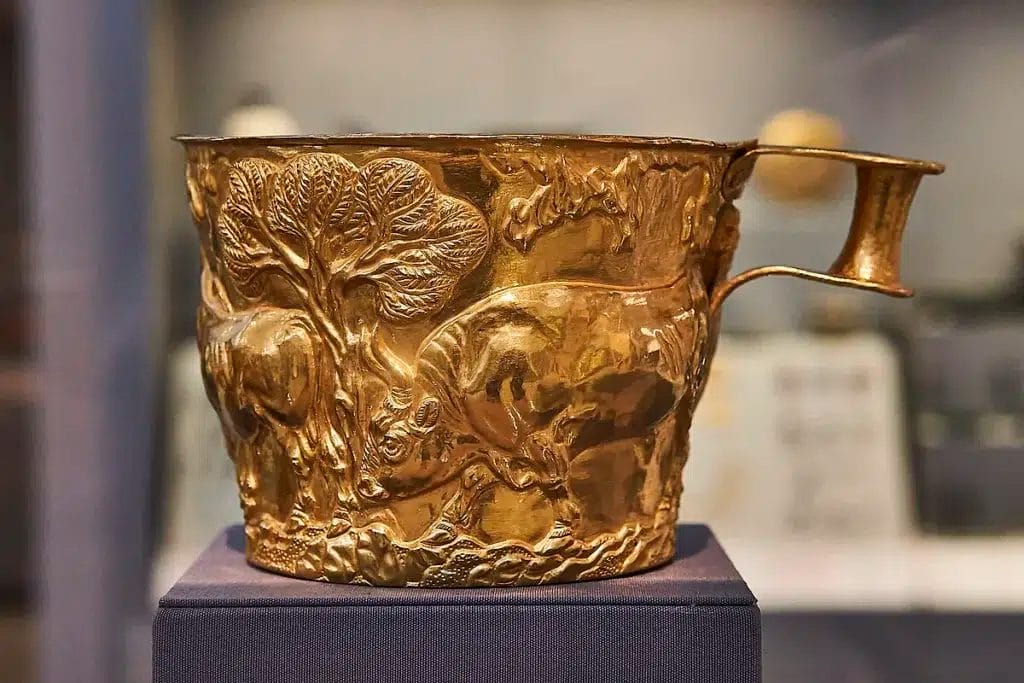
The violence in Minoan art around bulls is not always performance. The golden Vapheio cups, probably Mycenaean but deeply connected to Cretan themes, show capture scenes. One cup shows a net and a rope, a peaceful trick. The other shows a wrecked landscape and a bull that tramples a man. Those images link bulls to danger and to landscape control. They are not pictures of leaping. They are reminders that power over cattle takes different forms, from gentle cleverness to blood.
Gender in a dangerous arena
Minoan images of women in leaping scenes remind us that gendered labor in Bronze Age Crete is not a simple split. Women process in lines with jars and garments. They also ride, drive, and leap. The skin tone convention that paints women light and men dark is not a naturalistic color code. It is a visual rule the culture chose to follow. A woman standing to receive a landing or a woman mid-vault is part of the lexicon. That presence says something about the values of training, grace, and courage in elite households.
It also says something about how the later Minotaur story erases women. In the Greek legend, the women are victims shipped as a batch from Athens. Minoan pictures make women visible as trained participants. The shift from athlete to victim is a choice of story, not an inevitable fact.
More than sport
Leaping looks like sport at first glance. It has skill, risk, and audience. It also has ritual density. Before a performance, libations may be poured. Afterward, an offering might be made. Horns on roofs and stylized bull symbols in shrines bring the event into a cycle of sacred time. The bull can stand for more than itself. Fertility, strength, storm, and household power all converge on the animal in Minoan thought. To soar above that power is not only to flirt with danger. It is to participate in a world where human agility, divine favor, and animal force are brought into a single moving picture.
Built out of a love for history, kept free from distractions.
Spoken Past is an independent project shaped by curiosity, care, and long hours of research. Reader support helps keep it ad-free, sponsor-free, and open to everyone.
Technique, training, and teams
A leaper cannot learn timing and vaulting on the day of the show. The culture that produced frescoes and rings must also have produced spaces and routines for practice. Courtyards in elite houses with smooth plaster floors are candidates for training grounds. Wooden horn-frames or padded props could teach hand placement and hip swing well before a young athlete touched a horn. Spotters practicing catches would lower injury rates. Healers and masseurs likely worked near the court on festival days. You do not keep a tradition alive for centuries if every performance ends in catastrophe.
Clothing was part of the kit. Narrow belts cinch waists and help the back flex. Jewelry and hair tell status and style. Bare torsos on men and open bodices on women are not simply aesthetic. They leave shoulders free for grip and for controlled rotation. Sandals appear in some scenes and bare feet in others. The variation probably tracks surface and role. A horn-grabber might prefer grip. A landing partner might want protection.
The look and craft of Minoan painting
Minoan painters worked partly in true fresco where pigment is applied to wet lime plaster. As the plaster cures the pigment becomes part of the wall. They also used secco additions for details. The palette uses mineral colors that read clearly in sunlit courts. Blue, red, white, black, and yellow arrange macro shapes and micro details. The bull’s hide is a field for pattern. The human skin is a field for movement. Lines are sure. Outlines are continuous. Artists in this world learned the body at speed by drawing it again and again.
Restoration history matters. Early twentieth-century work at Knossos introduced cement and modern interpretation into old walls. Some restored panels put fragments into new contexts to form persuasive pictures. Museums now label which parts are original and which are modern to help viewers keep the difference in mind. The power of the composition is real. The exact edges of figures sometimes belong to a restorer’s hand. Thinking like a careful viewer means enjoying the image while reading the labels.
Labyrinth, palace, and memory
The palace at Knossos is a complex of courts, rooms, stairs, light wells, and corridors built and rebuilt over centuries. To a visitor, it is easy to get lost. That sensation helps explain how a Greek tale could fix on a labyrinth. The palace is not a maze by design. It is a memory palace by history. If you layer rebuilding, earthquake repair, and additions made for political and ritual needs, you get the feeling of endless rooms. Add bulls, processions, and acrobats in festival time and you get a story that future travelers could compress into a monster and a maze.
The memory of a practice survived in the Greek mind as a problem and a victory. The practice itself was probably a coordinated rite and sport in which human skill and animal power met in public view. The shift from performance to devouring tells you about the later author’s taste for heroes. A culture does not fear its own best athletes in their moment of grace. It celebrates them.
Reading the small things
Small objects expand the story. Rings compress a whole sequence into a coin-sized oval. You can see a forearm flex and a bull’s leg plant in a few engraved lines. Sealings that once closed containers carry tiny leapers and bulls that proved identity or ownership. A carved bull’s-head rhyton that once poured liquid during rites shows the same careful carving of nostrils, lips, and eyes that painters used to give the animal presence. Big festivals leave few ordinary things in place. Small objects carry ideas through time.

Are there real world parallels
Modern Iberian traditions sometimes invite comparison. In the course landaise, skilled performers dodge or leap young bulls in an arena. The differences matter. The Iberian animals are often horn-tipped to blunt injury. The rules are codified. The culture is continuous and documented. Minoan Crete is older by millennia and the record is visual. The comparison helps with biomechanics and with audience habits. It cannot serve as proof of identical practice. The safe way forward is to use parallels to test what is possible and to stop when the evidence goes thin.
What risk looked like
Bulls can kill. The artists did not need to show blood to mark risk. The speed of the animal in flying gallop, the narrowness of the waist, and the stretch of the landing body already make the point. A wrong step means a horn or a hoof. The value attached to leaping depends on the danger being real. That does not mean a city was casual with human life. Rituals that endure tend to manage risk with care. The presence of a rear partner in so many compositions is a quiet sign of safety culture in a sacred frame.
Why reclaim the leapers
The monster story is memorable. It wipes out the performers. Reclaiming the bull-leapers restores the people who trained, the handlers who knew animals, the painters who made motion legible, and the families who gathered to watch. The past becomes clearer when we do not let a later myth eat the earlier art. The result is more human and more precise. It replaces fear with skill and erasure with presence.
FAQ
Did Minoan bull-leapers die often?
The art does not record deaths and neither do surviving texts from Crete. Bulls are dangerous, so injuries were likely. The repeated presence of a landing partner suggests that teams used technique to reduce risk. A tradition that lasted across generations would have needed training and care to keep athletes alive.
Were leapers slaves offered to a bull?
The Greek Minotaur story imagines Athenians sent as tribute. Minoan art shows trained performers, male and female, in elite dress. Nothing in the imagery presents a human as a sacrificial victim in the act of leaping. The people are athletes and ritual agents, not fodder.
Were the bulls drugged?
There is no evidence in the images for muzzles, ropes, or restraints during a leap. Handlers could select animals by temperament and age. Selection and handling are more plausible than drugging. Rituals that display control tend to avoid visible short cuts.
Is the palace a real labyrinth?
Knossos is large and complex. It feels like a maze if you wander without a plan. The labyrinth in later myth is a narrative device. The palace is a layered building that grew over centuries rather than a designed puzzle.
How accurate are the restored frescoes?
Many panels combine original fragments with modern plaster to fill gaps. Museums label which parts are ancient. The overall scene reflects repeated ancient compositions. Exact outlines may include reconstruction. It is wise to admire the picture and read the labels together.
Why do women appear as leapers?
Minoan images include women in roles across ritual life. In leaping scenes women act as vaulters and receivers. The convention that paints women with lighter skin is a stylistic rule. The presence of women in dangerous skill roles is part of the culture’s visual language.
Is bull-leaping a sport or a rite?
It is both. The act demands skill and produces spectacle. Horns of consecration, libation vessels, and processional imagery add ritual weight. A festival could blend athletics, devotion, and community display in a single day.
Could the leap be purely symbolic?
The consistent mechanics across dozens of images argue for a real practice. Symbol and sport are not opposites here. The leap is a real feat that also carries meaning.