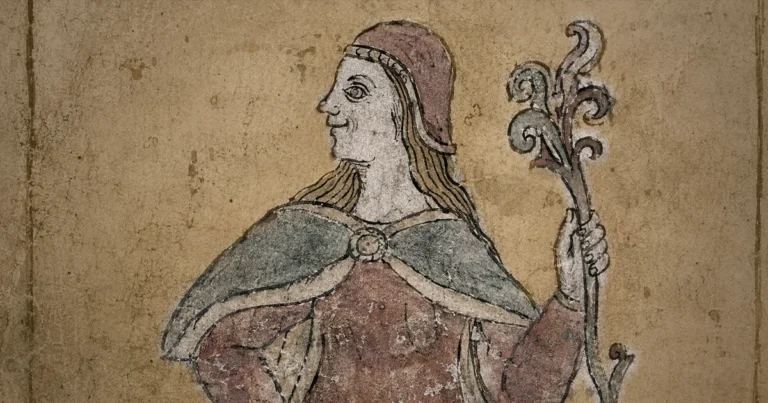

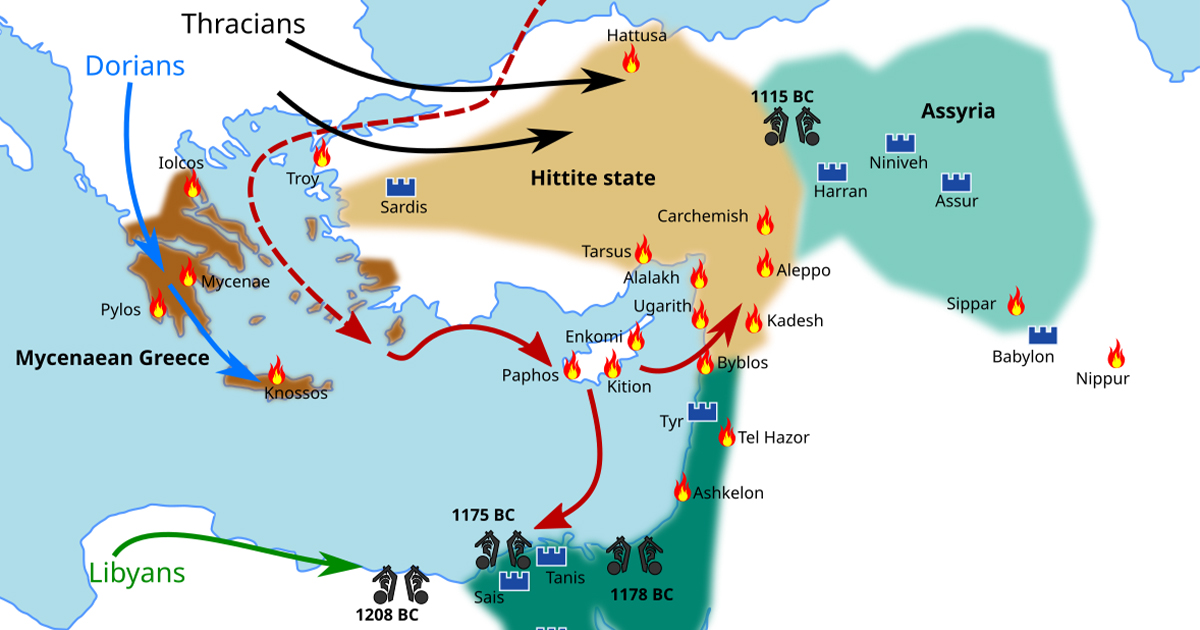
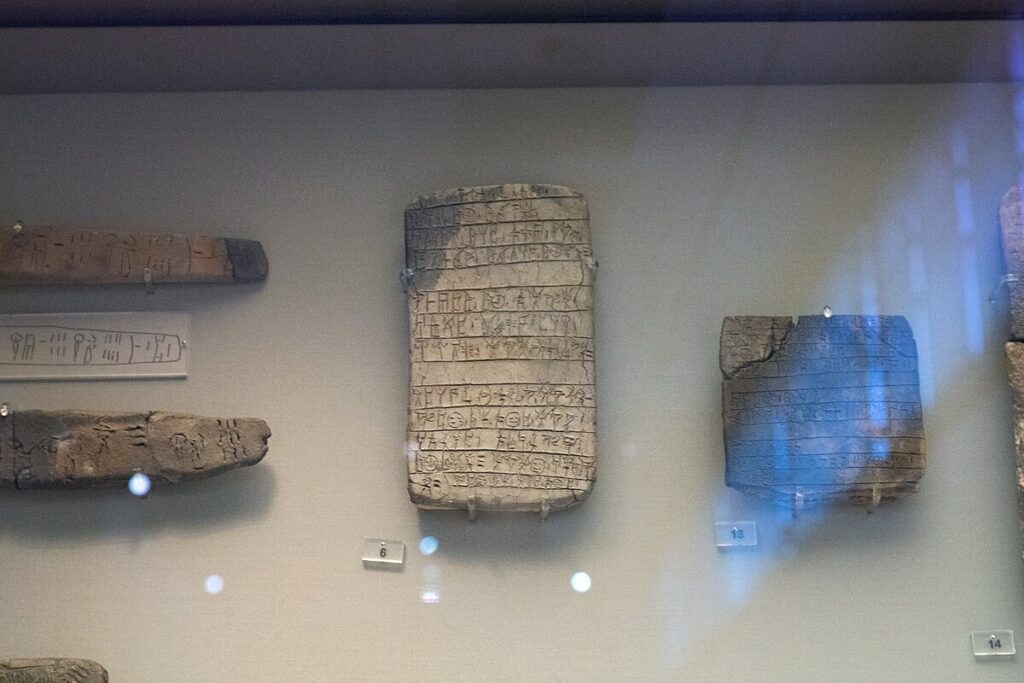
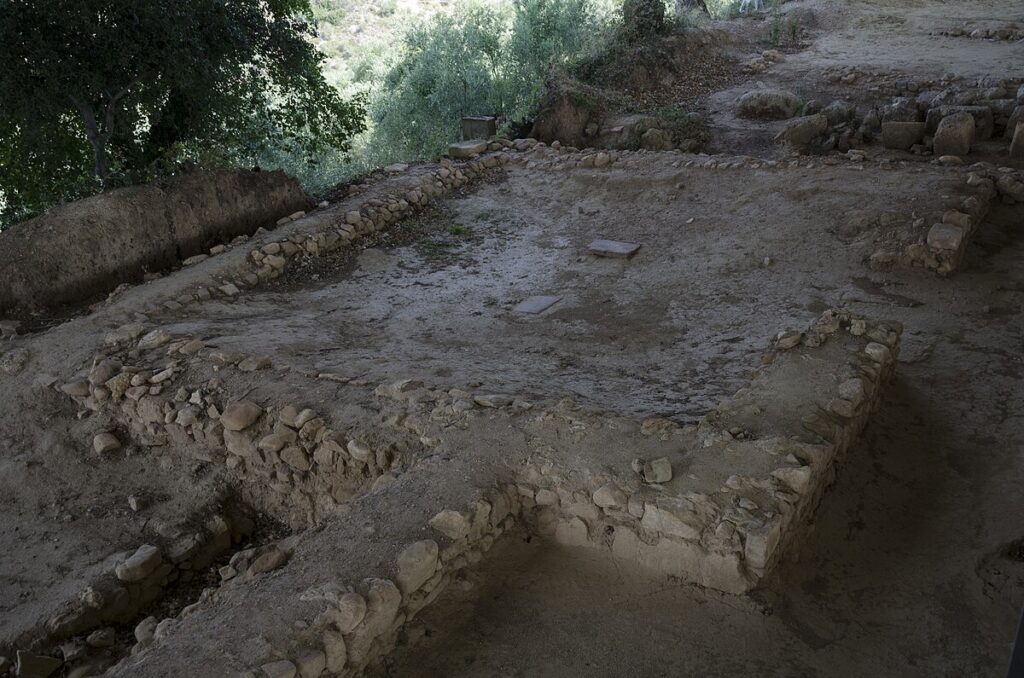
In the archive rooms of the Palace of Nestor at Pylos, scribes were still writing on clay when the building burned. The tablets they left behind, baked hard by the fire that destroyed the palace around 1180 BCE, record rowers being dispatched to coastal watch stations, soldiers being distributed across the kingdom, and rations being carefully measured out. None of those lists were ever acted on. The scribes never wrote another line. The palace was abandoned and never rebuilt. This scene, repeated in different forms from Mycenaean Greece to Hittite Anatolia and the Levantine port city of Ugarit, is what the Bronze Age collapse actually looked like at the human level: not armies sweeping civilization off the map in a single season, but administrative systems losing the capacity to function, granaries going unstocked, coastlines going undefended, and people eventually choosing to live without the palaces that had organized their world for three centuries. This article explains what actually failed, why the pressures stacked so dangerously, and what the end of the Bronze Age palatial world looked like from the ground up.
What the Bronze Age Collapse Actually Destroyed
The most precise way to describe what ended is this: palatial redistribution systems. The Mycenaean palaces at Pylos, Tiryns, Mycenae, and Thebes were not simply royal residences. They were the administrative centers of sophisticated palace economies, tracking land assignments, herd sizes, worker rations, and ship crews using Linear B tablets. The Hittite state at Hattusa coordinated a ring of vassal kingdoms through a central bureaucracy that allocated grain, extracted tribute, and dispatched armies through written commands. At Ugarit, royal estates worked alongside merchant capital and sea routes to sustain one of the eastern Mediterranean’s most sophisticated ports. Bronze Age wealth was not primarily gold and stone. It was information: the lists, tallies, and sealed jars that let a palace turn agricultural surplus into political power.
Those ledgers lived on clay and in officials’ heads, and both were tied to buildings that anchored authority. When key buildings burned or were abandoned, the tools of command collapsed with them. Armies did not need to lose battles for systems to break. If granaries were empty, if coastal watchmen went unfed, if scribes could not be paid in barley or oil, orders had no force behind them. In many places, the post-palatial archaeological horizon shows people staying in the same locations but institutions ceasing to function. The continuity of settlement and the discontinuity of administration are the two most important facts about the Bronze Age collapse.
Why No Single Cause Explains the Bronze Age Collapse
The Bronze Age collapse has attracted single-cause explanations for two centuries. In the nineteenth century, scholars blamed marauding Sea Peoples. In the twentieth, drought became fashionable. More recently, earthquake storms and the disruption of tin supply chains have each had their moment as the decisive factor. None of these explanations works on its own because none of them can account for the wide geographic spread of the collapse, the variability in timing between regions, or the specific sequence of failures that the archaeological evidence documents. What the evidence consistently shows is a stacking of pressures, each of which was manageable in isolation but collectively exceeded the capacity of palace economies to absorb.
Climate stress is real and well-documented. Paleoclimatic records from lake sediments, ice cores, and tree rings converge on a period of prolonged drought in the eastern Mediterranean during the late thirteenth and early twelfth centuries BCE. A 2023 study by Sturt Manning and colleagues at Cornell published in Nature identified severe multi-year drought coincident with Hittite collapse around 1198 to 1196 BCE. Pre-industrial agricultural systems were acutely sensitive to timing: two poor harvests out of four could halve barley yields, leave soldiers unpaid, and push farmers to abandon marginal land. But drought alone does not explain why heavily fortified palatial centers burned rather than simply contracted.
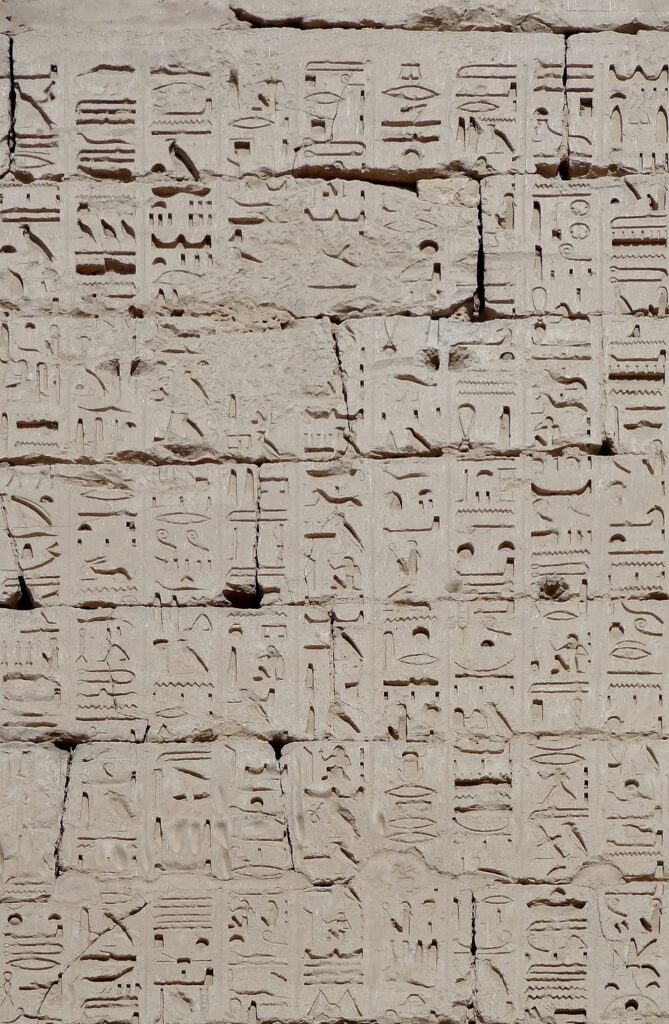
Seismic activity adds another layer. The eastern Mediterranean sits on active fault lines, and archaeologists have identified earthquake damage at several Aegean and Levantine sites in the relevant period. Earthquakes do not explain every fire or every abandonment, but they puncture surplus and morale with particular efficiency in cities whose elevated stone storage facilities, water systems, and road networks all require constant maintenance to function. A strong earthquake in one campaign season means lost harvest labor, blocked roads, and local elites suddenly unable to honor their obligations to the center. Maritime raiding compounds the effect. Egyptian reliefs at Medinet Habu record enemies arriving by sea and land during the reign of Ramesses III, and letters from Ugarit describe ships spotted offshore and requests for grain shipments from cities apparently struggling to feed themselves. Raiding both symptoms and deepens state weakness: it feeds on thinly defended coastlines and destroys the granaries and shipping that a weakened state most needs to recover.
The Tin Problem and the Fragility of Bronze
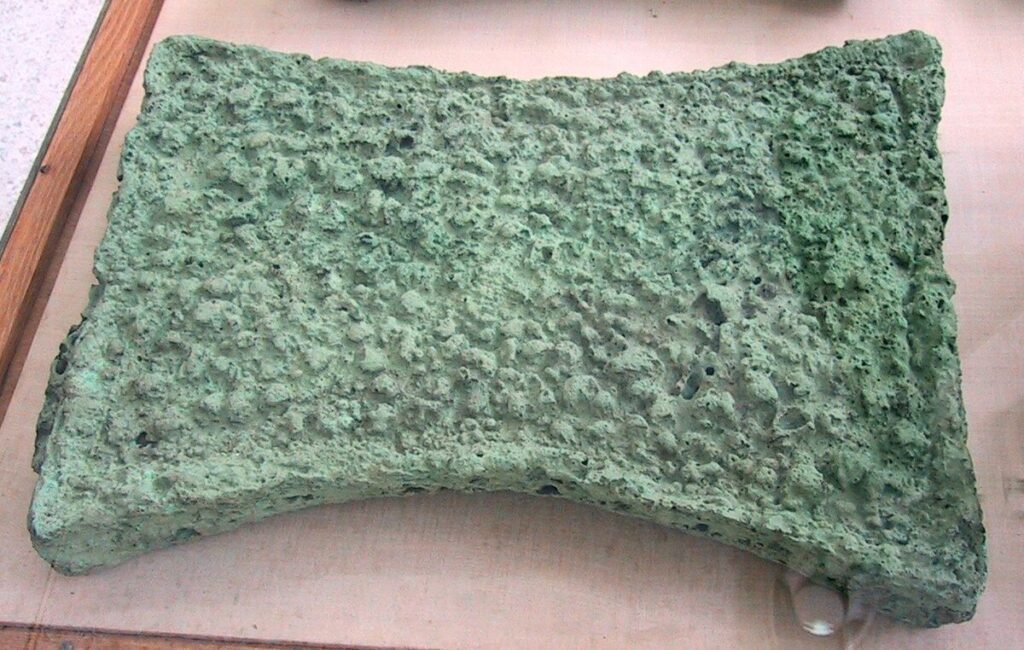
Bronze is copper plus tin, and that seemingly simple formula contained a structural vulnerability that the palatial world had spent three centuries building around without fully resolving. Copper had many sources across the eastern Mediterranean and Cyprus. Tin had far fewer, and they were far away: Cornwall, central Europe, Afghanistan, and possibly the Erzgebirge mountains between modern Germany and the Czech Republic. The supply chains that moved tin through central Anatolia or across open sea had been sustained by palace-organized convoys, guaranteed payments, and the infrastructure of ports capable of receiving and forwarding bulk cargo. When unsafe shipping, unstable ports, and rulers who could no longer guarantee payment combined, the cost and risk of tin shipments rose sharply.
The effect on bronze production is visible in the archaeological record. Metal objects from the post-collapse horizon are often rougher in form, made from recycled material, or replaced by iron equivalents that were technically inferior to well-made bronze but could be produced locally without dependence on long-distance supply chains. Iron did not defeat bronze in any direct technological competition. Bronze logistics failed, and iron filled the gap that failure opened. Eric Cline of George Washington University, whose book 1177 B.C.: The Year Civilization Collapsed (Princeton University Press, 2014) is the most widely read scholarly synthesis of the collapse evidence, has argued that the systemic fragility of Late Bronze Age economies, their dependence on multiple long-distance supply chains that all had to function simultaneously, was itself the deepest structural cause of the collapse.
Built out of a love for history, kept free from distractions.
Spoken Past is an independent project shaped by curiosity, care, and long hours of research. Reader support helps keep it maintained, carefully researched, and open to everyone.
The Voice of the Administrative Record at the Moment of Failure
The most gripping evidence for what the Bronze Age collapse felt like from inside is the administrative record, caught mid-sentence. The Pylos tablets are the clearest case. They record rowers being dispatched in groups of thirty, soldiers being positioned at coastal watch stations, and rations being carefully distributed against a threat the scribes apparently could see coming but not stop. These are not dramatic texts. They are the texture of a bureaucracy trying to harden its defenses while still operating through normal channels. The fire that baked those tablets also ended the hands that wrote them. The administrative voice and the administrative system stopped simultaneously.
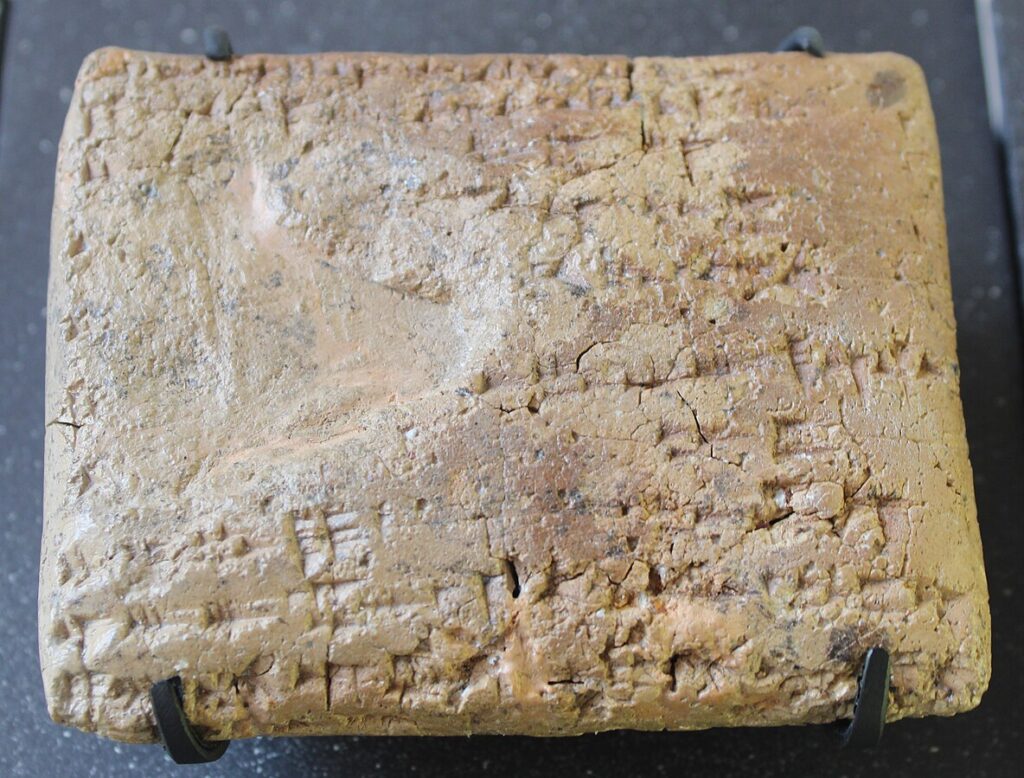
At Ugarit, cuneiform tablets include letters that read like dispatches from the edge of disaster. People from Cyprus requesting food. Messengers reporting enemy ships offshore. Scribes noting a shortage of grain and asking when the next shipment will arrive. The tone is anxious and specific, focused on rations and arrivals rather than politics or theology. This is a port city pulled between its dependence on the sea and its obligations inland, and the record simply stops. No final letter, no official statement. The scribes stopped writing and the city was not rebuilt.
Different Collapses: Hittites, Mycenaeans, Levantine Cities, and Egypt
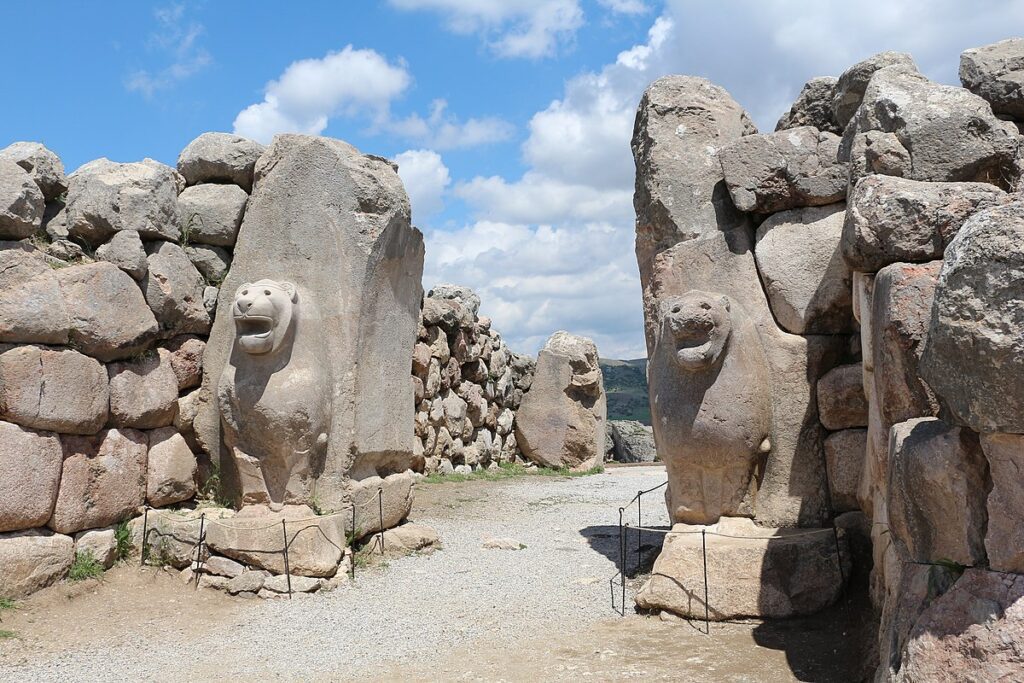
No two regions fell the same way, and the differences are as informative as the similarities. The Hittite Empire, centered at Hattusa, had long managed a wide ring of vassal kingdoms through a central bureaucracy. When grain shortfalls and frontier pressure combined with the loss of legitimacy that comes from failing to protect vassals, the outlying kings tested their obligations to the center and found them empty. Hattusa appears to have been evacuated rather than stormed: no massacre evidence, no treasure left behind, no signs of desperate last defense. The Lion Gate, built to project permanence and power, became a monument to an abandoned city. The later Neo-Hittite principalities that appeared in northern Syria in the following centuries point to fragmentation rather than annihilation: Hittite elites survived, reorganized at smaller scales, and continued operating without the imperial center.
In the Aegean, palatial burning gives way to smaller centers, cottage-scale craft production, and simpler burial practices. The so-called Greek Dark Age is real for palace architecture and Linear B script, which disappears entirely and is not replaced until the adoption of the Phoenician alphabet several centuries later. It is less dark for oral tradition, household craft, and village-level agriculture. Populations did not vanish: they reorganized at a scale below the palace’s reach, which meant below the palace’s costs as well. Levantine cities showed more variation. Some burned and were not rebuilt. Others contracted and continued. Phoenician ports of the following centuries developed a leaner commercial model, one that did not require large palace courts to sustain and that proved more resilient precisely because it was less centralized.
Egypt survived, and its survival is instructive. Ramesses III fought off two major attacks and recorded his victories in exhaustive detail at Medinet Habu. But survival was not triumph. The Third Intermediate Period that followed shows a state living permanently with the costs of the defensive effort: diverted grain, decentralized power, expensive military commitments that steadily eroded central authority. Egypt did not collapse. It entered managed decline, which may have been the hardest version of the Bronze Age collapse to endure because there was always enough continuity to prevent the kind of radical reorganization that smaller polities were forced into.
How the System Made Itself Brittle
Palace economies are efficient in fair weather. They concentrate decisions and surplus into a small number of compounds that function simultaneously as archive, granary, workshop, arsenal, and hiring hall. When fields yield and tribute flows, this concentration of functions allows rapid mobilization and sophisticated redistribution. When a shock cuts roads, raises sea risk, or removes a key node from the network, it removes all of those functions simultaneously. A burnt palace is not simply a royal house gone. It is the post office, bank, arsenal, and labor exchange gone in the same fire on the same night.
Late Bronze Age texts are full of obligations: vessels due, hides for the tannery, shipments promised, people counted and assigned. The system offered predictability and prestige to those inside it. It also imposed debt, corvée labor, and a loss of local flexibility. When the center stopped delivering the predictable protection and redistribution that justified those costs, local leaders who could keep people fed and together became more attractive than distant kings holding IOUs written in a script that was about to go extinct. The transition from palace to village was not experienced as civilizational collapse by most of the people who lived through it. It was a change in who you gave your barley to and who you asked for help when the harvest failed.
What Endured and What Came Next
The Early Iron Age is not empty. Fields still needed sowing, coasts still drew sailors, and the knowledge that had sustained Bronze Age civilization did not disappear with the palaces that had organized it. What changed was the scale and cost of coordination. Iron was not better than bronze for every purpose, but it was producible locally once smelting technology spread, which made communities less dependent on the long supply chains that palace systems had required. The Phoenician alphabet, developed from earlier Semitic scripts and spreading rapidly through the Levantine merchant networks of the tenth and ninth centuries BCE, lowered the cost of writing so dramatically that record-keeping became possible without a palace school. Accounts could be kept, debts remembered, and contracts honored without a central bureaucracy to validate them.
The collapse did not erase knowledge. It changed who owned it and how it moved. Farmers who knew their local rain patterns, smiths who could forge a cutting edge from recycled metal, sailors who navigated by stars and seasonal winds without palace-funded lighthouses: these people carried the practical knowledge of the Bronze Age forward into a world that no longer had the institutional structures to organize it at palatial scale. The later rise of the Assyrian Empire, and eventually the Persian one, demonstrated that the appetite for large-scale coordination had not died. It had been waiting for the conditions that made it viable again.
Sources: Eric H. Cline, 1177 B.C.: The Year Civilization Collapsed (Princeton University Press, 2014); Sturt W. Manning et al., “Severe multi-year drought coincident with Hittite collapse around 1198–1196 BC,” Nature 614 (2023), pp. 719–724; John Chadwick, The Decipherment of Linear B (Cambridge University Press, 1958); Trevor Bryce, The Kingdom of the Hittites (Oxford University Press, 2005); Assyriology and Near Eastern Archaeology Department, “The Ugarit Tablets,” Louvre Museum collection; Brandon Drake, “The Influence of Climatic Change on the Late Bronze Age Collapse and the Greek Dark Ages,” Journal of Archaeological Science 39 (2012), pp. 1862–1870.