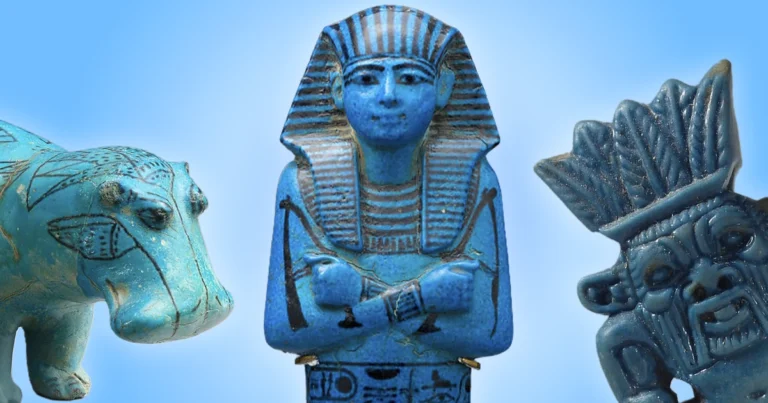

In 2009, conservators at the Liebieghaus Sculpture Collection in Frankfurt aimed a red LED lamp at a badly worn fragment of ancient Greek marble and watched. In the camera’s near-infrared range, tiny particles deep in the stone’s surface began to glow. The response was the diagnostic signature of Egyptian blue, the synthetic copper-calcium silicate pigment manufactured in the ancient Mediterranean from at least 3000 BCE. Its presence in the hairline grooves and hem recesses of a statue that appeared visibly white to the naked eye confirmed what decades of forensic research had been accumulating: Greek statue polychromy was not a decoration applied to some statues. It was the standard finish for virtually all of them. The white marble that generations of Western artists and museum visitors treated as the authentic classical ideal was always the stripped and weathered remnant of something much more visually complex. This post explains what forensic imaging has revealed about the original colors of Greek sculpture, how those colors were applied and why, and how far responsible modern reconstructions can legitimately go.
Why the Myth of White Marble Persisted for Three Centuries
The association of classical antiquity with white marble is not ancient. It is early modern. When Renaissance artists and architects began systematically studying ancient sculpture in Rome from the fifteenth century onward, the works they encountered had already been stripped of most of their paint by centuries of weathering and burial. The surfaces they saw were predominantly stone-colored. Their aesthetic judgments were formed on that basis, and those judgments shaped what European culture meant by “classical” for the next three hundred years.
Johann Joachim Winckelmann, whose 1764 work History of the Art of Antiquity established the dominant theory of Greek sculpture for the following century, argued that the pure whiteness of marble was an essential expression of ideal beauty. Oliver Primavesi of Ludwig Maximilian University, Munich, has documented in the Gods in Color catalogue how Winckelmann was simultaneously aware that ancient sources described painted statues and uneasy about what that meant for his aesthetic theory. He resolved the tension by deciding that the ancient sources referred to exceptional cases, not standard practice. That decision proved wrong, but its influence lasted into the twentieth century.
Photography accelerated the problem rather than solving it. Black-and-white plates, which dominated archaeological publication from the 1840s through the mid-twentieth century, could not record color and therefore did not record its absence. Plaster casts, the primary teaching medium for classical sculpture in most European and American universities through the early twentieth century, were uniformly white by convention. Entire generations of art historians, archaeologists, and artists were educated on a monochrome visual record of a polychrome material culture, and the habit of mind that produced was genuinely difficult to dislodge even after the evidence for color became incontrovertible.
Greek Statue Polychromy in the Forensic Evidence
The scientific case for Greek statue polychromy rests on several complementary analytical methods, each of which detects different aspects of the original paint system. Visible-induced luminescence (VIL) imaging works by illuminating a surface with red light and recording the near-infrared response; Egyptian blue fluoresces in this range even when its particles are too small or dispersed to be visible to the eye. A single VIL scan can map the entire distribution of Egyptian blue across a statue’s surface in a few minutes, revealing painted areas that a century of conventional examination missed entirely.
X-ray fluorescence (XRF) spectroscopy identifies the elemental composition of paint residues without removing any material from the object. Copper signals indicate Egyptian blue, azurite, or malachite. Iron signals indicate ochres and earths. Mercury signals indicate cinnabar. Lead signals indicate lead white or gilding grounds. Raman spectroscopy goes further by identifying the specific molecular structure of each compound, distinguishing, for example, between azurite and Egyptian blue, which both contain copper but have completely different chemical identities and therefore different appearances. Gas chromatography and mass spectrometry applied to micro-samples no larger than a grain of sand can identify the organic binders used to bind pigment to stone: beeswax, egg, resins, and gums each have distinct chemical signatures.
Cross-section analysis, in which a fragment of paint layer is mounted in resin and examined under a scanning electron microscope, reveals the stratigraphy of the paint system: the sequence of ground layers, paint coats, and surface glazes, and their relative thicknesses. This matters because it tells conservators not just what colors were used but in what order and with what technique, which is essential information for evaluating whether a proposed reconstruction is technically feasible. The convergence of these methods on consistent findings across dozens of analyzed statues has made the case for polychromy definitive. The debate is no longer about whether ancient Greek statues were painted but about what specifically was applied to any given object.

The Peplos Kore: Reading a Painted Surface Layer by Layer
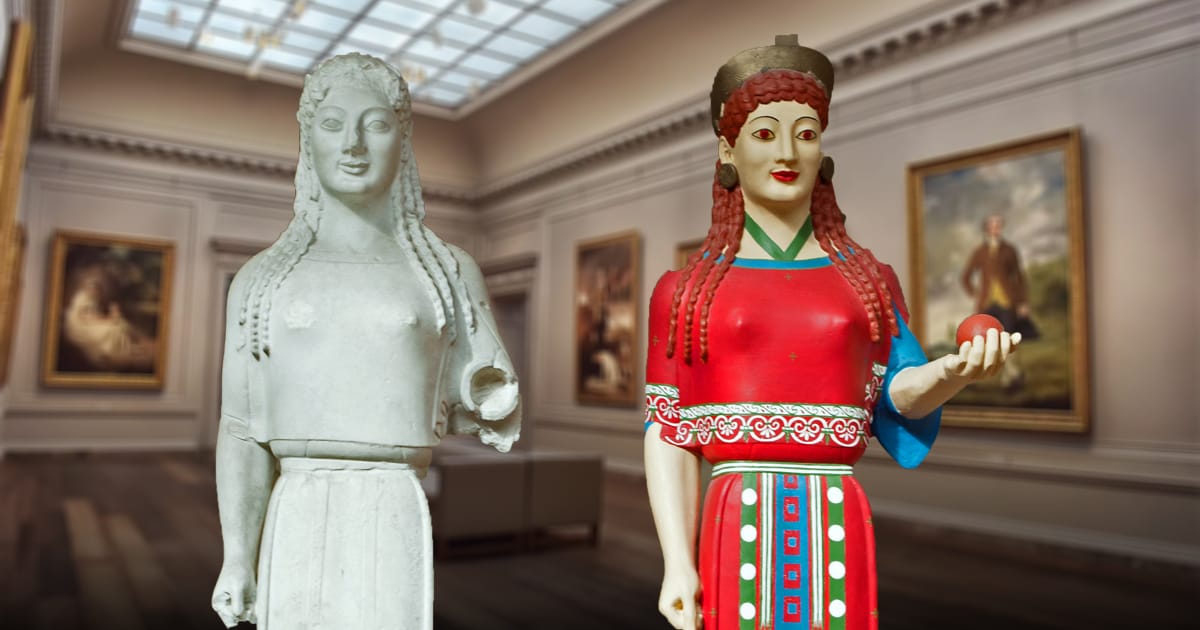
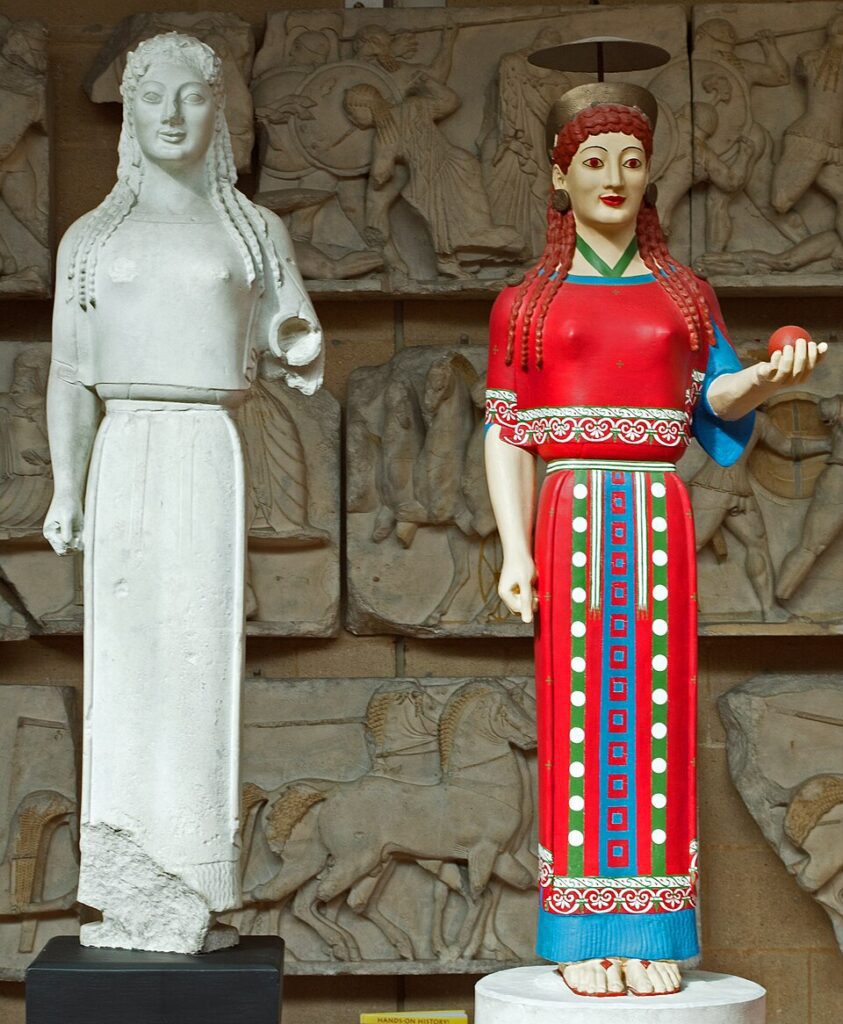
The Peplos Kore, housed in the Acropolis Museum in Athens and dated to approximately 530 BCE, is one of the most extensively analyzed polychrome statues in the Greek world. The figure’s apparent “peplos,” the heavy woolen garment implied by its straight lower silhouette, is now understood by many scholars to be a chiton, a lighter linen garment, worn under a more elaborately painted over-garment whose decorative program the paint made visible. The distinction matters because it changes the reading of the statue’s identity: if the figure wears a quiver attachment (indicated by a metal pin hole) and a more complex garment than a plain peplos, she may represent Artemis rather than a generic kore figure.
Raking light examination of the statue’s surface shows incised guidelines for painted borders: meander patterns, rosette sequences, and dot-and-dash bands that the painter followed when applying the decorative program to the garment hem and borders. These incisions are crucial evidence because they demonstrate premeditated design, not freehand decoration applied after the fact. The sculptor prepared the marble surface to receive specific painted patterns before the stone left the workshop. Ultraviolet fluorescence imaging separates the lake pigments used for the garment’s background color from the ochres used for border details, revealing the sequence in which different paint layers were applied.
The face and exposed skin of the Peplos Kore were painted with wax-rich encaustic, a hot-wax painting technique that ancient writers describe repeatedly as the standard medium for achieving lifelike skin tones in sculpture. Encaustic could be modeled while still warm to create subtle surface relief suggesting muscle and vascular structure beneath the skin, and it dried to a semi-translucent finish that caught light differently than the matte ochre used on garment fields. The visual hierarchy was deliberate: richly patterned textiles framing luminous, warm-toned skin, with gilded metal attachments at the ears, head, and possibly the wrists. Seen in a temple sanctuary under Mediterranean sunlight, the figure would have been immediately and continuously legible across a distance that makes the unpainted marble version almost disappear into its architectural setting.
Built out of a love for history, kept free from distractions.
Spoken Past is an independent project shaped by curiosity, care, and long hours of research. Reader support helps keep it maintained, carefully researched, and open to everyone.
The Aphaia Pediment and the Phrasikleia Kore: Color as Identity and Preservation
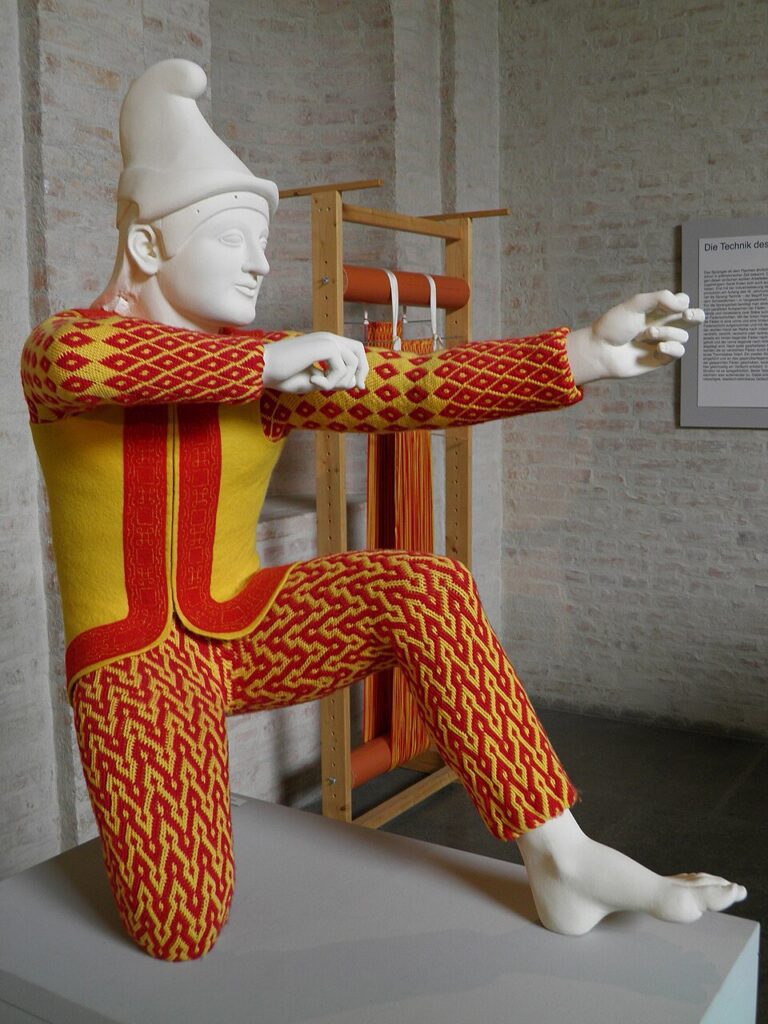
The Temple of Aphaia on Aegina, built around 500 BCE and excavated beginning in 1811 by the British architect Charles Robert Cockerell and a team that included the sculptor Bertel Thorvaldsen, produced pediment sculptures that preserve some of the richest pigment evidence from the Archaic period. The so-called Paris archer from the east pediment, now in the Glyptothek in Munich, wears a Scythian-style patterned cap and patterned leggings whose decorative programs are documented by both pigment traces and incised guidelines. VIL imaging has mapped Egyptian blue beads in the garment borders, and Raman analysis has identified malachite-based greens in what were originally copper-containing areas now partially converted by corrosion. The color on this figure does specific narrative work: it identifies the warrior as an eastern foreigner, distinguishable from the Greek defenders on the same pediment by his costume’s visible pattern vocabulary.
The Phrasikleia Kore, now in the National Archaeological Museum in Athens, represents a different order of preservation. Dedicated as a funerary marker for a young woman named Phrasikleia around 550 BCE and buried quickly after the sanctuary where it stood was deliberately covered, the statue spent roughly two millennia protected from the weathering that destroyed pigment on exposed surfaces. When excavated at Merenda in Attica in 1972, it retained paint layers of unusual completeness. XRF analysis has identified lead white beneath gilded areas at the jewelry and hair ornaments, confirming a ground-layer preparation system that ancient technical sources describe but that is rarely preserved well enough to verify analytically. Binder analysis supports both egg tempera and wax components in different areas of the paint system, consistent with the multi-medium approach that ancient writers attribute to the best Greek painters.
Vinzenz Brinkmann of the Liebieghaus Skulpturensammlung in Frankfurt, whose research program has driven the field since the early 1980s, has argued that the Phrasikleia Kore allows scholars to read a complete Archaic paint system almost as a technical manual. The sequence of grounds, pigment layers, and surface treatments preserved on this single object provides a template against which the more fragmentary evidence from other statues can be interpreted with greater confidence.

The Alexander Sarcophagus: Greek Technique on a Phoenician Monument
The Alexander Sarcophagus, carved around 310 BCE and discovered at Sidon in 1887 during excavations led by Osman Hamdi Bey for the Imperial Ottoman Museum in Istanbul (where it is still housed), demonstrates that the Greek polychrome system was not confined to Greek workshops or Greek patrons. The sarcophagus was made for a Sidonian ruler, almost certainly Abdalonymos, by sculptors working in a fully Greek technical tradition applied to a monument commissioned by a Phoenician king to express his political alliance with the Macedonian successor states after Alexander’s death.
Pigment analysis of the sarcophagus’s surviving paint traces shows the full range of the Greek toolkit: Egyptian blue in sky areas and weapon inlays, iron ochres for flesh tones on the Greek and Macedonian figures, malachite or copper-based green for vegetation, lead white for highlights, and selective gilding for weapon fittings and royal attributes. The color distribution does specific narrative work that the sculptural relief alone cannot accomplish. On the hunting frieze, the Greek hunters and the Macedonian royal party are distinguished from each other partly by slight differences in their garment colors. On the battle frieze, the Macedonian and Persian combatants are differentiated by their costume colors, allowing a viewer standing at a distance to parse the narrative without being able to read the sculptural detail of individual faces and equipment.
This narrative function of color is perhaps the most important practical argument against the assumption that painted sculpture was a cheaper alternative to pure stone. Color was not decoration in the modern decorative sense. It was a communication system that made complex visual programs legible across the distances at which architectural sculpture was typically viewed. A temple pediment figure twenty meters above ground level in strong Mediterranean light relies on color contrast rather than sculptural detail to convey identity and action. The detail was always there for close viewing, but the color was essential for the work the sculpture was doing from a distance.

Eyes, Skin, and the Technology of Lifelikeness
Ancient viewers did not look at blank white eyes. The cut pupil and tear duct channels visible on many Greek marble heads were designed to hold paint: a dark iris ring, a darker limbus edge, a small highlight spot to suggest reflectivity. The resulting eye was not technically realistic in the photographic sense, but it was socially legible. It returned the viewer’s gaze in a way that an unpainted marble eye, with its flat white surface, cannot do. Ancient descriptions of celebrated statues consistently use language that implies the figure appeared alive, capable of movement, on the verge of speech. That language makes no sense applied to unpainted stone. It makes complete sense applied to a figure with warm-toned skin, patterned garments, bright accessories, and eyes that appear to look back.
Bronze statues handled the lifelikeness problem differently. The Riace bronzes, recovered from the sea off Calabria in 1972 and now in the Museo Nazionale della Magna Grecia in Reggio Calabria, retain their inlaid copper lips and nipples, which gave warmth and color contrast against the darker bronze body. Their silver teeth, visible at the slightly parted mouth, are documented in ancient descriptions of the technique. Their eyes, now missing but leaving evidence in the sockets, were almost certainly inlaid with glass or stone irises and bone or ivory whites, with painted iris rings. The combination would have produced figures that, in strong light, might easily have been mistaken for living beings by viewers approaching from a distance.
The wax-rich encaustic finish applied to marble skin served a similar purpose. Pliny the Elder describes the technique in his Natural History in terms that suggest it was considered the superior medium for achieving color effects that mimicked living tissue: the translucency of wax allowed for glazed color effects that flat paint could not produce, and the slight sheen of a polished wax surface responded to moving light in ways that stone does not. Ancient workshop floors and tool deposits have produced evidence for the braziers and heated tools that encaustic application required, confirming that the technique was not a rare luxury but a standard part of the workshop process for high-quality marble sculpture.
How Reconstructions Are Made and Where They Must Stop
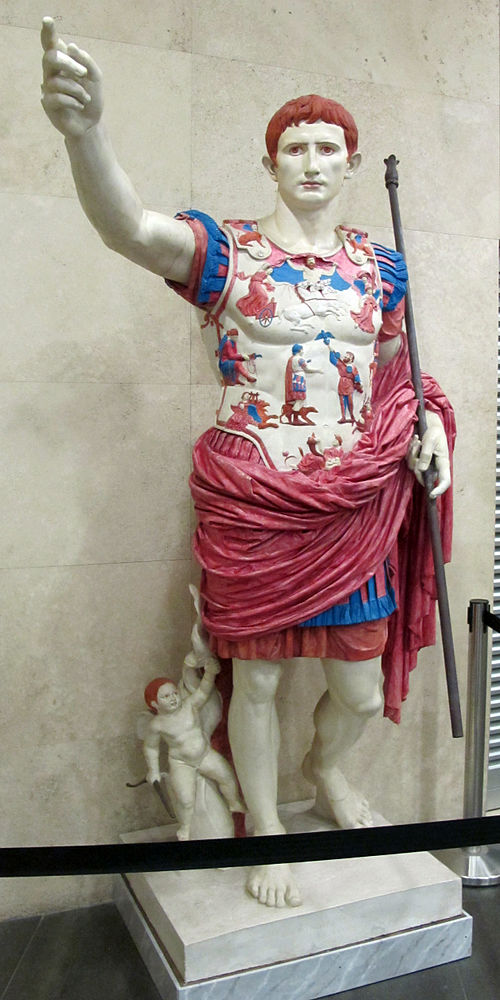
A responsible reconstruction of ancient polychromy begins exclusively from evidence: pigment traces mapped by VIL, XRF, and Raman; incised surface guidelines for pattern placement; nail holes and corrosion shadows from metal attachments; binder residues from GC-MS analysis. Everything that forensic examination can detect is documented before any interpretive decision is made. The reconstruction then proposes colors and patterns that are consistent with the evidence, comparable parallels from other analyzed objects of the same period and region, and the technical constraints of ancient painting practice. Every element of the reconstruction is labeled as either attested by direct evidence or inferred by analogy, and the two categories are never mixed without explicit flagging.
The difficulty is that what survives is rarely enough to reconstruct a complete color scheme with certainty. Forensic methods detect what remains; two thousand years of weathering, burial, and cleaning have removed most of what was applied. A patch of Egyptian blue in a garment hem does not tell you what color filled the garment field above it. A red ochre residue on a lip does not tell you whether the same ochre covered the entire face or was used only as a glaze over an encaustic base. Responsible reconstructions present their uncertainties explicitly, produce reversible work on cast copies rather than original objects, and publish the full technical dataset alongside the visual results so that other scholars can evaluate and challenge the interpretive choices made.
The brightness question is genuine. Exhibition reconstructions produced for public impact often push pigment saturation beyond what the evidence supports, because vibrant color reads better under artificial museum lighting than the more nuanced result that the original balance of matte fields, glazed areas, and metallic accents would have produced. Brinkmann and his collaborators have been careful to acknowledge this limitation in their published work, noting that their reconstructions represent one possible interpretation of the evidence rather than a verified historical reproduction. That distinction matters enormously for how the results should be communicated to general audiences.
Sources: Vinzenz Brinkmann, Renée Dreyfus, and Ulrike Koch-Brinkmann, eds., Gods in Color: Polychromy in the Ancient World (Prestel, 2017); research by Brinkmann’s team is documented at liebieghaus.de/en/polychromy-research; Heinrich Piening, “The Painted Surfaces of the Aphaia Pediment Sculptures,” in American Journal of Archaeology 119.3 (2015); Roberta Panzanelli, Eike Schmidt, and Kenneth Lapatin, eds., The Color of Life: Polychromy in Sculpture from Antiquity to the Present (Getty Research Institute, 2008); Daphne Bika, “A Colorful Past: Archaic Greek Sculptures,” TheCollector.com (2021); Pliny the Elder, Natural History, Book 35, trans. H. Rackham (Harvard University Press, Loeb Classical Library, 1952); Mary Beard, Pompeii: The Life of a Roman Town (Harvard University Press, 2008).