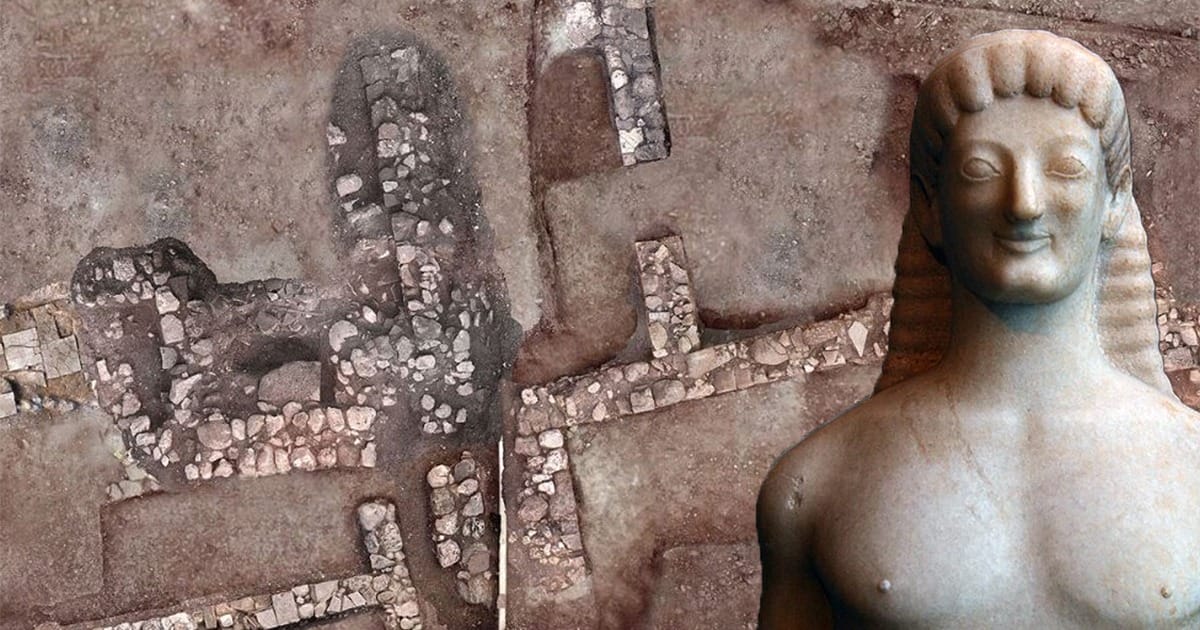
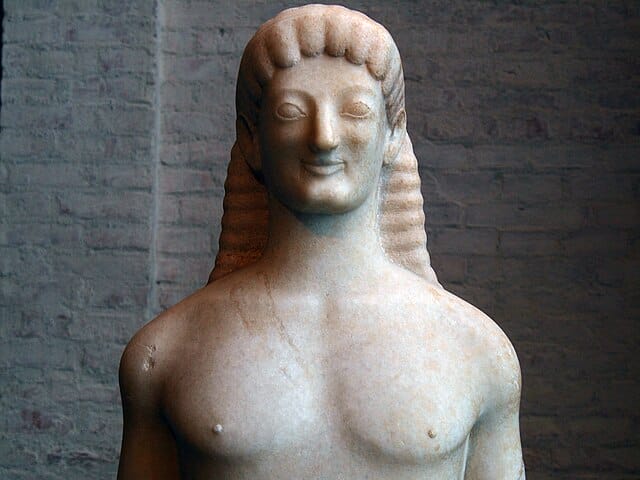
In 1846, farmers working the fields around the village of Chiliomodi in the Corinthia region of Greece pulled a marble statue from the earth. The figure, around 1.53 metres tall, showed a naked young man standing with his left foot slightly forward, his arms at his sides, and the corners of his mouth curved into the faint expression that art historians call the archaic smile. That statue, now known as the Kouros of Tenea and held at the Glyptothek museum in Munich since 1853, was the first physical proof that something significant had once existed here. Ancient writers had mentioned ancient Tenea for centuries: Pausanias placed it about sixty stades south of Corinth, Strabo noted its temple of Apollo Teneates, and both recorded the tradition that its founders were Trojan prisoners of war. But a marble kouros and a cluster of ancient references do not constitute a city. It took another 167 years and a systematic excavation led by Dr Elena Korka of the Greek Ministry of Culture to answer the question definitively.
A City Built by Trojans, Remembered by Greeks
The literary tradition behind ancient Tenea is more detailed than it might first appear. Pausanias, writing his Description of Greece in the second century AD, reported that the Teneates themselves claimed descent from Trojan prisoners whom Agamemnon had permitted to settle in Corinthian territory after the fall of Troy. Strabo, working in the first century BC, linked the city’s name to Tenedos, the small island off the coast of the Troad that served as a Greek forward base during the Trojan War, and traced both Tenea and Tenedos back to the hero Tennes, son of the Trojan ally Cycnus. These traditions were not isolated: Aristotle himself was cited in antiquity as having discussed the kinship between the peoples of Tenedos and Tenea, noting the striking similarity of their worship of Apollo as evidence of a shared cultural memory.
What this tradition describes is a community of refugees who rebuilt their identity in foreign soil. They chose a god appropriate to their situation: Apollo, healer, archer, and in his Teneatan aspect, patron of a people whose founding story was one of survival after catastrophic defeat. The cult of Apollo Teneates appears in both Pausanias and Strabo as the defining religious institution of the city. That the excavations since 2013 have revealed abundant evidence of religious activity, including votive figurines, altar ash, and a public building likely associated with a cult site, gives the ancient literary accounts a physical grounding they previously lacked.
The question of how literally to read these origin stories is a legitimate one in modern scholarship. Bronze Age population movements following the collapse of palatial civilisation around 1200 BC are archaeologically documented, and the movement of groups from Anatolia into the Aegean and mainland Greece during this period is consistent with what the Trojan War tradition describes in mythological terms. No inscription from Tenea itself yet confirms the Trojan connection, but the pattern of the tradition, preserved independently in Pausanias, Strabo, and the reference to Aristotle, gives it more credibility than a purely invented foundation myth would typically carry.
Ancient Tenea and Its Unusual Friendship with Rome
Tenea sits at an intersection of several ancient trade routes, roughly 15 kilometres southeast of Corinth and 20 kilometres northeast of Mycenae, on the road connecting Corinth with Argos and the southern Peloponnese. That geographical position made it an outward-looking city from very early in its history. Ancient tradition credits Tenea with supplying a significant portion of the colonists who accompanied the Corinthian Archias to found Syracuse in Sicily around 734 BC, a colonial venture that became one of the most powerful Greek cities in the western Mediterranean. Whether every detail of that tradition survives intact, the underlying theme is credible: a city on a main route between Corinth and Argos would have had strong commercial and social ties with the wider Greek world.
The most striking episode in Tenea’s political history is its survival of the Roman destruction of Corinth in 146 BC. The general Lucius Mummius Achaicus razed Corinth so thoroughly that the site lay essentially uninhabited for a century. Tenea was not touched. Ancient writers offered two explanations that may not be mutually exclusive. One was that Tenea had actively assisted the Romans against the Achaean League; the other was that the Romans, who traced their own origins through Aeneas to the Trojan royal house, extended sympathy to a city with demonstrably Trojan roots. The latter explanation has a certain cultural logic: Roman identity was deeply invested in the Trojan War narrative, and Virgil’s Aeneid made that investment explicit in literary form. Whether the motive was sentiment, politics, or Tenea’s simple unimportance as a military target, the consequence was significant.
Survival of the 146 BC destruction altered Tenea’s entire subsequent trajectory. With Corinth gone, the city was no longer a satellite of a dominant neighbour but an independent centre in a depopulated landscape. It minted its own coins, the earliest of which date from the second century BC and represent the city’s claim to full political autonomy. Archaeological finds from the Roman period at Chiliomodi, including fine tableware, glass vessels, and building materials consistent with the reign of Septimius Severus in the early third century AD, show a city that continued to thrive and modernise under imperial rule rather than declining after Corinth’s eventual refoundation by Julius Caesar in 44 BC.
What the Excavations Have Found
Dr Elena Korka’s connection with Tenea began in 1984 when she uncovered a sarcophagus near Chiliomodi during routine rescue work. The discovery stayed with her. When she launched a systematic programme in 2013, under the auspices of the Greek Ministry of Culture and Sports’ Directorate for Prehistoric and Classical Antiquities, she returned with an interdisciplinary team combining archaeologists, numismatists, physical anthropologists, and geophysical surveyors. The approach combined large-scale excavation trenches with surface survey and ground-penetrating radar, allowing the team to map subsurface features before committing to expensive and irreversible digging.
The initial seasons focused on the cemeteries surrounding the city’s edge, following the common ancient Greek practice of burying the dead outside the walls. By 2017 the team had uncovered a double-chambered burial compound containing an extraordinary range of grave goods. Three Hellenistic tombs held the skeletal remains of two adult men, five adult women, and two children. The graves contained decorated vases, gold and bronze jewellery, bone ornaments, and roughly 200 coins spanning the fourth century BC to the late Roman period. Among the seal rings was one bearing a representation of the Graeco-Egyptian god Sarapis enthroned with the hound Kerberos beside him, a religious hybrid that signals Tenea’s engagement with the wider Mediterranean world of the Hellenistic era.
In 2018 the team found the city itself. Excavating north of the cemetery complex, they uncovered an organised residential area stretching more than 670 metres, with well-preserved floors of marble, stone, and clay, room divisions with surviving door thresholds, and walls covered in mortar. A clay pipeline section 3.5 metres long, believed to be part of a sewage system, demonstrated the level of urban planning. Storage jars large enough to hold hundreds of litres of oil or grain were found in several rooms. The Greek Ministry of Culture described the construction quality as “luxurious” in its official announcement, a description supported by the dressed stone and interior plasterwork the team documented.
Built out of a love for history, kept free from distractions.
Spoken Past is an independent project shaped by curiosity, care, and long hours of research. Reader support helps keep it maintained, carefully researched, and open to everyone.
Baths, Coins, and the Evidence of a Functioning City
The 2019 season added a public bathing complex to the catalogue of finds, covering approximately 500 square metres and equipped with clay pipes, stone basins, and the hypocaust infrastructure needed for heated rooms. Roman-period bathhouses were not merely washing facilities. They served as commercial spaces where deals were struck, as political venues where civic gossip circulated, and as one of the few public institutions where people of different social ranks shared the same physical space. A bathing complex of this scale in a city the size of Tenea implies a town actively participating in the Mediterranean-wide culture of public amenity that characterised the Roman imperial period.
The numismatic record is particularly informative. The excavation has produced over 200 coins spanning a range from the fourth century BC through the late Roman period. Tenea’s own civic coinage, which began in the second century BC, carries portraits of Apollo on the obverse, consistent with the city’s cultic identity. Later issues from the Roman imperial period bear the likenesses of Septimius Severus, Julia Domna, and Caracalla, tying the city’s self-representation to the Severan dynasty that governed the empire in the early third century AD. Elena Korka and Constantine Lagos, who published a study of Tenea’s coinage in 2018, argue that the resumption of local minting after a period of interruption signals renewed civic confidence during the Severan period, a phase of significant building activity across the eastern empire.
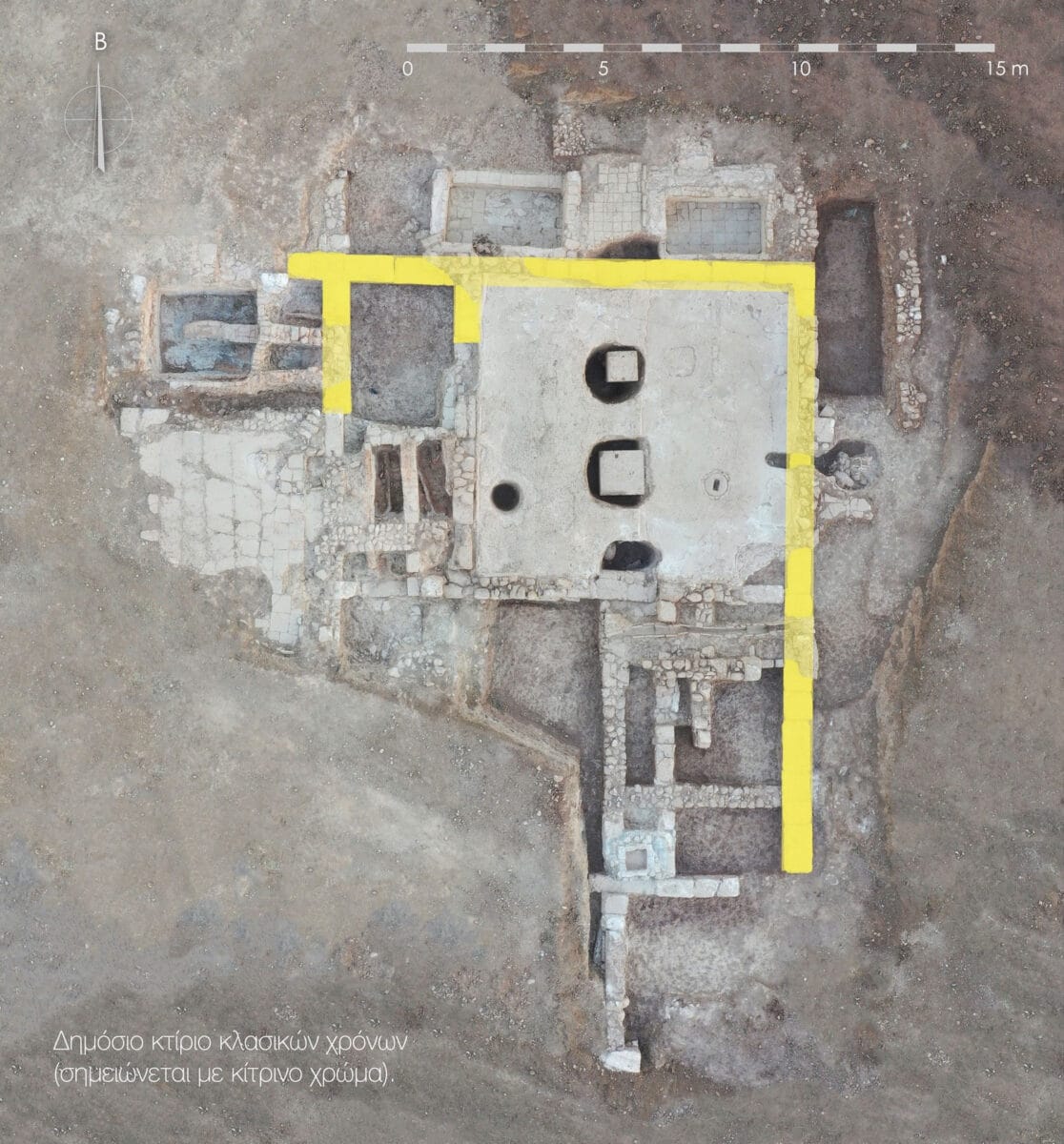
The 2022 season, the last major published campaign, identified the settlement of the classical city itself for the first time. Excavators uncovered a public building of 145 square metres whose floor was scattered with votive figurines, strongly suggesting an adjacent cult site. A massive retaining wall from the Early Classical period, running along the city’s boundary, showed that Tenea had undertaken significant civic construction as early as the fifth century BC. A large Roman-period cistern with internal dimensions of 15.2 by 8.4 metres, its floor constructed with vertical tiles on a thick mortar bed and its walls internally plastered, likely supplied water to the Roman city’s baths and fountains.
Tombs, Status, and the Memory of the Dead
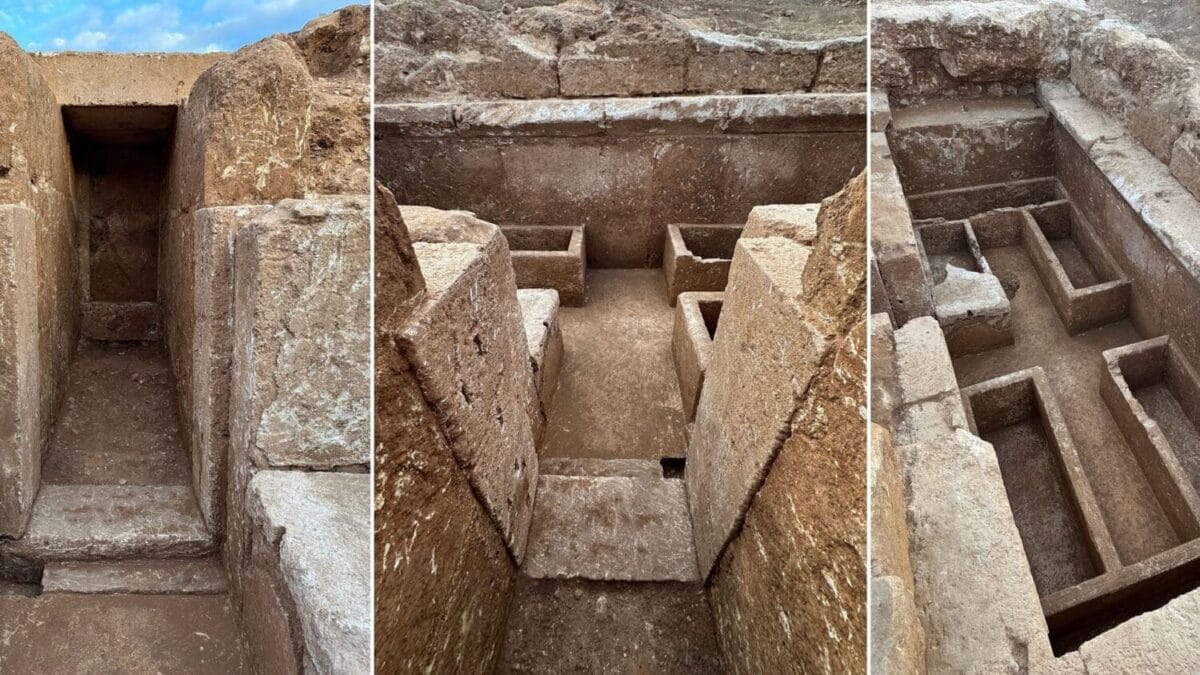
Among all the finds from the Tenea excavations, the funerary complex discovered on the city’s edge is the most architecturally ambitious. Its branching plan and multiple burial chambers recall the monumental tombs of northern Greece, and its contents span from the Hellenistic into the Roman period, indicating that the same family or community used and maintained the structure across multiple generations. Sarcophagi and stone coffers held skeletal remains alongside offerings of bronze vessels, glass ware, and animal bones placed with clear ritual intent. One ring bears an engraved representation of Apollo with a serpent, an image connecting the god’s role as healer with his oracular function, and reflecting the central position of Apollo Teneates in the city’s religious life.
Multi-generational use of a single funerary monument is significant for what it reveals about institutional continuity. A family or civic group that invests in a permanent tomb and maintains it over a century or more is one with stable resources, legal security over its property, and enough confidence in the future to build for it. Tenea’s tomb complex says, in stone, that some of its inhabitants expected their descendants to continue honouring them. The shift in burial style from Hellenistic chamber tombs to Roman-period stone coffers within the same complex shows a community that adapted to changing fashions without abandoning its commitment to the place.
What Ancient Tenea Tells Us About Middling Cities
Tenea was not Athens or Corinth. It never minted coins that circulated across the Mediterranean, never produced a philosopher whose name every schoolchild later learned, and never commanded an empire. What it did do was survive, and in surviving, it preserved a record of how ordinary urban life worked across seven centuries in the ancient Greek and Roman world. Its streets drained efficiently. Its water system supplied public baths. Its cemetery recorded the status ambitions of families who could afford marble sarcophagi and decorated jewellery. Its coins told the story of political independence, Corinthian subordination, and eventual Roman integration in a compressed numismatic narrative.
Medium-sized cities like Tenea are underrepresented in ancient sources precisely because their very ordinariness made them unremarkable to ancient writers who preferred dramatic events and famous individuals. Archaeology compensates for that literary bias by recovering exactly what written records skip: the threshold worn smooth by decades of foot traffic, the broken amphorae stacked in a storage corner, the cooking vessel with traces of carbonised residue still adhering to the rim. These objects are the granular texture of ancient life, and they are far more abundant at a city like Tenea than at a heavily excavated site like Athens or Pompeii, where centuries of earlier digging removed many of the stratigraphically complex deposits that allow careful dating.
The city appears to have been abandoned gradually rather than violently. No evidence of destruction by fire, earthquake, or military assault has emerged from the excavations. The sixth century AD, when Justinian’s plague was beginning its first cycle through the Mediterranean and when the Slavic migrations were beginning to reshape the Balkans, is the current best estimate for when occupation ceased. A city that ended not with a catastrophe but with a slow draining away of population and resources is historically common and archaeologically subtle. Its buildings did not burn; they simply fell, and the fields reclaimed them. That process of quiet ending has left the archaeology unusually well preserved, waiting under a thin layer of Corinthian soil for a survey team with patience and the right instruments.
Primary sources consulted: Pausanias, Description of Greece 2.1.3, Perseus Digital Library, Tufts University; Strabo, Geography 8.6.22. Secondary scholarship and reports: Elena Korka and P. Evaggeloglou, “A Cemetery Excavation Unearths Tenea’s Past,” in Archaeological Reports (2019), available via Academia.edu; Elena Korka and Constantine Lagos, “New Evidence for the Coinage of Tenea” (2018), summarised in the Tenea Project publications; New Finds from Ancient Tenea, Chiliomodi, Corinthia, Archaeology Wiki (2023), compiling the official Ministry of Culture reports from the 2022 season; Archaeology Magazine update on the city of Tenea (2018), Archaeological Institute of America. For the Kouros of Tenea: Glyptothek Munich, inventory no. 168, accession 1853.