
In August 30 BCE, Roman soldiers broke into the place where Cleopatra VII had shut herself away in Alexandria and found the queen dead, dressed in royal clothing, with her attendants Iras and Charmion dying or already dead beside her. The ancient accounts do not agree on the method. Some mention an asp, some mention poison, and some admit that the evidence was uncertain from the start. So, how did Cleopatra die? The clearest answer is that Cleopatra almost certainly died by suicide after Octavian captured Alexandria, but the famous snake bite story is much less secure than popular tradition suggests.
Cleopatra’s death mattered immediately because Octavian wanted to display her in a Roman triumph. She had ruled Egypt since 51 BCE, allied herself first with Julius Caesar and then with Mark Antony, and become the last major obstacle between Octavian and control of the Roman world. Her death ended Ptolemaic Egypt, removed Caesarion as a rival heir to Julius Caesar, and helped Octavian transform military victory into imperial authority. The asp made the story memorable, but the evidence points to something more complicated than a snake smuggled in a basket of figs.
What Happened in Alexandria Before Cleopatra Died?
Cleopatra died in Alexandria after the collapse of Mark Antony’s war against Octavian. The decisive defeat came at the Battle of Actium on September 2, 31 BCE, off the western coast of Greece. Antony and Cleopatra escaped to Egypt, but they could not rebuild the military position they had lost. In 30 BCE, Octavian invaded Egypt and advanced on Alexandria, the Ptolemaic capital and Cleopatra’s political base.
By the time Octavian reached Alexandria, Cleopatra’s options had narrowed. Antony killed himself after receiving false or confused news that Cleopatra was dead. According to Plutarch’s Life of Antony, Antony was carried to Cleopatra and died after seeing her one last time. Cleopatra then came under Roman control, although the exact setting of her final confinement is not fully clear. Ancient texts place the drama around her mausoleum, her monument, or confinement under guard, but they do not give a modern forensic description of the scene.
Octavian had a strong reason to keep Cleopatra alive. A defeated foreign queen could be paraded in Rome as proof of his victory. Cleopatra had an equally strong reason to avoid that fate. Roman triumphs were staged spectacles of domination, and the public display of Cleopatra would have reduced the former ruler of Egypt to a living trophy. Ancient tradition preserved her refusal to be led in triumph as a central motive for suicide.
The date of Cleopatra’s death is usually given as August 10 or August 12, 30 BCE. The uncertainty comes from the ancient chronology rather than from modern disagreement over the general sequence. She died after Antony and before Octavian’s formal settlement of Egypt as Roman territory. Her son Caesarion, also called Ptolemy XV, was killed soon afterward. Cleopatra’s children with Antony, Alexander Helios, Cleopatra Selene, and Ptolemy Philadelphus, were taken into Roman hands.
What the Ancient Sources Actually Say
The ancient evidence for Cleopatra’s death is not a single clean story. It is a cluster of Roman and Greek accounts written under Roman power, often decades after the event, and shaped by politics, literary style, and uncertainty.
Strabo Gives Two Different Possibilities
The Greek geographer Strabo is one of the earliest surviving writers to mention Cleopatra’s death. He says she killed herself secretly after falling into Octavian’s power, either by the bite of an asp or by applying a poisonous ointment. This is important because the snake was not the only explanation in circulation near the time. Poison was already part of the tradition.
Strabo does not give a detailed deathbed scene. He does not describe the basket of figs, the arm marks, or a careful investigation. His value is different. He shows that the cause of death was contested early, not only by modern historians looking back at the legend.
Horace Turns Cleopatra Into Augustan Poetry
The Roman poet Horace, writing in Ode 1.37, presents Cleopatra’s death as a dramatic refusal to be led in triumph. His poem is not a medical report. It is Augustan political poetry, written in the atmosphere of Octavian’s victory. Horace’s Cleopatra handles serpents and chooses death with a fierce resolve, but the poem’s main purpose is literary and ideological. It turns Rome’s enemy into a defeated yet formidable queen.
That distinction matters. Horace helps explain why the snake became such a powerful image, but he does not prove that a snake killed Cleopatra. Poetry can preserve a political mood without preserving a reliable forensic detail.
Plutarch Preserves the Famous Fig Basket Story
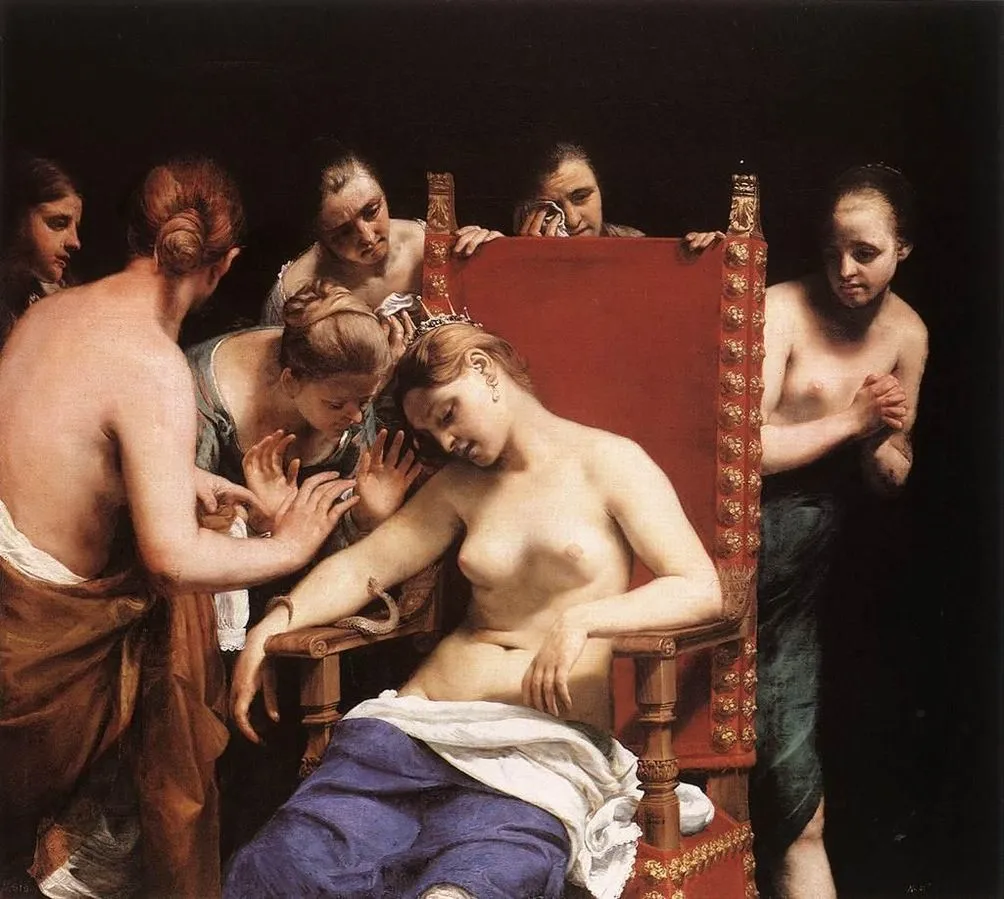
Plutarch, writing around a century after Cleopatra’s death, gives the fullest ancient narrative. In his account, Cleopatra bathes, dresses, eats a meal, and receives a basket of figs. The snake is said to have been hidden inside. When Octavian’s men arrive, they find Cleopatra dead, Iras at her feet, and Charmion adjusting Cleopatra’s diadem before collapsing.
Yet Plutarch is more cautious than the later legend. He says no snake was found in the room. He mentions reports of tracks near the sea-facing windows. He also notes two faint puncture marks on Cleopatra’s arm, but he presents the details as disputed. Plutarch even reports another possibility, that Cleopatra used a hollow implement, often interpreted as a comb or hairpin, to introduce poison.
This makes Plutarch useful but not definitive. He preserves the material that made the asp story famous, but he also preserves doubt. The ancient source most associated with the snake bite does not actually prove the snake bite.
Cassius Dio Adds the Poisoned Hairpin Tradition
Cassius Dio, writing in the early third century CE, also gives multiple versions. In one, Cleopatra uses a snake. In another, she uses a poisoned pin from her hair, scratching her arm so the poison can enter the blood. Dio says Octavian viewed her body and used the Psylli, a people associated in ancient literature with snake handling and venom treatment, in an attempt to revive her.
Dio’s account is late, so it cannot be treated as eyewitness evidence. Still, it confirms that the hairpin or needle tradition was not a modern invention. It was already part of the ancient explanatory field. When asking how did Cleopatra die?, the honest answer must include these rival ancient traditions rather than flatten them into one dramatic image.
Why Historians Doubt the Snake Bite
The snake bite theory is not impossible because snakes cannot kill. Egyptian cobras and vipers can be deadly. The problem is the full scenario. The traditional story requires a hidden snake, a controlled delivery method, rapid deaths, little visible trauma, and three victims dying in close sequence. Each part creates difficulty.
The Snake Would Have Been Hard to Hide
The snake in later tradition is often imagined as an asp, a word that can refer loosely to a venomous snake. In Cleopatra’s Egyptian setting, many readers identify it with the Egyptian cobra, partly because of the cobra’s royal symbolism. Yet an Egyptian cobra is not a small accessory. Experts at the University of Manchester, including Egyptologist Joyce Tyldesley and herpetology curator Andrew Gray, argued that a cobra large enough to kill multiple adults would have been too big to hide in a small basket of figs.
The basket matters because it is part of the mechanism. A snake bite death in a sealed royal chamber might be one claim. A snake secretly delivered past guards inside fruit is another. The more specific the story becomes, the more vulnerable it is to practical objections.
One Snake Killing Three People Is Unlikely
Cleopatra did not die alone in the standard account. Iras and Charmion died with her. That creates a biological problem. Venomous snakes do not function like mechanical syringes. They may bite without injecting venom, and the amount of venom delivered can vary. The Manchester researchers noted that it would be highly unlikely for one cobra to kill two or three people one after another in a controlled sequence.
The ancient writers knew the attendants died too, but they were not writing with modern toxicology. A Roman reader might accept the image because it was morally and symbolically satisfying. A modern historian has to ask whether the mechanism fits the reported result.
Snake Venom Does Not Match the Peaceful Death Scene Well
Medical analysis also complicates the picture. Cobra venom can contain neurotoxic and cytotoxic effects. Viper venom can cause severe swelling, bleeding, and tissue damage. A review of toxicology and snakes in the Ptolemaic dynasty published in Toxicology Reports discusses the ancient traditions alongside the biological problems of different venomous species.
The ancient descriptions emphasize Cleopatra’s royal composure rather than a scene of prolonged physical distress. That does not disprove snake bite by itself, because ancient authors shaped scenes for literary effect and may have omitted ugly symptoms. But it weakens the idea that the traditional image is a straightforward record of what happened.
The strongest argument against the snake is cumulative. The source tradition is divided. No snake was found, according to Plutarch. The delivery method is awkward. Three deaths are difficult to explain. The symptoms are not clearly described in a way that confirms envenomation. That is why many historians treat the asp as myth, later tradition, or symbolic interpretation rather than established fact.
Built out of a love for history, kept free from distractions.
Spoken Past is an independent project shaped by curiosity, care, and long hours of research. Reader support helps keep it maintained, carefully researched, and open to everyone.
The Poison Theory and the Hairpin
If the snake story is doubtful, poison is the strongest alternative. It appears in ancient sources and explains several details more efficiently. Poison could be concealed, administered in a controlled dose, and shared with attendants. It could also leave limited external evidence, depending on the substance and delivery method.
The hairpin version is especially important because it fits the two faint marks reported in the tradition without requiring a snake. Plutarch mentions a hollow implement called a knestis. Dio gives a more explicit version in which a hairpin is coated with poison and used after scratching the skin. These accounts do not prove that Cleopatra used a hairpin, but they show that ancient writers themselves considered a small poisoned object plausible.
Medical historians François Pieter Retief and Louise Cilliers argued in The Death of Cleopatra that poison is more likely than snake bite, especially because Cleopatra and her two attendants died in close succession. Their argument does not identify a single proven toxin. That restraint is necessary. No body, toxicological sample, or archaeological evidence survives to test.
Ancient authors also associated Cleopatra with poison knowledge. Plutarch reports that she tested poisons to find a death that would be least painful. This detail should be handled carefully. It may reflect genuine court knowledge, hostile Roman storytelling, or both. Hellenistic courts had access to pharmacological learning, and rulers such as Mithridates VI of Pontus were famously connected with poison lore. But the specific claim about Cleopatra’s experiments comes through literary sources shaped by Roman attitudes toward her.
Possible substances include plant based toxins, mineral poisons, or compounded mixtures, but naming a precise poison would go beyond the evidence. Hemlock, aconite, opium mixtures, and other substances are sometimes discussed in modern reconstructions, yet no ancient source gives a chemical recipe. The responsible claim is narrower. Cleopatra most likely died by a deliberately administered poison, either swallowed, applied to the skin, or introduced through a small sharp object.
Why the Asp Myth Became the Famous Version
The asp story survived because it did more than explain a death. It gave Cleopatra’s death a symbol. The cobra already carried royal and religious meaning in Egyptian culture. The uraeus, the rearing cobra worn on the pharaoh’s brow, signified divine protection and legitimate rule. A queen dying by cobra could be imagined as dying through a royal Egyptian emblem rather than through an ordinary poison.
This does not mean Cleopatra chose the symbol herself. It means the story made sense to later audiences. A poisoned comb might be more practical, but it is less visually powerful. A serpent tied Cleopatra to Egypt, danger, sexuality, divinity, and foreignness in one image. Roman writers and later artists had every reason to prefer the snake.
Octavian also had political reasons to control the story. He needed Cleopatra to appear defeated, dangerous, and foreign. Roman propaganda during the war had presented her as a corrupt eastern queen who had unmanned Antony and threatened Rome. A snake death fit that frame. It made her end theatrical and exotic, while also allowing Octavian to claim that he had wanted her alive.
The image entered Roman public memory quickly. Plutarch says Octavian displayed an image of Cleopatra with an asp in his triumph. That does not prove the event occurred that way. It proves that the regime understood the value of the image. Once displayed in triumph, repeated in poetry, and absorbed by later literature, the asp became easier to remember than the uncertainty in the sources.
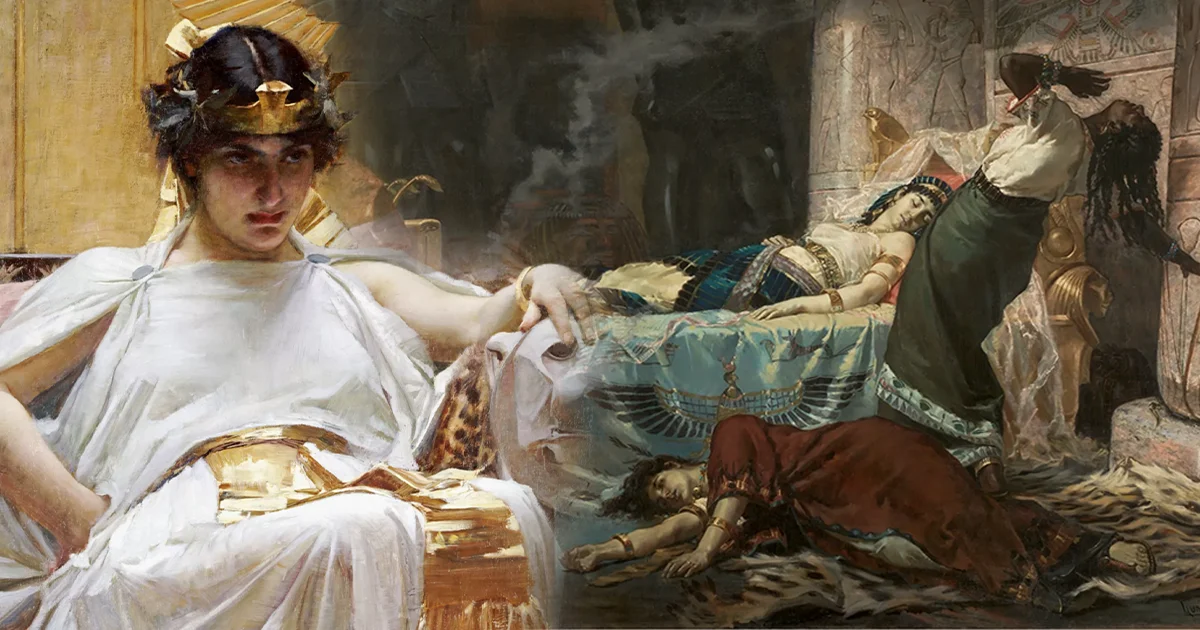
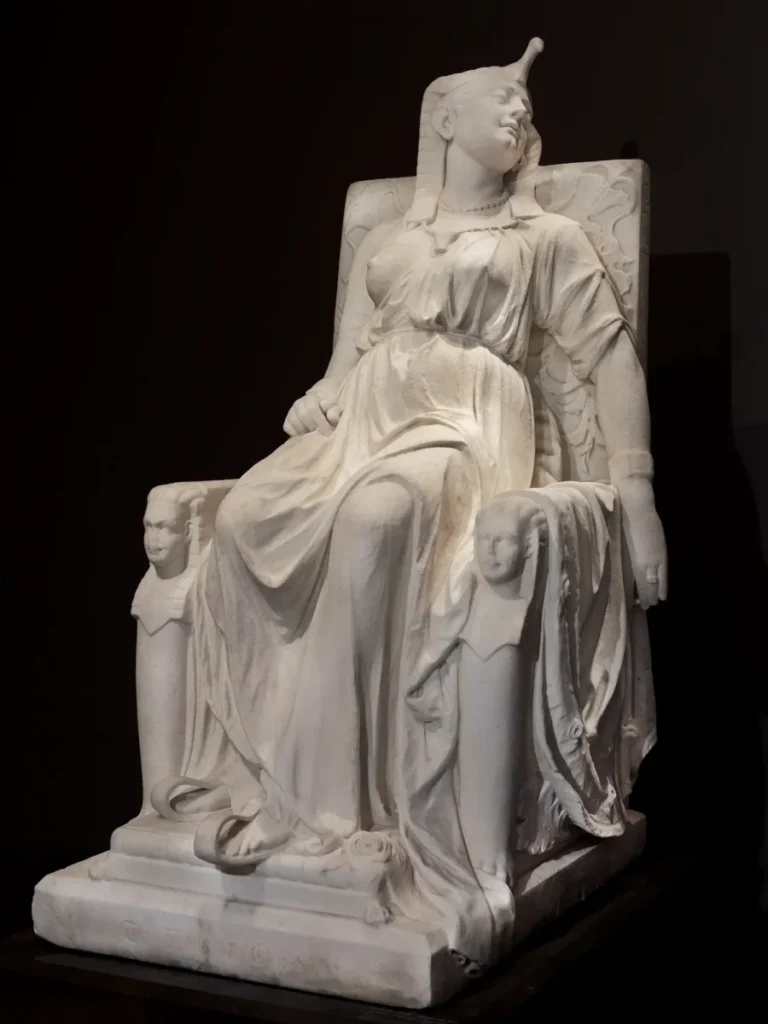
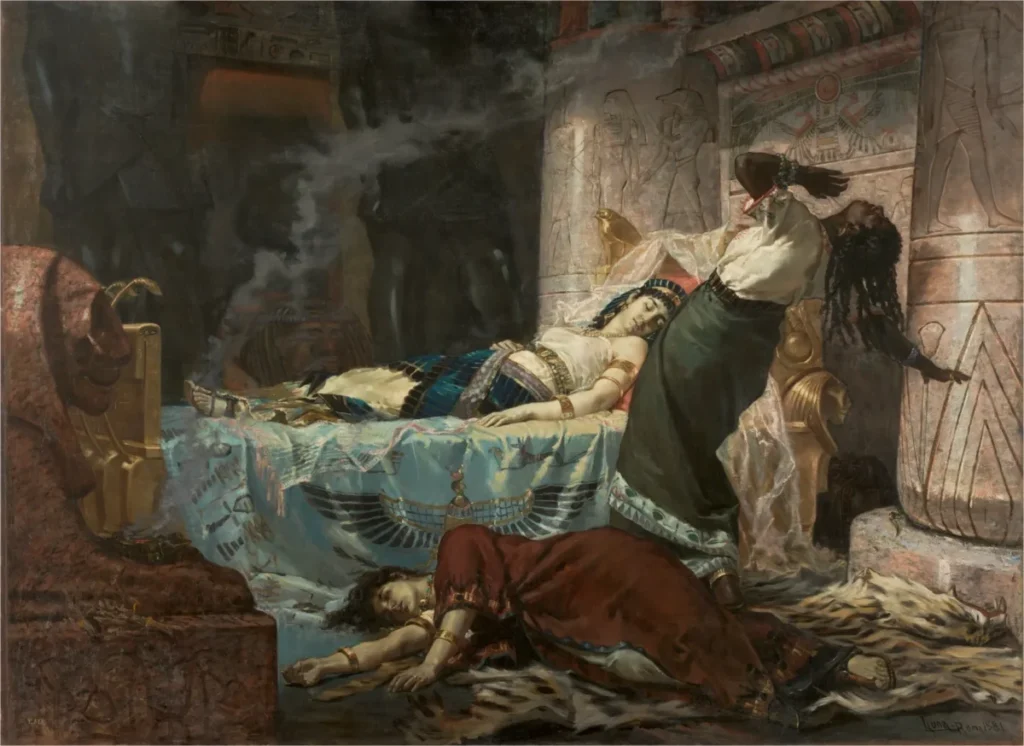
Later art completed the transformation from disputed report to visual certainty. Painters and sculptors placed the snake in Cleopatra’s hand, at her breast, on her arm, or near her throne. The works could be magnificent, but they belong to the history of reception as much as the history of 30 BCE. They show how later cultures imagined Cleopatra’s death, not necessarily how it happened.
What Can Be Said With Confidence?
The safest answer to how did Cleopatra die? is that she died by suicide in Alexandria in August 30 BCE, after Octavian captured the city and after Mark Antony’s death. The exact method cannot be proven. The snake bite is the most famous explanation, but it is not the best supported one when the ancient sources and biological evidence are weighed together.
The evidence supports several levels of certainty. It is highly likely that Cleopatra died after arranging her own death to avoid Roman humiliation. It is likely that Iras and Charmion died with her. It is possible that a snake was involved, because the claim appears in ancient sources. It is also possible, and probably more practical, that poison was administered through a drink, ointment, hairpin, needle, or hollow cosmetic object. Murder by Octavian’s agents is sometimes proposed, but the evidence is weaker and more speculative.
The location also remains partly uncertain. The final scene is connected with Alexandria and with Cleopatra’s royal monument or confinement after capture, but her tomb has never been securely identified. Ancient writers say Octavian allowed her to be buried with Antony, yet no archaeological discovery has confirmed the burial place.
That uncertainty is not a failure of the story. It is the story. Cleopatra’s death sits at the intersection of evidence, Roman propaganda, Egyptian symbolism, literary invention, and later artistic repetition. The asp belongs to that history, but it should not be treated as a settled forensic fact.
Frequently Asked Questions
How did Cleopatra die?
Cleopatra most likely died by suicide using poison in Alexandria in August 30 BCE. The exact method is unknown. Ancient sources mention an asp bite, poisonous ointment, and poison introduced with a small sharp object such as a hairpin or needle. The snake bite is famous, but poison is the more practical explanation.
Did Cleopatra really die from a snake bite?
She may have, but it is doubtful. The snake bite story appears in ancient sources, but those sources also preserve other explanations. Plutarch says no snake was found. Modern objections focus on the size of an Egyptian cobra, the difficulty of hiding one in a basket, the improbability of one snake killing three people in sequence, and the limited physical details in the ancient accounts.
What kind of snake was supposed to have killed Cleopatra?
The traditional snake is called an asp. In later interpretation, this is often identified as the Egyptian cobra because the cobra had strong royal symbolism in Egypt. Some readers have connected the word with vipers instead. The ancient terminology is not precise enough to identify one species with certainty.
Why do historians think poison is more likely?
Poison better explains the reported deaths of Cleopatra, Iras, and Charmion in close succession. It could be concealed more easily than a snake and administered more reliably. Ancient writers also mention poison, including ointment and a poisoned hairpin or needle. This makes poison an ancient explanation, not just a modern correction.
When did Cleopatra die?
Cleopatra died in August 30 BCE, usually dated to August 10 or August 12. The exact day varies in modern accounts because ancient chronology is not perfectly consistent. Her death came after Octavian captured Alexandria and after Mark Antony killed himself.
Where did Cleopatra die?
Cleopatra died in Alexandria, Egypt. Ancient accounts connect her final days with her mausoleum, monument, or guarded confinement after Octavian’s victory. Her actual tomb has not been securely found, although ancient tradition says Octavian allowed her to be buried with Mark Antony.
Who was with Cleopatra when she died?
Ancient accounts name two attendants, Iras and Charmion, as dying with Cleopatra. Plutarch describes Iras at Cleopatra’s feet and Charmion adjusting the queen’s diadem before collapsing. The scene is literary, but the tradition that her attendants died with her is consistent across the major versions.
Was Cleopatra murdered by Octavian?
There is no secure proof that Octavian had Cleopatra murdered. He had reasons to want her alive for a triumph, but he also benefited from her removal as a political problem. Murder remains speculation. The ancient sources more strongly support suicide, although they disagree about the method.
Why did the snake story become so popular?
The snake story was memorable because it connected Cleopatra with Egyptian royal symbolism, Roman ideas about the exotic East, and dramatic visual art. A cobra or asp gave artists and poets a powerful image. Over time, that image became more famous than the uncertainty preserved in the ancient sources.