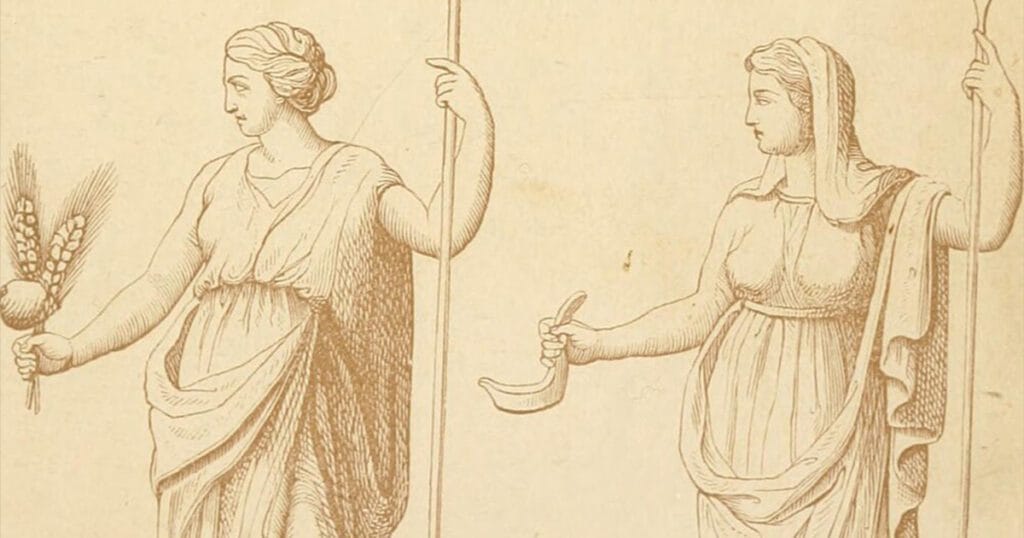
Hestia was the Greek goddess of the hearth, the place where a household cooked, gathered and made offerings to the gods. Her name was also the ordinary Greek word for a hearth. Ancient worshippers could speak of the fire in a house and of the goddess who received honour there using the same word. That closeness between a familiar object and a divine power explains why Hestia mattered in both domestic religion and the public life of Greek cities.
The Greeks told fewer elaborate stories about Hestia than about Zeus, Athena or Apollo. Yet surviving hymns place her at the beginning and end of the banquet, while civic poetry addresses her as the guardian of the city’s public hall. A sacrifice at Olympia could begin with Hestia even though the great sanctuary was dedicated to Zeus. Her importance is easier to see in the practices of worship than in the adventures of mythology.
The evidence also resists some attractive modern simplifications. Greek houses did not all contain a permanently burning stone hearth in the centre of the main room. Ancient artists could show Hestia walking among the other gods. And the familiar story that she surrendered her Olympian throne to Dionysus has no securely identified ancient narrative behind it. Looking closely at the surviving poetry, buildings and images gives a fuller account of a goddess whose presence was both ordinary and sacred.
Hestia's family and the choice to remain unmarried
In Hesiod’s Theogony, lines 453–500, Hestia belongs to the first generation of children born to the Titans Cronus and Rhea. Her siblings are Demeter, Hera, Hades, Poseidon and Zeus. Cronus fears that a child will overthrow him and swallows the children as they are born. Rhea saves Zeus by giving Cronus a stone wrapped like a baby. Zeus eventually defeats his father and frees the other children. Hestia is named first in Hesiod’s list of the children, a detail that later readers connected to the paradox of her being first born but last released from her father’s body.
The Homeric Hymn to Aphrodite, lines 18–32, tells us more about Hestia’s decisions. The hymn begins by celebrating Aphrodite’s power to stir desire among gods, humans and animals. It then names three goddesses whom Aphrodite cannot overcome: Athena, Artemis and Hestia. Apollo and Poseidon both seek Hestia in marriage. She refuses them, swears an oath while touching the head of Zeus, and chooses to remain unmarried. Zeus honours that decision by granting her a privileged place at the hearth and a share in the sacrifices offered to the gods.
The story does not say that Hestia was incapable of desire because she was literally a fireplace. She is presented as a goddess who can be courted, refuse suitors and make a binding promise. Her virginity belongs to a mythological explanation for her religious position. A married woman in many Greek communities moved into her husband’s household, whereas Hestia’s sphere was the continuing hearth that defined a household’s identity. That connection is a useful interpretation, although the hymn itself concentrates on her oath and the honours she receives, not on a developed theory of marriage and domestic space.
Hestia’s lack of children also distinguishes her from Demeter, whose relationship with Persephone drives a major Greek myth, and from Hera, whose marriage to Zeus is central to her divine identity. Hestia nevertheless belongs to the same family of gods. Her limited appearances in epic should not be mistaken for evidence that she was unimportant to worshippers. Greek poets chose their subjects according to the needs of their poems. The Iliad gives Hestia no comparable role to Athena or Hera in the fighting at Troy, but a hymn about the ritual meal has a very different reason to invoke her.
Why the first and last libations belonged to Hestia
The strongest evidence for Hestia’s everyday importance comes from a short religious poem. Homeric Hymn 29 addresses Hestia as an honoured presence in the dwellings of gods and mortals. It says that people do not properly hold a banquet without pouring sweet wine to her both first and last. A libation was an offering of liquid, often wine, poured out for a deity rather than drunk by the participants. The hymn is evidence for an ideal of ritual order: the meal begins and ends by acknowledging the power of the hearth.
This is a narrower and more useful claim than saying that every Greek meal, in every period and community, followed a single compulsory ceremony. The hymn gives us a poetic prescription, not a diary of domestic life. In practice Greek households differed in wealth, layout, region and the occasions on which they made offerings. The Oxford Classical Dictionary’s discussion of household worship by J. D. Mikalson identifies food offered at the hearth and wine poured before drinking among the attested practices, while also noting that the deities honoured in domestic rituals varied. The written evidence is strongest for what authors considered appropriate, not for how often every household performed it.
The distinction matters because Hestia was not the only god addressed in the house. Zeus could be worshipped as Zeus Ktesios, protector of stores, or Zeus Herkeios, associated with the household enclosure. Other domestic rites honoured Apollo and local protective powers. An oikos was more than a building: it included the family, dependants, property and the arrangements by which people lived together. Religious practices helped mark its boundaries and relationships. Hestia’s hearth belonged within that wider pattern of household religion, rather than replacing all other domestic gods.
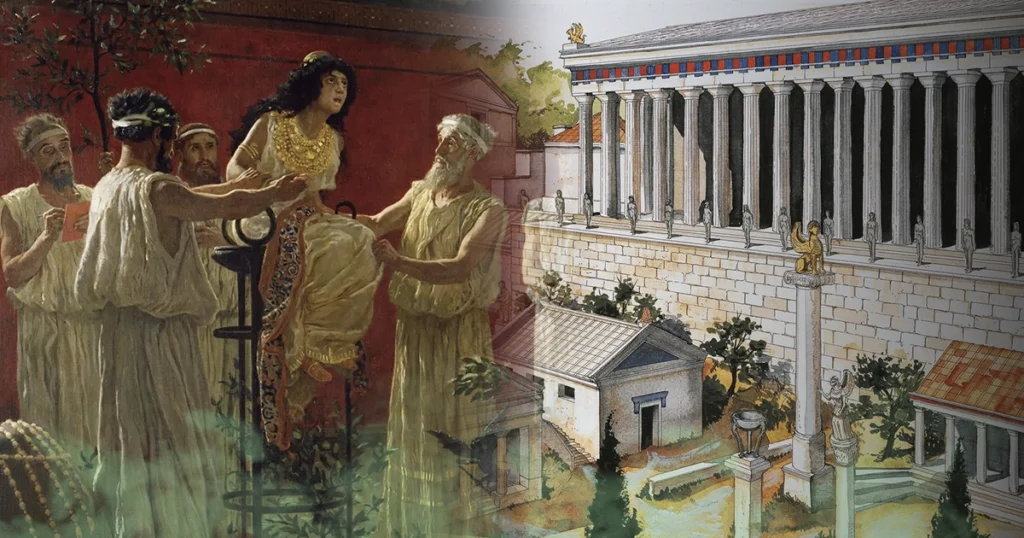
A second hymn, Homeric Hymn 24, invokes Hestia in Apollo’s sacred house at Pytho, the site of Delphi, and asks her to enter the poet’s house together with Zeus and favour the song. The two hymns are sometimes confused. It is Hymn 29, which also invokes Hermes, that speaks of the first and last libations; Hymn 24 addresses Hestia in relation to Apollo’s sanctuary. Their difference is revealing. Hestia belongs both in the home where people gather and in the sacred environment of a major sanctuary.
The privilege appears in a specific public ritual as well. Pausanias, Description of Greece 5.14.4, lists the order of sacrifices at Olympia and places Hestia first, before Olympian Zeus. The testimony comes from a traveller writing in the second century CE, many centuries after the earliest hymns. It cannot prove that every earlier sacrifice everywhere followed the same sequence. It does show that Hestia’s ritual precedence remained meaningful in a prominent Greek sanctuary during the Roman period.
Hestia's fire in the city hall
Greek religion was also a public affair. A polis was a self-governing civic community with institutions, officials and shared religious obligations. Many poleis maintained a communal hearth in a building called the prytaneion, usually translated as a town hall or civic hall. It was associated with the city’s governing officials, formal hospitality and communal dining. Hestia was therefore honoured not only as the goddess of a family home but also as a protector of the civic community’s shared centre.
The connection is particularly clear in Pindar’s eleventh Nemean ode. Although included among his Nemean poems, it celebrates Aristagoras of Tenedos, an Aegean island community, as he assumes a civic office. Pindar begins by invoking Hestia, daughter of Rhea and guardian of the prytaneia, and asks her to receive Aristagoras and his companions favourably. The poem refers to offerings of wine and the smoke of sacrifice as the officials honour her. These details tie the goddess to a real institutional occasion, not merely to a general ideal of domestic calm.
At Olympia the public hearth was a working part of sanctuary ritual. Pausanias 5.15.9–10 describes a room in the prytaneion containing an ash-built hearth on which fire burned by day and night. Ash from this hearth was taken to the great altar of Zeus, helping to build up the altar over time. Pausanias also names officials and attendants involved in the sanctuary’s sacrifices. The detail is valuable because it links fire, material remains, public organisation and repeated religious action. It is stronger evidence than an abstract claim that the civic flame symbolised unity.
Athens offers another view of the prytaneion’s social status. In Plato’s Apology 36d–e, Socrates, facing punishment after his conviction, provocatively suggests that he deserves meals at public expense in the prytaneion. Such meals were honours given to distinguished citizens and guests. His proposal was deliberately provocative because the building was associated with public recognition and the city’s hospitality. The text does not give a detailed description of a Hestia ritual, but it helps explain why the civic hall carried significance beyond ordinary administration.
A city’s common hearth could also express the relationship between communities. Greek colonisation involved founding settlements around the Mediterranean and Black Sea, often while maintaining religious and social ties with a parent city. Later descriptions and scholarly reconstructions refer to colonists taking fire from the mother city’s hearth for the new settlement. The image makes sense within Greek civic religion, but the surviving evidence is not a complete log of individual foundations. It would be misleading to claim that every colony carried an unbroken flame, or to identify particular journeys without a reliable ancient account. The important historical point is that a public hearth could represent the continuity of a community and the hospitality it extended to others.
What the hearth looked like in a Greek house
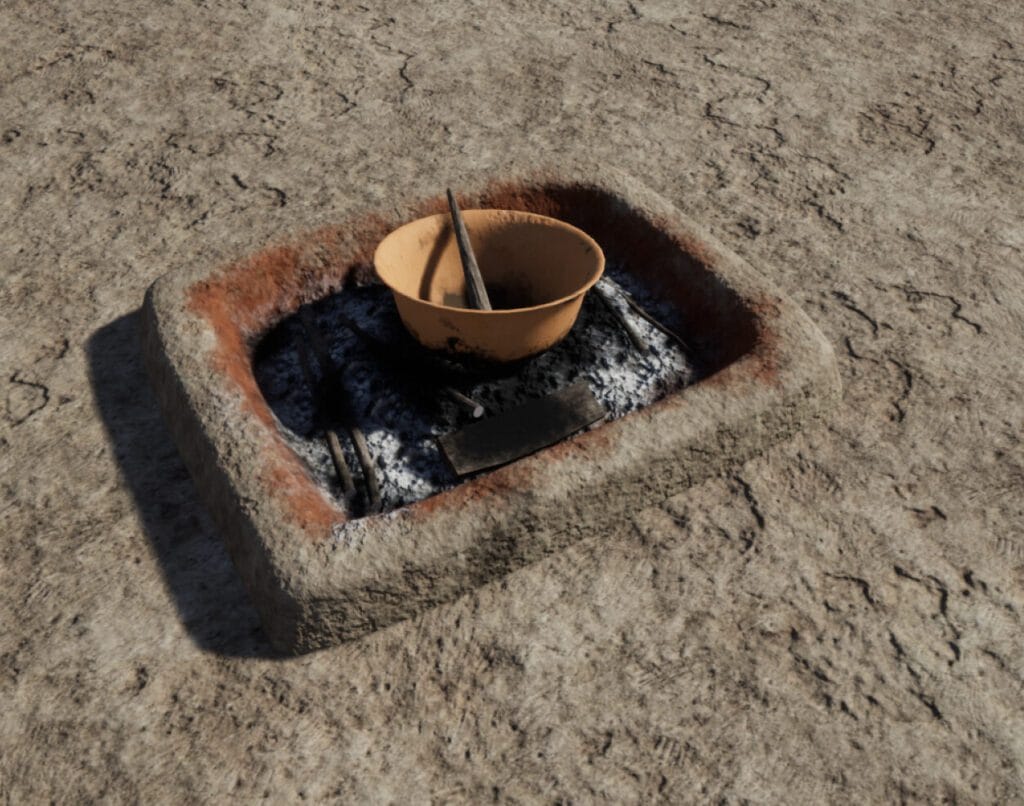
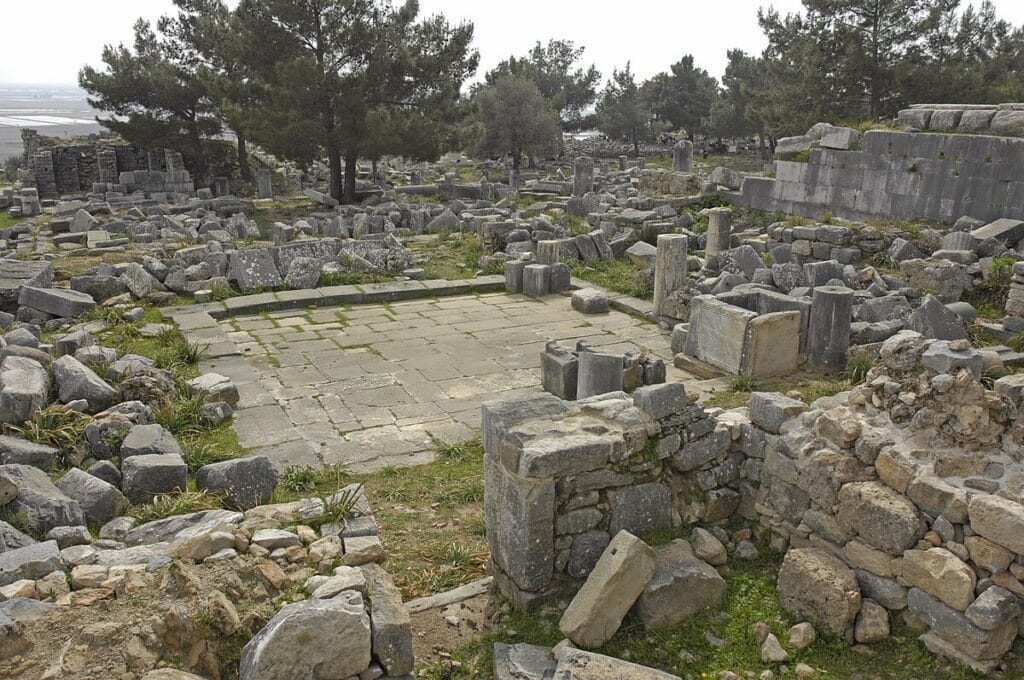
A household hearth supplied heat and a place to prepare food, but its physical form varied considerably. The large fixed circular hearths of some Mycenaean palace halls are familiar from archaeological plans, yet they should not be treated as a universal model for houses in Classical Athens or elsewhere. Homes might use braziers and other portable cooking equipment. Fires could be moved or extinguished according to need. A household’s sacred centre did not require a monumental fireplace built permanently into the floor.
This point has become important in archaeological discussions of Greek domestic religion. Katherine Swinford’s study of the semi-fixed nature of Greek domestic religion draws attention to the gap between literary descriptions of hearth rites and the limited archaeological evidence for fixed hearth-altars. Portable braziers survive across the Greek world. More recently, Ariadne Konstantinou’s 2024 study of Hestia similarly cautions against assuming that every Archaic or Classical house had an immovable central hearth. The symbolic language of the centre and the physical position of a cooking fire are related questions, but they are not identical.
The hearth’s role in household membership appears in literary descriptions of family ceremonies. The amphidromia was a rite associated with the reception of a newborn into the household. Later accounts describe carrying the infant around the hearth, an act that linked the child with the domestic group and its protective gods. Marriage could also bring a woman into a new household through rites associated with its hearth. The evidence is scattered, and we should resist turning these customs into a detailed universal timetable for every birth or wedding in ancient Greece.
The same caution applies to death. Greek communities developed practices for dealing with the pollution associated with a death in the house, and some later accounts connect the extinguishing or renewal of domestic fire with purification. The particular procedure depended on place and period. We cannot reconstruct a single Greek rule that all bereaved families extinguished their fire and relit it from the civic hearth. What can be said with greater confidence is that the household was a religious community and that the hearth, whether fixed or portable, was one of the places where that identity could be enacted.
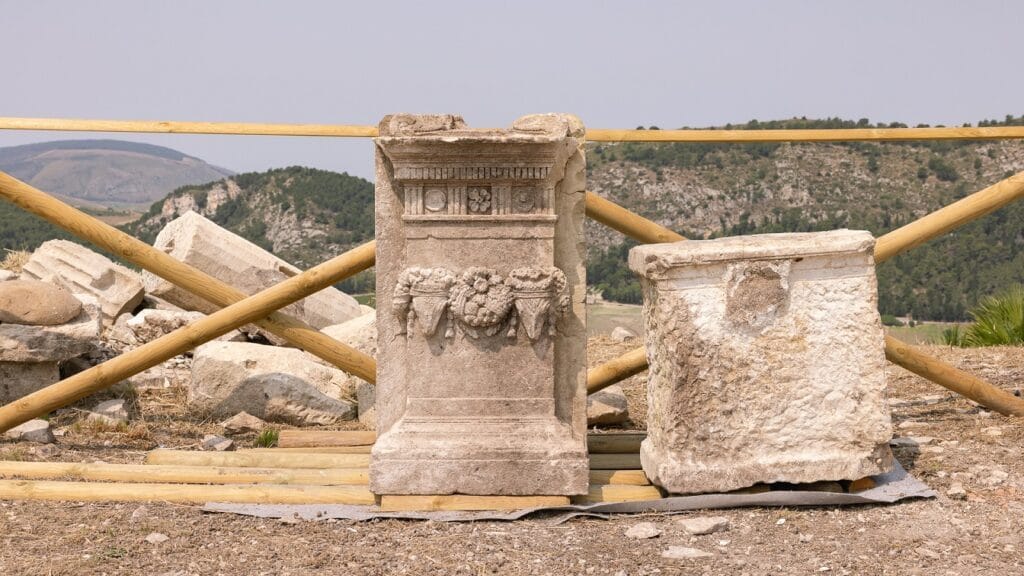
The scarcity of domestic religious objects does not mean the rituals were imaginary. Wine poured onto the ground, a small portion of food placed in a fire, or a prayer spoken before eating may leave little trace for an excavator. Conversely, finding an altar-shaped object does not automatically prove it was dedicated to Hestia. Archaeological interpretation needs a findspot, a date and, where possible, an inscription or a secure comparison. An object labelled a ‘household altar’ in a modern caption may have had a more complicated original use.
Enjoying Spoken Past?
I created Spoken Past to share my love of history. I research, write and develop everything myself, and I want my articles and basic guides to remain free for everyone.
If you enjoy my work, please consider supporting Spoken Past with a small donation.
A goddess with sanctuaries and images, despite her reputation
Hestia is often described as a goddess without temples or statues. Her cult was indeed closely associated with the hearth itself, and she was less prominent in surviving monumental temple programmes than Athena or Apollo. But ‘without’ is too absolute. In the second century CE, Pausanias 2.35.1 visited a sanctuary of Hestia at Hermione in the Argolid. He saw an altar used for sacrifice but no cult image. That is evidence for one sanctuary without a statue, not proof that no Greek sanctuary ever represented her in human form.
Elsewhere Pausanias describes Hestia among the figures on the base of Zeus’s great statue at Olympia, and he mentions statues including Hestia among the dedications of Mikythos there. Such notices show that the goddess could appear in monumental religious art even if her best-known form of worship did not require a cult statue. A visitor could encounter her as a named divine figure as well as in the fire of an altar.
There is earlier evidence too. Two sixth-century BCE Attic black-figure vessels depicting the wedding of Peleus and Thetis include Hestia among the divine guests. One is the Sophilos dinos in the British Museum, painted around 580–570 BCE. The other is the François vase, made around 570 BCE and now in Florence. Both show processions of gods arriving at the wedding of the mortal hero Peleus and the sea goddess Thetis, parents of Achilles. Hestia appears as a person participating in a mythological scene, not as an unattended fireplace.
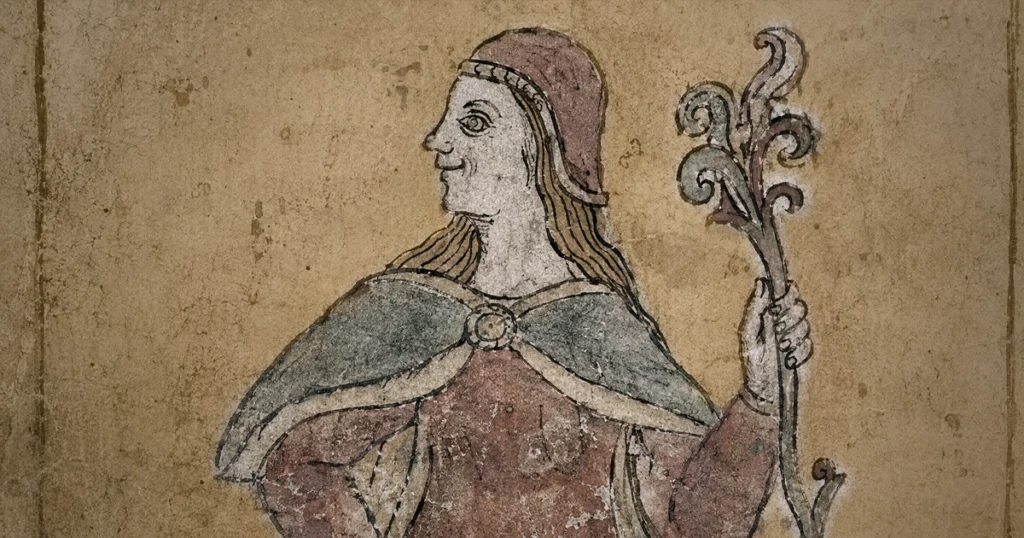
The significance of these images has been developed by Ariadne Konstantinou in the Journal of Hellenic Studies (2024). Earlier scholarship, especially interpretations influenced by the contrast between the stationary Hestia and the travelling Hermes, often treated her as the least humanlike of the Olympians. Konstantinou argues that the early poetry and vase paintings complicate that picture. Hestia is swallowed by Cronus, courted by gods and shown walking at a divine wedding. Greek religious imagination could recognise her as the hearth and also represent her as a woman with choices, relationships and movement.
Why Plato said Hestia stayed at home
One of the most influential passages about Hestia appears in Plato’s Phaedrus 247a. In a philosophical account of the soul, Socrates imagines the gods moving in a great heavenly procession led by Zeus. Hestia alone remains in the gods’ house. Later interpreters used this scene to explain her as the fixed centre around which other divine powers move. It is a memorable image, and it fits the association between a hearth and a settled household.
Yet Plato is writing a philosophical dialogue, not providing an inventory of standard Greek beliefs about which Olympians were permitted to travel. His Hestia stays at home within a particular myth about the soul. The earlier vase paintings place her in motion, while the Homeric Hymn to Aphrodite allows her to make a decision about marriage. The evidence does not force us to choose between a goddess who is literally a fire and a goddess who is literally a human-shaped person. Greek gods could be understood in different ways across rituals, poetry, art and philosophy.
The association with Hermes in Homeric Hymn 29 also deserves care. The hymn calls on both gods to dwell favourably in the house. Modern interpreters sometimes set them in opposition, Hestia representing a settled centre and Hermes the movement of people, goods and messages across boundaries. That contrast can illuminate Greek ideas about space, but the hymn itself asks the two deities to act together. An interpretation becomes misleading when it erases the particular ancient text it is supposed to explain.
Hestia, Dionysus and the twelve Olympians
Modern retellings often say that Hestia voluntarily surrendered her place among the twelve Olympian gods to Dionysus, avoiding an argument over the final seat. It is an appealing story, especially for a goddess associated with peace and stability. The problem is evidential. No securely identified ancient Greek text tells the familiar scene in which Hestia offers Dionysus her throne. The account should therefore not be presented as a documented Hellenistic myth, or used to explain a supposed historical decision taken by the gods.
Ancient sources do not supply a single universal roster of twelve Olympians for every context. Lists and visual arrangements could vary, and Hestia and Dionysus are both prominent in Greek religion. Plato’s procession names Hestia as remaining at home while eleven divisions of gods go out, but it does not narrate a throne exchange. Nor does the presence of Dionysus in an artistic group of twelve prove that Hestia resigned. The modern anecdote attempts to make differing lists into a single continuous story. Its neatness is a reason to check it, not evidence that it happened in Greek myth.
There is a larger point here about religious traditions. Greek communities were not governed by a single canonical scripture prescribing one fixed list of divine personalities. Poets, artists and worshippers could emphasise different groupings. Hestia’s place in worship did not depend on her inclusion in a particular painted assembly of gods. Her honours at the hearth and in civic rituals are documented independently of the later problem of counting Olympians.
Hestia and the Roman goddess Vesta
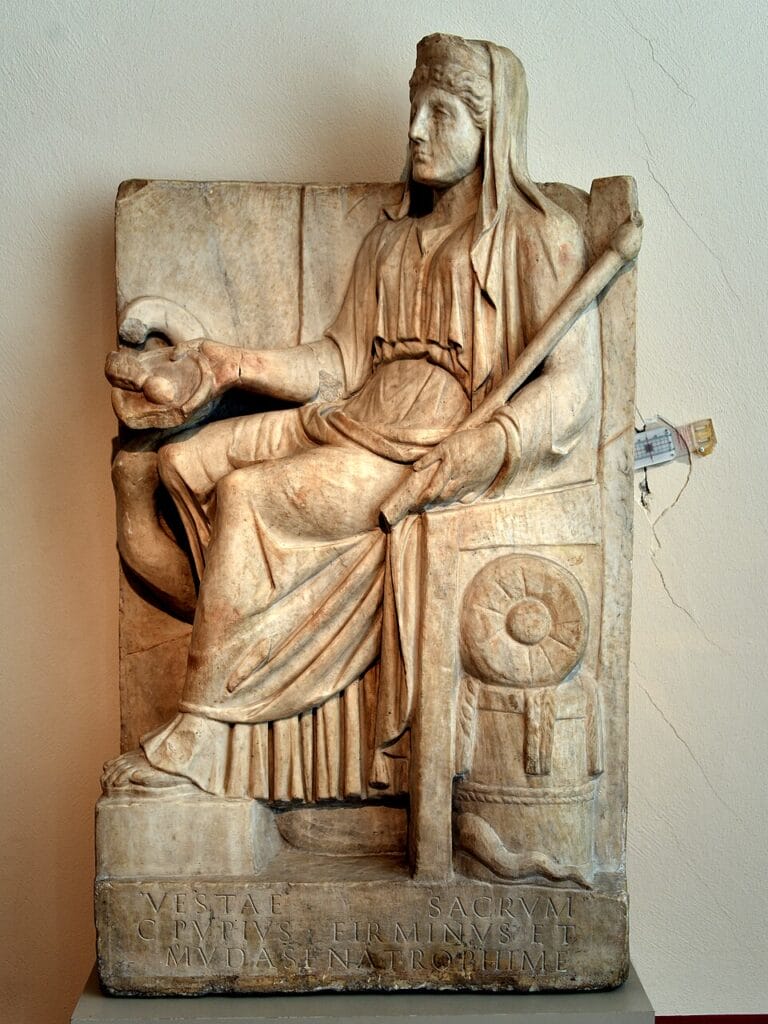
The Roman counterpart of Hestia was Vesta, also associated with the hearth, the community and sacred fire. Roman religion, however, developed an especially visible institution around her public cult. In the Roman Forum, the sacred fire of Vesta was tended by a priestly college of women known as the Vestal Virgins. Their duties and privileges formed part of the religious life of the Roman state. This was not simply a Greek prytaneion copied into a new setting. A fuller account of the priestesses appears in Spoken Past’s history of the Vestal Virgins.
In Plutarch’s Life of Numa 9–11, the Roman king Numa is credited with organising the Vestals, a tradition about the origins of Roman institutions rather than a contemporary account of early monarchy. Plutarch describes the priestesses’ thirty years of service and the severe penalties attached to breaking their vows. Those details should be understood within Roman social and legal history. Greek cities did not all maintain an equivalent college of six priestesses, and there is no basis for making the absence of such a college a measure of Hestia’s importance.
The Roman poet Ovid, Fasti 6.249–316, writes about Vesta’s festival and the circular shrine that housed her fire. He explains the absence of a cult image in that building and offers an ancient etymological speculation connecting Vesta’s name to the idea of standing. These are valuable testimonies to Roman religious imagination, but Ovid’s wordplay is not a modern linguistic demonstration of the goddess’s name. The relationship between the names Hestia and Vesta has been discussed by linguists, and precise derivations remain more difficult than a simple one-word translation suggests.
Comparing Hestia and Vesta reveals both shared religious concerns and different civic institutions. Each goddess could express the importance of a community’s hearth; each was connected to ritual purity and the continuation of sacred practices. But the Roman Vestals held distinctive legal status and responsibilities, while Greek worship of Hestia was distributed across households, sanctuaries and civic buildings. The difference is historical, not a ranking of which society cared more about its hearth.
What the evidence lets us know about Hestia
Hestia’s surviving evidence is unusually revealing because it comes from different kinds of source. Hesiod places her in the family of Cronus and Rhea. The Homeric Hymn to Aphrodite gives her a choice about marriage and a share in divine offerings. Hymn 29 describes the first and last libations of a feast. Pindar shows her invoked in the political life of Tenedos. Pausanias records her altar at Hermione and the burning civic hearth at Olympia. Sixth-century painted vessels depict her moving among the other gods. None of these sources, on its own, tells the whole story.
Nor do they establish a single unchanging set of Greek customs from the Bronze Age to the Roman period. The poetry was composed and transmitted over time, the cities had different institutions, and the buildings excavated today represent only a fraction of the places where ancient people cooked or prayed. The evidence is strongest when a claim stays close to a specific source: a libation described in a hymn, a fire described by a traveller, or a figure identified on a painted vessel. Details of ordinary household practice are harder to recover, especially when the action left no durable object behind.
Hestia was not invisible to the Greeks. She was honoured where people prepared food, welcomed new members into a household, offered wine, entertained civic guests and kept a public fire burning. Her cult linked religious action to the places where a community lived together. The remarkable feature is that a goddess could be present in so many ordinary settings while appearing so rarely as the protagonist of a grand myth. Her place in Greek religion is recorded most clearly in what people did around the hearth.