
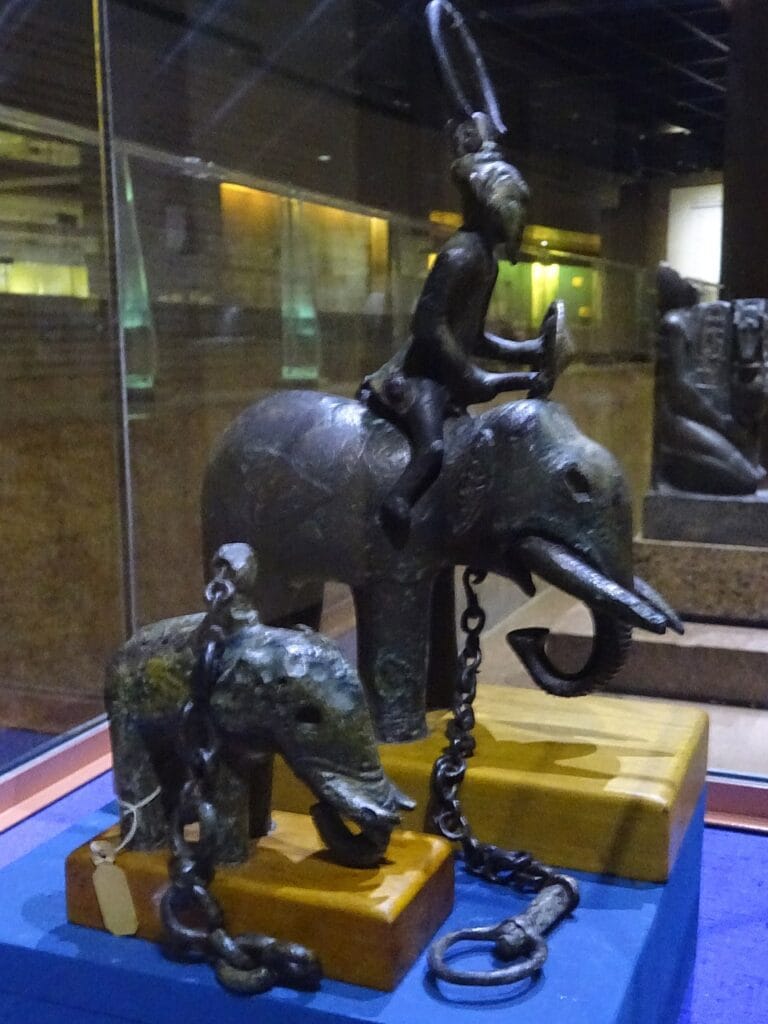
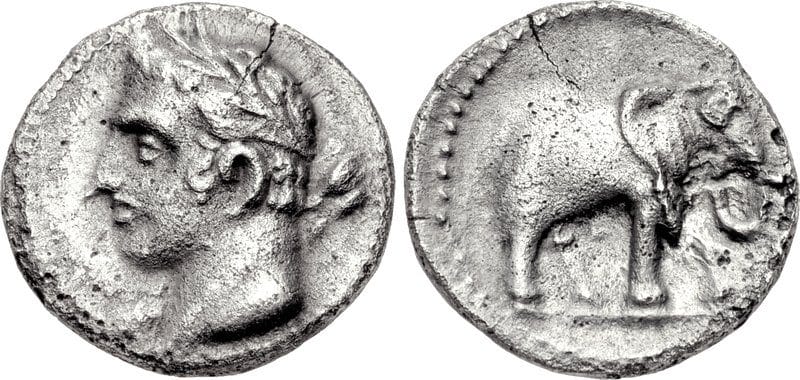
In the collections of the British Museum sits a small silver coin struck at a Carthaginian mint in the Iberian Peninsula sometime between 237 and 209 BCE (museum reference 1911,0702.1). It shows, on the reverse, an elephant walking calmly to the right with a cloaked rider perched on its neck, a short goad extended in the rider’s right hand. The animal is clearly an African type: the concave back, the large ears, and the relatively small head are all visible even at this scale. The coin is not a piece of royal vanity. It is military currency, struck to pay Carthaginian troops on campaign in Iberia, and its choice of imagery is functional: it tells the soldiers and anyone who handles the coin that this army possesses trained, guided, professionally handled elephants. Hannibal’s war elephants were not a legend embellished after the fact. They were a documented, organised, logistically demanding military asset with a specific biological identity, a specific training tradition, and specific tactical roles that Roman armies learned to counter only after two of the most destructive battles in their history. This article works through what the evidence actually shows about Hannibal’s war elephants: their species, their training, and the reasons Rome eventually found answers to them.
Which Species Were They: The North African Elephant Question
The species question has never been fully resolved, and anyone claiming otherwise is simplifying the evidence. The animals that served Carthage in the Punic Wars were almost certainly members of a North African population of elephant that is now extinct, formally designated Loxodonta africana pharaohensis, a subspecies of the African bush elephant or, in some taxonomic frameworks, a distinct form closely related to the modern African forest elephant (Loxodonta cyclotis). Both living African species were once classified as a single species, but DNA analysis from 2010 onward established that forest elephants and savanna elephants are as genetically divergent as mammoths from Asian elephants. The North African animals occupied territory across the Maghreb, along the coast of the Red Sea, and into what is now Sudan and Eritrea. They were smaller than the African savanna elephant, standing roughly 2.5 metres at the shoulder according to the evidence of Carthaginian coins, frescoes, and mosaics, with the large ears and concave back typical of African types rather than the rounded back and smaller ears of Asian elephants.
Their size relative to other elephant species matters for understanding their battlefield role. Polybius, writing in the second century BCE and drawing on direct knowledge of Hellenistic military practice, described a specific engagement at the Battle of Raphia in 217 BCE between the Ptolemaic king Ptolemy IV and the Seleucid king Antiochus III. In his Histories (5.84), Polybius records that Ptolemy’s African elephants, facing the larger Indian elephants of the Seleucids, were immediately overwhelmed by the size differential and the noise produced by the Indian animals. Ptolemy’s mahouts and the elephants themselves retreated before contact. This passage has been cited for two centuries as evidence that North African elephants were simply inferior to Indian ones, but the argument is too broad. At Raphia, a specific African elephant force, probably without adequate training time, encountered a specific Indian force in open terrain. What Polybius actually records is a failure of nerve among some of the African animals, not a general physical inferiority of the species. Hannibal’s elephants at the Battle of the Trebbia in 218 BCE performed their assigned role against Roman cavalry with considerable effect, and those were the same North African animals.
No one knows with certainty whether Carthage ever fielded Indian or Asian elephants as a regular component of its forces. The modern taxonomic status of the extinct Syrian elephant, Elephas maximus asurus, remains debated. The Syrian subspecies of the Asian elephant inhabited the Levant and may have survived there until around the eighth century BCE, when it appears to have been hunted to extinction, well before the Punic Wars. The J.F. Lazenby, in his military history Hannibal’s War, and H.H. Scullard, in his earlier classical review, both addressed the Surus question directly and concluded that the evidence for Surus being an Asian rather than an African animal is intriguing but ultimately ambiguous. A Syrian elephant acquired through eastern trade connections and named for its geographic origin is possible. What it was not was typical: the bulk of Hannibal’s force, then and throughout the Italian campaign, consisted of North African animals.
Surus and the Problem of One Famous Elephant
The name Surus comes from the Latin word for “Syrian,” and the animal who bore it is the only one of Hannibal’s elephants to have been individually named in the surviving sources. He appears in the Latin sources as Hannibal’s personal mount, the animal the general rode when he lost the sight of one eye in the Arno marshes in the spring of 217 BCE, the last surviving elephant after the deaths of the rest of the original Alpine crossing cohort during the harsh winter following the Battle of the Trebbia. The detail of Hannibal’s eye infection is provided by Livy, who is one of the two principal sources for the military history of Hannibal’s Italian campaign along with Polybius. Livy places Hannibal specifically astride Surus during the march through the Etruscan marshes, his scouts seeking firm footing in the flooded lowlands while the river Arno had overflowed its banks in the spring rains.
What made Surus remarkable enough to be named and remembered is almost certainly a combination of his size, his longevity in the campaign, and his association with the general personally. If he was larger than the other animals in Hannibal’s corps, that would be consistent with an Asian origin, since the Asian elephant is generally taller at the shoulder than the North African subspecies. But surviving animals in any long campaign also tend to be the most reliably trained, the most psychologically stable under sustained pressure, and the most thoroughly bonded to their handlers. Surus may have survived where others did not precisely because he was the best-trained and most resilient of the original group, regardless of species. His name, while suggestive, is not definitive evidence of geographic origin. A North African elephant of unusual size could have been acquired through eastern trading contacts and given the epithet Syrian simply as a distinctive nickname.
Where Carthage Got Its Elephants and the African Tradition Behind Them
Carthage did not invent the use of war elephants. The practice arrived in the Mediterranean world through contact with the Hellenistic kingdoms. Pyrrhus of Epirus used Indian elephants borrowed from the Seleucid court when he invaded Italy in 280 BCE, and their initial impact on the Romans was enormous. Legionaries who had never seen an elephant called them “Lucanian oxen” after the region of southern Italy where they first encountered them. The psychological shock of the animals and the noise they produced contributed to Pyrrhus’s early victories at Heraclea and Asculum. Carthage watched this demonstration carefully. The city already had access to elephant capture networks through its African trading relationships, and by the time of the First Punic War (264-241 BCE) it had begun incorporating African animals into its military forces. The Battle of Tunis in 255 BCE, where a Carthaginian elephant charge disordered the Roman legions of Marcus Atilius Regulus and contributed to a decisive Carthaginian victory, established the tactical model that Hannibal would inherit.
The supply chain for North African elephants ran through the same networks of Carthaginian traders and allied Numidian rulers who controlled the interior of the Maghreb. Young elephants, captured from wild populations in the Atlas Mountain forests and the river valleys further south, were held in managed facilities and trained over periods of years before deployment. The supply also drew on more southerly connections. The Meroitic Kingdom of Kush, centred at Meroë in what is now northern Sudan, maintained an extensive relationship with elephants that went well beyond their military use. At Musawwarat es-Sufra, a Meroitic ceremonial complex in the Keraba region of Sudan approximately 120 kilometres northeast of Khartoum, the walls of the Great Enclosure bear extensive elephant carvings and reliefs dating to the third century BCE and later. The complex has been investigated archaeologically by teams from Humboldt-Universität zu Berlin under Fritz Hintze beginning in 1960, and subsequently by an ongoing project under Dr Cornelia Kleinitz of the Deutsche Archäologische Institut. One interpretation of the Great Enclosure, though not the current consensus, identifies it as an elephant-training and holding facility, a possibility supported by the representations and by the scale of the courtyard spaces. What is clear is that the Meroitic culture had a sophisticated engagement with elephants, and the Kingdom of Kush supplied war elephants to multiple Hellenistic powers including the Ptolemies and the Seleucids. The chain from central African capture to Mediterranean battlefield was organised and well established long before Hannibal was born.
Built out of a love for history, kept free from distractions.
Spoken Past is an independent project shaped by curiosity, care, and long hours of research. Reader support helps keep it maintained, carefully researched, and open to everyone.
How Elephant Handlers Trained a Two-Ton Soldier
The training process for Carthaginian war elephants is not described in any surviving ancient manual, but the mechanics can be reasonably reconstructed from the comparative evidence of mahout practices documented in Hellenistic and South Asian sources, the physical requirements imposed by the battlefield record, and the practical constraints of elephant behaviour. Understanding how Hannibal’s war elephants were prepared for combat requires working backward from what the animals did in battle and combining that with what we know of elephant cognition and the general principles of large animal training that appear consistently across cultures and periods. Elephants are highly intelligent social animals with long memories and specific requirements for trust before they will accept sustained human handling. Calves captured young, before the age of approximately seven or eight, could be habituated to human presence, voice commands, and physical contact over the course of several months. An adult wild-caught animal was essentially untrainable for military purposes within any useful time frame.
The primary tool of the mahout in the Carthaginian tradition, as depicted on the British Museum coin, was the goad, equivalent to the South Asian ankuśa: a short stick with a metal hook or spike at the end, used to apply directional pressure to specific nerve points on the elephant’s skin, particularly behind the ear and along the neck and shoulder. The communication between handler and animal operated through combinations of voice commands, weight shifts from the rider’s seated position behind the animal’s head (or on the neck, as shown on Carthaginian coinage), and goad pressure. This is the same grammar of handling used across the full geographic range of working elephant traditions from India to West Africa, because it responds to the specific sensory and cognitive architecture of the elephant: highly responsive to social context, capable of learning complex command sequences, but entirely dependent on the quality of the individual relationship between handler and animal.
Battle training added layers of systematic habituation to noise, sudden movement, and crowd pressure. Handlers exposed training animals progressively to louder and more chaotic environments: rattling metal, burning wood, crowds of shouting people, the smell of blood and unfamiliar animals. Each stage was only advanced when the current level no longer produced a stress response. Group training, with multiple animals working in proximity, reinforced calm because a relaxed lead animal reduced the anxiety of the others. The logistical constraints of this process were formidable. An adult elephant requires roughly 150 to 200 kilograms of fodder per day and large quantities of fresh water. In Hannibal’s Italian campaign, his supply lines were already severely compromised by the Alpine crossing and the distances involved. The fact that most of his elephants died in the winter following the Trebbia in 218 BCE, after the battle in which they performed well, reflects the impossibility of sustaining that level of nutritional demand in the Etruscan marshes and the Po Valley winter without adequate foraging networks established in advance.
What Hannibal’s War Elephants Actually Did in Combat
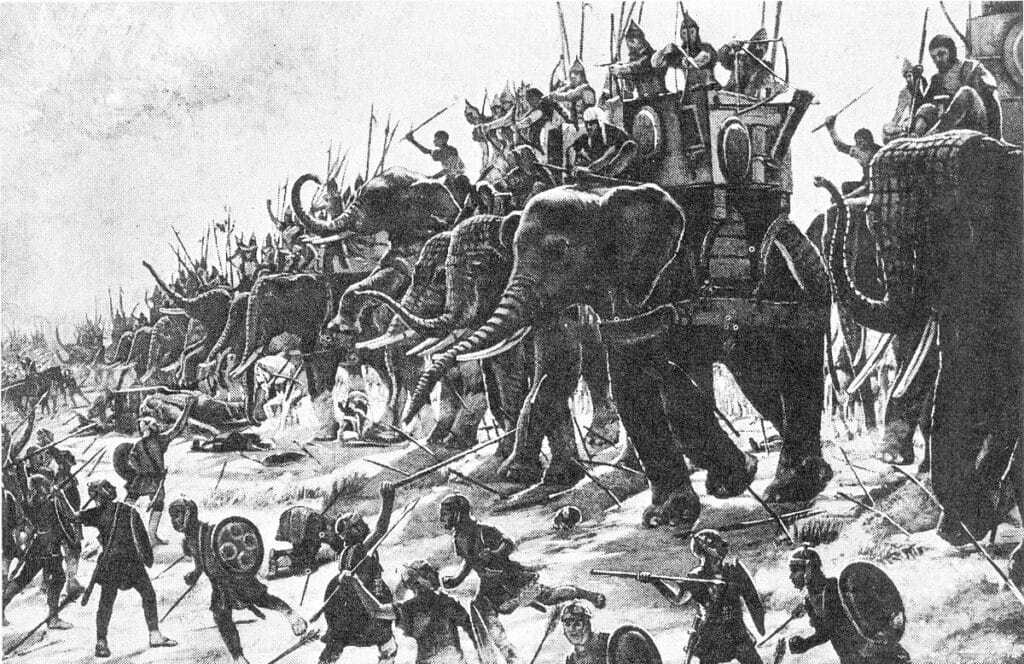
Hannibal’s war elephants were most effective as a cavalry disruptor and a terror weapon against troops who had not encountered them before. Their primary target in most engagements was the opposing cavalry. Roman horses not previously exposed to elephants would smell the animals, hear the unfamiliar low-frequency vocalizations and the percussion of their feet at a distance, and balk or bolt regardless of rider skill. A cavalry squadron that broke and fled in the opening minutes of a battle removed itself from the decisive phase of the engagement, typically leaving the infantry flanks exposed. At the Battle of the Trebbia, Hannibal positioned his elephants on the outer wings of his formation precisely to collapse the Roman cavalry before the infantry lines fully engaged. The subsequent rout of the Roman flanks, combined with the ambush of Mago’s hidden force, then produced the encirclement and destruction of the Roman army. The elephants did not win the Trebbia by themselves, but they did their assigned job: they removed the opposing cavalry from the equation at the moment when it was most critical.
Against infantry, the psychological effect was most pronounced in the initial encounter. The noise, the apparent size (which troops approaching on foot would initially overestimate), and the unfamiliarity of the animals produced a fear response that could break raw or poorly led units before physical contact occurred. Hannibal understood this and used the threat of the animals as a screening and channelling tool: keeping skirmishers behind a moving elephant screen while the main infantry force manoeuvred into position. Against veteran troops who had encountered elephants before, this tactic became significantly less reliable, and the outcome could reverse with catastrophic speed. An elephant that was wounded, frightened, or disoriented in a confined space would turn and run in whatever direction felt safest, regardless of who was in that direction. Handlers carried a chisel and mallet specifically for this scenario, driving the chisel into the animal’s spine at the base of the skull to kill it before it could stampede into its own army. The method is documented in ancient sources and confirmed by later Indian and Hellenistic military manuals.
Crossing the Rhone and the Alps: What the Sources Say and What They Get Wrong
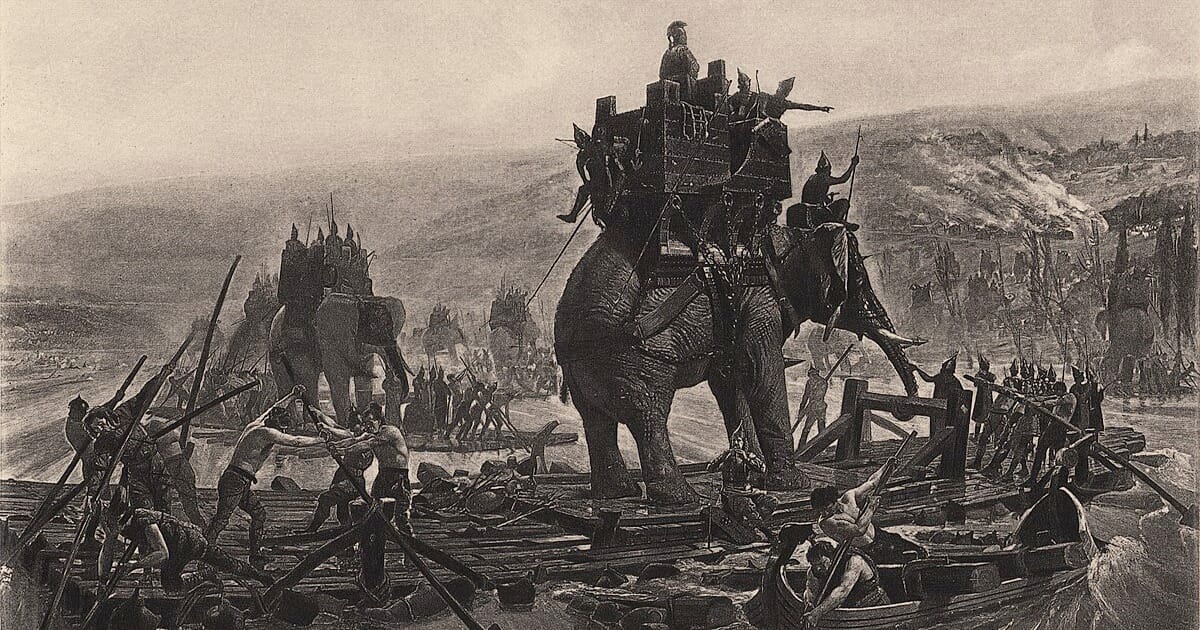
The most famous episode associated with Hannibal’s elephants is the Alpine crossing of 218 BCE, and it has been overlaid with so much subsequent romanticisation that the actual logistics require careful unpacking. Polybius and Livy, the two principal sources for the crossing, describe the Rhone crossing first. Their account of the elephants being loaded onto large rafts covered with earth, because the animals would not enter the water, has been repeated in almost every subsequent account of the campaign. It is, however, almost certainly wrong in at least one respect. Elephants are excellent swimmers and can cross wide rivers by swimming, using their trunks as snorkels. African elephants are documented swimming distances of up to fifty kilometres in open water. The Carthaginians, who had been working with elephants for decades, almost certainly knew this. The raft-loading account, as several modern scholars have noted, reads like a story constructed by authors who did not know elephants well, which Polybius and Livy, for all their virtues, did not. What is plausible is that some of the more nervous or less experienced animals were guided across on pontoons, while others swam alongside.
The Alpine crossing itself is more reliably attested as a genuine ordeal. Hannibal left Spain with approximately 37 elephants, having already had 40 at the start of the Iberian campaign in 220 BCE. The crossing of the Alps took approximately 17 days under conditions of extreme cold, snow, hostile Gallic tribes on the passes, and the sheer physical difficulty of keeping large animals moving on narrow mountain tracks without adequate forage. All 37 elephants survived the Alpine crossing itself, according to the sources, but most died in the following winter of cold and inadequate nutrition. Only Surus is attested as surviving into the later phases of the Italian campaign. Hannibal subsequently received additional elephants from Carthage and from allied sources at various points during the Italian years, though the numbers involved and the timing are disputed. His last major deployment of the animals came at the Battle of Zama in 202 BCE.
Zama and the Roman Countermeasures That Ended an Era
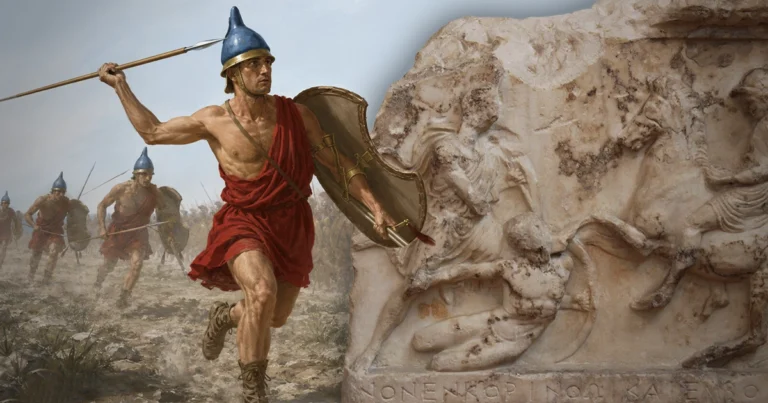
At the Battle of Zama on 19 October 202 BCE, Hannibal deployed approximately 80 elephants in front of his battle line as a shock force against the Romans of Publius Cornelius Scipio, who would later be known as Scipio Africanus. The number is itself significant and somewhat suspicious: Polybius and Livy both cite 80, but many modern historians have questioned whether that many trained animals could have been assembled given the state of Carthaginian resources after seventeen years of draining war. Whatever the precise number, they were not adequately trained. Scipio had spent years studying Hannibal’s tactics and had observed elephant behaviour in Spain. He designed his formation specifically for the Zama engagement, organising his cohorts in lanes rather than the standard checkerboard formation, with the lanes aligned from front to back. Light infantry armed with javelins and noise-makers was distributed throughout the formation. When the elephant charge came, the Roman light infantry directed the animals into the lanes with directed noise and missile fire rather than trying to stop them, then closed the lanes behind them.
The result was that many of the elephants ran the length of the Roman formation without causing significant casualties and exited harmlessly at the rear. The animals that could not be channelled into the lanes turned back and ran into the Carthaginian cavalry on the wings, causing the confusion that allowed Scipio’s allied Numidian cavalry, under Masinissa and Laelius, to close in and complete the encirclement. Hannibal’s elephants at Zama were insufficiently trained for the specific tactical situation they encountered. His earlier animals, trained for years by experienced handlers, had been a genuine military asset. The Zama cohort, assembled quickly from recent captures in the emergency of the final campaign, behaved exactly as inadequately trained elephants always do under extreme pressure: they ran toward the nearest exit from a terrifying sensory environment, and that exit was back through their own army.
After Zama, Rome brought captured Carthaginian elephants back to Italy and deployed them in subsequent campaigns, including the Macedonian Wars and the wars against the Seleucid Empire. Roman elephant use was always tactical rather than strategic, and the animals never became a permanent fixture in the imperial army the way cavalry did. The North African elephant population declined sharply through the combined pressures of capture for military and arena use and habitat destruction across the Maghreb. By the second or third century CE, the species was extinct north of the Sahara. What remains is a coin, a few mosaic panels, and the texts of Polybius and Livy: enough to reconstruct the outline of Hannibal’s war elephants as a weapon that was, at its best, precisely what the Carthaginian tradition had designed it to be, and at its worst, a liability that could decide a battle against its own army.
Primary sources: Polybius, Histories (especially Book 5.84 for Raphia, Book 3 for the Alpine crossing and the Trebbia, Book 15 for Zama); Livy, Ab Urbe Condita (Books 21-30 for the Second Punic War); Appian, Hannibalica. Secondary sources: J.F. Lazenby, Hannibal’s War: A Military History of the Second Punic War (Aris and Phillips, 1978); H.H. Scullard, Scipio Africanus: Soldier and Politician (Thames and Hudson, 1970); M.B. Charles, “African Forest Elephants and Turrets in the Ancient World,” Phoenix 62 (2008), 338-362; Musawwarat es-Sufra Project, Deutsche Archäologische Institut, Humboldt-Universität zu Berlin; DAI Musawwarat Project overview.