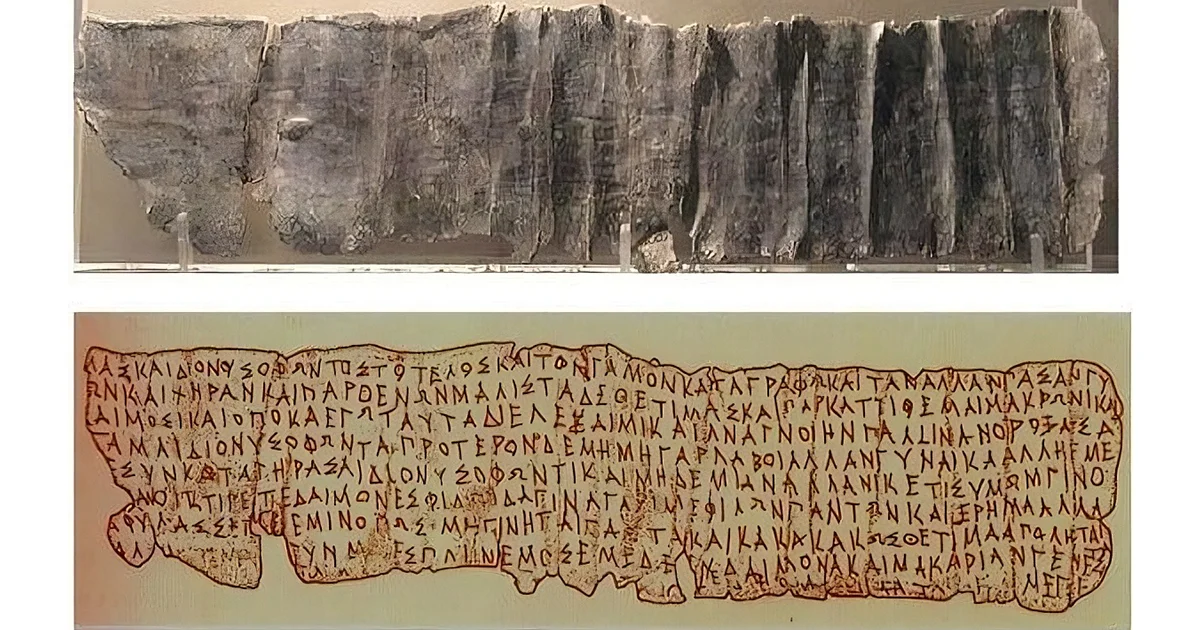
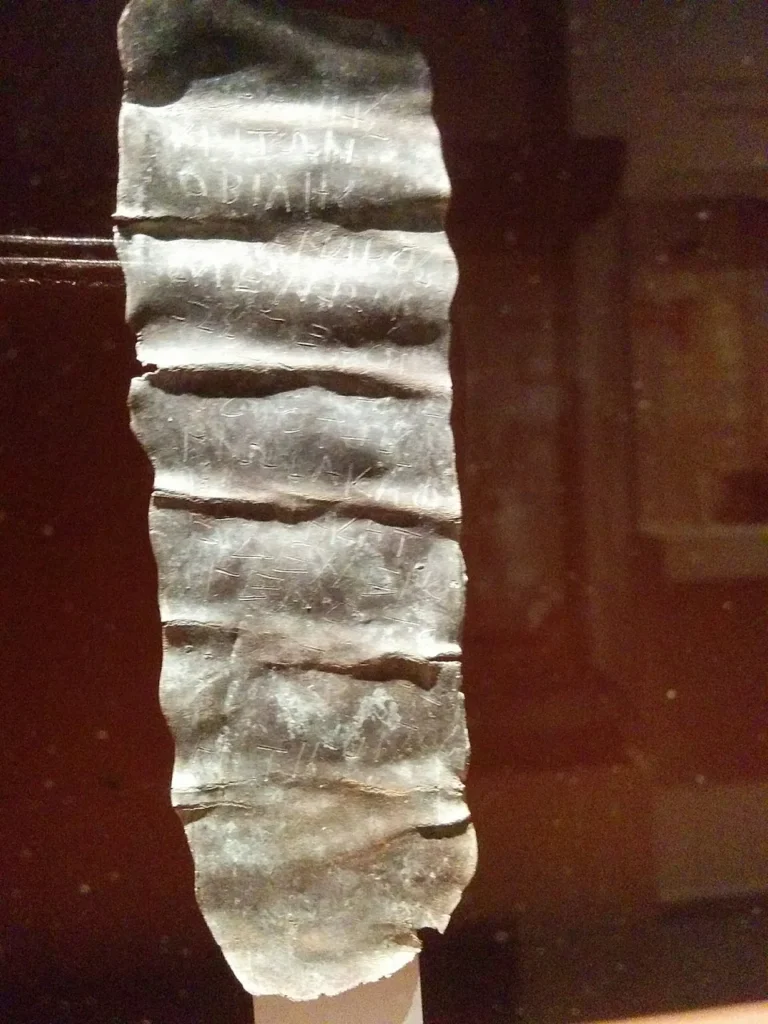
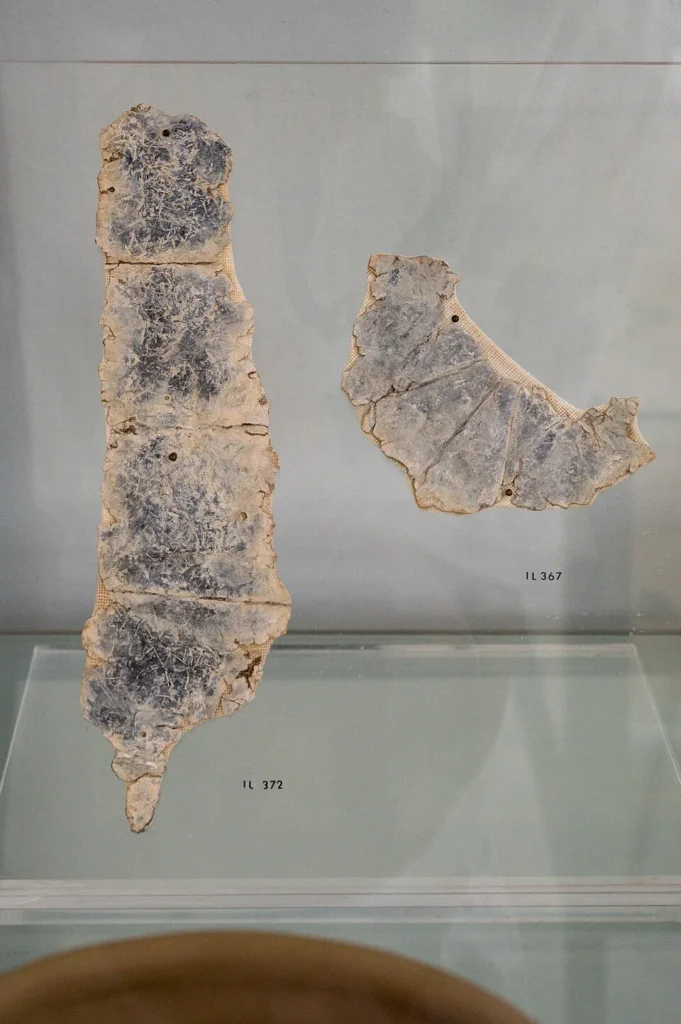
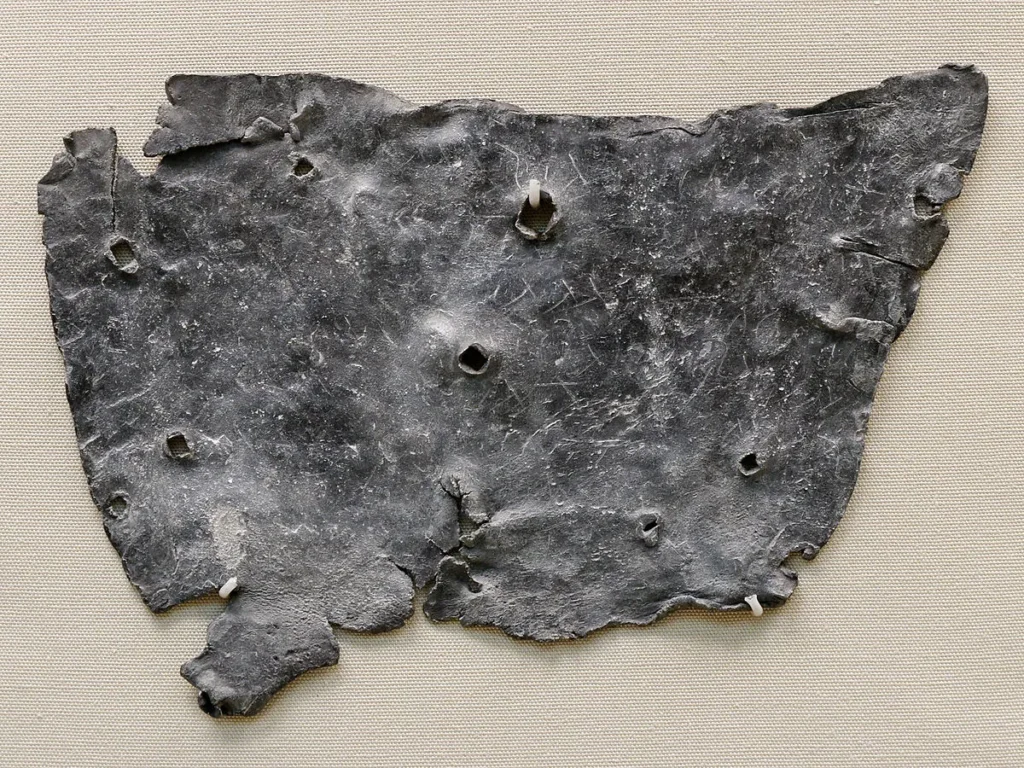
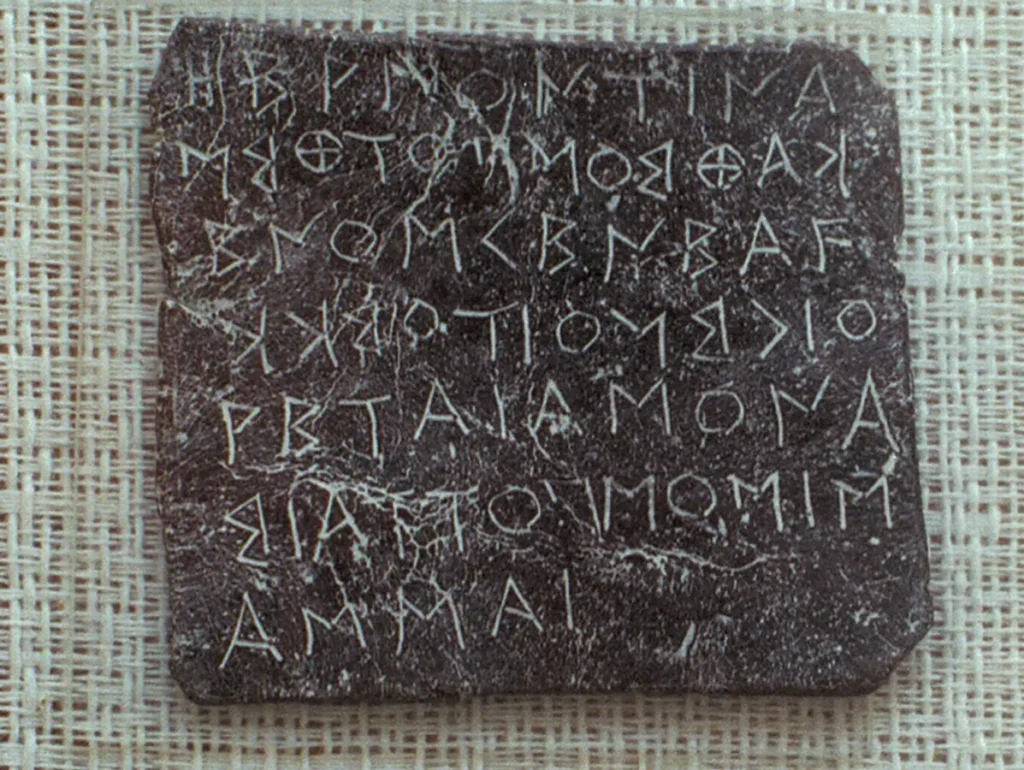
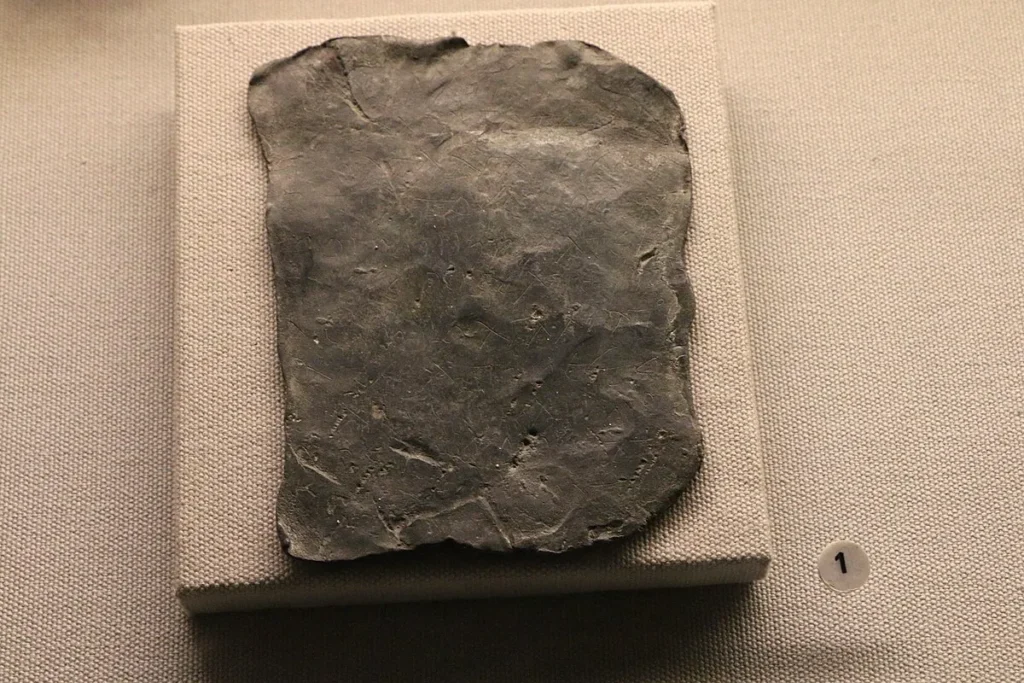
A Greek curse tablet, called a katadesmos in Greek and defixio in Latin, was a thin sheet of lead or lead alloy inscribed with a binding spell. Writers scratched names and short commands with a stylus, then rolled, folded, or pierced the sheet and deposited it where the dead or the gods would receive it. Most tablets address chthonic powers, the gods and spirits of the underworld who could restrain a rival’s tongue, sour a lawsuit, freeze a lover’s will, or cripple a racehorse. The material mattered. Lead was cheap, soft, and heavy, so it took letters easily and signaled permanence. Writers often added nails, hair, or little wax or clay figurines bound with wire, because contact with a person’s “essence” was thought to amplify the spell.
Where People Left Curses
Placement channeled the message. Graves were the most common repository, since the dead could carry petitions below. Wells and fountains were popular because they seemed to open downward toward chthonic spaces. Sanctuaries sometimes received public complaints against thieves or slanderers, especially when the god presided over justice. In cities like Athens and Pella, tablets turn up in cemeteries, sanctuaries, and water features, each spot chosen to move the words into the right divine jurisdiction.
How a Curse Tablet Worked: The Script and the Act
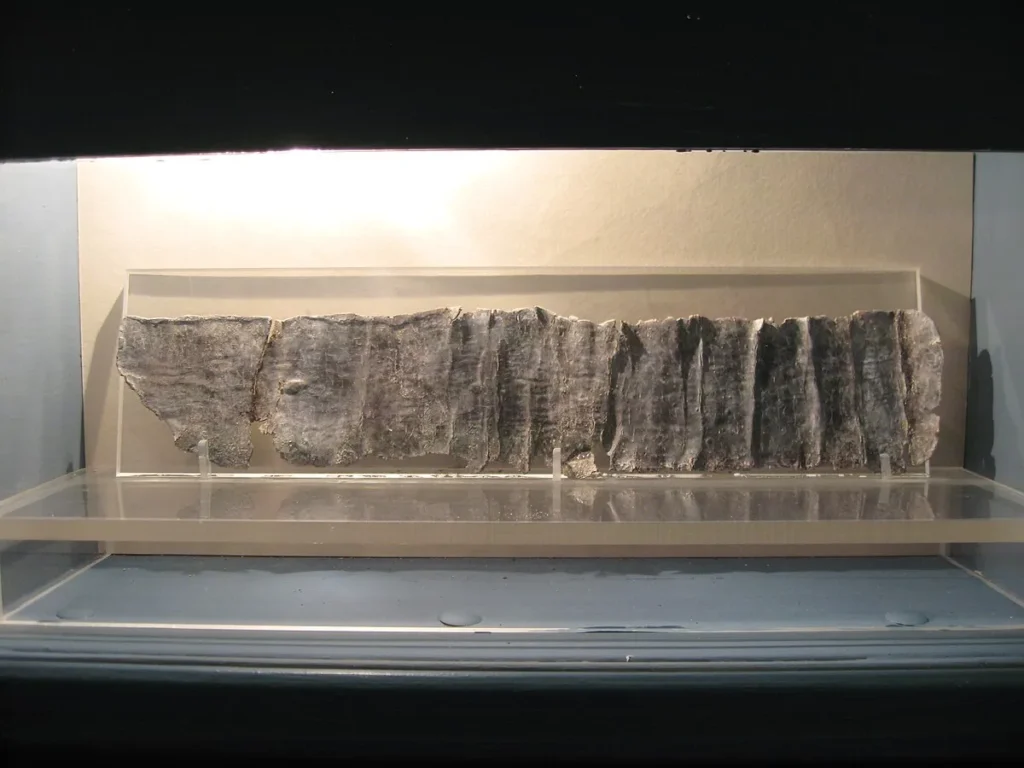
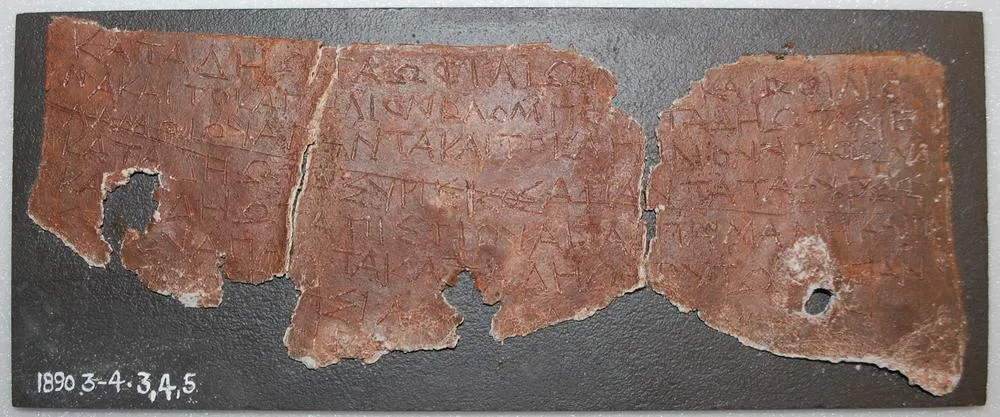
Cursing was ritualized writing. A typical tablet begins by naming the target, then commands binding or restraint. The writer lists body parts or faculties in a cascade, such as tongue, hands, feet, mind, and business. The spell may call specific gods, for example Hermes in his underworld role, Hecate at the crossroads, Persephone and the Erinyes, or nameless “spirits below.” Some texts add voces magicae, long strings of powerful syllables, and strange symbols. The script is not random. It marks the shift from ordinary speech to ritual utterance, where repetition and rhythm do the binding.
Finishing the text did not end the rite. Rolling or folding fixed the words. Driving a nail through the tablet sealed the spell and mirrored the force it sought to exert. Depositing the package in a grave or a well brought the command under the eyes of chthonic powers. The whole sequence created a gesture that the gods were expected to recognize. Writing, piercing, and placement stood in for handshakes and signatures.
What People Wrote: The Main Genres
Judicial Curses: Silencing Opponents in Court
Greek cities took law seriously, and litigants took no chances. Judicial curses aimed to make an opponent forget arguments, speak poorly, or lose nerve. A common formula binds the tongue, mind, hands, and feet, the four tools of a persuasive speaker. The writer sometimes lists all people who might speak for the other side: witnesses, associates, advocates, even friends who might join as co-litigants. Detail mattered, because omission risked a loophole. These tablets often invoke Hermes Chthonios, a divine guide of souls and a patron of cunning speech, as well as the dead themselves. The desired outcome is not murder. It is defeat in court, achieved by confusion, stammering, and loss of memory.
Erotic Magic: Separating Rivals or Pulling a Lover
Love magic splits into two strategies. Separation spells try to drive two people apart by making them quarrel or lose desire. Attraction spells, known later as agoge, try to draw the beloved to the petitioner and make her or him sleepless until surrender. A famous group from northern Greece shows both tactics, sometimes in the same dossier. The writer may list the beloved’s senses and body, then command each sense to turn away from a rival. Erotic curses often use more urgent language than court cases, and they add personal tokens, such as hair threads or scraps of clothing, to bind the spell to a specific body.
Business and Competition: Tavern Keepers, Trades, and the Circus
Some curses target shopkeepers, rival artisans, or performers. A petitioner can ask for a competitor’s deals to fail, kettles to crack, or hands to lose skill. In towns with public entertainments, tablets try to trip favorite rivals. Even in Greek environments under Roman rule, the basic machinery is the same: name the target, bind motion and mind, deliver the tablet to the dead or to a watery pit, then let the powers work.
Theft, Slander, and Everyday Wrongs
Another mode asks a god of justice at a sanctuary to identify or punish a thief or a slanderer. These tablets look less like private malice and more like public petition. The writer often promises the god a thank-offering if the wrong is righted. The tone leans legal, even when the setting is sacred.
Languages, Letters, and Layout
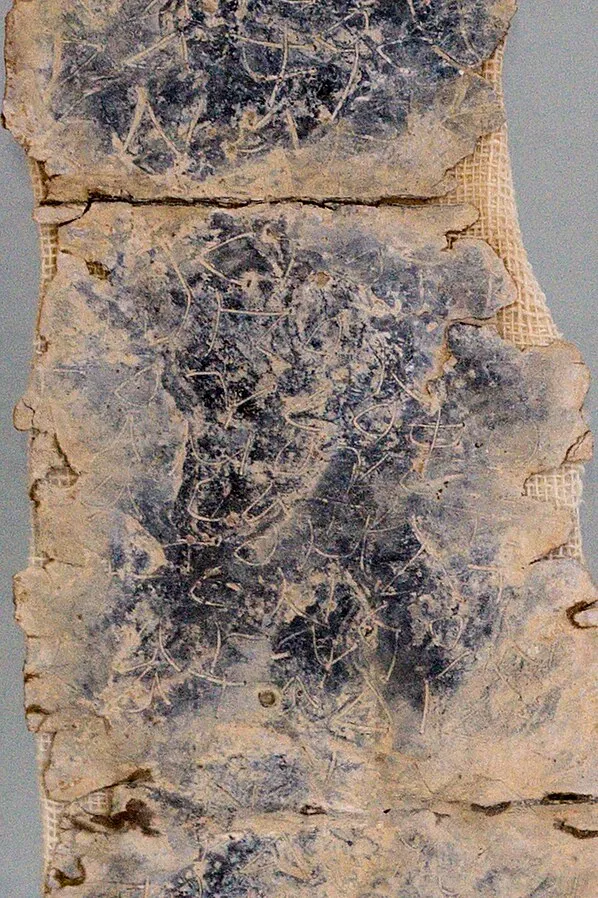
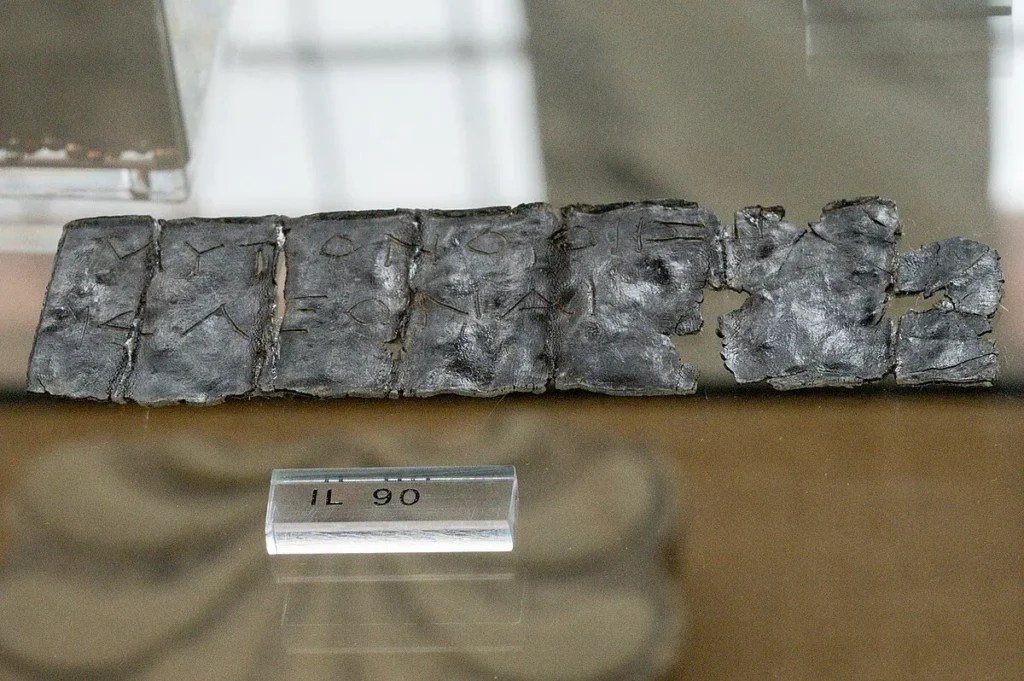
Curses are short, but they preserve vivid Greek. Writers use the local dialect, then switch registers inside the spell. Formulae like “I bind,” “I hand over,” or “until she submits” repeat across regions, while dialectal spellings reveal where a tablet was written. Names preserve local onomastics. Judicial curses tend to use large or clear letters, likely because they name many targets. Erotic curses often run in continuous script where the intensity of command and the rhythm carry the force. Lines can snake across the sheet. Words can be split or stacked, especially where the scribe wants to pile up binding verbs.
Some tablets include magical alphabets, figure-like letters, or symbols. These signs on Greek lamellae do not form a secret code. They compress an action that words also perform. A trident of lines can stand for piercing. Ladder shapes can suggest ascent or descent. When letters are written backward or boustrophedon, the unusual movement announces that the text belongs to another order of speech.
Names and Networks
Tablets read like city address books. They list litigants, witnesses, lovers, and family members. In northern Greek sites, men named Pausanias, Amyntas, and Philippos appear alongside women like Euboula, Stratonika, and Antiphila. The lists reveal social networks in miniature. A judicial curse might bind not only the main opponent, but whoever stands “with” him, an attempt to net friends and allies inside the same ritual fence. Erotic curses name the beloved, then capture a rival’s identity, a reminder that desire sits within city life, not outside it.
Because the tablets are inscribed by many hands, they also preserve literacy gradients. Some lines flow in practiced epigraphic capitals. Others stumble, repeat, and show correction marks. A petitioner could hire a specialist scribe, a goēs or magician. More often, ordinary people scratched a few lines as best they could. The handwriting, mistakes, and additions record individual fear and hope with unusual intimacy.
Gods, Spirits, and the Dead
Curses approach the divine with mixed etiquette. A few texts address gods with formal epithets: Hermes Chthonios, Persephone, Hecate, and the Erinyes. Others rely on unnamed daimones, the restless dead, or the “spirits below.” Petitioners ask these powers to seize a tongue, weigh down hands, or trap a mind in distraction. Many tablets call for alternating heat and cold, fevers and chills, as a way to shake resolve. The gods do not act alone. The dead carry messages and enforce the writ where living law cannot.
The list of addressees hints at the moral logic of cursing. A litigant does not demand death. He wants a fair hearing with stacked odds. A lover wants attention, not annihilation. Even where the language sounds violent, the form and target show a narrower aim: restraint, confusion, delay, or separation. The binding lasts “until” the beneficiary gets what he asked for. The tablet itself declares the condition that will release the spell.
Nails, Needles, and Figurines
Physical gestures frame the writing. Pierced tablets are common. A nail shot through the roll clinched the effect and locked the text. Tablet and body mirror each other. To restrain a person, the writer restrains the lead. Figurines appear with some deposits. They can be bound or pierced, then buried with the tablet. The small effigy stands in for the target, a material proxy that suffers the force named in the words. Hair clippings, threads, and scraps of clothing serve the same purpose by carrying a bit of the person’s ousia, or essence.
Built out of a love for history, kept free from distractions.
Spoken Past is an independent project shaped by curiosity, care, and long hours of research. Reader support helps keep it maintained, carefully researched, and open to everyone.
Why People Turned to Cursing
Risk, Uncertainty, and Asymmetric Tools
Greek cities prized public procedure, but procedure alone could not guarantee outcomes. Litigation involved memory, rhetoric, and alliances. Courting a lover involved reputation, family pressure, and distance. Small traders faced swings in demand. Curse tablets offered an asymmetric tool. For a few coins and an hour’s work, a petitioner could recruit gods and the dead to press his case.
Tradition at the Edge of Respectability
Binding spells sat at the edge of acceptable practice. Public religion did not celebrate them, yet their formulas borrow public language. Petitions ask for justice. Erotic spells speak the language of desire that lyric poetry made famous. The very fact that tablets were hidden shows a shared understanding: these rites were powerful and risky. They promised help in the cracks of law and custom, where luck and fear ruled.
The Ethics Inside the Spell
Some texts sound cruel. Yet they contain their own brakes. Writers define a condition that ends the binding, for example a fair verdict, a returned item, or a lover’s consent. The goal is not endless harm. It is leverage. Even when a tablet calls on the Erinyes, it calls them as prosecutors and enforcers. The petition seeks a specific result and sets terms for release.
How Scholars Read Tablets Today
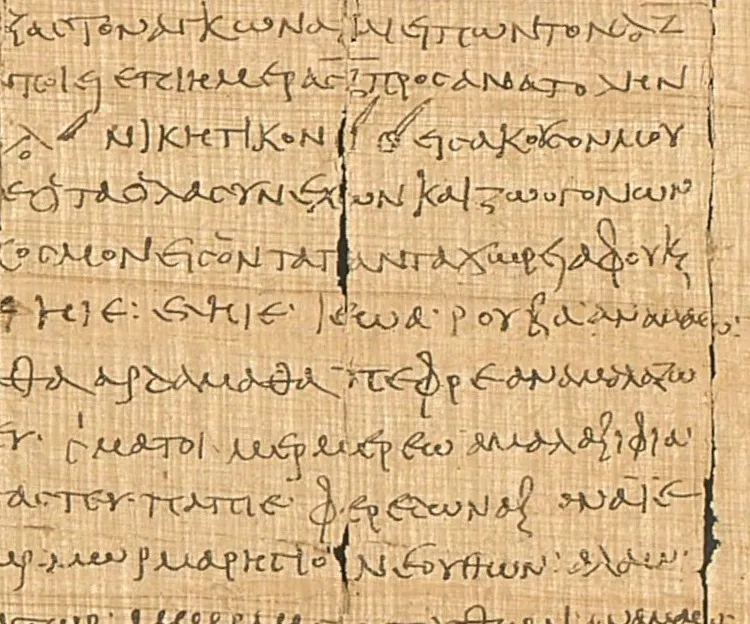
Curses are hard to read because most were rolled and buried. When excavators unroll a sheet, edges flake. Letters vanish. Editors reconstruct lines by analogy with better preserved texts. They compare dialect features to place tablets in space and time. Many dossiers come from Macedonian sites in the fourth century BC, others from Attica, Euboea, the Peloponnese, and Greek Sicily. The Greek Magical Papyri, a collection from Roman Egypt, supplies parallels for voces magicae and ritual directions, which helps unlock obscure parts of metal lamellae.
Beyond language, scholars track social context. Judicial curses cluster where popular courts flourished. Erotic curses appear where urban life squeezed men and women into tight spaces of rivalry and gossip. Business curses attach to crafts and entertainment. The patterns show that cursing was not a fringe habit. It was a quiet second track of action whenever stakes were high and control felt thin.
A Walk Through a Tablet: From Address to Deposit
Imagine a litigant named Theopropos who faces trial next week. He writes: “I bind the tongues and minds of Euippas, Amyntor, and whoever speaks with them.” He repeats the verbs in a string, then adds Hermes Chthonios and the Erinyes. He scratches the lines with a stylus into a thin lead sheet cut from a reused scrap. He rolls the sheet, pierces it with a nail, and carries it at night to a well in a public neighborhood. Theopropos drops it in, hears a small metal clink, and walks home. In the morning he still must argue his case, but he believes he has shifted the odds. He has placed his cause in hands that move unseen.
Curses and the Living City
Curse tablets remind us that Greek cities housed both dazzling public speech and private fear. Courts and assemblies train citizens to speak in daylight. At night, in the cemetery, writing runs small and cramped along a lead ribbon. The same names appear in both venues. A man who addressed a jury in the morning may have dropped a tablet in a grave at dusk. A woman who poured a libation to a goddess at a festival may have tied a strip of lead to a sanctuary fence and asked for a thief to be exposed. The texts preserve that double register with unusual clarity. They are the city’s whispers.
Why the Words Seem Repetitive
The repetitive style is deliberate. Binding works by saturation. The writer lists body parts and faculties to close loopholes. If the tongue slips the snare, the mind will catch. If the hands try, the feet will fail. Repetition builds rhythm, and rhythm builds force. In a ritual context, saying something three times is not pedantic. It is power.
What These Tablets Do Not Show
They do not show absolute uniformity or a single underground church of magic. Curses differ by region, need, and scribe. Some sound formal, others raw. Some mix high gods and underworld spirits. Others avoid named divinities and hand the case to the dead. Many are fragmentary. There is no master book of spells behind them, although handbooks did exist. The evidence shows a shared grammar of binding rather than a fixed liturgy. Variation is not a flaw. It is how everyday people fitted ritual to their very specific problems.
What People Wrote, Summed Up
They wrote names, commands, and conditions. They bound tongues for court. They separated rivals in love. They asked gods at sanctuaries to punish thieves and liars. They rolled, nailed, and buried the lead to send their words down. They trusted Hermes Chthonios, Hecate, Persephone, the Erinyes, the nameless dead, and whatever spirits lived in wells and graves. They hoped to turn risk into certainty, or at least to push chance in their favor.
FAQ: Greek Curse Tablets
What is a katadesmos?
A katadesmos is a Greek binding spell written on a thin metal sheet, usually lead. The word means a tying down. The text names a target and commands restraint, then the tablet is rolled, pierced, and deposited in a grave, a well, or a sanctuary.
Were curse tablets illegal?
Open practice could be frowned upon or prosecuted under broader laws against harmful rituals, which is one reason tablets were hidden. The surviving evidence suggests a tolerated gray zone rather than constant prosecution.
Who wrote them, and could women curse too?
Many tablets look self-written by ordinary people. Some show trained hands and formulae that point to hired ritual specialists. Women appear as petitioners and as targets, especially in erotic and domestic disputes.
Why use lead instead of papyrus?
Lead was cheap, soft, and durable. It preserved letters underground and signaled a binding meant to last. Writers sometimes reused scrap lead from other trades.
Which gods appear most often?
Hermes in his underworld role, Hecate, Persephone, and the Erinyes are common. Some tablets address unnamed daimones or the dead. Judicial curses frequently invoke powers tied to speech and justice.
Did curses aim to kill?
The standard goal was restraint rather than death. Most texts ask for confusion, silence, sleeplessness, or separation until a condition is met, such as a verdict or the return of affection.
How long did the binding last?
Many tablets state “until” a condition. Without such a release clause, the act of unrolling or physically breaking the tablet could symbolize an end, although the texts seldom explain undoing in detail.
What kinds of places yield the most tablets?
Cemeteries, wells, and sanctuaries are primary. Cemeteries use the dead as messengers. Wells deliver to chthonic spaces. Sanctuaries, especially of gods linked to justice, receive public petitions against theft or slander.
Why do some tablets include nonsense words and symbols?
Voces magicae and signs mark a shift to ritual speech. They are thought to carry intrinsic power and to signal to divine readers that the text belongs to a special register.
How do we know what missing parts said?
Editors compare fragments with better preserved parallels, weigh dialect features, and reconstruct patterns that recur across regions. The Greek Magical Papyri offer additional clues to formulas and ritual steps.