
The story opens with a world where the central plains have turned into a swamp of snakes and dragons, people are living in tree‑top nests, and only the high mountain caves offer dry ground.
Later writers remembered this early flood age as a time when water, beasts, and humans all mingled without clear boundaries, and it is inside this unstable landscape that beings later remembered as dragon kings and river spirits first emerge.
Flood waters, snakes, and dragons
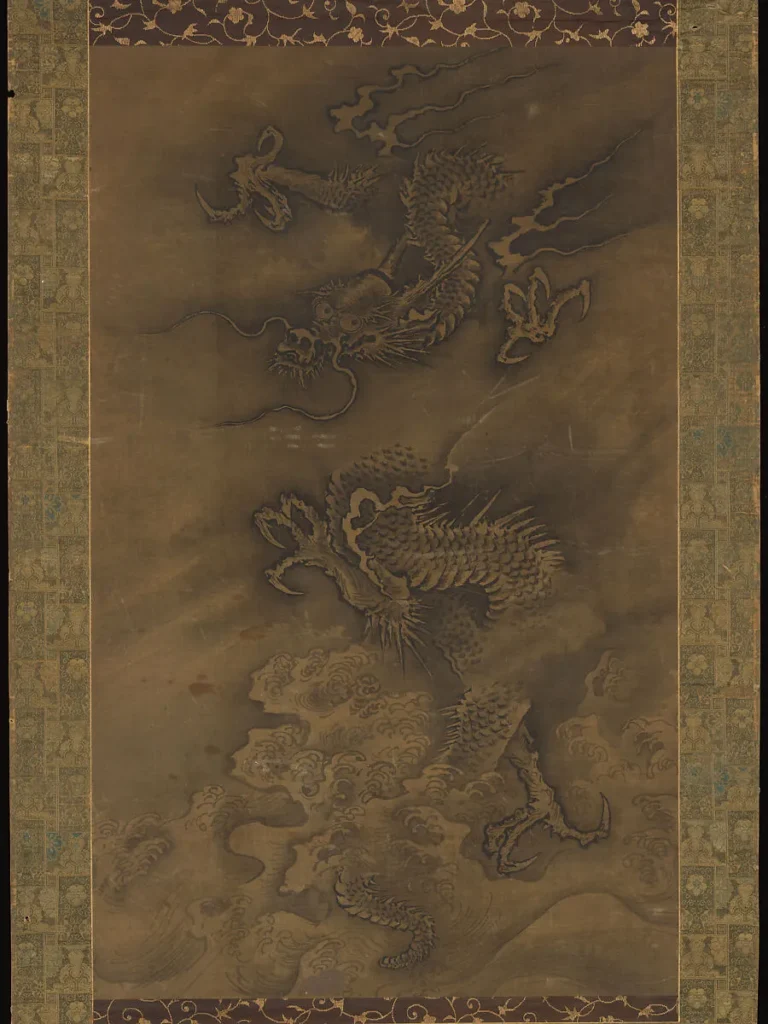
In one influential account, the great flood is described not as a simple wall of water, but as a collapse of all distinctions: wild grasses and forests overwhelm fields, birds and beasts crisscross the “middle kingdoms,” and venomous snakes and dragons occupy lands where people should live.
The sage kings respond in stages: first burning off the wilds and driving animals away, then having Yu dredge and guide the rivers until the waters finally flow into the four seas and stable farmlands appear.
These stories treat flooding rivers as living forces whose surging or calming expresses the moral state of rulers, so that hydrologic work is never only engineering, but always also a test of right rule.
When Yu succeeds in channeling the waters, he is said to “restore the Nine Provinces,” raise sacred mountains, and open river routes that carry tribute to the royal center, turning dangerous currents into pathways tying distant regions into a single political space.
In this context, dragons and snake‑bodied beings are not decorative monsters, but images of watery power and boundary crossing, especially when they are linked with rivers, seas, and storm clouds.
Dragon Kings in river myths
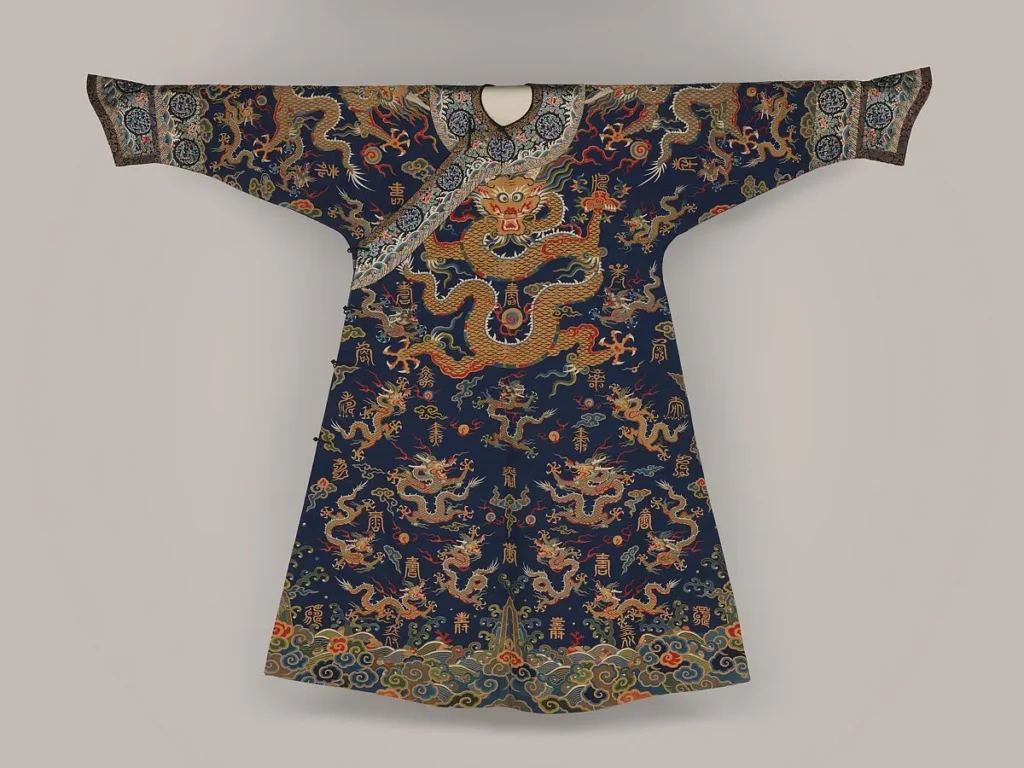
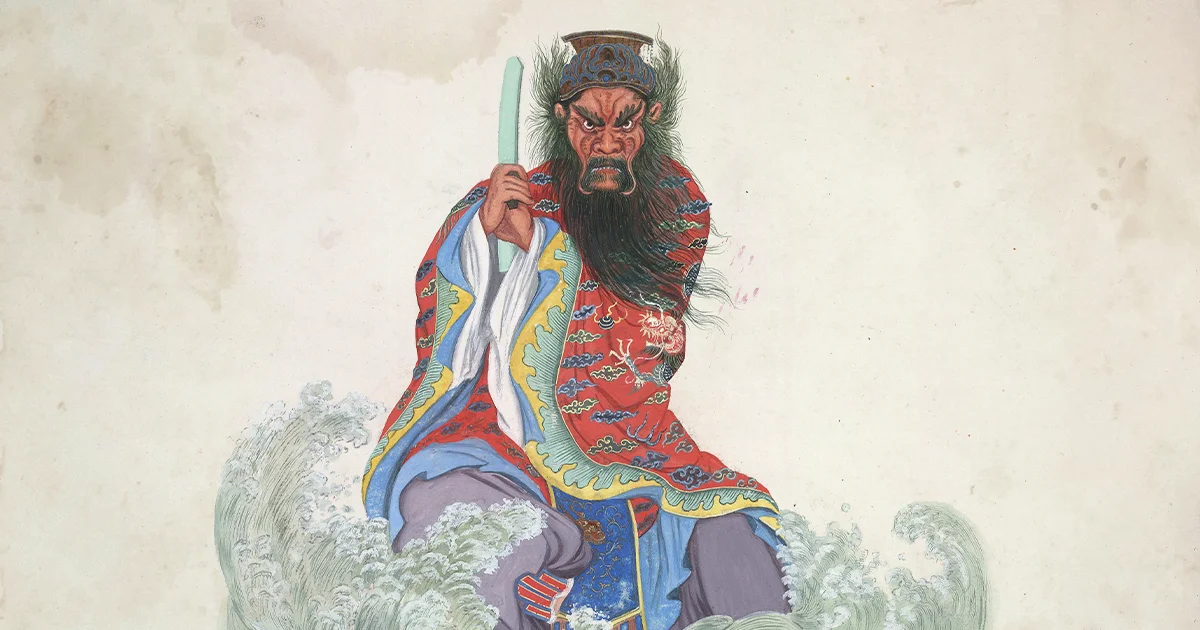
The figures that later readers would group under the idea of dragon kings are a cluster of dragon‑shaped or snake‑bodied powers who command water, send floods, or grant fertility to the land.
Some appear as outright rebels, like Gong Gong, whose very name is tied to wanton violence and uncontrolled waters, and who in several accounts stirs up a flood “rampant to Heaven,” battles the rightful thearch, and is finally drowned or executed.
Others resemble local river lords: in Sichuan stories, a wicked dragon dwelling in a deep pool causes repeated flooding until a hero defeats it in combat and imprisons it beneath a stone pillar, after which the surrounding plain can be safely irrigated.
These dragon figures can also be protective, as when Yu’s work is said to be aided by a yellow dragon that drags its tail through the mud to carve channels, or when dragon lineages are remembered as ancestors of ruling houses who control water and fertility.
Even creator deities are imagined with dragon bodies: Fu Xi and Nüwa often have human torsos above intertwined snake or dragon tails, and in some accounts their union or cooperation underlies both the ordering of waters and the establishment of kingship.
In this way, early tales present would‑be dragon kings as ambivalent rulers of currents and rain, whose favor brings crops and safe passage, but whose anger or rebellion unleashes floods that erase the human world.
Yu and the ordering of rivers
Yu stands at the center of early Chinese flood mythology as the human who learns to work with water rather than against it, and his success defines how later narratives imagine legitimate control over river spirits.
Where earlier figures like Gong Gong and Gun are said to try to dam rivers or fill lowlands, Yu systematically dredges and guides each major waterway so that they follow their “natural tendencies” to the seas rather than spread across the plains.
Texts describe him cutting channels for the Ji and Luo, opening the Ru and Han, arranging the Huai and Si, and ensuring that the Yellow River and Yangzi flow separately instead of merging into an “endless sea” that forces people into trees.
This hydraulic work is always paired with political and ritual achievements: Yu divides the land into Nine Provinces, establishes paired sacred peaks and rivers, and fixes tribute routes so that wealth travels by water from the periphery to the royal center.
Later inscriptions and local histories in regions like Kuaiji and Sichuan claim Yu as their patron, building temples at places linked to his marriage, tomb, or meetings with spirits, and presenting him as a prototype for any official who manages a river or irrigation project.
Because Yu succeeds where his father Gun fails, he also embodies the moment when flood control stops looking like a violent struggle against dragon powers and starts looking like the kind of ordered negotiation expected from a king.
Built out of a love for history, kept free from distractions.
Spoken Past is an independent project shaped by curiosity, care, and long hours of research. Reader support helps keep it maintained, carefully researched, and open to everyone.
Rebels, floods, and river gods
Early sources repeatedly link catastrophic floods with rebellion or criminality, so that punishing water becomes a model for punishing human offenders as well.
Gong Gong can be a corrupt official recommended to Yao, a would‑be usurper who rams the cosmic pillar of Mount Buzhou so hard that Heaven tilts and waters rush southeast, or a king who rules by letting water cover seven‑tenths of the world.
In one strand of tradition he “stirs up the waters into a rampant flood” until Yu is dispatched to open Dragon Gate and other chokepoints, separate the Yellow River from the Yangzi, and drain the land so that the Nine Provinces re‑emerge.
Gun, whose name is tied to a giant fish, sometimes accompanies Gong Gong as a failed water‑worker, using blocked embankments and stolen earth instead of open channels, and is executed when his techniques worsen the deluge.
Later accounts let Yu inherit or even be born from Gun’s body, seize “his predecessor’s task,” and complete his father’s work, which keeps the memory of criminal flood methods alive inside the very hero who corrects them.
These stories make clear that controlling a river is also a form of sentencing, since rebellious beings and peoples are exiled to the world’s edges or submerged in depths, much as later generals earn titles like “Wave‑Quelling” for putting down revolts in the southern commanderies.
A few key actors in this drama of rebellion and water include:
- Gong Gong, a watery rebel whose violence topples cosmic pillars, unleashes floods, and must be killed or drowned before order can return.
- Gun, a quasi‑fish ancestor whose flawed embankments and refusal to follow “the nature of water” prepare the way for Yu but mark him as a criminal predecessor.
- Xiangliu and other monsters, dragon‑like beings whose devouring of mountains and conversion of land into marshes extend Gong Gong’s destructive work.
Local cults of rivers and flood tamers
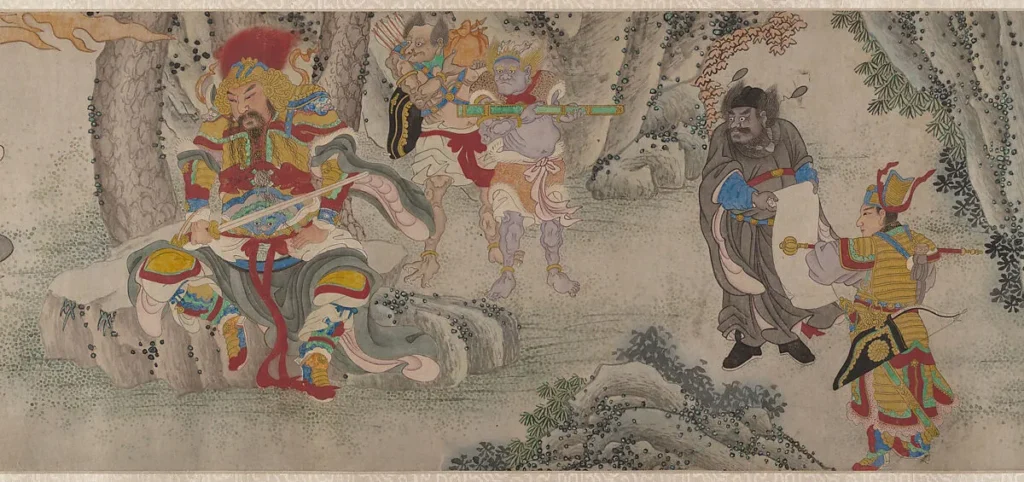
Alongside the grand sagas of Yao, Shun, and Yu, regional traditions present more localized river spirits and human patrons who look very much like district‑scale dragon kings.
In the southeast, texts portray Yu as the founding patron of Yue: he holds a great assembly of spirits at Kuaiji, executes a giant named Fangfeng for arriving late, and leaves a grave and altar that become the first sacred sites of the region.
Stories about his visit explain distinctive Yue customs, such as birds working in the fields in ranked lines, as gifts from Yu to repay the people for their labor on his tomb and flood works.
Far to the west in Sichuan, Yu’s role as archetype of the flood tamer is echoed in the historical official Li Bing, who builds the Dujiangyan diversion system and then becomes a river god receiving offerings and statues in his own temple.
Later Sichuan tales give the starring role to Er Lang, eventually identified as Li Bing’s son, who roams the region, discovers a dragon responsible for floods, defeats it in battle, and pins it beneath a pillar in a deep pool.
Although these Er Lang stories are later in form, they show how people along a specific river could imagine their safety as depending on a local hero’s victory over a dragon‑spirit that personified the river’s dangerous strength.
Many of these cults present the same basic cast of powers in local guise:
- A dangerous water spirit, often dragon‑like, linked to a particular stretch of river or sea.
- A human official or culture hero, credited with engineering works and also worshiped as a god after death.
- A ritual center, such as a temple, mountain shrine, or tomb, where offerings and petitions for rain, safe passage, or flood control are addressed to the spirit.
In this landscape, the difference between a river spirit, a local dragon, and a remembered official becomes thin, which is why later language about dragon kings fits these early patterns so easily.
Nüwa, dragon bodies, and cosmic rivers
Another path into early ideas of river lords runs through the myths of Nüwa, a goddess who combines dragon form, fertility, and world‑repair after the flood.
One influential account pictures the world after a cosmic disaster: the four corners of the earth collapse, the sky no longer fully covers the land, fires and floods rage without stopping, and fierce beasts and birds of prey devour unprotected people.
Nüwa responds by smelting “five‑colored stones” to patch the sky, cutting off the legs of a gigantic turtle to prop up the four quarters, killing a black dragon to rescue the central province, and piling reeds’ ashes to halt surging waters.
These five‑colored stones evoke the Five Phases, so her work is not only mechanical repair but re‑harmonizing the temporal and elemental cycles that had been thrown out of joint.
Elsewhere, Nüwa is said to have fashioned humans from yellow earth or mud and to preside over the transformations of the fetus, making her the patron both of human bodies and of the fertility that floods both threaten and sustain.
Han tomb art regularly pairs Nüwa with Fu Xi as intertwined snake‑bodied figures holding tools or celestial emblems between sun and moon, visually bridging Heaven, Earth, and the watery underworld in the way dragon kings are imagined to connect sky, rain, and river.
Because they stand guard at tomb gates or coffin lids, these dragon‑bodied deities also act like custodians of safe passage through dangerous liminal zones, just as river spirits must be placated for safe crossings in life.
Sacrifice, philosophy, and river spirits
Alongside mythic narratives, Warring States and Han texts argue over how humans should deal with spirits, including the powers that inhabit rivers and floods.
Ritual specialists claim to know which animals are acceptable for sacrifices and which bodies are inauspicious, as when certain oxen or pigs cannot be offered in a “river sacrifice,” and they present themselves as mediators who keep human and spirit realms in proper hierarchy.
Philosophical writers often criticize these specialists, not because they deny spirits, but because they object to attempts to manipulate divine realms for gain or to overstep the separation between human and numinous powers.
One text praises a “spirit‑man” who is not harmed by floods, droughts, lightning, or freezing rivers, yet does not seek to control them, instead accepting life and death as part of Heaven’s order and refusing to cling to things that “can never overcome Heaven.”
Another argument insists that sacrifice should be a form of self‑cultivation rather than a technique for forcing spirits to act, while yet another warns that trying to gain the same powers as spirits undercuts the very distance that makes ritual meaningful.
A different voice develops a monistic cosmology in which humans, spirits, and natural forces all share qi, and argues that misrule generates “bad qi” which shows up as disasters and anomalies in rivers, seasons, and stars.
In this view, ordering rites correctly and governing with humanity allows rulers to “summon spirits” and bring Heaven, Earth, and rivers into harmony, not by becoming gods themselves, but by aligning human action with patterns already present in the cosmos.
Taken together, these debates show that early thinkers saw river spirits as real powers whose favor or anger manifested in floods and droughts, but they differed sharply on whether kings should try to become like dragon kings themselves or accept a more limited, ritualized role.
In the end, the surviving stories suggest that early China imagined a spectrum of watery beings, from rebellious dragons that tear down pillars and drown the land, through tamed river gods honored at local shrines, to cosmic dragon couples who knit together sky, earth, and sea.
The evidence does not present a single, fixed doctrine of dragon kings, but it does show recurring patterns in which dragons, rivers, and sovereignty are tightly linked, leaving room to see later dragon kings as heirs to these older myths of flood, order, and negotiation with river spirits.
Much remains uncertain, since our sources are fragmentary and often reworked, yet they allow a clear sense that when early writers pictured dragon kings and river spirits in early China, they were thinking about how human rulers lived with, bargained with, and sometimes defied the dangerous waters that framed their world.