
Long before the Lydians stamped the first coins from electrum in the seventh century BCE, people across the ancient Near East, Egypt, and the Indus Valley had already been conducting complex commercial transactions for over two thousand years without them. They set prices in weight-silver and measured grain, cleared debts through entries in administrative ledgers, moved bulk metal value in standardized ingot forms, and guaranteed the integrity of goods through cylinder seals pressed into clay. These were not primitive approximations of a monetary economy waiting for coins to complete them. They were fully functional systems for storing, reckoning, and transferring value that addressed every practical need their societies had, and they worked at scales ranging from a daily ration of barley to the cargo of an entire merchant ship. Understanding how ancient economies worked without coins requires separating the functions that money performs from the specific material forms it takes.

The functions of money before coins existed
Economists identify three core functions that any money system must perform: serving as a unit of account so that prices can be stated and compared, acting as a means of exchange so that transactions can be settled, and functioning as a store of value so that wealth can be preserved across time. Ancient economies before coinage fulfilled all three of these functions, just with different materials and institutions than modern people are accustomed to. The British art historian Charles Seltman captured the distinction concisely: metal used to facilitate the exchange of goods is currency; currency used according to specific weight standards is money; money stamped with a device is coin. By this definition, money existed for millennia before coins, and the invention of coinage was a refinement of existing practice rather than a revolution that created exchange out of nothing.
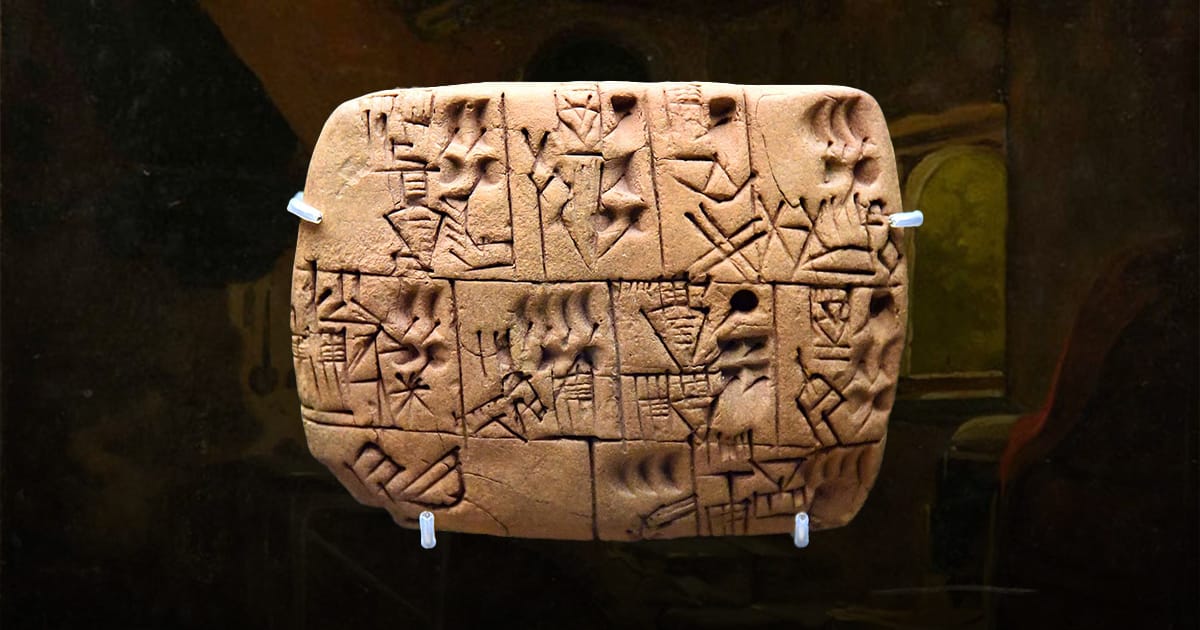
The standard myth of economic history holds that ancient people bartered goods directly until coins made complex trade possible. This picture misrepresents how pre-coinage economies actually functioned. Cuneiform tablets from Ur III Umma, dated to around 2100 to 2000 BCE, show a sophisticated accounting system in which state-sanctioned merchants received capital goods from administrators, traveled to obtain imports, and settled their accounts in silver by weight when they returned. Prices were stated in shekels of silver even when the actual settlement happened in grain, textiles, or other commodities. The accounting language was silver; the physical exchange could be in anything the parties agreed upon. Barter, where it occurred at all, was a local expedient for small face-to-face transactions, not the organizing principle of an economy.
How Egypt’s deben weight system worked
The ancient Egyptians developed one of the best-documented weight-based exchange systems of the pre-coinage world. Beginning around 3100 BCE, they used a unit called the deben, equal to approximately 93.3 grams, as a standard measure of value. During the Twelfth Dynasty of the Middle Kingdom, around 1985 to 1773 BCE, the system was refined to include a smaller unit called the kite, ten of which equaled one deben, used specifically to measure gold and silver. The deben did not represent a coin or a physical object that changed hands in every transaction. It was an accounting unit, a shared language for stating prices, the same way modern accounting uses a currency unit even when no physical cash changes hands.
Egyptian papyri and ostraca from settlements like Deir el-Medina, the artisan village at Thebes where the workers who built the royal tombs lived, show how this worked in practice. A villager might list an axe as worth 25 deben of copper, a tunic at 5 deben, and a jar of fat at 1 deben, then agree to trade the tunic and jar for the axe. No metal changed hands. Both parties simply agreed that the goods were equivalent in deben terms, and the transaction settled. When metal did change hands, it came as weighed pieces, hacksilver or copper scraps or rings, assessed on a balance scale by both parties before settlement. The act of weighing was a public and formal moment that both participants and witnesses could evaluate.

The silver standard of Mesopotamia
In Mesopotamia, palace and temple economies of the third millennium BCE ran on a parallel system in which weighed silver served as the primary reckoning unit alongside measured barley. The shekel, originally a weight unit equal to approximately 8.3 grams, was the basic accounting measure; sixty shekels made one mina, and sixty minas one talent. These were not denominations of coins but units of weight applied to silver ingots, rings, or scraps that could be divided and weighed to any amount required for a given transaction. Administrative tablets from Ur III period Umma, examined by economists studying ancient Near Eastern commerce, show a highly centralized system in which a comptroller distributed capital goods to licensed merchants, who then acquired exotic imports and settled their accounts with the palace through silver-denominated entries in the administrative ledger.
Published equivalence rates converted between silver and other commodities at officially set ratios that could shift with harvests and political circumstances. In normal years, one shekel of silver might be officially equivalent to a set volume of barley, allowing prices for both to be stated in the same unit and exchange to happen across commodity types without direct barter. When harvests failed or political disruption cut supply chains, the rates moved, and administrative texts recording the changes preserve a record of economic stress that complements the more dramatic narratives of military and political history. The absence of physical coins did not mean the absence of prices, credit, debt, or financial calculation. It meant those things operated through different instruments.

Built out of a love for history, kept free from distractions.
Spoken Past is an independent project shaped by curiosity, care, and long hours of research. Reader support helps keep it ad-free, sponsor-free, and open to everyone.
Oxhide ingots and how metal moved value across the Bronze Age world
For long-distance trade, where carrying weighed silver for every transaction was impractical, bronze-producing societies of the Late Bronze Age developed standardized metal forms that made large-value transfers more manageable. The most distinctive of these were the copper oxhide ingots, flat rectangular blocks of nearly pure copper with corner extensions that provided handles for carrying and stacking. The Uluburun shipwreck, excavated by the Institute of Nautical Archaeology off the coast of southern Turkey, carried 354 copper oxhide ingots totaling ten tons, alongside approximately one ton of tin ingots, when it sank sometime around 1300 BCE. The ingots were stowed in four rows across the ship’s hold in a herringbone arrangement specifically designed to prevent shifting at sea, indicating that this was a routine and carefully managed cargo rather than an improvised load.
The oxhide ingot’s distinctive shape was not decorative. The corner extensions provided carrying handles for moving individual ingots, each weighing between ten and thirty-seven kilograms, and the standardized form allowed merchants to count and estimate value quickly without weighing every piece. Lead isotope analysis of the Uluburun ingots has traced the copper to Cyprus and the tin to sources in the Taurus Mountains of Turkey and, for roughly a third of the cargo, to mines in Central Asia’s Tajan and Uzbek highlands, indicating that the Late Bronze Age metal supply chain reached over two thousand miles from the eastern Mediterranean to Central Asia. A merchant anywhere in this system who received copper oxhide ingots knew exactly what he had, how to price it, and how to cut it to the size needed for a workshop or a smaller transaction.

How ancient economies built trust without coins
The greatest challenge for any exchange system operating without state-guaranteed coinage is trust: how do transacting parties know the weight is honest, the quality genuine, and the promise enforceable? Ancient economies before coinage addressed this problem through overlapping layers of institutional guarantee. Cylinder seals and stamp seals pressed into the clay stoppers of storage jars, baskets, and doors created tamper-evident closures that identified the packer and the authority responsible for a shipment. A broken seal left visible evidence of interference that could be reported to the palace or temple administration that issued the original seal. Weights themselves carried authority marks: duck-shaped and lion-shaped weights inscribed with a ruler’s name or title signaled official oversight and gave merchants grounds to challenge a counterpart’s balance by appealing to the standard the state had publicly established.
Administrative tablets functioned as portable memory and transferable promises. A scribe could record a debt owed, a delivery accepted, or a balance to be settled at a future date, and that tablet had legal standing that could be invoked before palace judges if one party defaulted. Rather than transporting silver across cities for every intermediate transaction, merchants and officials moved tablets and account entries, with the physical settlement happening periodically when accounts cleared. This was not a primitive version of modern banking. It was a different solution to the same problem of enabling exchange between parties who were not physically exchanging goods of exactly equal value at exactly the same moment, and it worked because the administrative institutions that backed the records had the authority to enforce them.

Textiles, shells, and other pre-coin stores of value
Silver and grain were the dominant reckoning units in the ancient Near East and Egypt, but they were far from the only media through which value was stored and transferred. Fine textiles condensed substantial amounts of skilled labor into portable, divisible, and easily assessed form. They appear in Bronze Age treaty gift lists, in marriage settlements, and in the cargo manifests of merchant vessels alongside metal ingots and luxury ceramics. In early China, cowrie shells from the Indian Ocean served as a widely recognized exchange medium during the Shang Dynasty, from roughly 1600 to 1046 BCE. The tomb of Lady Hao at Anyang, dated to around 1250 BCE, contained over 6,800 cowries alongside bronze vessels and jade objects, placing shells among the most highly valued grave goods of one of the most powerful women in Shang society. Later Chinese bronze imitations of cowrie shells show how a natural organic medium was eventually standardized in a more durable material without adopting the coin form.
Bronze vessels, particularly bowls, tripods, and drinking sets, also circulated as high-value items in gift economies between elites across the Bronze Age Mediterranean. Their weight was recorded, their capacity sometimes marked by inscribed standards, and their recognizable form made them assessable by any party who received them. An Egyptian pharaoh sending bronze vessels to the king of Hatti as part of a diplomatic gift exchange was not being generous in an economically unserious way. He was moving value in a form that both parties could assess, store, and eventually convert to metal for other purposes if they chose to, using the same weighing and accounting infrastructure that handled grain and silver.

Why coinage eventually replaced these systems
The first coins were minted in Lydia in western Anatolia sometime in the late seventh century BCE, probably under King Gyges or one of his successors, from electrum, a natural alloy of gold and silver found in local river deposits. The invention was not motivated by dissatisfaction with weight-based metal exchange, which had functioned adequately for over two thousand years. It was motivated by specific practical needs that coins addressed more efficiently: paying soldiers and mercenaries in the field where scales and administrative ledgers were unavailable, collecting taxes in a portable guaranteed form from populations spread across a large territory, and facilitating small everyday transactions in markets where the cost of weighing and assaying metal on every purchase was prohibitive. The die stamp on a coin provided a state guarantee of weight and purity that eliminated the need for private assaying at the point of exchange, making small commercial transactions between strangers faster and cheaper.
Coinage did not replace pre-coinage exchange systems immediately or completely. Weighed silver, grain measures, and administrative account entries continued to operate alongside coined money for centuries after the first Lydian electrum pieces appeared. The transition was slow and uneven, varying by region, transaction type, and the depth of state involvement in local economies. What the invention of coinage changed was not the existence of pricing, credit, and value transfer, all of which had existed for millennia, but the cost of conducting those operations at small scale and at long distance between strangers who shared no administrative relationship. The pre-coinage systems that preceded coins were not primitive. They were solutions to the same problems that coins eventually solved, developed under different institutional conditions, and they worked well enough to support some of the most economically complex societies the ancient world produced.

Sources: Piotr Steinkeller, “The Administrative and Economic Organization of the Ur III State,” in The Organization of Power: Aspects of Bureaucracy in the Ancient Near East, SAOC 46 (Oriental Institute, 1987); Daniel C. Snell, “The Activities of Some Merchants of Umma,” Iraq 39.1 (1977); Cemal Pulak, Uluburun Late Bronze Age Shipwreck Excavation, Institute of Nautical Archaeology; Ian Shaw and Paul Nicholson, The Dictionary of Ancient Egypt (British Museum Press, 1995); Henry Breasted, Ancient Records of Egypt, vol. 2 (University of Chicago Press, 1906); Michael Jursa, Aspects of the Economic History of Babylonia in the First Millennium BC (Ugarit-Verlag, 2010).