

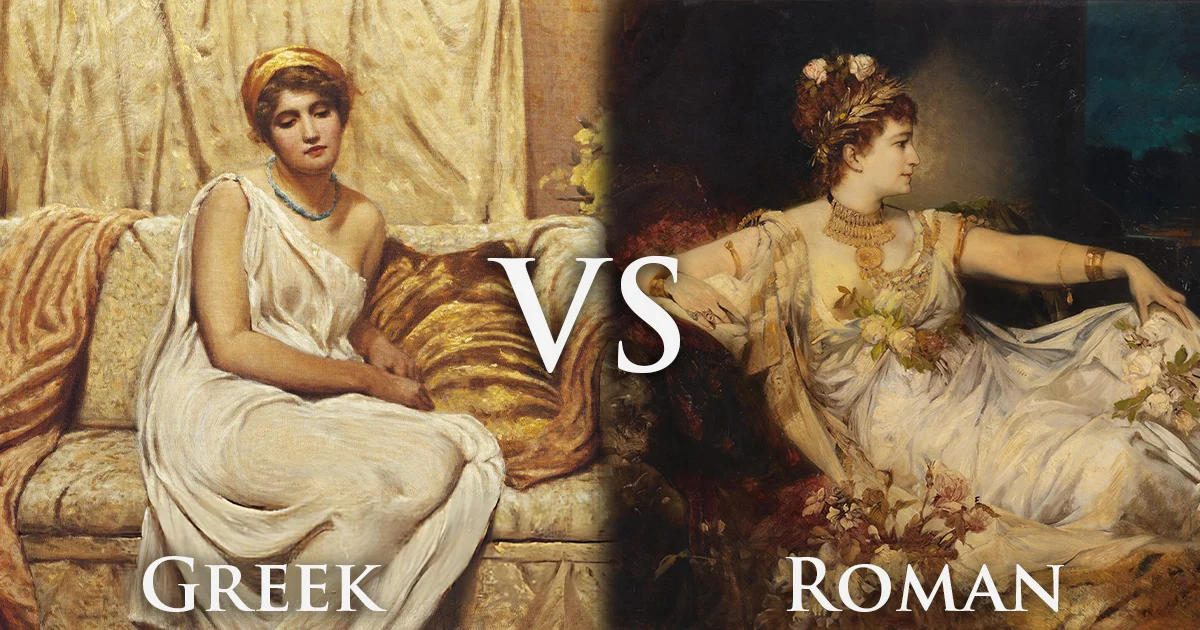
In a torchlit Roman wedding, a young bride steps forward in a bright saffron veil that covers her hair, her face, and almost her whole body, while in an Athenian procession a girl carries a heavy woolen robe woven for a goddess, its pinned shoulders and deep overfold hiding nearly every curve.
Already, the contrast hints at the core question of ancient Greece vs ancient Rome clothing: two Mediterranean societies used garments to warm and cover the body, but even more to mark status, gender, piety, and power.
Greek peplos and Roman stola
In much of archaic and classical Greece, the iconic female garment was the peplos, a large rectangle of wool folded, pinned at the shoulders, and often belted to create a deep overfold that concealed the torso and most of the legs.
Its heavy fabric usually hid the body’s shape so completely that front and back could look almost the same, especially in sculpture of the early classical period.
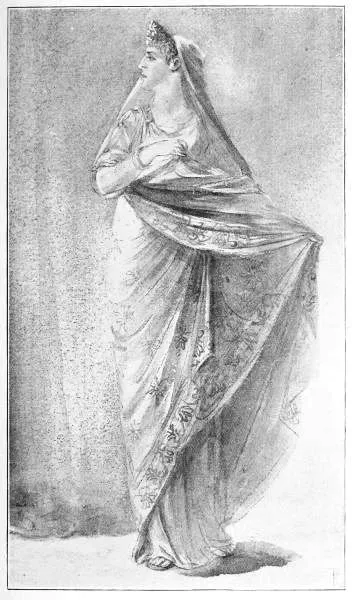
By contrast, the emblematic garment of the respectable Roman wife was the stola, a long over‑dress with shoulder straps, worn over a tunic and often finished with a colored border along the hem so that observers could recognize marital status even when a cloak covered the upper body.
Roman writers treated the stola as the visible sign of a lawful marriage, so strongly linked to respectability that the word itself could stand for the ideal matron.
Greek peploi were closely associated with myth and ritual, from the first woman fashioned for the gods’ purposes to the ceremonial robe offered to a city’s patron deity, and were especially tied to the dangerous, in‑between status of maidens whose sexuality needed containing.
Roman stolae, on the other hand, anchored a woman within a civic and legal order, marking her as a citizen’s wife and distinguishing her from slaves, freedwomen without such marriages, and women whose sexual behavior was publicly condemned.
Linen chitons and Roman tunics
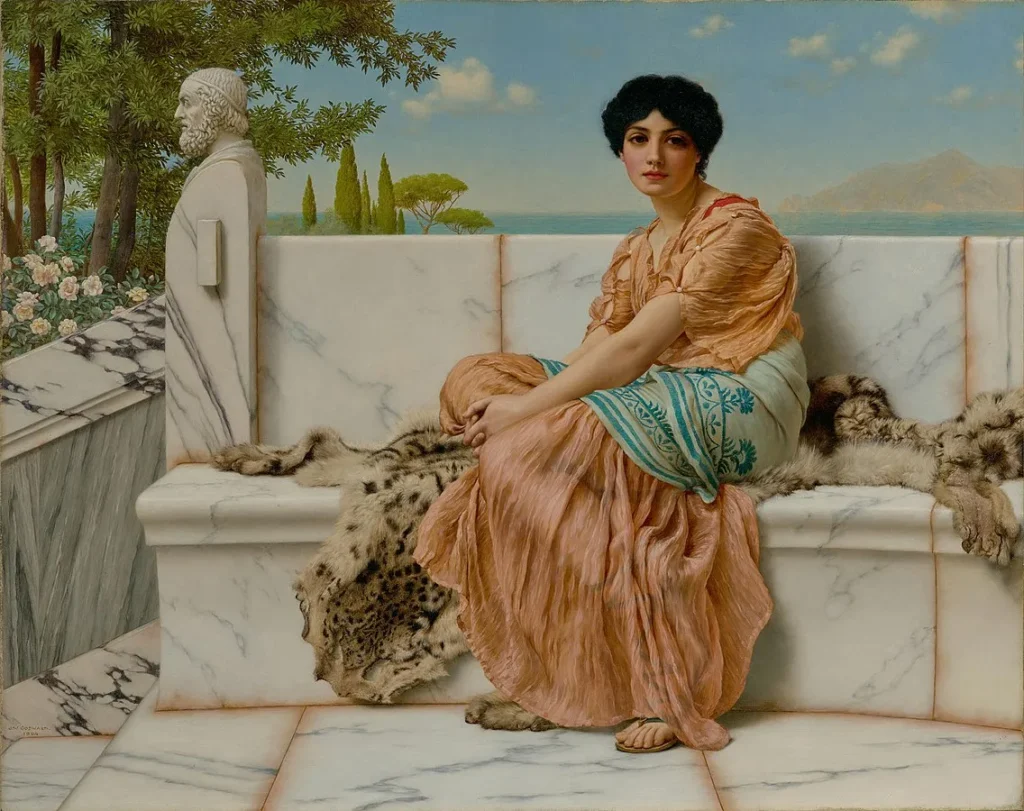
Over time many Greek women adopted the linen chiton, a sewn, sleeved garment that hung to the feet and could be fastened with buttons or stitching along the shoulders.
The chiton’s fine folds and sometimes sheer fabric allowed the shape of the body to show through, which made it both a symbol of luxury and a display of female fertility and desirability, especially when contrasted with the heavier peplos.
In Rome, the basic garment for women and men alike was the tunic, also reaching to the feet for women of status, but cut and sewn in ways that differentiated wearers by rank, gender, and occasion.
Elite women could wear long, voluminous tunics with decorative borders or woven stripes, belted high under the bust and combined with the stola and palla, while working women and slaves often had shorter or simpler tunics that freed their arms and legs for labor.
Greek chitons were explicitly linked to the eastern Mediterranean, both through language and through stories about their adoption, and remained associated with wealth, leisure, and refined living even after some Greek men abandoned them in favor of plainer cloaks.
Roman tunics, by contrast, were part of a conservative civic wardrobe in which even modest changes in length, sleeve shape, or added decoration could signal moral judgment, effeminacy, or luxurious excess.
Everyday ancient greece vs ancient rome clothing
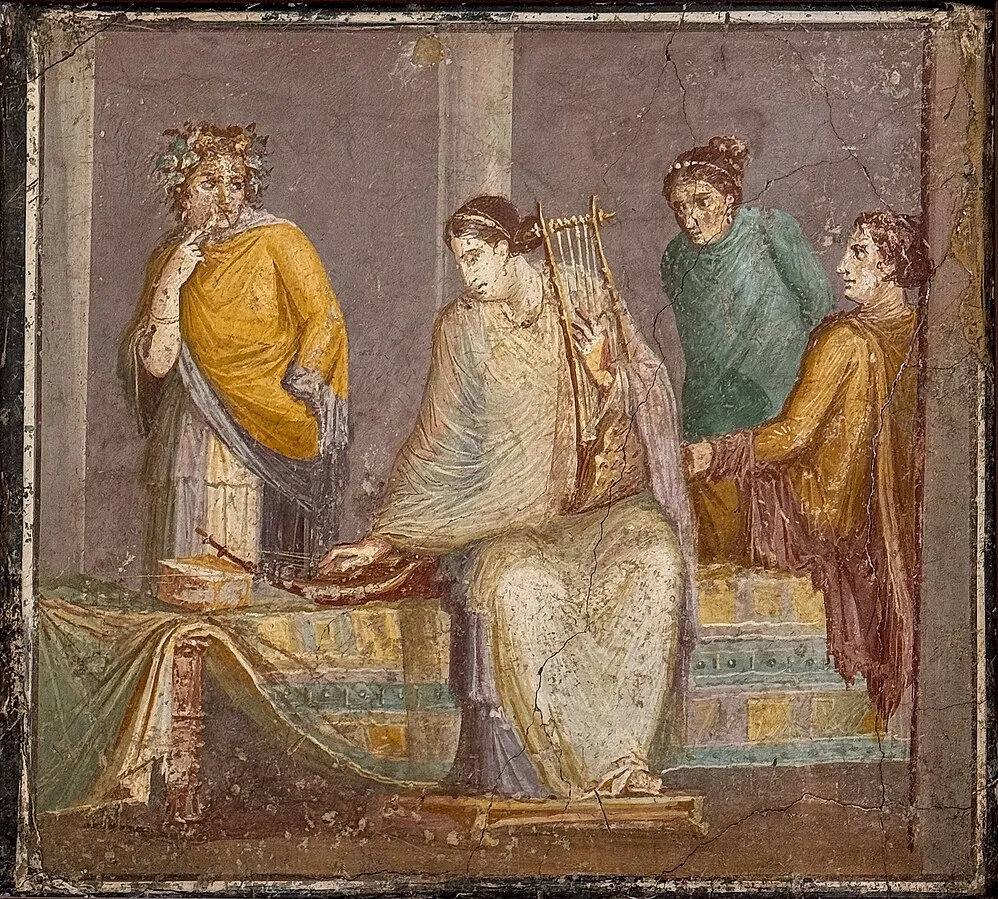
For everyday dress, many Greek men combined a chiton with a large mantle called a himation, or, increasingly, wore the mantle alone, wrapped in ways that signaled age, status, and even mood to those trained to read the folds.
Women usually wore a chiton under a mantle or peplos, so their daily clothing involved multiple layers of fabric that restricted movement and emphasized modest posture.
In Rome, citizen men were ideally identified by the toga, but in practice most daily work was done in tunic and cloak, while the toga appeared in courts, assemblies, and rituals.
Women’s everyday clothing consisted of long tunic, stola for those entitled to it, and palla, yet surviving evidence also shows many women, especially outside formal contexts, in just tunic and mantle without the full ceremonial package.
Greek garments were typically rectangles of cloth manipulated by pinning, folding, and belting, which allowed considerable variation in use over a lifetime, from plain everyday wraps to decorated ritual outfits.
Roman clothing, while still relying heavily on draped rectangles, incorporated more cutting and sewing, especially in tunics and some cloaks, which created more sharply differentiated garment types for specific roles.
Color, fabric and luxury
Both cultures valued color, but Roman writers spoke more often and more anxiously about the moral meaning of particular hues.
Greek evidence shows that white, purple, red, and black all carried strong associations with ritual purity, mourning, warfare, and status, yet everyday garments of ordinary people were likely in dull or undyed shades because bright colors required expensive dyes and maintenance.
Romans developed an even more explicit color code, with purple and scarlet linked to the highest ranks, special shoes and stripes for officeholders, and dark garments for mourning, while bright saffron was strongly tied to brides and to certain ritual contexts.
Laws and moral commentary in Rome targeted luxurious colors and fabrics more directly than surviving Greek regulations, which rarely limited dress outside specific religious settings.
As for fabric, Greek women in earlier periods favored thick wool for peploi and used fine linen for chitons, while wealthy households could afford textiles so delicate that later observers compared them to modern gauzes.
Romans retained wool and linen but also embraced cotton and especially silk, including transparent silk that critics condemned as morally dangerous because it displayed the body while pretending to clothe it.
Greek texts and images suggest that conspicuously fine garments, rich patterns, and imported styles signaled both prosperity and a certain distance from manual work, but the moral charge attached to such display was often muted compared to Rome.
Roman authors, by contrast, regularly linked women’s sumptuous fabrics, jewels, and elaborate styling to anxieties about luxury, social disorder, and the proper boundaries of female behavior.
Built out of a love for history, kept free from distractions.
Spoken Past is an independent project shaped by curiosity, care, and long hours of research. Reader support helps keep it maintained, carefully researched, and open to everyone.
Gender, modesty and the covered body
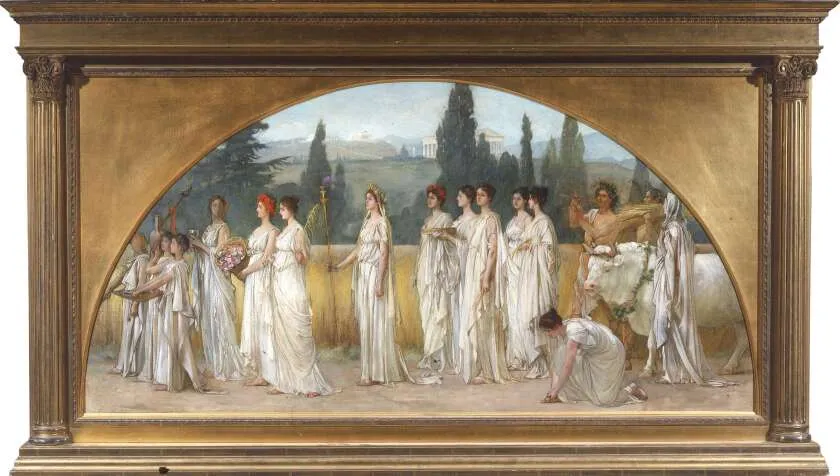
In both societies, clothing marked bodies as male or female and indicated how tightly a person should control movement, gesture, and visibility.
Greek women’s peploi and chitons covered the body from shoulders to feet, often in several layers, and could be rearranged to veil the head in public or ritual situations, turning fabric into a tool for modesty and controlled self‑presentation.
Similarly, Roman wives were ideally wrapped in long tunic, stola, and palla, and were often described as modest when veiled in public, even though portraits and paintings show that in practice many appeared unveiled in streets and forums.
Girls in both cultures had their own markers, from special garments dedicated at sanctuaries to particular amulets or fillets, which signaled age, virginity, and readiness, or unreadiness, for marriage.
Both Greeks and Romans used undress or partial dress to signify vulnerability, sexual availability, or social inferiority, whether in the bare limbs of servants and laborers or in the revealing outfits associated with entertainers and prostitutes.
Yet the Roman discourse on respectable and non‑respectable women’s clothing is much sharper, with certain garments and colors, like particular veils or even the toga in some accounts, used to separate honorable matron from adulteress and professional sex worker.
Greek imagery tends instead to emphasize the contrast between the well‑covered citizen woman and the patterned, fitted costumes of foreigners, warriors, or mythic figures, reserving extreme exposure for scenes of violence, madness, or ritual inversion.
In both worlds clothing operates as a kind of second skin that can either protect a person’s social identity or publicly strip it away.
Clothing, status and law
Textiles were expensive in Greece and Rome, so garments were long‑term investments that embodied wealth as well as modesty.
Evidence from contracts, price regulations, and temple inventories shows that outfits could be bought ready‑made, commissioned from specialists, or produced within households, and that fine fabrics, dyes, and decorations multiplied value far beyond raw fiber costs.
In Greek cities, explicit clothing regulations are rare and mostly confined to religious contexts, such as rules on color, footwear, or acceptable materials in sanctuaries and funerary spaces.
These rules underline how strongly clothing could signal ritual purity or pollution, but they do not amount to a general dress code for everyday life.
In Rome, by contrast, laws and moral discourse repeatedly addressed dress in public life, from who might wear specific stripes, colors, or jewels to limits on bridal and funeral display and anxiety over sumptuous foreign fabrics.
Women’s clothing in particular was supposed to display rank and sexual status, distinguishing citizen wife, unmarried girl, freedwoman, and prostitute through combinations of garment type, color, veil, and adornment.
Greek status distinctions are present but often subtler, expressed through size and quality of garments, complexity of drapery, and access to decorated mantles or foreign pieces, rather than through a long list of rigidly policed civic markers.
In both cultures, however, the wealthy could signal their position simply by owning more garments, rotating them to keep colors fresh and fabrics crisp, while the poor often relied on a few worn pieces that betrayed hard use.
Foreign styles and cultural identity
Greek representations frequently contrast native draped dress with the sewn, patterned, and tightly fitted clothing of peoples from Persia, Thrace, and other regions, including long‑sleeved jackets, trousers, and body‑hugging suits.
These outfits marked wearers as outsiders, even when they were mythic figures or slaves on Greek soil, and their close fit made them look almost like decorated skin compared to the loose Greek mantles.
At the same time, some Greek elites adopted selected foreign garments such as sleeved chitons, short over‑tunics, and luxurious fur‑trimmed coats, especially for festival wear or religious service, using them to show both wealth and cosmopolitan reach.
Women and children appear especially often in these imported styles, which reinforces a broader Greek tendency to associate femininity and foreignness with luxury.
Roman evidence likewise marks certain items as foreign, from Gallic hooded capes and heavy boots to eastern patterned robes and trousers, often used in art to identify barbarians, soldiers, or provincial figures.
Yet Roman elites also appropriated foreign fabrics and fashions, particularly rich silks and patterned textiles, while publicly worrying about what such luxuries meant for Roman identity and moral fiber.
In both societies, then, garments from outside the traditional wardrobe could signal dangerous otherness when worn by an enemy, seductive glamour when adopted by an elite woman, or martial vigor when used to clothe cavalry and frontier troops.
The balance between rejection and appropriation of foreign dress reveals how both Greeks and Romans negotiated their place within a wider Mediterranean world through what they put on their bodies.
Craft, maintenance and the life of garments
Behind the visible differences between Greek and Roman clothing lay similar labor‑intensive crafts of spinning, weaving, dyeing, and finishing cloth.
Loom weights, weaving tools, and literary descriptions show that Greek households, especially women and slaves, produced much of their own cloth on vertical looms, while specialists handled fulling, bleaching, and some dyeing.
Roman Italy and its provinces developed dense networks of textile producers, dyers, fullers, and clothiers, ranging from home workers to large operations supplying armies and urban markets, yet domestic spinning and weaving remained vital for many families.
Because garments were expensive, care and maintenance mattered greatly: wool cloaks could be brushed, aired, and treated by fullers, while linen and finer fabrics might be washed and redyed as colors faded.
Bright whites and rich purples were especially costly to maintain, which meant that garments in such colors not only proclaimed wealth at the moment of purchase but continued to do so every time they emerged clean and vivid from the fullers’ workshops.
In both cultures, clothing linked bodies to the wider economy through the value of raw materials, the skill of artisans, and the networks of trade that brought coveted fibers and dyes from distant lands.
So when comparing ancient greece vs ancient rome clothing, the contrast is not only between peplos and stola, chiton and tunic, but between two related systems that used fabric, color, and form to negotiate gender, status, piety, and contact with the outside world, leaving modern historians with rich evidence yet also significant gaps and open questions.