
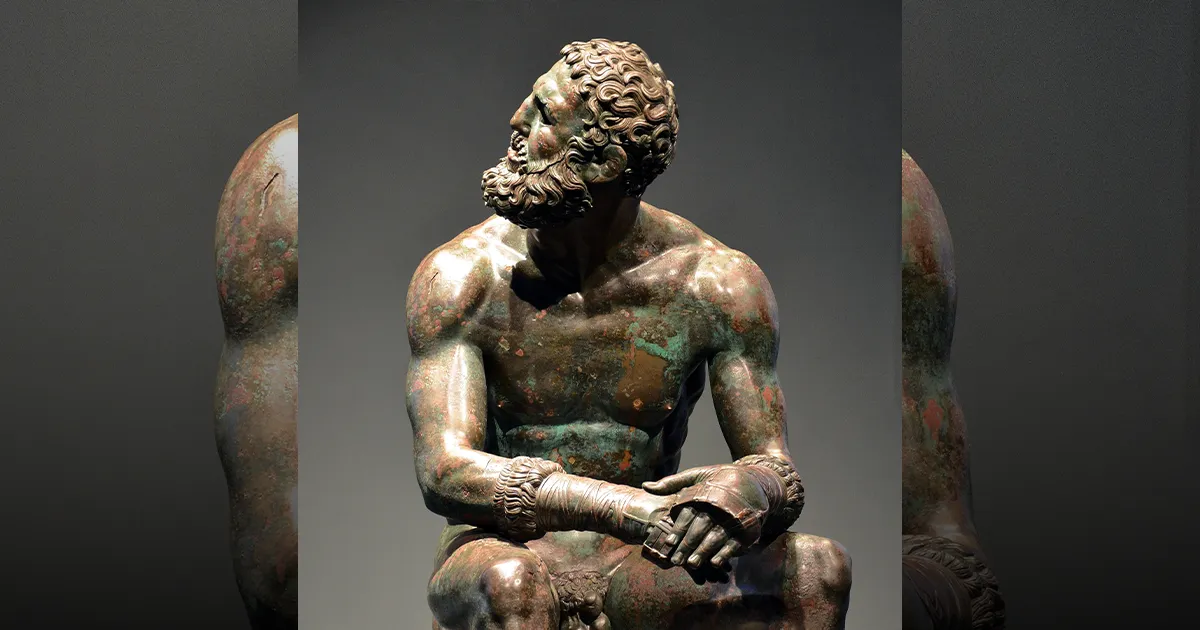
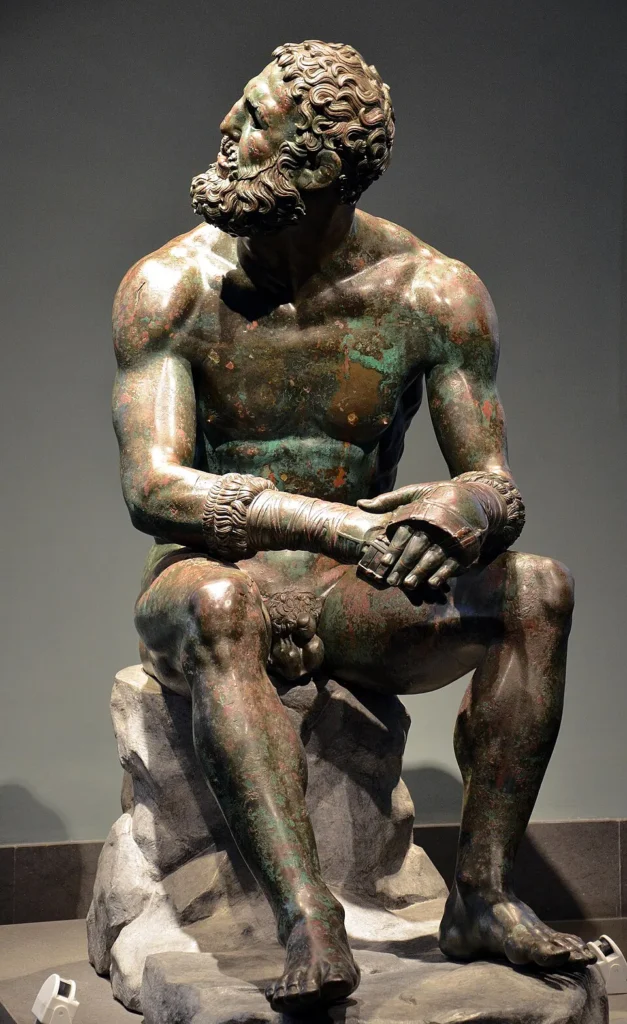
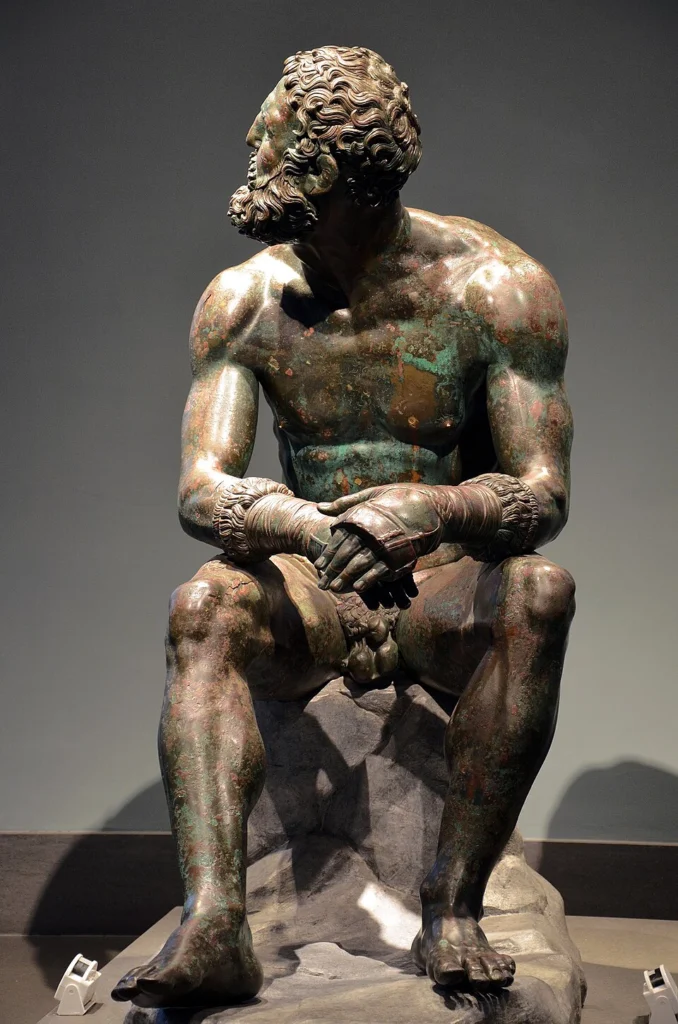
In March 1885, workers clearing land on the south slope of Rome’s Quirinal Hill for a planned National Dramatic Theatre struck something unexpected at roughly 5.5 metres below ground level. The Italian archaeologist Rodolfo Lanciani, who was supervising the dig as Rome’s chief archaeological officer, watched as a seated male figure emerged from the earth over the course of several hours. He later wrote that in a long career full of discoveries, he had never felt anything like the impression created by this figure coming slowly out of the ground, as if awakening after a long repose from his gallant fights. What had emerged was the Boxer at Rest, a hollow bronze statue 128 centimetres tall, depicting a middle-aged professional boxer seated after a fight, still wearing his leather hand-wraps, his face and head mapped with injuries accumulated over years of competition. The statue, now held at the Museo Nazionale Romano in the Palazzo Massimo alle Terme in Rome, is one of the finest surviving originals of Hellenistic Greek sculpture and one of the most anatomically specific records of ancient athletic life we possess. This post examines what makes it technically exceptional, what it records about Greek boxing, and why it represents such a significant departure from the sculptural conventions that preceded it.
The discovery on the Quirinal and why the statue survived
The Boxer at Rest was found within weeks of a second unrelated bronze, the so-called Hellenistic Prince, both of them buried in the retaining walls of an ancient building in the vicinity of the Baths of Constantine. The careful, deliberate manner of their burial, each statue positioned rather than simply discarded, has led scholars to conclude that they were hidden intentionally rather than lost by accident. The most widely accepted explanation is that the concealment happened during the late antique period, perhaps in the fifth century CE when successive waves of sacking made Rome’s public bronzes vulnerable. Since bronze could be melted down and recast as coins, weapons, or church fittings, almost every large-scale bronze of the ancient world was eventually destroyed in this way. Between 100 and 200 Hellenistic bronzes are known to survive today. The Boxer’s survival results directly from the decision of an unknown individual to hide it underground.
Lanciani’s reaction at the moment of discovery was widely reprinted in the years that followed, because it captured something that later scholarly analysis confirmed: the statue has an immediate physical presence unlike that of marble copies of Greek originals, which is what most Roman collections contain. The distinction is fundamental. Virtually all the famous Greek sculptures known from Roman collections, the Discobolus, the Doryphoros, the Apollo Belvedere, survive only as marble copies made centuries after the Greek originals. The Boxer at Rest is an original. It preserves the surface decisions of its maker directly: the texture of skin, the angles of cuts, the weight distribution of a figure in genuine repose. The art historian Paul Zanker, in his study Roman Art Roman Art published by Getty Publications (2010), noted that early scholars found the Boxer at Rest troubling precisely because it violated the ideals of calm nobility that eighteenth-century theorists like Johann Winckelmann had projected onto classical antiquity. Its damage was too specific, its age too visible, its dignity too functional to fit the expected categories.
How the Boxer at Rest was made
The statue was produced using the indirect lost-wax casting method, known in French as cire-perdue, the standard technique for large-scale ancient bronzes. In the indirect method, a sculptor first models each section of the figure in clay, then produces a wax sheath over that clay original, then adds an outer mould and internal supports before draining the wax with heat so that molten bronze can be poured into the resulting cavity. The figure was cast in at least eight separate sections, including the head, torso, each arm above and below the glove, the left leg, and the middle toes, which were then welded together and cold-worked to eliminate the joins. A 2019 thermographic study of the Boxer at Rest and the Hellenistic Prince by by Orazi et al., published in the Journal of Archaeological Science: Reports, confirmed the multi-section casting by detecting temperature differentials at the weld points and identified the alloy composition as a bronze of copper, tin, and lead consistent with Hellenistic workshop practice.
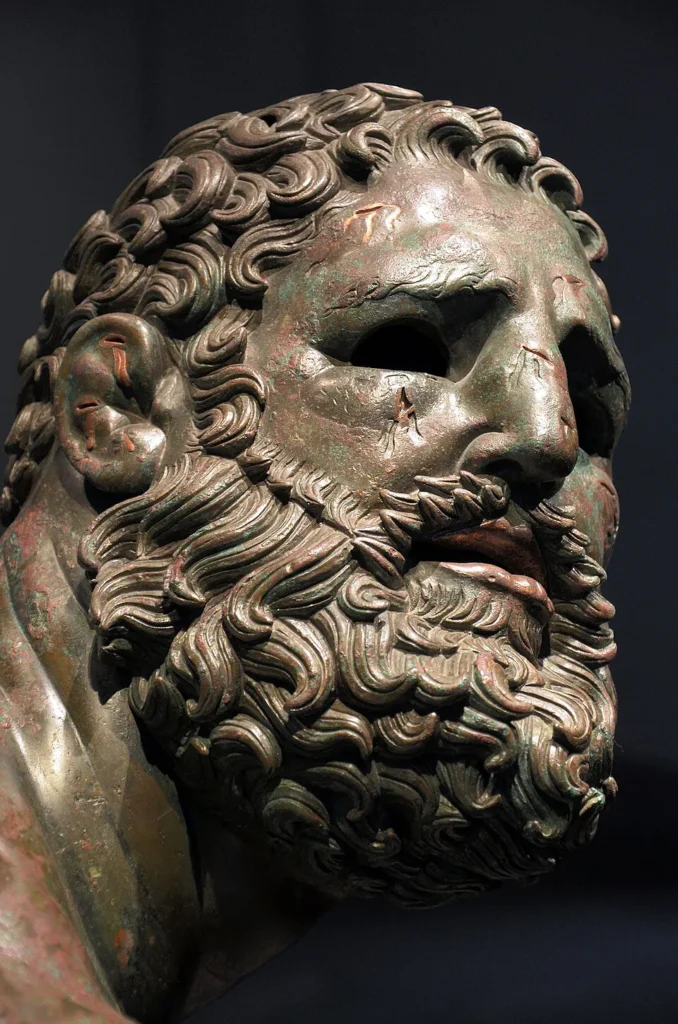
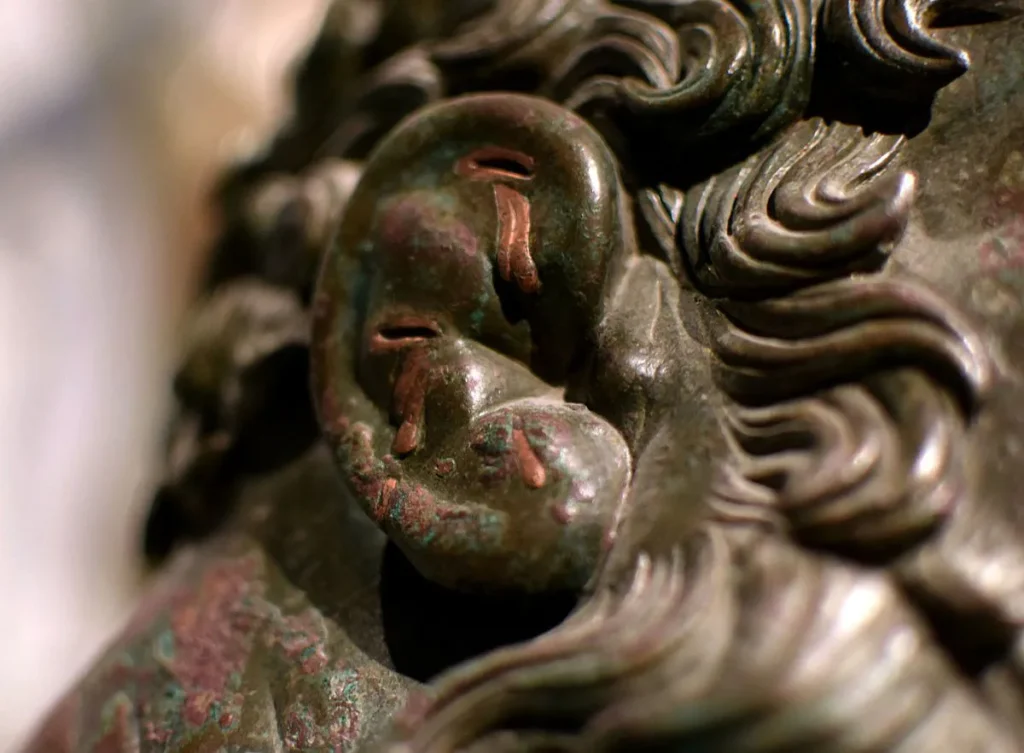
The copper inlays that give the statue its most startling visual effect were added as a separate operation. Red copper, a distinct material from the bronze of the main body, was hammered or cast into channels cut into the bronze surface at specific anatomical sites: the lips, the nipples, the lacing of the himantes (the leather hand-wraps, from the Greek himas, meaning leathern strap), and the wounds on the face, scalp, and shoulder. The effect in person is one of fresh bleeding: the reddish copper reads against the darker, oxidised bronze surface as something that has just happened rather than something that has been still for two millennia. The Met’s documentation of the 2013 loan notes that drops of copper appear to have just fallen from the boxer’s face onto his right thigh and arm, the kind of directional detail that required the artist to calculate the posture of the figure and the path of the blood simultaneously.
Reading the injuries: what they record about Greek boxing
Ancient Greek boxing, pyx, was a sport with almost no rules beyond a prohibition on grappling and a general ban on eye-gouging. There were no weight categories, no rounds, and no ring; bouts ended when one fighter was unable or unwilling to continue. Strikes targeted the head overwhelmingly, because body blows were less effective without closed-fist gloves of modern design, and the himantes, leather thongs wound tightly around the knuckles and wrists, concentrated force at the bony ridge of the hand rather than cushioning it. The result was a pattern of chronic craniofacial injury that the Boxer at Rest records in exactly the way a sports medicine physician would expect.
A 2021 clinical reading of the statue by Chan, published in Clinical Orthopaedics and Related Research, identified the following specific conditions: a broken and multiply re-broken nose with widened nostrils and obstruction of the nasal passage sufficient to explain the open-mouthed breathing posture; bilateral auricular hematoma, the condition commonly called cauliflower ear, in which repeated haematomas within the cartilage of the pinna provoke fibrous thickening and cartilage distortion; periorbital swelling consistent with blunt trauma to the right orbital rim; and multiple laceration scars on the brow ridge and cheekbones, positioned precisely at the anatomical sites where bone lies close beneath the skin and therefore splits most readily under impact. Chan noted that the specific clustering of injuries, heavy on the right side of the face with the right eye more damaged than the left, is consistent with a primarily right-handed opponent, suggesting the sculptor may have modelled damage with specific biomechanical intent rather than distributing it symmetrically for aesthetic reasons.
The statue also carries evidence of older injuries beneath the fresh ones. Incised lines and textural variations on the cheekbones and around the orbital ridges represent healed scars from earlier bouts. The copper inlays mark the current damage; the cold-worked surface records the accumulated past. This layering is not incidental. It is the sculptor’s explicit statement that the figure has a career history, not just a single dramatic moment. The boxer’s body is a professional biography written in damaged tissue, and the statue reads that biography from multiple time depths simultaneously.
Built out of a love for history, kept free from distractions.
Spoken Past is an independent project shaped by curiosity, care, and long hours of research. Reader support helps keep it maintained, carefully researched, and open to everyone.
The himantes and the question of identity
The boxer’s hands are bound in himantes rather than in the heavier, lead-weighted sphairai that Roman-era texts describe as having replaced them in a later period. The himantes were cut from ox-hide leather and wound tightly around the fingers, knuckles, and wrists in a spiral pattern, hardening into a surface that was both protective for the wearer and damaging to the opponent. The Met’s technical notes on the 2013 exhibition identify the lacing pattern visible on the statue as consistent with ancient descriptions of himantes in sources including Virgil’s Aeneid Book 5, where they are described as stiff with blood and strengthened over previous fights. The binding in the Boxer at Rest still shows the copper inlay of the stitching, placing the detail in the same register of anatomical specificity as the wounds themselves.
The identity of the subject is unknown and probably unknowable. Some early scholars proposed that the statue depicted the famous ancient Olympian Theogenes of Thasos, who according to ancient sources won more than 1,300 bouts across multiple Panhellenic festivals. Others, including Seán Hemingway of the Metropolitan Museum, have suggested that the iconographic connections to the pose and proportions associated with Lysippos of Sikyon, the personal sculptor of Alexander the Great who died around 300 BCE, place the work within a stylistic tradition derived from Lysippos even if it is not by his hand. The Met’s exhibition catalogue from the 2013 loan notes specifically that the statue’s iconography draws on Lysippos’s representations of Herakles at rest, connecting the injured athlete to a heroic tradition while simultaneously insisting on his physical particularity. He is not Herakles. He is someone who looks like what Herakles would have looked like if Herakles had been a working professional rather than a mythological ideal.
The body: function, age, and pose
The torso of the Boxer at Rest is the part of the statue that most clearly separates it from Classical idealism. The chest is compact and dense rather than expansive. The abdomen is tight without being anatomised into decorative segmentation. The obliques and serratus anterior muscles are indicated in their functional relationship to rotational movement, not advertised as ornament. The musculature is specific to the work of throwing punches repeatedly over years: the shoulders are heavy, the neck is thick, and the trapezius muscles are overdeveloped in the way characteristic of fighters who spend large amounts of time working against resistance at shoulder height. This is not the balanced, harmonious body of the Doryphoros, Polykleitos’s fifth-century BCE canon of ideal human proportion. It is a body shaped by a specific occupational demand, and every deviation from classical proportion is a record of that demand.
The posture requires careful attention. The boxer sits on what appears to be a low rock, both feet grounded but unequally weighted, his right arm resting across his thigh and his left arm slightly raised and forward. His head turns to the right and slightly upward. The Met’s curatorial interpretation suggests the turn responds to an external stimulus: applause from spectators, a trainer’s instructions, or the entrance of the next opponent. Whether or not a specific narrative is intended, the head turn produces a figure that is alert rather than collapsed, professional rather than pitiful. He is resting, not defeated. The distinction is precise and deliberate. His legs carry enough muscular tension to rise. The pose is temporary.
Hellenistic realism and what it broke from
The Boxer at Rest belongs to a sculptural shift that art historians associate with the Hellenistic period, conventionally dated from the death of Alexander the Great in 323 BCE to the Roman conquest of Egypt in 31 BCE. Greek sculpture before this period tended toward the idealised and the atemporal: figures frozen in controlled poses that belonged to no specific moment, bodies standardised to proportional systems designed to embody abstract virtues like balance and order. Polykleitos of Argos codified one such system in his Canon, a text that no longer survives but whose content can be partially reconstructed from his statue the Doryphoros. A figure built on that system would not have a broken nose, because the nose is an asymmetrical accident of a specific life and the canon requires symmetry.
Hellenistic sculptors rejected this prescription in stages. The shift brought age, emotion, occupation, and physical damage into the acceptable range of sculptural subjects. Children were depicted as children rather than as small adults. Old women appear in terracotta figurines. Drunken satyrs and sleeping figures occupy states that Classical convention had excluded as too transient or too undignified for monumental bronze. The Boxer at Rest extends this logic into a domain that Classical ideology had treated with particular reverence: the athletic body, which had been a locus of divine association and civic virtue in the fifth and fourth centuries BCE. To show an athlete damaged, aged, and at rest is not to reject athletic culture. It is to insist on the physical reality of what that culture demanded from the men who participated in it, and to treat that physical reality as worthy of the same artistic attention previously reserved for abstract ideals.
The ancient colour of the statue matters here. When the Boxer at Rest was new, the bronze would have been a warm, reflective brown approximating the tanned skin of an outdoor athlete. The copper inlays would have read as genuinely red against that background, the wounds vivid and immediate. Modern viewers see a patinated, darkened surface in which the copper areas are distinguishable by their distinct oxidisation colour rather than by anything approaching the original contrast. To see the statue as it was intended to be seen requires actively reconstructing a polychrome object from what now appears nearly monochrome. This is a general problem with ancient bronze, and one that the Boxer at Rest illustrates with unusual clarity because its inlaid wounds depend entirely on colour contrast for their narrative function.
The statue’s afterlife and its 2013 journey to New York
After its 1885 discovery, the Boxer at Rest was initially acquired by the Italian state in 1886 and displayed in the Palazzo dei Conservatori on the Capitoline Hill alongside other major ancient bronzes. In 1902 it was moved to the Palazzo Massimo alle Terme, where it has remained as one of the collection’s two primary Hellenistic bronze originals, the other being the Hellenistic Prince found in the same 1885 excavation. The statue has traveled internationally on very few occasions. In 2008 it went to the Antikensammlung at the Staatliche Museen zu Berlin for six weeks. In 2009 it was displayed in the Senato della Repubblica in Rome. In 2013 it was loaned to the Metropolitan Museum of Art in New York as part of the Year of Italian Culture in the United States, the most substantial international exhibition of the work to date.
The Met’s approach to displaying the statue in 2013 is worth examining, because it shows how the curatorial framing of an ancient object shapes how viewers respond to it. The exhibition, organised by Seán Hemingway of the Met’s Department of Greek and Roman Art, placed the Boxer at Rest in dialogue with Roman marble copies of earlier Greek originals, making the technical and expressive gap between an original bronze and a later marble reproduction physically legible to visitors standing in the same room. The lighting was designed to emphasise the copper inlays and the three-dimensionality of the facial damage in a way that the Palazzo Massimo’s installation, where the statue sits in a relatively diffuse gallery environment, does not prioritise. Thousands of American visitors encountered the statue in those weeks in conditions specifically calibrated to foreground the qualities that make it unusual. Many of them later described it as the single most memorable thing they saw during the exhibition.
Primary sources and key studies: Rodolfo Lanciani, Ancient Rome in the Light of Recent Discoveries, Houghton Mifflin, 1888; Metropolitan Museum of Art, The Boxer: 2013 exhibition catalogue; Seán Hemingway, “The Boxer at Rest,” in Power and Pathos: Bronze Sculpture of the Hellenistic World, ed. Jens Daehner and Kenneth Lapatin, J. Paul Getty Museum, 2015; Jacob Chan, “Art in Science: The Boxer at Rest,” Clinical Orthopaedics and Related Research, 2021; N. Orazi, F. Mercuri, et al., “The Boxer at Rest and the Hellenistic Prince: A Comparative Thermographic Study,” Journal of Archaeological Science: Reports, Vol. 24, 2019; Paul Zanker, Roman Art, Getty Publications, 2010.