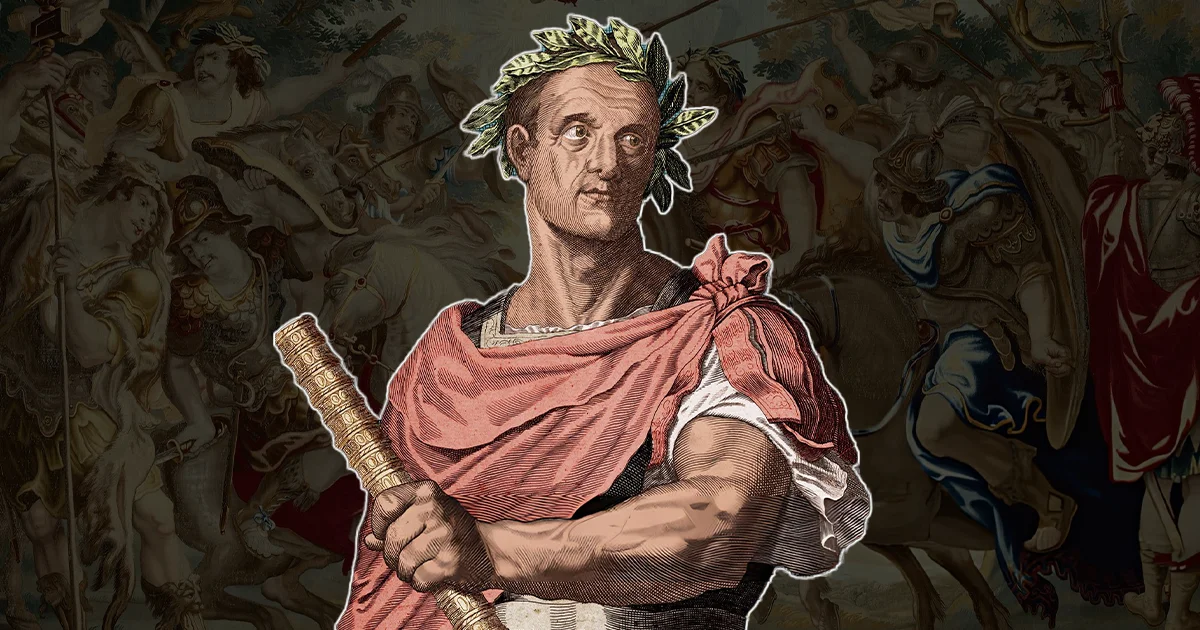
The battle of Pharsalus on August 9, 48 BC marked the turning point of the Roman Civil War. Julius Caesar, commanding 22,000 infantry against Pompey the Great’s 47,000, achieved victory through tactical innovation and veteran discipline. The engagement in the Thessalian plain destroyed the Pompeian forces and left Caesar master of the Roman world. What Caesar describes in his Civil War as the decisive clash happened because Pompey finally abandoned his hilltop position and deployed onto level ground, giving Caesar the opportunity he had sought for days.
The battle of Pharsalus demonstrated how tactical genius and disciplined troops could overcome numerical superiority. Caesar’s eyewitness account in Book 3 of the Civil War provides the most detailed ancient description of any Roman battle, allowing modern scholars to reconstruct the engagement with precision.
Caesar’s March into Thessaly
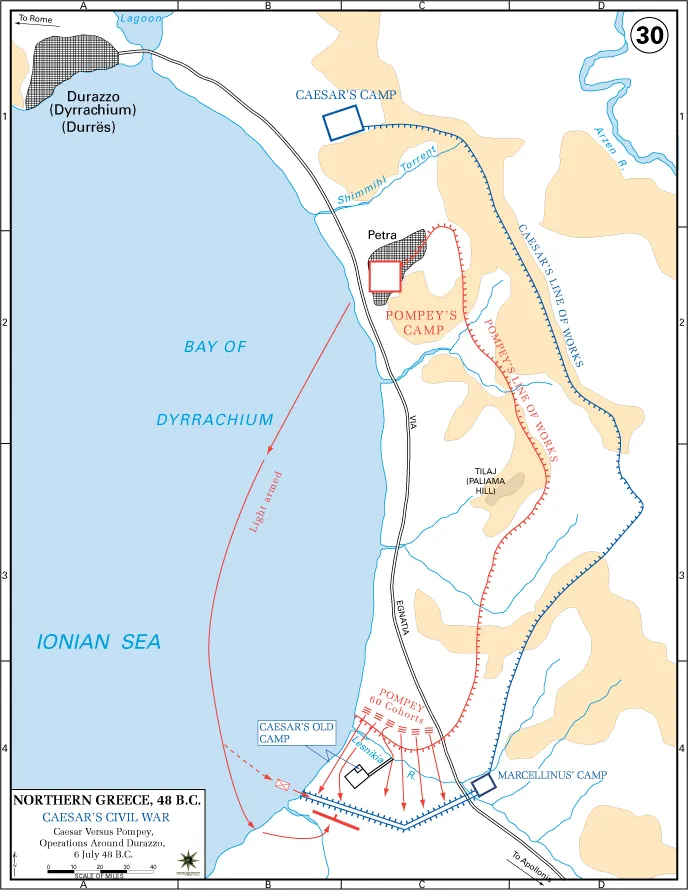
After his defeat at Dyrrachium in July 48 BC, Caesar withdrew from the Epirote coast into central Greece. He sacked the city of Gomphi, which had refused him entry, then accepted the surrender of Metropolis. Caesar records in the Civil War that he reached a suitable place in the fields where the grain was nearly ripe and decided to await Pompey’s arrival there.
All the Thessalian cities obeyed Caesar except Larisa. Scipio held that city with two legions. A few days after Caesar established his camp, Scipio joined forces with Pompey, and the combined army marched south to confront Caesar.
The strategic situation favored neither commander decisively. Caesar controlled the harvest-rich plains and could feed his army through foraging, while Pompey held Larisa and maintained communication routes north to Macedonia and west to Epirus, where Cato commanded fifteen cohorts and Pompey’s fleet.
The Standoff Before Battle
Caesar positioned his camp near the Enipeus River along the road from Larisa to Pharsalus. Appian reports in his Civil Wars that the two camps stood thirty stades apart, roughly four Roman miles. Pompey established his camp on a hill in the foothills. Morgan’s archaeological study places this location on rolling ground east of Mount Kaloyiros, near the ancient town of Palaepharsalus.
For several consecutive days, Caesar brought his army out from camp and deployed it in battle formation. He states in the Civil War that at first he arrayed his troops on his own ground, somewhat distant from Pompey’s camp. On successive days he advanced closer, bringing his battle line right up below Pompey’s hills.
Pompey, who had his camp on a hill, deployed his line at the lowest slopes of the mountain. He seemed always to be waiting, expecting that Caesar would expose himself to unfavorable terrain by advancing uphill to attack. Caesar’s description uses different terms for the same topographical features depending on his perspective: what appeared as a collis (hill) from a distance became montes (mountains) when viewed from below, and the various ridges descending to the plain could be called iuga (ridges).
Caesar abandoned hope of provoking battle and decided to move his camp to another district. Plutarch reports in his lives of both Pompey and Caesar that Caesar intended to march to Scotussa. Just as Caesar’s troops were ready to depart, scouts observed something unusual. Pompey’s battle line had advanced further from his fortifications than was customary, far enough that engagement could occur on ground not decisively unfavorable to Caesar.
Caesar immediately reversed his decision. The army unpacked, reformed, and prepared for battle.
Pompey’s Battle Plan
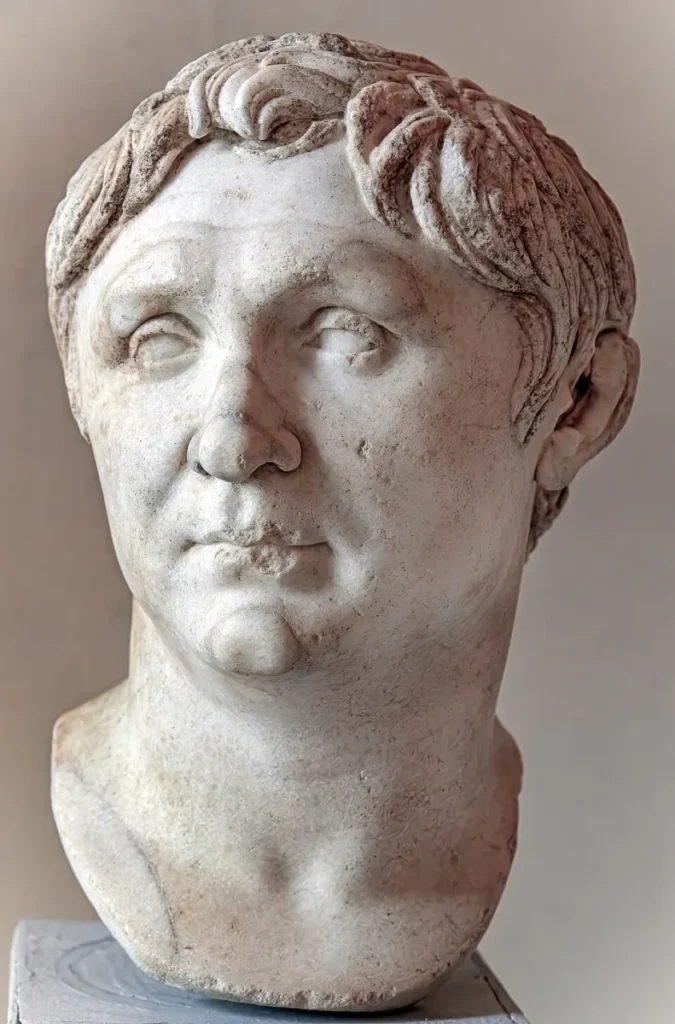
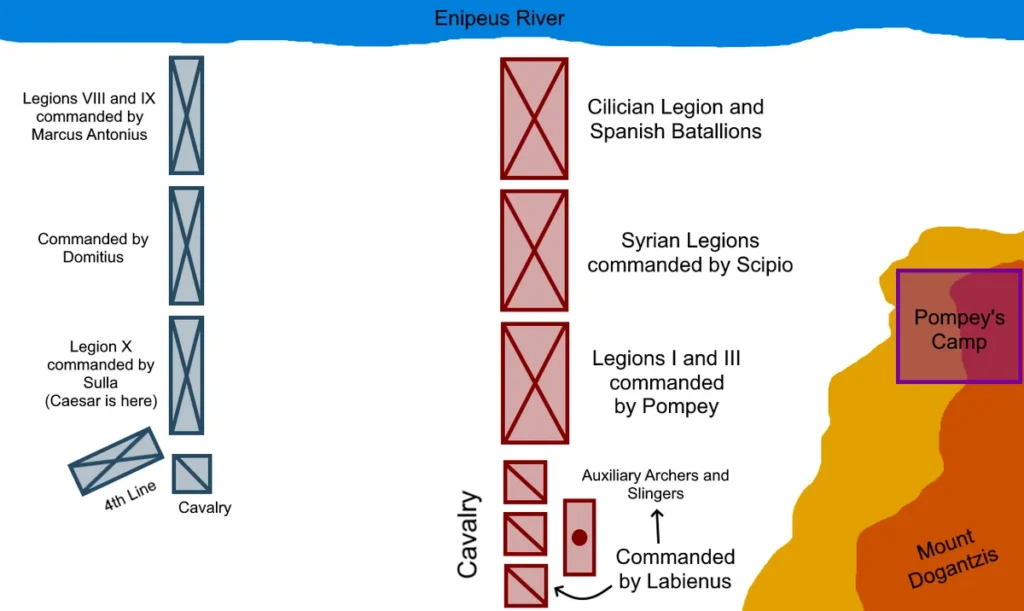
Pompey had determined to rely on his overwhelming cavalry superiority to win the battle of Pharsalus. He commanded 7,000 cavalry against Caesar’s mere 1,000. The plan, as Caesar describes it in the Civil War, called for Pompey’s massed cavalry to overwhelm Caesar’s horsemen, then sweep around Caesar’s right flank and attack the infantry from behind while the Pompeian infantry remained stationary to receive Caesar’s frontal assault.
This strategy reflected confidence in numerical advantage but also revealed inexperience. Pompey’s legions included many recent recruits from his eastern levies, men who lacked the battlefield experience of Caesar’s Gallic veterans. By ordering them to receive Caesar’s charge rather than advance to meet it, Pompey perhaps attempted to compensate for their comparative lack of training.
Morgan’s analysis demonstrates that Pompey’s battle line stretched at least four kilometers across the plain. With 110 cohorts containing 47,000 infantry arrayed in triple line, the front rank consisted of forty-four cohorts. Each cohort occupied approximately 250 feet of frontage, based on the standard Roman spacing of six feet per soldier and formation depth of ten ranks. The 7,000 cavalry massed on Pompey’s left wing required additional space, though the exact depth of their formation remains unknown.
Caesar’s Deployment and Innovation
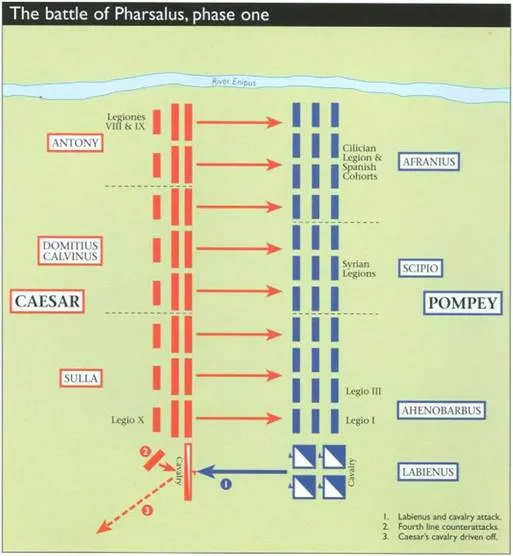
When Caesar approached Pompey’s camp, he observed the enemy deployment carefully. A stream with difficult banks protected Pompey’s right wing. All of Pompey’s cavalry, archers, and slingers massed on his left wing, positioned to execute the planned flanking maneuver.
Caesar arrayed his eighty cohorts, containing approximately 22,000 men, in the standard triple battle line. Seven cohorts remained behind to guard his camp. His thousand cavalry took position on the right wing, where they would face Pompey’s mounted force.
Caesar recognized immediately the mortal danger that Pompey’s cavalry superiority posed to his right flank. His tactical response, described in detail in the Civil War, demonstrates the battlefield improvisation that marked his military genius. Caesar withdrew a single cohort from each of six legions and formed these troops into a fourth line positioned obliquely behind his cavalry.
This fourth line represented Caesar’s strategic reserve, held back specifically to counter Pompey’s cavalry at the critical moment. Caesar instructed these cohorts to remain concealed until he gave the signal, then to advance rapidly against the enemy horsemen using their pila (javelins) as thrusting spears aimed at the faces of the cavalry.
For a full overview on Julius Caesar, see our comprehensive blog here.
The Infantry Engagement
At Caesar’s signal, his first and second lines charged toward Pompey’s position. The Caesarian veterans expected Pompey’s troops to advance to meet them, as was standard Roman practice. When the legionaries realized that the Pompeian line was remaining stationary, the centurions halted the advance.
This moment illustrates the exceptional discipline and training of Caesar’s army. In the chaos and noise of battle, with thousands of men charging at a run, the centurions managed to halt their cohorts, allow the men to catch their breath and redress their ranks, then resume the advance. Such control required years of campaigning together and absolute confidence in officers and comrades.
The troops charged again, hurling their pila at close range to shatter the enemy formation, then drawing their gladii (short swords) for close-quarters combat. The two infantry lines crashed together with tremendous force. Caesar describes in the Civil War how his first and second lines engaged Pompey’s triple line in brutal hand-to-hand fighting.
Pompey’s decision to receive the charge rather than advance proved costly. His men lost the psychological advantage of aggressive forward movement and the physical momentum that aided the shock of contact. Standing still to receive Caesar’s charge, they absorbed the full impact without delivering equivalent force in return.
The Cavalry Action
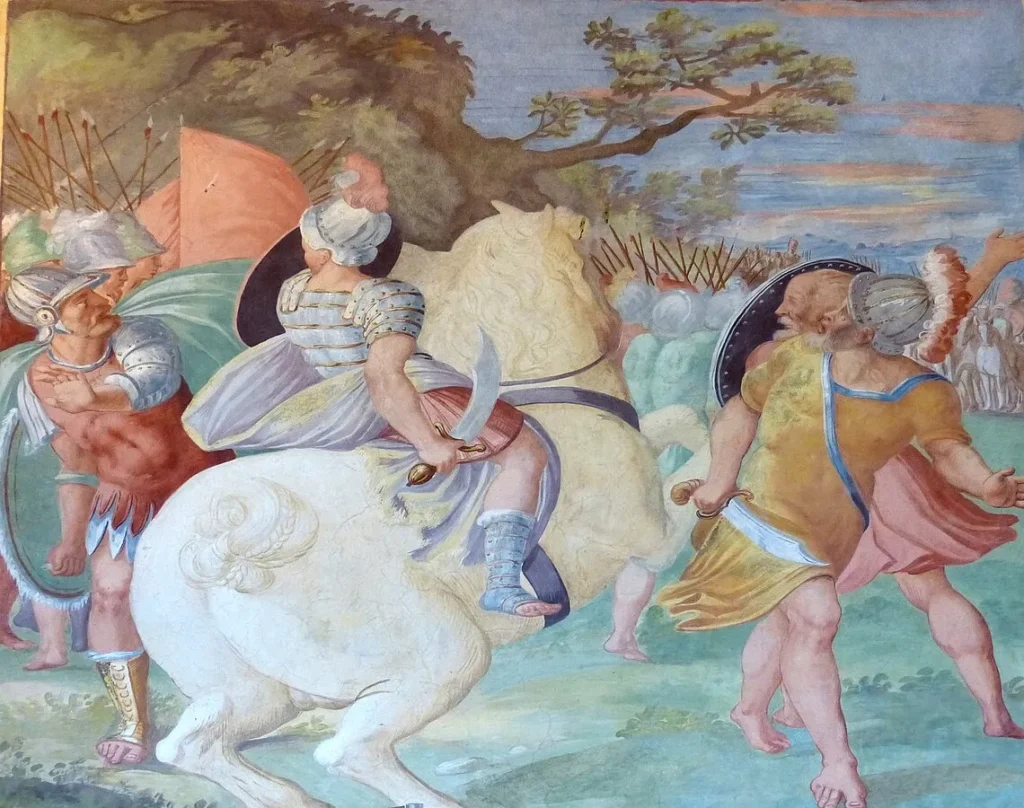
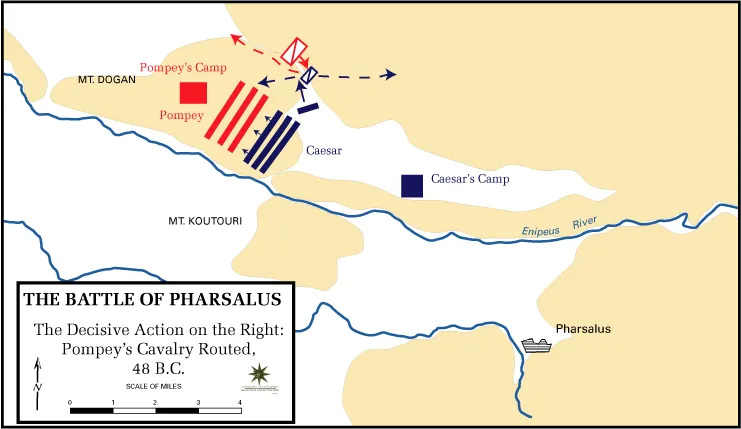
Simultaneously with the infantry clash, Pompey’s 7,000 cavalry on the left wing charged Caesar’s thousand horsemen. The Pompeian cavalry, backed by archers and slingers, drove Caesar’s cavalry back through sheer weight of numbers. Caesar’s horsemen gave ground gradually, and the Pompeian cavalry began deploying into squadrons to wheel around Caesar’s exposed right flank.
The moment of crisis had arrived. Pompey’s battle plan was unfolding exactly as intended. In moments, thousands of enemy cavalry would strike the unprotected flank and rear of Caesar’s infantry line, rolling up his formation and destroying his army.
Built out of a love for history, kept free from distractions.
Spoken Past is an independent project shaped by curiosity, care, and long hours of research. Reader support helps keep it maintained, carefully researched, and open to everyone.
Caesar’s Fourth Line Strikes
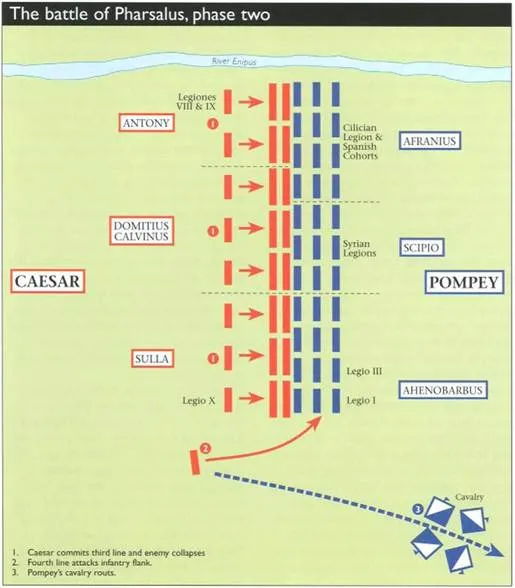
At this exact moment, Caesar signaled his fourth line forward. The cohorts that had remained concealed behind his cavalry suddenly advanced at the run against the Pompeian horsemen. The enemy cavalry, caught deploying from column into line to execute their flanking maneuver, found themselves attacked by fresh infantry appearing where they expected only routing horsemen.
Caesar had given explicit instructions that these cohorts were to use their pila not as throwing weapons but as thrusting spears, and to aim specifically for the faces of the cavalry. The psychological impact proved devastating. Roman cavalrymen were young aristocrats, often vain about their appearance. The threat of facial disfigurement from iron spear points thrust upward by infantry broke their nerve.
The Pompeian cavalry, surprised, disordered, and unable to mount effective resistance against infantry at close quarters, turned and fled. Caesar records in the Civil War that they retreated to the highest mountains east of the battlefield. The entire massed cavalry force, 7,000 strong, broke and ran within minutes of contact with perhaps 3,000 Caesarian infantry.
The fourth line then wheeled against the now-unprotected archers and slingers. These light troops, possessing neither armor nor close-combat weapons, were massacred where they stood. Caesar’s fourth line cohorts reformed and executed a devastating right hook, striking into the exposed left flank and rear of Pompey’s main infantry line.
The Decisive Moment
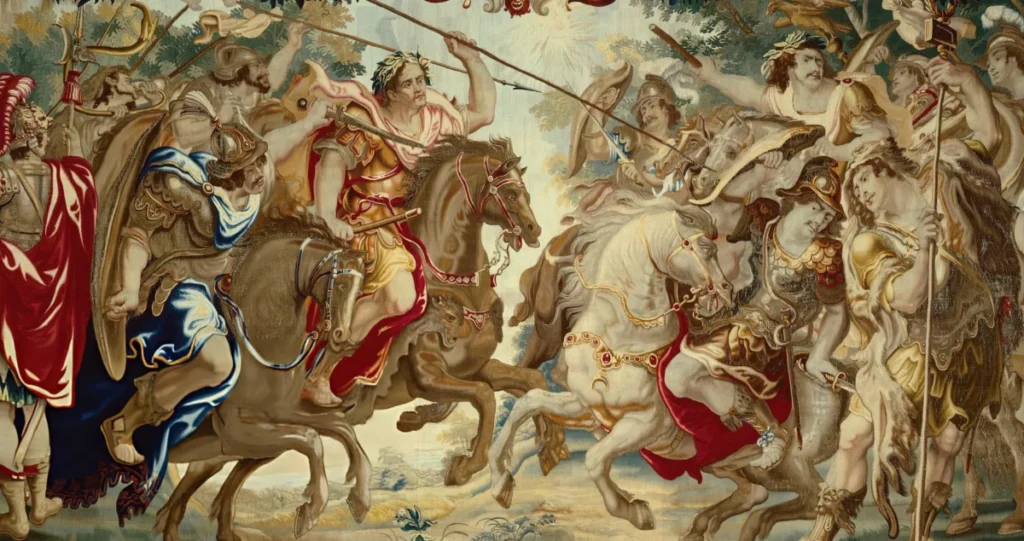
The pressure exerted from two directions simultaneously created panic in Pompey’s left wing. The troops of the first cohorts began to waver, then break. Caesar, observing this critical moment from his command position, ordered his third line forward.
Throughout the infantry engagement, Caesar had held his third line in reserve. These troops, his most veteran and battle-hardened legionaries, had waited while their comrades in the first and second lines fought Pompey’s infantry frontally. Now they advanced as fresh troops against exhausted enemies, relieving the tired men of Caesar’s first and second lines while simultaneously pressing the attack with renewed vigor.
The combination of frontal assault by fresh troops and flanking attack from the fourth line shattered Pompey’s left wing. The panic spread down the line as cohort after cohort broke and fled. Caesar writes in the Civil War that the victory originated from those cohorts stationed in the fourth line to counteract the cavalry, as he had declared when encouraging his troops before battle. It was by these that the cavalry were repulsed, by these that the archers and slingers were massacred, and by these that the Pompeian left wing was surrounded and the rout started.
The Rout and Pursuit
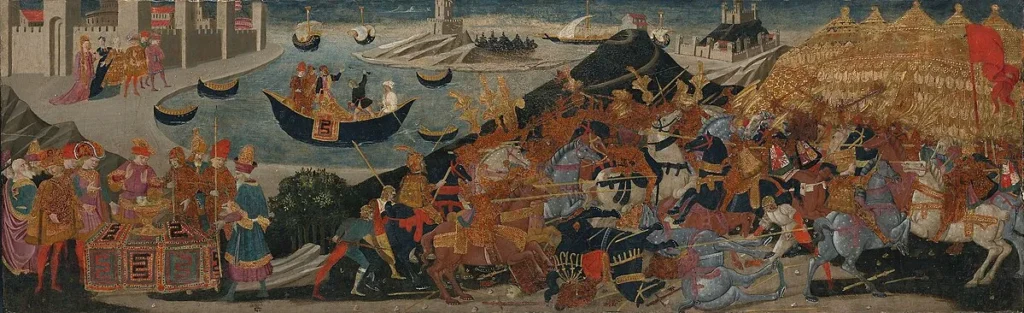
Pompey’s army broke completely. The infantry fled back toward their camp. Despite the intense midday heat of the Thessalian summer, Caesar urged his men not to slacken but to press the assault on the enemy camp immediately.
The cohorts guarding Pompey’s camp, along with Thracian and barbarian auxiliaries, attempted to resist. For a time they fought determinedly, but Caesar’s veterans forced them from the wall. All the defenders fled, using their centurions and military tribunes as guides, into the highest mountains that adjoined the camp.
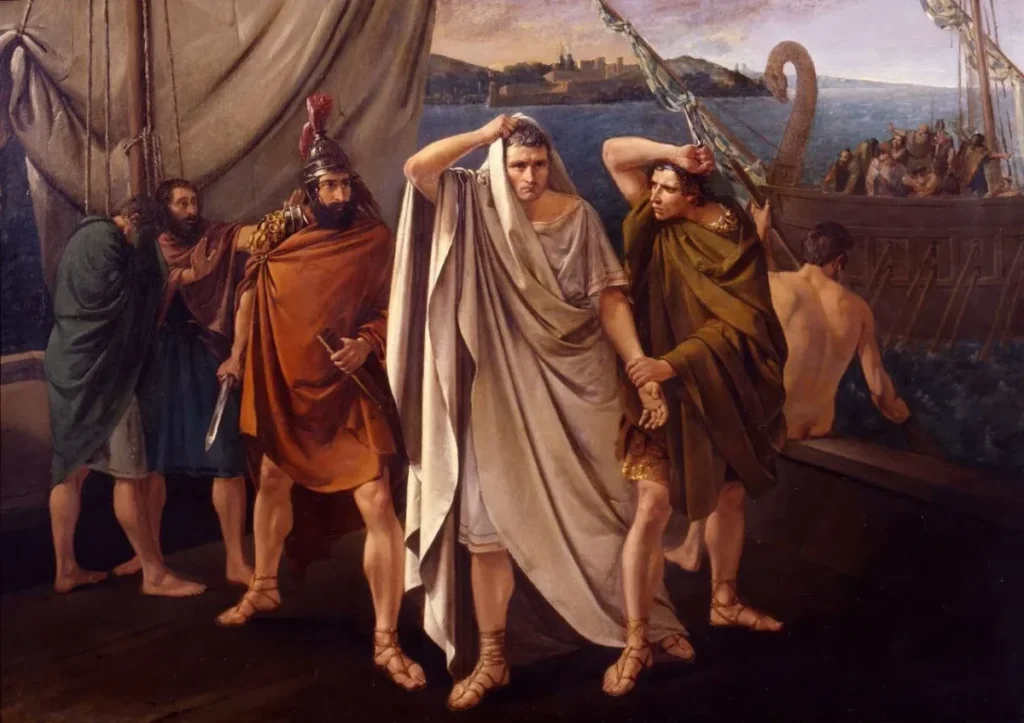
Lucius Domitius Ahenobarbus, one of Pompey’s senior commanders, fled from the camp into the mountain and was killed by Caesar’s cavalry. Pompey himself, according to Caesar’s account in the Civil War, rode out through the rear gate of his camp and hastened to Larisa. From there he continued north through the Tempe pass to the Aegean coast. He never commanded legions again.
The defeated Pompeians, approximately 24,000 men, took refuge on a waterless mountain. Morgan identifies this as Mount Kaloyiros itself, whose perimeter of approximately four Roman miles could be surrounded in an afternoon by Caesar’s army.
The Siege and Surrender
Caesar recognized a tactical problem. He commanded at most 22,000 soldiers while 24,000 Pompeians held the mountain. If Caesar distributed his men evenly around the mountain’s base, the Pompeians on interior lines could concentrate against a single sector, achieve overwhelming local superiority, and break through to escape.
Caesar therefore ordered the construction of a continuous earthwork around the entire perimeter of the mountain. This fortification would enable a few defenders at any point to hold off many attackers until reinforcements arrived. The troops had to complete this work before nightfall, or the Pompeians could slip away in darkness.
The Pompeians recognized that the mountain lacked water and that their position was untenable. They abandoned the height and began retreating along its ridges toward Larisa. To intercept this movement, Caesar took four legions and marched by a more convenient route. Advancing six Roman miles, he deployed his battle line across the Pompeians’ path.
When the Pompeians observed Caesar’s deployment, they halted on another mountain. A stream flowed below this position. Caesar’s men dug an earthwork to cut the Pompeians off from water. When the work was complete, the Pompeians sent envoys to negotiate surrender.
At first light on August 10, Caesar ordered all who had taken position on the mountain to descend from the higher ground onto the plain and throw down their arms. The Pompeians obeyed. The battle of Pharsalus and its aftermath were over.
Casualties and Strategic Consequences
Caesar reports in the Civil War that not more than 200 of his soldiers fell in the battle of Pharsalus, though thirty centurions died. These officer casualties reflect the Roman military system in which centurions led from the front and bore disproportionate risk.
Caesar records Pompey’s losses as approximately 15,000 dead and 24,000 captured, including the cohorts that had garrisoned the fortified posts near Pompey’s camp. These numbers, though possibly inflated for propaganda purposes, indicate the scale of Pompey’s defeat.
The battle of Pharsalus destroyed Pompey’s field army in a single day. The strategic consequences extended across the Roman world. Most eastern cities and kingdoms immediately declared for Caesar. Pompey fled to Egypt seeking refuge, but was murdered by courtiers eager to curry favor with the victor.
Though Pompeian resistance continued in Africa and Spain, requiring several more years of campaigning before Caesar emerged as undisputed master of the Roman world in 45 BC, the battle of Pharsalus decided the essential question. No Pompeian force would ever again match the army destroyed in Thessaly.
Battlefield Topography and Location
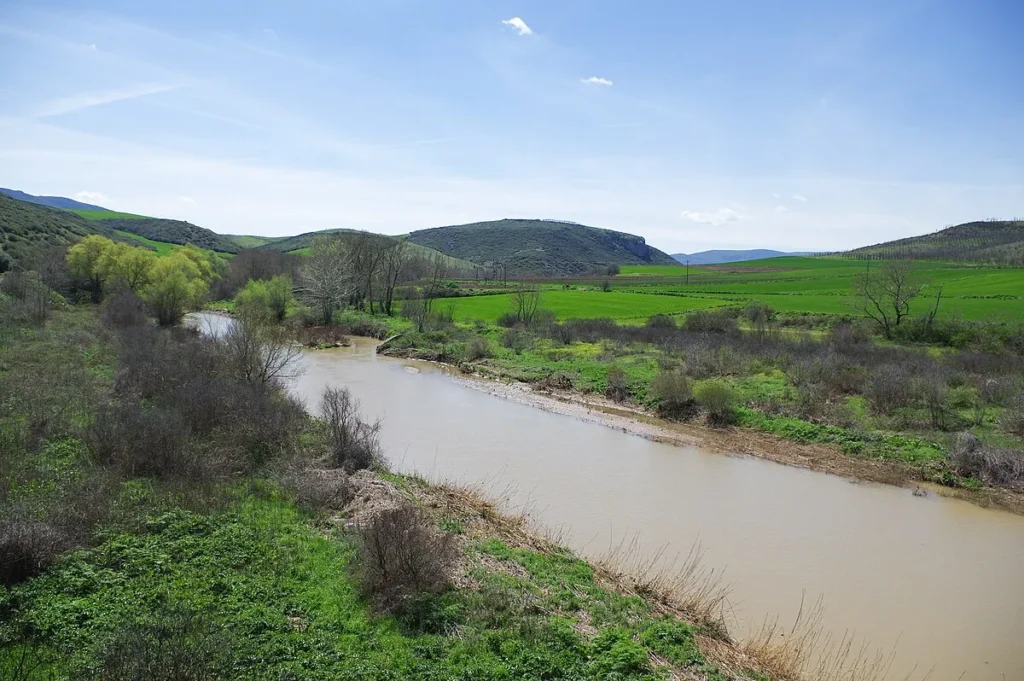
Morgan’s comprehensive archaeological and topographical study of 1983 establishes that the battle of Pharsalus occurred on the north bank of the Enipeus River. Previous scholars had debated whether the engagement took place north or south of the river, with proposed locations spread across more than twelve miles of the Thessalian plain.
Morgan demonstrates that only one location fits all the topographical details Caesar provides in the Civil War. The battlefield lies near the modern village of Driskoli, identified through Hellenistic period pottery sherds as the site of ancient Palaepharsalus. Pompey’s camp occupied rolling ground in the foothills east of Mount Kaloyiros, while Caesar’s camp stood near the river crossing on the main road from Larisa.
The battle line stretched across the plain between these positions, with sufficient width to accommodate Pompey’s 110 cohorts arrayed in triple formation plus 7,000 cavalry. The waterless mountain where Caesar besieged the defeated Pompeians was Kaloyiros itself. The ridge along which the Pompeians attempted to retreat toward Larisa runs above the villages of Karatzoli and Souletsi, where Caesar intercepted them near a stream.
The Battle’s Tactical Lessons
The battle of Pharsalus showcases several tactical principles that Caesar mastered through years of campaigning:
- Economy of force through strategic reserves
- Concentration of strength against enemy weakness
- Timing the decisive blow for maximum psychological impact
- Exploiting victory through immediate and relentless pursuit
- Maintaining troop discipline even during rapid offensive action
- Reading enemy intentions and preparing specific counters
Caesar’s use of the fourth line as a concealed reserve dedicated to a single specific purpose represents battlefield improvisation at the highest level. Rather than simply adding depth to his formation, Caesar identified Pompey’s strategy, deduced the critical moment when that strategy would create vulnerability, and positioned forces to exploit that moment decisively.
The battle of Pharsalus confirmed what the Gallic campaigns had demonstrated: Caesar commanded not only the finest army in the Roman world but possessed the military genius to employ that army with devastating effectiveness. No rival combined strategic vision, tactical flexibility, and the absolute confidence of veteran troops to the degree Caesar achieved.