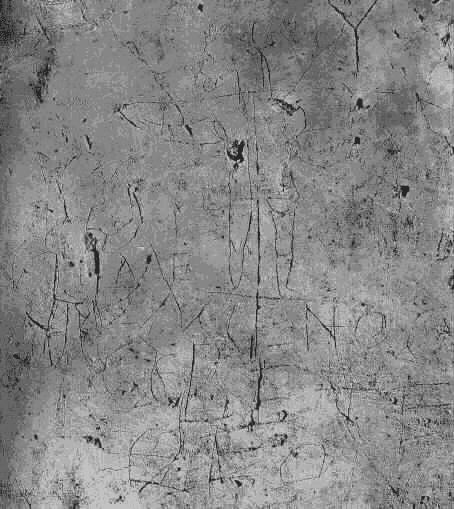
In a stairwell of the Casa di Maius Castricius in Pompeii, epigraphers from the Ancient Graffiti Project documented forty-seven individual marks on a single plastered wall surface: names, short phrases, a sketch of a gladiator with his shield at the correct angle, and numerical tallies whose purpose the surrounding inscriptions do not explain. The wall is not exceptional by Pompeian standards. It is typical. The city sealed by Vesuvius in 79 CE preserves more than eleven thousand individual ancient graffiti, making it the single richest surviving corpus of informal Roman writing in the ancient world. But Pompeii is not an isolated phenomenon. Greek pilgrims scratched their names and prayers into columns at Philae in Egypt’s far south. Merchants and soldiers cut quick notes into the plaster of temple walls at Dura-Europos on the Euphrates. Satirists scratched caricatures into the surface of buildings on Rome’s Palatine Hill. What connects all of these is not criminality or marginality but a specific kind of communication: quick, located, personal, and addressed to a particular set of readers who knew exactly where the wall was and what kind of message it could carry. This post explains how scholars recover these texts, what they actually say, and why they constitute a primary historical source that formal inscriptions cannot replace.
What Ancient Graffiti Are and How They Differ from Official Inscriptions
The technical distinction between ancient graffiti and formal inscriptions is not about subject matter or quality. It is about production. A formal inscription on stone or bronze was commissioned, drafted, cut by professional masons, and often erected in a public location with some form of administrative involvement. The process left a document designed to be permanent, authoritative, and read by a broad or indefinite audience. Graffiti were produced individually, without external authorization, using whatever tool was at hand, typically a pointed stylus, a nail, a coin edge, or a knife, and addressed to a specific local audience who would encounter the wall in the normal course of daily movement through a building or neighborhood.
Rebecca Benefiel of Washington and Lee University, the founder and director of the Ancient Graffiti Project, which has digitized and contextualized over two thousand Pompeian and Herculaneum wall inscriptions as of 2022, has argued that the spatial specificity of graffiti is their most important characteristic. Unlike stone inscriptions that were often moved from their original locations in antiquity or during excavation, graffiti survive where they were written. A graffito scratched at child height in a stairwell tells you something different about its author than the same text scratched at adult height in an atrium. A cluster of names in a waiting area outside a workshop tells you something about how that space was used. The location is inseparable from the meaning.
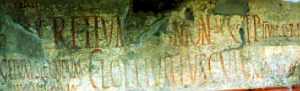
Painted graffiti, called dipinti in the technical literature, form a distinct subset. Dipinti were applied with a brush in red or black paint and required slightly more preparation than scratched marks. Election notices (programmata) were almost always dipinti, painted by professional sign-writers hired by electoral campaigns but carrying endorsements from specific named individuals or groups. The distinction between a scratched personal note and a painted electoral notice reflects different levels of investment and intention, but both belong to the same informal communicative ecosystem and both use the city’s walls as a shared medium.
How Epigraphers Recover Faded and Damaged Ancient Graffiti
The recovery of ancient graffiti from fragile plaster surfaces requires a toolkit that conventional epigraphy did not develop. Reflectance Transformation Imaging (RTI) is currently the most widely used method for enhancing shallow incised strokes that weathering and surface contamination have made invisible to normal light. The technique captures the surface under a series of lights positioned at different angles, then mathematically synthesizes the results to produce an image in which surface relief that is too subtle for the eye to detect under any single lighting condition becomes clearly visible. Jacqueline DiBiasie Sammons, whose work with the Ancient Graffiti Project applied RTI systematically to Herculaneum wall inscriptions and published the results in the Journal of Archaeological Science Reports in 2018, demonstrated that RTI regularly recovers strokes that even experienced epigraphers had missed in decades of direct examination.
Multispectral imaging addresses the different problem of faded painted graffiti. Dipinti painted in red ochre on white plaster fade through exposure to UV radiation until they become invisible to the naked eye, but their chemical composition remains detectably different from the surrounding plaster when examined in specific wavelength bands. Multispectral cameras that capture reflected light in ultraviolet, visible, near-infrared, and infrared wavelength ranges can reveal these faded texts as ghost images in processed composites. The technique is particularly valuable in Pompeii because many building facades were replastered and repainted multiple times, leaving successive layers of dipinti at different depths that normal light cannot separate.
Photogrammetry and three-dimensional scanning complement the imaging methods by capturing the complete surface topography of a plastered wall at resolutions fine enough to study the sequence in which individual graffiti were scratched. When two marks overlap, the three-dimensional record reveals which cut deeper and therefore which was scratched first, allowing epigraphers to establish the relative chronology of marks within a cluster. Combined with knowledge of building history, replastering phases, and room function, this stratigraphic information allows scholars to construct a detailed picture of how a wall accumulated its marks over time and what different social groups were using the same space.
Ancient Graffiti in Pompeii: What the Walls Are Actually Saying
Pompeian graffiti cover an enormous range of content and social register. The most quoted are the sexual boasts and obscene insults concentrated in the Lupanar, the city’s main commercial brothel, and in the baths, but these represent a small and stylistically recognizable subset of a much larger corpus. The majority of Pompeian graffiti are names, numerical tallies, quotations from Roman literary texts (Virgil is the most frequently quoted author), short prayers, commercial notices, gladiatorial fan records, and the kind of social commentary that people write when they want to be noticed by a particular audience rather than by the city as a whole.
Mary Beard of the University of Cambridge, whose Wolfson Prize-winning study Pompeii: The Life of a Roman Town (Harvard University Press, 2008) integrates the graffiti evidence with archaeological and textual sources across the city’s life, has argued that the wall-writing culture of Pompeii was not a marginal activity carried out by the illiterate or the criminal. It required at minimum the ability to write, which in a society where formal literacy rates for men ran at perhaps twenty to thirty percent and for women significantly lower, was itself a social marker. Someone who scratched a line of Virgil on a wall in a well-frequented corridor was displaying cultural capital, not hiding ignorance.
The election programmata that cover Pompeii’s external walls are particularly illuminating as social documents. They endorse specific candidates for the positions of aedile and duovir, the town’s principal municipal offices, and they identify their endorsers by name and often by occupation or associational membership. Endorsements from specific named bakers, dyers, fruit-sellers, and tavern-keepers have been documented. The spatial distribution of endorsement clusters across the city’s neighborhoods corresponds closely to the ward organization of the town, suggesting that electoral campaigning in Roman Pompeii was organized through neighborhood networks rather than city-wide party machinery. The walls are campaign records in the most literal sense possible.
Built out of a love for history, kept free from distractions.
Spoken Past is an independent project shaped by curiosity, care, and long hours of research. Reader support helps keep it maintained, carefully researched, and open to everyone.
Figural Graffiti: Ships, Gladiators, and the Knowledge They Encode
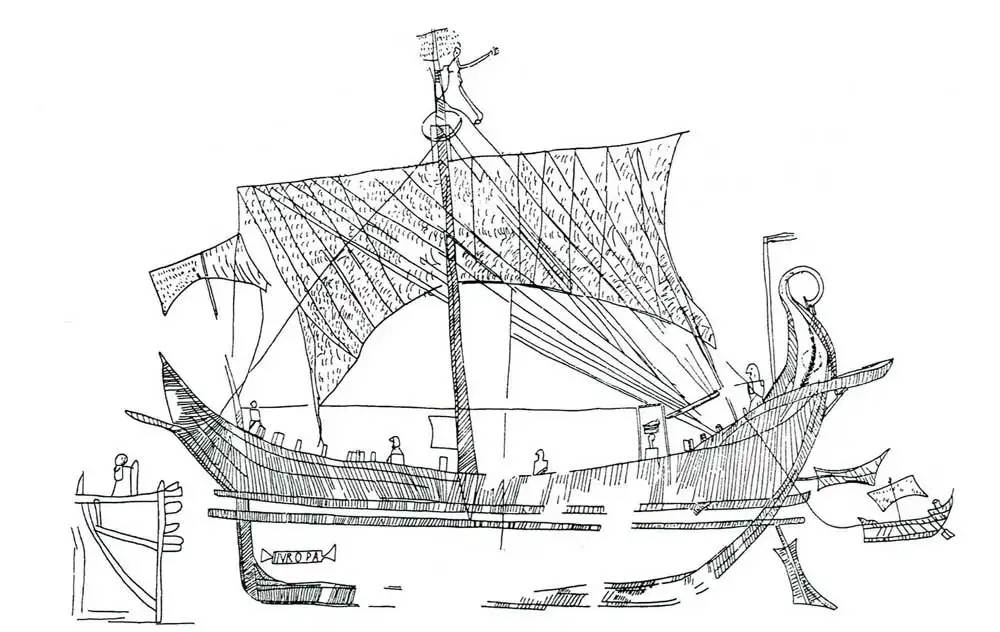
The scratched drawing that gives the Casa della Nave Europa in Pompeii its modern name is a cargo ship rendered with a detailed understanding of maritime technology: the hull’s sheer line correctly conveys a loaded vessel’s waterline, the shrouds and stays are positioned correctly relative to the mast, and the sail’s attachment to the yard is rendered in a way that suggests the person drawing it knew how the rigging actually worked under load. This is not a child’s sketch. It is a technical drawing produced by someone whose working knowledge of ships was good enough to get the structural details right from memory on a vertical surface in awkward conditions.
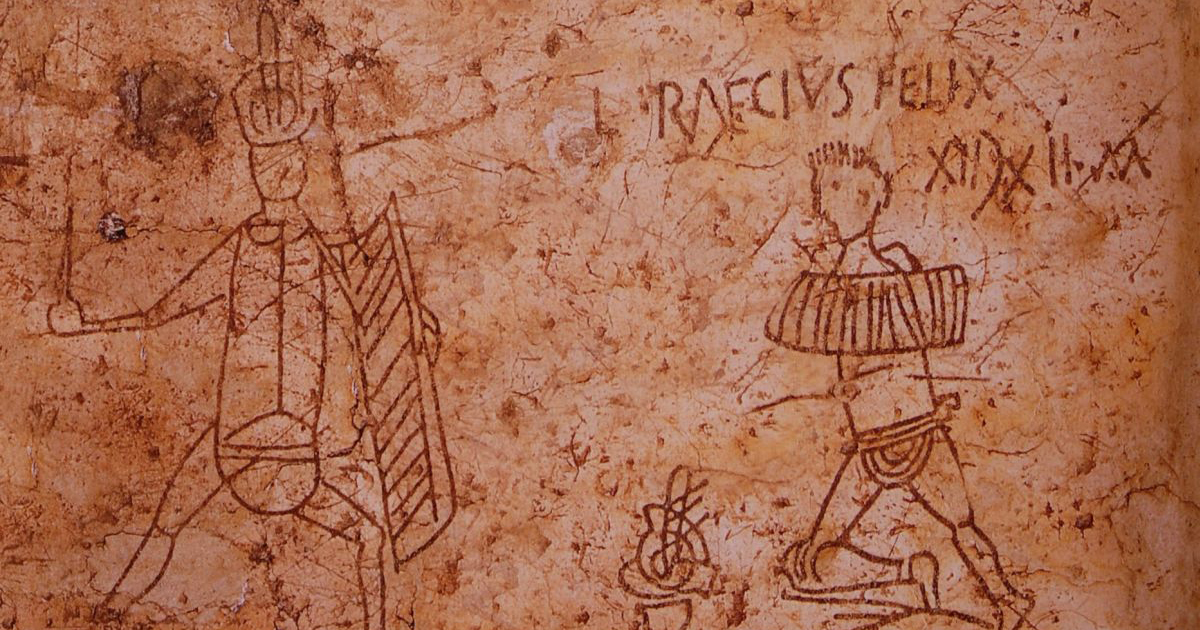
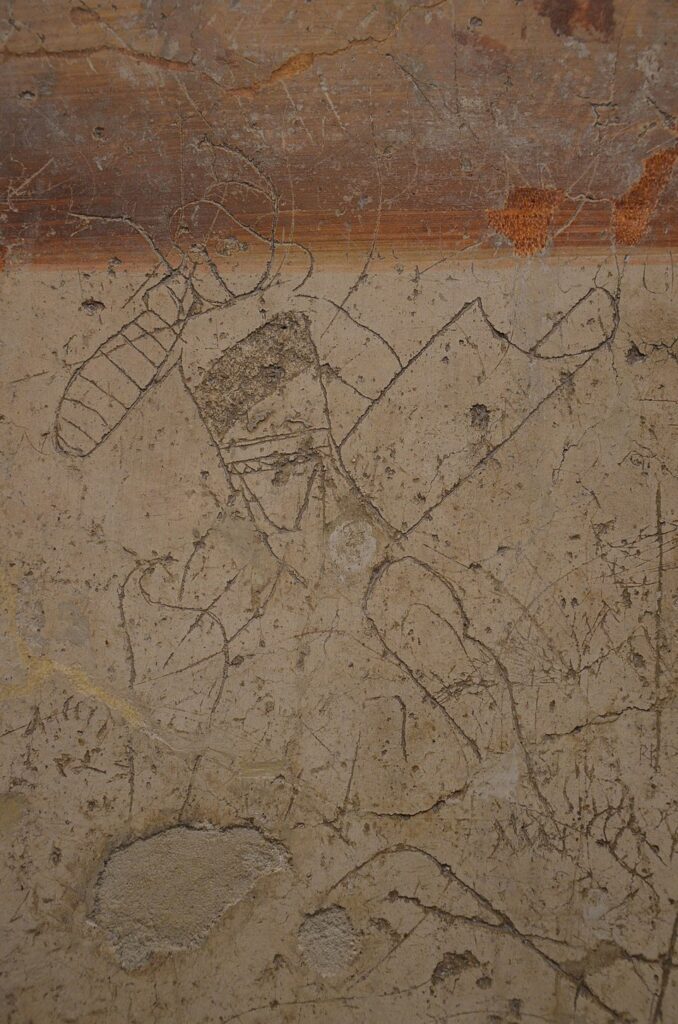
Gladiatorial graffiti in Pompeii’s theatre corridor and elsewhere show the same quality of embedded professional knowledge. Gladiators are depicted with their equipment correct to type: a retiarius, or net-fighter, is shown with his net in the proper throwing position and his trident at the correct angle for close combat. A secutor, his standard opponent, carries the curved shield and close-fitting helmet that distinguished the type from a murmillo. The fighters’ names are often scratched beside them with their record of victories, sometimes citing specific opponents. These drawings are fan records rather than professional illustrations, but the technical accuracy of the equipment details reflects a public culture so thoroughly saturated with gladiatorial spectacle that casual enthusiasts had internalized the fine visual distinctions between different fighter types.
The linguistic content of Pompeian graffiti is equally rich for historians of the Latin language. James Adams of All Souls College, Oxford, whose study of the Latin of the Roman army and non-literary sources documented extensive phonological and morphological variation in inscriptional Latin, has drawn on Pompeian graffiti as a primary corpus for reconstructing features of spoken Latin that formal literary texts suppress. The dropping of final consonants, the merger of the vowels represented by the letters i and e in unstressed syllables, the confusion of the letters b and v reflecting a change in their pronunciation, and the use of colloquial verb forms all appear in Pompeian graffiti in ways that allow linguists to date and locate specific sound changes in the Latin language’s development toward the Romance languages.
Beyond Pompeii: Philae, Dura-Europos, and the Alexamenos Graffito
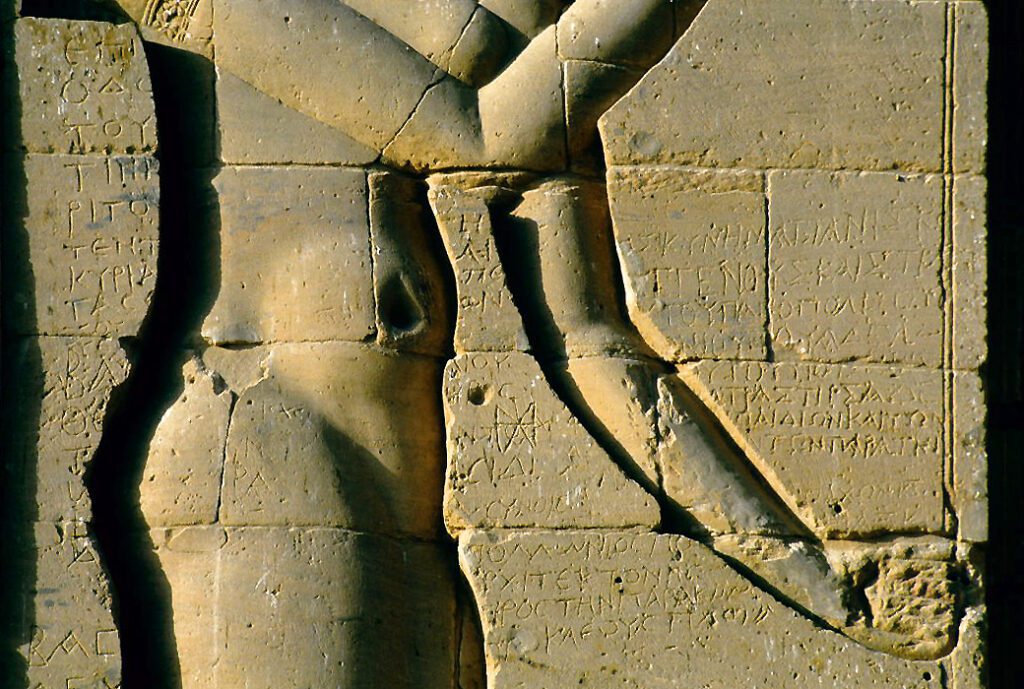
The temple complex of Philae, on an island in the Nile at the first cataract, was a major pilgrimage destination for Isis worshippers from Egypt, Greece, Rome, and Nubia for roughly a thousand years. Visitors cut their names, prayers, and images into the columns and doorframes of the sanctuary throughout its active period, producing a multilingual, multicultural corpus of devotional graffiti that functions as a register of pilgrimage traffic at the empire’s southern edge. Greek names appear alongside Demotic Egyptian texts and Meroitic script. Small boat images echo the processional barque of Isis that was central to the temple’s ritual life. A traveler who scratched his name in Greek at Philae in the second century CE was participating in a practice that extended back centuries and would continue for centuries more, a long duration that formal inscriptions rarely capture.
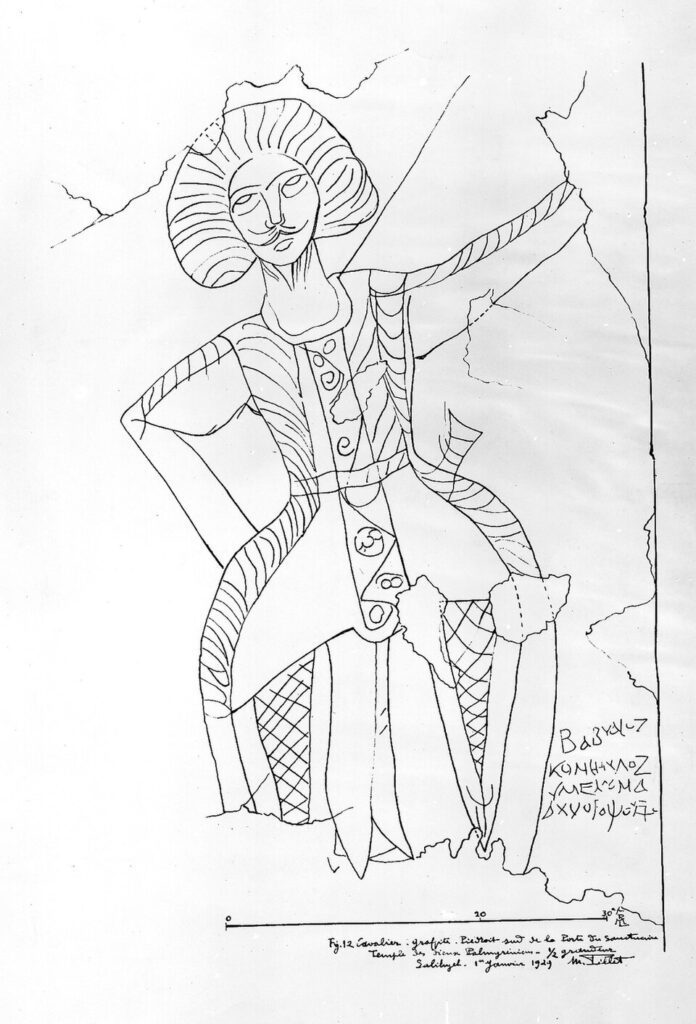
At Dura-Europos on the Euphrates, the meeting point of Roman, Parthian, and local Syrian cultures, temple walls, gate towers, and private houses preserve graffiti in Greek, Latin, Palmyrene Aramaic, and Parthian, often in the same location. The site’s excavation by Yale University and the French Academy between 1928 and 1937 produced one of the most linguistically diverse corpora of ancient informal writing known. A soldier’s name scratched beside a deity’s image in a sanctuary is not vandalism in the context of Roman military religion; it is a votive dedication by a different medium, acknowledging the deity’s presence and asking for protection in terms that the scratched mark made permanent. The Dura graffiti document the footfall of the garrison and the movement of merchants and pilgrims through sacred spaces in a frontier city where official documentation was always in Roman Latin but daily life was conducted in half a dozen other languages.
The Alexamenos graffito on the Palatine in Rome is a different order of document entirely. Scratched into the plaster of what appears to have been a paedagogium, a schoolroom for imperial household slaves and freedmen, probably in the late second or early third century CE, it shows a human figure raising a hand in the orans posture of prayer toward a crucified figure with a donkey’s head, accompanied by a Greek caption that reads roughly “Alexamenos worships his god.” The image is juvenile mockery of a Christian classmate, not a theological argument, but its survival as one of the earliest visual representations of the crucifixion, however satirically intended, gives it an importance entirely out of proportion to its artistic ambition. It documents the moment when Christian practice was visible and mockable enough that a schoolboy found it worth his while to scratch a caricature of it on a wall his classmate would see.
What Ancient Graffiti Tell Us That No Other Source Can
Formal historical sources record what elites wanted to remember. Literary texts reflect the concerns of educated men writing for educated audiences. Official inscriptions preserve what states and wealthy individuals wanted to advertise. None of these sources tells you what a dyer said to a baker outside a Pompeian tavern in 60 CE, or what a soldier at a Euphrates frontier post thought was worth scratching into the wall of the deity’s sanctuary he was guarding, or what a schoolboy on the Palatine found funny enough to spend time and risk punishment to draw.
Graffiti fill that gap. They record the social texture of daily life in the ancient city at the level of individual encounters rather than historical events. They preserve the spoken registers of ancient languages that written literature consistently suppresses. They map the use of interior spaces in ways that architecture alone cannot document. And they record the presence of individuals who would otherwise be entirely invisible: the person who scratched a name beside a doorway, the apprentice who tallied a flour delivery, the pilgrim who wanted Isis to remember that she had passed through this particular column on this particular journey.
The responsibility that comes with this evidence is methodological care. A graffito read out of context, without knowing its room, its height from the floor, its position relative to adjacent marks, and the building’s use history, is a fragment with no anchor. The same text means something different scratched above a workshop counter, on the wall of a private dining room, and in the corridor of a public bath. Recovering that context requires the combination of high-resolution imaging, three-dimensional survey, architectural history, and comparative epigraphy that projects like the Ancient Graffiti Project have been building the infrastructure to support. The walls are still speaking. The question is whether scholarship is listening to the whole wall or just the parts that make good quotations.
Sources: Rebecca Benefiel, “Dialogues of Ancient Graffiti in the House of Maius Castricius in Pompeii,” American Journal of Archaeology 114.1 (2010), pp. 59-101; Rebecca Benefiel and Holly Sypniewski, “Greek Graffiti in Herculaneum,” American Journal of Archaeology 122.2 (2018), pp. 209-244; Jacqueline DiBiasie Sammons, “Application of Reflectance Transformation Imaging (RTI) to the study of ancient graffiti from Herculaneum, Italy,” Journal of Archaeological Science Reports (2018); Ancient Graffiti Project, Washington and Lee University, ancientgraffiti.org; Mary Beard, Pompeii: The Life of a Roman Town (Harvard University Press, 2008); J.N. Adams, Social Variation and the Latin Language (Cambridge University Press, 2013); Clark Hopkins, The Discovery of Dura-Europos (Yale University Press, 1979).