
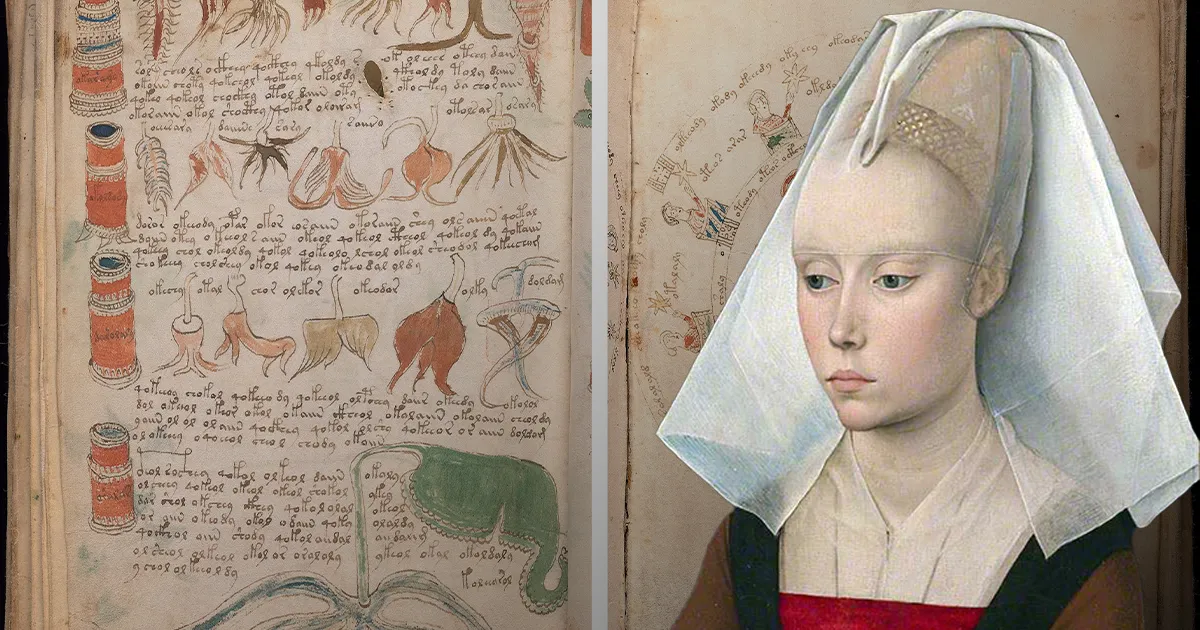
In 1969, rare book dealer Hans P. Kraus donated a curious manuscript to the Beinecke Rare Book and Manuscript Library at Yale University, where it was catalogued as MS 408. The codex had passed through the hands of Holy Roman Emperor Rudolf II, a Prague alchemist, an Italian Jesuit college, and an antiquarian bookseller before arriving on Yale’s shelves. Its calfskin vellum was radiocarbon dated in 2009 by a team led by physicist Greg Hodgins at the University of Arizona to between 1404 and 1438, with 95 per cent confidence. Its pigments, analysed by McCrone Associates in Westmont, Illinois, are consistent with that early fifteenth-century range. The text, however, has never been deciphered. No scholarly consensus exists on its language, purpose, or author. What the Voynich Manuscript does have, in abundance, is pictures. And when you set those pictures beside the known genres of fifteenth-century medical literature, a recognisable structure emerges. The manuscript looks, page for page, like a medical compilation, assembled from borrowed imagery and sealed with an invented script that kept its contents from casual readers.
What the Beinecke Library has established about the physical object
The Beinecke Library’s summary of the manuscript divides its content into six sections that any historian of medieval medicine would find immediately familiar. There are botanicals, containing drawings of 113 unidentified plant species. There are astronomical and astrological drawings, including zodiac charts ringed with small figures. There is what the library calls a biological section, filled with nude female figures in interconnected pools and pipes. There are cosmological foldouts. There are pharmaceutical drawings pairing over a hundred medicinal herbs and roots with apothecary jars. And there are dense text pages with star-shaped flowers marking each entry, which the library describes as resembling recipes. That is not a random collection of subjects. It is the exact bundle of materials you find in a physician’s or midwife’s reference book from the same period.
Raymond Clemens, Curator of Early Books and Manuscripts at the Beinecke, co-edited the 2016 Yale University Press facsimile of the manuscript and assembled a team of specialists to examine it from alchemical, cryptographic, forensic, and historical perspectives. Their conclusion was not a decipherment but a confirmation: the manuscript behaves like a medieval European object, physically and visually, even if its text refuses to yield. The radiocarbon date rules out a modern forgery. It also rules out Roger Bacon, the thirteenth-century English friar whose name was attached to the manuscript for decades, since Bacon died more than a century before the vellum was made. What the date leaves open is the full range of early fifteenth-century possibilities, from a physician compiling his own working reference to a commercial scribe producing a sophisticated cipher book for a patron who wanted something that looked learned and could not be read by rivals.
Lisa Fagin Davis, Executive Director of the Medieval Academy of America and a faculty member in manuscript studies at Simmons University’s School of Library and Information Science, has spent three decades studying the manuscript as a codicologist rather than a cryptographer. In a 2025 presentation to the Centre for Medieval Studies at the University of Toronto, she focused on the manuscript’s material construction, its quire structure, watermark patterns, and the physical evidence for how its bifolios were originally ordered. Her approach treats the Voynich as a medieval object first and a mystery second, which is exactly the right way to read it.
The botanical section and how medieval scribes copied plants
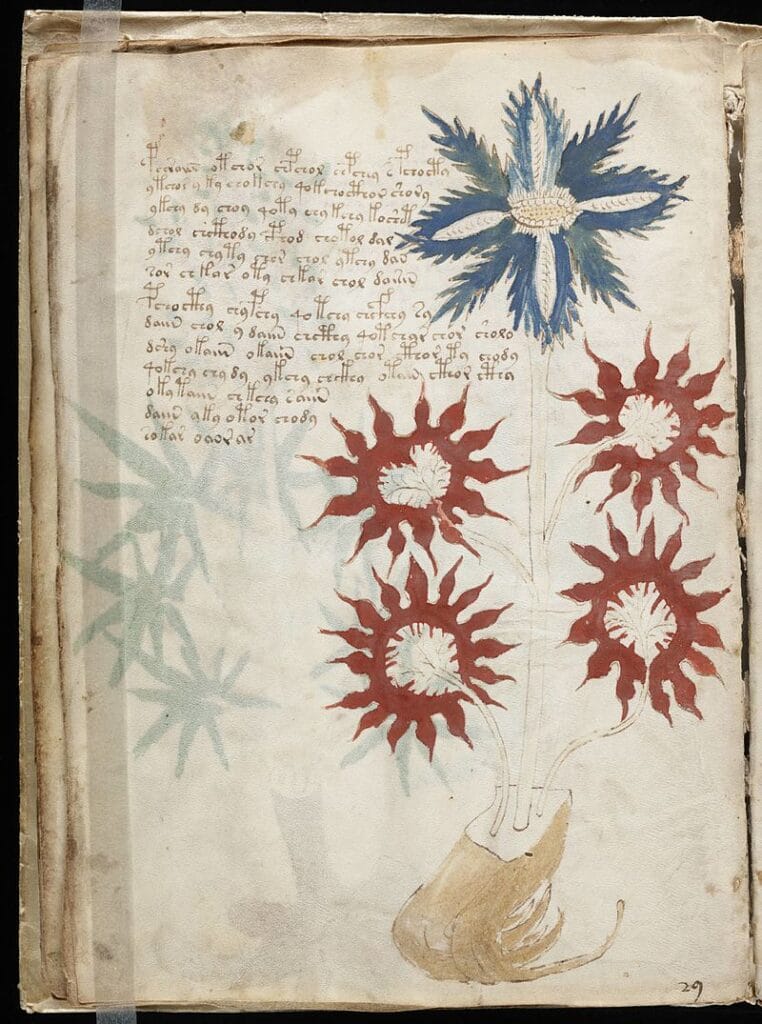
The manuscript opens with full-page plant drawings, and they are strange in a very specific way. Roots from one botanical tradition fuse to leaves from another. Flowers sit on stems that could not support them in nature. The colour washes are applied with a confidence that suggests copying from an existing painted model rather than drawing from a living specimen. This is not the look of a naturalist working outdoors. It is the look of a scribe working from several damaged or incomplete exemplars, filling gaps in one model by borrowing parts from another, and producing plants that match no real species because they were never meant to represent individual species.
This copy-work method is well documented in the history of medieval herbals. When a scribe could not draw from life, and most medieval scribes could not, they worked from workshop pattern books, from the illustrated margins of earlier compilations, and from the diagrams in whatever damaged or incomplete manuscripts came to hand. The result was a familiar genre of composite plant, known to historians of botanical illustration as a copy-of-a-copy type, where the diagnostic features that would allow identification have been lost across successive generations of copying. The plants in the Voynich look exactly like that. A handful have been tentatively linked to real species: a rosette structure that might be a thistle, a branching pattern that resembles maidenhair fern. Most cannot be matched, not because they represent exotic unknowns, but because they were assembled from pieces of several different plants and no longer exist in the real world.
The point of the herbal section, in a medical compilation, was never precise botanical accuracy. It was recognition and memory cuing. A user who already knew that a plant with this general leaf shape and these root characteristics was used for a specific complaint needed only a sketch to confirm they had the right ingredient. Accuracy down to the species level was less important than the visual shorthand that matched a recipe entry to a shelf of dried material. The Voynich herbal section, awkward composites and all, fits that functional description precisely.
Women in baths and the medical tradition of balneology
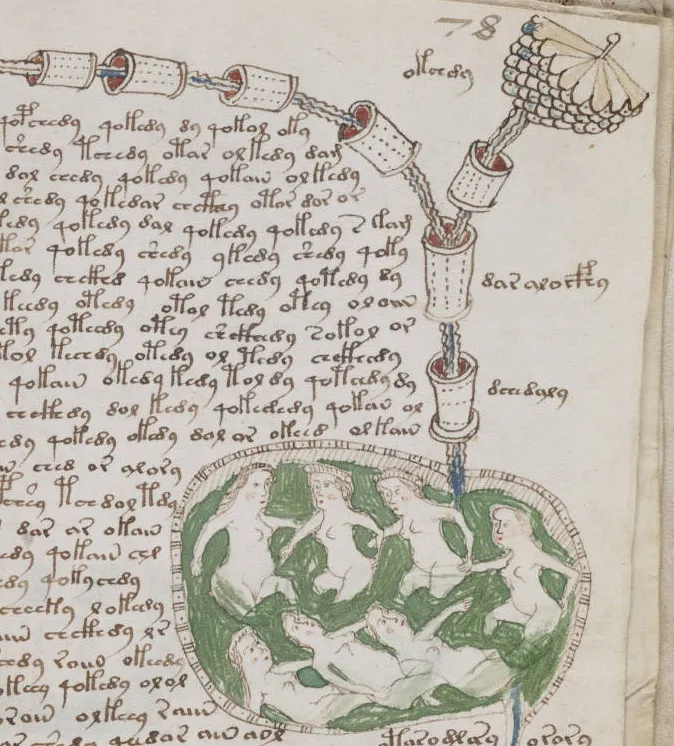
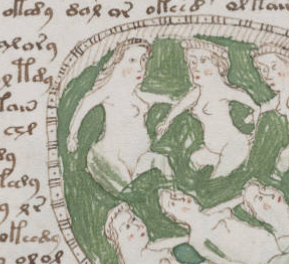
The most discussed section of the Voynich Manuscript shows dozens of nude female figures standing, sitting, or floating in green pools connected by pipes, channels, and tubular structures. This section puzzles people who come to it expecting anatomy or cosmology. It makes immediate sense to anyone who has opened a medieval balneological treatise, a genre of medical writing concerned with the therapeutic use of baths, which flourished across the Italian, German, and Bohemian medical traditions throughout the fourteenth and fifteenth centuries.
Balneology in women’s medicine addressed a specific and urgent cluster of conditions. Baths were prescribed to warm the womb and promote menstrual regularity, to ease postpartum swelling and accelerate recovery after childbirth, to treat skin conditions associated with retained fluids, and to manage the range of reproductive complaints that medieval physicians grouped under the heading of uterine suffocation. Illustrated balneological texts show women entering baths in sequences, moving from pool to pool, sometimes holding implements or labels that marked the therapeutic stage of the treatment. The Voynich figures cradle small stars and carry what look like labels. Some sit under spouts. Others pass through connected chambers in what reads like a procedural sequence.
The hydraulic-looking conduit system connecting the pools in the Voynich has no equivalent in anatomy or cosmology but maps clearly onto the visual language of bath architecture in illustrated regimen literature. Hot springs at northern Italian spa towns, particularly Bagni di Petriolo and the Euganean spas near Padua, were illustrated in exactly this schematic style in contemporary health manuals. The absence of male figures in the bathing section is another signal. This is a section about women’s bodies and the medical procedures applied to them, which is why only women appear.
Built out of a love for history, kept free from distractions.
Spoken Past is an independent project shaped by curiosity, care, and long hours of research. Reader support helps keep it maintained, carefully researched, and open to everyone.
The zodiac rounds as medical timing calendars
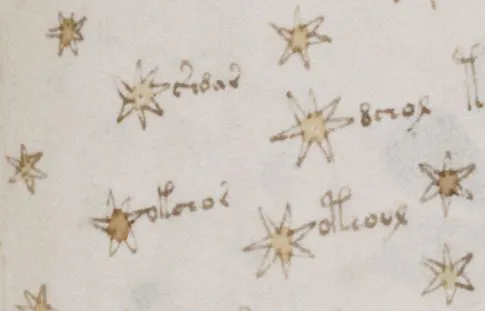
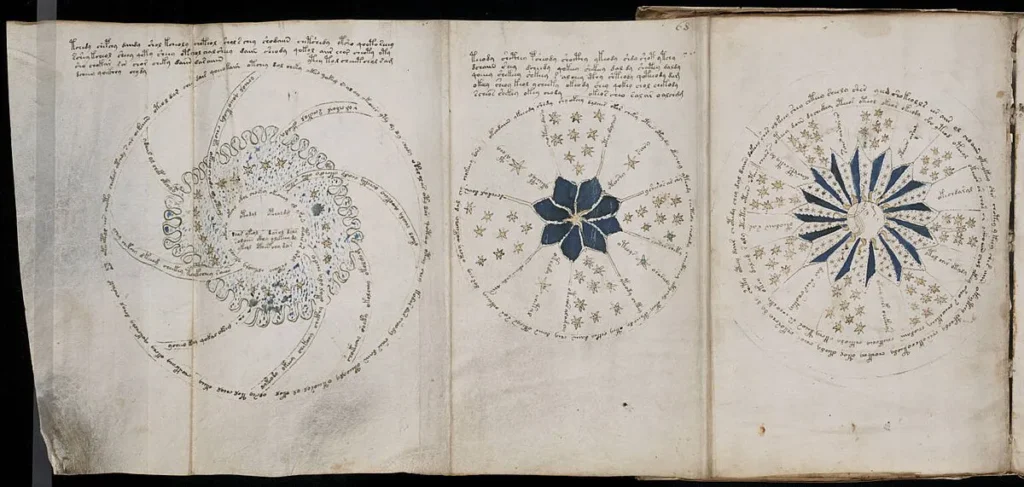
The Voynich Manuscript’s zodiac section is unusual in ways that become less unusual when you place it beside medieval medical calendars rather than astronomical treatises. Two zodiac signs are duplicated in different colours. The series begins with Pisces rather than Aries, which is the wrong starting point for an astronomical calendar but a plausible starting point for a calendar keyed to a specific point in the agricultural or medical year. Month names in Latin letters have been added to at least ten of the diagrams in a hand that most analysts consider later than the main script. Each zodiac round is ringed by small figures in barrels or long dresses, each holding a star or a label.
Medieval medical literature used zodiac imagery to answer the question of when. Bloodletting tables told practitioners which signs were unfavourable for opening a vein. Regimen calendars assigned different dietary recommendations to different months. Gynaecological treatises specified optimal timing for conception, for purging, and for bathing by moon phase and zodiac position. These texts were often illustrated with exactly the format visible in the Voynich: a central zodiac circle ringed by small human figures representing the months or the people whose health depended on the calendar’s guidance. The figures in the Voynich rounds, carrying stars and seated in what look like barrels or tubs, fit the visual vocabulary of monthly health figures, not astronomical personifications.
The later addition of month names in ordinary Latin letters reinforces this reading. Someone who used the manuscript needed those labels to navigate the calendar section efficiently. They added them in their own hand because the original script did not make the months legible to them, which suggests either that the script was genuinely private to its first user or that the labelling hand belonged to someone who acquired the book later and needed to annotate it for practical use. Either scenario is consistent with a medical reference book passing between owners across generations.
Pharmaceutical pages, apothecary jars, and the look of a formulary
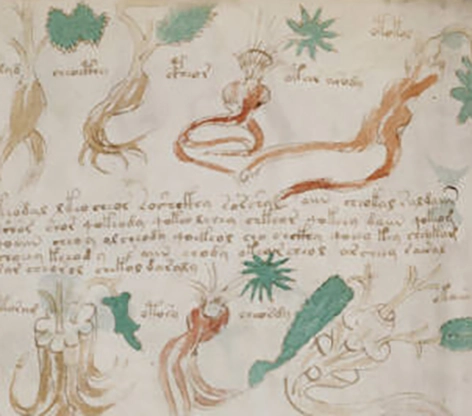
Near the back of the manuscript, the page layout shifts dramatically. The full-page plant drawings give way to rows of containers: glazed jars with distinctive rims and bellies, roots shown in cross-section to indicate which part of the plant is intended, sprigs laid beside containers as visual cues. Star-flower marks appear at the start of each paragraph in the accompanying text, dividing it into numbered or categorised entries in exactly the way that a recipe list is divided. This is the pharmaceutical section, and it is the most plainly communicative part of the book.
Apothecary jar iconography was standardised across Italian and Central European medical compilations of the fifteenth century. A round-bellied jar with a specific rim profile meant an unguent. A tall, narrow jar meant a liquid preparation. A wide-mouthed container with a cross-section root next to it meant a dry powder preparation. These visual conventions existed precisely because formulary users needed to locate ingredients at a glance across a cluttered apothecary shelf. The jars in the Voynich pharmaceutical section conform to those conventions closely enough to suggest the compiler either worked from a specific exemplar or was familiar with the standard visual language of the genre.
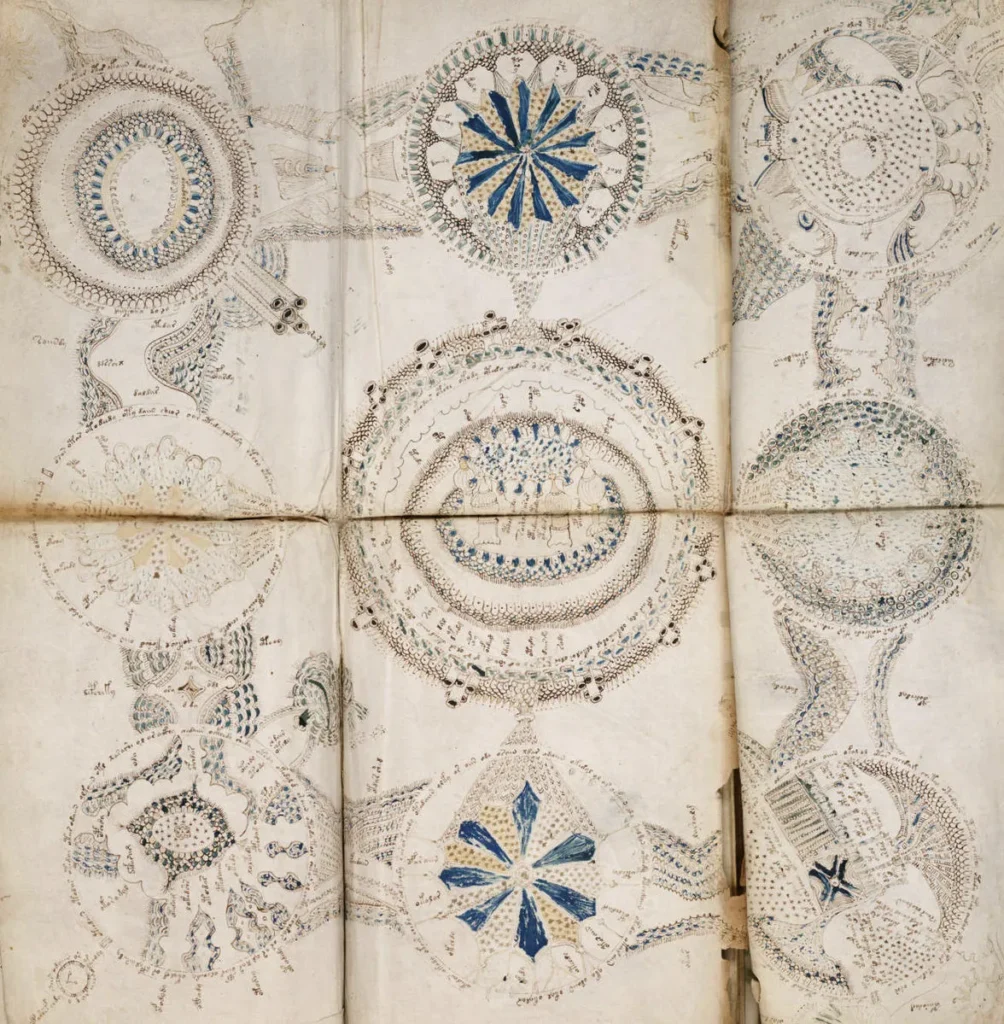
The cross-sectioned roots beside the jars are a particularly specific detail. Dissecting a root to show its internal structure, and drawing that cross-section next to the container that would hold the processed preparation, is a device that appears in Italian pharmacy manuscripts from the Veneto and Lombardy regions dating to the late fourteenth and early fifteenth centuries. The presence of this detail in the Voynich points toward a northern Italian or Central European compilation tradition, which aligns with the architectural evidence in the nine-rosette foldout, where the castle merlons are of the Ghibelline swallowtail type associated with the Verona region and the Dolomites.
The script as a seal and the foldout as a prestige diagram
The invented script of the Voynich Manuscript has attracted more attention than any other feature of the codex, but it makes the most sense when you understand the fifteenth century’s taste for secrecy in practical medical and craft literature. Guild craftsmen encoded proprietary recipes with cipher letters or abbreviations that only initiated members could read. Physicians folded herbals, regimens, and recipe lists into personal reference books and protected their specific dosages and compound preparations with private notation. Alchemists routinely wrote in systems that mixed genuine text with deliberate obfuscation to prevent rivals from reproducing their processes.
The Voynich script is more systematic and more thoroughgoing than most of these partial-cipher strategies, but it follows the same logic. The pictures remain fully legible to anyone trained in the visual conventions of medieval medical literature. The text is sealed. A user who already knew the base recipes from training and practice could navigate the book by pictures alone, using the text only to check specific quantities or timing rules that they had not memorised. The script turns a familiar compendium into a prestige object. It declares expertise. It also makes the book commercially valuable in ways that plain text compilations could not be, because it could not be reproduced without the key.
The nine-rosette foldout, the manuscript’s most spectacular page, fits the same logic. It bristles with interconnected chambers, tubes, towers, and starbursts. Cosmological diagrams of this type appear regularly in ambitious medical miscellanies as synthetic summary pages, pulling together the book’s humoral, astronomical, and geographical frames of reference into a single visual statement. The diagram does not need to be original. Compilers borrowed elaborate foldouts from earlier sources constantly. Its function was social: it told a reader or patron that this was a serious, learned book whose content was ordered by a coherent understanding of the cosmos. The pictures told the story. The script locked the door.
Why failed decipherments have not changed what the pictures say
More than a century of attempted decipherments has produced no agreed solution. William Newbold in the 1920s claimed to read microscopic shorthand attributable to Roger Bacon, a theory demolished after his death when reviewers showed his method was projecting patterns onto microscopic scratches in the vellum. William Friedman, the cryptographer who broke Japan’s Purple cipher during World War II, spent years on the Voynich and concluded only that the text had unusual statistical properties. More recent attempts, including a 2017 claim by a medievalist that the text encoded an extinct dialect of Nahuatl and a 2019 computer science paper proposing a self-citation generation process, have each attracted media attention and then scholarly rebuttals within months.
What none of these decipherment attempts has addressed is the pictures. The pictures do not depend on the script being readable. They communicate independently through the visual conventions of their genre. A page of apothecary jars beside star-marked recipe paragraphs communicates its purpose whether you can read the paragraphs or not. A sequence of women in interconnected baths communicates its medical context regardless of what the accompanying text says. The argument for a medical compilation rests on the pictures, not on the script, which is why it has survived every failed decipherment attempt in robust health.
If the text is ever decoded, the most likely outcome is what the pictures already suggest: a set of recipes with measurements, regimen notes with timing rules, bath protocols with cautions and exceptions, and the usual asides about humors and temperaments that appear in every late medieval medical miscellany. That would be a historically significant discovery about the content of one particular fifteenth-century compilation. It would not be surprising. The pictures have been telling us what kind of book this is since 1912, and they have been largely right.
Sources: Beinecke Rare Book and Manuscript Library, Yale University, “Voynich Manuscript” collection highlight; Yale University Library, Beinecke MS 408 catalog record; Raymond Clemens, ed., The Voynich Manuscript (New Haven: Yale University Press, 2016); Greg Hodgins, University of Arizona Accelerator Mass Spectrometry Laboratory, radiocarbon dating results 2009, reported in University of Arizona News, 2011; Monica Green, ed., The Trotula: A Medieval Compendium of Women’s Medicine (Philadelphia: University of Pennsylvania Press, 2001); Linda Ehrsam Voigts and Patricia Deery Kurtz, Scientific and Medical Writings in Old and Middle English: An Electronic Reference (Ann Arbor: University of Michigan Press, 2000); Elaine Leong, Recipes and Everyday Knowledge: Medicine, Science, and the Household in Early Modern England (Chicago: University of Chicago Press, 2018).