In the spring of 1922, excavators clearing the Temple Repositories at Knossos lifted two faience figurines, each showing a woman holding live serpents in raised hands. They dated to around 1600 BCE. Four thousand years earlier, Sumerian priests at Nippur venerated a divine gatekeeper named Ningishzida whose emblem was a pair of horned serpents rising from his shoulders. And in the tomb of Tutankhamun, sealed in 1323 BCE, researchers eventually identified the earliest fully developed ouroboros image: a serpent biting its own tail wrapped around the sleeping solar god at the hinge between night and day. These three examples, separated by geography, culture, and a millennium of history, all point to the same persistent pattern. Serpents in creation myths appear across the ancient world not because one culture borrowed from another, but because the animal kept generating the same set of available meanings wherever people lived alongside it. This article examines why, working through specific examples from Egypt, Mesopotamia, Norse tradition, Mesoamerica, Minoan Crete, and South Asia to show what serpents were actually doing at the beginnings of worlds, dynasties, and sacred spaces.
What Real Snakes Do That Made Them So Useful Cosmologically
The symbolic vocabulary of serpents across ancient cultures did not come from pure theological imagination. It grew from specific, observable behaviors that communities living in close contact with snakes over thousands of years recognized and found useful for thinking with. Shedding is the most obvious. A snake emerges from its old skin visibly renewed, its colors bright, its body undiminished. For communities whose survival depended on seasonal rains returning reliably, on grain stores holding their energy through winter, on rivers flooding on schedule, a creature that demonstrably shed and renewed its own body was a natural candidate for representing cyclical continuity.
Movement without limbs offered a different kind of intellectual generativity. A snake traces a continuous line through space using only its body. Straightened, it reads as a road or a river. Coiled, it reads as stored potential. Biting its own tail, it reads as a closed cycle. The same form produces all three geometric possibilities without any change in the animal itself, which made it uniquely versatile as a diagram for spatial and temporal concepts that otherwise required abstract language to express. Venom gave snakes a double nature no other common animal possessed so clearly: the same creature could kill quickly or, in the right hands, provide material for an antidote. This made snakes the obvious symbol for any domain where the crucial variable is not the thing itself but the practitioner’s control over it, medicine, knowledge, law, the threshold between life and death.
Snakes also live at boundaries. They emerge from cracks in the earth, haunt the edges of wells and springs, appear unexpectedly at doorways and storerooms. Any ancient community that built walls, stored grain, or marked graves encountered snakes precisely where the boundary between inside and outside, between the living world and what lay beneath it, was most porous. That consistent physical behavior generated consistent symbolic behavior: snakes became the guardians of thresholds, the monitors of passages between domains, the appropriate presence at any crossing that mattered.
Egypt: Apep, Mehen, and the Ouroboros
Egyptian cosmological thinking produced several distinct serpent figures, each doing different work within the creation cycle. Apep, the chaos serpent, was the threat that the solar barque of Ra had to defeat each night as it traveled through the underworld before dawn. Apep was not a figure from a single founding myth that was then remembered ceremonially. He was a permanent, ongoing threat, and priests at the temple of Amun at Karnak performed daily rituals against him, binding and burning effigies, because the maintenance of cosmic order required active, repeated intervention. The sun rose each morning because people did the work to ensure it.
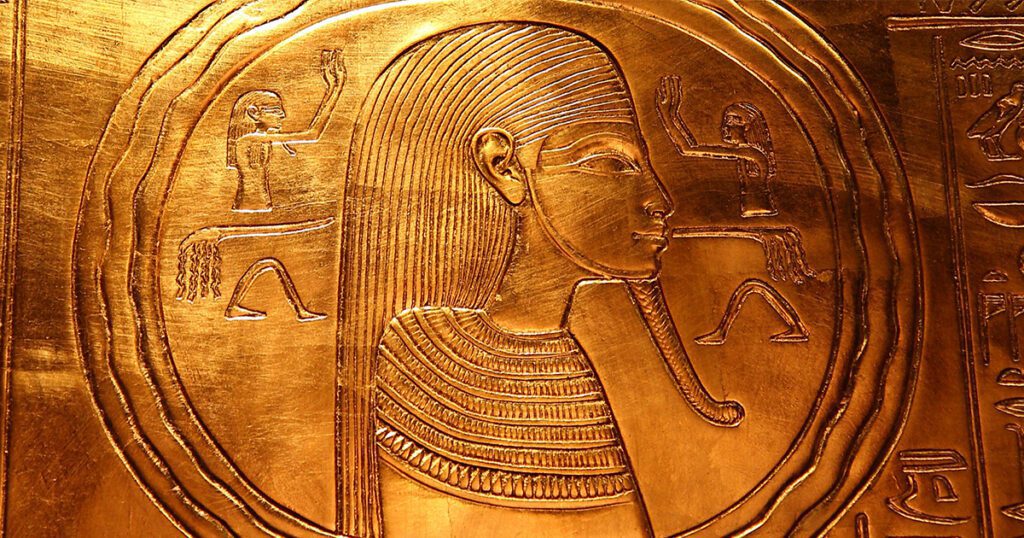
Mehen, by contrast, was a protective coiling serpent whose body enclosed the solar god during the dangerous nighttime journey. Representations in the Amduat and other New Kingdom funerary texts show Mehen as a multi-coiled serpent whose rings form a protective envelope around the recumbent Ra-Osiris at the moment of transition between death and rebirth. The ouroboros that appears for the first time in Tutankhamun’s tomb carries a related but distinct meaning: it is an image of the completed solar cycle, the endpoint of night that connects to the beginning of day. The serpent biting its own tail is not a symbol of eternity in a philosophical sense. It is a diagram of the mechanics of solar renewal: the night has an end, the end connects to a beginning, and the serpent’s closed body makes that connection visible and stable.
Jormungandr and Tiamat: When the Serpent Is the World’s Edge
The Norse Midgard Serpent, Jormungandr, is a son of Loki who grows so large in the ocean surrounding the world that he bites his own tail and encircles Midgard completely. His function is cosmological in the most literal possible sense: he defines the boundary of the inhabited world by occupying the space beyond its edges. The world needs a limit to be a world, and that limit needs to be alive and dangerous to enforce itself. Jormungandr is the reason Midgard stays Midgard. His eventual release at Ragnarok, when the ring breaks and he lets go, is the mythological statement that a world without its boundary is not a world anymore.
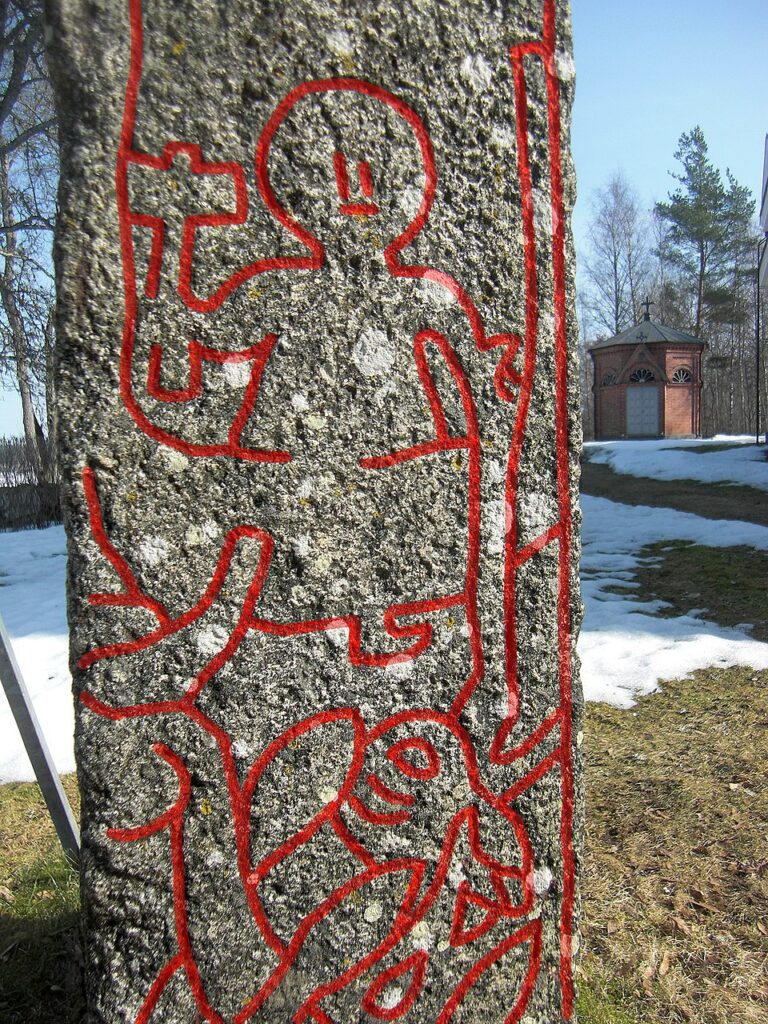
The Altuna runestone in Uppland, Sweden, carved in the eleventh century CE, shows Thor in a boat hauling on a fishing line that disappears beneath the water, where Jormungandr bites the hook. The image is a compressed statement of Thor’s defining function throughout Norse mythology: the protection of the inhabited world against the forces that would undo it. That someone chose this scene for a memorial stone confirms how central the myth was as a framework for thinking about endings and the cosmic forces that keep ordinary life possible.
Tiamat in the Babylonian Enuma Elish is a different kind of world-serpent. She is the primordial chaos dragon whose body, after her defeat by Marduk, becomes the physical structure of the cosmos: her ribs form the vault of the sky, her lower half becomes the earth, her eyes become the sources of the Tigris and Euphrates. The dismemberment is not destruction but transformation. Chaos does not disappear when the ordered world is created. It is reorganized into the architecture of that world. This is a sophisticated cosmological argument: the force that had to be overcome to create order is the same force that the ordered world is built from. The serpent’s body is not excluded from creation. It is creation’s material.
Built out of a love for history, kept free from distractions.
Spoken Past is an independent project shaped by curiosity, care, and long hours of research. Reader support helps keep it maintained, carefully researched, and open to everyone.
Teotihuacan’s Feathered Serpent: Sky and Earth in One Body
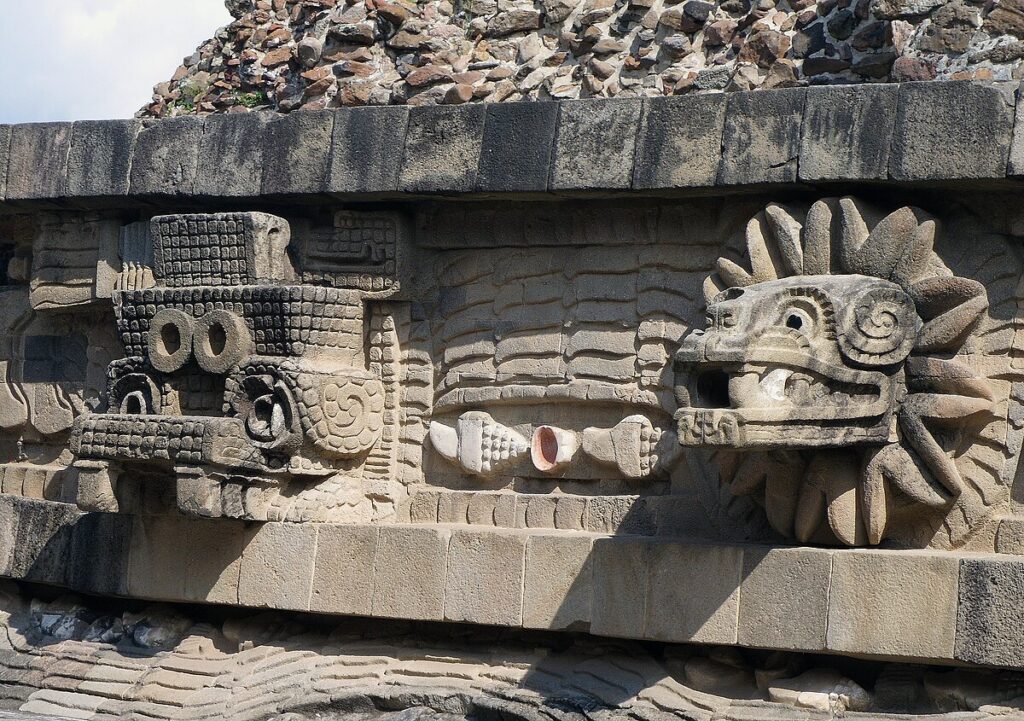
The Temple of the Feathered Serpent at Teotihuacan, built in the third century CE, is covered with alternating heads of a feathered serpent and what most scholars identify as a goggled storm deity, set within a framework of undulating serpent bodies. The combination encodes a specific cosmological argument about the relationship between water and wind, agricultural fertility and the meteorological cycle. This was not decorative. It was the ideological program of Teotihuacan’s ruling elite expressed in the most permanent medium available.
The feathers on the serpent are the crucial element. Feathers signal the capacity to move through air, to be simultaneously of the earth and of the sky, to bridge the registers of a cosmos organized around the vertical axis connecting underworld, earth, and heaven. A feathered serpent is the perfect messenger between these realms because it belongs anatomically to none of them. Excavations by archaeologist Saburo Sugiyama beneath the temple in the 1980s and 1990s revealed hundreds of sacrificial human burials associated with serpent imagery at the foundation level, confirming that the cosmological program on the facade was enacted through real deaths. The serpent at the beginning of the world required blood at the beginning of the temple.
The Minoan Snake Goddess and Ningishzida: Household and Royal Beginnings
The two faience figurines from Knossos show women holding live serpents that coil around their raised arms and across their bodies. They were found in the Temple Repositories alongside other cult objects dated to around 1600 BCE. Whatever these figures represent, goddess, priestess, or a category that does not translate easily into modern terms, their posture is confident. The serpents are controlled. The composition reads as a demonstration of competent authority over something powerful, not fear of it.
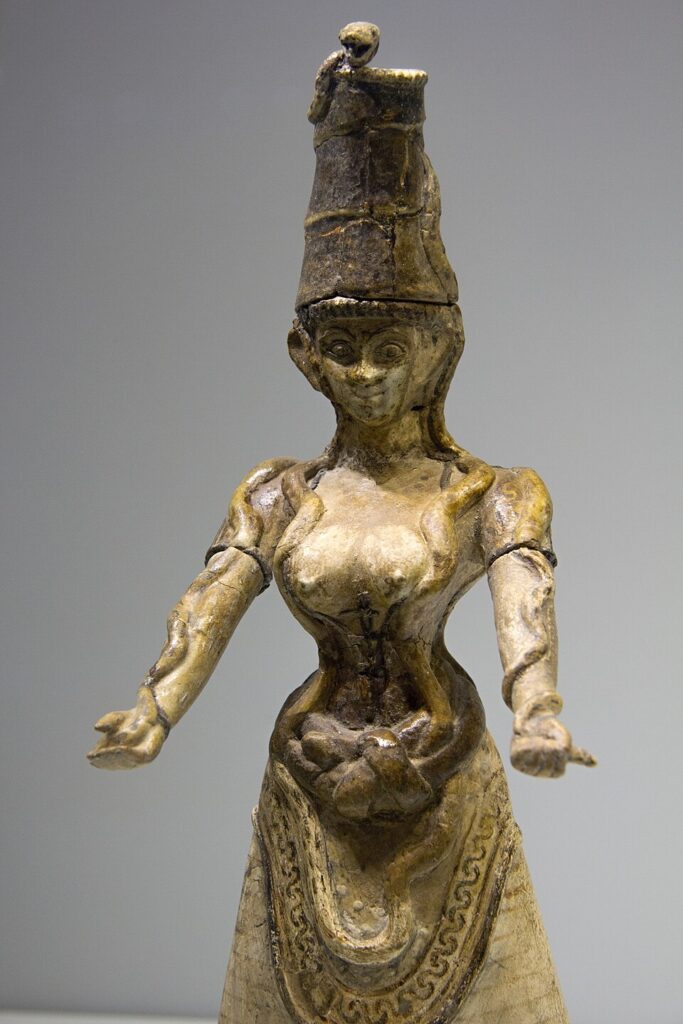
This reading connects to later Greek traditions of the agathos daimon, the household serpent spirit understood to protect storerooms and agricultural wealth and requiring regular offerings. The Minoan figures may represent a much older version of the same principle: the serpent as guardian of stored potential, the force that keeps the household’s resources intact through the months between harvest and planting. This is creation at a domestic scale, and it is just as essential to survival as any cosmic creation narrative.
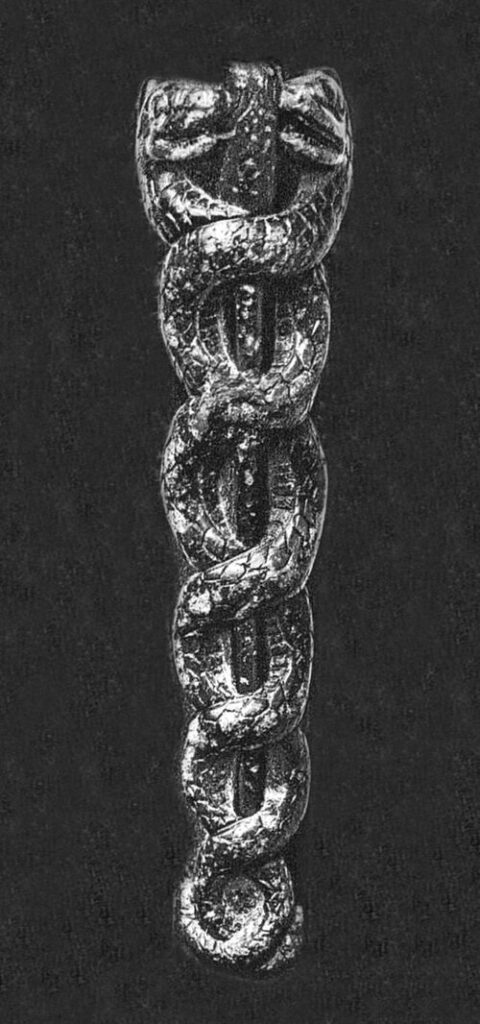
Ningishzida in Mesopotamia operated at the opposite end of the social scale. He was a chthonic deity of the underworld, a divine gatekeeper controlling passage between the living and the dead, and his emblem documented on the libation vase of Gudea of Lagash around 2100 BCE showed two horned serpents rising symmetrically from his shoulders. The Sumerian text known as the Death of Ur-Namma describes Ningishzida receiving the deceased king at the entrance to the underworld, confirming that his serpent emblem was not decorative but jurisdictional. He was the guardian of the threshold between life and death, and the snakes on his shoulders were the visual proof of his authority over that crossing.
Ananta Shesha and Mucalinda: Serpents That Support Creation
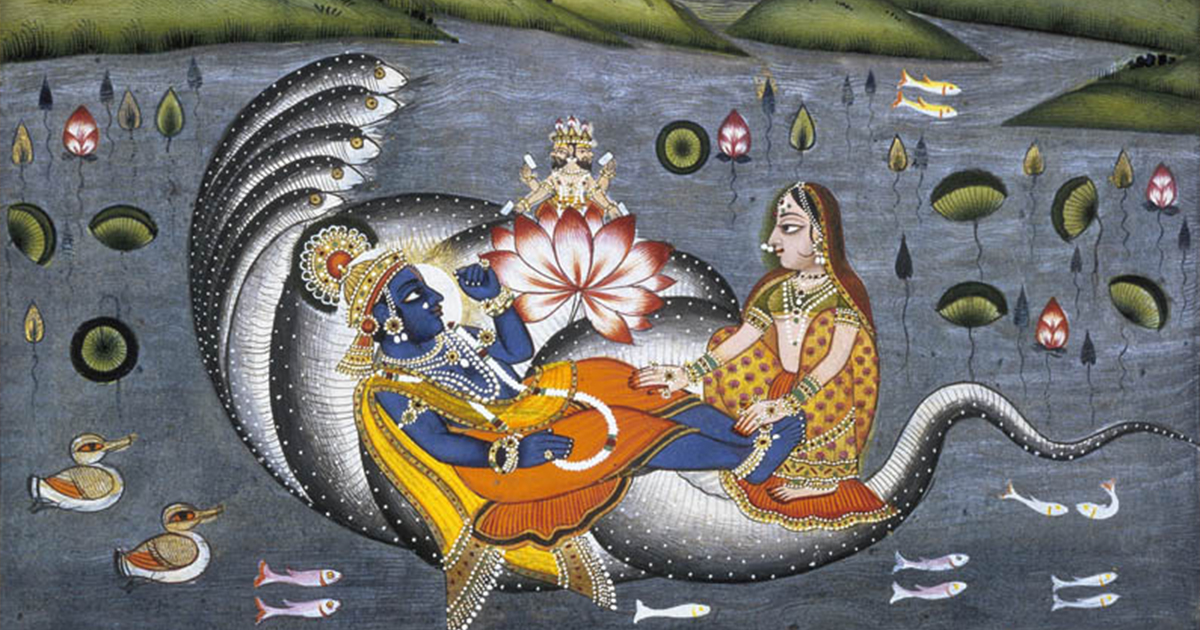
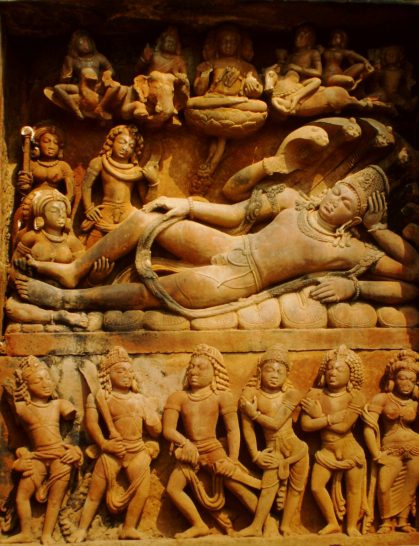
The fifth-century CE relief at Deogarh showing Vishnu asleep on the coils of the cosmic serpent Ananta Shesha presents a fundamentally different kind of serpent relationship than the combat imagery of Egypt or Babylon. Ananta, whose name means endless, is not a chaos monster that must be defeated. He is a supportive foundation. Vishnu’s sleep on Ananta’s coils is the condition that makes the next creation possible: the god rests between worlds on the serpent who maintains the potential of everything that will exist when the god wakes. The serpent here is not the enemy of order. He is the substrate on which order rests during the interval when it does not yet exist.
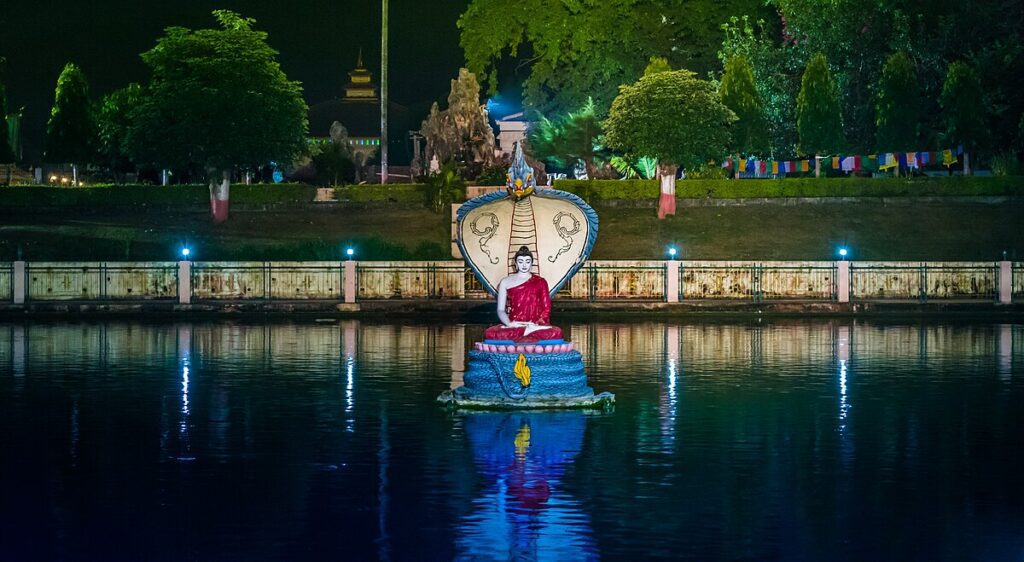
The Mucalinda story from early Buddhist tradition describes how, during seven days of heavy rain following the Buddha’s enlightenment at Bodh Gaya, the naga Mucalinda emerged from underground and wrapped his coils around the meditating Buddha, raising him above the floodwater and sheltering him with his spread hood. The image, which became one of the most widely reproduced icons in early Buddhist art across South and Southeast Asia, shows a multi-headed serpent as protector at the moment of world-historical creation: the emergence of the dharma into the world. Mucalinda correctly identified who required his protection and provided it. The serpent did not need to be defeated or domesticated. He was already on the right side of the threshold.
Why the Pattern Persists Without a Single Explanation
The global distribution of serpents in creation myths does not require a common origin or a universal psychology to explain it. It requires recognizing that actual snakes have a consistent set of observable properties, renewal through shedding, boundary-marking through coiling, double capacity for harm and healing, threshold-dwelling through their preference for cracks and liminal zones, that independently generated similar symbolic vocabularies in different communities that had never been in contact. The Minoan figurine-maker and the Teotihuacan stone-carver were not drawing on the same tradition. They were drawing on the same animal.
What varies between traditions is which properties any given community emphasized and for what purpose. Egyptian cosmological theology needed both a boundary-keeper and a chaos monster, so it developed Mehen and Apep as distinct figures. Norse mythology needed a world-edge marker and produced Jormungandr. Mesoamerican urban ceremony needed a vertical axis connecting earth and sky and developed the feathered serpent. South Asian Buddhist iconography needed a protector for the moment of world-historical transformation and developed the Mucalinda story. Each tradition selected from the same vocabulary and arranged it according to its own needs. The comparisons are real and illuminating. The differences are where the specific history of each culture actually lives.
A beginning is a threshold, and thresholds require guardians who can be present without spectacle, who understand the boundary they monitor, and whose authority over the crossing is legible to everyone who approaches. Snakes fill that requirement better than almost any other animal. They live at boundaries naturally. They carry both threat and the potential of protection in the same body. They are found wherever human settlements exist. Every culture that built walls, stored grain, dug wells, or marked graves had to develop a working relationship with actual snakes, and that relationship consistently generated the symbolic vocabulary that cosmological thinking then put to use at the largest possible scales.
Sources: Jan Assmann, Death and Salvation in Ancient Egypt (Cornell University Press, 2005); Erik Hornung, The Ancient Egyptian Books of the Afterlife (Cornell University Press, 1999); John Lindow, Norse Mythology: A Guide to Gods, Heroes, Rituals, and Beliefs (Oxford University Press, 2001); Wendy Doniger, The Hindus: An Alternative History (Penguin Press, 2009); Samuel Noah Kramer and John Maier, Myths of Enki, the Crafty God (Oxford University Press, 1989); Saburo Sugiyama, Human Sacrifice, Militarism, and Rulership (Cambridge University Press, 2005).