
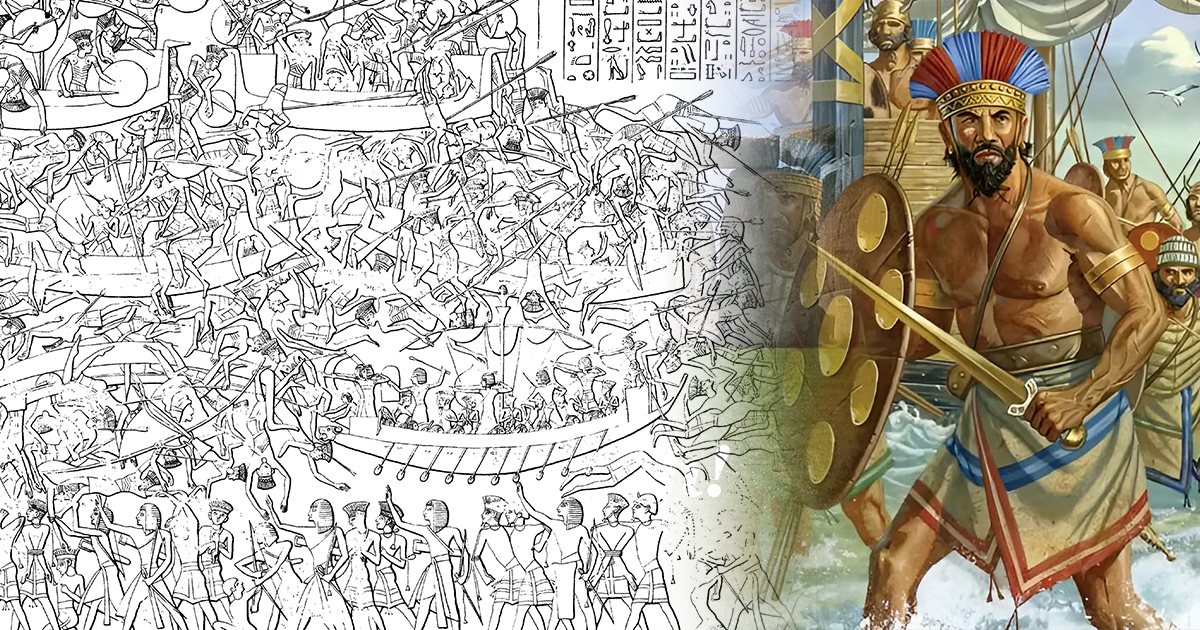
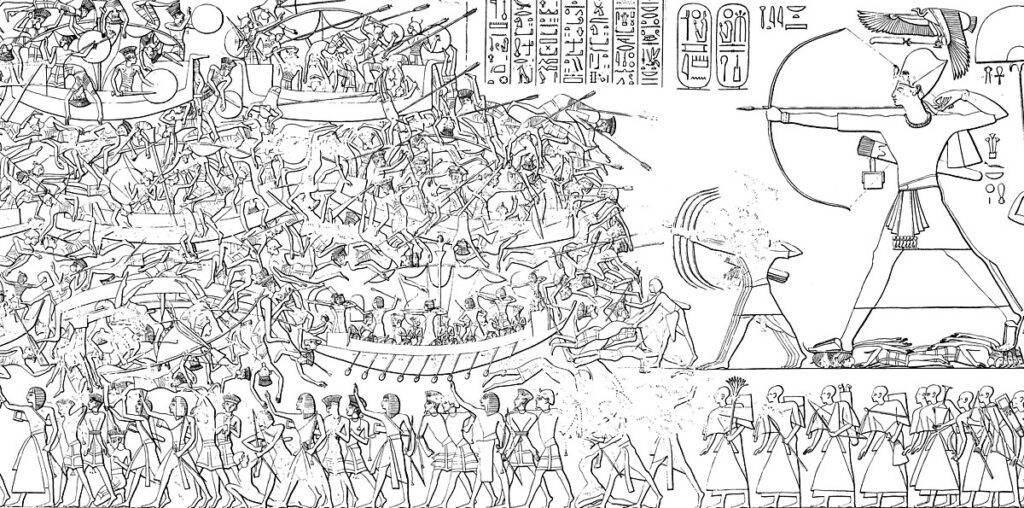
In the eighth year of Pharaoh Ramesses III’s reign, around 1177 BCE, a coalition of sea-borne groups launched a coordinated attack on Egypt by land and sea simultaneously. Egyptian artists recorded their defeat at the temple complex of Medinet Habu in extraordinary detail: ships locked side by side in the Nile Delta, archers firing from the banks into the crowded enemy decks, warriors in feathered headdresses and horned helmets struggling in the shallows as their vessels capsized. The relief inscriptions name the attackers as the Peleset, Tjekker, Shekelesh, Denyen, and Weshesh. Modern historians call them the Sea Peoples, a practical label covering several distinct groups who raided, migrated, served as mercenaries, and eventually settled across the eastern Mediterranean during one of the most disruptive transitions in ancient history.
What “Sea Peoples” actually means
“Sea Peoples” is not a name any of these groups used for themselves. It is a modern scholarly label derived from Egyptian phrases like “peoples of the sea” and “foreign countries of the sea” that appear in New Kingdom inscriptions. The groups named across these inscriptions, including Sherden, Shekelesh, Lukka, Peleset, Tjekker, Denyen, and Weshesh, do not represent a single nation or ethnic group. They were probably a mix of regional communities, displaced populations, and coalitions formed opportunistically during a period of widespread instability. Some of these groups fought against Egypt; others served in Egyptian armies as elite mercenaries. The Sherden, for instance, appear in earlier reliefs as personal bodyguards of Ramesses II before showing up as enemies in the Medinet Habu accounts of Ramesses III. “Enemy” and “ally” were roles that the same group could occupy at different times depending on circumstance.
The Late Bronze Age world the Sea Peoples entered
To understand who the Sea Peoples were and what they did, it helps to understand the world they entered. During the Late Bronze Age, roughly 1550 to 1200 BCE, a system of interconnected palace economies linked Egypt, the Hittite Empire, Kassite Babylon, Mycenaean Greece, Cyprus, and the Canaanite city-states of the Levant into a network of diplomatic exchange, luxury trade, and political alliance that scholars have called the Great Powers Club. The correspondence between these states survives in the Amarna Letters, a collection of over 350 clay tablets found in Egypt in 1887 that record kings addressing one another as brothers while their Canaanite vassal cities bargained for protection. Copper oxhide ingots moved by ship from Cyprus across the Mediterranean to workshops as far west as Sardinia; tin traveled from mines in the Taurus Mountains and Central Asia to reach smiths who needed it to produce bronze. The entire system depended on routes staying open and on the palace administrators who managed supply staying in power.
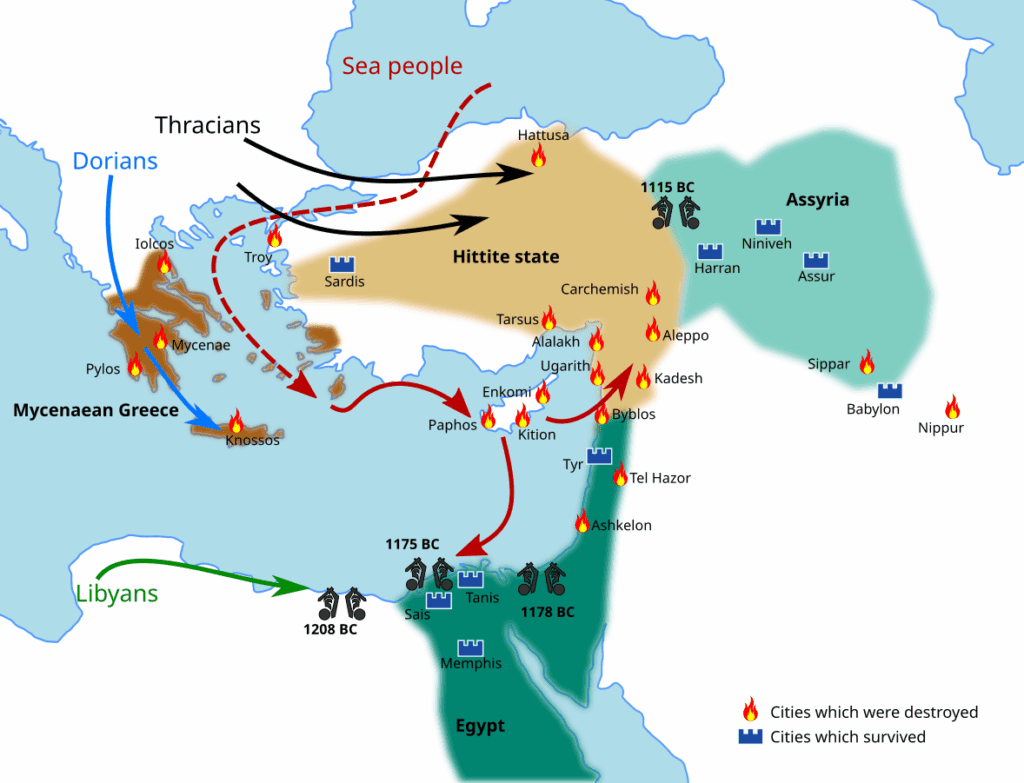
That system began to fracture badly in the late thirteenth century. The Hittite capital of Hattusa was abandoned and burned. Ugarit, the great Levantine trading port whose cuneiform archives include some of the most urgent crisis correspondence ever recovered, was destroyed and never rebuilt. Mycenaean palaces on mainland Greece stopped functioning and their Linear B administrative records ceased. Several Canaanite cities were burned in close succession. In the middle of all this disruption, the Sea Peoples appear in Egyptian texts, raiding coastlines that had previously been part of a stable and prosperous world.
What the Medinet Habu reliefs show
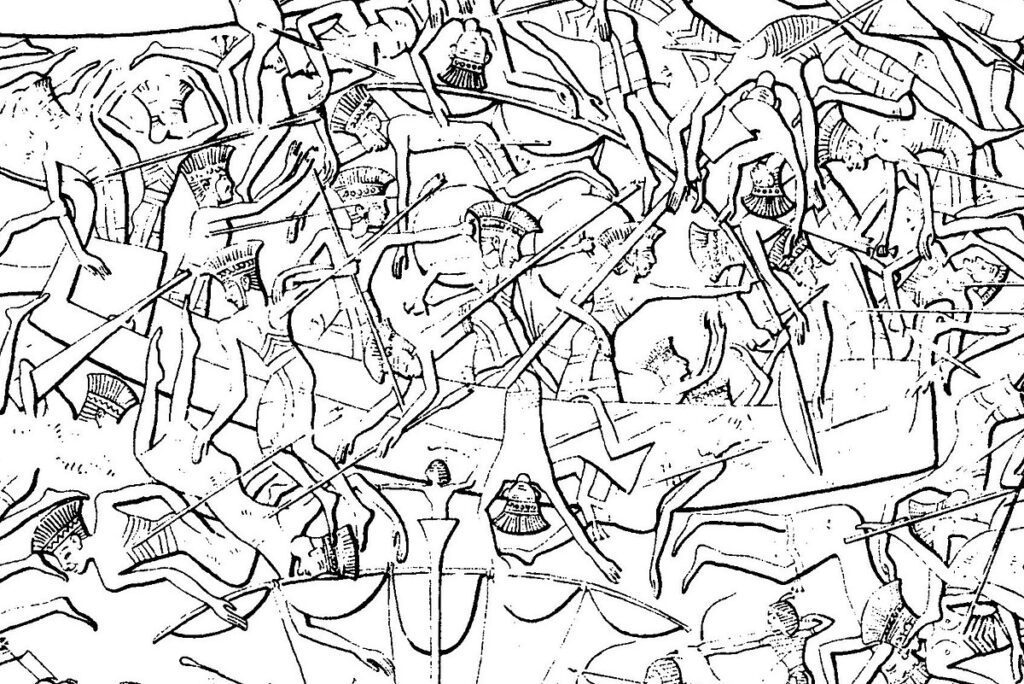
The Medinet Habu reliefs of Ramesses III are the single richest visual and textual source for the Sea Peoples, and they record two distinct engagements. The first is a land battle on the Levantine frontier in which Egyptian chariots and infantry clash with Sea Peoples columns that are accompanied by ox-carts carrying families and household goods, indicating that at least some of these groups were migrating rather than simply raiding. The second is the naval ambush in the Nile Delta mouth in which Egyptian archers fire from both riverbanks while crews board and capsize enemy vessels. The relief text accompanying the sea battle describes a planned ambush, suggesting that Egyptian commanders had warning of the fleet’s approach and prepared their response accordingly rather than simply reacting.
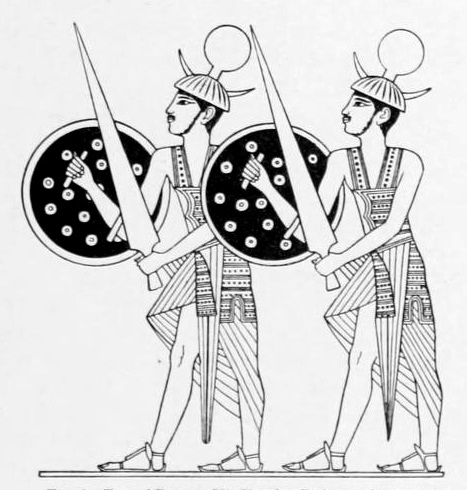
The reliefs are royal propaganda, not documentary journalism. They are composed to celebrate Egyptian victory and divine favor rather than to provide an accurate tactical record. But the repeated technical details across the panels, including specific helmet designs, shield types, sword forms, and ship construction, are consistent with independent archaeological finds from the same period and carry more weight than pure invention. The Sherden are shown with distinctive horned helmets capped by a disk, short round shields, and bronze body armor. The Peleset wear tall feathered headdresses and scale corslets. These are recognizable categories of equipment that appear elsewhere in the archaeological record, not generic “foreign enemy” designs.
The weapons and ships of the Sea Peoples
The Naue II sword, a long, leaf-shaped slashing weapon whose design originated in central Europe, spread widely across the Mediterranean at exactly this period. Several examples have been found at sites across Greece, the Levant, and Egypt. The distribution of this sword type is one of the material markers that archaeologists use to trace the movement of the groups associated with the Sea Peoples, since its design differs meaningfully from the earlier Bronze Age swords in use across the eastern Mediterranean. The ships depicted at Medinet Habu have high prows and sterns, a simple square sail, oars, and prominent shield racks along the railings. Whether the enemy vessels carried true bronze-shod rams is still debated among naval archaeologists, but the Egyptian accounts consistently emphasize grappling and hand-to-hand boarding rather than ramming tactics, which fits the confined waters of the Delta ambush and the crowded conditions visible in the reliefs.
Built out of a love for history, kept free from distractions.
Spoken Past is an independent project shaped by curiosity, care, and long hours of research. Reader support helps keep it maintained, carefully researched, and open to everyone.
Did the Sea Peoples cause the Bronze Age collapse?
An older generation of scholars blamed the Sea Peoples directly for the Bronze Age collapse, treating them as an overwhelming external force that destroyed the palace economies of the eastern Mediterranean from outside. This explanation no longer commands scholarly consensus. Eric Cline of George Washington University, writing in his 2014 book 1177 B.C.: The Year Civilization Collapsed, argues instead that the palace systems of the Late Bronze Age collapsed through a combination of interconnected failures: drought, earthquake damage, internal political breakdown, the disruption of long-distance trade networks, and migration pressure acting together in a pattern that no single cause can explain. The Late Bronze Age system was so tightly interdependent that when disruption hit multiple nodes simultaneously, the whole network became vulnerable. The Sea Peoples were part of that story, but they were operating within a crisis that had structural causes well beyond their capacity to have generated alone.
The crisis correspondence from Ugarit supports this reading. Late letters from the city’s archives include requests from the king of Alashiya, ancient Cyprus, warning that enemy ships had been sighted offshore, and a desperate appeal from the Hittite king asking Ugarit to send grain because famine had struck the Hittite heartland. These are not letters written by people facing a sudden unexpected attack. They are letters written by administrators trying to keep a struggling system running as multiple pressures converged simultaneously. The Sea Peoples were the most dramatic visible element of that convergence, not its hidden cause.
Where the Sea Peoples settled
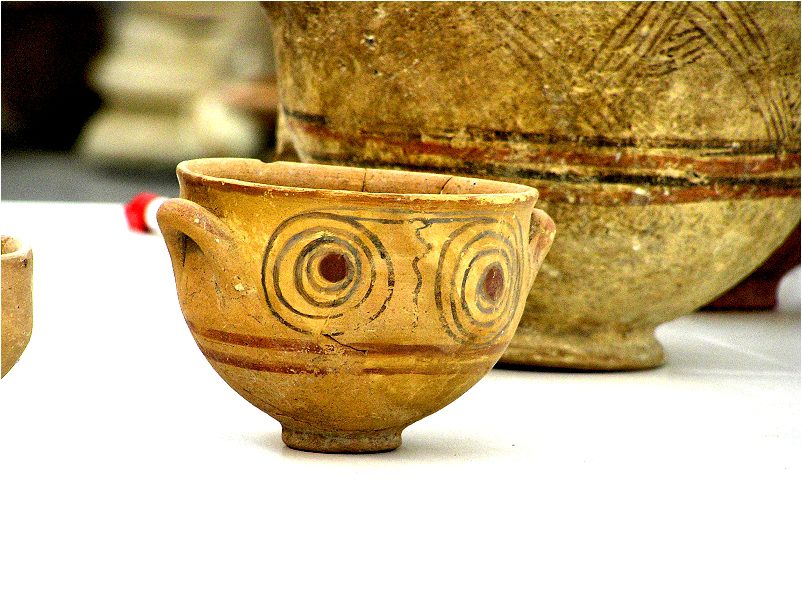
After the campaigns of Ramesses III, Egyptian texts record that captured Sea Peoples groups were resettled on land in Egypt’s sphere of control with obligations of service. The policy was integration and oversight, not extermination. In the southern coastal plain of Canaan, the early Iron Age archaeological record at sites including Ashkelon, Ashdod, Ekron, Gath, and Gaza shows a pattern of cultural change that fits the arrival of new communities mixing with existing local populations. Pottery with Aegean-influenced shapes and decoration, produced in local clay, appears in these layers and is known to archaeologists as Philistine Bichrome ware. House plans change to include four-room layout types alongside older forms. Animal bone assemblages shift, with pig remains becoming more common at some sites than in preceding Bronze Age layers.
The connection between the Peleset named in Egyptian texts and the Philistines of the biblical and archaeological record is probable but not fully proven. “Peleset” is an Egyptian demonym and “Philistine” is a later cultural category used for the communities that occupied these coastal cities in the Iron Age I period. The overlap is strong enough that most scholars accept a connection, while acknowledging that the Philistine cultural identity that developed at these sites was the product of interaction between incoming groups and existing Canaanite populations over the course of a generation or more, rather than a simple population replacement.
Where the Sea Peoples came from
The question of Sea Peoples origins has generated more debate than almost any other problem in Bronze Age studies and remains genuinely unresolved. Proposals for homelands include the Aegean islands, southwestern Anatolia, mainland Greece, Cyprus, Sardinia, Sicily, and combinations of several of these. The name Ekwesh, one of the groups listed in the Merneptah Stela recording an earlier wave of attacks under Ramesses II’s successor around 1208 BCE, has been compared to Achaean, the Homeric term for Mycenaean Greeks, by scholars including Robert Drews in his study of Bronze Age warfare. The Sherden have been tentatively associated with Sardinia; the Lukka with southwestern Anatolia, where a region called Lukka appears in Hittite texts as a source of maritime raiders. None of these identifications is settled, and the distribution of equipment types, pottery, and personal names across the relevant sites suggests that the Sea Peoples coalitions were genuinely mixed in origin rather than representing the displacement of any single population.
How scholars study the Sea Peoples
The methodological challenge in Sea Peoples research is that the primary textual sources, mainly Egyptian inscriptions, are victory narratives written from a single perspective by the winners. They name groups from the outside, attribute unified motivation and behavior to coalitions that were probably loosely organized, and present the outcome as divinely ordained Egyptian triumph rather than as a messy military and political process. Reading these inscriptions against the grain means asking what they take for granted rather than only what they assert, and comparing their claims against independent evidence from archaeology, epigraphy, and the crisis correspondence of other states. The late letters from Ugarit and Hatti are particularly valuable because they were written from within the crisis rather than after it, by administrators who had no interest in presenting the situation more favorably than it was.
Isotopic analysis of human remains from sites associated with Sea Peoples activity, ancient DNA studies, and materials provenance work on metal objects and ceramics are all adding new dimensions to the picture that text-based research alone cannot supply. These methods are still producing results at specific sites, and the picture will continue to develop. What can be said now is that the Sea Peoples were a real historical phenomenon, that their movement was part of a broader pattern of migration and disruption rather than its cause, and that the communities they helped found in the southern Levant developed into culturally distinctive populations who left a substantial imprint on the region’s Iron Age history.
Sources: Eric H. Cline, 1177 B.C.: The Year Civilization Collapsed (Princeton University Press, 2014); Robert Drews, The End of the Bronze Age: Changes in Warfare and the Catastrophe c. 1200 BC (Princeton University Press, 1993); Medinet Habu, vols. 1-2, Oriental Institute Publications (University of Chicago Press, 1930-1932); Merneptah Stela, translations in Ancient Records of Egypt vol. 3, ed. James Henry Breasted; Assyriology tablets from Ugarit RS 20.238 and related correspondence, in Pierre Bordreuil et al., Une Bibliotheque au sud de la Ville (1991); Trude Dothan and Moshe Dothan, People of the Sea: The Search for the Philistines (Macmillan, 1992).