
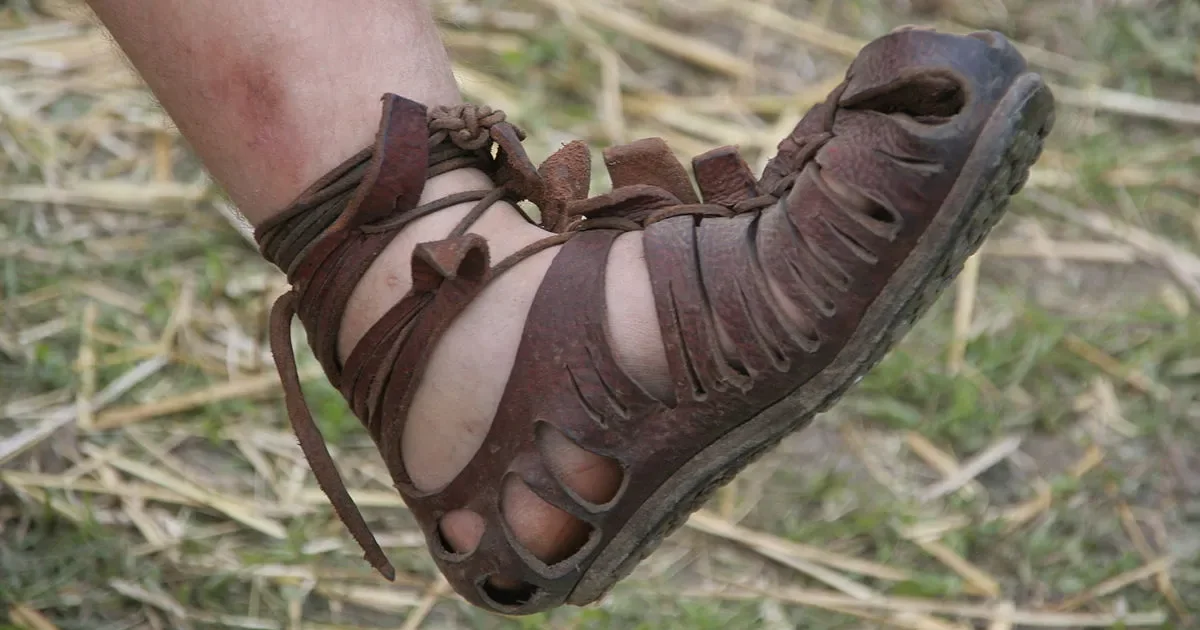
The Roman army did not conquer distance with swords. It conquered distance with feet. The footwear that carried legionaries across Italy, Gaul, the Danube, and the Syrian steppe was the caliga, an openwork military sandal with iron hobnails hammered through its thick leather sole. The caliga was no fashion statement. It was a piece of engineered kit made to bite road, drain water, shed mud, and last under load. When we talk about how Rome moved, we are really talking about how leather and iron met a thousand kinds of ground.
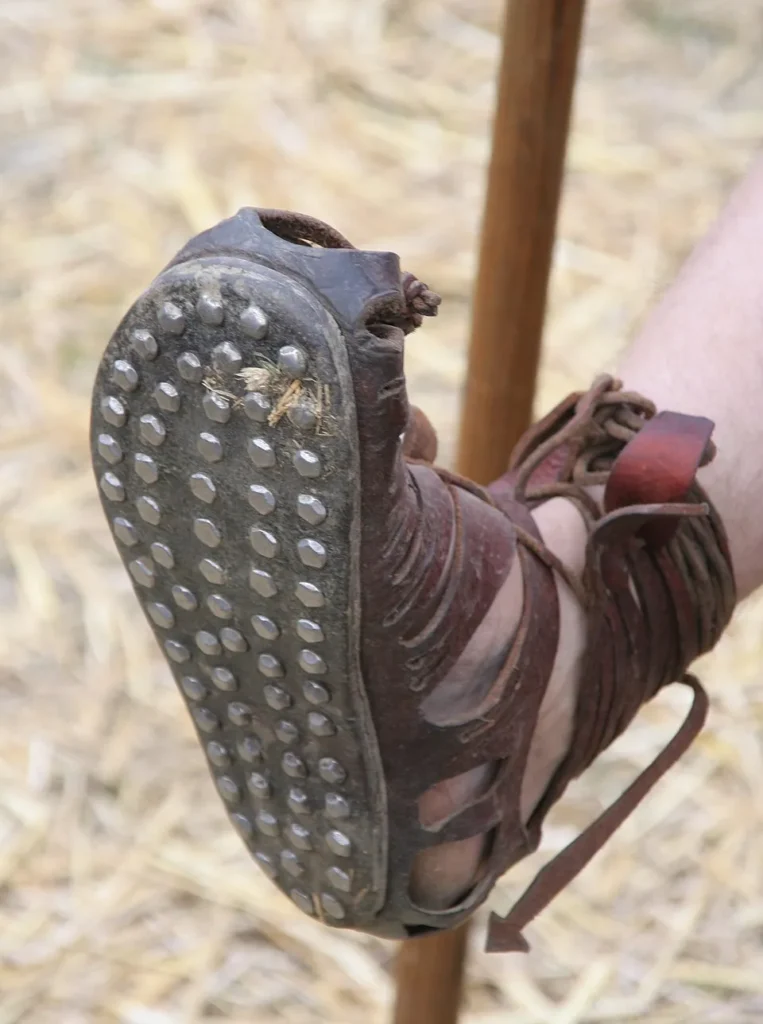
Caligae, plural of caliga, appear early in the empire. They are strongly associated with the first to third centuries CE, the height of Rome’s professional standing army. The footwear linked every man in the ranks, from raw recruit to grizzled veteran. Its design seems simple at a glance: a tough, stacked sole, a lattice of leather straps that wrapped the foot and lower ankle, and an underbelly studded with iron. In practice, the caliga was a dynamic solution to problems soldiers still face: traction on mixed terrain, breathability under sweat, stability with a heavy pack, and repairability in the field. Roman caligae hobnail patterns for long marches were not an afterthought. They were the point.
The word, the wearer, the work
The word caliga probably comes from a diminutive of calceus, shoe. Roman writers sometimes used caliga generally for soldier’s footwear. The caliga’s most famous appearance in literary memory is the nickname of Gaius, the future emperor Caligula, who as a child followed his father Germanicus among soldiers on the Rhine in tiny “little boot” shoes. The anecdote tells us two things. First, the caliga was a recognized badge of the miles, the fighting man. Second, the shoe’s profile was distinctive enough to name a person.
What set caligae apart from civilian shoes was the hobnailed sole and open upper. The hobnail is a short iron nail with a domed or flat head. Driven from the inside out, then clenched or peened, it created a field of hard points under the foot. The openwork upper was cut from a single piece of leather, often from cowhide, split into straps that crossed and buckled. This allowed air flow and drainage. When a soldier crossed a stream, his caligae did not act like water buckets. They let water out and kept the foot relatively dry. Blisters, the old enemy, still happened. The shoe made them fewer.
How a caliga was built
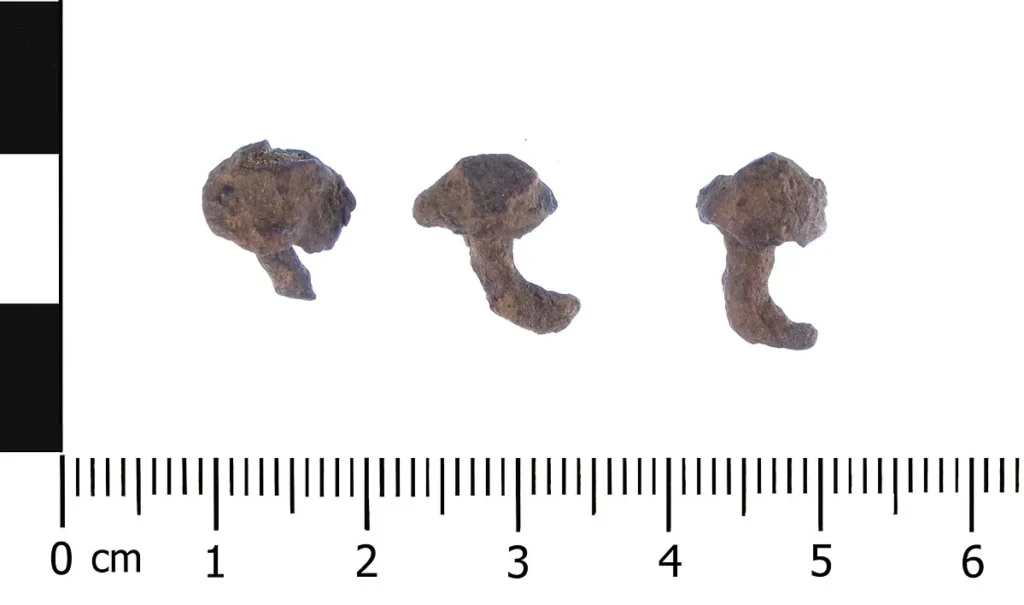
Archaeology allows a close look at the craft. Caligae were layered. The sole was not a single slab. It was a sandwich: insole, midsole, outsole, sometimes with a thin reinforcing lamina between. The total thickness of this stack could reach a centimeter or more. Roman leatherworkers used awls, knives, and punches. They stitched with linen or sinew, and they nailed. The hobnails, typically around 6 to 12 millimeters in shank length and 6 to 9 millimeters across the head, were set in patterns to fix the layers and to distribute pressure. A single shoe could carry 60 to 120 hobnails. Some pairs used even more.
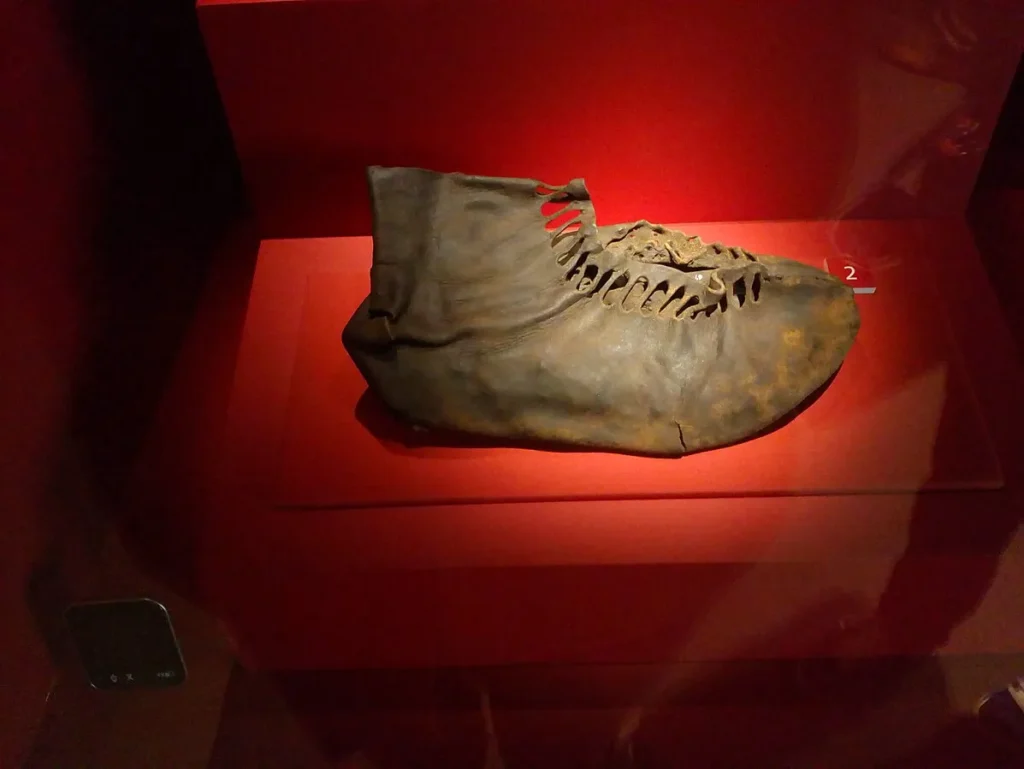
The uppers were cut as one piece and laced with thongs through slits or eyelets. The tongue, sometimes a separate flap, shielded the top of the foot from rubbing. The heel might include a cup or counter stiffened by stacked leather. Most caligae we know come to us as fragments: soles, upper cutwork, and hordes of nails. In waterlogged conditions, like those along the British frontier, leather survives. Whole shoes have turned up in wells, ditches, and barracks floors.
Why sandals, not closed boots?
There is a modern intuition that a soldier needs a closed boot. Ancient evidence suggests the opposite for Rome’s core period. An open upper vented heat. It reduced the mass of wet leather that had to dry each night. On long marches, soldiers crossed rivers and walked in rain. A closed boot traps moisture. Wet leather softens, then it stretches and rubs, then it grows mildew. An openwork caliga lets air pass between the straps and the foot. The toes are exposed, so the shoe cannot hold standing water. The result is a fast-drying system with fewer foot infections.
The open upper also made the shoe easier to repair. A broken strap could be replaced or spliced without dismantling the whole. Leather, unlike modern synthetic uppers, can be patched with simple tools. Field repairs mattered. The army carried nails, needles, and scraps. Contubernia, eight-man tent groups, shared spare parts. A shoe that could be kept going without a cobbler’s bench was gold on a winter road.
Hobnails: the iron underworld
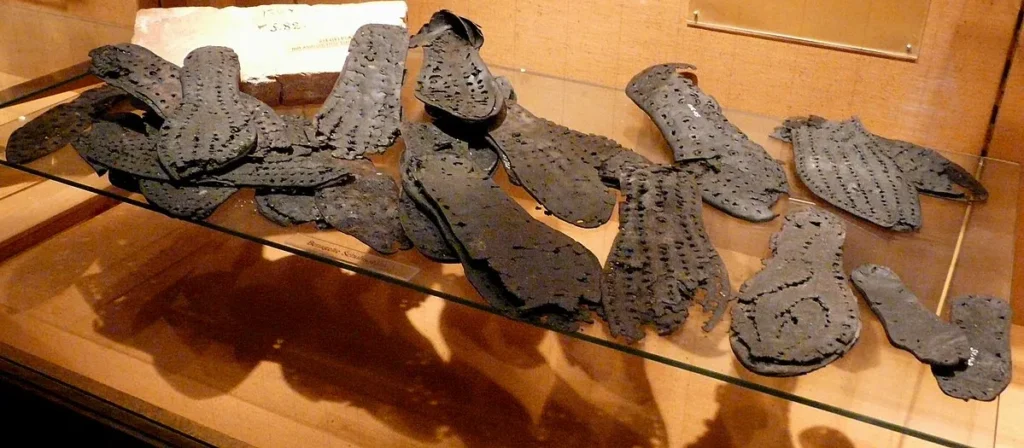
The hobnail turns the caliga from sandal into machine. It does three jobs. First, it stitches the sole layers together, much like rivets. Second, it provides grip on dirt, turf, and timber. Third, it protects the leather sole from abrasion against stone.
Patterns matter. Roman caligae hobnail patterns for long marches were not random scatter. Archaeologists have documented repeating schemes: dense fields beneath the heel and forefoot where load is greatest, with a less dense band through the midfoot to keep flexibility. Some soles used a perimeter ring of nails that acted as a sacrificial guard. Others formed decorative or unit markers, such as letters or simple figures, though the latter is debated and may be rare. The consistent element is the concentration under heel and metatarsal heads. The foot leaves iron where it needs it.
The iron heads wear down. Nails loosen. A soldier on campaign would have replaced missing nails often. The maintenance cycle for hobnailed footwear is short. Nails pull through softened leather when wet, and they shear when catching in cracks. That is a price for traction. The alternative is slipping, and a slipped foot under a heavy pack is a broken ankle. The army chose the price of upkeep.
How far and how fast in caligae
The distances traversed by Roman troops have become cliché: twenty Roman miles a day, more if pressed. A Roman mile is about 1,480 meters. Ancient writers like Vegetius described training marches at differing paces, loaded and unloaded, meant to harden recruits. Even if we treat such descriptions with caution, a professional army that held a frontier from the North Sea to the Euphrates had to move predictably. That means footwear that allowed a steady cadence on mixed ground without crippling the wearer.
Caligae meet that demand. The sole is stiff enough to spread load, so a soldier’s foot does not flex excessively under weight. The hobnails create a hard contact with road metal on the empire’s engineered highways. On dry stone they spark, but they also keep the foot from skidding on the gravel topping. On clay they bite. On grass they act like short cleats. Snow and ice are the worst surfaces, then and now, and army manuals ancient and modern do not pretend otherwise. A caliga on ice is better than a bare leather sole because iron still bites edges and grain. It is not magic. In sleet on a steep hillside any boot needs caution.
What the archaeological record shows
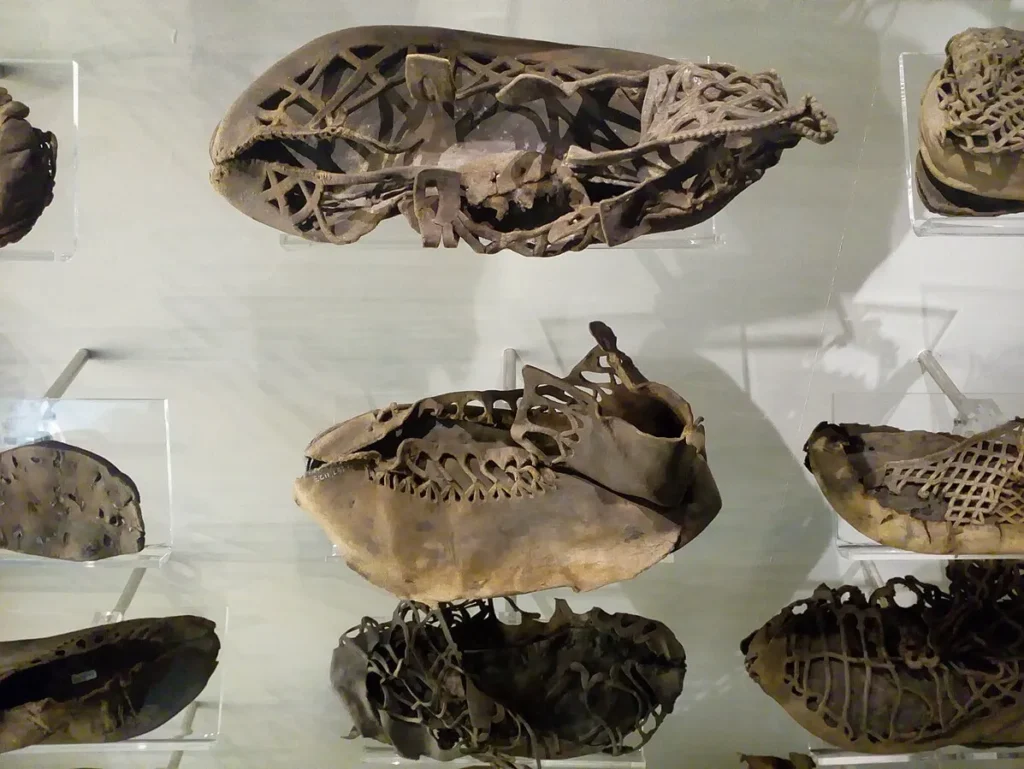
Frontier sites in Britain, especially around Hadrian’s Wall, have produced the richest record of Roman footwear. Waterlogged deposits preserve both leather and wood. Vindolanda, near modern Bardon Mill, has yielded thousands of shoes in various styles. Some are simple one-piece carbatinae, rawhide or leather shoes wrapped and laced around the foot. Others are elegant, with elaborate cutwork uppers. Among them are unmistakable caligae soles with hobnails still clenched in place.
The range of sizes is striking, from tiny child’s shoes to outsized men’s footwear. The shoe dump at a fort shows the full social spectrum. Soldiers’ families lived near garrisons, and traders and craftsmen had their own footwear needs. The result is an archaeological chorus of feet. The caliga stands out because of its nails. They endure where leather rots, so even when upper fragments are gone, a scatter of hobnails can mark a barrack room floor.
Saalburg, the reconstructed fort on the Upper Germanic-Raetian limes, preserves and displays military footwear types, including caligae and closed boots from later centuries. The display allows visitors to see sole construction in section, to count nail patterns, and to compare marching sandals to later calcei, closed boots. The difference is not just cosmetic. It marks a shift in military dress and perhaps in tactics and climate exposure.
To explore Hadrian’s Wall and the places where so many caligae have been found, see the detailed site overview on English Heritage’s Hadrian’s Wall page.
For a living collection rooted in excavation, the Saalburg Roman Fort Museum presents original finds and reconstructions, including footwear.
For a curator’s perspective on hobnail function and patterns from the British frontier, the Vindolanda Trust has an accessible note, “The Curator’s Favorite Shoes,” discussing studding and support.
For current finds that keep adding to what we know, Vindolanda’s update on new discoveries at Magna Fort, “Magna Shoes,” gives a sense of ongoing work and scale.
These four resources anchor the shoe to a place and a research tradition. They will keep you oriented as we dive deeper into how caligae were used, repaired, and eventually replaced.
The science of a step: pressure and pattern
Imagine a soldier in his thirties, five and a half Roman feet tall in the old averages, carrying his pack, shield, and weapons, perhaps 30 to 40 kilograms total. Every step deposits more than body weight onto the ground. Peak pressures are concentrated in the heel strike and across the heads of the first and second metatarsals as the foot pushes off. If the leather sole were naked, those hot spots would grind out first.
Hobnail placement follows this pressure map. Nails cluster under the heel, sometimes in a horseshoe arrangement. They also cluster under the ball of the foot. The midfoot is often sparser to keep some flex. The outer perimeter ring takes scuffing. The result is that the nails wear down in a way that keeps the shoe stable. If the forefoot lost nails first, toe-off would slip. If the heel lost them first, heel strike would skate. Roman cobblers understood feet.
There is another subtlety. A dense nail field stiffens the sole. Iron is less compressible than leather. A soldier who spends months on hard roads benefits from a platform that spreads pressure. Modern boot designers call this shank stiffness and midsole support. Rome achieved a similar effect with stacked leather and iron.
Weight, noise, and the sound of an army
Hobnails add weight, but not as much as some imagine. A pair of caligae with 200 nails total might carry an extra 300 to 500 grams of iron, depending on nail size. The payback in durability and safety outweighs the penalty. An interesting byproduct is sound. An army in caligae on stone makes a bright ringing. Ancient sources notice the noise of marching men. Sound alone does not win battles. It does carry. In the night, the ring of nails on a bridge announces a crossing.
The music of iron was a morale phenomenon. Soldiers identified the cadence of march by sound, and civilians in a town felt an army’s presence through it. In a world of wooden wheels and animal hooves, the hard click of hundreds of small iron heads on paving cuts through. Caligae changed the acoustic landscape.
Caligae and climate
Rome’s empire stretched across climates. From the wet cool of Britannia to the aridity of Syria, footwear had to adapt. Caligae appear most associated with western and northern provinces in the first two centuries. In colder seasons, soldiers might have worn footwraps or socks with their caligae. Some sites have produced knitted or stitched socks, including examples thought to be children’s garments, but the idea translates to adults in harsh weather. Leather does not insulate by itself. Wool and felt do.
In the east and in deserts, the openwork upper was a blessing. Heat stress is as dangerous as cold. A breathable shoe that allows evaporation reduces maceration of the skin. Grit is the enemy in deserts. Hobnails are strong, but moving sand finds seams. Caligae in such environments would have suffered more frequent repairs at the rear edge and inside the sole layers where sand abrades.
Officers, ranks, and footwear
Not every Roman soldier wore caligae at every moment. Officers are often depicted in closed footwear, calcei, particularly in formal contexts. Fashion lines between civilian and military could blur. A centurion, for example, might appear on duty in more polished kit. The ranker’s caliga, however, was the working standard. It suited drill yards, marches, and roadwork. Reliefs on monuments show soldiers with bare knees and studded sandals. Statues of emperors in military garb are more likely to show closed boots, which signals status and public image rather than daily wear on a muddy parade ground.
Built out of a love for history, kept free from distractions.
Spoken Past is an independent project shaped by curiosity, care, and long hours of research. Reader support helps keep it maintained, carefully researched, and open to everyone.
Repair culture: how to keep a shoe alive
The Roman army had logistics for shoes. Hobnails were cheap. Leather was valuable, but military procurement could be centralized at regional fabricae, state-run workshops that produced arms, armor, and kit. Shoes could be built in bulk. In the field, soldiers or camp cobblers replaced nails and restitched seams. Soles might be resoled, new leather sewn onto old uppers. Sometimes old shoes were cut down so that the sturdy forefoot could be reused as a patched toe for another shoe. The waste stream of barracks shows cut and re-cut pieces.
A practical question arises: how did soldiers hammer nails in a world without portable vises and lasts? The answer is simple tools. A small anvil or iron plate, a hammer, and a wooden last, even if crude, suffice. A man could hold the shoe on the last, drive nails through from above, then peen them against the iron plate to clench. Recruits learned this along with sharpening stakes and cleaning armor. A unit without shoe-repair knowledge would be immobile a month into a wet season.
The hobnail as a footprint in time
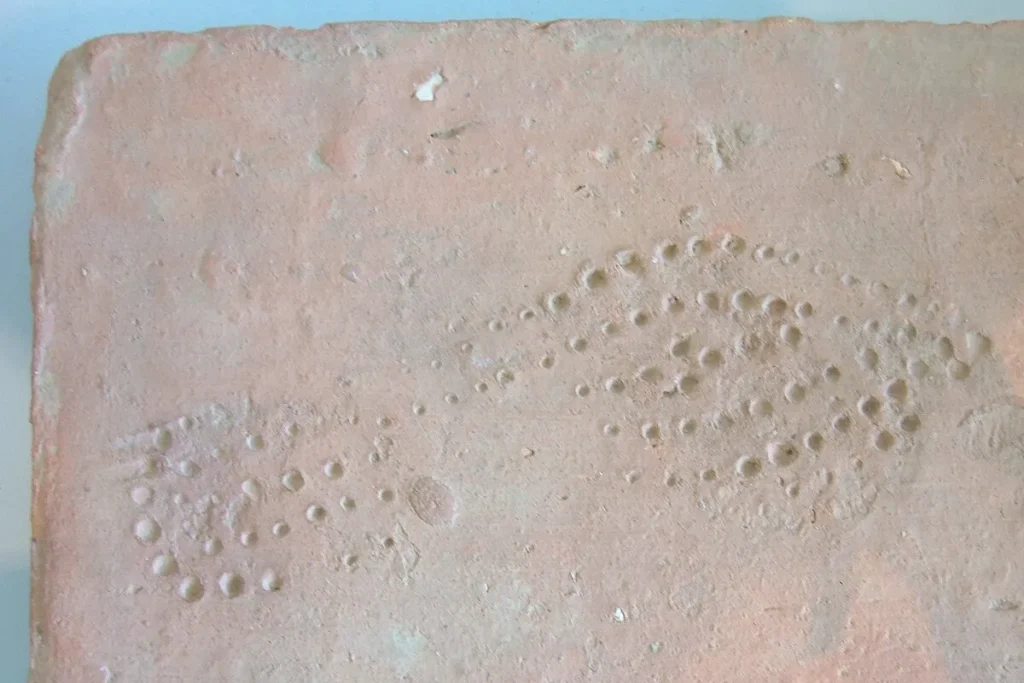
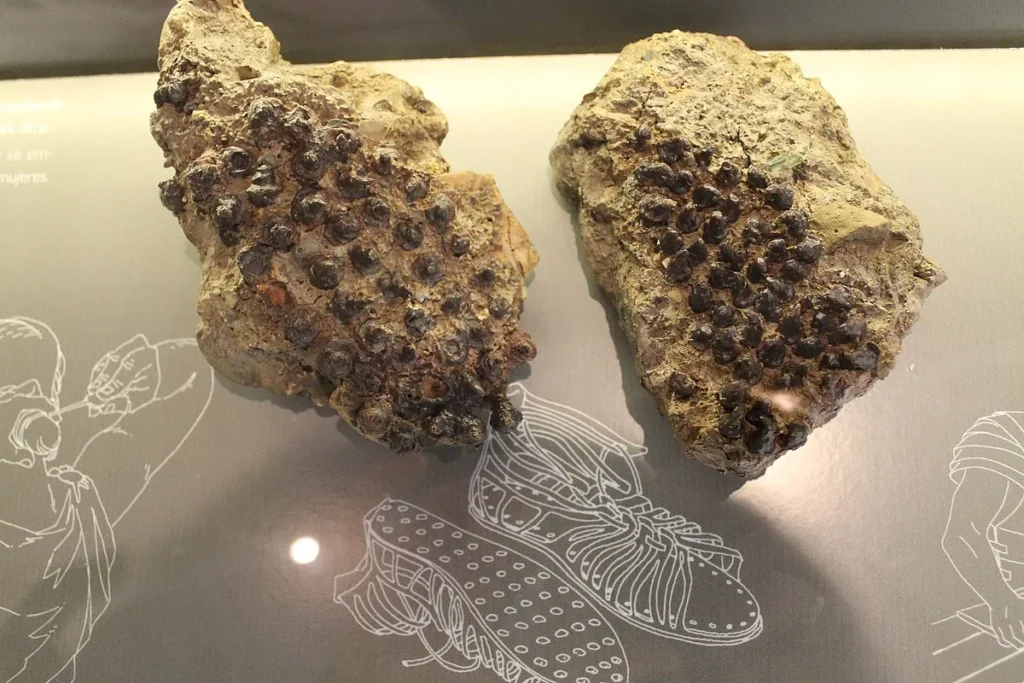
Hobnails are more than functional. They are diagnostic. Tiles and bricks recovered from the empire often bear the print of a caliga sole impressed while the clay was wet. Sometimes these impressions are crisp enough to count rows of nails. At kiln sites and legionary brickyards, soldiers walked where tiles were drying. Their shoes left data. Archaeologists read these prints to reconstruct nail counts and spacing. When the leather is gone, the nail pattern still speaks.
Caligae off the road: camp life and fatigue duty
Marching is only part of a soldier’s life. In camp, caligae held up to carpentry, ditching, and stone-hauling. The nails that punish a road also bite wood and timbers. When building a rampart, a soldier climbs in mud. When policing a barrack, he walks on timber floors. The shoes perform different jobs in these contexts. In barracks, hobnails chew wood. Roman floors and platforms show pitting from this. When soldiers entered a principia, the headquarters building, they sometimes used mats at entrances to reduce damage.
The same features that make caligae effective outdoors make them punishing on soft floors indoors. That tradeoff was accepted. Soldiers did not carry a second pair for indoor wear when on the line. Officers and clerks working primarily under cover might have preferred softer soles. In winter quarters, closed shoes grow more common in the material record as the centuries pass. The army’s footwear kit was never static.
Boots in the late empire: from openwork to closed
By the third century, and certainly by the fourth, closed footwear becomes more visible in art and archaeology. The reasons include changes in uniform, shifts in climate during the late antique period, and the evolution of soldiers’ daily tasks. Late Roman boots were often nailed too, but the uppers covered the foot. The word caliga continued in some texts as a general term for military footwear. The specific openwork sandal of the early empire fades, though it does not vanish everywhere at once. In wet, cool provinces, a closed upper is a comfort. In dress contexts, a closed boot is smart.
The disappearance of the classic caliga from the historical spotlight should not be read as failure. It did its job for centuries when the army’s core mission was to walk and fight far from base. As garrisons settled and cavalry’s role grew, footgear adapted. The story of footwear follows the story of the army.
What the roads asked of shoes
Roman roads were not uniform. An idealized highway had layered foundations, a crown for drainage, and a cambered surface of compacted gravel or paving stones. In reality, winter freeze lifted stones, spring floods washed edges, and local contractors built in local ways. A caliga met flat basalt in one mile and rutted marl in the next. Hobnails performed best on firm gravel and fitting stonework. In swamps and clay, the shoe’s open upper and quick drain mattered more than the nail’s bite.
There is also the weight of the soldier to consider. Pack load varied. A legionary could carry sixty to seventy Roman pounds in a full marching kit, roughly 20 to 23 kilograms. Add armor and weapons on the body, and the foot carried a heavy, lively load. The caliga needed to keep the ankle aligned. A stiff sole helps. An overly soft one lets the foot sink and twist. Roman cobblers were not thinking in modern biomechanical terms. They were reacting to feedback: what kept men on their feet and what failed.
Could a caliga be comfortable?
Comfort is a loaded word. For a trained soldier who marched daily, the caliga would have felt normal. The straps could be adjusted for swelling through the day. Wool socks or footwraps added comfort in cold weather. The insole gradually molded to the foot. The iron underfoot is not something the wearer felt because the heads sat flush with the outer sole, and the inner insole separated the foot from the shank. What he did feel was the platform’s stiffness. That stiffness is tiring for untrained feet at first. Over time it spreads load and prevents bruising.
Blisters and chafing did happen. Preventive measures included rubbing feet with oil or tallow, changing socks when possible, and rotating shoes to allow them to dry. Salt in sweat stiffens leather when it dries, so periodic greasing kept straps supple and reduced cuts. The army’s daily routine included kit maintenance. A man who neglects his feet does not march tomorrow.
The economy of nails and leather
Hobnails were consumables. A large unit could go through tens of thousands in a season. Iron was abundant compared to quality leather. The empire’s tanning industry was organized, smelly, and essential. Oak-bark tanning produced tough soles. Uppers might be cut from slightly thinner hides for flexibility. The smell of a fort included leather dressing, pine pitch, and the acrid tang of ironworking. Supply officers and contractors ensured that hides arrived at workshops and finished shoes reached units. Shoes were issued and checked like weapons.
A soldier valued his shoes. He might be docked for losing them or for presenting for duty in unserviceable footwear without good cause. Commanders were not fools. They knew that a barefoot man is a liability. Even on ration-strapped frontiers, spare footwear appears in lists of stores. Bean counters counted nails.
Evidence across provinces
While Britain grabs attention because of preservation, the continent and the Mediterranean have produced ample footwear finds in pits, wells, and graves. The Rhineland yields shoes from forts and towns. Spain has produced caligae soles in burials. Italy shows civilian variants of the openwork sandal. A hobnail is a small object. It travels in a pocket of mud stuck to a broken tile. Archaeologists must be persistent to connect nail scatters to definite shoes, but patterns emerge.
Regional variation matters. In wetter provinces one sees more dense nail fields, possibly reacting to mud and turf. In dry provinces some shoes favor thinner soles. This is a general impression, not a law. Unit supply and the luck of preservation complicate the picture. What matters for our purpose is that the caliga’s logic held across climates and social settings. When soldiers left the fort to repair a watchtower, they wore the same iron-studded soles they wore on the great road.
Myths to retire
Two myths recur. First, that hobnails were useless on stone roads because they slipped. This is false in general and true in specific. On polished marble, any shoe without a soft rubber-like sole will slip. Roman roads were not polished marble. They were rough stone and compacted metal. Hobnails grip edges. Second, that caligae were crude compared to modern boots. In engineering terms, they solved the problem with available materials as elegantly as any modern military boot solves it with polymers. A modern boot is better on ice and better at waterproofing. A caliga is faster to dry, easier to repair, and cooler in heat.
Caligae in public memory
No other ancient shoe has such a clear emotional presence. A German emperor’s heir was nicknamed after it. Kids today try on replicas at forts and feel a link to the rank and file of antiquity. At Saalburg, at Housesteads on Hadrian’s Wall, and in museum cases from York to Nijmegen, a caliga invites you to imagine a march. A shoe is intimate. Armor keeps enemies away. Footwear keeps the road near.
The sound of a hobnailed sole on a Roman bridge is gone. The ingenuity remains. Iron and leather made a rhythm across a continent. When we picture a legion on the move, picture a hundred thousand iron heads hitting ground, every step a small act of engineering perfection.
FAQ
Were caligae worn year-round, even in winter?
Often yes. In colder months soldiers likely added socks or footwraps, and in later centuries closed boots became more common in harsh conditions. The openwork design did not bar winter use, it simply required insulation.
How many hobnails did a typical caliga use?
A typical range is 60 to 120 per shoe, with higher counts in heavy-duty pairs. Clustering at the heel and forefoot is standard, with a lighter midfoot.
Did soldiers make their own repairs?
Yes. Units maintained simple toolkits. Nails could be replaced at the company level, and straps patched or spliced. Major repairs and resoling might go to a camp cobbler or workshop.
Were caligae only military footwear?
The caliga is closely associated with the army, but hobnailed soles appear on civilian shoes too, especially work shoes. Openwork uppers and nailed soles are not exclusive to soldiers.
Why not use wooden clogs or fully closed boots from the start?
Clogs existed in some provinces and appear at frontier sites, but they are heavy and less suited to long marches. Closed boots hold water and dry slowly. The caliga maximized drainage, breathability, and repairability for a marching army.
Did hobnails damage Roman roads?
Not in a meaningful way. Road surfaces were built to endure carts with iron-shod wheels and animal traffic. Hobnails wear down faster than a road does.
How long did a pair of caligae last?
It depends on terrain and load. With routine replacement of nails and occasional patching, months of hard service are plausible. A negligent wearer could destroy a pair in weeks.
Were there standardized sizes?
Evidence from shoe dumps shows many sizes, which implies some standardization in production. The presence of child and women’s sizes at forts also reflects broader communities around garrisons.
Could hobnail patterns identify a unit?
Sometimes a nail pattern forms a simple mark, but robust, consistent unit signatures are not well documented. Most patterns serve function first.
Did officers wear caligae?
In daily duties some did, but in formal or ceremonial settings officers are often shown in closed boots. Rank influenced footwear, but function ruled on the march.