In 1974 farmers near Lintong, Shaanxi, broke into a pit and found ranks of life-size soldiers. Among the shattered terracotta, excavators began lifting real weapons: copper-tin bronze swords with intact edges, dagger-axes with crisp bevels, crossbow triggers that still moved when cleaned. Many of these pieces had lain in the ground for more than two thousand years, yet their surfaces were not eaten away. The edges still read as edges, not as softened curves. What kept them so sound is not a trick coating, and not a miracle of the air. It is a combination of alloy design, finishing, burial environment, and chance that we can now describe with some precision.
The weapons come from the mausoleum complex of Qin Shi Huang, first emperor of a unified China, built roughly between 246 and 210 BCE. The largest excavation zones, known as Pits 1, 2, and 3, lie a short walk from the tall earthen mound that covers the emperor’s tomb. The finds include thousands of bronze arrowheads, hundreds of spear and halberd blades, dozens of straight double-edged swords, and a remarkable population of bronze crossbow mechanisms. Archaeologists, conservators, and materials scientists have examined these objects with portable X-ray fluorescence, scanning electron microscopy, metallography, and controlled burial experiments. They have sampled the surrounding loess soils, analyzed the corrosion films, and measured microhardness at edges and cores. The outline that follows rests on that technical work, as well as on the visible evidence in the pits and galleries.
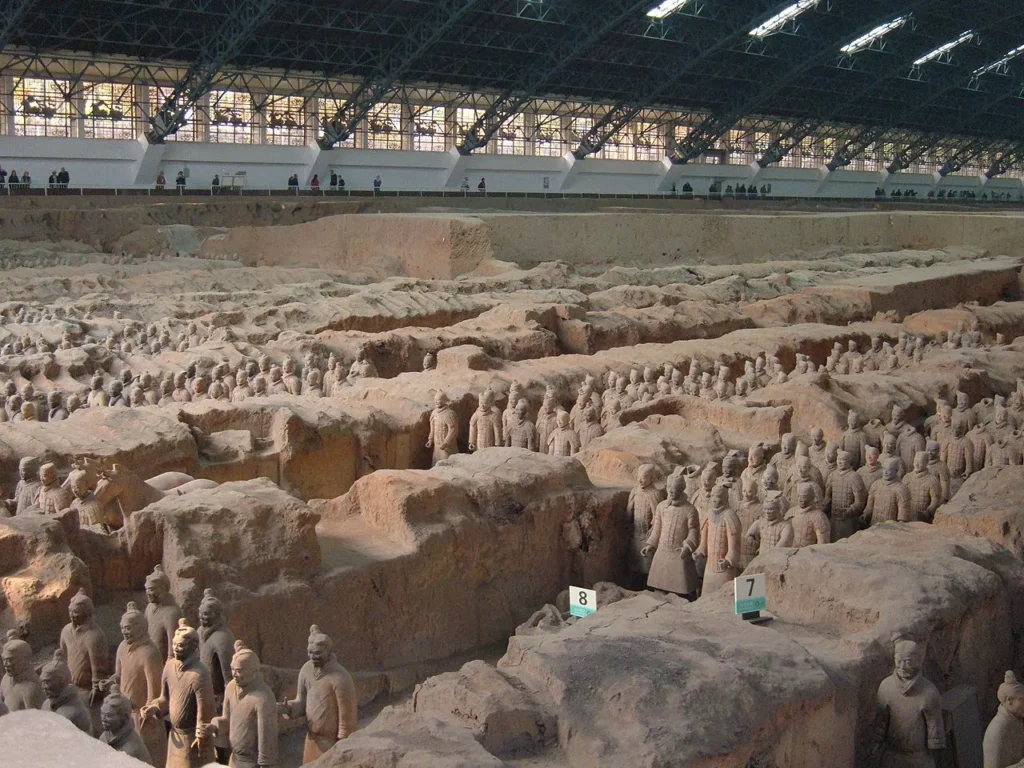
What kinds of weapons did the pits hold, and how were they made?
The army in the pits is not an abstract sculpture garden. It held gear that could cut, pierce, and fire. The main bronze classes are clear.
-
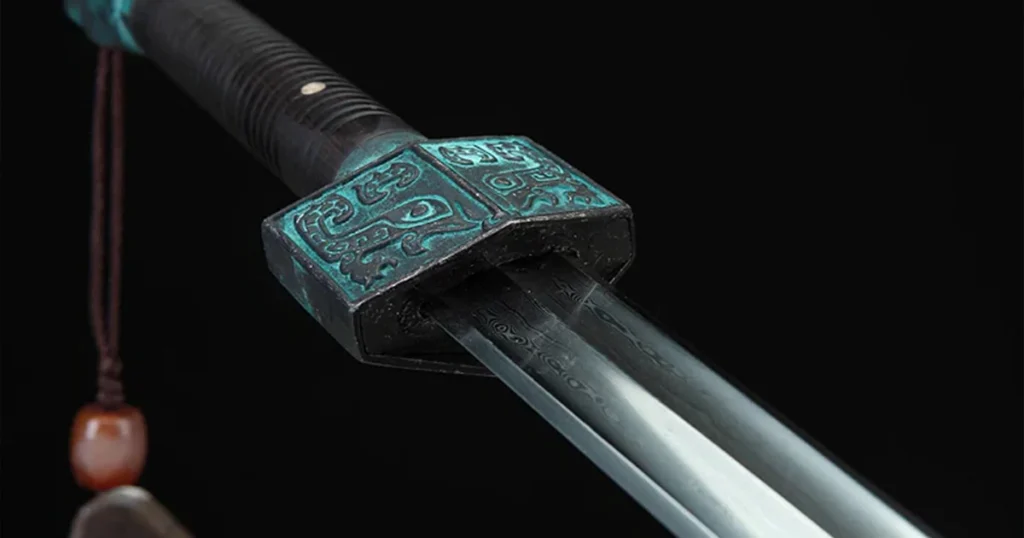
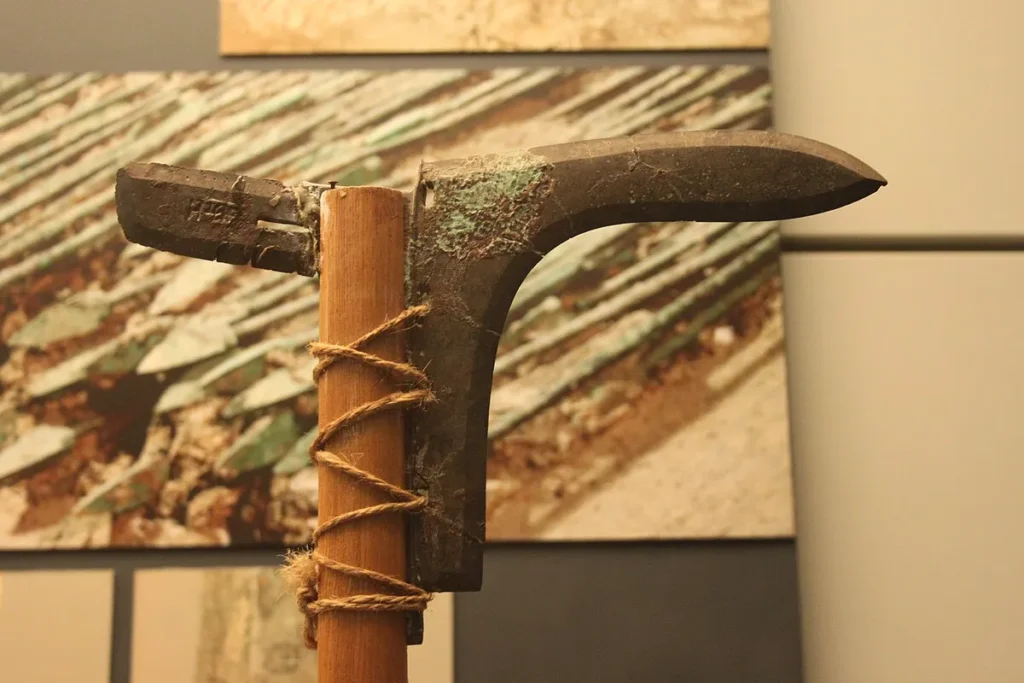
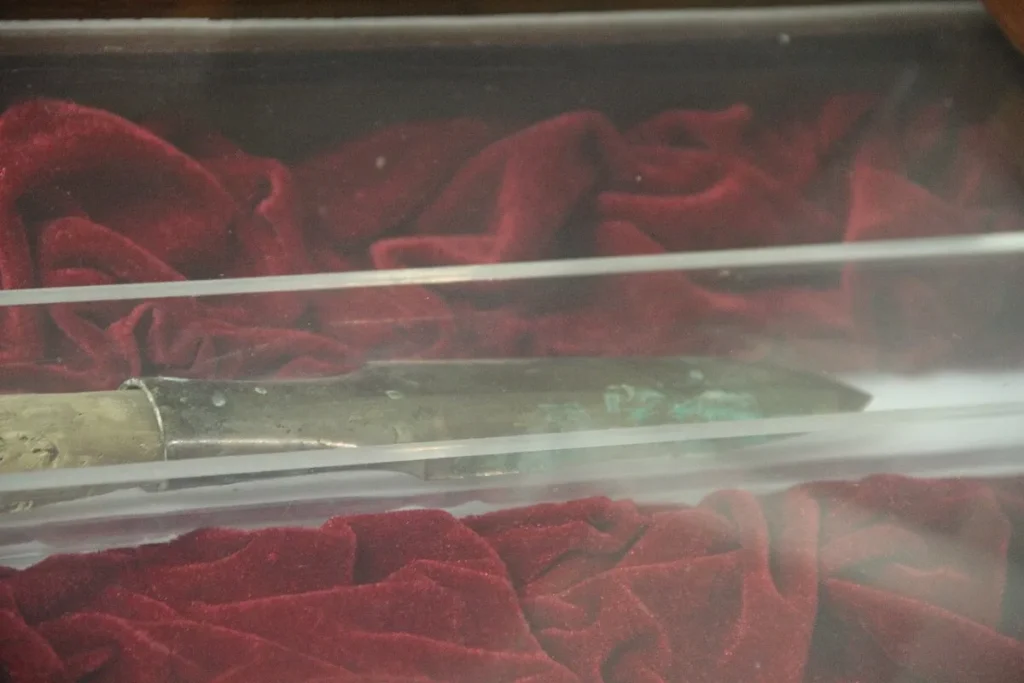
Straight swords (jian): double-edged, usually around 80–95 cm long, with a shallow central ridge and bevels ground to a fine line. Some have tangs for attaching grips, and some preserve fittings.
-
Dagger-axes (ge): a lateral blade with a socket for mounting on a pole. On many specimens the cutting edge is slightly recurved and shows deliberate bevel geometry.
-
Spearheads (mao): socketed, leaf-shaped blades mounted to poles.
-
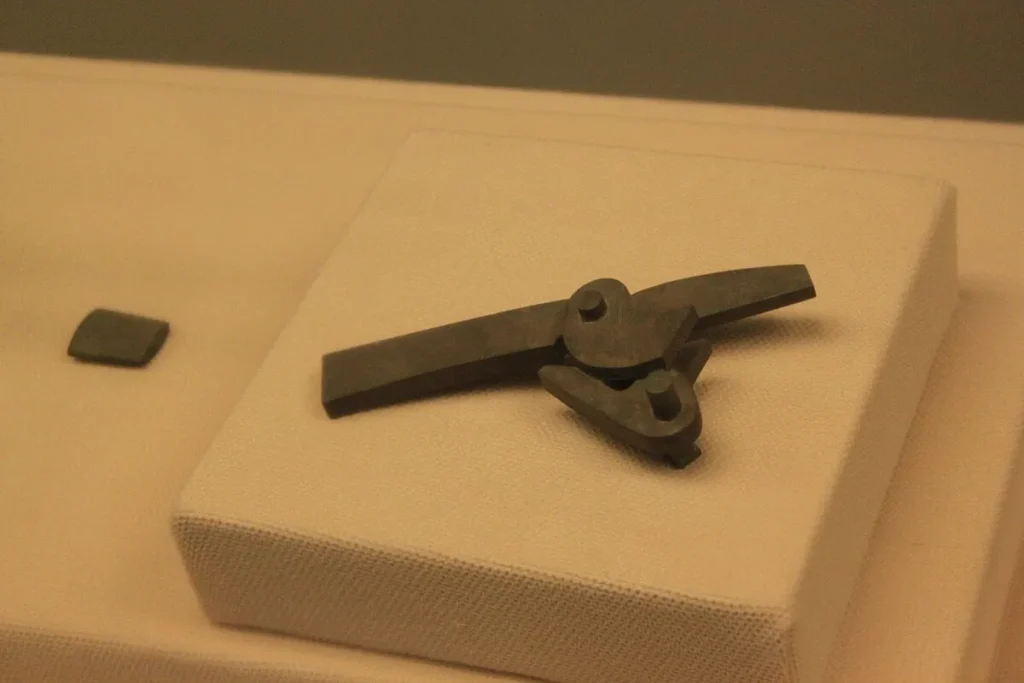
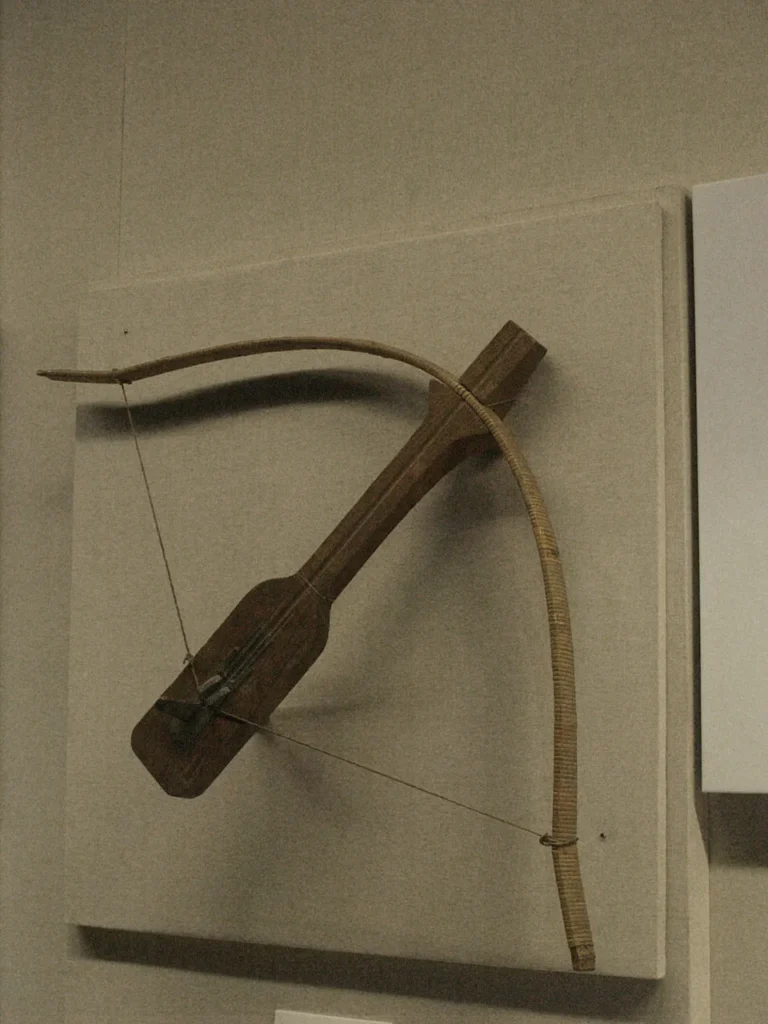
Crossbow mechanisms: trigger sets cast and machined from bronze, made of multiple interlocking parts with inscriptions and tight tolerances.
-
Arrowheads: small three-vaned bronzes in the hundreds of thousands, often found bundled.
The dominant metal is bronze, a copper-tin alloy, sometimes with lead added to improve fluidity during casting. Trace arsenic appears occasionally, probably from ore sources rather than intentional alloying. Blades and points were cast in standardized molds, then the working edges were ground, polished, and in many cases quenched. The crossbow triggers, in contrast, were precision fittings cast and finished to interlock, which is why so many still articulate when cleaned.
Although each class of object varies, the broad pattern in the edged weapons is familiar to any bronze metallurgist. Higher tin content increases hardness and reduces ductility, which works for a cutting edge. Lead additions, if present, tend to pool in the metal and help molten bronze fill corners of molds. A blacksmith cannot make a martensite in bronze, since that is a steel phenomenon, but he can drive the copper-tin alloy into a phase mixture that hardens a quenched outer zone. Thin edges with tin content above about 12 weight percent can gain a noticeably higher microhardness than cores that cool more slowly.
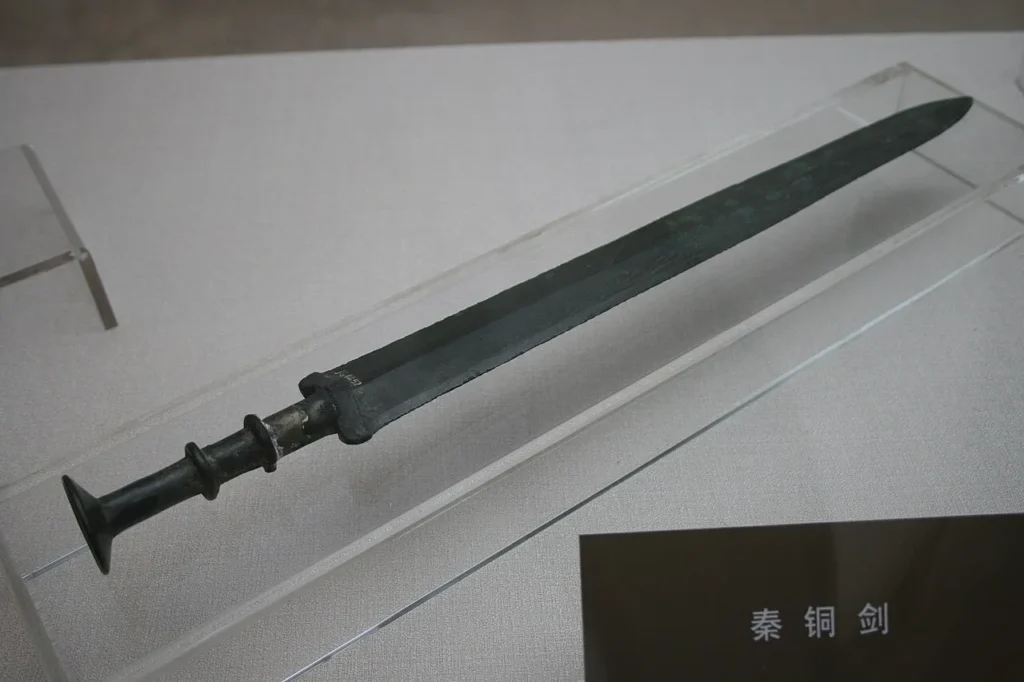
What did early observers think kept the weapons bright?
A claim took hold in the late twentieth century that the Qin solved bronze rust with a technology ahead of its time: chromium plating. This idea grew from reports of chromium traces on the surfaces of some weapons and the observation that many of these surfaces had not corroded deeply. The romance of a proto-stainless coating made for an irresistible story. It fit a modern expectation about technological leaps, and it echoed how the Qin are often described: standardized, ruthless, efficient.
The trouble is that when researchers mapped where chromium actually appears, and when they checked how thick any chromium-rich layer truly is, the picture changed. Only a minority of weapons carry measurable surface chromium. Where it does appear, it tends to occur near parts that once touched lacquered wood such as scabbards and handles. Many well-preserved blades show no chromium signal at all. Films are not uniform or thick enough to count as an engineered conversion layer. And experimental reproductions of chromium coatings do not look like the patchy signals found on the mausoleum pieces.
One major open publication assembled this evidence and tested the old claim directly. The authors concluded that chromium on the weapons does not come from deliberate anti-rust treatment, and that it does not explain the good preservation of the assemblage. A plausible path for the chromium is the lacquer used on the wooden parts of weapons and fittings. Lacquer was everywhere in the mausoleum complex, and it could move trace elements onto adjacent metal during burial. For a concise, accessible version of that research, see the open Scientific Reports study, which includes object-by-object mapping and soil data. The full article is available on Nature’s platform, and an institutional open-access version sits in UCL’s repository.
If not plating, then what kept the weapons sharp?
Several factors, acting together, produce the effect that visitors notice in the galleries: crisp edges, legible inscriptions, bright copper-red or dark brown tones instead of deep green craters.
First, alloy choices helped the edges survive. Tin-rich bronze resists wear and takes a clean grind. When an edge loses only a fraction of a millimeter to corrosion over two millennia, that old choice matters. Tin also encourages the growth of tin oxide at the surface when corrosion begins. Cassiterite, SnO₂, is a stable, hard, and relatively protective film, not a friable copper salt. A thin tin-rich skin can slow further attack. Put differently, the chemistry of the metal pushes corrosion toward a tougher product layer that adheres.
Second, finishing and heat treatment mattered. Many swords and halberd blades show careful grinding, sometimes to a mirror-like polish. Polishing does not create protection by itself, but it reduces the area of micro-pits where corrosion can start. There is also evidence, in the form of harder outer zones on some blades, for quenching. Rapid cooling locks in harder phases at the edge. Harder edges hold their line. Even if minor corrosion blooms, the profile is still there.
Third, the burial environment was kind. The pits cut into loess, a wind-deposited silt that blankets much of north-central China. This soil is typically fine grained, slightly alkaline, and low in chloride ions. It drains slowly and retains a relatively stable moisture profile. Those conditions matter for copper-based alloys. Chlorides are the villains in bronze disease, a self-sustaining cycle of attack that can chew through objects. In loess with low chloride concentration, an object has a fighting chance to form benign layers like cuprite, Cu₂O, and cassiterite instead. Slight alkalinity slows the dissolution of tin oxide. Fine grains reduce the oxygen circulation that would otherwise feed deep corrosion. The soil is not magic, but it is favorable.
Fourth, the pits created a microclimate. The army was buried under beams and earth, then later caps of roofing in the exhibition halls protected parts of the site further. But before the museum phase, the pits themselves were relatively closed systems. Oxygen was limited, and temperature swings were muted. Erratic wetting and drying cycles, which can be destructive to copper alloys, were uncommon. The result is corrosion that tends to form thin films instead of deep pustules.
What do the corrosion layers show under the microscope?
A cross-section through a corroded Qin bronze tells a consistent story. The outermost layer is often a thin crust of soil particles and carbonates. Beneath that lies a zone of oxidized copper products. The most common phase is cuprite, a dense red oxide that can form a coherent layer a few tens of microns thick. Below the cuprite, at the metal interface, tiny islands and seams of tin oxide appear. In well-preserved pieces the cassiterite can be spotty rather than continuous, yet it acts as a backstop. Where the tin oxide thickens, attack slows. In samples where chlorides are present the familiar pale green atacamite and paratacamite may appear, but in the mausoleum context they are often sparse.
These films explain why a sword edge still catches light. Instead of a flaky, cavernous mess, the corrosion layers are thin, compact, and adherent. The outer crust can be cleaned mechanically under magnification without revealing a jagged canyon. Conservators can stop once they reach the sound cuprite rather than chasing friable pustules down through the object.
How did Qin metalworkers design the weapons to cut and thrust?
There is a visible logic to the blades. Swords stand out. Most Qin swords are long by earlier standards, a useful reach for infantry. Their beveled edges are straight and relatively thin, suited to cutting as well as thrusting. Dagger-axes and spears show a different logic: socketed construction for pole mounting, with blade profiles optimized for chopping and piercing. Edges are not semicircular files, they are knife edges with specific angles.
The alloy supports that logic. Higher tin at the edge, if present, gives a harder bite. Quenching the blade after grinding increases outer hardness further. Polishing gives clean geometry. When corrosion is restrained by soil chemistry, these decisions persist in literal outline. Many swords still show the faint central ridge that stiffens the blade. Dagger-axes still show the step where the bevel meets the body. The numbers that matter here are not dramatic. A small microhardness increase at the edge can keep a blade from rolling under use. A smooth finish can halve the number of nucleation sites where attack begins. Any one step is incremental. Together they are decisive in how the objects look now.
Was chromium present at all, and if so, where did it come from?
Chromium shows up in analytical surveys, but not as an engineered layer. In object-by-object mapping, chromium tends to appear near hilts, scabbard mouths, and areas where bronze sat next to lacquered wood or leather. Lacquer is ubiquitous in the mausoleum complex. The warriors’ colorful garments and armor were once lacquered and painted. Scabbards, grips, and fittings were sealed with lacquer to protect wood and to provide a ground for pigments and inlays. During burial, ions move. Trace chromium from adjacent organic coatings can migrate toward the bronze surface and become physically associated with corrosion films. Where the metal never touched lacquer, chromium is often absent.
In practical conservation terms, this origin matters. If chromium were an engineered conversion coating, one might aim to retain such a layer during cleaning. In reality, there is usually no thick film to lose, and the priority becomes stabilizing the metal and its benign oxide layers. The key message is simple: even where chromium is absent, the weapons often look excellent. The preservation pattern does not track chromium’s presence or absence. It tracks soil chemistry and the presence of stable corrosion products. For a clear and readable summary of the scientific case, see the open Scientific Reports paper noted above and the duplicate record in UCL’s repository, both of which include maps and methods.
What role did the loess soil play?
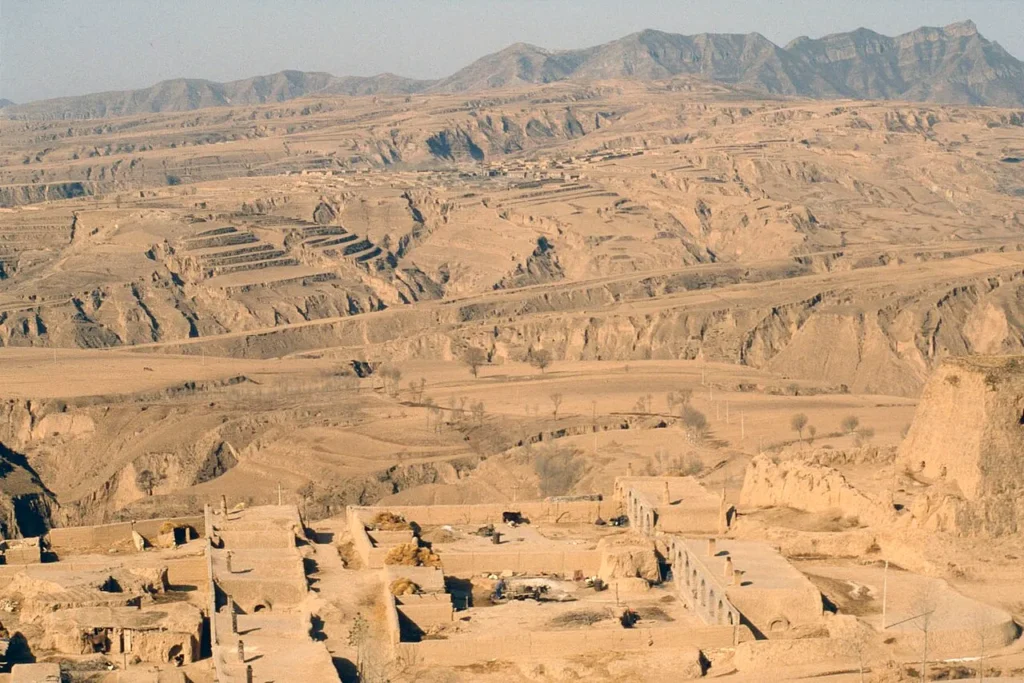
Loess is windblown silt, dominated by quartz, feldspar, and carbonates. It forms cliffs and thick blankets across Shaanxi and neighboring provinces. As a burial medium it has three properties that matter for copper alloys.
Low chloride content. Chloride triggers bronze disease, the aggressive, cyclic form of copper corrosion. In coastal or salt-contaminated sites, bronze disease can devour artifacts within years of excavation. Loess far from marine influence usually keeps soluble chloride down, and the pits show that pattern.
Slightly alkaline pH. In soils that are mildly alkaline, tin oxide is less soluble. That allows a dense, protective cassiterite film to remain intact if it forms. Alkalinity does not prevent all corrosion. It tips the outcome toward stable films and away from friable salts.
Fine texture, stable moisture. Fine silt limits convective gas flow and abrupt drying cycles. Without constant pulses of oxygen and moisture swinging in and out of the pores, corrosion advances slowly. Instead of building towers of blistered malachite, the copper tends to form a thin cuprite layer that adheres.
The geological setting of the mausoleum, in other words, handed the weapons a favorable envelope. It did not take the place of good alloy design. It allowed that design to matter over centuries.
Enjoying Spoken Past?
I created Spoken Past to share my love of history. I research, write and develop everything myself, and I want my articles and basic guides to remain free for everyone.
If you enjoy my work, please consider supporting Spoken Past with a small donation.
How standardized were the weapons, and does standardization affect preservation?
The Qin state became famous for standard measures, from axle widths to coin types. The weapons echo that ethos. Crossbow trigger sets consist of bronze levers, catches, and locks that were cast and finished to repeatable sizes. Swords share lengths and grind geometry. Arrowheads match within tight size bands. Standardization serves tactics and logistics, but it also affects how the weapons age. Uniform geometry means uniform thickness. Uniform thickness means that, for a given corrosion depth, edges will disappear or remain in similar ways from piece to piece. Because the corrosion depth was often small, the result a visitor sees is rows of nearly identical edges and planes.
Standardization also reveals itself in inscriptions. Some crossbow parts carry makers’ marks that help researchers reconstruct batches and assemblies. These marks remain legible on many pieces because corrosion did not erase them. Again, the loess and the alloys did the quiet work.
Did Qin artisans quench their blades, and how can we tell?
Direct heat treatment evidence in ancient nonferrous metals is subtle. In steels, transformations leave strong microstructural signatures. In copper-tin bronzes, investigators look for phase distribution, dendrite arm spacing, and hardness differences between edge and core. For some Qin swords, measurements suggest that the outer edge is significantly harder than the interior. That change is consistent with quenching or with rapid cooling in a thin section after final grinding. Researchers also see limited dealloying at the very surface, which is common in bronzes that have started to oxidize and can make the outer film relatively tin-rich.
The practical test is behavioral: the edge holds a line under abrasion and looks sharp after cleaning. No one claims a Qin sword behaves like a tool steel blade. The claim is that for a copper-tin alloy, processed with skill and buried in kind soil, the edge that was made remains visible.
How do we know any of this?
The arguments do not rely on a single spectacular object. They come from sets of observations.
-
Compositional analysis: Portable X-ray fluorescence on large numbers of weapons builds histograms for tin and lead content across classes. More invasive techniques, such as ICP-MS on small samples, refine these numbers and identify trace elements.
-
Microscopy and mapping: Scanning electron microscopy with energy-dispersive X-ray spectroscopy maps the elements in corrosion layers and metals. Chromium, if present, shows up in patches that correlate with adjacent organic fittings. Cuprite and cassiterite appear as distinct phases, often in the order described above.
-
Soil chemistry: Samples from the pits show low soluble chloride content and slightly alkaline pH. Grain size analysis confirms the fine texture typical of loess. Burial experiments in similar soils reproduce the tendency toward stable copper oxides and thin films.
-
Mechanical tests: Microhardness measurements at edges and cores track the effect of alloy composition and heat history. Edges often read harder than cores.
-
Experimental replication: Casting bronzes with Qin-like compositions, polishing and quenching them, and burying them in soils with controlled chemistry allows researchers to watch which variables matter. Thin, adherent cuprite films and patchy tin oxide appear reliably in low-chloride, slightly alkaline media, while thick, aggressive salts require the chlorides that the pits lack.
This package of methods is typical of modern archaeometry. None of the techniques changes the object’s narrative by itself. Together they explain why an edge line in a gallery still looks like an edge and why a crossbow trigger still articulates once cleaned.
Where did lacquer fit into the picture?
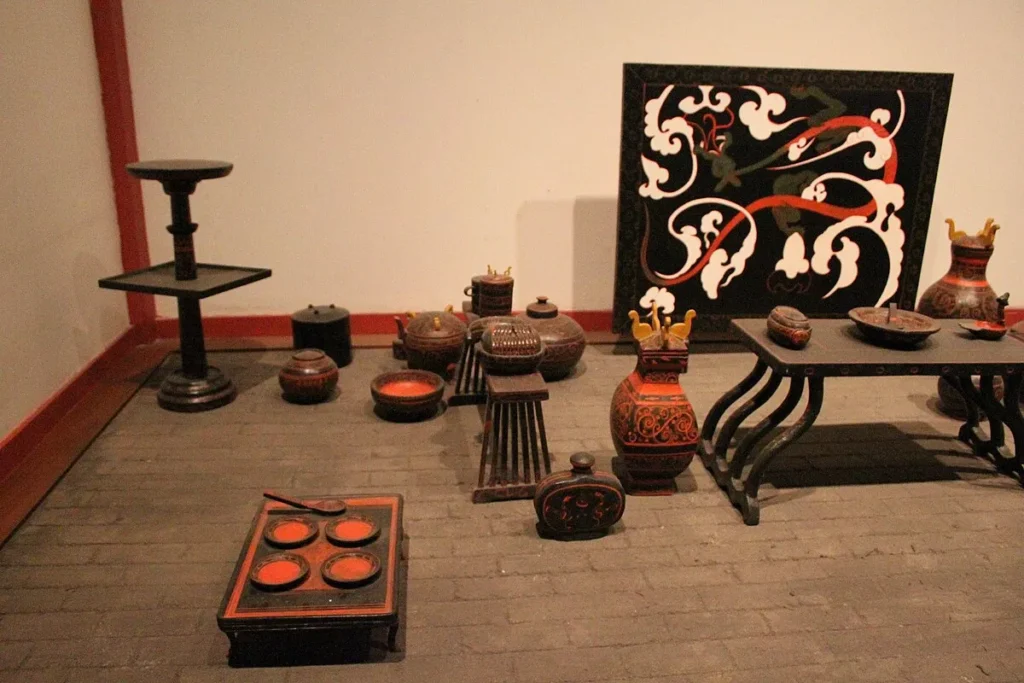
Lacquer, the polymerized sap of Rhus species, sealed wood and gave a base for paint. Qin workshops coated shields, scabbards, and grips, as well as ceremonial goods that never touched a battlefield. Lacquer can trap and carry trace elements. During burial, moisture and decay move those elements into contact with metal. That story fits the distribution of chromium on some weapons: concentrated near places where lacquered wood sat against bronze.
The point is not that lacquer made the weapons safe. The point is that lacquer was common in the pits and on the soldiers, which makes it a credible local source for stray signals on metal surfaces. The chromium myth falls for a familiar reason: a surface trace was read as a deliberate treatment without checking whether the trace appears where a coating would be practical, and without asking if objects without the trace are equally well preserved. Both checks came back negative.
Why are iron pieces from the period usually worse off than the bronzes?
Iron corrodes in soils like those at Lintong much more aggressively than copper alloys do. Chloride is not the only driver of rust. Oxygen and water suffice. Where bronze tends to form a thin cuprite film that seals the surface, iron builds thick layers of rust that can expand and crack, admitting new water and oxygen. The Qin state did produce iron, and iron objects occur in the mausoleum complex, but few preserve with the same clarity as the bronze blades and mechanisms. The survival of sharp bronze edges is a reminder that, in certain soils, bronze is the better long-term material.
What have the weapons revealed about the Qin state?
The weapons underline the scale and organization of the Qin project. Standardization of parts, surface finishing to a consistent specification, and mass production of arrowheads all speak to an industrial logic. Marks on crossbow triggers connect specific workshops and officials to their products. The alloy choices and finishing details suggest that craftspeople understood, in practice, how to balance hardness and toughness in a copper-tin system. When the site’s geology let those choices persist, we gained an unusually clear laboratory for ancient production.
There is also a quieter point. The preservation of so many edges tempts one to think that every Qin blade still looks new. That is not the case. Some pieces show more corrosion than others. Some were twisted when the roofs collapsed. Edges on a few swords are blunted because the profile was ground conservatively to begin with. The rule remains simple: good alloy, clean finish, and kind soil produce crisp results.
What are the takeaways for conservation and display?
Museums now treat the weapons as case studies in how burial environment shapes preservation. The lesson is emphatic.
-
Control chloride exposure after excavation. Washing with chloride-bearing water or storing in damp, salty conditions can undo centuries of favorable chemistry.
-
Clean to stable layers, not to bare metal. A compact cuprite film is not a flaw. It is a protective layer that belongs on the object. Chasing an imagined metallic shine risks damage.
-
Record lacquer associations. Chromium or other elements found at surfaces may point to adjacent organic components. Recording these associations helps reconstruct scabbards and grips even when the wood is long gone.
-
Use soil analogs when experimenting. Tests of bronze behavior should include slightly alkaline, low-chloride loess to reproduce mausoleum outcomes, as well as chloride-rich controls to demonstrate the difference.
Myth vs. evidence: did the Qin invent anti-rust chrome technology?
Claim: The Qin coated their bronze weapons with a chromium-based conversion film that worked like a modern passivation, which is why the weapons look fresh.
Evidence: Chromium appears only on some weapons, usually in patches near where lacquered wood touched metal. Many of the best-preserved blades have no chromium at all. Chromium-rich layers are thin and irregular, not uniform coatings. Soil chemistry and alloy behavior account for the preservation pattern. Open publications that tested these points conclude there is no ancient anti-rust process at play and that chromium is not the cause of preservation.
Verdict: No deliberate chrome plating. Good soil and good bronze are enough.
FAQ
Were all Qin weapons bronze?
No. The mausoleum complex includes iron tools and likely some iron fittings, although bronze dominates among the weapons recovered from the main pits. Iron corrodes more aggressively in the pit environment, so bronze pieces survive with clearer edges and surfaces.
How sharp are the swords by modern standards?
They are sharp in archaeological terms: bevels and edges are intact and clean, suitable for study and sometimes able to slice soft materials after careful cleaning. They are not comparable to hardened steel blades. Their value lies in what they reveal about Qin craft and alloy use, not in cutting performance today.
Do the crossbow mechanisms still work?
Several cleaned mechanisms articulate, which reflects their precise manufacture and limited corrosion. Springs and strings are organic and do not survive, so full function is not possible, but the bronze trigger components show how the sear and catch system operated.
Is tin content uniform across all blades?
No. Analyses show ranges. Edged weapons tend to have tin levels that favor hardness, while some fittings and larger castings include more lead for castability. The overall pattern is consistent with deliberate choices rather than accident.
Could the weapons have been oiled before burial?
It is possible that oil or organic coatings were applied in service or at deposition. If present, those coatings would have decayed. No surviving continuous organic film explains the preservation in the way soil chemistry and bronze behavior do.
Why do some weapons look greener than others?
Color depends on local microenvironments. Thin cuprite looks red or brown; thicker malachite films look green. Variations in moisture, porosity, and proximity to organics shift the balance of corrosion products from one piece to the next.
Are there inscriptions on the bronze weapons?
Yes, some items carry marks that name officials, workshops, or units. These marks support studies of Qin administration. Their legibility today owes much to the limited corrosion depth in the pits.