
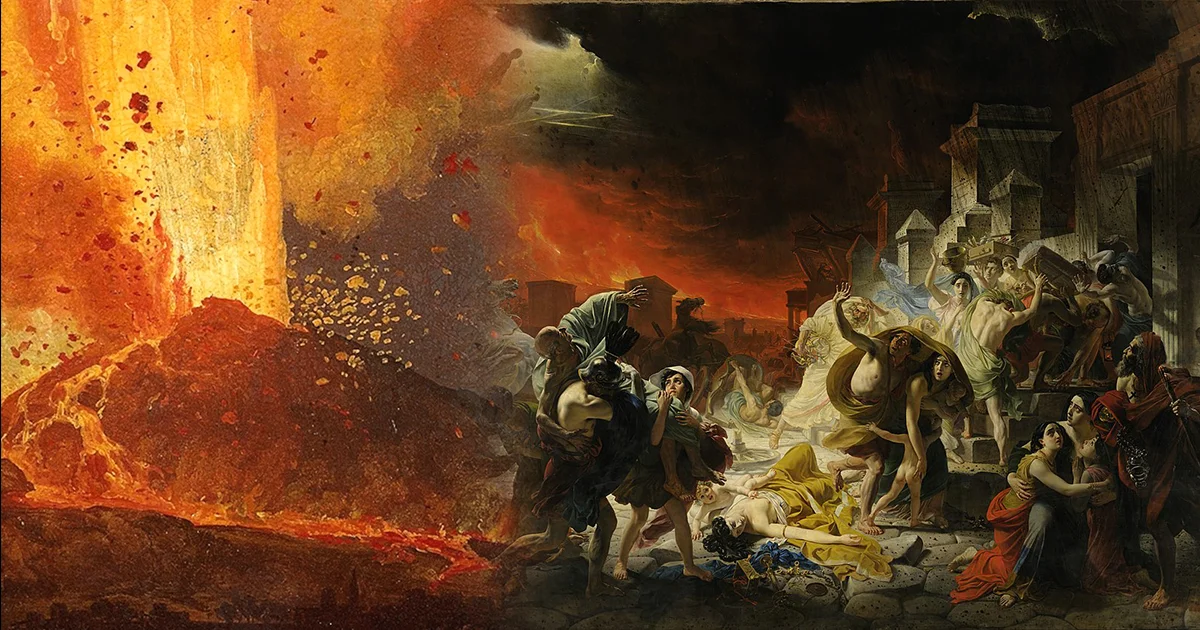
Mount Vesuvius erupted on August 24, 79 AD, burying the Roman cities of Pompeii and Herculaneum under volcanic ash, pumice, and pyroclastic surges that killed approximately 16,000 people within 24 hours. The catastrophe began around 1 PM with an explosive Plinian eruption that shot a column of superheated gas, rock, and ash 20 miles into the atmosphere. For the first 12 hours, Pompeii’s residents faced a deadly choice: flee through falling pumice stones the size of fists, or shelter indoors where accumulating ash threatened to collapse roofs. Those who stayed initially survived the pumice fall, but at dawn the volcano’s eruption column collapsed, sending six successive pyroclastic surges racing down the mountain at 100 miles per hour with temperatures exceeding 570°F.
Pliny the Younger, a 17-year-old Roman who witnessed the eruption from Misenum across the Bay of Naples, provided the only surviving eyewitness account in letters to historian Tacitus. He described the volcanic plume as resembling a Mediterranean pine tree, with a tall trunk spreading into horizontal branches of ash and pumice. His uncle, Pliny the Elder, commander of the Roman fleet and a naturalist obsessed with documenting phenomena, sailed toward Vesuvius to investigate and rescue friends trapped at Stabiae. The elder Pliny died on the beach, apparently from asphyxiation caused by toxic gases and ash.
Modern archaeological excavations have uncovered the frozen final moments of Vesuvius’s victims, preserving their death poses in volcanic ash that hardened around their bodies like plaster. These hollow forms, filled with plaster by archaeologists in the 19th century, show parents clutching children, slaves chained in their quarters, and wealthy citizens who delayed evacuation too long clutching their most valuable possessions. The speed and ferocity of the pyroclastic surges left no time for escape—victims died instantly from thermal shock as superheated air seared their lungs and vaporized soft tissues.
What Happened During the First 12 Hours
Vesuvius’s eruption began violently around 1 PM when the mountain’s magma chamber ruptured, releasing gas and molten rock that had been building pressure for centuries. The initial explosion created a Plinian column—named after Pliny the Younger who described it—that rose vertically into the stratosphere. Pumice stones ejected from the crater rained down on Pompeii, located just five miles southeast of the volcano. These porous volcanic rocks, ranging from pebble to fist-sized, accumulated at a rate of six inches per hour.
Pompeii’s estimated population of 11,000 people reacted in different ways to the falling pumice. Many fled immediately, grabbing what they could carry and streaming toward the city gates. Archaeological evidence shows approximately 80% of Pompeii’s residents escaped during these first crucial hours when evacuation was still possible. The pumice stones, while frightening and capable of causing head injuries, fell slowly enough that people could run between impacts or use shields, pillows, or wooden boards as protection.
Those who remained believed their sturdy homes would shield them from the volcanic bombardment. Many retreated to ground-floor rooms or cellars, waiting for the eruption to end. But the accumulating pumice created a deadly trap—as layers built up on roofs and in streets, the weight exceeded what buildings could bear. Some structures collapsed, crushing inhabitants who had thought themselves safe. Streets filled with waist-deep pumice, making movement increasingly difficult and eventually impossible.
Herculaneum, located seven miles west of Vesuvius on the opposite side of the volcano, experienced the eruption differently. The prevailing wind carried the pumice column toward Pompeii and away from Herculaneum, giving residents more time to evacuate. Archaeological evidence suggests most of Herculaneum’s population escaped during the first phase of the eruption. However, approximately 300 people sought shelter in stone boathouses along the ancient beach, hoping to escape by sea. They would not survive the night.
Darkness fell as the volcanic cloud blocked the sun, creating a terrifying twilight where day and night became indistinguishable. Pliny the Younger described this as “not the darkness of a moonless or cloudy night, but as if the lamp had been put out in a closed room”. Lightning flashed through the volcanic plume as electrical charges separated in the ash column. By midnight, approximately 10 feet of pumice had buried Pompeii’s streets.
When the Pyroclastic Surges Struck
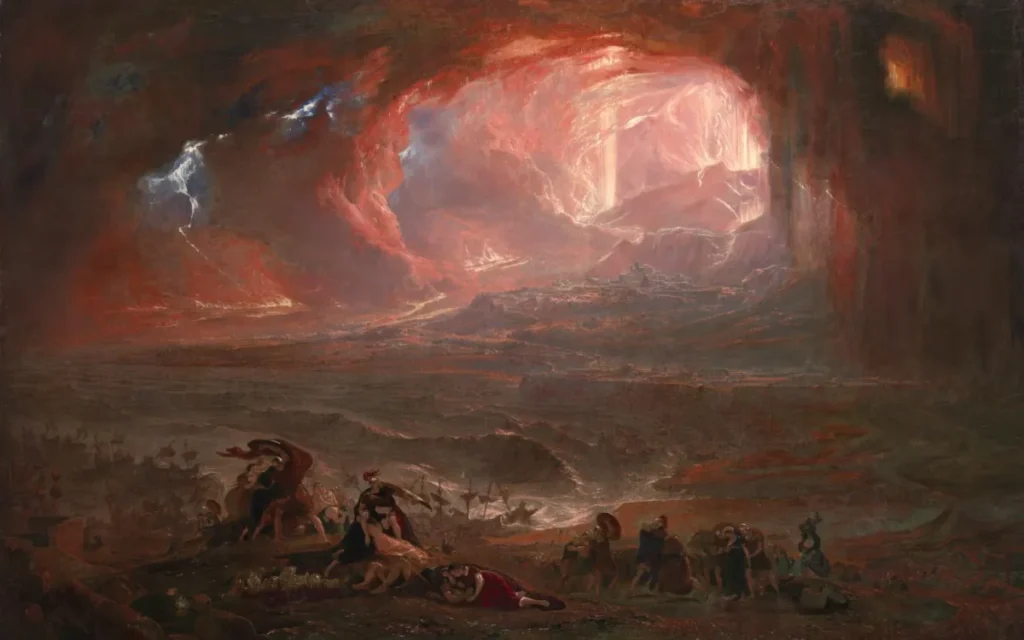
Around 6:30 AM on August 25, the volcanic eruption entered its deadliest phase. The Plinian column that had been shooting ash and pumice skyward for 18 hours became unstable and collapsed. This collapse sent the first of six pyroclastic surges racing down Vesuvius’s slopes—avalanches of superheated gas, ash, and rock fragments moving at hurricane speeds. These ground-hugging currents of volcanic material are the most lethal phenomenon in explosive eruptions.
The first surge struck Herculaneum within minutes, traveling the seven miles from crater to coast in approximately four minutes. The 300 people sheltering in the stone boathouses died instantly as 570°F gases incinerated their lungs before they could draw breath. Modern forensic analysis of their skeletons shows distinctive cracking patterns caused by rapid heating that boiled brain and body fluids, causing skulls to explode. The victims’ bodies were flash-carbonized, preserved as dark stains on the stone where they fell.
Pompeii endured four hours of additional pyroclastic surges before the most devastating wave struck around 7:30 AM. This surge overtopped Pompeii’s walls, which had protected the city from earlier, smaller flows. Anyone still alive in Pompeii—the estimated 2,000 people who had stayed or been unable to evacuate—died within seconds. The superheated ash cloud penetrated buildings, filled every street and alley, and suffocated victims where they crouched.
The pyroclastic surges differed fundamentally from the earlier pumice fall in both lethality and preservation. Where pumice buried victims under layers of stone, pyroclastic surges engulfed them in clouds of hot ash that hardened into volcanic tuff. This ash molded around bodies, capturing the exact positions of death. When the organic material decomposed over centuries, hollow cavities remained—perfect negative impressions of Vesuvius’s victims.
Giuseppe Fiorelli, director of Pompeii excavations from 1863 to 1875, pioneered the technique of pouring plaster into these body-shaped voids. The resulting casts revealed heartbreaking details: a man who covered his mouth and nose with his tunic trying to filter toxic air, a dog twisting in its death throes while still chained to a post, a pregnant woman lying on her side with her hands protecting her swollen belly. These casts transformed Vesuvius’s victims from statistics into individuals whose final moments became permanently visible.
Why Pliny the Elder Sailed Toward the Volcano
Pliny the Elder, 55 years old and serving as commander of the Roman fleet stationed at Misenum, was a polymath who had written the 37-volume Naturalis Historia, an encyclopedia covering everything from astronomy to zoology. When Vesuvius erupted, Pliny saw both a natural phenomenon worthy of documentation and a military emergency requiring naval response. His nephew Pliny the Younger, who lived with him, recorded that the elder Pliny initially ordered a small boat to carry him closer to observe the eruption column.
Before departing, Pliny received a message from Rectina, a friend whose villa stood at Vesuvius’s base. She begged for rescue, trapped between the mountain and the sea with no escape route. Pliny immediately changed plans, ordering quadriremes—large warships capable of carrying dozens of evacuees—to be prepared. He transformed his scientific expedition into a rescue mission, demonstrating the Roman virtue of pietas—duty to friends and fellow citizens.
The fleet sailed directly toward Stabiae, a town south of Pompeii where Pliny’s friend Pomponianus owned a villa. The wind that had carried Vesuvius’s ash plume away from Misenum now worked against the ships, blowing them straight toward the erupting volcano. Falling pumice and hot ash rained on the vessels, and the sea began to shallow as volcanic debris accumulated on the seafloor. The helmsman urged Pliny to turn back, but the elder Pliny quoted the saying “Fortune favors the brave” and ordered the fleet onward.
Upon reaching Stabiae, Pliny found Pomponianus frantically loading possessions onto ships. The elder Pliny, according to his nephew’s account, bathed, dined, and slept—either demonstrating remarkable composure or failing to grasp the eruption’s severity. When the household decided to evacuate at dawn as conditions worsened, Pliny went to the beach where he collapsed. His servants tried to rouse him, but he appeared to suffocate, his airways clogged with volcanic ash or his heart failing from toxic gas exposure.
Pliny the Younger’s account emphasizes his uncle’s bravery and scientific curiosity while acknowledging the fatal miscalculation. The elder Pliny’s corpulent physique and chronic respiratory problems, which his nephew mentions, may have made him particularly vulnerable to volcanic gases and ash inhalation. His body was recovered three days later, appearing more asleep than dead—a detail suggesting asphyxiation rather than burning or trauma.
Built out of a love for history, kept free from distractions.
Spoken Past is an independent project shaped by curiosity, care, and long hours of research. Reader support helps keep it maintained, carefully researched, and open to everyone.
How Vesuvius Preserved Pompeii for 1,500 Years
The volcanic material that killed Pompeii’s inhabitants also sealed the city in a time capsule that preserved buildings, artwork, and everyday objects with extraordinary fidelity. The 20 feet of pumice and ash that buried Pompeii created an oxygen-free environment preventing decay. Wooden furniture, food, fabrics, and organic materials that normally decompose within years survived for 17 centuries. When excavations began in the 18th century, archaeologists discovered bread still in ovens, wine still in amphorae, and graffiti freshly scratched on walls.
The eruption sequence itself contributed to preservation quality. The initial pumice fall buried ground floors while leaving upper stories exposed to pyroclastic surges that blasted away second-floor structures. This created a pattern where ground-floor rooms remained intact while upper levels vanished, allowing archaeologists to excavate complete street-level interiors. Roofs collapsed inward from pumice weight, but walls generally survived, maintaining building footprints.
Herculaneum experienced different preservation conditions due to its distance from Vesuvius and the types of volcanic material it received. While Pompeii drowned in loose ash and pumice, Herculaneum was engulfed by pyroclastic surges that solidified into volcanic rock up to 75 feet deep. This dense material created challenges for excavation but provided superior preservation—even wooden beams, doors, and bed frames survived intact. Second stories that disappeared in Pompeii remain visible in Herculaneum, offering rare glimpses of multi-story Roman architecture.
After the eruption, survivors who returned to Pompeii tunneled through the ash searching for valuables and salvageable building materials. These ancient looters left vertical shafts and horizontal tunnels throughout the buried city, occasionally breaking through walls and floors in their search. Some tunnels hit jackpots—rooms where wealthy families had hidden jewelry and coins before fleeing. Most salvage attempts occurred within decades of the eruption while the city’s layout remained in living memory.
Over centuries, the location of Pompeii and Herculaneum was forgotten. Vegetation grew over the volcanic deposits, and new settlements arose on top of the buried cities. The ancient towns became myths, their existence doubted until accidental discoveries in the 16th century led to systematic excavation in the 18th century. The volcanic catastrophe that destroyed these cities paradoxically gave them immortality, preserving more information about daily Roman life than any other archaeological site.
What Modern Archaeology Revealed About the Victims
Excavations at Pompeii have uncovered approximately 1,150 bodies out of an estimated 2,000 who died in the city. The remaining victims likely lie in unexcavated sections or were completely vaporized by pyroclastic surges. At Herculaneum, the 300 victims in the boathouses represent nearly all the known casualties from that city, suggesting most residents successfully evacuated. These skeletal and cast remains provide unprecedented information about Roman demographic composition, health, and social structures.
Analysis of Herculaneum skeletons revealed unexpected details about Roman nutrition and lifestyle. Dental health was excellent compared to medieval populations, with relatively few cavities despite the absence of modern dentistry. Height averages matched those of present-day Italians, contradicting assumptions that ancient people were significantly shorter. Bone analysis showed varied diets with substantial fish consumption, supporting historical accounts of Roman fishing industries.
The boathouse victims’ positions when death struck revealed they were organized by family groups, with women holding children and men standing at the perimeter. This suggests they maintained social order even as catastrophe approached, with males attempting to shield families from the approaching surge. One woman clutched a heavy purse containing coins and jewelry, unwilling to abandon wealth even facing death. A Roman soldier died in full armor, suggesting he was on duty helping with evacuation.
Pompeii’s plaster casts capture more emotional detail than skeletons alone could provide. A cast called “The Garden of the Fugitives” shows 13 people who died together in an orchard while attempting to flee. Their contorted positions and reaching arms convey the desperation of their final moments. A mother and daughter died in an embrace, the mother’s arms wrapped protectively around the child. A dog’s cast shows the animal straining against its chain, unable to escape as ash filled its nostrils.
Forensic analysis of victim positioning demonstrates most Pompeiians died from thermal shock rather than suffocation, contradicting earlier assumptions. The instant heat of pyroclastic surges caused muscle spasms that froze bodies in distinctive “pugilistic postures”—arms raised and fists clenched as if boxing. This occurs when extreme heat causes proteins in muscles to contract, pulling limbs into characteristic positions. The speed of death meant victims had no time to shield their faces or curl into protective positions.
Why 18th Century Artists Painted Vesuvius
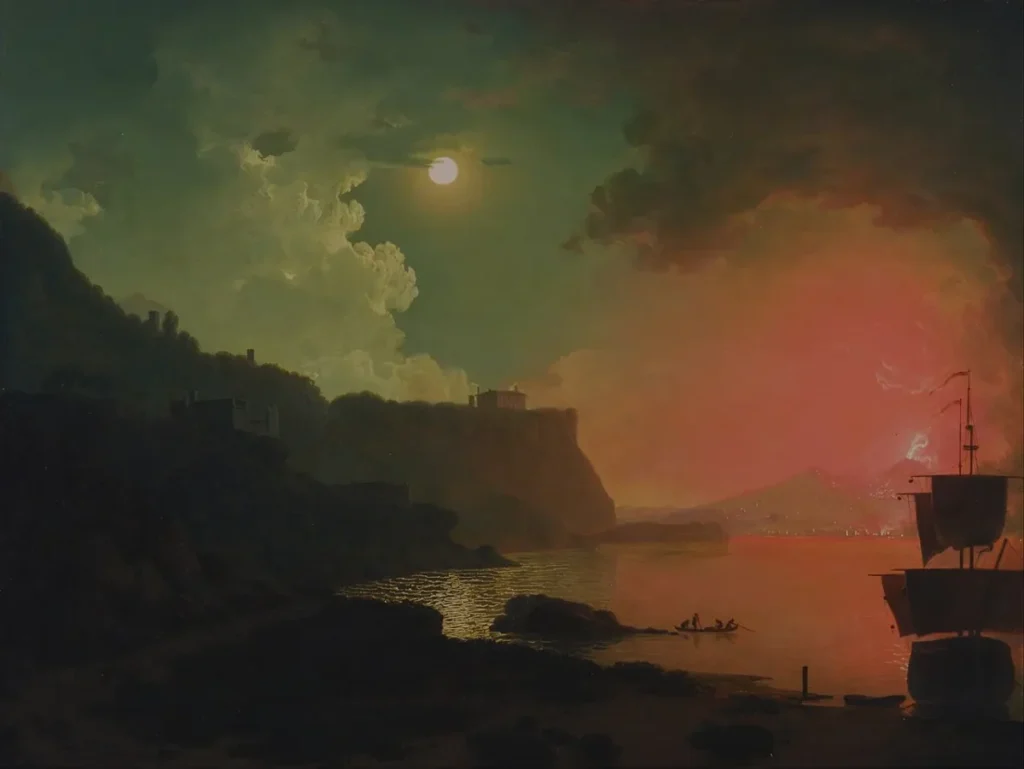
The rediscovery of Pompeii in 1748 coincided with the Grand Tour era when wealthy young Europeans traveled Italy to complete their education. Vesuvius became the tour’s most spectacular stop, offering visitors the thrill of viewing an active volcano combined with sobering visits to excavated ruins. Artists recognized commercial opportunities, establishing studios in Naples to supply tourists with volcanic souvenirs. Pierre-Jacques Volaire, a French painter, specialized exclusively in Vesuvius paintings, producing over 30 different eruption scenes.
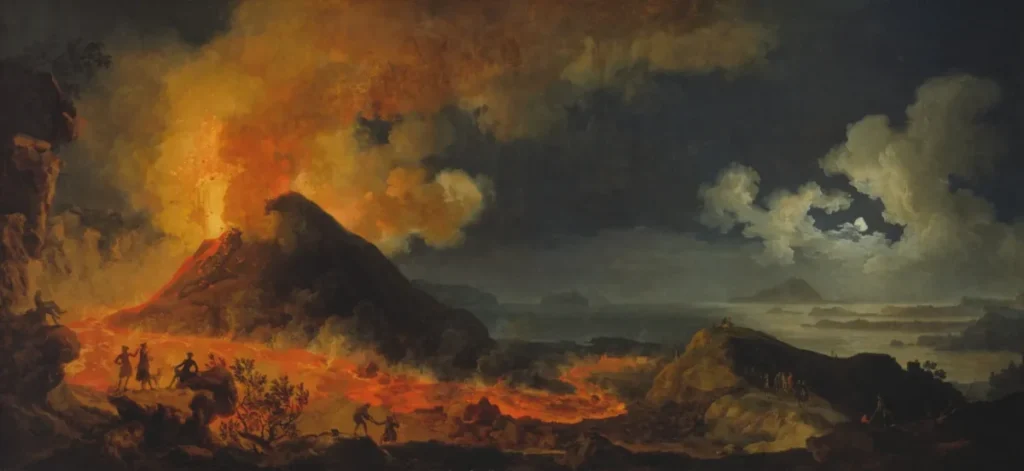
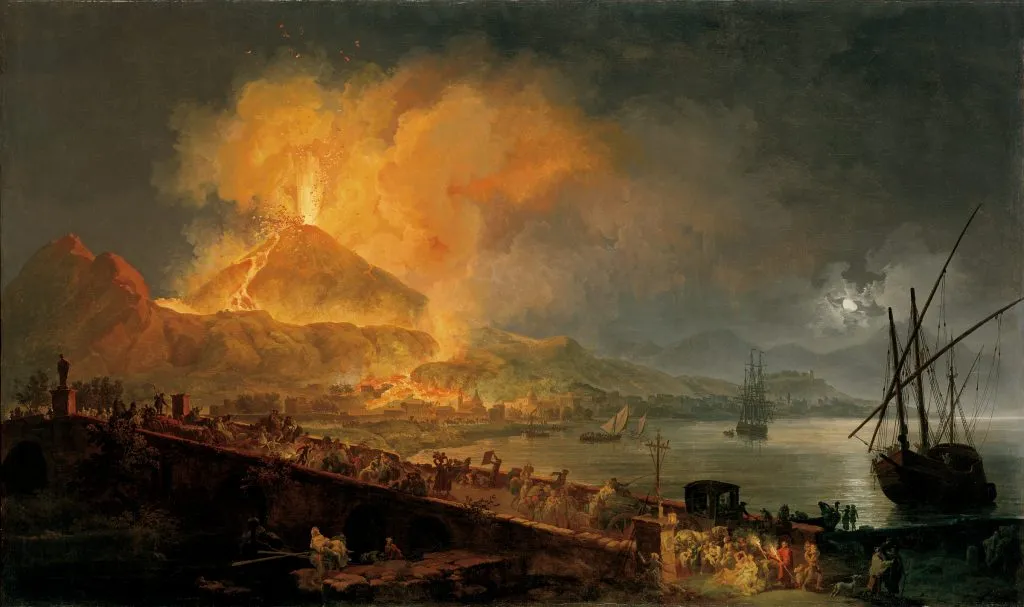
Volaire witnessed the May 14, 1771 eruption firsthand and painted it multiple times from different vantage points. His works follow a formula: Vesuvius dominates the background with red lava contrasting against dark sky, while tiny figures in the foreground flee or observe the spectacle. These paintings satisfied tourist demand for dramatic mementos while documenting genuine geological events. Volaire inscribed many canvases with specific eruption dates, transforming them into historical records as well as artwork.
John Martin, an English artist famous for apocalyptic paintings, brought a different sensibility to Vesuvius imagery. His 1822 painting The Destruction of Pompeii and Herculaneum treated the ancient catastrophe as sublime spectacle, emphasizing nature’s overwhelming power over human civilization. Martin’s canvas measured over 8 feet wide, immersing viewers in the disaster scene. The painting’s theatrical quality—with dramatic lighting, tiny figures dwarfed by volcanic fury, and meticulous architectural detail—made it a popular attraction displayed in music halls with accompanying narration.
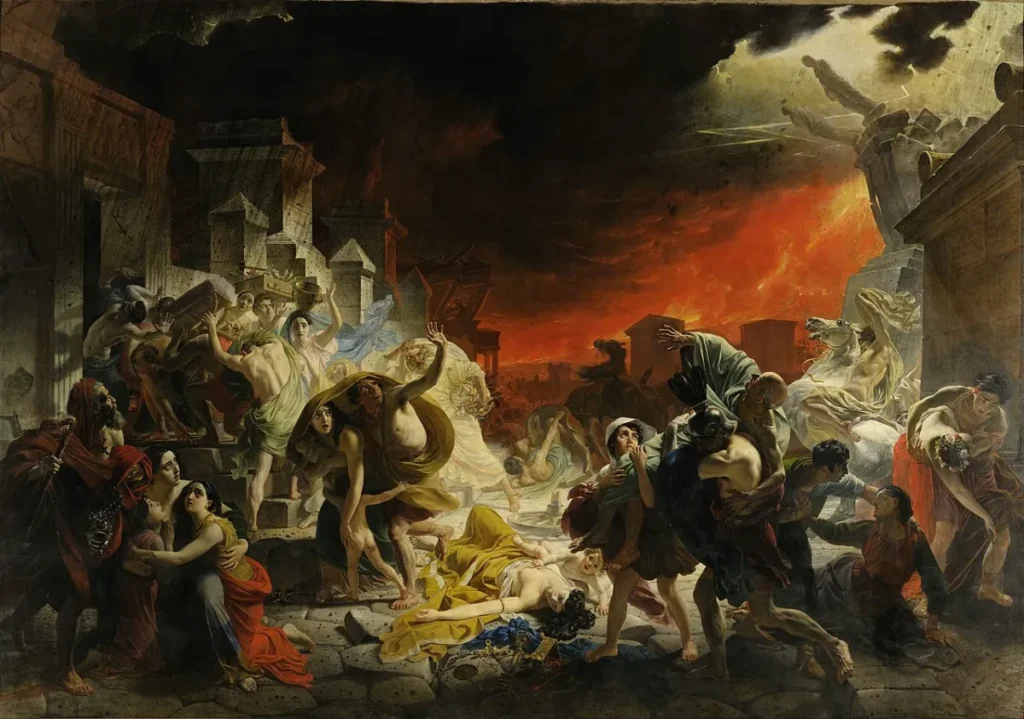
Karl Bryullov, a Russian painter, created the most ambitious Vesuvius painting in 1833. The Last Day of Pompeii measured 15 feet by 21 feet, depicting dozens of figures fleeing through collapsing architecture as lightning illuminates the scene. Bryullov spent months in Pompeii studying excavated buildings and artifacts to ensure archaeological accuracy. The painting became a sensation when exhibited in Italy and Russia, attracting enormous crowds and inspiring poems, musical compositions, and theatrical productions.
These artistic interpretations of Vesuvius’s eruption served cultural functions beyond mere decoration. They allowed viewers to contemplate mortality, fate, and nature’s indifference to human achievement while safely removed from actual danger. The paintings emphasized the sublime—that combination of beauty and terror that captivated Romantic era sensibilities. By depicting ancient catastrophe, artists could explore themes of destruction and loss that resonated with contemporary audiences facing rapid industrialization and social change.
[IMAGE 7 HERE — Caption: Vesuvius Erupting at Night watercolor by Joseph Mallord William Turner, circa 1817-1820. Source: Tate Britain.]
Title: Vesuvius Erupting Night watercolor Turner 1817
Link: https://commons.wikimedia.org/wiki/File:Joseph_Mallord_William_Turner_-Vesuvius_Erupting_at_Night-_Google_Art_Project.jpg
Alt: Turner watercolor showing Mount Vesuvius erupting at night with red glow and atmospheric effects
Description: Vesuvius Erupting at Night, watercolor and graphite on paper, circa 1817-1820, by Joseph Mallord William Turner. Source: Tate Britain, London.
Frequently Asked Questions
How many people died when Vesuvius erupted in 79 AD?
Approximately 16,000 people died in Pompeii, Herculaneum, and surrounding settlements when Mount Vesuvius erupted. Pompeii lost about 2,000 residents out of 11,000, while Herculaneum’s casualties numbered around 300. Most people who evacuated during the first 12 hours survived, but those who stayed died instantly when pyroclastic surges struck.
What killed most Vesuvius victims?
Pyroclastic surges killed most victims through thermal shock when superheated gases exceeding 570°F instantly seared lungs and vaporized soft tissue. Death was instantaneous, occurring before victims could draw breath. Earlier theories suggested suffocation from ash, but forensic analysis shows characteristic heat-induced muscle contractions proving thermal death.
How long did the Vesuvius eruption last?
The Vesuvius eruption lasted approximately 24 hours from the initial explosion around 1 PM on August 24, 79 AD until the final pyroclastic surges struck Pompeii around 7:30 AM on August 25. The deadliest phase occurred in the eruption’s final four hours when the volcanic column collapsed.
Why didn’t Pompeii residents evacuate immediately?
Many Pompeii residents initially stayed because they believed sturdy buildings would protect them from falling pumice. Approximately 80% did evacuate during the first 12 hours, but 2,000 people either chose to remain protecting property, were physically unable to flee, or were slaves with no choice.
How was Pompeii preserved after the eruption?
Volcanic ash and pumice buried Pompeii under 20 feet of material, creating an oxygen-free environment that prevented organic decay. Wooden objects, food, fabrics, and even bodies were preserved for 1,700 years until excavations began in 1748. The ash hardened around victims, creating hollow molds that archaeologists filled with plaster.
Who was Pliny the Elder and how did he die?
Pliny the Elder was a 55-year-old Roman fleet commander and naturalist who sailed toward Vesuvius during the eruption to rescue friends and document the phenomenon. He died on the beach at Stabiae from apparent asphyxiation caused by toxic volcanic gases and ash inhalation. His nephew Pliny the Younger recorded the only eyewitness account.
When was Pompeii rediscovered?
Pompeii was accidentally rediscovered in 1599 during canal construction, but systematic excavation didn’t begin until 1748. The city’s location had been forgotten for over 1,500 years after vegetation covered the volcanic deposits and new settlements arose above the buried ruins.