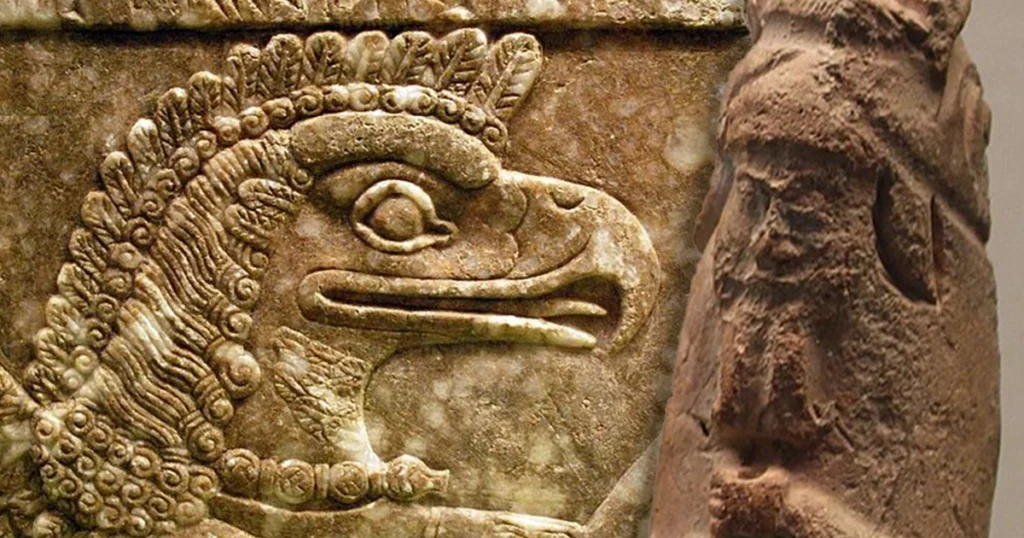
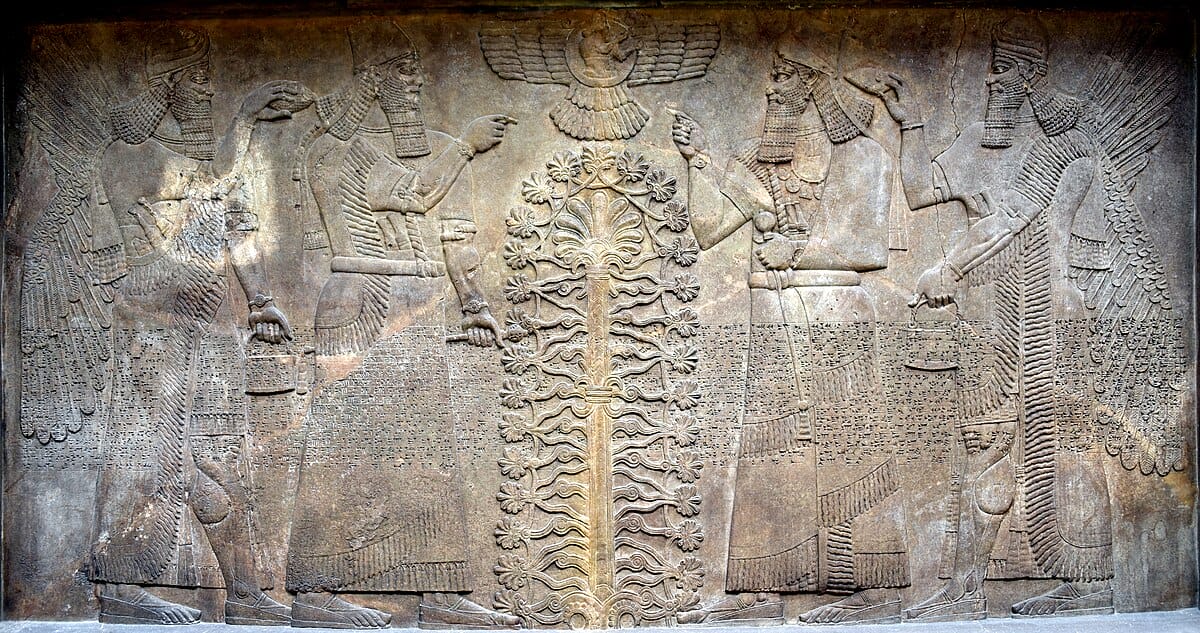
The winged figures on Assyrian palace walls are among the most recognizable images from ancient Mesopotamia. Some have the heads of eagles, others have human faces framed by elaborate beards and horned crowns. Many carry a small bucket and hold up an object resembling a cone. They appear beside kings, sacred trees and doorways, sometimes in repeated pairs that occupy an entire wall. Their meaning becomes clearer when those images are read alongside cuneiform texts about the apkallu, the legendary sages of Mesopotamia.
The apkallu were associated with wisdom given by the gods before the great flood. Later Assyrian ritual specialists also made clay figures of supernatural guardians and buried them beneath floors to protect buildings. The relationship between the seven primeval teachers, the creatures represented by those small figures and the towering figures carved in palaces is close, although it is not identical in every text or image. The familiar bird-headed figures belong especially to the surviving art of the first millennium BCE, long after the mythical age in which the sages were said to have lived.
The evidence reaches across very different centuries. A Babylonian priest writing in Greek told of a fish-like teacher who came from the sea. A tablet copied at Hellenistic Uruk placed sages beside kings from before the flood. Assyrian instructions explained how protective figures should be made and installed, while archaeologists have recovered some of those figures from the floors of ancient buildings. Together these sources show why Mesopotamian scholars believed their knowledge was inherited, and why kings wanted the same beings protecting their palaces.
What Was an Apkallu?
The Akkadian word apkallu, related to Sumerian abgal, means a sage or person of exceptional wisdom. It could describe a legendary being, but it was not confined to mythology. Mesopotamian texts also used the term for people whose expertise carried unusual prestige, including priests, learned scholars and occasionally members of royal families. The related term ummânu referred to a trained expert, often a scholar or master craftsman. These overlapping words mattered because later scholars could claim a relationship to the first sages without claiming to be immortal creatures themselves.
The sages were particularly associated with Enki, known in Akkadian as Ea. Enki was a god of wisdom, craftsmanship, fresh water and powerful ritual knowledge. His domain included the Abzu or Apsû, the subterranean source of fresh water imagined beneath the inhabited world. Eridu, one of southern Mesopotamia’s oldest sacred cities, was closely associated with his cult. In the stories about the apkallu, knowledge comes out of that watery divine realm and enters the world of cities, temples and human rulers.
The distinction between myth and historical evidence is essential. Mesopotamian scribes did not possess an archaeological record of seven actual teachers who lived before a worldwide flood. They preserved religious and scholarly traditions explaining where civilized knowledge came from and why certain kinds of expertise carried authority. An academic iconographic study published through the University of Zurich’s Iconography of Deities and Demons project traces these traditions through ritual texts, palace imagery and surviving small objects. It also warns that the identification of any individual image is not always secure.
The same scholarly caution applies to the three commonly discussed forms. Assyrian art shows human-headed winged figures, figures wearing a fish skin over the head and back, and bird-of-prey-headed winged figures. The human-headed examples are often bearded and may wear horned crowns. Fish-cloaked figures can look like a person emerging from the open mouth of a large fish, with the fish’s body falling down the wearer’s back. The eagle-headed figures have a human body and bird’s beak, sometimes with wings extending behind them. These are iconographic categories, not a proven one-to-one portrait gallery of the seven named antediluvian sages.
Frans Wiggermann’s 1992 study of Mesopotamian protective spirits and their ritual texts remains fundamental because it compares the prescriptions of exorcists with the objects excavated from buildings. It shows that protective beings were not simply subjects for sculpture. Their images belonged to rituals through which people sought to keep illness, hostile supernatural forces and other dangers away from inhabited space. The same figure might be relevant to a royal palace, a domestic threshold or a sick person’s room, depending on the ritual context.
The Seven Sages Who Lived Before the Flood
Mesopotamian stories often divided the remote past from later human history with a great flood. In the traditions surrounding the apkallu, seven sages belonged to the age before that catastrophe. Their authority derived from their proximity to the gods and from their role in bringing or preserving the arts necessary for civilized life. After the flood, texts describe scholars who continued the chain of learning under different conditions. This was a religious model of cultural memory, not a chronology that can be checked against the dates of the first historical cities.
One especially important document is the Uruk List of Kings and Sages, copied in the Seleucid period around 165/164 BCE. The tablet pairs seven rulers from before the flood with seven sages and then continues with rulers and scholars after it. In the list, Adapa is associated with the first king, Ayalu or Alulim; subsequent names include Uanduga, Enmeduga, Enmegalama, Enmebuluga, Anenlilda and Utuabzu. Spellings vary across texts and modern editions. The point of the arrangement is the sequence: kings have advisers, and their wisdom has a history extending back to the first mythical reigns.
The list was copied by Anu-belshunu, a scholar at Uruk who identified himself as a descendant of Sin-leqi-unninni, the celebrated name associated in later tradition with the Epic of Gilgamesh. That personal detail is not incidental. Alan Lenzi’s study, “The Uruk List of Kings and Sages and Late Mesopotamian Scholarship” (2008), argues that the tablet helped establish the prestige of particular learned families. It linked their contemporary scholarship to the oldest imaginable line of authorized knowledge. Its value to a temple scholar was therefore both religious and professional.
The flood was a boundary in that genealogy. The sages before it were imagined as possessing extraordinary, often divine, knowledge; those afterward included human experts associated with particular kings and written works. The list does not prove that all Mesopotamians believed every skill had been taught in a single prehistoric episode. It tells us what a learned tradition at Hellenistic Uruk chose to emphasize about its origins. That tradition was centuries older than the surviving tablet, but the tablet itself belongs to a specific institution and historical moment.
A second body of evidence comes from the Assyrian ritual tradition usually called Bīt Mēseri, associated with the protection or enclosure of a house. Its incantations name apkallu and prescribe protective images. The text connects the legendary sages to practical ritual work in a way that the Uruk list does not. These sources should be compared rather than treated as interchangeable: a scholarly genealogy, an exorcistic instruction and a Greek-language history were composed for different audiences and purposes.
Oannes, the Fish-Cloaked Teacher from the Sea
The best-known narrative of the first sage comes from Berossus, a Babylonian priest who wrote a history of his homeland in Greek during the early third century BCE. His Babyloniaca has not survived as a complete work. We know passages through later writers, especially the transmission of Alexander Polyhistor’s excerpts by Eusebius and subsequent chroniclers. The version available today is therefore a mediated account of a Babylonian tradition, not a complete book in Berossus’ own hand.
Berossus called the first teacher Oannes. He described a creature with a fish’s body, a human head beneath the fish’s head and human feet below the tail. Oannes came out of the sea bordering Babylonia and spent the day among people, speaking intelligibly and teaching them. At night he returned to the water. The lessons were practical and institutional: writing, mathematics, building cities and temples, establishing laws, measuring land and cultivating crops. The surviving passage, transmitted in Eusebius’ Chronicle, presents civilization as knowledge delivered to humanity by a being from beyond ordinary human society.
The name Oannes is commonly connected with Uanna, the first apkallu in other Mesopotamian traditions, while Adapa also enters the chain of identifications. These connections are important, but they developed through texts separated by many centuries. It is safer to say that the figures became associated than to assume that every ancient author understood them as precisely the same person. Berossus’ story also explains why fish-cloaked sages make sense within Mesopotamian religious imagery: a human figure wearing a fish skin visually joins the world of human experts to the waters of Ea.
The imagery is more than a modern reconstruction. The British Museum’s unbaked clay fish-cloaked apkallu figurine, museum number 90999, shows the form clearly. Dated to the Neo-Assyrian period, it was probably one of seven deposited together, although its exact excavation provenance is uncertain. A chalcedony cylinder seal in the same museum also depicts a fish-cloaked apkallu holding a bucket and cone beside a palm tree. The fish costume was one durable form of the sage’s image, not a description of an excavated prehistoric species.
The story of Oannes sometimes attracts modern claims about visitors from outer space or an otherwise unknown advanced civilization. Those claims do not follow from the evidence. Berossus was transmitting a mythic account of the origin of human knowledge, while the archaeological figurines belong to known Mesopotamian religious and artistic traditions. The real historical question is how priests and scholars used such stories to explain the authority of their learning.
Adapa and the Wisdom That Did Not Bring Immortality
Adapa was another learned figure associated with Eridu and Ea. In the myth usually called Adapa and the South Wind, he performs duties for the god, including providing food and attending to the temple. His wisdom is exceptional, but he remains mortal. That distinction becomes the centre of the story when an incident at sea brings him into conflict with the sky god Anu.
While Adapa is in a boat, the South Wind overturns it. Angry at what has happened, Adapa breaks the wind’s wing, preventing it from blowing for seven days. Anu summons him to heaven to explain the offence. Before he goes, Ea instructs him how to behave and warns him not to eat or drink what is offered there. The advice becomes disastrous when Anu orders food and water of life to be brought. Adapa refuses them and returns to earth without immortality. The surviving texts leave room for disagreement over Ea’s motives and over the theological point of the refusal.
The best-known manuscript comes from the fourteenth-century BCE archives at Amarna in Egypt, where Akkadian served as a language of international diplomatic communication. The Hebrew University of Jerusalem’s Sources of Early Akkadian Literature entry for the Amarna tablet VAT 348 identifies the manuscript and its scholarly editions. Shlomo Izre’el’s critical study of the Adapa myth discusses six known fragments, including the substantial Amarna witness and later fragments from Assurbanipal’s library at Nineveh. This is a much firmer basis for the textual history than assigning an unverified earliest date to a different site.
The myth survives in damaged form, and its ending should not be presented as though every line were intact. The broad narrative is clear: Adapa possesses wisdom that approaches divine knowledge, but he does not gain eternal life. What that failure means is debated. It may help explain the limits of human existence, the dangerous consequences of obeying divine instructions without knowing their full purpose, or the position of ritual experts who handle sacred knowledge without becoming gods.
Adapa was useful as a comparison for royal learning. Mesopotamian kings and court scholars could invoke him as a model of extraordinary intelligence, ritual skill or mastery of difficult texts. Such claims tell us how those rulers wished to be understood, not that they literally possessed the powers attributed to Adapa. The prestige of the first sage could be borrowed by people who wanted their knowledge to appear both ancient and divinely sanctioned.
Enjoying Spoken Past?
I created Spoken Past to share my love of history. I research, write and develop everything myself, and I want my articles and basic guides to remain free for everyone.
If you enjoy my work, please consider supporting Spoken Past with a small donation.
Why Assyrian Apkallu Carry Buckets and Cones
The small bucket carried by many Assyrian protective figures is usually identified by the Akkadian term banduddû. The object raised in the other hand is often called mullilu, a term associated with purification. The pairing is common in ninth-century BCE palace reliefs, especially those from Ashurnasirpal II’s Northwest Palace at Nimrud, ancient Kalhu. It is not universal. Some figures carry plants, maces or other objects, and some raise an empty hand. The images therefore cannot all be explained by a single mechanical gesture.
One reading is that the cone-like implement was used symbolically to sprinkle or apply purifying liquid from the bucket. This makes sense in scenes where the figure approaches a king or guards a doorway, places that Assyrian ritual specialists regarded as needing protection. The Metropolitan Museum’s relief panel showing a winged figure with bucket and cone notes that the implement is described in Akkadian as a purifier and that the gesture may have a protective meaning. That is strong evidence for a ritual association, although no surviving carving shows liquid actually leaving the object.
Another interpretation draws on agriculture. The stylized tree between paired figures may refer to fertility and royal prosperity, and the raised object resembles the male flower cluster used in the pollination of date palms. The Metropolitan Museum’s catalogue of another Nimrud panel discusses this possibility while acknowledging that the precise identity of the object remains unclear. These interpretations are not necessarily mutually exclusive, but the specific claim that the figure is always physically sprinkling holy water goes beyond what the stone itself demonstrates.
The details around the gesture deserve attention. The figures wear patterned garments, jewelry, sometimes weapons and often rosette ornaments associated with the supernatural world. Their wings and heads make them unlike ordinary courtiers. Some stand beside a tree that is highly stylized rather than a botanical drawing. Others face the king, whose authority was presented as resting on divine favour. The repeated combination of objects and settings suggests protection, blessing and the maintenance of royal order, even where an exact ritual action cannot be reconstructed.
There is also a significant distinction between the figures’ names and their visual meaning. The Metropolitan Museum’s discussion of a human-headed relief explicitly cautions that identifying every palace guardian as an apkallu is an interpretation, supported by parallels with buried figurines and ritual texts, rather than a label carved beside each figure. A palace image could carry several related associations at once. That caution is especially important when discussing the bird-headed figures, which modern popular accounts often identify as the seven antediluvian sages without qualification.
Clay Guardians Hidden Beneath the Floors
The strongest connection between apkallu mythology and excavated ritual practice comes from small clay figurines. Assyrian exorcists, called āšipū, prepared protective figures for buildings and installed them in carefully chosen places. Such rituals are commonly called apotropaic, meaning intended to turn away danger. A protective image was meant to do something: guard a threshold, oppose hostile forces or secure the inhabited space against threats that could not be fought by ordinary weapons.
Wiggermann’s edition and analysis of the ritual texts includes the Bīt Mēseri material and other instructions for arranging figures around a house. These texts give names and categories of beings and describe rituals through which the images were made effective. They should not be flattened into a single rule requiring precisely fourteen figures in five identical positions in every building. Different ritual texts and different archaeological deposits preserve different arrangements. The broader principle is clear: protective figures were placed at vulnerable points in the built environment, sometimes out of sight beneath the floor.
The archaeology is unusually direct. The British Museum’s bird-headed clay apkallu, museum number 91839, is recorded as having been discovered in a brick receptacle set into the floor at Nimrud. The catalogue associates it with other figurines that probably belonged to a set of seven. A second bird-headed figure, number 90992, is part of the same documented group. These are not simply objects that happen to resemble mythological beings. Their recorded discovery context matches the protective practice described in the ritual tradition.
Another example comes from the Metropolitan Museum of Art. Its bird-headed winged apkallu figurine, object 54.117.26, was found under a floor in a palace building at Nimrud. It is only 14.2 centimetres high, with four wings, a beaked face and a bucket held at its side. The museum explains that such figurines were mould-made and installed as part of ceremonies to protect interior spaces. A figure small enough to hold in the hand could therefore participate in the same protective language that appeared on a palace wall many times larger.
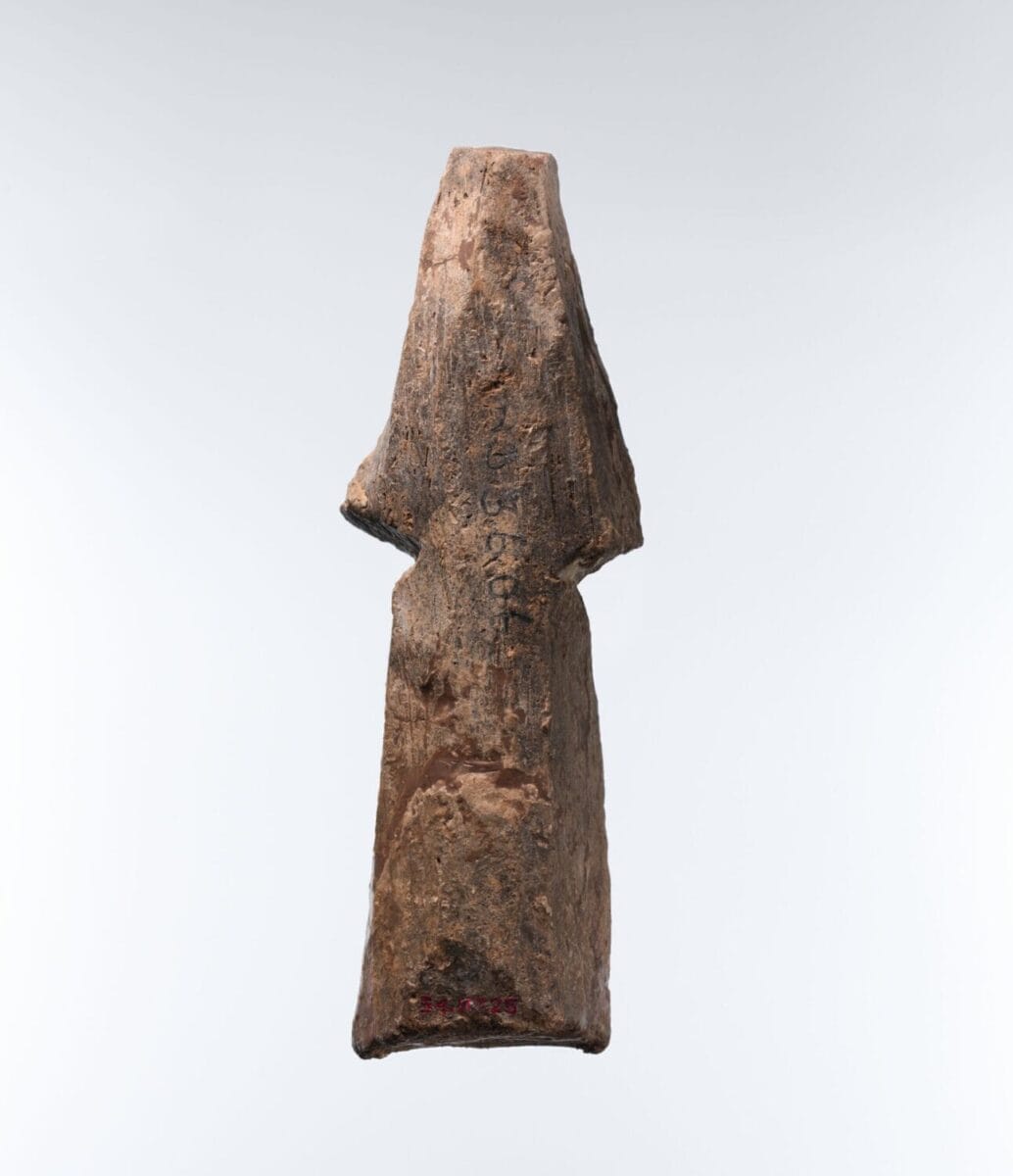
The choice of location helps explain the practice. A doorway was a passage between protected and exposed space. A foundation lay beneath the inhabited rooms and carried the building’s weight. Rooms associated with sleeping, worship or the king’s presence had their own vulnerabilities. By placing images at such points, ritual specialists established a perimeter of supernatural protection. It would be misleading to claim that every Assyrian wall literally contained an apkallu; what survives are particular deposits at particular sites, not evidence for a universal building requirement.
The figurines also demonstrate how closely religion and skilled labour were connected. Somebody prepared the clay, shaped the image, organized the deposition and recited the required words. These were acts performed in a material building, not merely ideas recorded in myth. When excavators find the figures sealed in their ancient positions, the ritual instructions and the archaeological evidence illuminate one another in an unusually tangible way.
The Guardians on the Walls of Assyrian Palaces
The great palace reliefs belong to the political world of the Neo-Assyrian Empire. Ashurnasirpal II, who ruled from 883 to 859 BCE, decorated his Northwest Palace at Nimrud with extensive carved stone panels. Protective figures appear beside stylized trees, near the king and around architectural transitions. Many are shown in pairs. Their detailed feathers, robes, jewellery and ritual objects were once part of painted interiors; the bare gypsum visible in museums today does not reproduce their original appearance.
The arrangement was deliberate, but its meaning was not limited to a single formula. A Metropolitan Museum panel from Nimrud belonged to a group of four protective figures placed around a doorway, facing both outward and inward. Such a location makes sense for images understood as guardians of access. Other panels placed the figures around a stylized tree or beside the king. The repetition made protective imagery part of the architectural experience of moving through the palace, not an isolated illustration hung on a wall.
Assyrian kings also used palaces to communicate political authority. Reliefs of campaigns, tribute and royal accomplishments presented an empire under the control of its ruler, while supernatural guardians represented the divine order surrounding that ruler. The political messaging of Assyrian palace art extended far beyond apkallu imagery, but the guardians contributed to the same environment of royal legitimacy. They placed the king’s rooms within a world protected by beings associated with powers older than any living dynasty.
Later palaces developed related imagery. Sargon II built Dur-Sharrukin, near modern Khorsabad, in the late eighth century BCE, and its monumental sculpture included elaborate winged guardians. Human-headed and bird-headed figures must be identified object by object, however. It is unsafe to assign an unverified Louvre inventory number, discovery date or bird-headed identification to a particular panel simply because it came from Khorsabad. The original article’s account of Botta’s shipments and the Louvre’s supposed reaction requires separate documentary confirmation and has therefore not been repeated as fact.
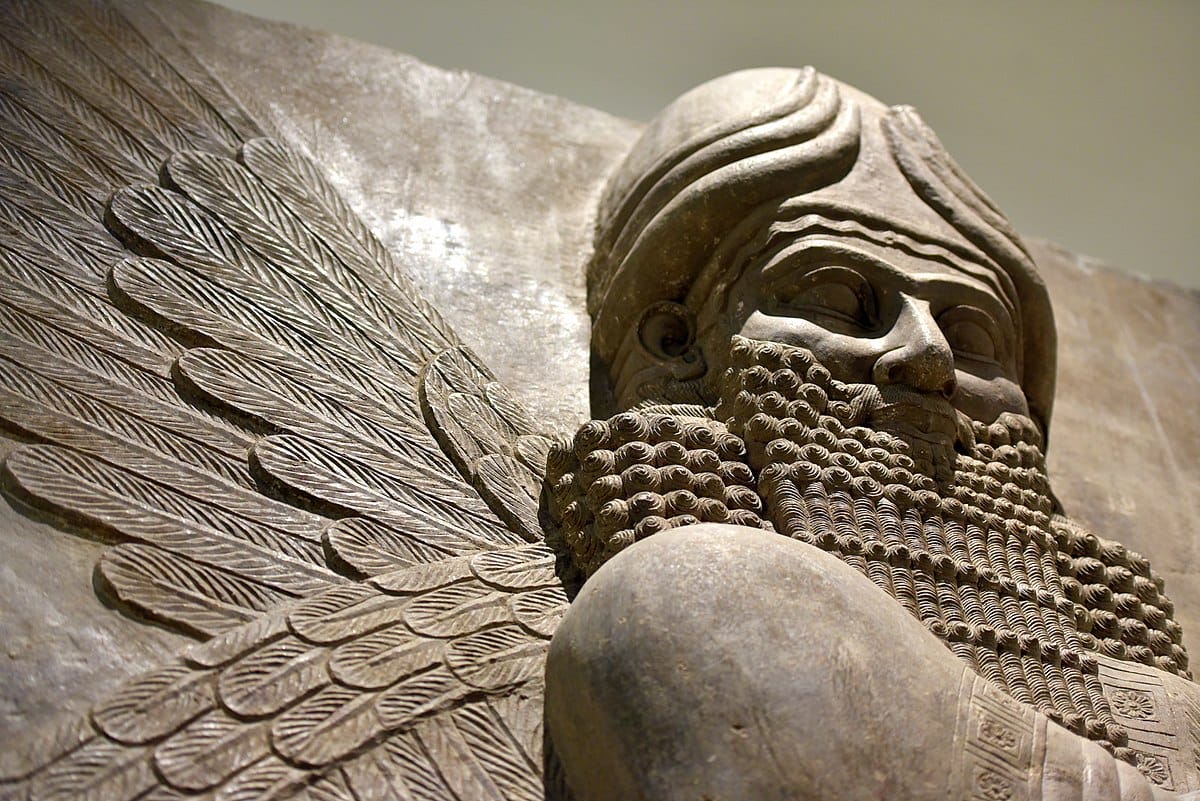
The difference between a palace panel and a buried figurine matters. A relief was visible to people entering the building; a deposited clay figure generally was not. The first participated in the public language of the palace, the second in a ritual action concealed within its fabric. Their iconography overlaps, and the scholarly identification of palace figures with apkallu draws partly on that overlap. It does not follow that every carved figure was consecrated by precisely the same procedure as every small clay guardian. A careful reading preserves both the connection and the limits of the evidence.
Kings could also claim wisdom in words. Sennacherib and Ashurbanipal presented themselves as rulers with extraordinary intellectual and technical capacities. The apkallu tradition offered a powerful model for such claims because it placed learned expertise at the beginning of civilization itself. Yet the precise wording of a particular royal boast should be checked against its inscription before it is quoted. The larger point is secure: Assyrian royal ideology joined divine support, military power, construction and learned skill in the image of a legitimate king.
How the Apkallu Tradition Survived Assyria
The Neo-Assyrian Empire collapsed at the end of the seventh century BCE, with Nineveh falling in 612 BCE. The traditions surrounding the sages continued in Babylonia. Berossus wrote his Greek history centuries after the first major Assyrian palace reliefs were carved, and the Uruk list was copied later still. The continued use of these stories shows that the apkallu belonged to a scholarly inheritance extending beyond one empire and one artistic programme.
The Uruk list is particularly revealing because it places learned names alongside kings and ends with the copyist’s own scholarly ancestry. By presenting scholarship as an inheritance from the earliest ages, it could dignify the work of those who copied, interpreted and taught ancient texts. This was not a claim that an individual scholar had personally met Uanna or Adapa. It was a statement that the knowledge held by his profession belonged to a long, authoritative tradition. The persistence of scribal schools and temple scholarship helped make such claims meaningful.
Mesopotamian stories about primeval wisdom have also been compared with traditions elsewhere in the ancient Near East. Enoch’s association with heavenly knowledge and ascent, for example, invites comparison with Mesopotamian figures associated with exceptional learning; Adapa’s missed opportunity for immortality invites comparison with other accounts of human mortality. Similarity, however, is not proof of direct borrowing. Dates, textual transmission and the specific content of each story must be established before a historical connection can be argued. The apkallu should be understood first within the surviving Mesopotamian evidence, rather than as a shortcut to explaining every later flood or wisdom tradition.
The archaeological record provides a final contrast. We can identify a moulded clay bird-headed figure placed beneath a palace floor and read a museum’s record of its discovery. We can examine the detailed wings and bucket on a carved relief and compare them with descriptions of protective beings in ritual texts. We can also read a Hellenistic scribe’s claim that his profession descended from the sages who advised the first kings. These are different kinds of evidence, and each answers a different question. Together they explain how the apkallu could be remembered as the teachers of humanity and represented as guardians of buildings centuries after the mythical age to which they belonged.