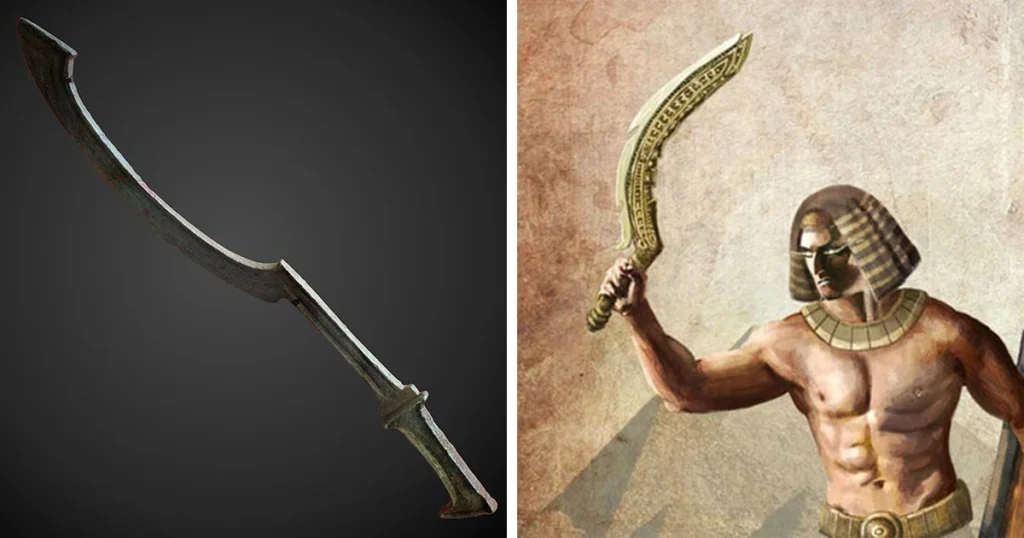
The khopesh was one of the most recognizable weapons of ancient Egypt. Its bronze blade began with a straight section near the hand and then widened into a forward-curving cutting edge. The result looked part sword and part axe. Egyptian kings raised it above defeated enemies in temple reliefs, while actual examples have survived in burials and museum collections. The shape was practical enough to become a weapon, but distinctive enough to become an emblem of royal power.
The weapon is usually associated with Egypt’s New Kingdom, approximately 1550 to 1070 BCE, when pharaohs campaigned in Nubia and the eastern Mediterranean. Yet the curved sword was not invented in isolation on the Nile. Related blades had circulated in western Asia long before Egyptian artists began repeatedly depicting them. The khopesh developed within a connected Bronze Age world where metalworkers, soldiers and rulers exchanged weapons and ideas as readily as luxury goods.
Modern descriptions often say that a khopesh was designed to hook an enemy’s shield and drag it aside. Its curve makes that movement mechanically possible. The surviving evidence, however, cannot establish that shield-hooking was its main purpose or a standard Egyptian fighting technique. Understanding the khopesh requires looking separately at what its metal could do, what Egyptian images actually show, and why rulers chose to be portrayed holding it.
What made the khopesh different from a straight sword?
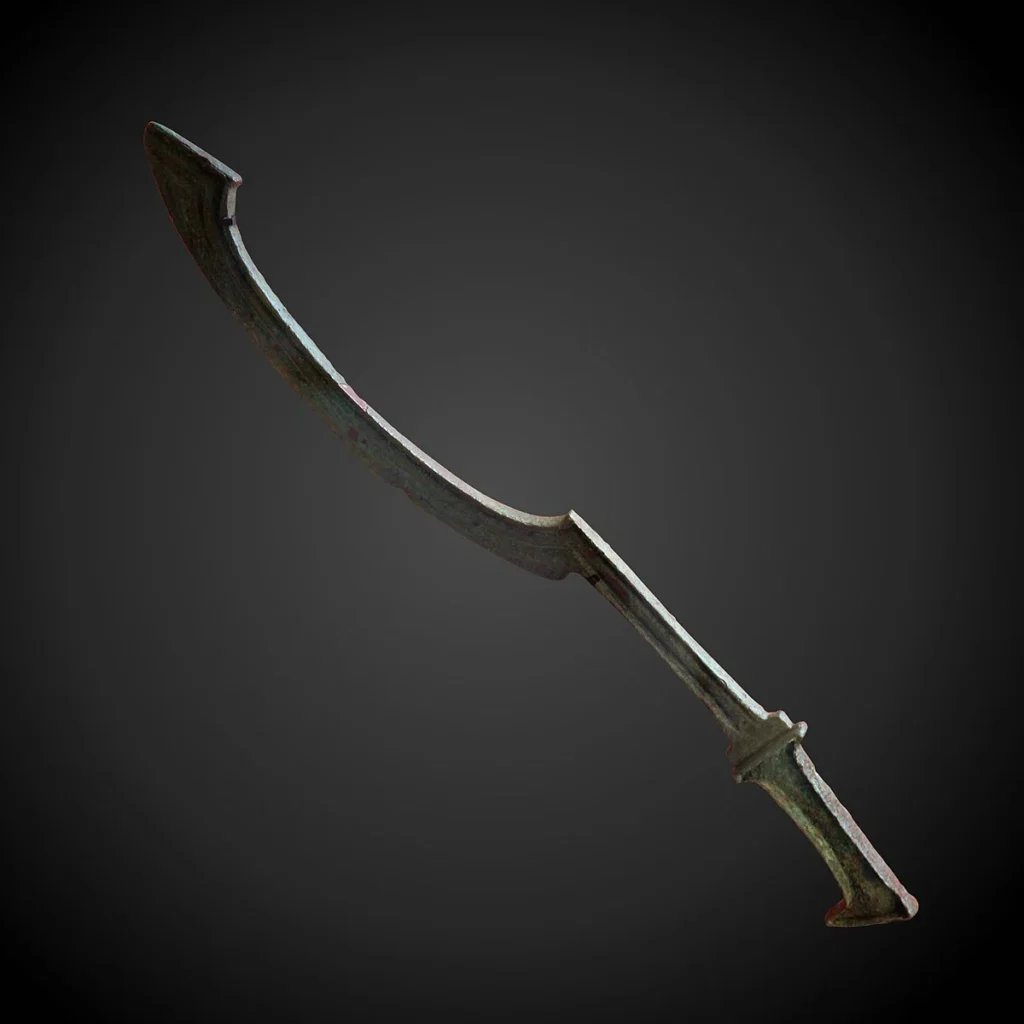
A khopesh was normally a relatively short, one-handed weapon with a curved blade concentrated toward its far end. Unlike an agricultural sickle, which cuts along the concave inner edge, the Egyptian fighting blade generally placed its cutting edge on the outer, convex side of the curve. This matters because a downward or diagonal stroke presents the sharpened edge to its target without requiring the hand to reverse the weapon. The heavy forward portion could give a blow something of the momentum of a small axe.
The shape varied. Some surviving weapons have a pronounced crescent, while others have a more gradual bend. A straight lower section separates the cutting part from the grip, and many examples have a thickened back that supports the blade. The word ‘sickle-sword’ is a convenient modern description, but the weapon did not function like a harvesting tool. Its characteristic profile brought a chopping edge forward of the hand, making it suitable for forceful cuts at relatively close range.
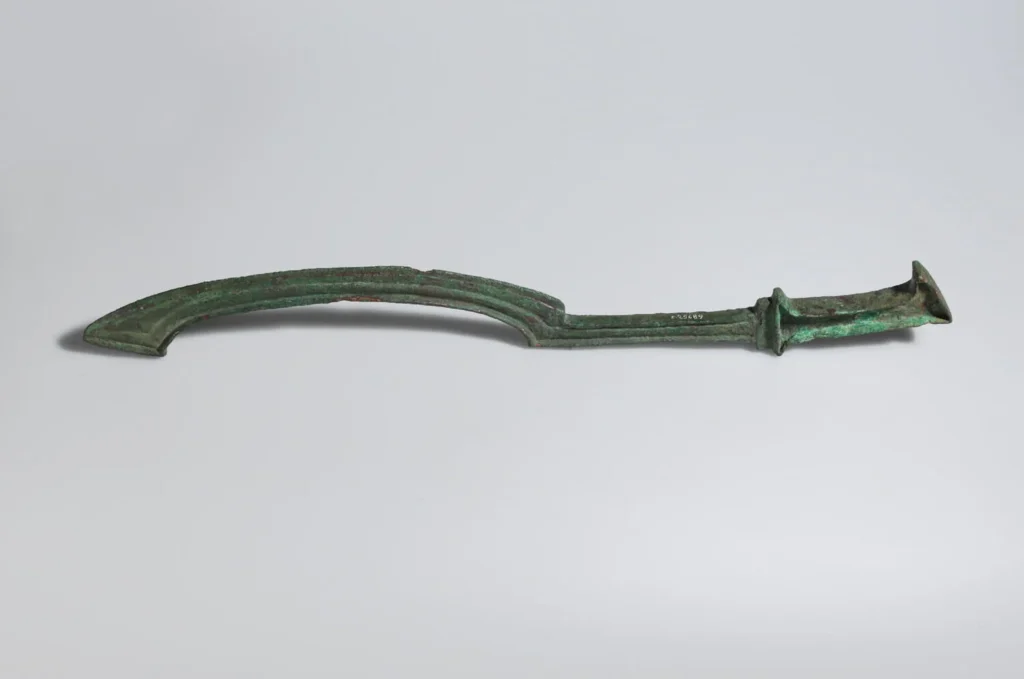
One particularly clear example is the bronze khopesh in the Louvre collection, inventory E 25689. It measures 57.5 centimetres long and 4.8 centimetres wide, and bears the throne and birth names of Ramesses II, who ruled in the thirteenth century BCE. The museum calls the object a harpè, the French cataloguing term for a curved sword. It also notes missing inlay and only a reported, not archaeologically documented, origin at Qantir in the eastern Nile Delta. The royal inscription is secure; the findspot is less certain.
The Louvre weapon illustrates a limitation of talking about the khopesh as if every example were identical. Its dimensions are those of a particular object, not a universal regulation size. A similarly shaped sword could have been made heavier, thinner, more decorative or more suited to actual cutting. Without individual measurements and metallurgical examination, claims that all khopeshes weighed a particular amount, had a fixed balance point or used exactly the same grip are unjustified.
How did the curved sword reach Egypt?
The khopesh belongs to a broader Near Eastern family of curved swords and axe-like weapons. Archaeologists have identified early sickle-shaped forms in Mesopotamian art, although a curved object in a third-millennium relief is not automatically a metal sword of the later Egyptian type. Some early representations may show clubs or long-handled axes. The distinction matters because the recognizable Egyptian khopesh appeared after centuries of experimentation with crescent-shaped cutting weapons.
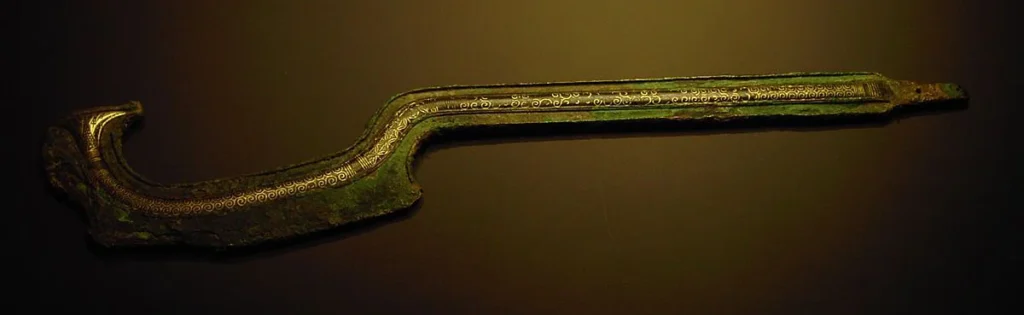
Objects from western Asia show that this was not a uniquely Egyptian idea. A copper-alloy sickle-sword in the British Museum from northwestern Iran, broadly dated to 2000–1000 BCE, preserves a steeply curved blade and tang. Its tip is broken, and the museum records a weight of 829 grams for the surviving object. The broad dating and incomplete blade prevent it from being used as a precise model for Egyptian fighting, but it demonstrates the geographic range and physical diversity of the weapon family.
Egypt’s contact with Canaan and Syria intensified during the second millennium BCE through trade, migration, diplomacy and warfare. During the Second Intermediate Period, political power in parts of the Nile Delta was held by rulers conventionally called the Hyksos. Their presence coincided with military changes often associated with western Asia, including chariot technology. The familiar claim that the Hyksos personally introduced every new weapon is too simple. Objects and techniques could move through merchants, captured equipment, tribute and craftsmen without a single moment of invention or adoption.
Rebecca Dean’s 2013 University of York study of Egyptian weapons summarizes arguments that manufacturing knowledge for the khopesh reached Egypt from Canaan and notes depictions of foreign tribute including curved swords. The exact route and timing remain uncertain. By the Eighteenth Dynasty, beginning around 1550 BCE, the Egyptian form was established and was being incorporated into the royal and military imagery of the expanding New Kingdom state.
Bronze casting, blades and handles
The typical New Kingdom khopesh was made of bronze, an alloy of copper with tin. Bronze was valuable because the proportions of the alloy and the treatment of the finished object could produce a harder cutting edge than unalloyed copper. The smith first had to form the unusually curved blade, then finish its surfaces and edge. Some examples have a blade, shaft and handle cast as one piece; others preserve evidence for separate grip materials or fittings. It is unsafe to assume that every khopesh had wooden scales fixed by rivets.
A cutting edge and a thick back served different purposes. The sharpened outer curve concentrated force along a narrow contact line, while the thicker part of the blade resisted bending. The precise metallurgy of individual objects is a matter for scientific analysis rather than an inference from their colour. Daniel Boatright’s University of Liverpool research on Egyptian Bronze Age weapon composition and function approaches the subject through measurements, metallurgical evidence and comparisons across the eastern Mediterranean. This kind of analysis is necessary because the visible outline of a bronze sword alone cannot reveal its alloy composition, manufacturing sequence or how the blade was used.
Not every surviving khopesh has a cutting edge suitable for combat. A weapon made for presentation, a temple, or burial could reproduce the silhouette without receiving the same finish as a fighting blade. Conversely, an archaeological blade may have lost part of its original edge through corrosion or restoration. A blunt museum object cannot by itself prove that soldiers fought with blunt swords. The question must be answered object by object, using construction, context and physical examination.
Could a khopesh really hook an opponent’s shield?
The inside of a curved khopesh could theoretically catch the rim of a shield or the shaft of a weapon. Once a curve passes behind an exposed edge, pulling the hand backward can apply force from a direction a straight blade cannot easily reach. That is a plausible mechanical property, especially when the opponent is close enough for the curve to engage. It explains why shield-hooking has become a popular account of the weapon’s design.
What it does not establish is a historical drill. No surviving Egyptian military manual explains a prescribed sequence of hooking a shield, twisting it down and following with a cut. Nor do temple battle reliefs function as frame-by-frame records of swordsmanship. Accounts of second-rank specialists pulling shields aside for spearmen, or of charioteers catching reins and dragging opponents from their vehicles, are plausible stories built from the shape of the weapon. They are not tactics established by surviving Egyptian sources.
A shield was not a passive target. Its bearer could shift position, push back or retreat; the hooked sword itself could become trapped. Bronze blades also had limits when subjected to sideways force. An attempted pull might succeed, fail or expose the wielder. Modern practical reasoning can illuminate these possibilities, but it cannot tell us how frequently a New Kingdom soldier used them or whether the hook was the decisive reason the weapon became popular.
The safer conclusion is that the khopesh was capable of cutting and, under suitable circumstances, interfering with an opponent’s equipment. The relative importance of those functions is disputed. Its forward-heavy form is consistent with a chopping weapon, while its striking appearance and its repeated depiction in royal ceremonies indicate another use that is exceptionally well documented: the visible expression of authority.
What experiments can tell us about its fighting power
Experimental archaeology can test whether a replica blade is capable of inflicting serious damage. It cannot reconstruct an entire ancient battle. Rebecca Dean commissioned a bronze replica based on the larger of the two khopeshes from Tutankhamun’s tomb and described controlled cutting experiments in the experimental section of her thesis. The replica used bronze with approximately 12 percent tin and a wooden grip. The tests were designed to investigate the weapon’s capacity to cause injury, not to demonstrate a historically attested system of shield-hooking.
The replica was used against animal tissue, and the recorded blows produced substantial cuts. That result shows that a suitably made khopesh could be a dangerous edged weapon rather than an exclusively ceremonial prop. It does not prove that every ancient khopesh was sharpened, that a particular battlefield movement was common, or that ancient soldiers would have produced identical results under combat conditions. Replica composition, sharpening, target and operator all affect the outcome.
Dean also draws attention to a fundamental ambiguity in the visual record. Egyptian art often shows the khopesh in royal processions, symbolic violence and scenes of victory, while straightforward depictions of ordinary soldiers actually striking opponents with it are much less common. Some weapon-like objects shown in ritual scenes may even have been wooden. The same silhouette could therefore signify a real implement, a ceremonial version of it, or a royal claim to overwhelming force.
The khopesh in the New Kingdom army
Egypt’s New Kingdom military campaigns involved many kinds of soldiers and equipment. Archers used bows to engage opponents at a distance; infantry carried spears, shields and other close-combat weapons; chariots offered mobility and a platform for missile fire. A khopesh was one possible sidearm within that larger system. The claim that it was issued to every soldier, or to a specific second rank whose job was to drag down shields, goes beyond what the sources can establish.
The weapon is often associated with the great royal campaigns of the Eighteenth and Nineteenth Dynasties. Pharaohs such as Thutmose III, Seti I and Ramesses II appear in accounts and images of fighting in Syria and the Levant. Their victories were important to Egypt’s imperial position, but royal battle narratives were also political statements. An image of the king attacking an enemy tells us how the court wanted victory to be understood, not necessarily what happened to one particular enemy in one particular moment.
The British Museum’s cast of Seti I at Karnak makes this distinction especially clear. It records part of a monumental relief in which the king raises a khopesh while trampling Libyans. The cast itself was made in the nineteenth century, from a relief carved in the reign of Seti I. Its museum record identifies the raised weapon explicitly, but the cast is not an excavated sword and does not document an actual sword stroke. It is evidence for royal representation and the recognizable shape of the weapon.
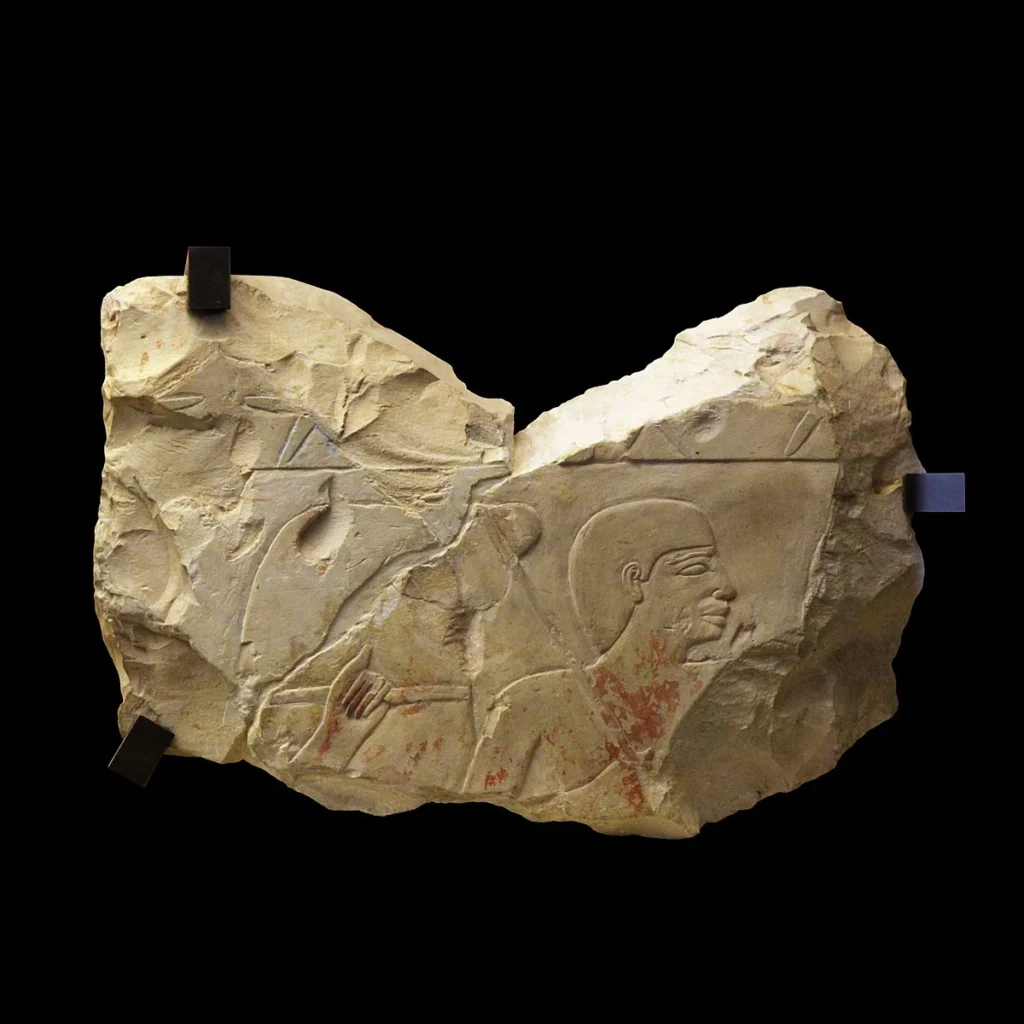
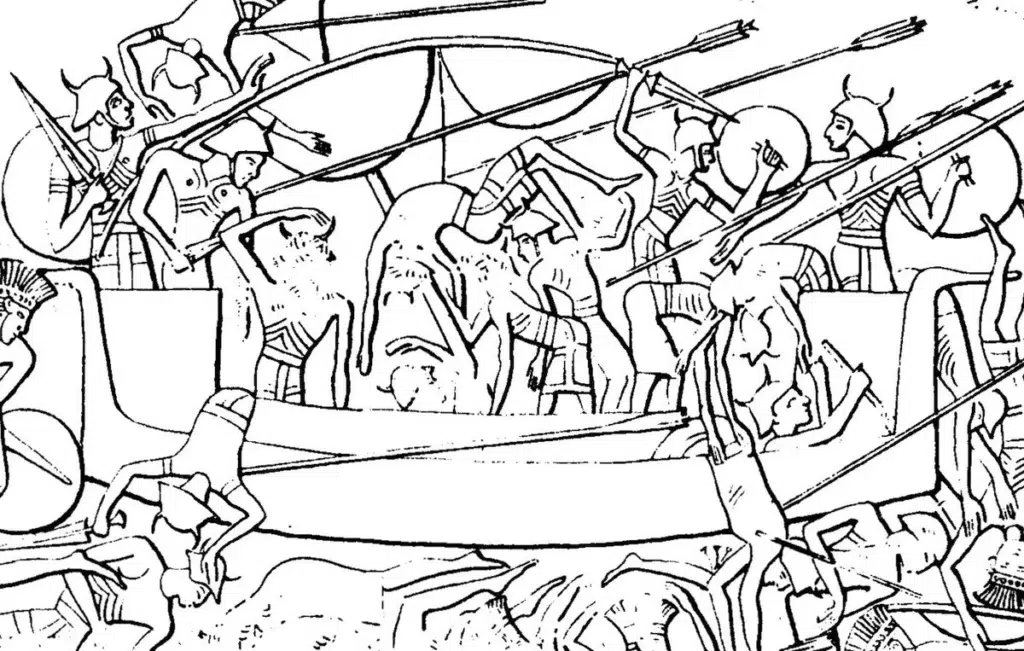
At Medinet Habu, the mortuary temple of Ramesses III on the west bank of the Nile at Thebes, military reliefs show Egyptian encounters with Libyan groups and enemies conventionally grouped as the Sea Peoples. The Epigraphic Survey’s published plates and the accompanying translations of the inscriptions allow these scenes to be examined in context. They depict shields, weapons, captives and victory, but they were created to proclaim the king’s success and divine support. They do not establish that khopeshes won the battle by pulling away round shields.
The Medinet Habu reliefs need to be read as royal monuments rather than tactical photographs. Egyptian artists organized crowds, enemies and weapons according to conventions of status and legibility. Fallen equipment can communicate defeat; a raised sword can announce the ruler’s power. Even when an artist drew real weapons accurately, the arrangement of those weapons could serve a political story rather than reproduce the movements of combatants.
Enjoying Spoken Past?
I created Spoken Past to share my love of history. I research, write and develop everything myself, and I want my articles and basic guides to remain free for everyone.
If you enjoy my work, please consider supporting Spoken Past with a small donation.
Why pharaohs and gods held the khopesh
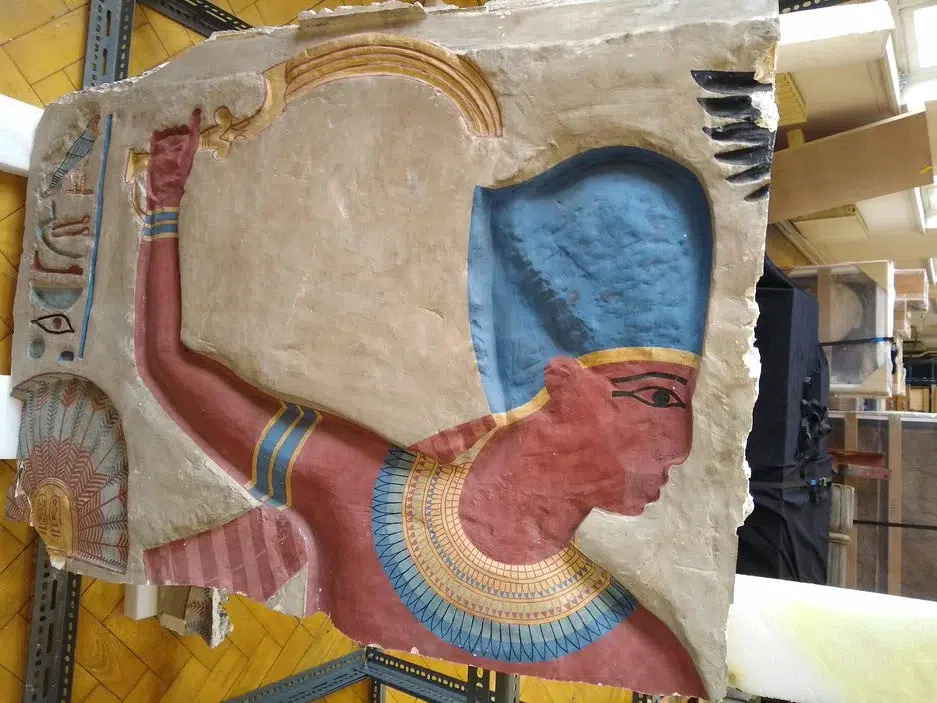
The clearest evidence for the khopesh’s importance is its place in royal iconography. In the traditional Egyptian smiting scene, the king seizes an enemy and raises a weapon over him. The scene can represent military conquest, but it also expresses the king’s duty to defeat disorder and maintain maat, the proper order of the world. A royal weapon therefore carries religious and political meaning even when it looks like equipment that could be used on a battlefield.
A small Eighteenth Dynasty limestone stela in the British Museum depicts a king raising a khepesh over a kneeling enemy before the god Ptah. The smaller figure of the captive and the presence of the god are essential to the composition. The scene announces the ruler’s superiority and divine legitimacy. It is not evidence that a khopesh was used to capture that particular individual, or that the posture records an actual execution.
Richard H. Wilkinson’s 2015 study of weapons and the visual language of dominance places such representations within a wider Egyptian system of gestures and objects that communicate submission. Within this visual language, a curved sword could become a symbol because it was both visibly distinctive and associated with the authority of the king.
The association could continue long after particular battlefield equipment changed. The Metropolitan Museum’s statue of Horus protecting Nectanebo II, dated to 360–343 BCE, shows the late pharaoh holding a sword beneath the falcon god. The museum interprets the whole sculpture partly as a visual play on the ruler’s Egyptian name. Its catalogue number is 34.2.1, a detail sometimes misstated in secondary discussions. This is a late image of kingship, not proof that New Kingdom tactics remained unchanged for a thousand years.
Tutankhamun’s two khopeshes
Tutankhamun, who ruled in the later Eighteenth Dynasty, was buried with two khopeshes. They are valuable evidence because their discovery in a royal tomb provides a secure context for the objects. The larger weapon was sufficiently substantial to be selected as the model for Dean’s experimental replica. The existence of two examples also cautions against treating the khopesh as a single standardized weapon with one fixed size and one precise function.
The tomb assemblage, excavated by Howard Carter and his team after its discovery in 1922, contained a remarkable range of equipment associated with royal life and status. The Griffith Institute’s Tutankhamun Spatial Archive preserves Carter’s excavation documentation and helps place the weapons within the wider contents of the tomb. An object buried with a king might have been practical, symbolic, ceremonial, or several of these at once. The burial context alone does not settle the question.
Dean notes that Carter described the larger khopesh as more suited to crushing than cutting. That observation complicates the modern assumption that all such blades had a keen edge and worked in exactly the same way. It also explains why experimental tests of a sharpened replica cannot simply be projected onto every surviving object. A carefully made ceremonial weapon can preserve the profile of a fighting sword while differing significantly in how its surface was finished.
Other kings used curved swords too
The khopesh was part of a regional tradition, and surviving objects show its prestige beyond Egypt. A remarkable Middle Assyrian sickle-sword in the Metropolitan Museum belonged to Adad-nirari I, king of Assyria in the thirteenth century BCE. It is made of bronze, measures 53.5 centimetres along its length, and carries a cuneiform inscription identifying the king and his ancestors. The inscription runs along both sides of the blade and its noncutting edge.
The Metropolitan Museum considers it likely that the Assyrian weapon was used in royal ceremonies rather than necessarily in battle. This is an important comparison: curved swords were useful as emblems of rulership across the ancient Near East, not merely as ingenious cutting tools. Their inscriptions, decoration and deposition can be just as informative as their geometry. An Egyptian khopesh with a royal name and an Assyrian sickle-sword with a royal inscription participate in related political languages, although the societies and objects were not identical.
Such comparisons do not prove that later curved swords, including the Greek kopis or much later scimitars, descended directly from the Egyptian khopesh. Weapons can converge on similar shapes because similar distributions of weight suit cutting, and names can resemble one another without a demonstrated chain of transmission. Establishing direct descent would require a connected sequence of securely dated artifacts and textual evidence, not just a silhouette that looks familiar.
What did the Egyptian name mean?
The Egyptian word conventionally written ḫpš is often rendered khopesh or khepesh in English. The same consonantal form was associated with the foreleg or haunch of an animal, an important cut of meat in offerings. The resemblance between a bent foreleg and a curved weapon helps explain the terminology, although the historical development of the word should not be reduced to a modern visual pun. Ancient Egyptian writing normally recorded consonants, so the vowels in the modern English spelling are conventional.
The royal use of the word also intersected with ideas of physical strength. This does not mean every instance of ḫpš in an Egyptian text denotes a sword. Translators must read the surrounding sentence and the determinative, a sign that helps classify the meaning of a written word. For the history of the weapon, the actual object, its inscription and its archaeological context are more secure evidence than an isolated English translation of a hieroglyph.
Did iron make the khopesh disappear?
The khopesh is most strongly represented in New Kingdom Egypt, but dating its disappearance to a single battle or technological breakthrough is misleading. Ironworking expanded across the eastern Mediterranean during the transition from the Late Bronze Age into the Iron Age. Yet the arrival of iron did not instantly render every bronze weapon obsolete. Supply, manufacturing skill, military preference and regional practice all influenced the pace of change.
Straight iron swords, changes in armour and changing fighting styles are sometimes suggested as explanations for the khopesh’s decline. Those factors may have mattered, but the available evidence does not demonstrate that any one of them caused the Egyptian khopesh to be abandoned at a specific date. The survival of curved swords in ritual and royal imagery also makes the end of a battlefield type difficult to date. A symbol can remain recognizable long after its everyday military use has diminished.
The same caution applies to claims about iron khopeshes. Bronze is securely documented in the Louvre and Metropolitan Museum examples discussed here. A routine transition to iron khopeshes during the New Kingdom is sometimes asserted, but the surviving museum objects and archaeological studies discussed here do not establish such a widespread change. It would be misleading to treat that assertion as a proven stage in the weapon’s development.
What the khopesh reveals about Egyptian warfare
The khopesh was a real Bronze Age weapon with a curved outer cutting edge and a form capable of delivering forceful blows. Its hook might also have been used to interfere with a shield or another weapon, but the exact technique remains unrecorded. The objects in museums tell us about metallurgy, size, inscription and manufacture. Temple reliefs tell us how rulers chose to display their power. Experiments show what a carefully made replica can do under controlled conditions. Each kind of evidence answers a different question.
That distinction makes the khopesh more historically interesting than the simple image of a soldier yanking away a shield. The same bronze form moved through workshops, armies, royal courts and temples, acquiring meanings beyond its cutting edge. Its place in Egyptian history lies in that combination of practical weaponry and political imagery, and in the questions archaeologists can still ask of the surviving blades.