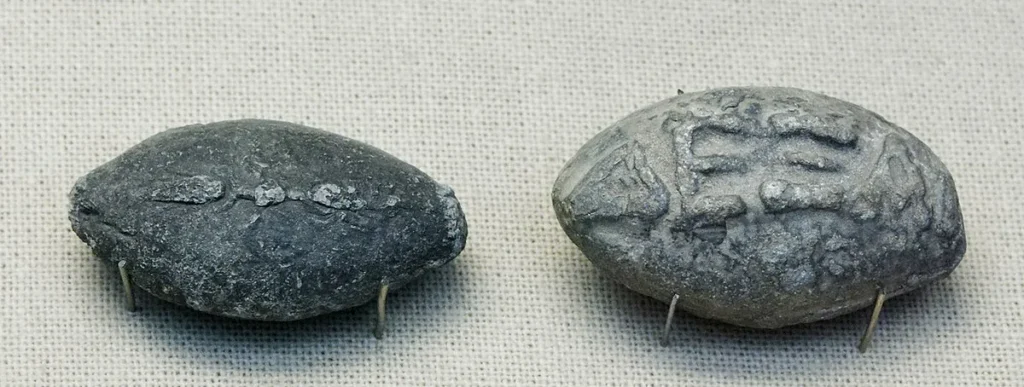
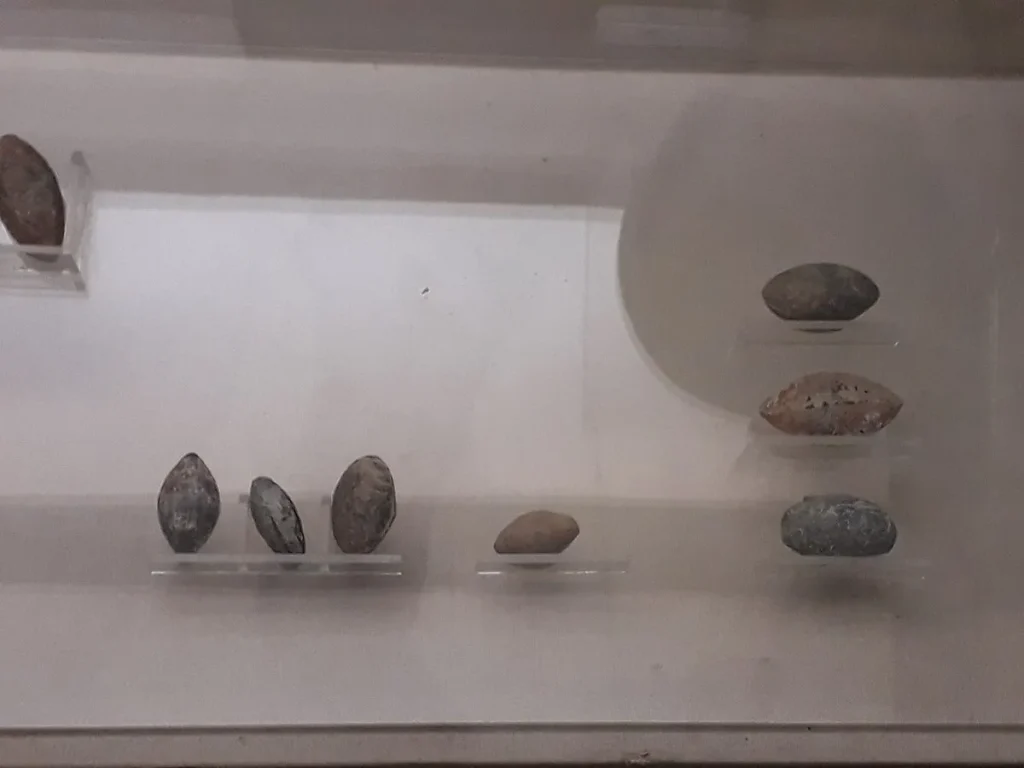
In the case at the British Museum, two gray almonds sit side by side, each the size of a thumb and heavy for their size. One carries a winged thunderbolt. The other carries a single word in raised Greek letters: ΔΕΞΑΙ. The imperative is crisp and short. Dexai which means ‘take this’, or ‘catch’. The joke lands a moment before the bullet does.
These projectiles are not stones. They are lead bullets built to fly farther, hit harder, and carry a message. Greek soldiers and their allies used them from at least the fifth century BCE through the Hellenistic period. The best ancient description comes from Xenophon, who praised Rhodian slingers for their skill and for the reach they achieved with lead ammunition rather than cobbles. Archaeology fills in the rest. Excavations from Greece to Cyprus, Macedonia, the Aegean islands, and farther afield into Hellenistic and Roman contexts have produced thousands of lead sling bullets, often biconical and often inscribed. Some name a city. Some name a commander. Some carry simple verbs like labe, take, or nikā, conquer. A few are crude, funny, or obscene. The language turns a humble missile into a line of dialogue in a loud and dangerous conversation.
This article stays close to the artifacts. It follows where they were cast and where they were found. It looks at how letters sit on metal. It considers weight, shape, and the physics that made a slinger’s shot frightening at 150 meters. It places Greek taunt bullets beside other kinds of messages in lead, from royal monograms in Macedonia to later Roman jokes that show the tradition never died. Along the way, it treats inscriptions as evidence for logistics, training, and morale, not just as a novelty to photograph behind glass.
What exactly was a Greek sling bullet?
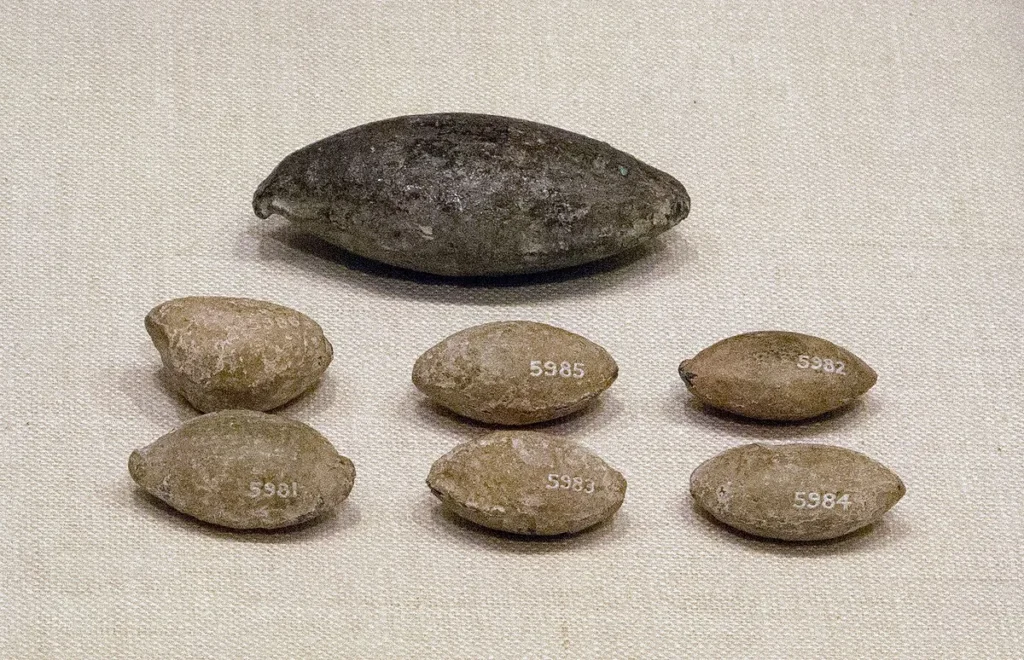
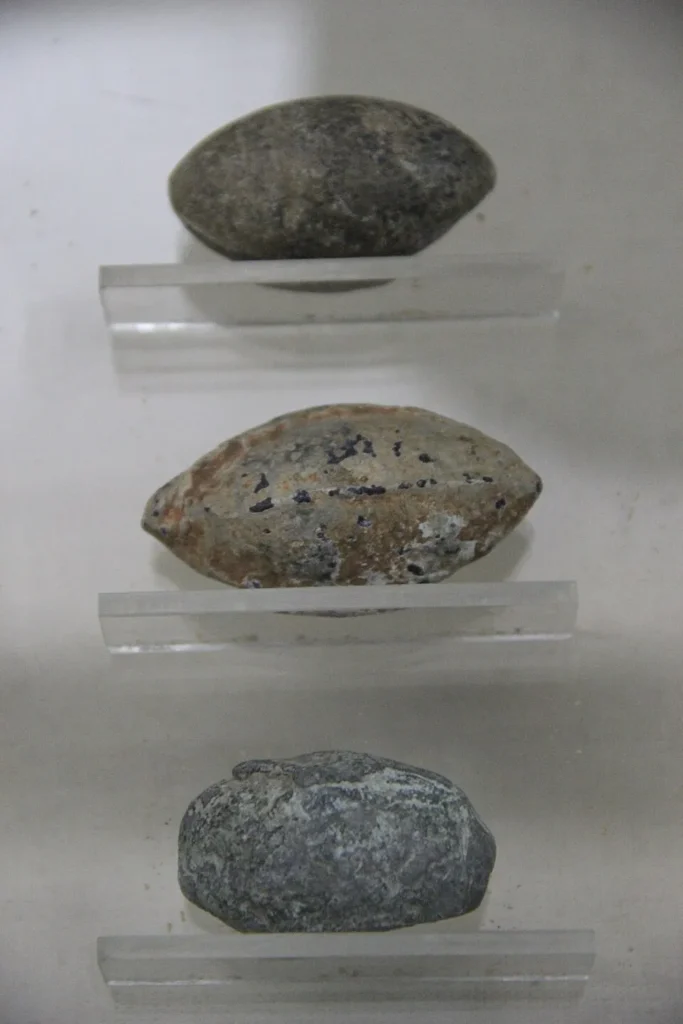
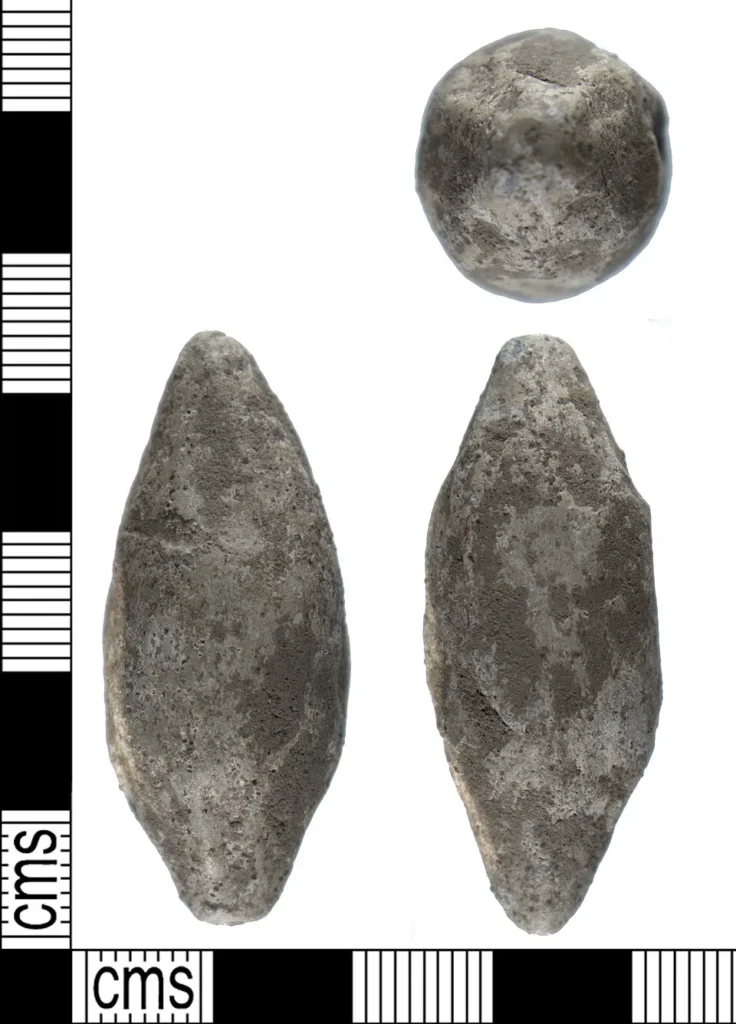
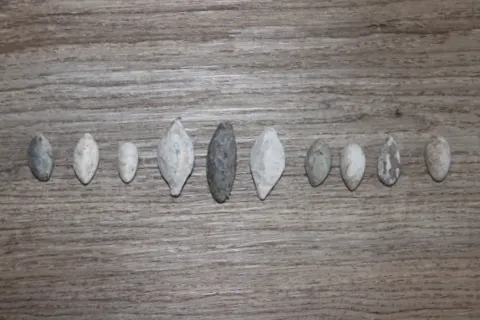
A sling bullet, in Greek contexts called a molybdos when made of lead, is a small cast projectile with a pointed oval profile. Modern writers call the shape biconical or almond-shaped. In hand, a typical Greek bullet is between 30 and 45 millimeters long, about 20 millimeters across at the middle, and weighs somewhere between 20 and 60 grams. Some are lighter, especially for very long-range harassing fire. Some are heavy, above 80 grams, built for force rather than reach. The British Museum example with ΔΕΞΑΙ measures 43 millimeters and weighs about 105 grams, a bruiser by Greek standards.
Two features stand out when you pick one up. First, the density. Lead’s density sits around 11.34 grams per cubic centimeter, three times granite and about ten times water. That density keeps the bullet compact, so it slips through the air with minimal drag. Second, the shape. The two points and the gentle belly between them make the bullet orient itself in flight much like a thrown American football. The rotation stabilizes its path. The result is a small object that a trained slinger can release at high speed, on a shallow arc, toward a target that might stand 150 or even 200 meters away.
Why lead instead of stone?
Stone is free, which is why soldiers used it everywhere. Lead is heavy, which is why armies that could afford it preferred it for long-range work. For a given weight, lead produces a smaller projectile. Less surface area means less drag. With less drag, the same slinger can throw the same mass farther. The material also lets makers control weight precisely. They can pour metal into a mold, trim the casting scar, and produce batch after batch within a narrow range. Archaeologists frequently find clusters of bullets at a site that match each other closely in mass and size. The uniformity does not prove official arsenals, but it suggests organized production and supply. On campaign, a baggage train could carry thousands of identical rounds the size of olives.
How were they made?
Greek bullets were cast in two-part molds. Clay and stone molds survive. Metal molds would have worked too, yet are much rarer in the archaeological record. The mold halves carry the negative of the bullet’s shape, often in rows, so multiple bullets can be poured at once. A narrow gate at the tip of each negative lets molten lead run into the cavity. After cooling, the caster opens the mold and breaks the sprue that links the bullets. The scar at one end is a small flat or notch where the metal was cut away. On many pieces the scar is visible, a signature of the production line.
Inscriptions enter at two stages. If you want letters to stand up from the surface, you cut the letters backward into the mold so that the casting will produce raised script. If you want incised letters that cut into the bullet’s skin, you scratch or chisel them after casting. Raised letters are more common for short, forceful words. Incised letters often appear on longer lines of text, like a civic name or a magistrate.
The visual difference matters. Raised scripts signal planning and scale. Someone carved a mold face that would produce hundreds of copies of the same message. Incised scripts can be personal, or at least small-batch. Both are real. Both make sense in the settings where bullets were used.
How far and how fast did they fly?
Velocity depends on the slinger, the sling length, and the bullet weight. Experimental work with trained slingers suggests launch speeds between roughly 30 and 60 meters per second for war-weight bullets. A 40 gram bullet at 60 meters per second carries about 72 joules of kinetic energy, comparable to a heavy war arrow. A heavier 80 gram bullet launched at the same speed doubles the energy. The sling’s advantage lies in range. Greek and Hellenistic armies learned to use slingers to harass enemies at distances where archers could not reply in kind, or to rain bullets on troops crowded on a wall during a siege.
Xenophon’s famous passage about Rhodian slingers fits the physics. He notes that Rhodians, who used lead, could reach targets beyond the range of stone slingers. The line is not a laboratory report. It is a soldier’s memory of the difference between one kind of shot and another. The archaeological record agrees. Lead bullets cluster on battlefields and siege lines at distances that make sense if trained teams stood well outside the easy reach of return fire.
Who used slings and when?
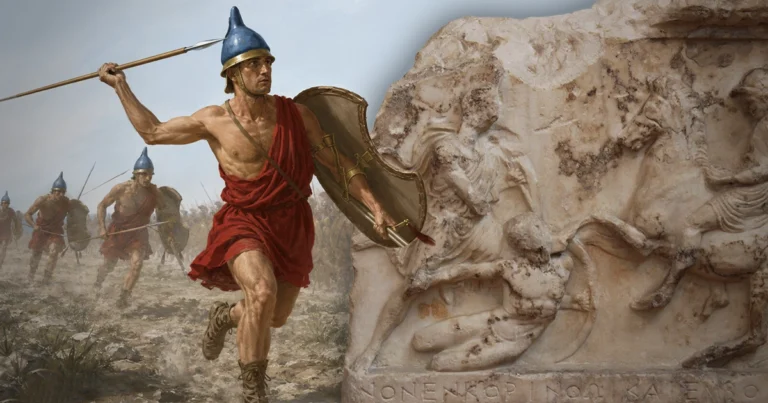
Slings were universal. In Greek warfare, slingers appear as psiloi, lightly equipped troops who skirmished ahead of a phalanx or alongside peltasts. Some city-states likely trained their own. Many hired specialists. Rhodian slingers become a stereotype in the fourth century BCE because islanders had a tradition of practice and because the Hellenistic armies that grew out of Alexander’s conquests needed expert missile troops to complement cavalry, elephants, and heavy infantry. In the Peloponnese, in mainland Greece, and along the Aegean coast, slingers fought in both field operations and sieges. The practice survived into the Roman period without losing its edge. Lead bullets remained common wherever a commander needed to hit something soft and human at a distance.
What did the inscriptions say?
Short and sharp. The most common Greek taunts use the imperative. Dexai, take this, or catch. Labe, take. You can feel the grin in the grammar. The bullet carries a joke the enemy never wants to get. Another set of words proclaim victory or exhort it: nikā, conquer, or forms of Nike as a divine name used as shorthand. Some bullets carry symbols rather than words, especially thunderbolts, tridents, and stars. The thunderbolt sits in a long tradition of Greek martial imagery. Put it on a bullet and the sense is obvious. Zeus has nothing on us. Alternatively, we are the thunder that finds you.
Other inscriptions identify origin. A civic genitive, like Rhodion, of the Rhodians, may mark a shipment or a unit. The name of a commander could mark a batch as well. Hellenistic bullets occasionally carry a royal name or the abbreviated start of one. Letters Phi and Iota have been read as an abbreviation for Philip on examples from Macedonian contexts. Even where the reading is cautious, the pattern matches what Hellenistic kings did with coins, seals, and other military equipment. Ownership mattered, pride mattered, and a name on a missile extended both.
A few texts spill into comedy or insult. Those are rarer in Greek contexts than they are in some later Roman finds, but they exist. What survives is likely a fraction of what was cast. Salted humor does not always survive corrosion, field conditions, and the habits of nineteenth-century collectors. Still, enough has come down to make the point. Soldiers wanted to be heard even when they knew their sentences would end as dents in a shield.
How were the messages arranged on the metal?
No one standardized the typography, yet patterns repeat. Raised letters are usually neat capitals, arranged in one line across the belly of the bullet. They measure a few millimeters high. The line follows the long axis, so a viewer who holds the bullet across the palm reads from point to point. Greek letters are carved so that they cast correctly when reversed in the mold. The depth of the letter cut varies. Deep cuts throw a shadow where lead rises highest. Only the simplest verbs and names lend themselves to this method, since a longer phrase would fill too much of the surface and risk tearing during demolding.
Incised letters after casting are looser. Some bullets carry letters that lean, rise, and fall across the curve. Some crowd a second line underneath the first. Where the incised line crosses the casting scar, the cut grows shallow. Where corrosion pitted the skin, a stroke breaks. This imperfection helps conservators. It proves the letters were cut into the metal after pouring and trimming. In a few cases both methods meet. A raised symbol fills one face, a lightning bolt, for example, while a short incised word sits on the other face where a maker or a soldier had a few seconds to add a thought with a burin.
When did the practice begin, and how long did it last?
Casting lead bullets seems to be old wherever the sling is old, but widespread inscription becomes visible in the Classical and Hellenistic Greek world, roughly the fifth through the third centuries BCE. The habit persists into the second and first centuries as Greek units fight for and against Rome, and it continues in Roman contexts. The message style changes with language and setting. Latin verbs appear alongside Greek ones. Names shift from city and king to unit and general. The undercurrent continues. People still want their missile to say something on the way out and on the way in.
Were the messages only for the enemy?
Not always. Some are for the enemy’s eyes and ears, which is why they stay short and audible when shouted. Others are for one’s own side. A bullet stamped with a civic name could reassure a levy that the arsenal had done its job. A royal monogram worked the same way for soldiers who followed a king. A god’s symbol might encourage devotion in the ranks as much as it would frighten anyone across the field.
There is also the possibility of a third audience, one in the future. Bullets marked with a date, a magistrate, or a particular campaign are rare, but serial elements in the molds hint that administrators cared about tracking batches. A tally scratched into a mold face, or a letter that takes the place of a number, can tell a quartermaster which tree of castings went to which unit. That is accountability, not propaganda. The bullet knows where it was born.
Did Greek taunts echo a broader culture of battlefield speech?
Yes. Greek warfare had a strong oral component that modern readers sometimes miss. Speeches before battle, hymns on the march, paean shouts at the charge, and insults traded between skirmishers belong to the same world. Attic comedy has a physical sense of humor that translates well to a projectile’s voice. Vase inscriptions, where a painter writes a name or a kalos, show a habit of turning an object into a speaker. Against that background, Dexai makes perfect sense. It is the object talking. It is also the person behind the object talking through it.
What can one word tell us about literacy?
A lot, in context. Sling bullets are not long texts. They do prove that artisans and soldiers could recognize a short word, a civic genitive ending, or the letters that begin a king’s name. That recognition does not require advanced schooling. It does require familiarity with letters in public places. A world where coins, temple dedications, and street-side decrees carry capitals is a world where a two-syllable joke fits on a bullet.
The use of Greek on bullets found outside a Greek-speaking center can reveal political and cultural ties. In some places Greek is the language of the army even when local speech differs. In others, bilingual practice puts Greek and a local language side by side on equipment. The spread of Greek lettering on bullets after Alexander’s conquests is not just about supply lines. It is about what language meant at a campfire.
How were bullets used tactically?
Three main ways. As skirmish tools in open field, slingers worked in front of and between blocks of infantry, harassing enemy light troops and screening their own side’s movements. In that setting bullets broke formations by pain and surprise. A shield stops a bullet well enough, yet no one can keep a shield perfectly angled while running on rough ground. Shots that whip past a shield rim strike collarbones, thighs, and unarmored faces.
Second, as countersniper weapons. Slingers duel with archers and javelin men, aiming for forearms and heads. The sling’s high arc lets a slinger place a bullet on a man who peeks over a rim. The hollow whirr that some bullets make in flight adds fear out of proportion to the chance of a hit, which matters when neither side wears much armor.
Third, during sieges and assaults, sling teams worked over walls and from towers, pelting crews who pushed rams or hauled ladders, and knocking men from parapets. On defense, slingers could stand well behind a parapet and arc shots into the besiegers’ works. On offense, slingers pushed forward under cover of shields and engines, then cleared stretches of wall so that ladders could go up. In siege contexts, inscribed bullets take on a nasty directness. The target is not a faceless enemy across a field, it is a man on a wall who has been staring back at you for days.
How deadly were they?
A sling bullet can break bone, smash teeth, and crack a skull. It can also penetrate soft tissue deeply, especially at short range. Ancient medical writers describe slinging wounds that required extraction with forceps, and surgeons still extract small lead projectiles from accident victims today. Defensive equipment mattered. A bronze helmet with a good crest and cheekpieces blunts even a fast bullet. A linen or composite cuirass absorbs bruising blows to the torso. Limbs and faces remained vulnerable. In a tangle of men, a cluster of high-speed bruises can have a tactical effect far greater than the number of men killed. Bullets turned confidence into hesitation. They made phalanxes lift shields a little higher and look the wrong way.
Did the Greeks ever drill holes to make bullets whistle?
Perforated bullets appear from time to time in the archaeological record, more often in Roman contexts and in clay than in Greek and in lead. Some scholars argue the holes were for poison, which would leak or evaporate before reaching a target. Others argue the holes create a whistling or whooshing sound. Experimental archaeology confirms that a small hole does produce an audible tone in flight. Whether Greek armies used that effect intentionally in the Classical period is a harder question, since most whistling finds are later and many are not lead at all. It remains reasonable to suppose that soldiers quickly learned that the noise itself had value, even when the projectile was too light to be lethal. Terror is a tactic. Silence can be one too.
Built out of a love for history, kept free from distractions.
Spoken Past is an independent project shaped by curiosity, care, and long hours of research. Reader support helps keep it maintained, carefully researched, and open to everyone.
What does the weight tell us about purpose?
Weight classes correlate with aims. Very light bullets, say 15 to 25 grams, fly far under an expert’s hand and serve to harass at extreme distances. A middle class from 25 to 50 grams balances range and impact. Heavy pieces above 60 grams, like the British Museum example, punch harder at shorter range and were probably useful in tight siege situations or where the slinger could work from a protected position. When archaeologists find concentrations of heavy bullets near the foundations of a wall, the pattern suggests that defenders or close-in attackers were exchanging fire at an angle that minimized travel time. When they find lighter bullets scattered far out, the pattern looks like open-field skirmishing, where reach matters more than knockdown.
Did city-states and kingdoms make their own ammunition?
They often did. A city with a foundry could pour shot in clay molds by the hundred. Campaign narratives imply that armies carrying metal tools and vessels could melt scrap to cast bullets on the move if needed. Mold faces travel well. A tile or stone panel cut with a dozen biconical cavities weighs little and serves until it cracks. For larger efforts, a kingdom’s central workshops funded by the court could cast metal ornaments, siege bolts, arrowheads, and sling bullets alongside each other. The presence of a name or symbol in high relief argues for this kind of organized production, at least for part of the supply.
Case study: the one-word joke, ΔΕΞΑΙ
Dexai is the second person singular aorist imperative of dechomai, receive. It reads as take it or catch. On a battlefield the tone is sarcastic. It is the insult shouted by a skirmisher who aims and lets go. The Greek tells you the sender’s world. A shot that says dexai is probably cast in a Greek workshop or cast with a Greek mold face and launched by a Greek-speaking soldier, even if the target is not. The presence of a thunderbolt on the opposite side dresses the joke in a symbol that any viewer will read without language. A bolt and a verb, a god and a grin.
Small as it is, the word also preserves the mechanics of message-making. Greek capitals carved in a mold show a letter cutter who can write backward with confidence. That tells us something about craft literacy. The letter cutter’s work also suggests a production run. No one cuts backward just to make three pieces. The intent was to cast many, and to cast them for distribution to a unit that could sling the same line at an enemy over and over again.
The king’s name as a message
Not all texts are jokes. A bullet that bears the abbreviated start of Philip’s name comes from a world where kings used every object they could to project presence. If you served under a Macedonian ruler, you already saw the royal name on coins, banners, and seals. Seeing letters that begin that name on the bullet you placed in your sling extended the circle. The other side of the bullet often matched the tone, with a thunderbolt or a star that had already become royal emblems in Macedonian art. This kind of piece is propaganda and logistics at once. It tells your enemy who is shooting. It tells your quartermaster what box this batch belongs to.
Messages beyond Greece: continuity and change
Later Roman bullets found in Hispania, the Balkans, and Britain, keep the habit alive. Latin texts include short imperatives like feri, strike, vulgar slurs that need no translation, and jokes mounted on the thin line between pain and laughter. The Roman examples matter here for two reasons. First, they prove that messaging on missiles lasted as technology and armies changed. Second, they help interpret the Greek evidence by analogy. When a Greek bullet carries only a name, the Roman habit of marking unit or general suggests that Greek examples might do the same. When a Greek bullet carries a symbol alone, Roman parallels suggest pride, allegiance, or an intent to intimidate.
How we know: methods behind the reading
The evidence is tactile and technical. Conservators and archaeologists use several tools to make small letters on dark metal speak clearly.
-
Raking light and RTI: Raking light at low angles throws tiny ridges into relief. Reflectance Transformation Imaging builds a light field around a small object so a viewer can adjust the virtual angle later, which helps separate corrosion from a shallow stroke.
-
X-radiography: Corrosion layers sometimes hide letters that sit a millimeter below the surface. Radiographs pick up density changes that reveal a hidden line or confirm a symbol.
-
Digital microscopy and 3D scanning: High magnification and surface models allow a reader to see the burrs left by a burin or the soft edges left by a mold cut. Raised letters show the outlines of the original reverse carving. Incised letters show metal displaced to both sides of a stroke.
-
XRF and metallography: Composition tests using X-ray fluorescence measure trace elements that might link batches. If two groups of bullets share a distinctive alloy signature, they might share a workshop or a source of scrap. Lead isotope analysis can go further, though it is invasive and not suited to every collection.
-
Provenience and context: Findspots matter. A cluster of bullets on a slope facing a wall tells a different story than the same cluster on a wall walk. Where excavations are well recorded, the layer and the association with other items anchor a date and a narrative.
This set of methods does not turn every fragment into a clean text, yet it allows scholars to write a history of production and use that would be impossible if we relied only on chroniclers. Words on bullets are primary sources. So are weight, scar, and scar orientation.
Stone, clay, and lead, three families of ammunition
It is helpful to see lead bullets as part of a spectrum. On one end sit stones, picked up and shaped by use. They cost nothing, which matters for militias and for emergencies. They vary wildly in size and weight. In the middle sit fired-clay bullets that can be molded in quantity by any city with a kiln. They have more uniformity than stone, and they can be perforated or decorated. On the far end sit lead bullets. They cost labor and fuel, and they tie a unit to a supply chain, yet they pay back the investment with reach and reliability. Greek armies used all three. What sets the lead bullets apart in the story here is their ability to carry letters cleanly. Clay can do it. Lead does it better.
What about accuracy?
A trained slinger can hit a man-sized target reliably at medium distances. Accuracy falls off as range grows, which is why units fought in clusters and volleys. The sling is a weapon that rewards rhythm and practice. Rhodian specialists and islanders with a tradition of hunting small game kept that rhythm from youth. In a Greek city where slinging was less a way of life, training mattered. It takes time to learn how to tune sling length to bullet weight, how to choose a release knot that does not snag under stress, and how to adjust aim for wind and slope. A unit that drilled together could put patterns of bullets into a space with destructive effect even when individual shots wandered.
Did inscribed bullets ever matter in negotiations or truces?
There is no direct proof that an inscribed bullet changed a general’s mind. There is indirect proof that men paid attention to what landed near them. When a negotiation drags on during a siege and both sides trade insults from the wall and the ditch, a projectile that carries the name of a king or a city can harden resolve. It can also make laughter on a wall, which is not nothing. Morale is a resource. Messages help to spend it.
Thick of it: a battlefield scene built from artifacts
Place yourself on a low ridge facing a valley. You stand in line with a dozen others, each with a sling doubled through your fingers. A leather bag slaps your hip, full of elliptical gray bullets streaked white from oxidation. The enemy has skirmishers too. Their stones fly high and fall short. Your captain calls for low arcs aimed at the men behind their shield line. You take a bullet that reads labe in neat raised letters. The mold cutter carved backward yesterday and you hold the forward letters today. Your sling hums as you bring it round twice and let go. The bullet snaps away at shoulder height. A heartbeat later, another man’s bullet hisses past your ear. When the enemy line wavers and lifts its shields, your captain calls for a pause so that your own heavy infantry can come up without a shower of your own shot. On that pause, someone near you holds up a bullet with a thunderbolt and a cocked smile. Dexai, he says, and you laugh because everyone on both sides knows the word.
Museums, chance finds, and the shape of the record
The corpus is a patchwork. Some pieces come from nineteenth-century digs where contexts were not recorded with modern care. Others come from systematic excavations where the exact layer and coordinates survive in notebooks and databases. Many, especially outside Greece, come from chance finds by farmers and walkers who bring bullets to local museums. Portable Antiquities Scheme records in Britain, for example, show how many Roman bullets turn up in fields far from documented battle sites. Greek examples concentrate in and around cities, forts, and harbors where Classical and Hellenistic fighting is known from other sources. Patterns are good enough to draw broad lines. They are not fine enough to locate every skirmish.
Why do some bullets carry only a symbol?
Because symbols communicate across noise. A thunderbolt strikes the eye even when dirt and corrosion have softened the edges. On a moving target, a crisp line of letters is harder to see than a bold icon. A wall of men who see lightning dancing on the projectiles that pepper their shields will talk about that at night. In the morning the memory will survive the words. A trident or a star works the same way for other communities. The image also invites some ambiguity. If your unit captured a crate of the enemy’s bullets, you could use them with impunity. A symbol on your side that matches a symbol on theirs breeds confusion. Confusion under fire has value.
Are inscribed bullets rare or common?
Depends on where you look. At some sites inscribed bullets form a small fraction of the total, a handful among hundreds. At others they are relatively frequent, perhaps because a workshop there favored raised letters, or because a siege demanded morale work as much as it demanded metal. One tally from a city destroyed in the fourth century BCE records nearly five hundred lead bullets, of which over a hundred carry words or symbols. The ratio is striking, and it hints at how the practice could bloom in a single theater of war when conditions were right.
A note on Greek verbs and humor
A final linguistic point returns to dexai and labe. Both can mean take. Dexai shades toward receive or accept. Labe shades toward grasp. That nuance does not change the joke, yet it flavors it. A dexai bullet is the sneer that tells you to accept your gift. A labe bullet is the bark that tells you to grab what is already coming. The choice would have been as natural to a Greek speaker as the choice between take it and catch in English. Language lives in context. So do weapons.