The siege of Uršu did not go as the Hittite king expected. A battering ram had failed, the commanders were making excuses, and reinforcements had not arrived. From somewhere away from the besieged city, the king demanded another ram, this time made in the Hurrian manner, and ordered his officers to heap up earth for an assault. His frustration survives in an Akkadian-language account preserved among the tablets from the Hittite capital at Hattuša. The document gives a rare view of an early second-millennium BCE siege from the perspective of a command struggling to make its equipment work.
The armies of the Bronze Age could attack fortified cities with more than ladders and courage. Written records from Syria and Anatolia mention battering rams, mobile towers, earthworks and the difficult movement of equipment. Tiny cylinder-seal scenes may show wheeled machines in action. Egyptian reliefs show soldiers scaling walls under covering fire. These sources reveal a long history of siege engineering before the catapults familiar from classical Greek and Roman warfare.
They do not, however, amount to an instruction manual. The length of a Bronze Age ram, the number of men operating it, and the materials used to protect its crew are rarely stated. Much of the timber, leather and rope has disappeared, while artistic scenes reduce complicated campaigns to images of victory. Reconstructing Bronze Age siege weapons therefore requires separating what the evidence actually records from what later siege technology makes plausible.
Why Bronze Age cities were difficult to capture
In much of the ancient Near East, the Bronze Age covers the third and second millennia BCE, although its beginning and end differ by region. Fortified cities were political centres, storehouses, places of worship and refuges for surrounding communities. A ruler who wanted to control a territory often had to take its towns, not simply defeat an opposing army in open country. Walls protected people and supplies, while gates channelled movement into narrow approaches that defenders could watch and attack.
A city wall could be built of mudbrick on stone foundations, with towers, parapets and protected entrances. The weakness of mudbrick is obvious when it is wet or neglected, but a thick, maintained wall was an immense obstacle to men standing below it. The builders of Middle Bronze Age settlements in the Levant sometimes added broad earth ramparts faced with a sloping surface, known as a glacis. This protected the base of the defences and complicated a direct approach. Excavated fortification systems at sites such as Tell eṣ-Ṣâfi/Gath show how substantial such constructions could be. They were not uniform across the region, and there was no single standard slope or gate plan.
A glacis could make a ram hard to bring close enough to strike a useful target. A ditch or uneven ground could prevent a wheeled vehicle from advancing. A gateway might be defended by towers or designed to prevent a straightforward rush. Attackers therefore needed to change the terrain as well as attack the structure. Moving earth, gathering timber, protecting workers and keeping an army supplied were as important as the striking force of any individual weapon. The Tell eṣ-Ṣâfi/Gath excavation study documents the scale of Early and Middle Bronze Age fortification systems, although the full article was not accessible for detailed measurements in this review.
The attackers also faced time. A siege army needed food, water, transport animals and labourers. It might have to hold the countryside against relief forces while preventing the garrison from bringing in supplies. A city that could resist for weeks or months might outlast a campaign season or force negotiations. Siege weapons mattered because they offered ways to change that calculation: to breach a gate, reach a parapet or persuade defenders that continued resistance would become impossible.
Battering rams were already known in third-millennium Syria
The earliest substantial evidence for battering rams comes from administrative and diplomatic texts rather than surviving wooden machines. In the archives of Ebla in Syria, a term written gu4-si-dili has been interpreted as a battering ram. It appears in the treaty between Ebla and Abarsal, and other Ebla documents record materials associated with the equipment. One text concerns copper for a ram’s striking component; another records wool intended for a felt covering. These references are especially valuable because they concern the equipment as something that could be counted, supplied and discussed, rather than as a spectacular invention introduced for one battle.
The interpretation depends on specialist readings of Sumerian and Eblaite terminology. In his 2009 study of Early Bronze Age glyptic art, Davide Nadali discusses the Ebla evidence, including ARET XIII 5 and the administrative texts ARET IV 2 and 13. The textual references support the presence of rams in the third millennium BCE. They do not tell us that every city owned identical machines, or that the mechanism of an early ram matched the suspended beams known from much later descriptions.
A ram works by delivering repeated force to a vulnerable part of a fortification. A timber beam can strike a gate, doorframe or section of wall; a metal fitting may protect its end from damage. The basic principle is straightforward, but the engineering details are not. A hand-carried beam and a ram mounted in a covered wheeled frame are different solutions. Ancient words translated as ‘ram’ do not necessarily distinguish all their variants. The Ebla references make it reasonable to discuss prepared siege machinery, while leaving the precise internal mechanism of each machine unresolved.
The target mattered as much as the weapon. A gate was a necessary opening in an otherwise continuous defensive line, but a gatehouse could be among the best defended parts of a city. A ram might attack doors or their supporting structure, while workers tried to clear debris or create an approach. It would be misleading to describe a fixed crew of four or six men, a standard suspension system or a bronze head on every Bronze Age ram. Those details belong to possible reconstructions, not to what the surviving Ebla records establish.
Uršu: a siege in which the equipment failed
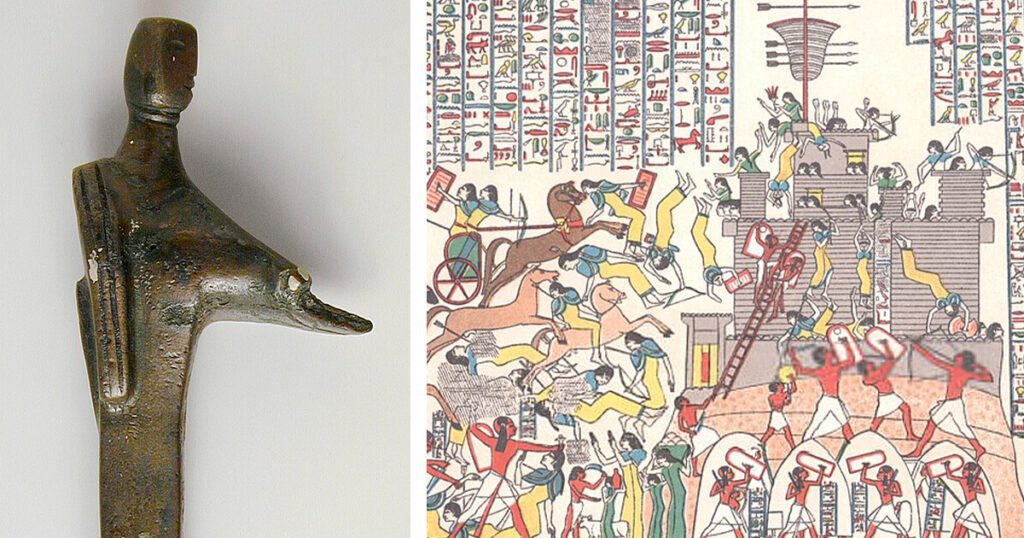
The Old Hittite narrative known as the Siege of Uršu, catalogued as CTH 7, is unusually candid about military frustration. It is preserved in Akkadian among the Hittite archives, and is generally associated with the early Hittite kingdom and the reign of Hattušili I in the seventeenth century BCE. The exact location of Uršu, probably somewhere in the southeastern Anatolian or northern Syrian region, remains uncertain. Its narrative does not clearly tell us how the siege ended. Turgut Yiğit’s study of the text notes both its uncertain outcome and the fact that the king was receiving reports from commanders rather than directing the assault in person.
The king’s orders are revealing. He complains about a broken ram and demands a replacement constructed in the ‘Hurrian manner’. He also orders an earthwork to be built and criticises an ally who promised a tower and a ram but did not deliver them. The combination suggests that siege machines were specialised assets, that different regions were associated with different methods of construction, and that a siege could fail through poor logistics and command even when the necessary technology was understood. It is not proof that the Hurrians invented the battering ram or that their machines followed a standard design.
The narrative is also a warning against reading royal texts as neutral battle reports. Its surviving form is shaped around blame, excuses and the king’s authority. Gary Beckman’s study of CTH 7 and Old Hittite historiography examines the document as a historical composition, although the complete article was not freely accessible during this review. The record is strong evidence that rams, towers and assault earthworks belonged to the Hittite military vocabulary. It cannot provide the detailed dimensions, crew drills or precise sequence of wall destruction sometimes claimed in modern retellings.
Uršu makes one point especially clear: siege technology was inseparable from materials and transport. If a ram broke, another had to be constructed or brought in. If the ground was unsuitable, earth had to be moved. If an ally failed to provide equipment, the operation suffered. An army with excellent infantry could still be stopped by a badly managed siege, and the defenders did not need to defeat it in open battle to achieve that result.
Wheeled siege towers and the disputed cylinder seals
Some of the most intriguing images of possible early siege machinery are smaller than a modern postcard. Cylinder seals were rolled across wet clay to leave repeating scenes. Examples from Syria and impressions excavated at Tell Beydar show wheeled structures, people, weapons and buildings. Nadali argued that several of the vehicles usually called tilt-wagons could instead be battering rams, while taller wheeled structures might represent mobile siege towers. In some scenes, a pole projects towards a building; in others, men stand on or beside the wheeled apparatus.
These images have a serious interpretive problem. A cylinder seal is not a technical drawing, and its scenes can combine ritual and warfare. Nadali himself records alternative readings: some structures could be shrines, some scenes could represent ritual conflict, and one apparently mobile ‘tower’ might be a protective vehicle for a single important person. The suggestion that the seals depict siege engines is plausible and supported by the written evidence for rams and towers, but it remains an interpretation. It would be inaccurate to say that the Tell Beydar impressions prove the existence of multi-storey assault towers built to one known specification.
The distinction between a tower and a covered wagon also matters. A tower offers height, potentially allowing archers to threaten defenders behind a parapet or permitting an assault at a higher level. A lower shelter protects men working near a gate or wall. Wheels make either structure mobile only when the terrain permits it. Nadali’s analysis identifies several four-wheeled vehicles and suggests their roles from the people, poles and buildings shown alongside them. It does not establish the thickness of their wooden walls, how many floors they had, or how they were moved over rough approaches.
The Ebla texts mention another piece of equipment alongside the ram, written giš-má-NE. Its exact meaning and form remain debated. Nadali notes a proposed reading that might suggest a fire-related vehicle, but he does not treat this as settled. The safest conclusion is that third-millennium Syrian texts refer to more than one kind of siege apparatus and that some contemporary images may illustrate them. That is already significant: complex siege warfare was not simply a late Assyrian development.
Mari shows the machines in a working military system
The archives from Mari, a major city on the Euphrates in present-day Syria, add another dimension. Old Babylonian texts of the early second millennium BCE refer to battering rams and siege towers together. They also discuss moving the machines, sometimes by boat, and preparing earthen approaches so equipment could be brought near walls. Such records reveal an administrative and logistical system behind a siege. Men had to construct or transport the machines, choose an approach and keep the works usable while the garrison resisted.
The evidence is discussed in detail by Nadali, who cites Mari texts including ARM XXI and ARM XXVI. The records are particularly important because they do not rely on a modern inference from an image. They speak of machines and their movement in the language of military administration. At the same time, they are not a complete inventory of a single siege. It is possible to establish the existence of certain tools without knowing the exact order in which they were deployed.
Mari also preserves the resistance of defenders. Jordi Vidal’s study of the siege of Razama in 1765 BCE examines an unusually aggressive defence described in Mari correspondence. The city was not a passive target waiting for attackers to break down its walls. Defenders could attempt to disrupt an enemy’s works and equipment, creating a battle of initiative around the perimeter. Vidal’s publicly accessible abstract supports that general picture; the full analysis of ARM 14 104+ was not available for independent collation in this run.
One Mari letter, cited by Nadali as ARM XXVI 318, describes pitch being placed before an enemy siege tower and ignited. The detail explains why a large wooden machine was vulnerable even if its frontal covering offered some protection against arrows. Fire could be an attacker’s weapon against timber defences, but it could also be a defender’s best answer to a siege engine that had reached the wall. The battle was not simply a contest between a ram and a gate; it was a struggle to keep men and equipment functioning under attack.
Enjoying Spoken Past?
I created Spoken Past to share my love of history. I research, write and develop everything myself, and I want my articles and basic guides to remain free for everyone.
If you enjoy my work, please consider supporting Spoken Past with a small donation.
Ladders, shields and the danger beneath a parapet
Not every attempt to capture a city required a large machine. Scaling ladders allowed soldiers to reach the wall-top, but climbing placed them at an immediate disadvantage. A man on a ladder could not manoeuvre freely, and defenders could concentrate missiles and blows on a narrow point. Attackers needed a way to distract or suppress the defenders while a few men climbed. Bows, shields and coordinated infantry assaults therefore belonged to the same siege system as rams and towers.
Egyptian evidence is especially useful for understanding ordinary protective equipment. A Middle Kingdom model shield, spear case and spears from Asyut, now at the Metropolitan Museum of Art, represents a shield imitating cowhide with rawhide reinforcement. It is evidence for shield form and materials in the Egyptian military tradition. It is not evidence that this particular model represents a purpose-built wheeled mantlet. The original article treated it as proof of mobile siege screens, an inference that goes beyond the museum’s identification.
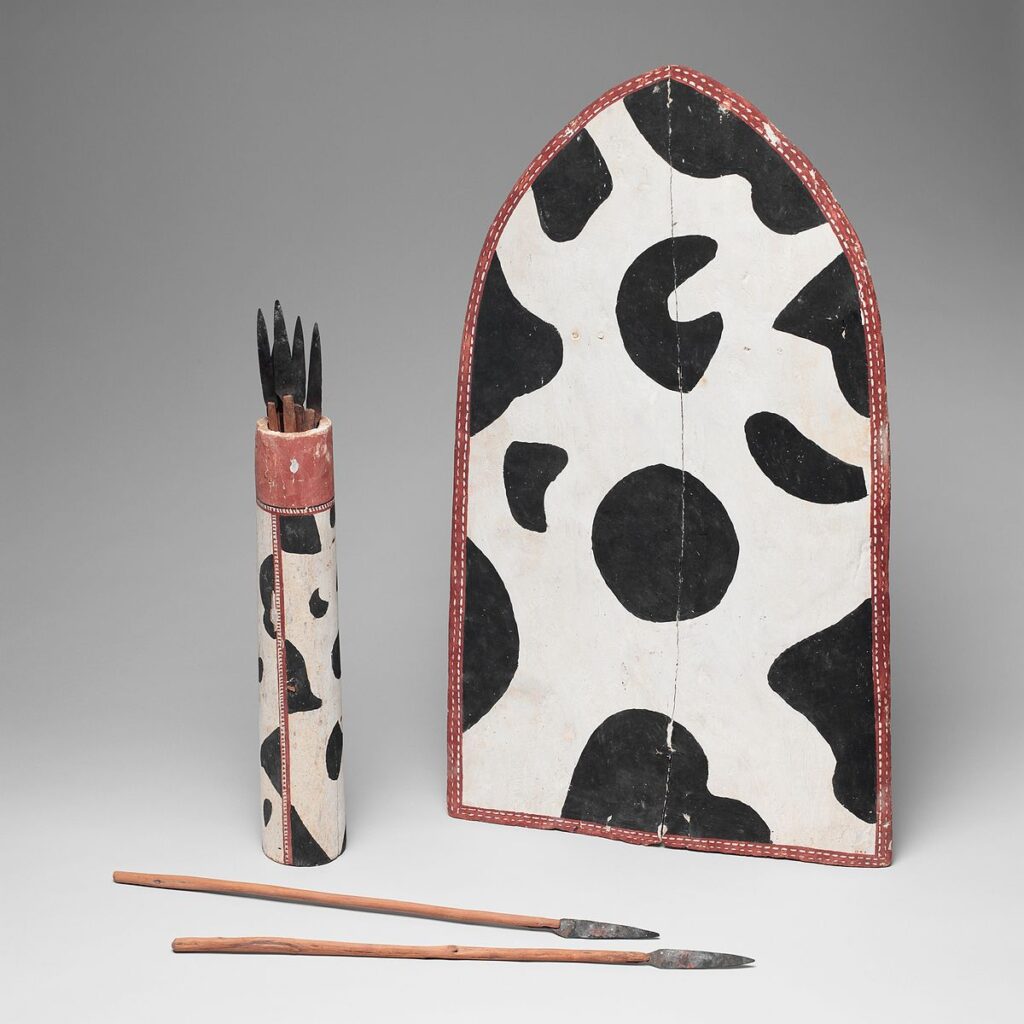
A mantlet is a large portable screen used to shield men approaching a dangerous position. The principle is sensible in siege warfare, and protective screens are known in later military traditions. For the Bronze Age, however, the surviving images and texts do not justify a universal reconstruction with two carriers, one kneeling brace-man and an archer firing around the edge. The practical challenges are easy to explain without inventing a drill: a heavy shield obstructs movement, protection from missiles at the front does not prevent stones or weapons falling from above, and the closer men get to a wall, the greater the defenders’ advantage of height.
The Egyptian models are therefore best used as evidence for the weapons and shields carried by soldiers, not as a scale drawing of siege equipment. A reader can learn a great deal from that distinction. The fact that a shield was made to withstand blows does not tell us that it was rolled against a city wall, and the fact that a protective screen would have been useful does not prove that every army employed one.
Dapur: a Late Bronze Age assault shown in stone
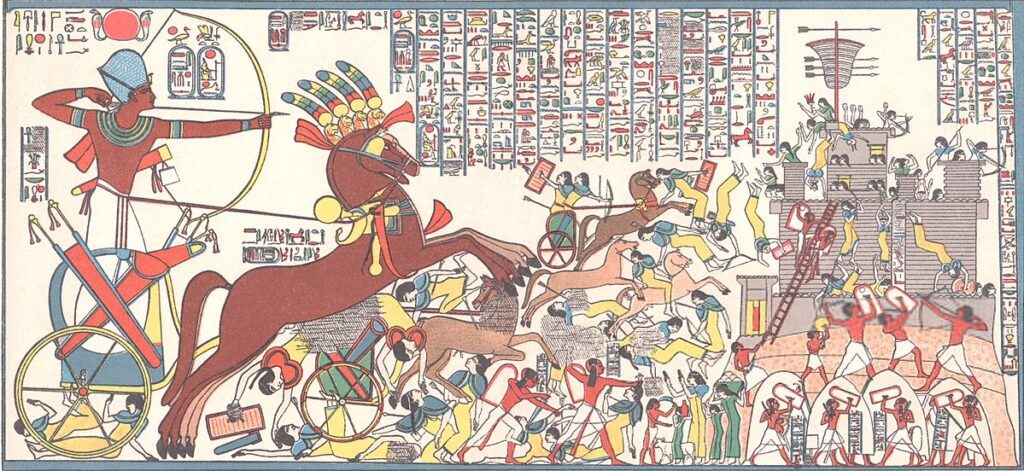
The reliefs of Ramesses II’s campaign against Dapur offer a much more explicit image of an assault on a fortified place. The scenes were carved at the Ramesseum, the king’s mortuary temple at Thebes, during the thirteenth century BCE. Dapur is generally placed in the Syrian sphere contested by Egypt and the Hittites, although the precise identification of the ancient site is disputed. The reliefs belong to the royal presentation of military victory, not to an independent field report. Even so, they preserve valuable information about the forms of fighting Egyptian artists thought appropriate to a siege.
The city appears as a defended, elevated settlement. Soldiers advance towards its walls, ladders are set against the fortifications, and archers support the attack. The composition gives an impression of simultaneous action, with the king’s family and the victorious Egyptian army prominent. It does not establish a minute-by-minute tactical order, and it should not be used to claim that a ram, a sapping gallery and incendiary crews were all working together at Dapur unless those particular actions can be identified in the relief. The Egyptian Ministry of Tourism and Antiquities identifies the Ramesseum as Ramesses II’s mortuary temple; the published image record of the Dapur scene identifies the relief and its setting.
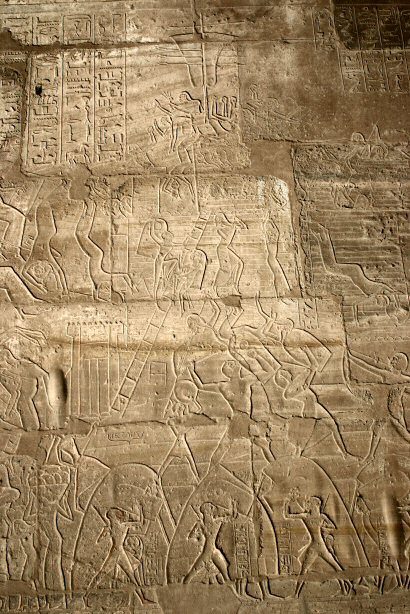
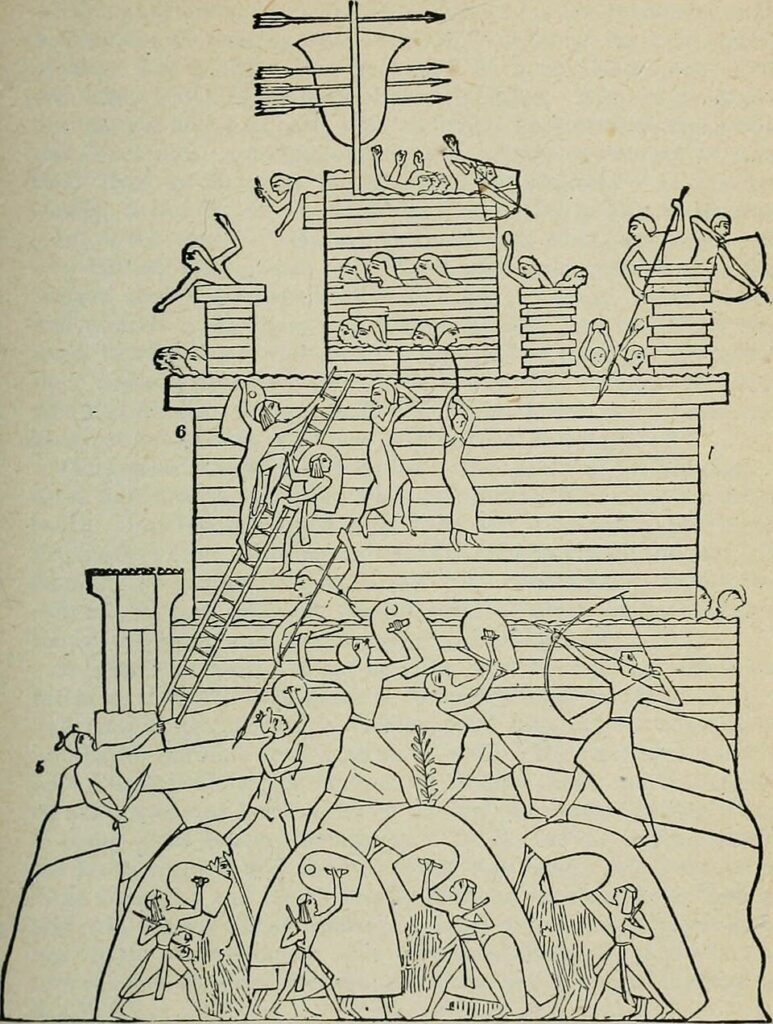
It is tempting to read a relief as if every figure were a photograph of an actual moment. Egyptian royal art has a different purpose. The ruler’s authority, the prowess of his troops and the submission of enemies are central to the composition. Artists could bring events that occurred at different moments into one coherent scene, and figures are arranged to make the action legible. The siege ladders and archers are still meaningful evidence, but their arrangement is not a tactical manual. Dapur is most useful when set beside the Hittite and Mari texts: the relief shows one kind of assault clearly, while the tablets reveal the logistical and mechanical work that royal art often leaves out.
The original article repeatedly dates the siege to about 1274 BCE, a precision that should not be retained without explaining the competing chronologies for Ramesses II’s Syrian campaigns. It is safer to place the representation in the thirteenth century BCE and the campaign within his reign. This avoids confusing the Dapur scene with the much better-known Battle of Kadesh, also represented in the Ramesseum’s royal programme.
Picks, earthworks and the problem of mining a wall
A fortification could also be threatened from below. If workers removed enough supporting material from beneath a wall, a section might collapse; alternatively, they could weaken foundations, dig towards a gate or construct an earth ramp to overcome the height of a defence. Such work demanded labour and protection. The distinction between a siege ramp built to reach a wall and a tunnel cut beneath it is important, because both may be called ‘siege engineering’ but they operate in very different ways.
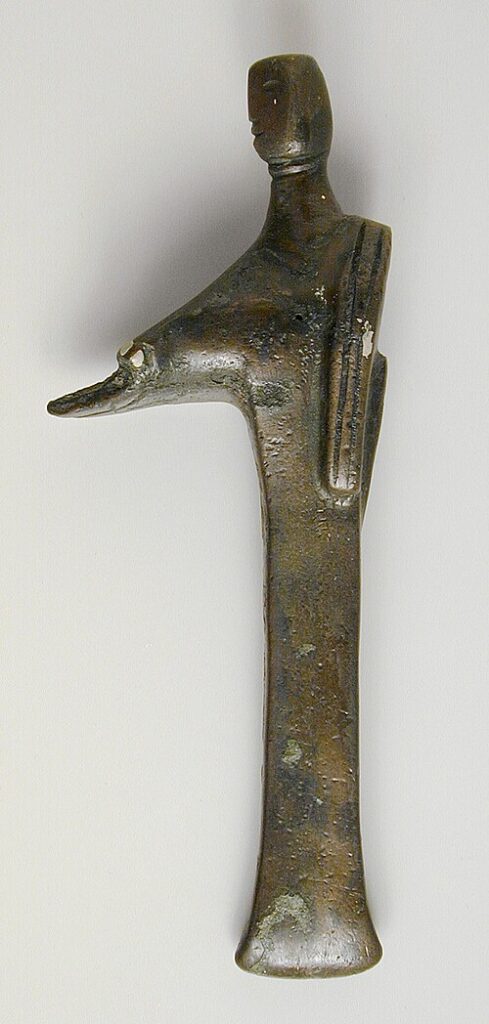
The original article described Bronze Age sappers using Luristan bronze picks in a standard procedure: tunnelling beneath mudbrick, installing timber props and burning the props to bring the wall down. The process is familiar from descriptions of later siege warfare, but the article supplied no Bronze Age excavation or text establishing that complete sequence. A bronze pickaxe from Luristan dated approximately 2350 to 2100 BCE is indeed held by the Los Angeles County Museum of Art. The museum identifies it as a pickaxe and classifies it among arms and armour; it does not identify it as an excavated siege-mining implement. Its presence in the archaeological record cannot demonstrate its use against a specific city wall.
The more secure Bronze Age evidence concerns the movement of earth to create approaches. The Uršu narrative orders an assault earthwork, and Mari documents discussed by Nadali describe earthen ramps associated with siege engines. A ramp changes the relationship between a machine and a wall: equipment that cannot cross a steep slope or ditch may be able to advance once workers have built a more manageable approach. This also makes the workers a target. Their activity could be opposed by missile fire or sorties, while an attacker had to protect the earthwork from destruction and keep moving material into place.
Mining and countermining are credible techniques in the longer history of siege warfare, but the specific claims about Bronze Age countermining teams, flooding galleries and exact pick designs need direct period evidence. They should not be presented as a documented standard operating procedure merely because similar methods are attested in later periods. The most dramatic surviving archaeological example of a siege ramp in the region, at Lachish, dates to Sennacherib’s Assyrian attack in 701 BCE, firmly in the Iron Age. The 2021 archaeological reconstruction of that ramp is an excellent comparison, not proof of what happened at Uršu a millennium earlier.
Fire could destroy the machine as well as the gate
Wooden siege machines created an obvious vulnerability. A covered ram or mobile tower might shield its operators from missiles, but it also contained timber, lashings and potentially combustible coverings. The Mari account of burning pitch before a siege tower is therefore more informative than a generic claim that ‘ancient armies used fire’. It records a particular attempt to destroy a particular piece of enemy equipment. Nadali also notes a third-millennium Ebla text concerning felt for a ram covering, though the record does not establish exactly how that felt was treated or whether it was intended primarily to resist arrows, fire or weather.
Fire could threaten wooden gates and other exposed structures. Yet the original article’s detailed prescriptions about resin mixtures, heat-induced failure of bronze hinges, sand pots placed at fixed intervals, and crews using specific buckets of water were not supported by Bronze Age sources. Nor is the blanket assertion that sand rather than water was always the correct response defensible. The appropriate response depends on what is burning and how the material behaves. Describing an unverified ‘standard’ defensive method creates an illusion of precision where the sources are silent.
What we can say is that combustible materials shaped tactical choices. An attacker might try to ignite vulnerable timber; defenders might attempt to burn a siege tower before it could reach the wall; protective coverings and the need to withdraw endangered machinery follow naturally from that risk. The Mari evidence analysed by Nadali gives this interaction a specific historical setting. Later Assyrian reliefs showing defenders hurling burning objects and soldiers protecting rams demonstrate that the problem persisted, but they must not be silently projected backwards as photographs of Bronze Age practice.
What a coordinated assault may have involved
The evidence points to several complementary methods, but it does not permit a universal Bronze Age battle plan. One army might try to starve a city into surrender. Another might build an earthwork to move a ram or tower closer. A third might attack with ladders and missile troops while attempting to force an entrance elsewhere. The available manpower, terrain, strength of the walls and willingness of the garrison to resist all shaped the choice. A large machine was useful only if it could reach the target, be protected and be repaired.
A possible sequence can be reconstructed without pretending that every step is attested at one site. Workers prepare an approach while soldiers protect them. A ram threatens a gate or wall face, drawing defenders to that point. Archers and shielded infantry attempt to prevent the garrison from concentrating its fire. A mobile tower might raise attackers’ firing position, where the ground and construction allow it. Meanwhile the besieged can burn equipment, attack the works or hold out in expectation of relief. This is a synthesis of capabilities attested across different sources, not a description of the Dapur relief or the siege of Uršu in their entirety.
The sources also expose a fundamental imbalance in our knowledge. The attacking king was more likely to commission inscriptions or reliefs than the defenders were to preserve their account. Uršu is unusually revealing because it admits frustration; Razama is revealing because the surviving correspondence preserves active resistance. A siege could end through negotiation, betrayal, starvation or withdrawal without producing the spectacular breached wall that later artists preferred to show. The military history of siege weapons is therefore also a history of what written and visual sources choose to remember.
Why the Assyrian rams look so different
The best-known ancient Near Eastern siege machines appear on the palace reliefs of the Neo-Assyrian kings, especially in the first millennium BCE. Their protected wheeled rams and elaborate assault scenes, also discussed in Spoken Past’s article on Assyrian propaganda, are far easier for modern readers to recognise than a disputed third-millennium seal impression. The reliefs are later than the Bronze Age, however, and their engineering cannot simply be assigned to the armies of Ebla, Mari or Hattuša. The difference between a suggestive early representation and a detailed later image is a difference in the evidence, not necessarily proof of a sudden invention.
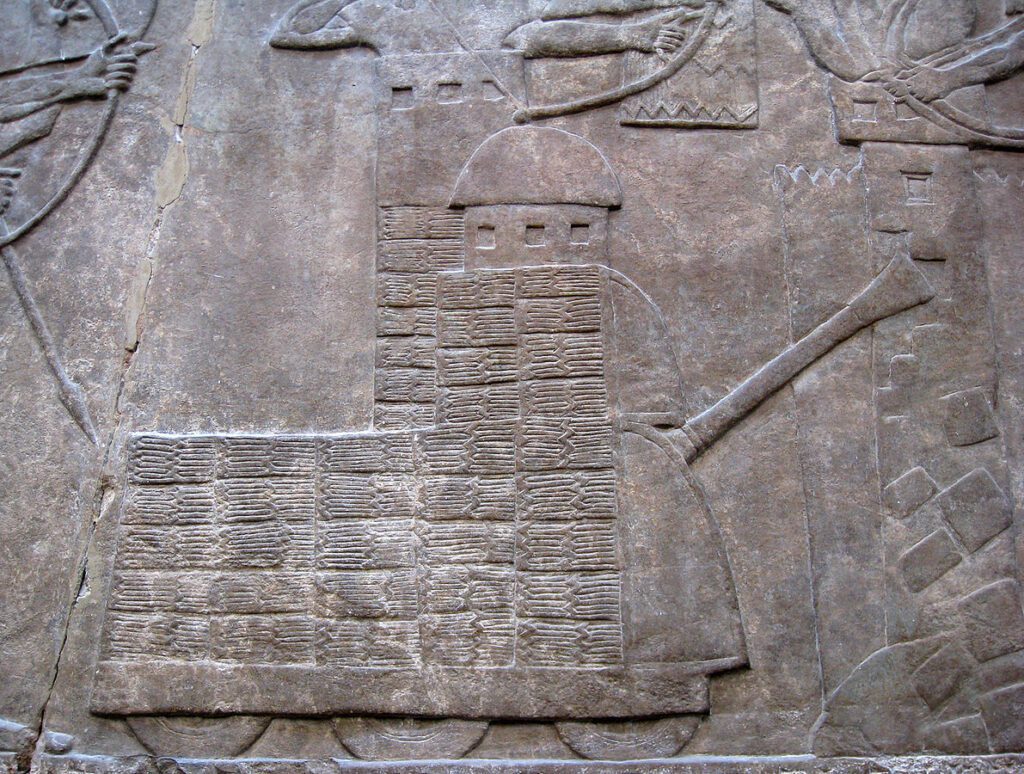
The Assyrian siege of Lachish in 701 BCE illustrates both the continuity and the danger of comparison. The army used a massive ramp and siege engines, and the archaeological remains of the ramp can be examined alongside royal reliefs. The Lachish research makes it possible to test aspects of the visual account against physical remains. No comparable combination of preserved siege installation and detailed pictorial narrative is available for every Bronze Age case. Later evidence can show how a technology developed, but it cannot fill each earlier gap automatically.
The weapons of the Bronze Age were not a single forgotten arsenal waiting to be reconstructed down to its bolts and ropes. The evidence is stronger, and more interesting, when its limits are respected. Ebla’s documents identify early siege equipment; Mari records its movement and its vulnerability; Uršu shows a king struggling with failed machinery; Tell Beydar offers disputed but potentially revealing images; and Dapur preserves the appearance of a royal assault. Together they establish that ancient armies had been thinking systematically about the problem of fortified cities long before the rise of classical artillery. Their exact machines remain partly beyond recovery, but the military challenge that produced them is unmistakable.