Around 3500 B.C., before the first pyramid rose at Giza and centuries before the unification of Upper and Lower Egypt, craftsmen in the Predynastic settlement of Naqada were already producing small objects with a luminous blue-green glaze that had no obvious parallel in nature. These were not painted stone or colored clay. They were something altogether different: a fired composite material with a quartz body and a vitreous surface that shimmered in a way Egyptians would later call tjehent, meaning “dazzling” or “brilliant.” That word tells you everything. Egyptian faience was not a cheap substitute for precious stones. It was a sacred substance in its own right, and the civilization that produced it would refine the technology for five thousand years without ever abandoning it.
Egyptian faience is a non-clay ceramic material composed of a crushed quartz or sand core coated with a soda-lime-silica glaze, typically blue-green in color due to copper oxide, fired at temperatures between roughly 800 and 1000 degrees Celsius. The result is a hard, glassy-surfaced object that can hold fine detail, take almost any shape, and retain its color over millennia. It is not related to the tin-glazed earthenware produced in Faenza, Italy, despite sharing the name. Scholars often prefer the terms “glazed composition” or “sintered quartz” to avoid that confusion, but Egyptian faience remains the dominant term in museum collections and the academic literature.
What Egyptian Faience Is Made Of
The core of faience is composed primarily of ground quartz or sand, bound together with small quantities of lime and either natron (a naturally occurring sodium salt found in dry lake beds across Egypt) or plant ash. This core is white and relatively fragile before firing. The glaze that covers it is a separate layer: a soda-lime-silica glass tinted with mineral colorants. Copper compounds, particularly malachite and copper oxide, produce the characteristic blue-green color most associated with the material. Manganese produces purple. Cobalt, used from the New Kingdom onward, yields a deeper, more saturated blue. Iron-rich compounds produce red and brown tones, though these are less common.
The overall composition, as documented in modern archaeometric analysis, includes compounds of calcium, sodium, potassium, magnesium, titanium, and aluminium alongside the dominant quartz. A 2024 open-access study published in the journal Minerals (DOI: 10.3390/min14060586) describes faience as “the earliest high-tech ceramic fired in advanced kilns,” a characterization that reflects how technically demanding it was to produce consistent results from these materials. The core had to be shaped and allowed to dry before glazing. The glaze had to adhere correctly. The firing had to reach the right temperature range without over- or under-vitrifying the surface.
What makes faience genuinely remarkable is not any single ingredient but the combination: common materials, locally available or tradeable, transformed through controlled heat and chemistry into objects that resembled precious blue stones like turquoise and lapis lazuli. According to the Metropolitan Museum of Art’s essay on faience technology and production, faience may have developed partly as a way to replicate the appearance of rare semi-precious stones using accessible raw materials, while still commanding high prestige alongside gold and silver.
The Three Ways Egyptians Glazed Faience
The glazing methods used to produce faience are among the most studied aspects of its technology. Scholars, building on the foundational typology established by Pamela Vandiver in her 1982 contribution to Archaeological Ceramics (Smithsonian Institution Press), have identified three distinct techniques, all of which appear across different periods and production sites.
The first is efflorescence glazing. In this method, soluble salts are mixed directly into the quartz body. As the object dries, those salts migrate to the surface through capillary action. When fired, they form a glaze in place. No separate glaze material needs to be applied, which makes this technique efficient but somewhat difficult to control.
The second is cementation glazing. Here, the shaped core is buried in a powder mixture of glaze ingredients and fired inside that bed. The glaze compounds vaporize and condense onto the object’s surface during firing, forming a coating without direct application. Evidence of this technique survives in the form of ceramic firing vessels with fused faience residues on their interior walls, recovered from production sites.
The third is application glazing, in which a slurry of glaze material is painted, dipped, or poured onto the surface before firing, much as a potter would glaze a ceramic vessel. This method gives the craftsman the most direct control over coverage and thickness, and it is the technique most commonly associated with fine painted decoration.
As the Australian Museum’s resource on Egyptian faience notes, combinations of these methods were used in practice, and a single workshop might employ more than one technique depending on the object type and the desired finish.
Enjoying Spoken Past?
I created Spoken Past to share my love of history. I research, write and develop everything myself, and I want my articles and basic guides to remain free for everyone.
If you enjoy my work, please consider supporting Spoken Past with a small donation.
Where and When Faience Was Produced
The earliest confirmed examples of Egyptian faience date to the Predynastic period, roughly the fourth millennium B.C. Beads and small amulets with glazed quartz compositions have been recovered from Naqada-period burials, and the material was already considered prestigious enough to accompany the dead by the time Egypt was moving toward political unification.
By the Old Kingdom, faience production was established enough to be used in monumental architecture. The Step Pyramid complex at Saqqara, built for the pharaoh Djoser around 2650 B.C., included underground chambers lined with blue-green faience tiles. These tiles recreated the appearance of reed matting in a permanent, shimmering material in a context designed to house the king’s spirit for eternity.
The New Kingdom period, roughly 1550 to 1070 B.C., represents the peak of faience production in terms of volume, technical sophistication, and artistic variety. The city of Amarna, founded by the pharaoh Akhenaten on the middle Nile, has yielded direct physical evidence of faience and glass workshops through excavations conducted by Paul T. Nicholson and his colleagues for the Egypt Exploration Society. Nicholson’s work, documented in Brilliant Things for Akhenaten (EES, 2007), uncovered production debris, molds, kiln furniture, and raw material caches that confirm large-scale organized production in a dedicated craft quarter.
Memphis, the ancient administrative capital, continued as a production center into the Roman period. Nicholson’s later project at Kom Helul, also published by the EES in Working in Memphis (2013), documented faience manufacture continuing well into the first centuries A.D., demonstrating that the technology survived Egypt’s absorption into the Roman Empire with its basic methods intact.
What Faience Meant to Ancient Egyptians
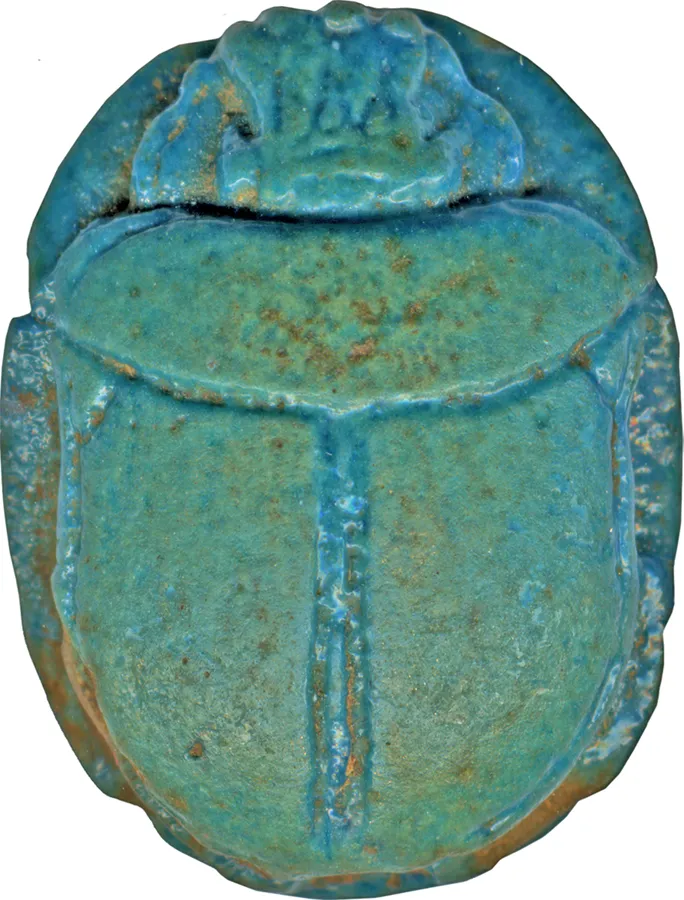
The cultural meaning of faience cannot be separated from its physical properties. The blue-green color, in Egyptian symbolic thought, was associated with the Nile at flood, with vegetation, with fertility, and with concepts of resurrection tied to the god Osiris. Scholars interpret this color symbolism based on object contexts and funerary use patterns rather than direct ancient textual statements, so it is worth treating these associations as well-supported scholarly interpretation rather than documented Egyptian doctrine. What is certain is that faience objects were placed in tombs in enormous quantities, and that the material’s shimmer was understood as meaningful rather than merely decorative.
Amulets in faience form a vast category of surviving objects. The djed pillar, associated with Osiris and stability. The wadjet eye, used for protection. The scarab, symbol of the sun god Khepri and of cyclical regeneration. These were produced by the tens of thousands in faience over more than three millennia, placed on mummies, deposited in tombs, worn by the living, and offered at temples.
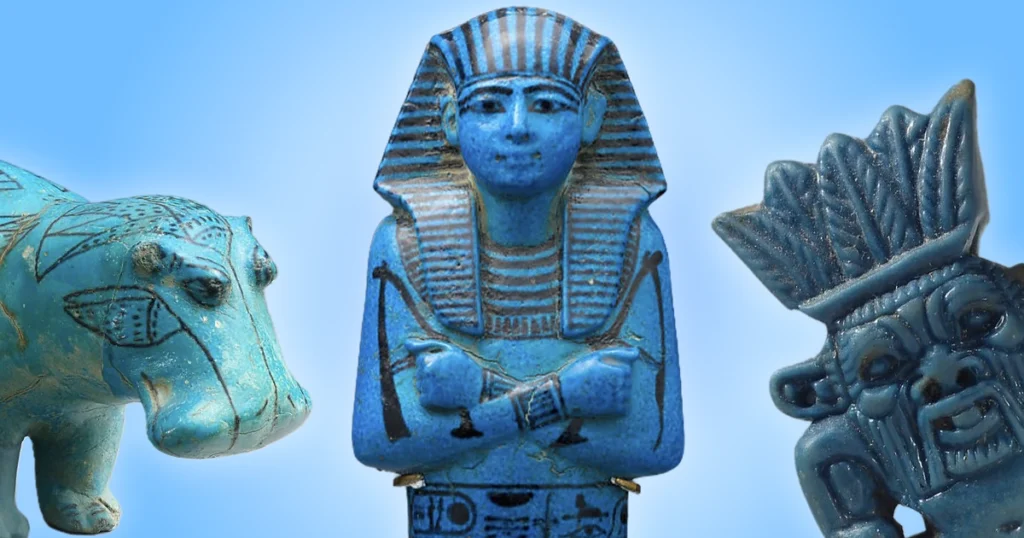
Shabtis, the small servant figurines placed in tombs to perform labor in the afterlife on behalf of the deceased, were among the most commonly faience-manufactured object types during the New Kingdom and later periods. A shabti in faience was not simply a practical clay figure given a coat of paint. It was made of a substance the culture understood as connected to transformation and eternal life.
The Metropolitan Museum of Art confirms that Egyptians described the material as tjehent and considered it filled with the shimmer of the sun and imbued with powers of rebirth. That association remained consistent across thousands of years of production.
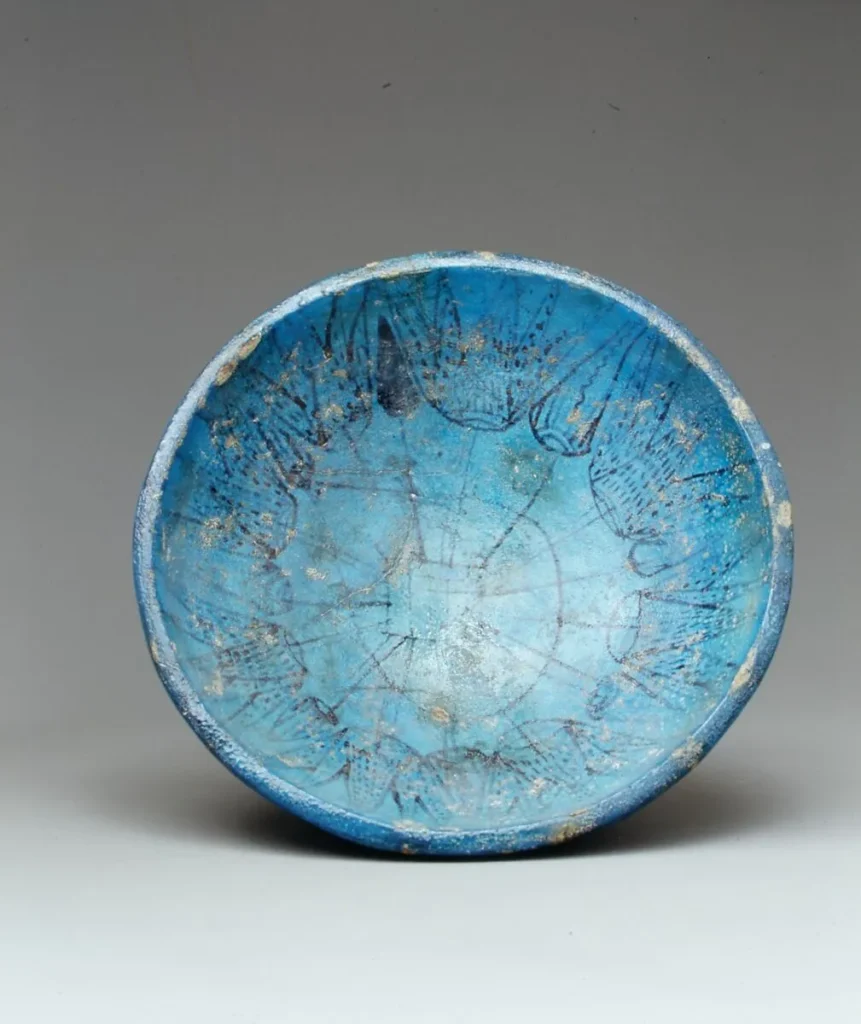
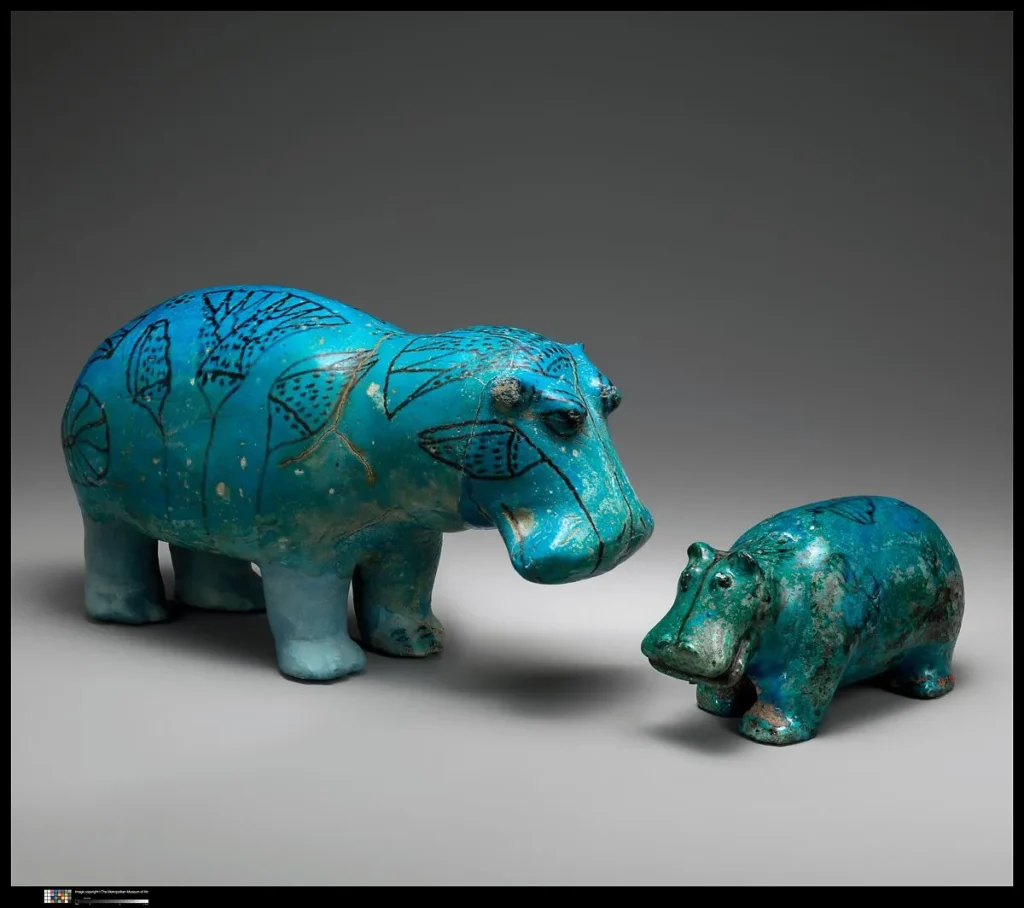
Royal and elite uses of faience extended well beyond the funerary sphere. Vessels, jewelry, inlays for furniture and architectural elements, game pieces, and model objects appear across palace and temple contexts throughout Pharaonic history. The blue hippo figurines now held in museum collections worldwide, including several at the Metropolitan Museum of Art, are faience objects from the Middle Kingdom period, roughly 2055 to 1650 B.C. Their painted decoration of lotus flowers and marsh plants reinforces the same cluster of associations: water, growth, abundance, and the liminal world of the Nile.
Is Egyptian Faience Unique to Egypt?
The short answer is no, though the question is more complicated than it first appears. The technology of vitreous coatings on quartz-based cores appears in Mesopotamia and the Levant as well as in Egypt, and the relationship between these regional traditions remains a live debate in the archaeometric literature.
Glazed steatite, a soft stone treated with a vitreous surface, predates the development of a fully synthetic quartz-body faience and appears across both Mesopotamia and Egypt. Whether Egyptian craftsmen developed their faience tradition independently or adapted techniques through contact with neighboring cultures has not been conclusively resolved. M. S. Tite and Andrew Shortland, in their 2008 monograph Production Technology of Faience and Related Early Vitreous Materials (Oxford University School of Archaeology Monograph 72), treat faience as part of a broader pattern of vitreous material development across Egypt, the Near East, the Indus Valley, and eventually Europe, spanning from the fifth millennium B.C. through the Roman period.
What distinguishes Egyptian faience is not independent invention but the scale, continuity, and symbolic elaboration it achieved. No other ancient culture produced faience objects in the same quantities, over the same unbroken timespan, or integrated the material so thoroughly into religious, funerary, royal, and everyday life. The technology was also eventually transmitted outward. Faience production appears in Nubia, in the Aegean Bronze Age, in the Phoenician world, and eventually across the broader Mediterranean. In each case, the basic technique traces back through contact to the Egyptian and Near Eastern traditions.
Paul T. Nicholson of Cardiff University, who has led excavations at both Amarna and Memphis for the Egypt Exploration Society, remains the leading field authority on faience production sites. His excavation reports represent the most direct archaeological evidence for how workshops were organized, what raw materials craftsmen stockpiled, and how production methods changed over time.
The Egyptians themselves likely had no category equivalent to “high-tech ceramic.” For them, the material was tjehent: dazzling, sacred, and alive with the light of the sun. That description, consistent across five thousand years of unbroken production from the Nile Delta to Roman-period Memphis, is a more accurate account of what Egyptian faience actually was than any materials-science definition provides on its own.