


In November 1999, two unlicensed metal detectorists working in the beech forests on the Mittelberg hill near Nebra, Saxony-Anhalt, struck a bronze disc with their spades. They damaged it in the process and quickly sold it, setting off a years-long chain of police investigations that culminated in a sting operation in Basel in 2002, when state archaeologist Prof. Dr. Harald Meller of the Landesamt für Denkmalpflege und Archäologie recovered the object for public science. The Nebra Sky Disc, now held at the State Museum of Prehistory in Halle, is a 30-centimetre bronze plate inlaid with gold sun, crescent moon, and stars, including a cluster representing the Pleiades. It was buried around 1600 BCE alongside two bronze swords, two axes, and other objects. The disc encodes the angle between solstice sunrises and sunsets at latitude 51 degrees north, meaning that whoever commissioned and used it needed to observe the sky with sustained, deliberate attention. That attention required silence. Silence in the Bronze Age was not simply the absence of noise. It was a managed resource, deployed across metalworking workshops, megalithic gathering spaces, battlefield approaches, and skywatching platforms, and this post examines the evidence for each of those uses in turn.
What the Material Record Can and Cannot Tell Us
Archaeologists cannot record ancient quiet directly. There are no decibel readings from a Bronze Age barrow. What the record does preserve is the physical infrastructure that required or produced silence, and Margarita Díaz-Andreu of the University of Barcelona, whose 2025 review article in the Annual Review of Anthropology surveys the full field of archaeoacoustics, defines the discipline precisely as the study of sound-producing devices and of the acoustic properties built into ancient spaces. The logic runs in both directions. If a stone circle amplifies a speaker’s voice at its centre and dampens echoes along the perimeter, that is a design choice with consequences for how people behaved inside it. If a barrow passage bends at a right angle and forces single-file entry beneath a low lintel, bodies and voices slow down together.
The chronological scope here is roughly 3200 to 1200 BCE in Europe and the eastern Mediterranean, with the Únětice culture of central Europe and the Nordic Bronze Age providing the richest material for this question. Several independent methodologies converge to make silence recoverable as a historical fact rather than a romantic projection. Archaeoacoustics measures impulse responses in standing monuments and uses digital modelling to reconstruct what demolished spaces once sounded like. A 2020 study published in the Journal of Archaeological Science used scale-model acoustic testing of Stonehenge to show that the original sarsen configuration would have significantly reduced reverberation inside the ring while boosting speech intelligibility at its centre. That is not proof of ritual silence, but it is proof of an engineered acoustic environment, and engineered environments imply deliberate management of sound.
Use-wear analysis on metalworking tools records the phases of the casting sequence, which alternate between loud percussion and quiet observation. Spatial syntax in graves and shrines shows controlled-access passages that physically enforce slow, careful movement. Astronomical alignments at sites from Stonehenge to the Mittelberg encode the need for patient, sustained watching. Instrument finds, including Nordic lurs and strike-plates, mark the moments when sound was intentionally generated against a quieter background. The argument in each case is modest: silence is inferred where the material record requires attentive behaviour and where the physical layout would have produced or enforced it.
Ritual Spaces and the Architecture of Quiet
The monumental architecture of the European Bronze Age is remarkably consistent in the way it controls how bodies move and how sound travels. Long barrows and passage graves, many of which were repurposed and reopened during the Bronze Age after Neolithic construction, channel visitors through narrowing passages that force single-file movement. Low roofs and right-angle bends between the entrance and the central chamber reduce ambient noise dramatically. The acoustic dead zone at the centre of many circular monuments, where footsteps produce almost no echo, creates a qualitatively different sensory experience from the open landscape outside. These are not accidental features. They are design consequences of the building decisions made at each site.
Stone circles present a more nuanced picture. Clive Ruggles of the University of Leicester, whose work on British and Irish stone alignments has been central to the archaeoastronomy literature for decades, has argued against the idea that every stone circle was a precision astronomical observatory, pointing out that the orientations of most sites are consistent with broad cultural attention to solar and lunar cycles rather than exact measurements. What they do preserve, regardless of their astronomical precision, is a design that places a leader or officiant at a specific point relative to a crowd, with sightlines to a distant horizon. That arrangement structures a gathering around a moment of collective attention. The Ring of Brodgar on Orkney, a circle of 60 original stones spanning roughly 104 metres in diameter, sits on a narrow neck of land between two lochs. The walk to it from any direction is exposed and directional. It teaches approach. Bodies arriving there would have been tuned by the landscape itself before any ceremony began.

Bronze Age votive deposits provide a different angle on ritual silence. Hoards of metalwork placed in bogs, rivers, and watery margins across northern and western Europe show extraordinary consistency: objects grouped and positioned deliberately, often in pristine condition, in locations remote from settlements. The act of deposition involves approach, placement, and withdrawal. The withdrawal is the moment that scholars of ritual practice find most revealing. Nothing more is done or said at the site; the object passes from the human social world into a different register entirely. That boundary is marked, in many contemporary and ethnographically documented traditions, by an enforced pause in speech. The physical remoteness of the deposition sites reinforces this reading: you could not perform this act in a noisy public context even if you wanted to.
The Listening Workshop: Metallurgy, Moulds, and Mines
Bronze-working is not a uniform process. It alternates between phases of intense physical noise, ore-breaking, bellows-driven furnace roar, and the crack of the pour, and phases of concentrated quiet in which the outcome of the work depends on the smith listening carefully to the material. Most European Bronze Age bronzes cluster around eight to twelve percent tin by weight, a composition that shifts the alloy’s colour from copper-red toward golden yellow and significantly increases hardness. Judging whether a cast object has reached the right temper requires striking it and listening to the ring it produces. A properly annealed axe, reheated and slowly cooled to reduce internal stress, rings with a clear, sustained tone. A cracked or poorly quenched blade rings flat and dull. That test requires a moment of hush.

Crucibles and moulds recovered from Bronze Age workshop sites preserve the trace evidence of this alternation. Crucibles show glassy inner walls where the melt ran smooth, and spattered outer faces from pour events. Two-part stone moulds for socketed axes and rapiers carry fine internal detail: sprues placed to manage gas escape during pouring, vent holes to prevent cold shuts where two streams of metal meet at a low temperature. Preparing and preheating a two-part mould before a pour, aligning the halves, and binding them against internal pressure are all tasks requiring careful coordination and minimal disturbance. A jarred mould cracks its seams. A startled smith drops a crucible. The quiet in a casting workshop is not ceremonial. It is process control.
Underground at sites like Great Orme on the northern Welsh coast, where Bronze Age miners extracted copper ore between roughly 1900 and 600 BCE in galleries now excavated by the Great Orme Exploration Society and studied in detail by teams including those led by Simon Timberlake of the Cambridge Archaeological Unit, the sensory demands of safe working were acute. Ore-pickers sorted material by weight and colour in cramped galleries lit by animal-fat lamps. A tapped stone answers back differently depending on whether it is solid rock or a void. The warning sign of an unstable ceiling is acoustic: a tick, a faint series of pops, a tone shift in the rock. Mining silence is survival equipment, not etiquette.
Built out of a love for history, kept free from distractions.
Spoken Past is an independent project shaped by curiosity, care, and long hours of research. Reader support helps keep it maintained, carefully researched, and open to everyone.
Stored Force: Silence and Bronze Age Warfare
The weapons of the European Bronze Age are among its most intensively studied artefacts. Naue II swords, which spread across Europe from the Aegean in the thirteenth and twelfth centuries BCE, show edge damage consistent with cutting rather than thrusting, suggesting combat styles that required lateral body movement and close coordination between fighters. Shield typology, analysed in detail by Barry Molloy’s influential study in Antiquity, distinguishes between shields designed for individual display and those engineered for formation tactics where fighters overlap coverage. Formation tactics require pre-arranged signal systems, and signal systems only function when the baseline is quiet enough for the signal to stand out.
Nordic lurs, the paired bronze horns found in bogs across Scandinavia and dated to the later Bronze Age, produce a powerful, carrying note that modern acoustic tests have demonstrated can project over distances of several kilometres in open terrain. Lurs survive in pairs with nearly identical tuning, suggesting they were played in coordination. That coordination implies a conducting moment: a signal before the signal. Somebody had to indicate that the lur players were about to begin, which required the attending group to fall quiet enough to hear the preparation. The lur is not evidence of background noise. It is evidence that sound and hush were alternated deliberately.
Ambush tactics, attested in Near Eastern texts from the same period and plausibly extended to European contexts by the evidence of wooded terrain, river crossings, and narrow valleys in areas with concentrated weapon deposits, require extended silence before the moment of action. Warriors binding metal fittings to prevent noise, horses muffled, movement staged to avoid skyline silhouettes: these precautions appear consistently in historical and ethnographic accounts of ambush warfare and are the logical consequence of having opponents who listen for approach. The moment the ambush breaks is the moment silence ends and signal begins. The contrast between the two states is the tactical weapon.
Sky, Disc, and the Watching Pause
The Nebra Sky Disc encodes a specific agricultural and calendrical rule for central Europe: when the Pleiades appear at the same position as the crescent moon depicted on the disc, it is time to intercalate the lunar calendar with the solar year by inserting an extra month. Sebastian Dieck and colleagues at Otto-von-Guericke University of Magdeburg, in their 2024 archaeometallurgical study published in Scientific Reports, demonstrated that the disc’s manufacture involved advanced hot-forging techniques that left specific microstructural signatures in the bronze. The disc required extraordinary skill to produce and extraordinary skill to use. Using it meant watching the night sky from a specific vantage point on the Mittelberg, where the two gold horizon arcs correctly frame the angle between solstice sunrises and sunsets at that latitude. That observation requires absolute stillness and sustained attention over multiple nights, because the relevant celestial events unfold slowly and cannot be rushed.
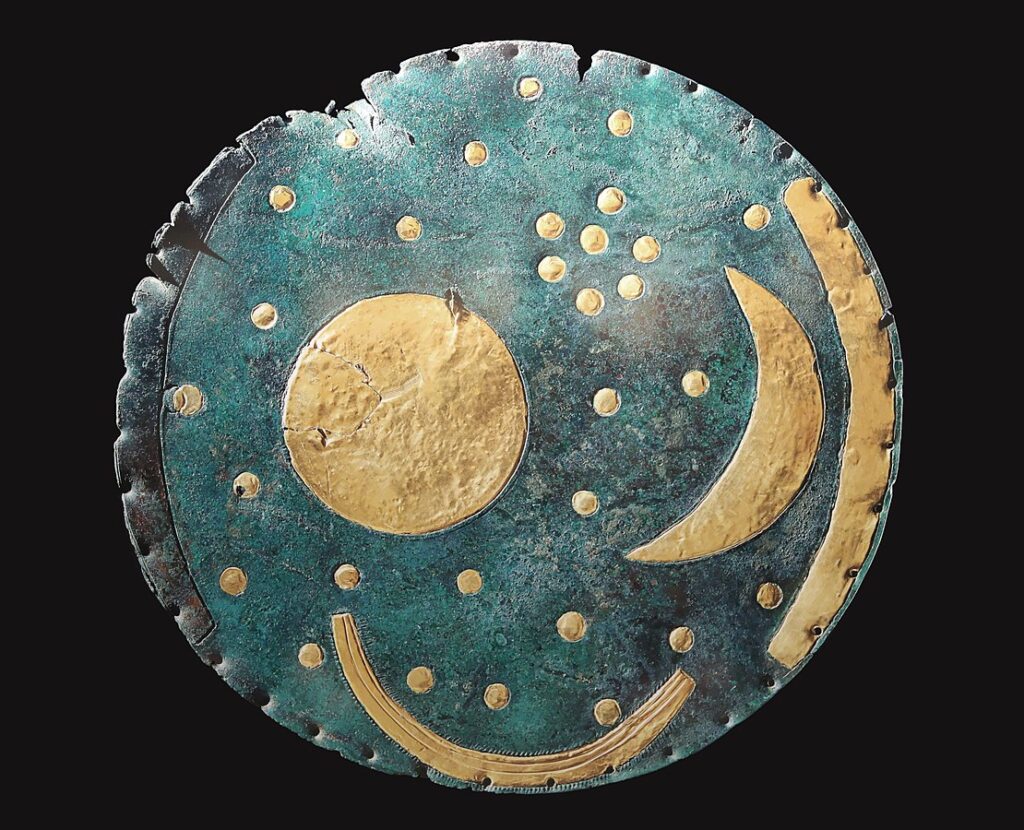
The debate over the disc’s precise function has a scholarly dimension worth noting. Archaeoastronomer Emília Pásztor, whose 2024 contribution to the Journal of Skyscape Archaeology revisited the disc in connection with the major Stonehenge exhibition, has argued that the apparent match between the disc’s arcs and the solstice angle at latitude 51 degrees north could be coincidental, and that its function may have been more broadly symbolic than calendrically precise. The majority view, associated with Harald Meller and astronomer Wolfhard Schlosser, maintains that the angular match is too accurate to be accidental and that the disc functioned as a practical instrument for agricultural timing. Either interpretation requires that whoever handled the disc was observing the sky with the kind of focused attention that crowds and conversation prevent.
The Trundholm Sun Chariot from Denmark, a bronze horse on a wheeled cart drawing a gilded disc, makes solar movement tangible and portable in a different way. It invites procession. Processions operate on tempo: a start, a stop, a pause at each station, and then a sound that marks the next movement. The object’s appearance at a critical moment in a processional sequence would have broken the preceding silence, not the other way around. In a world without mechanical clocks, the alternation of silence and sound was a primary timekeeping technology. The Sun Chariot is its monument.

Domestic Life and the Social Politics of Quiet
House archaeology from the European Bronze Age is largely a record of hearths, storage pits, loom weights, and grinding stones, the furniture of ordinary daily repetition. But the spatial configuration of those houses carries acoustic consequences that are rarely discussed. At well-preserved Bronze Age settlements like the pile-dwellings of the Alpine lake shores, studied intensively since the nineteenth century and now a UNESCO World Heritage Site, buildings were packed tightly onto narrow platforms with shared walls and open-sided working areas facing the lake. Sound carried freely between households. The back rooms of these structures, separated from the main living area by a partition or a step, functioned as buffer zones where sound was muffled by distance and mass.
Close work thrives on quiet. Threading a loom, piercing a hide, carving a wooden handle, inlaying amber into a pin: all of these are tasks documented in Bronze Age archaeological assemblages, and all of them are tasks that benefit from minimal auditory distraction. Skill transmission in pre-literate craft traditions operates through demonstration and imitation, not verbal instruction. The master smith’s actions speak; the apprentice watches. The instructional silence is not empty. It is dense with information about tempo, posture, and listening, and it forms the backbone of technical knowledge transmission across generations.
Silence also maps social hierarchy. In any community sharing a courtyard or a working yard, the person who does not have to raise their voice to command attention is the person with the most established authority. The wear patterns on stone benches near doorways at Bronze Age settlements suggest long hours of sitting in proximity without the kind of constant activity that produces noise. Bodies together, mouths often still: that is the texture of shared social space in most pre-modern communities, and the Bronze Age was no different. Silence in these contexts is not absence but presence, the full weight of co-habitation conducted at a managed volume.
Sources: Margarita Díaz-Andreu, “Archaeoacoustics: Research on Past Musics and Sounds,” Annual Review of Anthropology 54 (2025), doi:10.1146/annurev-anthro-071323-113540; Sebastian Dieck et al., “Archaeometallurgical investigation of the Nebra Sky Disc,” Scientific Reports 14 (2024), doi:10.1038/s41598-024-80545-5; Bruno Fazenda et al., “Using scale modelling to assess the prehistoric acoustics of Stonehenge,” Journal of Archaeological Science 122 (2020), doi:10.1016/j.jas.2020.105218; Emília Pásztor, “The World of Nebra Sky Disc and Stonehenge,” Journal of Skyscape Archaeology 9.2 (2024), equinoxpub.com; Barry Molloy, “For Gods or Men? A Reappraisal of the Function of European Bronze Age Shields,” Antiquity 83 (2009), doi:10.1017/S0003598X00099348; Harald Meller, “The Sky Disc of Nebra,” in Harry Fokkens and Anthony Harding (eds.), The Oxford Handbook of the European Bronze Age, Oxford University Press, 2013.