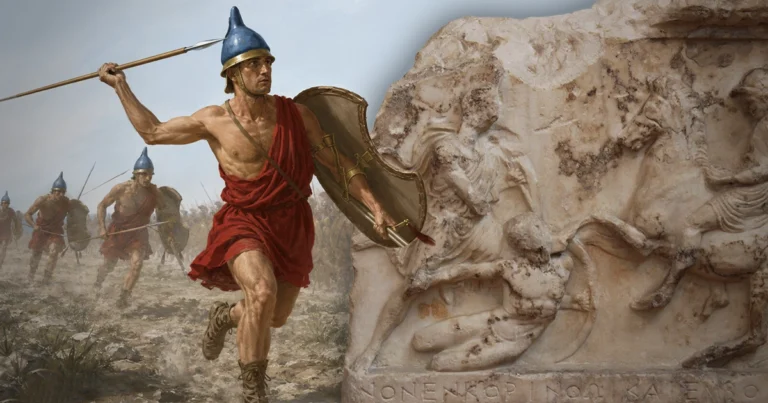
What Ambush Mathematics Means
Commanders in the ancient world learned fast that numbers do not fight by themselves. They fight through space and time. “Ambush mathematics” is a practical way to describe how ground, visibility, timing, and cohesion can multiply a small force so that it hits above its weight. Ambush, in the strict sense, means striking by surprise from a concealed position into a moving or distracted enemy. The mathematics is not a formula on a tablet. It is the consistent arithmetic of frontage, density, angles, intervals, and minutes that turns a narrow pass, a lakeshore fog bank, or a ravine into a weapon.
A few working definitions keep the logic clear. A defile is a narrow passage where formations must compress. Frontage is the width that a body of troops occupies to fight effectively. Cohesion is a unit’s ability to move and act as one. Intervisibility means who can see whom across the ground. A kill zone is the space where the ambusher concentrates fire or shock while the target cannot deploy or escape cleanly. Once you think in those terms, classic episodes like Lake Trasimene, the Caudine Forks, the Sabis River, and the Teutoburg Forest cease to look like miracles. They become examples of the same arithmetic.
Why Terrain Beats Simple Headcounts
Numbers lie when the field erases them. A road threading a steep valley might accept only two maniples or a single file of carts at a time. A lakeside causeway can force thousands of men into a marching column that cannot turn to face a sudden threat. A broken maze of thickets can cut line of sight into short windows so that signals fail and officers cannot correct a mistake. Surprise magnifies these effects, because shock consumes the few minutes a victim needs to redeploy.
Picture a column of 12,000 marching through a pass whose fighting frontage is only 150 yards. If an ambusher can engage that frontage with 2,000 fighters from two angles, the effective local ratio is not 6 to 1 against the ambusher, it is closer to 2 to 1 in the ambusher’s favor at the point of contact. If the ambusher then blocks the exits, the rear files cannot help the front. The column’s surplus numbers become trapped mass, not combat power.
Ancient writers noticed the arithmetic even when they did not express it as math. Livy stresses the compression of Roman ranks at Lake Trasimene. Caesar describes the Nervii attacking while his legions were still unpacking baggage at the Sabis, turning deployment time into a weapon. Tacitus underlines how the forest and marsh at Teutoburg broke Roman lines into pieces. Each account, in its own idiom, shows the same logic: constrain the enemy’s frontage, fragment his units, deny his officers sight and time, and then attack from multiple directions with prepared forces.
The Core Mechanics: Five Multipliers You Can See on a Map
Frontage Compression at the Point of Impact
Armies fight on a line that matches how many files can swing weapons or throw missiles. If ground shrinks that line, the enemy cannot bring his full number to bear. A steep slope or a banked road that drops into a lake cuts frontage drastically. At Trasimene the Romans marched between water and wooded hills, so even if the whole army had been present, only the head and a sliver of the main body could fight. Compression also weakens cavalry, which needs room to turn and charge.
Visibility Windows and the Failure of Control
Intervisibility decides whether a general can command. Forested spurs that jut into a road, ridges that hide one segment from the next, or morning fog across a lake sever the chain of orders. Ambushers choose positions where the victim cannot see the whole line of attack, which forces piecemeal responses. If standards vanish into thicket and dust, the soldier fights the man in front of him rather than obeying a plan.
Time Theft: Deployment and Decision Lags
A marching army is a long creature. When surprised, the head forms a battle line while the middle still files through a choke point and the rear does not know a fight has begun. The decision lag between the first alarm and a coherent formation can be ten minutes or more. Ambushers have prepared positions, prearranged signals, and a short path from cover to strike. Every minute of delay multiplies the ambusher’s relative power.
Angle of Attack and the Two-Front Problem
A well-built ambush is not only a blow from the side. It is two or three blows at once. Attackers who hit front and flank, or both flanks together, force the victim to split attention and rotate units under stress. Even a small cavalry detachment that appears in the rear can panic baggage handlers and cut off retreat, which turns pressure into rout.
Exit Control: Gates, Crossings, and Dead Ground
Ambushers seek terrain that lets them block doors: a bridge at the end of the pass, a gate road through a fortification of earth, a ford that only a few can use at once. Once exits are sealed, a stampede begins, and the victim’s mass becomes a hazard to itself. Dead ground on slopes, where missiles cannot reach, becomes a safe lane for the ambusher to move reserves.
Lake Trasimene: A Lakeshore Corridor Becomes a Trap
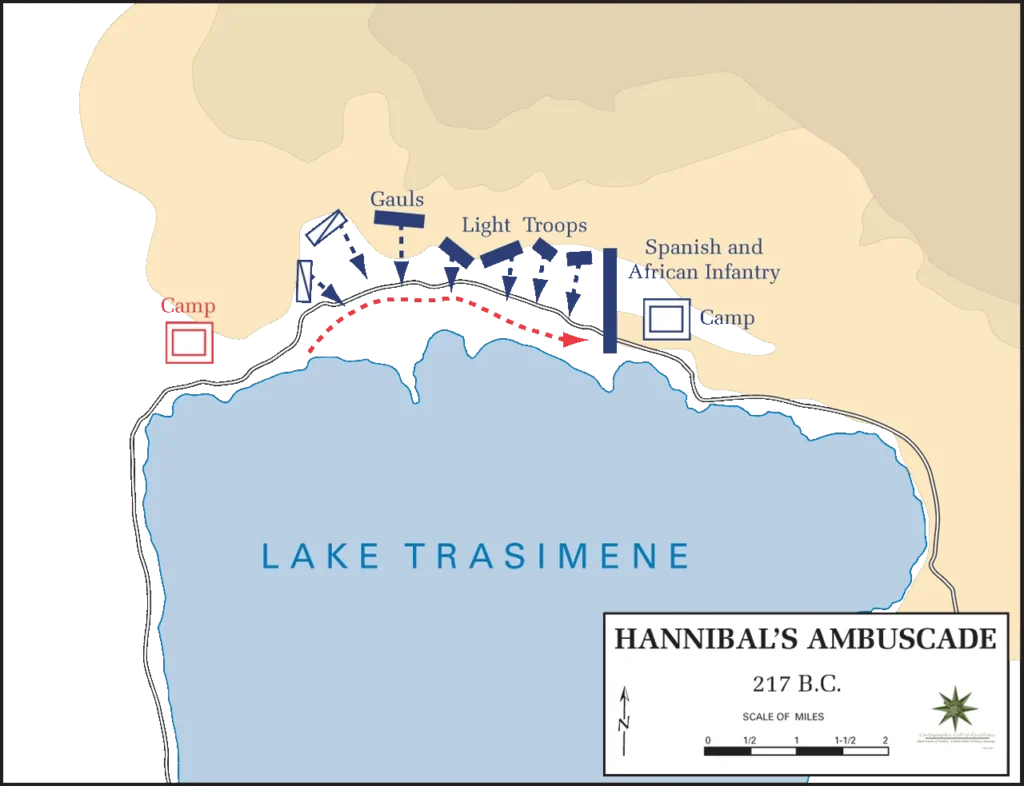
In 217 BCE the Carthaginian commander Hannibal lured the Roman consul Flaminius along the northern shore of Lake Trasimene. The road ran beneath wooded spurs, with the water on one side and hills on the other. The Carthaginians placed heavy infantry and cavalry in cover along the slopes, with a blocking force at the far end. Morning fog settled over the water, masking movement. When the Roman head entered the basin, the trap closed: a frontal block, flanking infantry surging down from timber, and cavalry stopping retreat.
The arithmetic is brutal. The Roman column could not deploy more than a fraction of its men at once. Their standards and officers vanished in fog and thicket. Once the exits were closed, the mass of men and animals pressed inward. Within hours, a consular army ceased to exist. Minimal Carthaginian losses, maximum Roman losses: the math of a corridor turned into a killing ground.
Teutoburg Forest: Earthworks, Weather, and Patience
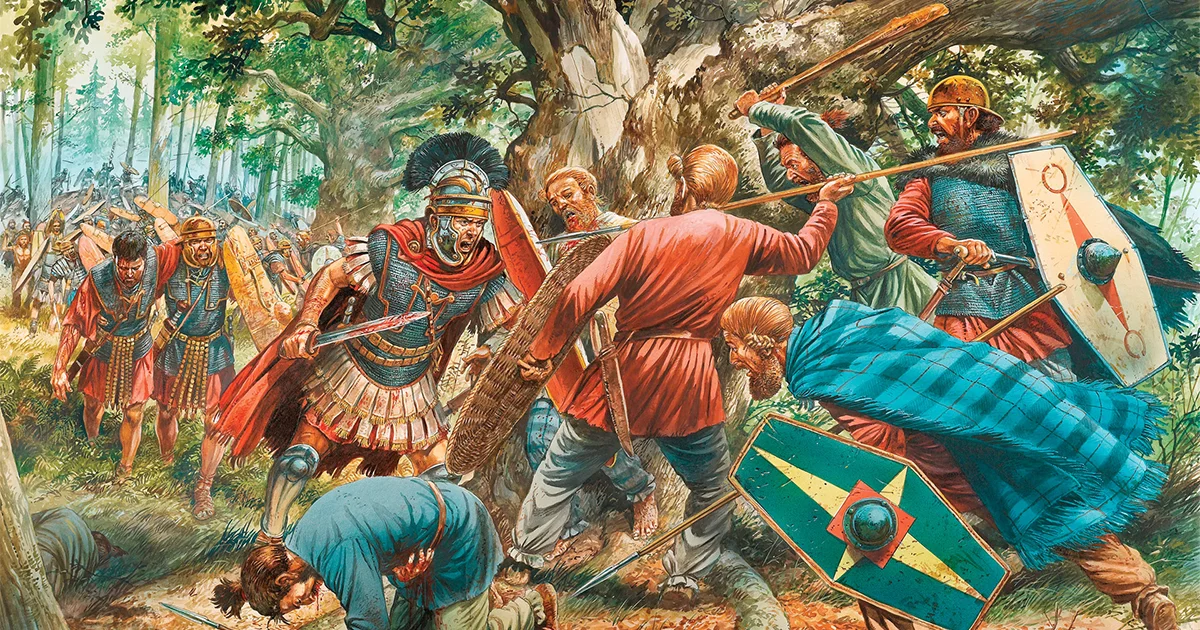
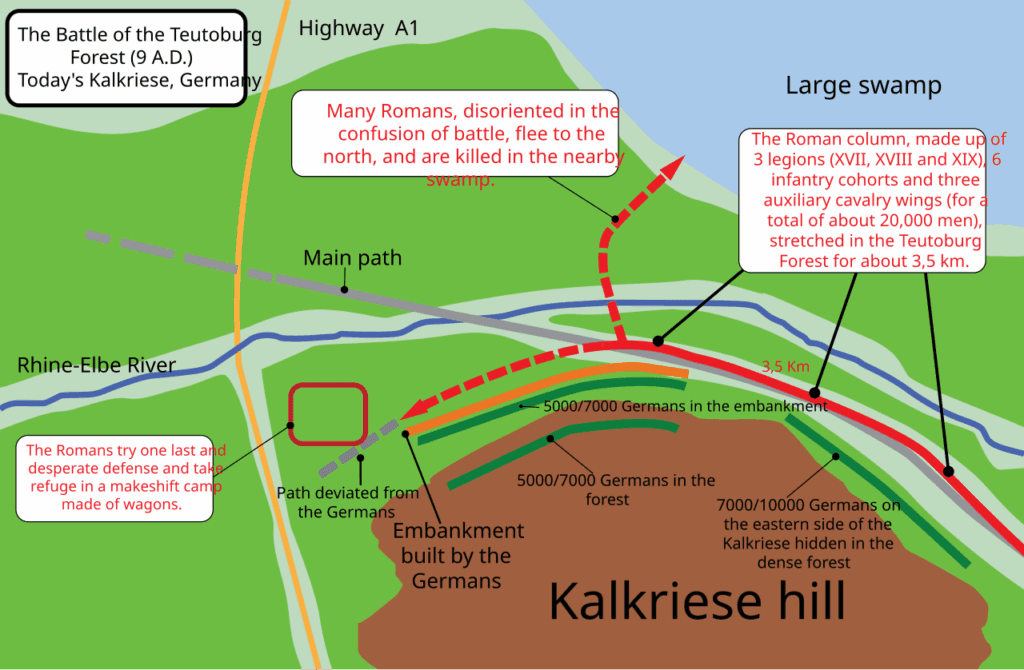
In 9 CE, the Roman governor Publius Quinctilius Varus marched three legions and auxiliaries through the forested wetlands of northern Germania. His guide, the Cheruscan noble Arminius, prepared the route. Along a forest edge by a marsh, Germanic warriors built earthen berms and cut brush screens that hid massed spears until the signal. Rain turned the road to muck. The Roman column stretched and fragmented as carts bogged down.
Arminius struck along the length of the line. Because the ground let only thin segments fight, legions that could have crushed a frontal assault bled in packets. The berms protected throwers and then jumpers with spears. The weather soaked bowstrings, the marsh denied cavalry, the brush broke signals, and the earthen bank created a steady firing platform. Over several days the Romans tried to break free, but the math never changed. The Germans kept fighting where frontage stayed small, visibility stayed poor, and exits were blocked.
The Caudine Forks: A Pass Turns Numbers to Hostages
Not every ambush requires slaughter. In 321 BCE during the Second Samnite War, Roman consuls marched into the Caudine Forks, a mountain valley connected by two narrow defiles. The Samnites blocked each exit with barricades. With no room to fight and no supplies, the Romans had numbers without power. They accepted humiliation and disarmament in exchange for release. This was the mathematics of the exit gate at work: when both doors shut, the bigger army suffers more because it consumes more and cannot wheel about. A fight would have meant disaster, so a ritual surrender followed.
The Caudine Forks teach several lessons that recur in bloodier cases. A scouting failure puts a large army into a narrow place that it cannot leave. Food and water flows matter as much as weapon swings. The ambusher’s strength is control of the doors and time, not a higher headcount.
The Sabis River: Seconds and Yards Decide Outcomes
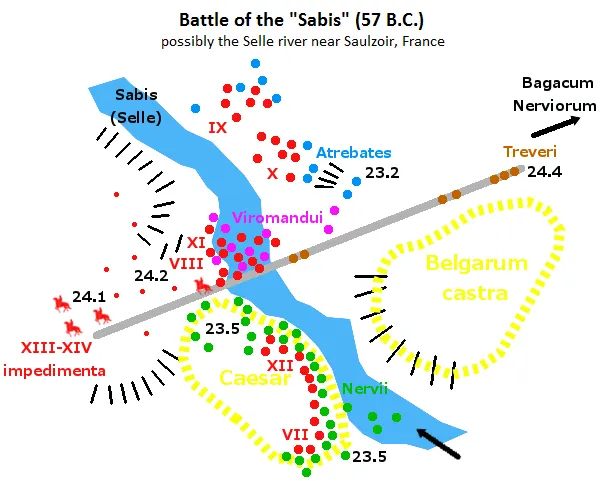
At the Sabis in 57 BCE, Caesar marched with his legions toward a riverside camp. The Belgic Nervii hid in tall brush on rising ground beyond the stream. They waited until Roman skirmishers and engineers were scattered, baggage trains were moving, and standards were not yet aligned. Then they charged. Caesar’s narrative emphasizes that the attack landed while cohorts were still arriving, with officers absent from their men. This is ambush mathematics on a clock. The Nervii used a veil of vegetation and a short distance to deny the Romans the ten minutes they needed to become legions instead of raw parts.
Caesar recovered with ad hoc leadership, pulling standards together and funneling reserves where the pressure was hottest. The Nervii came close because they turned the riverbank into a temporary defile and took away time. Here the arithmetic was nearly equal until Roman cohesion, once restored, reasserted the advantage of training.
Thermopylae and the Logic of Choke Points
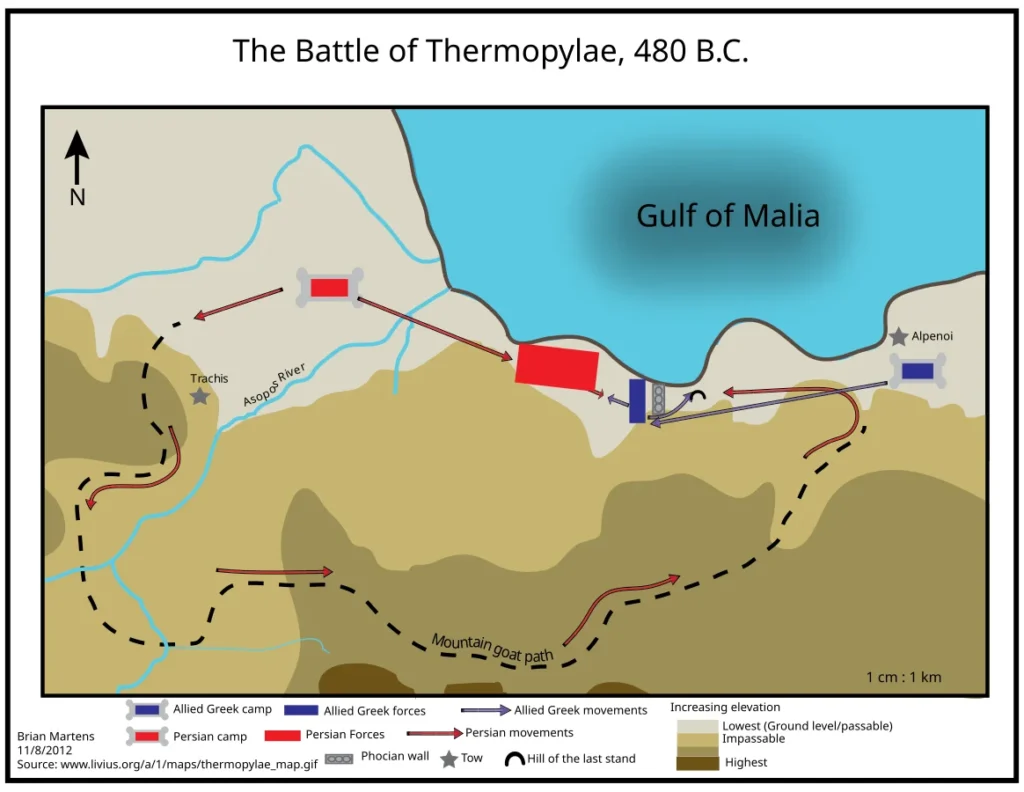
Thermopylae in 480 BCE is not an ambush story in the classic sense, because the Greeks expected contact. It is essential to ambush math because it shows how a narrow pass can erase a massed advantage. The coastal gate at Thermopylae forced the larger Persian army to attack on a frontage where only a few units could engage at once. The Greeks knowingly converted topography into a multiplier for discipline and armor. The flank path over the hills, revealed by local guides, shows the counter: if the victim can be hit from a second direction or if a hidden path exists, choke points fail. Control the exits, control the math.
Built out of a love for history, kept free from distractions.
Spoken Past is an independent project shaped by curiosity, care, and long hours of research. Reader support helps keep it maintained, carefully researched, and open to everyone.
A Cross-Cultural Case: Rivers, Wind, and Constrained Waterways
Although this study keeps to antiquity, riverine and coastal warfare obey the same arithmetic. At Red Cliffs in 208 CE, commanders fought in a stretch of the Yangtze where wind and current could trap fleets along a bank. Fire and tethered hulls turned a water lane into a kill zone. The lesson maps back to land. When wind, current, or tide squeezes movement into a predictable corridor, a smaller force that controls timing and angle can magnify itself dramatically. The ground is water, but the math is the same.
When Terrain Multiplies the Other Side
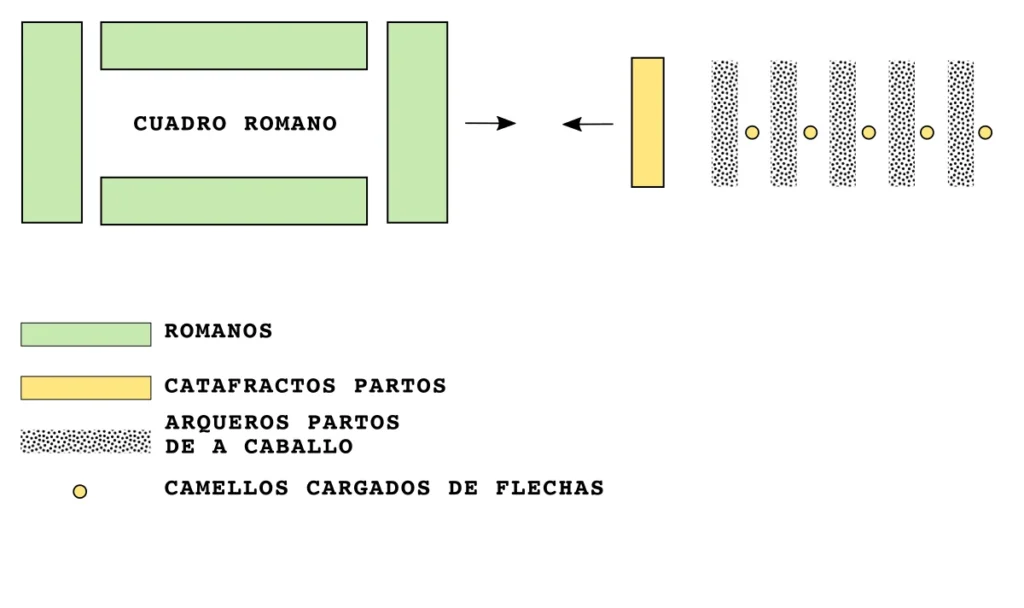
Ambush mathematics cuts both ways. At Carrhae in 53 BCE, Crassus marched into the wrong kind of openness. A flat, dry plain with short grass and few obstacles multiplied Parthian horse archers rather than Roman infantry. The Parthians controlled range and angle, showering arrows while cataphracts waited to charge disordered spots. Here the ambusher was not behind a hedge. He was in the negative space of the plain, using mobility and depth to keep the Romans from ever reaching a workable frontage. The lesson is simple: if the field favors the other arm, the math turns against you even with a larger headcount.
How Small Forces Build Ambush Power
Reconnaissance and Ground Proofing
Good ambushers do not just look at a map. They walk the route at the right hour. They measure how far a shout travels, where dew or fog sits, how many minutes a file needs to clear a bend, and which bushes truly hide a crouched man. In every successful ancient ambush, there is a guide, a local ally, or a commander who knows the ground intimately. Arminius served with the Romans before he served against them. Hannibal had scouts and Numidian riders who treated roads and gullies as tactical facts rather than lines on a chart.
Concealment That Endures Movement
Armies make noise even when they are still. The best ambush sites hide the approach and the wait, not only the first volley. Timber screens, folds in the ground, and reverse slopes keep shields, spearpoints, and helmet crests out of sight. In wooded country, men lie back from the edge until the signal, because the human eye notices contrast, not depth. In open country, the ambusher sits behind a swell or an earth bank, then runs the last yards.
Prearranged Signals and Phased Triggers
An ambush that fires too early burns away its advantage. One that fires too late hits the rear, not the head. Ancient forces used horn calls, flaming torches in daylight smoke, or fixed triggers like a cart crossing a tree with a notch. Hannibal’s camp used the lake fog as a scheduled screen. Arminius used the moment when carts stuck in muck to time the rush. The signal is not only a start flag. It synchronizes angles so that front, flank, and rear pressure combine.
Reserve and Exit Management
Small forces multiply themselves again when they reserve a strike group. If the victim breaks one point and tries to get through, the reserve plugs the breach. If the victim wavers at the front door, the reserve appears in the rear to collapse nerve. Controlling exits is the same as controlling morale, because men fight harder when they see a path out. The ambusher’s reserve closes that path at the worst moment. At Trasimene, cavalry roamed to block escape. At Teutoburg, repeated cutoffs forced the Romans from one bad place to another.
Ammunition and Fatigue Cycles
Projectile ambushes require stockpiles. A line of javelinmen that throws once and then has nothing left will be swept aside. Successful ancient ambushers pre-position baskets of stones, racks of spears, and stacks of arrows behind cover. They also rotate small groups in and out of the firing edge to manage breathing. Roman and Greek writers noticed how fatigue erased advantages. The small army that plans to be fresh for the second hour often beats a larger one that spent that hour stumbling into formation.
How Larger Armies Avoid the Trap
Scouts, Flankers, and Depth
A large army can dilute ambush math by creating multiple sensing layers. Light infantry or mounted scouts ride ahead and along the sides to feel out brush screens and berms. Flankers occupy ridges and woods before the main body steps into the funnel. Depth in marching order means having formed cohorts ready behind the baggage rather than a single long thread of unready men.
Bypass and Delay
If a road smells wrong, commanders can halt and shift to high ground, even at the cost of a day. It offends pride to pause when the enemy taunts, yet the arithmetic of time usually favors caution. Hannibal wanted Flaminius to chase at Trasimene. The safer answer would have been to camp on advantageous ground and send probes along the lakeshore at dawn.
Exit Assurance
Engineers can throw temporary bridges and clear secondary tracks before the main column commits. In a pass, small detachments seize far-side ridges to hold a door open. The goal is not comfort. It is to prevent the moment when a gate slams and the column becomes a hostage to terrain.
Weather Watch
Fog, rain, and wind each change visibility and footing. When a plan depends on signals, weather decides whether signals travel. If fog pools along a lake at dawn, a commander who insists on moving then is doing the enemy’s work. The defensive answer is simple: march when the enemy’s likely screen is weak.
What Ancient Sources Say, and How to Read Them
Ancient narratives are not manuals, so they must be read with care. Livy on Trasimene favors moral portraiture, yet he gives hard hints about ground and visibility. Caesar in the Commentaries is a sharp-eyed observer of time and alignment. Tacitus is terse and bitter about Roman mistakes in Germania, but he names the marsh and the barriers along the road. Polybius, though earlier, provides clear discussions of passes and the value of taking the ridge line. Each author uses his own lens, so variants appear. Where one says fog, another says dust, and a third says confusion. The consistent facts are the fixed geography, the forced compression of frontage, and the delay between alarm and formation.
Case Studies in Brief: The Same Arithmetic in Different Climates
Mountain Passes
In the Judean highlands at Beth Horon, rebel forces several times struck Roman or Seleucid columns in the ascent or descent. The basic conditions recur: narrow road, steep sides, and limited line of sight. Rebels rolled boulders, felled trees, and attacked the head and baggage simultaneously. With exits threatened, panic turned a controlled retreat into a rout. The lesson is the same from Italy to Judea: passes reward patience and reconnaissance, not speed.
Forest and Marsh
Northern Europe’s mixed forest and wet ground favored ambush. Narrow dry lanes acted like corridors through a building. If the corridor bends every hundred yards, sight collapses, and any voice command dies in the brush. An enemy who knows the corridors and their bends chooses where to strike. The defender who does not stops being an army and becomes a line of separate groups.
Riverbanks and Forcing Grounds
Rivers can protect a flank or trap a column against the bank. At the Sabis, the Nervii hid in brush above a steep margin. The river forced Romans to cross and climb into a hit. If the column is strung along the bank, then front, middle, and rear are fighting different fights. The counter is to secure crossings before the main body closes.
Open Plains
On a plain with firm ground, cavalry and light missiles rule. If an infantry army fails to entice the cavalry into poor terrain or to protect its flanks with ditches and stakes, the arithmetic of range and mobility multiplies the horsemen. Carrhae shows how openness can be the ambusher’s screen, because distance and dust hide where the next shower will fall.
Putting It Together: The Checklist Ancient Officers Actually Used
Officers who lived through one bad march learned a ritual before committing to a risky route.
- Walk the exit: make sure the far door exists and can be held.
- Test visibility: place a standard at a bend and ride back until it disappears; that is your signaling interval.
- Measure marching time through the funnel: know how many minutes the head will be alone.
- Occupy flanks before the column enters: use light troops to deny the classic ambush ledges.
- Weight the column for contact: put formed cohorts near the front and rear, not just baggage.
- Confirm weather risks: fog and rain are enemy allies if you need rapid signals.
- Secure ammunition: if you expect brush fighting, stock javelins and stones ahead of time.
- Keep a reserve: not only for fighting, but for holding the exit open when panic hits.
Small forces invert the list. They find the bend where a standard vanishes at fifty paces, they place their strong men at the flank ledge, they set a reserve to shut the door, they signal when the head is two minutes beyond the lip, and they make the first strike from two angles. That is the ambush mathematics that keeps repeating across centuries.
FAQ
How did ambushers keep large armies from simply turning to face them?
They forced contact where turning was impossible or too slow. In a steep defile, a column cannot widen. On a lakeshore road, water blocks one flank. In thickets or marsh, wheels and hooves bog down. The ambush hits before the head can form a broad front, and a second blow hits the rear or baggage so that officers must split attention.
Did cavalry ruin ambushes by riding around them?
Only in open country. In forest, marsh, broken hills, or along a banked road, cavalry loses speed and formation. Ambushers often placed stakes, felled trees, or used ditches to keep horses from turning the flank. Where the ground was open, as at Carrhae, ambushers were the cavalry.
How important was weather?
Weather often decided timing. Fog hides movement and muffles distance. Rain soaks bowstrings and turns tracks to mud, which stretches columns and creates the exact gaps ambushers need. Wind matters near water because it controls smoke and fire and it drives boats along constrained lanes.
Why do accounts sometimes disagree on the details?
Ancient authors wrote with different aims. Some wanted moral lessons, others wrote to defend decisions. Yet when you map the ground and the marching route, the core conditions repeat: compressed frontage, broken visibility, stolen minutes, and blocked exits.
Can a strong army ambush a strong army?
Yes. Ambush is not a poor man’s tactic alone. Hannibal had a quality army and used ambush to maximize it. Caesar’s legions themselves laid ambushes on a smaller scale, using woods and ravines to hit enemy foragers or rearguards. The principle is geometric, not social.
What is the single best defense against ambush?
Maintain scouts and flankers, and refuse to enter a funnel until exits are secured. The best defense is to avoid presenting the geometry that makes surprise lethal.