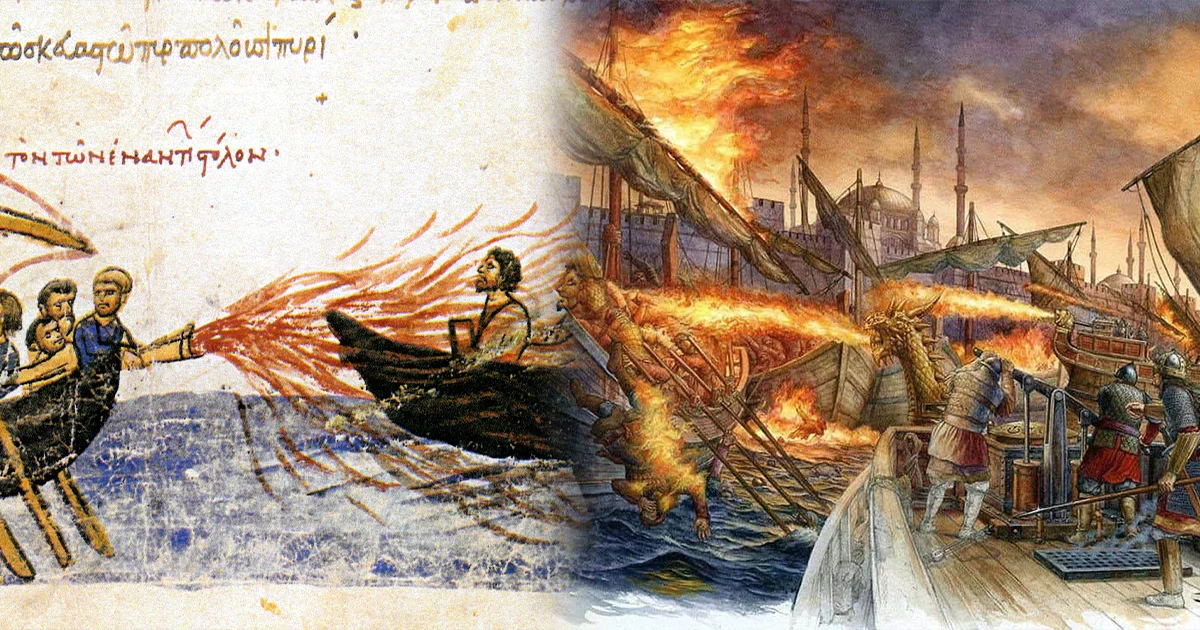
Greek fire was a liquid incendiary weapon deployed by the Byzantine navy from the late seventh century through the twelfth century that burned on water and resisted conventional extinguishing methods. The formula and delivery system are credited to Callinicus, an artificer from Heliopolis in Syria who arrived in Constantinople as a refugee during the reign of Constantine IV (668-685 AD). According to the Byzantine chronicler Theophanes the Confessor, writing in the early ninth century, Callinicus “prepared sea fire” and used it to ignite Arab ships during the first Muslim siege of Constantinople, allowing the Romans to “come back in victory”. The weapon’s primary delivery method involved bronze tubes called siphons mounted on warships known as dromons, though Byzantine forces also hurled clay pots filled with the substance or poured it from cranes.
The exact composition of Greek fire remains unknown because Byzantine emperors classified it as a state secret for more than four centuries. Primary sources describing the weapon include Theophanes’s Chronographia (composed circa 810-814 AD), Constantine VII Porphyrogennetos’s De Administrando Imperio (mid-tenth century), and the Tactica of Emperor Leo VI the Wise (895-908 AD). Modern scholars agree that petroleum naphtha formed the base, likely supplemented by quicklime, sulfur, resin, and other combustibles. The weapon gave Byzantium a decisive naval advantage during critical periods when Arab and later Russian fleets threatened the empire’s survival.
Theophanes And The Siege Of Constantinople 674-678
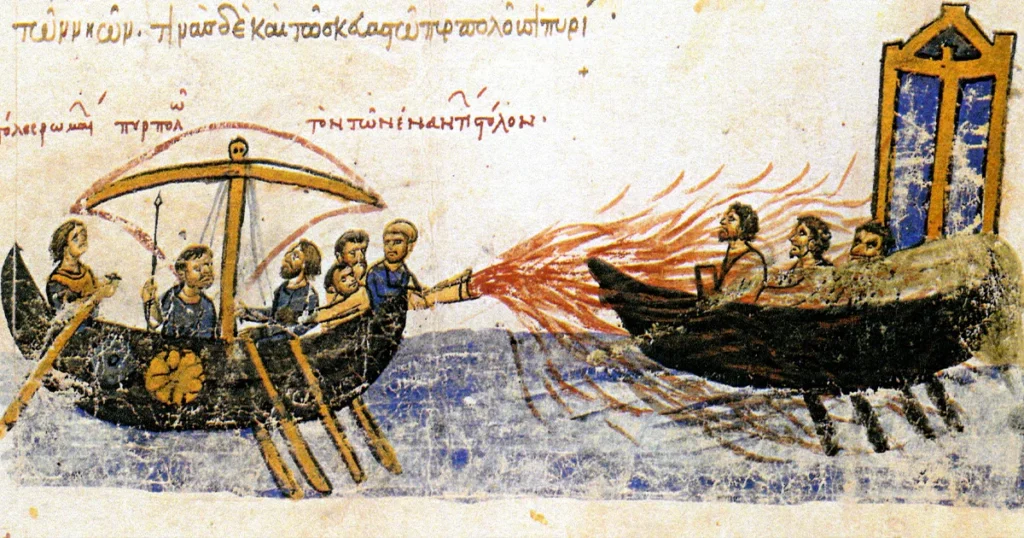
Theophanes the Confessor (circa 750s-818 AD) provides the earliest detailed account of Greek fire in his Chronographia, though the chronology of his narrative is confused. He records that in the Byzantine year 6164 (September 671 to August 672), Emperor Constantine IV stationed large biremes equipped with fire cauldrons and dromons carrying siphons in the small harbor of Caesarius on Constantinople’s southern shore. These preparations anticipated the arrival of Arab fleets intent on capturing the Byzantine capital.
According to Theophanes, the Muslim fleets did not reach Constantinople until the following year, besieging the city from April to September 673 before withdrawing to winter quarters at Cyzicus. The siege continued in this pattern for seven years by Theophanes’s reckoning, with Arab forces returning each spring to renew their assault. Only at the end of his entry for the year 6165 does Theophanes mention Callinicus by name, writing that “at that time Kallinikos, an artificer from Heliopolis of Syria, having taken refuge with the Romans and having prepared sea fire, ignited the ships of the Arabs and burned them with their crews”.
The chronological confusion in Theophanes’s account stems from his use of multiple source traditions, including a lost Syriac chronicle. The fact that he describes dromons equipped with siphons in 671-672 but attributes the invention to Callinicus in an entry dated 673 suggests either that the weapon was developed earlier than tradition held or that Theophanes conflated events from different years. Modern historians generally date the effective deployment of Greek fire to approximately 673-674 during the first major Arab naval assault on Constantinople.
Callinicus Of Heliopolis And The Syrian Formula
Callinicus (also spelled Kallinikos) was an architect and engineer from Heliopolis, a city in the Syrian province that had fallen to Arab conquest following the Battle of Yarmuk in 636 AD. As a Christian refugee fleeing Muslim rule, he brought technical knowledge to Constantinople during a period when the Byzantine Empire faced existential threats on multiple fronts. The title “artificer” used by Theophanes indicates that Callinicus possessed specialized craft knowledge, likely including familiarity with petroleum deposits and combustible mixtures used in the Near East.
Byzantine sources do not describe Callinicus as inventing an entirely new incendiary substance, as various fire weapons had existed in antiquity. His contribution was the combination of a particular liquid formula with a pressurized projection system that could shoot streams of flame at enemy vessels from a distance. This innovation transformed naval warfare by allowing Byzantine ships to set enemy vessels ablaze before they came alongside for boarding actions.
Later Byzantine tradition credited Callinicos’s descendants with maintaining control over Greek fire production through a hereditary guild. This familial monopoly reinforced the security protocols surrounding the weapon and ensured that manufacturing knowledge remained concentrated within a small group loyal to imperial authority. The geographic origin of Callinicus in Syria, a region with natural petroleum seeps, supports the hypothesis that naphtha formed the base of his formula.
Constantine VII And The Divine Secret
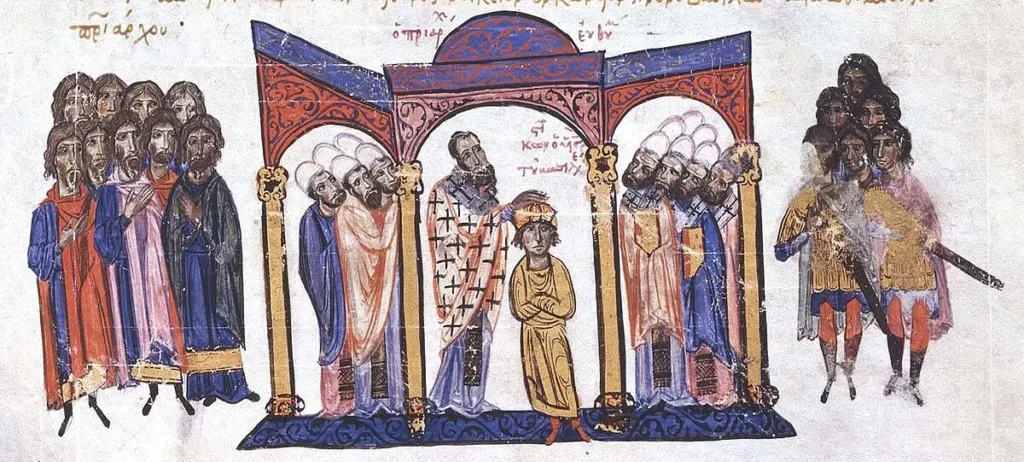
Constantine VII Porphyrogennetos (reigned 913-959 AD) addressed Greek fire directly in his manual De Administrando Imperio, composed as governing instructions for his son. When discussing the weapon, Constantine attributed its origin not to human invention but to divine revelation, writing that “an angel of the Lord appeared to the great and holy Constantine” and revealed the formula. This supernatural framing served multiple purposes: it elevated the weapon’s importance, reinforced its exclusively Byzantine character, and made disclosure tantamount to sacrilege.
Constantine’s text included explicit prohibitions against sharing the secret with foreign nations. He warned that previous emperors who had been asked to provide Greek fire to allies “were condemned and anathematized by the whole senate and by the Church” and that those who revealed it would face divine punishment. These warnings combined religious sanction with political enforcement to maintain operational security across generations.
The emperor’s manual also contained practical information about petroleum sources within Byzantine territory, indicating that supply logistics formed part of imperial defense planning. Constantine specified regions where crude oil could be obtained and stored, ensuring that the raw materials for Greek fire production remained under state control. This administrative dimension reveals that maintaining the weapon’s effectiveness required coordination between military operations, resource extraction, and manufacturing workshops.
Petroleum Naphtha As The Base Ingredient
Although no Byzantine source provides a complete recipe for Greek fire, converging lines of evidence point to petroleum as the primary component. The alternative name “liquid fire” used in Byzantine texts suggests a fluid rather than solid base, and references to the substance being “prepared” or “shot” indicate a pumpable consistency. Natural petroleum seeps occurred throughout the Byzantine world, particularly around the Black Sea, in Syria, and in certain Aegean islands.
The Greek term “naphtha” designated petroleum products in ancient and medieval usage, and Byzantine sources occasionally refer to Greek fire as “prepared naphtha” or “artificial fire” to distinguish the weaponized mixture from raw crude oil. Chemical properties of petroleum explain several characteristics attributed to Greek fire in historical accounts: it floats on water, burns at high temperatures, produces thick smoke, and cannot be extinguished by dousing with water alone. These qualities made it particularly effective in naval combat, where enemy crews had limited means to fight fires aboard wooden ships.
Modern scholarly debates about Greek fire’s composition focus on identifying the additives that enhanced crude oil’s incendiary properties. Proposed ingredients include:
- Quicklime (calcium oxide), which reacts violently with water to generate heat
- Sulfur, which lowers ignition temperature and produces noxious fumes
- Resin or pitch, which increases viscosity and helps the mixture adhere to targets
- Saltpeter (potassium nitrate), though evidence for its use before the thirteenth century remains debatable
The specific proportions and preparation methods remain unknown, and it is likely that the formula varied across different manufacturing centers or evolved over the weapon’s four-century history.
Built out of a love for history, kept free from distractions.
Spoken Past is an independent project shaped by curiosity, care, and long hours of research. Reader support helps keep it maintained, carefully researched, and open to everyone.
Siphon Projection Systems On Dromons
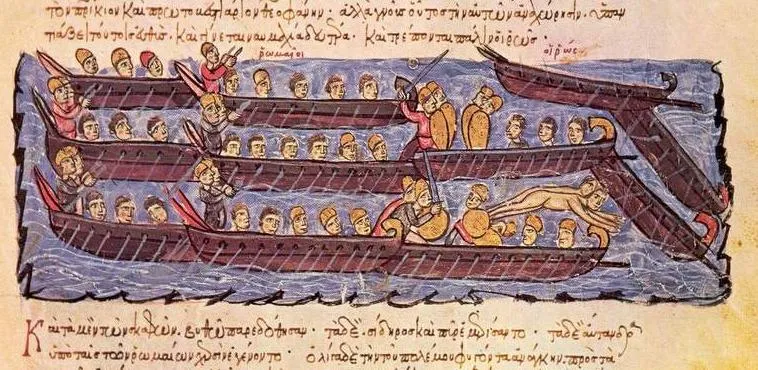
The defining characteristic of Greek fire as a Byzantine weapon system was projection through bronze tubes called siphons, distinguishing it from earlier incendiaries that were simply thrown or poured. Siphons were mounted on dromons, the empire’s primary warships, typically positioned in the bow beneath the forecastle where they could target approaching enemy vessels. Additional siphons could be installed amidships or at the stern on larger dromons, providing coverage in multiple directions.
The tenth-century emperor Leo VI describes siphon operation in his Tactica, noting that the devices shot liquid fire “through tubes” and required careful handling to avoid accidents. Contemporary manuscript illustrations, particularly in the Madrid Skylitzes manuscript (circa 1160), depict dromons with prominent tube projectors at the bow, often shown emitting flames toward enemy ships. These visual sources confirm textual descriptions and provide evidence for the siphon’s external appearance and mounting configuration.
Modern reconstructions suggest that siphon systems incorporated several components: a reservoir or pressure vessel to hold the liquid fire under compression, a heating element (likely a brazier) to raise the temperature of both the nozzle and the fluid, and a valve mechanism to control discharge. The bronze construction allowed the device to withstand heat without melting and prevented corrosion from the petroleum-based mixture. Pressure was likely generated through manual pumps operated by crew members, similar to Roman-era force pumps used for firefighting and bilge water removal.
The effective range of siphon-projected Greek fire remains uncertain, but tactical descriptions in Leo VI’s Tactica suggest it was employed at relatively close range after initial exchanges of arrows and javelins. Byzantine naval doctrine called for dromons to approach enemy vessels while projecting fire, then coupling alongside for boarding actions once the enemy’s fighting capacity had been degraded by flames and casualties.
Hand-Held Cheirosiphons And Clay Grenades
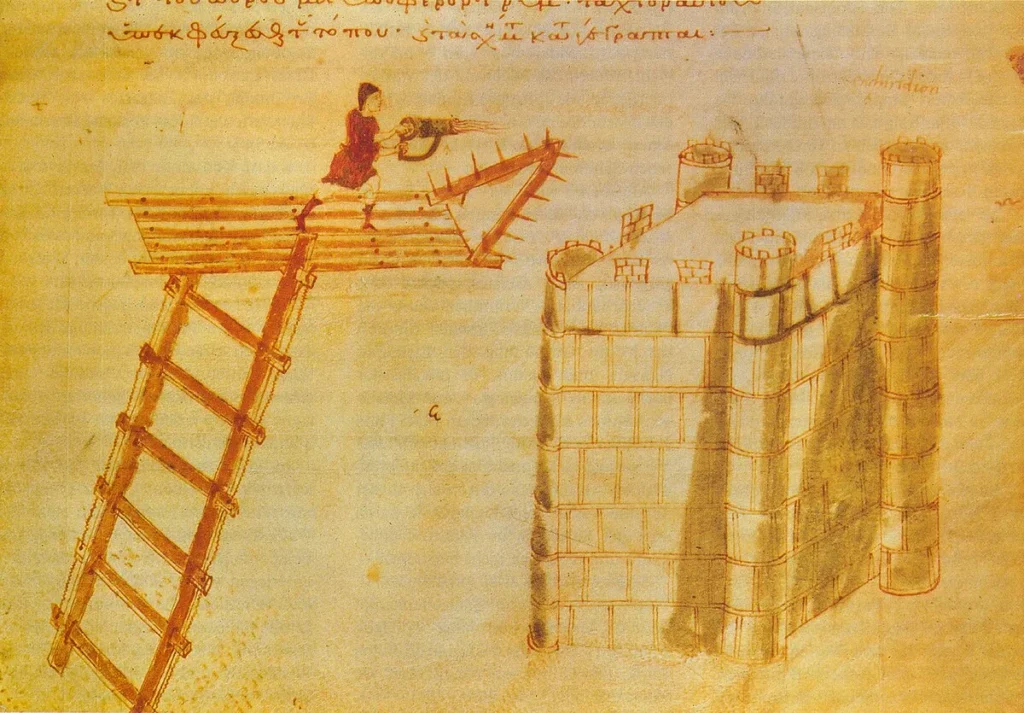
While ship-mounted siphons represented the primary delivery system for Greek fire in naval warfare, Byzantine forces employed alternative methods for siege operations and defensive actions. Hand-held projectors called cheirosiphons (from the Greek meaning “hand siphon”) allowed individual soldiers to spray liquid fire at enemy formations, siege engines, or defenders on city walls. These portable flamethrowers appear in tenth-century military treatises and in manuscript illustrations showing soldiers operating pump-action devices.
Cheirosiphons extended the tactical application of Greek fire beyond naval contexts, making it available to field armies conducting sieges or defending fortifications. Byzantine military manuals prescribe their use against wooden siege towers and battering rams, where the incendiary effect could destroy expensive equipment and disrupt assault operations. The psychological impact of flame weapons enhanced their effectiveness, as soldiers facing jets of burning liquid often broke formation even before suffering significant casualties.
In addition to siphon projection, Byzantine forces deployed Greek fire in sealed clay vessels that functioned as incendiary grenades. These containers, called chytrai or tzykalia in Greek sources, were filled with the combustible mixture and hurled by hand or catapult at enemy ships and troops. Archaeological examples recovered from sites including Chania on Crete confirm the use of ceramic grenades between the tenth and twelfth centuries. The vessels typically measured 10 to 15 centimeters in diameter and featured narrow necks that could be sealed with wax or pitch to prevent leakage.
Leo VI Tactica And Tactical Deployment
Emperor Leo VI the Wise (reigned 886-912 AD) incorporated detailed instructions for Greek fire deployment in his Tactica, a comprehensive military manual composed between 895 and 908 AD. The naval sections of the Tactica, also circulated separately under the title Naumachika, describe how dromon crews should coordinate the use of siphons with other weapons and maneuvers during sea battles. Leo emphasizes that Greek fire should be employed after archers and javelin throwers had engaged the enemy but before attempting to couple ships for boarding.
The Tactica specifies that siphon operators required specialized training and that dromons carrying Greek fire needed additional crew members to manage the weapon system. Leo recommends positioning the most experienced soldiers near the siphon to protect the operators and exploit openings created when enemy crews recoiled from the flames. He also describes defensive uses of Greek fire, including projecting it at enemy vessels attempting to couple with Byzantine dromons or using it to break free from grappling attempts.
Nikephoros Ouranos, a Byzantine general writing in the late tenth century, paraphrased and expanded Leo VI’s Naumachika with additional tactical observations based on campaign experience. Nikephoros describes using Greek fire to target enemy oarsmen through their oar ports, a technique that disabled ships by killing or wounding the rowers needed for propulsion. He also mentions employing pikes thrust through thalamian (lower bank) oar ports to breach enemy hulls below the waterline, causing them to flood and sink.
The Loss Of The Formula After 1204
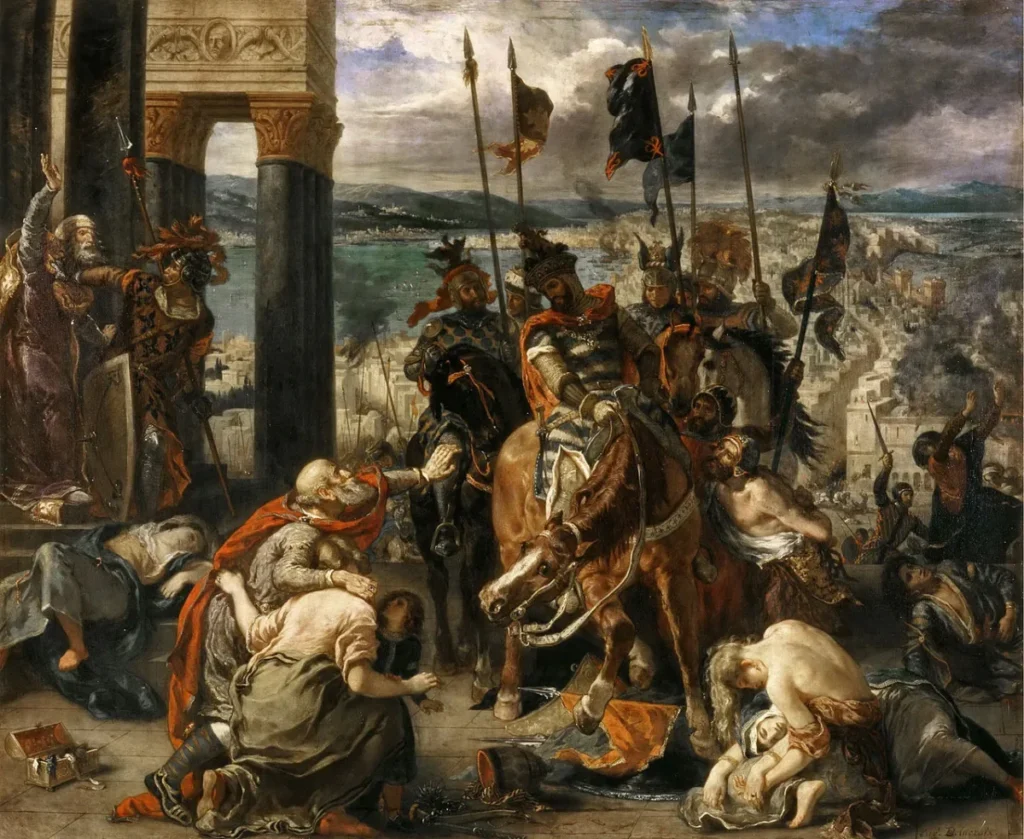
Greek fire remained an effective Byzantine weapon through the eleventh century, but references to its use decline dramatically in twelfth-century sources. The final documented deployment occurs during the reign of the Komnenian emperors, after which the weapon disappears from both Byzantine and foreign chronicles. Several factors contributed to the loss of Greek fire’s formula and manufacturing capability following the Fourth Crusade’s sack of Constantinople in 1204.
The collapse of centralized imperial authority during the Latin occupation of Constantinople (1204-1261) disrupted the administrative structures that had maintained production security for centuries. The hereditary guilds controlling manufacture were scattered, and the Byzantine successor states established at Nicaea, Trebizond, and Epiros lacked the resources and institutional continuity to reconstitute Greek fire production. When the Palaiologian dynasty restored Byzantine rule in Constantinople in 1261, more than half a century had passed since the weapon’s last use, and the knowledge chain had been broken.
The secrecy protocols that had protected Greek fire for four centuries became the mechanism of its loss. By restricting knowledge to a small group of manufacturers and prohibiting documentation of the formula, Byzantine emperors ensured that disruption of this group would result in total loss of capability. No written recipe survived, and oral transmission within family workshops proved vulnerable to the political catastrophes of the early thirteenth century.
Modern Reconstruction Attempts And Scholarly Debate
Twentieth and twenty-first century scholars have attempted to reconstruct Greek fire through analysis of Byzantine textual sources, chemical experiments with proposed ingredients, and practical testing of siphon delivery systems. The historian John Haldon conducted notable experiments building functional siphon projectors based on Byzantine descriptions and Roman-era pump technology, demonstrating that pressurized projection of flaming liquids was technically feasible with medieval materials and methods. These reconstructions confirmed that petroleum-based mixtures could be shot several meters and would continue burning on water surfaces.
Chemical analysis suggests that a mixture of petroleum distillates (naphtha), resin, and sulfur would produce effects consistent with Byzantine descriptions: difficult to extinguish, capable of burning on water, and producing thick smoke. The addition of quicklime would explain accounts of Greek fire igniting or intensifying when doused with water, as calcium oxide’s exothermic reaction with water generates sufficient heat to reignite petroleum vapors. However, no modern reconstruction can be verified as matching the original Byzantine formula, and scholarly debates continue regarding specific proportions and preparation techniques.
Appendix Six of Pryor and Jeffreys’s The Age of the ΔΡΟΜΩΝ (2006) synthesizes current scholarship on Greek fire, emphasizing that the term became generic in medieval Arabic and Latin sources for various incendiaries, complicating efforts to identify references to the specific Byzantine weapon. The authors note that “the entire debate about Greek Fire has been bedevilled by the fact that the term became used widely in both Arabic and Latin for almost any combustible, irrespective of the delivery system”. This linguistic confusion requires careful source criticism to distinguish siphon-projected liquid fire from catapult-hurled pots or other flame weapons.