A Viking king trapped in a burning hall because he was too fat to squeeze through the doorway makes an unforgettable story. The trouble is finding a medieval text that actually tells it. The surviving accounts of Scandinavian rulers who died in fires describe attacks, revenge, religious conflict and, in one case, a king who ordered his own hall burned. None of these surviving medieval accounts attributes a ruler’s failure to escape to his body size.
There are several real stories that might be confused with it. The Icelandic Njáls saga gives an extraordinarily detailed account of a family burned inside its farmhouse. The Swedish king Ingjald is said to have died in a fire of his own making. Another Swedish ruler, Blót-Sveinn, is attacked in a burning house. And the Norwegian king Olaf Haraldsson was known as Olaf the Stout, although his death took place on a battlefield in 1030. These are different people, different episodes and different kinds of evidence.
The distinction matters because a saga is not a recording made at the scene. Many of the narratives were written down in thirteenth-century Iceland, long after the events they claim to describe. Their authors cared about kinship, legitimate rule, vengeance, Christian belief and the reputations of the dead. Those interests shaped the stories they told. The tale about a king too large for a doorway has no identified place in that surviving evidence, and there is no established history of how the modern version originated.
Why burning a hall was such a serious threat
A powerful Scandinavian household needed a building large enough to receive guests, distribute food, negotiate alliances and accommodate dependants. At many sites the principal structure was a longhouse, a timber-framed building whose walls could include turf and whose roof might be thatched or covered with turf. Its arrangement varied by place, period and status. Some buildings combined living space with a byre or storage rooms; others had substantial halls intended for feasting and political display. A fire threatened the household’s people and the material setting of its authority.
The tactic called house-burning in Icelandic saga literature exploited that vulnerability. Attackers could surround a building, set combustible material alight and prevent defenders from leaving. A house that offered protection from weapons became dangerous once the fire spread. The attackers did not need to breach the door while the defenders still had the advantage of shelter. In the sagas, burning people indoors could end a feud decisively, yet the means of killing raised questions about honour and responsibility.
The archaeological evidence requires a separate judgement. Burned postholes or layers of charcoal can demonstrate that a structure was damaged by fire; they cannot, on their own, identify arson, a named victim or the motive. A forensic archaeological investigation at Borgring, a Viking Age ring fortress in Denmark, examined how traces of burning might reveal the course of a fire. Anders Bornfalk Back’s study of burned Iron Age farms around Uppsala similarly argues that patterns across multiple sites can help identify periods of violence. Neither study proves a particular saga episode happened as narrated. Their value lies in showing what physical evidence can and cannot establish.
The burning of Njáll’s house
The best-known Icelandic account concerns Njáll Þorgeirsson, an experienced legal adviser who lived at Bergþórshvoll in southern Iceland. Njáls saga follows the relationships between his household, the warrior Gunnar of Hlíðarendi and rival families whose disputes gradually become lethal. Njáll’s sons participate in the killing of Höskuldr, a man Njáll himself had fostered. Attempts to settle the killing through the Icelandic assembly, the Alþingi, fail. Flosi Þórðarson and his supporters then set out to avenge Höskuldr by attacking Njáll’s home.
The Iceland described in the saga had no king or standing royal police force. Chieftains, households and their allies pursued lawsuits, paid compensation and, when settlements failed, sometimes resorted to violence. The Alþingi was a national meeting place for legal proceedings and political negotiation. Its institutions are central to the story because the burning is presented as the disastrous outcome of a dispute that people repeatedly had opportunities to resolve. The saga’s treatment of law is one reason its author spends so much time on agreements, insults, witnesses and the consequences of revenge.
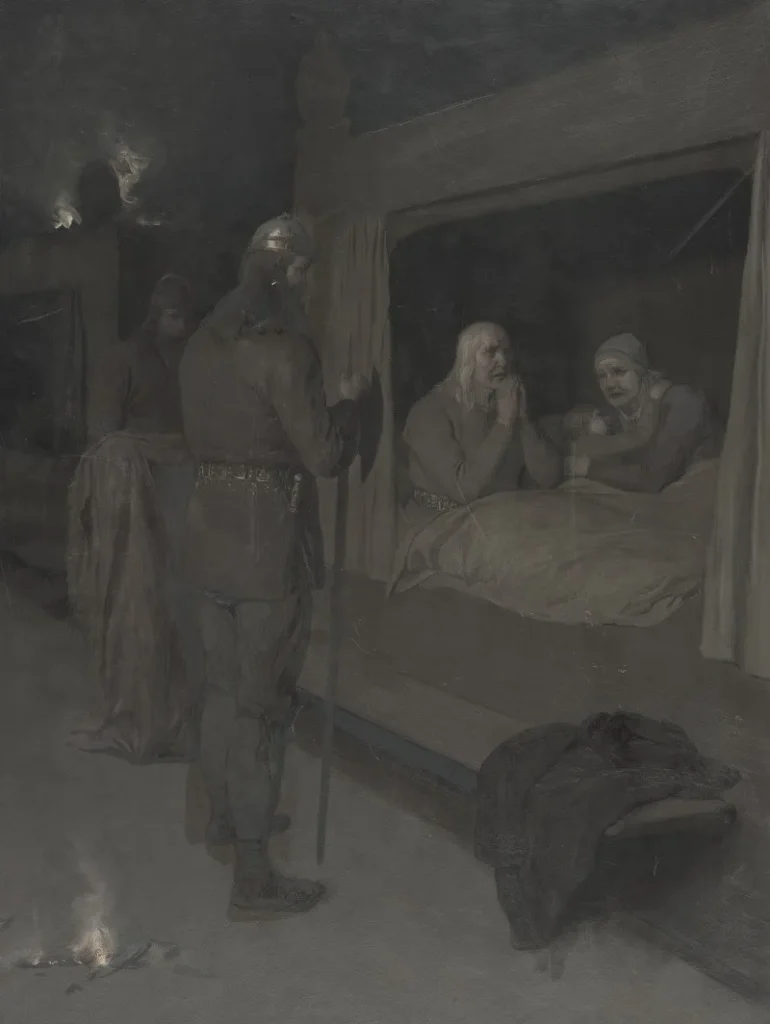
In the burning episode of Njáls saga, Flosi’s men surround the farmhouse and station guards to watch for possible exits. The defenders resist from inside, using their position to make a direct assault costly. Flosi then decides to burn the house. The saga makes him acknowledge the gravity of the choice: these are Christians about to kill other Christians by fire. The author is not describing an ingenious solution to a narrow doorway. He is showing how a feud has reached a point at which the attackers are willing to commit an act they recognise as morally dangerous.
The first attempts to light fires by the doors fail when women inside throw whey and water onto the flames. One attacker then proposes putting burning material in a loft above the hall. The people inside do not realise what has happened until fire spreads overhead. More fuel is placed outside the doors. The sequence is unusually specific about how the attack proceeds, but it remains a literary narrative written long after the events it depicts. Its physical details cannot be treated as a forensic reconstruction of a particular fire.
Flosi refuses a settlement that would spare Njáll’s sons, yet he allows women, children and servants to leave. Helgi, one of Njáll’s sons, tries to get out disguised as a woman. He is recognised and killed. Njáll himself is offered safe passage, but refuses. In the saga’s account, he is old and does not wish to live after his sons in dishonour. His wife Bergþóra also stays, saying that they had promised to share their fate. Their young grandson Þórðr remains with them. The three lie down beneath an ox-hide as the house burns.
Not everyone dies. Kári Sölmundarson, Njáll’s son-in-law, escapes and becomes the principal avenger of the burning. The narrative follows him through subsequent killings, legal conflict and eventual reconciliation. The survival of Kári is crucial to the plot: the attackers’ attempt to end one conflict produces another. The scene is therefore about choices and their consequences, as well as the practical difficulty of escaping a house under armed siege. No one is described as being physically unable to pass through a doorway because of their weight.
The saga probably took its surviving literary form around 1280, while its main action is set in Iceland around the turn of the eleventh century. Annette Lassen’s scholarly overview stresses the author’s careful composition and engagement with legal, Christian and earlier literary material. The 2018 study of its manuscript tradition likewise shows that its text continued to be copied and interpreted. A saga can preserve memories of real people and events without giving us every spoken exchange or tactical detail exactly as it happened.
Ingjald, the Swedish king who burned his own hall
The story of Ingjald, called hinn illráði, usually translated as the Ill-Ruler or Ill-Advised, belongs to a different tradition. In Ynglinga saga, the opening work of Snorri Sturluson’s Heimskringla, Ingjald rules among the early kings associated with Uppsala. The narrative is partly legendary and reaches back into a past for which contemporary written evidence is scarce. It should not be read as a secure royal biography with reliably dated episodes.
Snorri first presents Ingjald as an aggressor who invites neighbouring rulers to a feast in a new hall. When his guests are drunk, he has the building set on fire. The rulers trapped inside die, and Ingjald takes over their territories. This earlier episode is important: the same ruler who later dies in a burning hall is first described as using a hall fire to kill political rivals. The narrative makes his eventual death look like the reversal of his own method of gaining power.
In the account of Ingjald’s end, a ruler called Ívarr víðfaðmi, Ivar the Wide-Fathoming, gathers an army against him. Ingjald is at a feast at Ræning with his daughter Ása. He concludes that he cannot defeat Ivar and that flight would leave him surrounded by enemies. Father and daughter make the people in the hall drunk and have the building set alight. The hall and those inside burn. Snorri’s Old Norse account presents the act as a deliberate response to an impossible political position, with no suggestion that the king was stuck in an exit.
Ynglinga saga also incorporates verses attributed to the poet Þjóðólfr of Hvinir, whose Ynglingatal traces a royal ancestry through stories of deaths and burials. The verses are important evidence for the tradition behind Snorri’s prose, although their dating, transmission and relationship to historical events require care. Snorri was writing centuries after the supposed early Swedish kings. The presence of an old-looking poem does not allow us to verify the precise circumstances of Ingjald’s death, the location of Ræning or the existence of every named ruler.
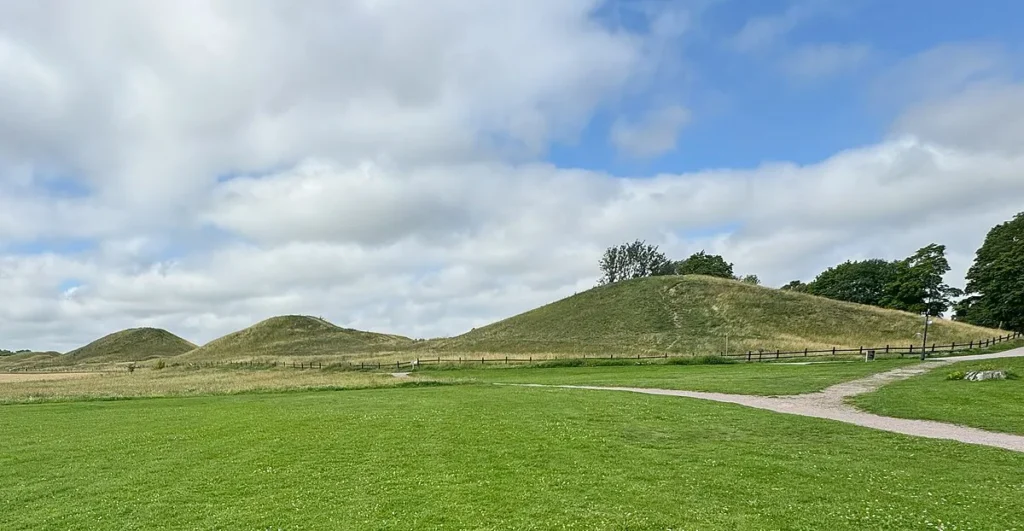
The great burial mounds at Gamla Uppsala show that the region contained a powerful elite in the sixth and seventh centuries. They do not identify Ingjald or prove that a particular burning in the saga took place. Connecting a legendary royal name directly to an archaeological feature would require evidence that the site does not presently supply. The mounds help explain why Uppsala became a setting for royal memory; they are not a photograph of Snorri’s story.
Another Olaf was burned, but he was not Olaf the Stout
The next generation in Ynglinga saga adds a second royal death by fire. Ingjald’s son Óláfr trételgja, usually called Olaf Tree-Feller, leaves Sweden and settles in Värmland. According to the saga, many people follow him, food becomes scarce and the population blames its ruler for the poor harvests. The people accuse Olaf of neglecting sacrifices and burn him in his house as an offering to Odin. The account belongs to the same uncertain early royal genealogy as Ingjald’s story.
Olaf Tree-Feller must not be confused with Olaf Haraldsson, the eleventh-century Norwegian king later venerated as Saint Olaf. They share a common royal name, but the stories place them in different periods and give them entirely different deaths. The Tree-Feller narrative links fire to famine, kingship and sacrifice. It says nothing about a king’s size, and its explanatory pattern reflects a medieval author’s understanding of older pagan traditions rather than a verified record of a sacrifice.
Enjoying Spoken Past?
I created Spoken Past to share my love of history. I research, write and develop everything myself, and I want my articles and basic guides to remain free for everyone.
If you enjoy my work, please consider supporting Spoken Past with a small donation.
Blót-Sveinn: the king who escaped the fire and was killed
Blót-Sveinn, or Svein the Sacrificer, appears in traditions about the struggle over Christianity in late eleventh-century Sweden. In the version preserved at the end of Hervarar saga ok Heiðreks, King Inge refuses to take part in pagan sacrifice and is driven out. Sveinn offers to perform the rites and is accepted as king. After several years, Inge returns with a small force, surprises Sveinn at dawn and sets fire to the house in which he is staying.
The critical detail is what happens next. In Nora Kershaw’s translation of the saga’s closing royal genealogy, Sveinn comes out of the house and is immediately killed. One of his men, Þjófr, is said to have burned inside. This account is direct evidence against any claim that Sveinn died because he could not fit through the exit. He does get out. A different narrative associated with Orkneyinga saga compresses the episode into a report that Inge trapped and burned Sveinn in a house, without the same detail about his escape. The versions do not agree about exactly how he died.
Neither version should be treated as an eyewitness record. Their surviving forms reflect medieval Scandinavian and Icelandic perspectives on the establishment of Christian kingship, and their descriptions of pagan practice serve the story of a ruler’s legitimacy. A dispute about the final moments of a king’s life cannot be settled by combining the most dramatic elements of conflicting texts. In neither version examined here does the king’s weight explain his death.
Olaf the Stout died at Stiklestad
The famous king whose nickname actually refers to physical build is Óláfr Haraldsson, who ruled Norway from about 1015 until 1028. He is known in Old Norse as Óláfr digri, usually rendered Olaf the Stout or Olaf the Thick. The adjective tells us how he was described, but it does not establish a medical condition, his exact weight or whether he could move through a particular doorway. Medieval nicknames could be descriptive, ironic, political or traditional. Treating one as a clinical measurement is an error.
Olaf’s career is unusually well connected to the politics of his age. He fought to establish authority over Norway, sought to strengthen royal power and promoted Christianity. Opposition from powerful Norwegian families and the influence of Cnut, ruler of England and Denmark, eventually forced him from the kingdom. Olaf returned in 1030 in an attempt to recover his position. His campaign ended at the Battle of Stiklestad in Trøndelag, where he was killed. His later cult as Saint Olaf transformed the defeated king into one of medieval Norway’s most influential sacred figures.
The surviving narratives disagree over some particulars of the battle, and later accounts interpret his death through the lens of sainthood. Snorri’s saga of Olaf Haraldsson, in a modern scholarly translation, devotes extensive attention to his return, the fighting and the development of his cult. None of that account places Olaf in a burning hall at his death. The event is a battle, not an escape attempt. The king’s epithet cannot supply the missing episode.
It is tempting to explain the popular tale by saying that people blended Olaf’s nickname with Ingjald’s death and the burning in Njáls saga. That is possible as a modern misunderstanding, but it has not been demonstrated. Without an identifiable early retelling, a dated printed version or another traceable chain of transmission, such a proposed origin remains speculation. The evidence supports a narrower conclusion: the known stories differ from the claim, and the claim itself still needs a source.
What the buildings and archaeology can actually tell us
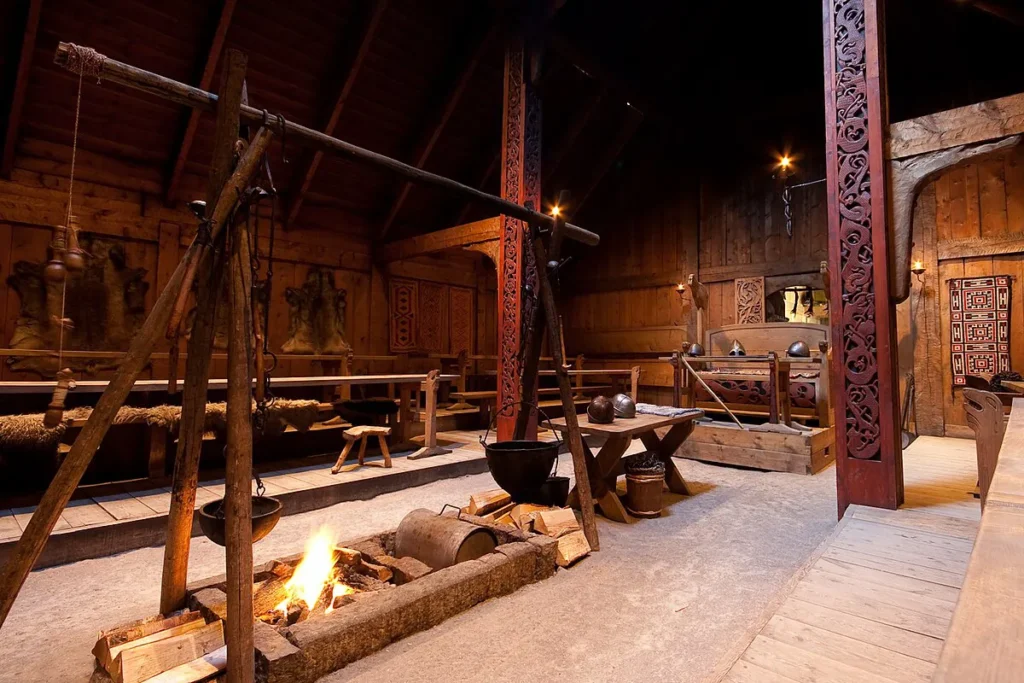
A longhouse was not necessarily a small hut with one tiny door. The excavated elite complex at Borg in Norway’s Lofoten islands included a very large building. Museum Nord’s account of its reconstruction gives a length of 83 metres and a width of 12 metres for the reconstructed chieftain’s house, which represents a late phase of the building. Its rooms had different uses, and archaeological interpretation draws on hearths, artefact distribution and soil chemistry. This is a valuable example of the scale a powerful household could command, although it cannot stand in for every house described in every saga.
A building’s entrances, internal divisions, roof covering and fuel load would affect how fire developed and how people might escape. Smoke and heat are dangerous, and attackers controlling an exit would make survival still harder. The evidence examined here does not justify those universal claims. Modern fire investigation depends on the specific building, ventilation, ignition point and materials. A reconstructed hall or a burned archaeological deposit does not establish what happened at the doorway of a named medieval ruler’s house.
The physical problem in the fat-king tale is therefore doubly unsupported. There is no identified medieval passage about the king being too large to escape, and there is no evidence for the measurements or circumstances of the alleged doorway. We cannot test an imagined body against an imagined exit. By contrast, Njáls saga supplies a clear narrative reason why its victims were trapped: enemies controlled the building and decided whom to let out.
How to distinguish a saga episode from a modern anecdote
When a historical anecdote is repeated without a name, a text or a date, the first question is where its earliest recoverable version appears. A claim about a Viking king should be traceable to a saga chapter, a chronicle, a poem, a later retelling or a modern writer who cites one of those. Each step matters. A modern summary may simplify a saga; a saga may reshape an earlier poem; a thirteenth-century author may interpret a much older event according to the values of his own society.
The word Viking itself also needs care. It can describe seaborne raiding and the wider Scandinavian Viking Age, usually placed from the late eighth to the eleventh century. Ingjald’s story belongs to a legendary earlier royal past, while Njáls saga concerns Icelandic farmers and chieftains whose disputes were not royal affairs. Treating every northern figure in these narratives as an interchangeable Viking king erases distinctions that the sources make. The difference between mythological royal ancestry, Icelandic family saga and eleventh-century political history is essential to understanding what can be verified.
The problem of using Snorri Sturluson as a historical source is especially important here. His accounts preserve material that might otherwise be lost, including earlier verse, yet his narrative decisions were shaped by the literary and political concerns of medieval Iceland. An episode told by Snorri is evidence that a story was circulating in the form he recorded. It is not automatic proof that the event occurred as he described it. The same distinction applies to the richly developed burning scene in Njáls saga.
No identified primary source says that Olaf the Stout, Ingjald, Blót-Sveinn or Olaf Tree-Feller was unable to escape a fire because of his body size. Ingjald is said to have ordered a hall burned; Blót-Sveinn is said in one version to have escaped a burning house before being killed; Olaf Tree-Feller is said to have been sacrificed in a fire; and Olaf Haraldsson died fighting at Stiklestad. These are the actual accounts against which the popular story must be measured. Until an earlier text is produced, the fat-king anecdote should be presented as unsubstantiated, not as a forgotten incident of Viking history.