
In 712 CE, the compiler O no Yasumaro presented Empress Genmei of Japan with a manuscript called the Kojiki, the Records of Ancient Matters. It is the oldest surviving literary work in Japanese and the primary written source for the Shinto religion. In its first book, among the myths of the age of the gods, one episode stands apart for its structure, its imagery, and its consequences for later Japanese history. A storm god descends to earth, finds a family destroyed by grief, and kills an eight-headed serpent using nothing more violent than very strong sake and a well-designed fence. That serpent is Yamata no Orochi, and its death produces a sword so perfect that it stalls a divine blade mid-stroke and eventually becomes one of Japan’s Three Imperial Regalia. This post examines the myth in full: its sources, its cast, its geography, the mechanics of the trick, and the meaning of what the god finds when he splits open the last tail.
The two chronicles that carry the myth
The story survives in two early Japanese chronicles completed eight years apart. The Kojiki was presented to the imperial court in 712 CE and is the older record. The Nihon Shoki followed in 720 CE. Inoue Nobutaka, Professor of Religious Studies at Kokugakuin University in Tokyo and general editor of the Kokugakuin Encyclopedia of Shinto, describes the two texts as complementary rather than competing sources: the Kojiki presents a single authoritative version of each myth, while the Nihon Shoki systematically records variant tellings under the heading “one account says,” preserving regional divergences that the Kojiki’s unified voice suppresses.
The difference in method shapes how the Orochi episode reads in each. The Kojiki version is tightly structured, its repetitions deliberate and incantatory, its sequence of eights (eight heads, eight tails, eight vats, eightfold fence) giving the episode a ritual completeness. The Nihon Shoki version adds geographical alternatives and minor variations in names, reminding the reader that the myth belonged to specific communities in specific river valleys before it became national property. For anyone wishing to read the episode in English, Basil Hall Chamberlain’s 1882 translation of the Kojiki, hosted in full by the Internet Sacred Text Archive at sacred-texts.com, remains the most accessible starting point.
The political purpose of both chronicles also deserves a word. Empress Genmei commissioned the Kojiki to establish a written record of imperial genealogy and divine origin at a moment when Japan was consolidating its state structures along Chinese bureaucratic lines. The myth of Susanoo and Yamata no Orochi was not simply a good story to preserve. It was a story that explained where the sword in the emperor’s regalia came from, which made it a political document as much as a mythological one.
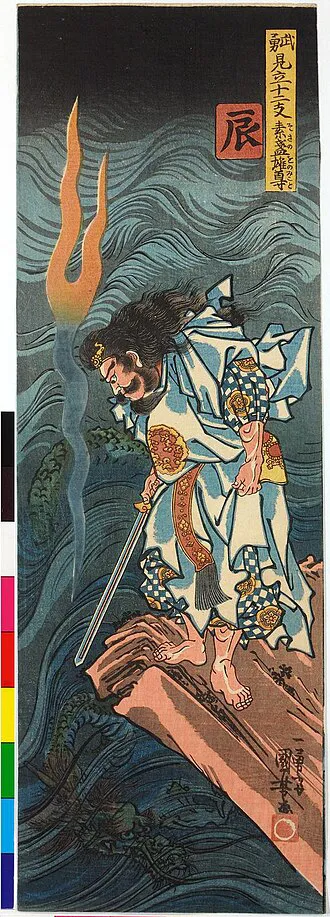
The cast: storm god, rice maiden, and eight-headed serpent
Susanoo (須佐之男命) is one of the most complex deities in the Japanese pantheon. Brother to Amaterasu the sun goddess and Tsukuyomi the moon god, he is produced when their father Izanagi washes his nose during a purification ritual after returning from the underworld. He inherits dominion over the sea, but his grief at the death of his mother consumes him. He weeps until rivers flood and mountains crack. He travels to heaven to say farewell to his sister and causes such chaos there, destroying rice paddies, defiling sacred halls, and flinging a flayed horse into a weaving room, that Amaterasu retreats into a cave and plunges the world into darkness. The gods expel him from heaven.
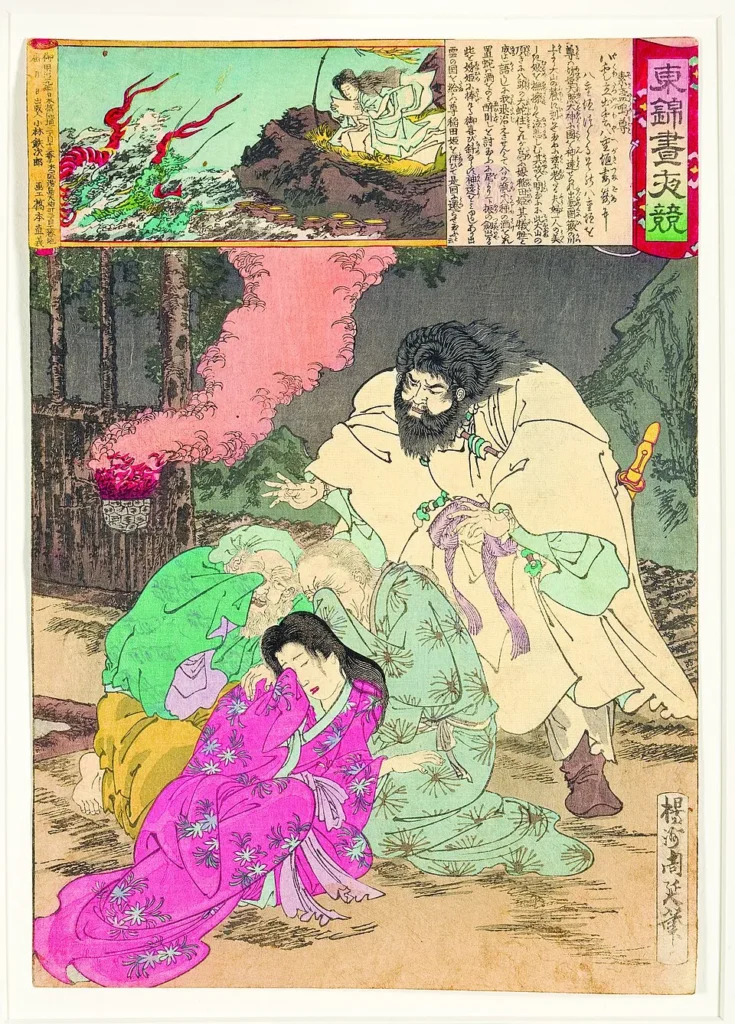
He descends to the province of Izumo in western Japan, to the upper valley of the Hi River, and finds an old couple sitting with a young woman. Their names are Ashinazuchi and Tenazuchi, meaning roughly Foot-Stroking Elder and Hand-Stroking Elder, names that suggest protective figures hovering over a child. They have had eight daughters. A serpent called Yamata no Orochi has come each year and eaten one. They have one daughter left: Kushinadahime (櫛名田比売), whose name combines the words for comb and rice paddy. Her link to agricultural abundance makes her survival, and the threat to her, the economic heart of the story. Susanoo promises to kill the serpent in exchange for her hand.
Yamata no Orochi (八岐大蛇) is the eight-forked great serpent. Its body spans eight valleys and eight hills. Its eyes are red as winter cherries, its belly permanently inflamed and bloodied. The eights are not precise integers. In Japanese mythic language, ya, meaning eight, signals totality and ritual completeness. The serpent has as many heads as a thing can have. It fills every valley, claims every crossing, and eats every daughter. It is as large as the problem it represents.
The names carry the whole story inside them
Every major element in the Orochi episode has a name built from the number eight, and understanding those names is the key to understanding the episode’s internal logic. The sake Susanoo demands is yashiori no sake, meaning eightfold-refined or eightfold-matured liquor. The fence is yaegaki, the eightfold fence. The sword Susanoo draws from the serpent’s tail is Ame-no-Murakumo-no-Tsurugi, the Heavenly Sword of Gathering Clouds, a name anchored to storm and sky.
That initial name matters enormously. Susanoo is a storm god. The sword he finds has his own elemental signature in its name. It belongs to him by nature before he finds it by accident. Later, after different hands use it in different circumstances, it earns the ground-level name Kusanagi, meaning Grass-Cutting Sword. The arc from cloud to grass exactly mirrors the myth’s arc. A god of sky and storm descends to earth, defeats a river beast, and settles into domestic life among rice paddies. The sword’s renaming confirms the descent is complete and permanent.
The yaegaki name also refuses to stay inside the Orochi episode. When Susanoo finishes the killing and prepares a home for Kushinadahime in Izumo, he composes a poem. The Kojiki presents it as the oldest waka in the literary record, the first 31-syllable Japanese poem ever written down. It opens: Yakumo tatsu / Izumo yaegaki / tsuma-gomi ni / yaegaki tsukuru / sono yaegaki wo. Rising like eightfold clouds, Izumo’s eightfold fence, for my wife to dwell in, I raise an eightfold fence, that very eightfold fence. The fence that held a monster becomes the fence that holds a marriage. The structure of a trap becomes the structure of a home. The repetition is not ornamental. It is the same word performing two entirely different kinds of work across a single myth cycle.
Place and geography: Izumo and the flood-reading of Yamata no Orochi
The Kojiki locates the action upstream on the Hi River, identified since at least the medieval period with the Hii River in modern Shimane Prefecture. Shimane is the province where Izumo Grand Shrine stands, one of the oldest and most revered Shinto shrines in Japan, dedicated to Okuninushi, a descendant of Susanoo. The association between Susanoo’s earthly adventures and Izumo is deep and consistent across the mythological record. Some versions in the Nihon Shoki shift the setting south to the E-no-kawa in Aki Province, identified with the Gonokawa in modern Hiroshima Prefecture. The geographic variance is evidence that the myth was told by multiple communities along multiple rivers before the imperial court chose one version as authoritative.
Scholars of Japanese religion have long noted that a serpent described as spanning eight valleys and eight hills, coming annually to a riverside household, and consuming daughters one by one, maps with striking precision onto a river system in seasonal flood. The heads and tails of Yamata no Orochi are the braids and distributaries that a river throws across a lowland plain when snowmelt or autumn rains push it beyond its banks. The annual consumption of one daughter describes what a recurring flood does to a subsistence farming household over years: it takes the crop, then the labour, then the household itself. Susanoo’s approach, building diversionary channels to direct the force of water into controlled pools where its energy is dissipated and contained, before cutting through the silt and tangle that the flood has deposited, is classic hydraulic engineering given mythic form.
This reading, sometimes called the euhemeristic or natural-allegorical interpretation, does not exhaust the episode. It coexists with ritual, cosmological, and literary readings in Japanese scholarly tradition. Folklorist Noriko Reider of Miami University of Ohio, whose work on Japanese supernatural traditions draws on the deep archive of Japanese folklore studies, has noted that Japanese dragon and serpent figures carry a wider range of meanings than the flood-control interpretation captures, including associations with the sea, with the boundary between living and dead, and with the unpredictable creative-destructive power of water in all its forms.
Built out of a love for history, kept free from distractions.
Spoken Past is an independent project shaped by curiosity, care, and long hours of research. Reader support helps keep it maintained, carefully researched, and open to everyone.
The method: how the eightfold fence works as a trap
What makes Susanoo’s approach distinctive is that it does not rely on superior force. He commissions the construction of a fence with eight gates and places one tub of yashiori no sake behind each gate. The fence channels movement. The gates create choice points. The tubs provide a reward at the end of each channel. When Yamata no Orochi arrives and passes through the first gate, one head finds its tub and begins to drink. A second head follows a second gate. The serpent distributes itself through the trap architecture until all eight heads are engaged simultaneously, each locked in its own trough of powerful sake. The serpent is too large and too dispersed to leave. It drinks until it cannot stand.
The weapon Susanoo uses when the serpent collapses is described in the Kojiki as a totsuka-no-tsurugi, a ten-hand-span sword, which is a standard mythic designation for a divine weapon rather than a precise measurement. He cuts the body to pieces systematically, working from head toward tail. In the Nihon Shoki, Susanoo is also described as turning Kushinadahime into a comb and placing her in his hair before the fighting begins, a detail that appears in the Kojiki’s preceding verses as well. The gesture removes her from danger without removing her from the scene. She is present, in his sightline, at the closest possible remove from the action. He is working for her, and she is watching him do it.
The ritual dimension of the trap structure deserves attention. Eight in Japanese mythic language signals not a count but a condition of fullness. Eight vats mean the trap is complete, that no head has been left without a tub, that no gap in the architecture allows escape. Eight gates mean the fence is total. The number ensures that the trap is as large as the monster. The method is described with enough procedural precision in both chronicles, the specific instruction to build the fence with this many gates and place this specific liquor behind them, to suggest that the authors wanted their audience to understand the plan as an act of calculation rather than improvisation.
The sword inside Yamata no Orochi and its afterlife
Storm gods slaying serpents appear across Eurasian mythology: Indra strikes down Vrtra in the Rigveda, Zeus defeats Typhon in Hesiod, Marduk dismembers Tiamat in the Babylonian Enuma Elish. The structural parallel is old and well documented in comparative mythology. What distinguishes the Orochi episode from most of those parallels is the presence of a manufactured object inside the monster’s body. A sword is not a natural part of a serpent. Its presence in the last tail is an intrusion, something stored rather than grown, something placed there rather than evolved there. Susanoo does not find a treasure in the conventional sense, something left by a previous owner or buried beneath the lair. He finds a weapon that the serpent has been carrying inside itself, possibly without knowing it was there.
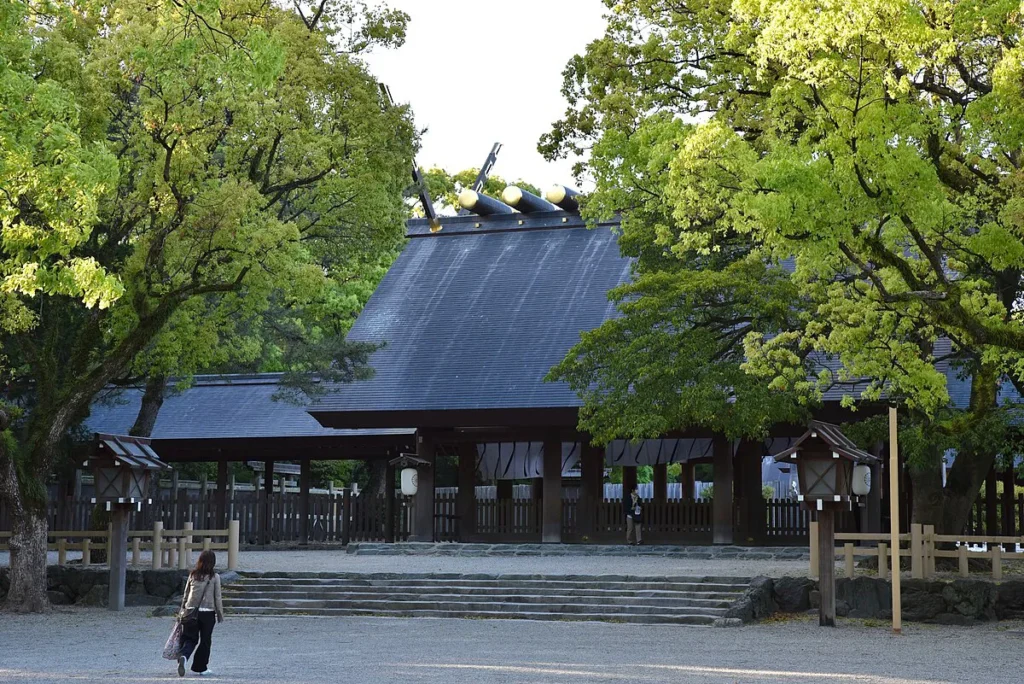
When Susanoo’s blade reaches the last of the eight tails and strikes iron, the text stops him. He cannot cut through it. He investigates, splits the tail open, and draws out a sword so sharp that a god’s weapon cannot get past it. In the Kojiki, he presents it to Amaterasu. It passes between several divine and human custodians over subsequent generations, acquiring the name Kusanagi, meaning Grass-Cutting Sword, when the hero Yamato Takeru uses it to survive a fire attack by cutting the surrounding grass. Kusanagi eventually comes to rest at Atsuta Shrine in Nagoya, where it is held today as one of the Three Imperial Regalia of Japan alongside the mirror Yata no Kagami and the jewel Yasakani no Magatama. The sword is never displayed publicly. Its authority resides in its custody, not in being seen.
The image of a sword inside a serpent is a metaphor made literal. A country’s continuity and the legitimacy of its rulers are drawn out of chaos, not received from a stable order above. Susanoo did not inherit the sword. He did not win it in fair combat with its previous owner. He found it inside a monster he tricked into unconsciousness. The means of its discovery is as important as the object itself: the sword was always there, waiting in the body of the thing that had been devouring the land’s daughters, and it took a god with the intelligence to design a fence to reach it.
Variants, shrines, and the living cult of the eightfold fence
The Nihon Shoki’s practice of recording alternative versions of the same myth prevents the Orochi story from becoming a single fixed narrative. One variant shifts the river setting from Izumo to Aki. Another varies the name of the sword. A third gives different names to the elderly couple. These variants do not contradict the core structure of the episode but show that different communities along different rivers told versions centred on their own geography. The myth was not the property of a single shrine or province. It belonged to the rivers.
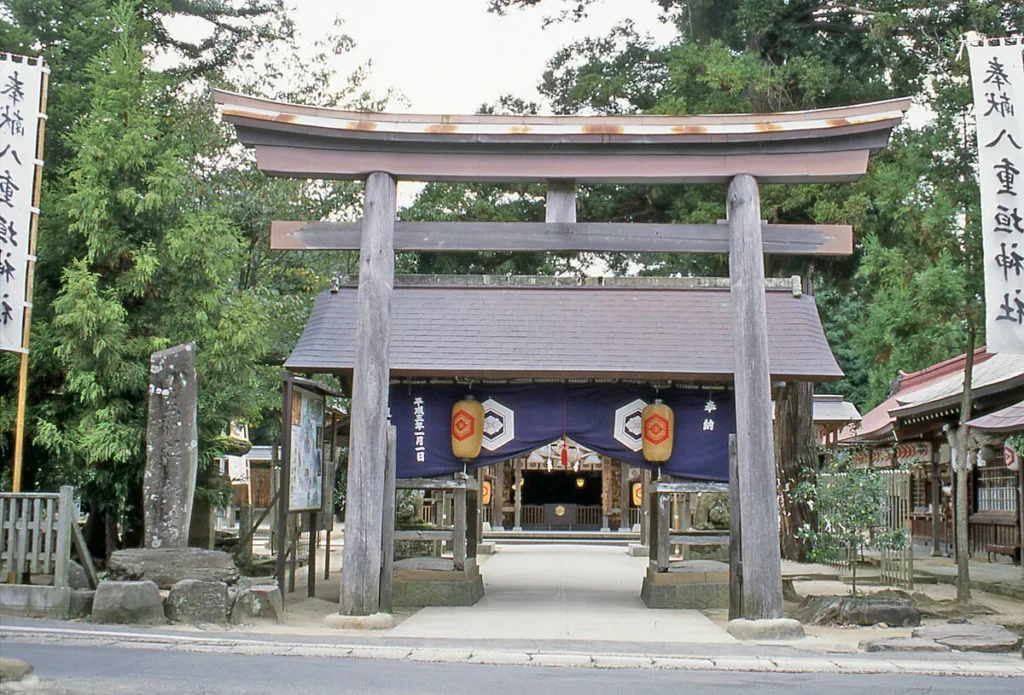
The yaegaki theme, the eightfold fence of Susanoo’s closing poem, has its most direct living embodiment at Yaegaki Shrine in Matsue, Shimane Prefecture. The shrine is dedicated to Susanoo and Kushinadahime jointly and is one of the oldest surviving sites of their combined cult in Izumo. It is visited primarily by people seeking blessing for marriage and romantic partnership, a purpose that derives directly from the episode’s conclusion: the storm god who built a fence to trap a monster rebuilt that fence as a home for his wife. Visitors float small wooden boats on a sacred pond within the shrine precincts, watching how quickly or slowly their boat drifts as a sign of what their love life holds. The paper boats dissolve into the pond eventually. The fence remains.
Atsuta Shrine in Nagoya, the traditional custodian of Kusanagi, maintains a different but equally direct relationship to the episode. Atsuta is one of Japan’s highest-ranking shrines, receiving millions of visitors annually, and its authority rests entirely on the claim to hold the sword that Susanoo drew out of Yamata no Orochi’s tail. The museum attached to the shrine holds a significant collection of donated artefacts, though the sword itself is kept in the inner sanctum and never exhibited. The gap between the visible shrine and the invisible sword is, in a sense, the whole point: the sword’s power is its custody, and custody requires that it remain unseen.
What Edo and Meiji artists kept and what they changed
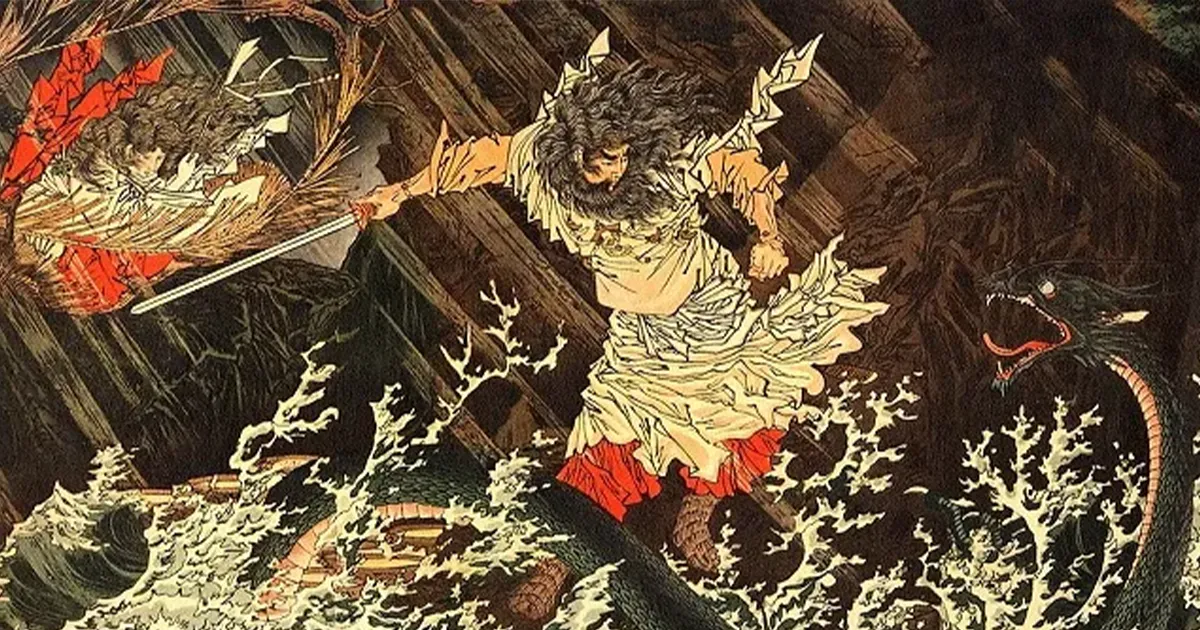
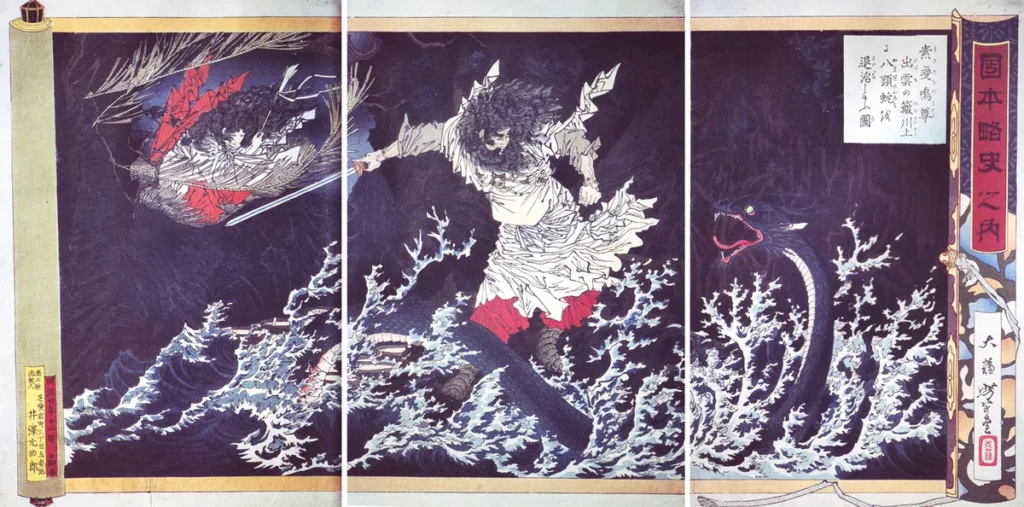
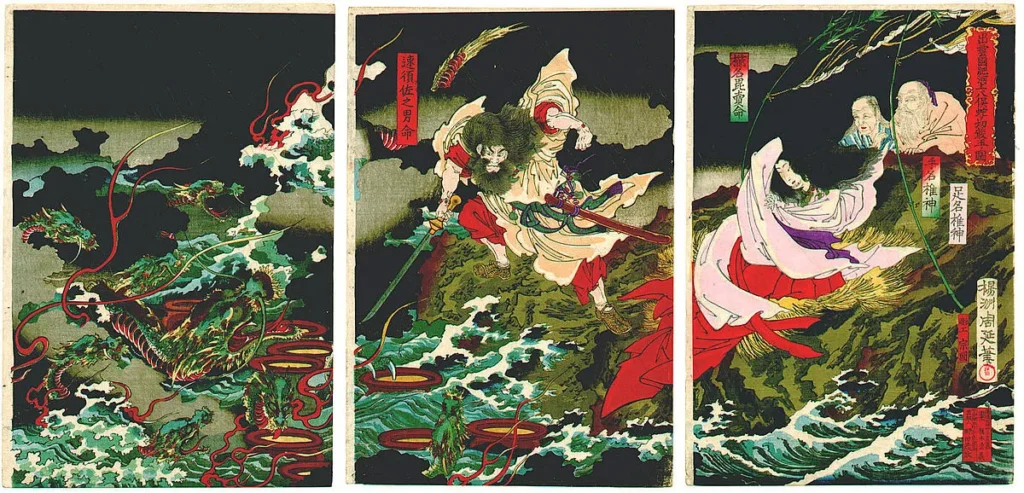
The visual language of the Orochi episode was largely fixed by Edo and Meiji period printmakers, particularly Utagawa Kuniyoshi (1797 to 1861) and Tsukioka Yoshitoshi (1839 to 1892). Both artists returned to the subject repeatedly and established the iconographic conventions that persist in Japanese popular culture to the present day. Susanoo appears in either court robes or warrior armour, carrying a sword whose curve is typically that of a tachi or katana rather than the straight-bladed totsuka-no-tsurugi the text describes. The anachronism does not bother artists for whom dramatic effect outweighs archaeological precision.
Yamata no Orochi is always shown with eight distinct heads and tails, each neck and tail having its own trajectory in the composition. The challenge for artists is showing eight heads as a coherent visual mass while keeping each one individually readable, and the best prints solve this by arranging the necks in a wave or fan pattern that mirrors the braid of a river system. The vats of sake appear prominently, placed at floor level, with the serpent’s necks draped over their rims in the posture of stupefied collapse. The visual heaviness of this image, the dead weight of a great creature undone by its own appetite, is one of the most consistently satisfying things in Japanese mythological art.
One iconographic detail that rarely appears in Western discussions of the episode is the comb. In several prints and in the Kojiki text itself, Susanoo holds the transformed Kushinadahime in his hair as a comb throughout the battle. When it appears in prints, it is typically tucked at the side of the god’s head, small enough to miss at first glance but clearly present. Its inclusion signals to a Japanese viewer that the girl has not been forgotten, that the battle is being fought for her specific benefit, and that the god’s competence as a protector was established before the first cut.
Sources: Basil Hall Chamberlain, trans., Ko-ji-ki or Records of Ancient Matters (Yokohama: R. Meiklejohn, 1882; repr. at sacred-texts.com); Inoue Nobutaka et al., eds., Encyclopedia of Shinto, “Susanoo” entry, Kokugakuin University Digital Museum (2006); W.G. Aston, trans., Nihongi: Chronicles of Japan from the Earliest Times to A.D. 697 (London: Kegan Paul, Trench, Trubner, 1896; repr. Charles E. Tuttle, 1972); Donald Philippi, trans., Kojiki (Tokyo: University of Tokyo Press, 1968); Noriko Reider, Japanese Demon Lore: Oni from Ancient Times to the Present (Logan: Utah State University Press, 2010); Michael Dylan Foster, The Book of Yokai: Mysterious Creatures of Japanese Folklore (Berkeley: University of California Press, 2015); Felicia Gressitt Bock, Classical Learning and Taoist Practices in Early Japan (Tempe: Arizona State University Center for Asian Studies, 1985).