
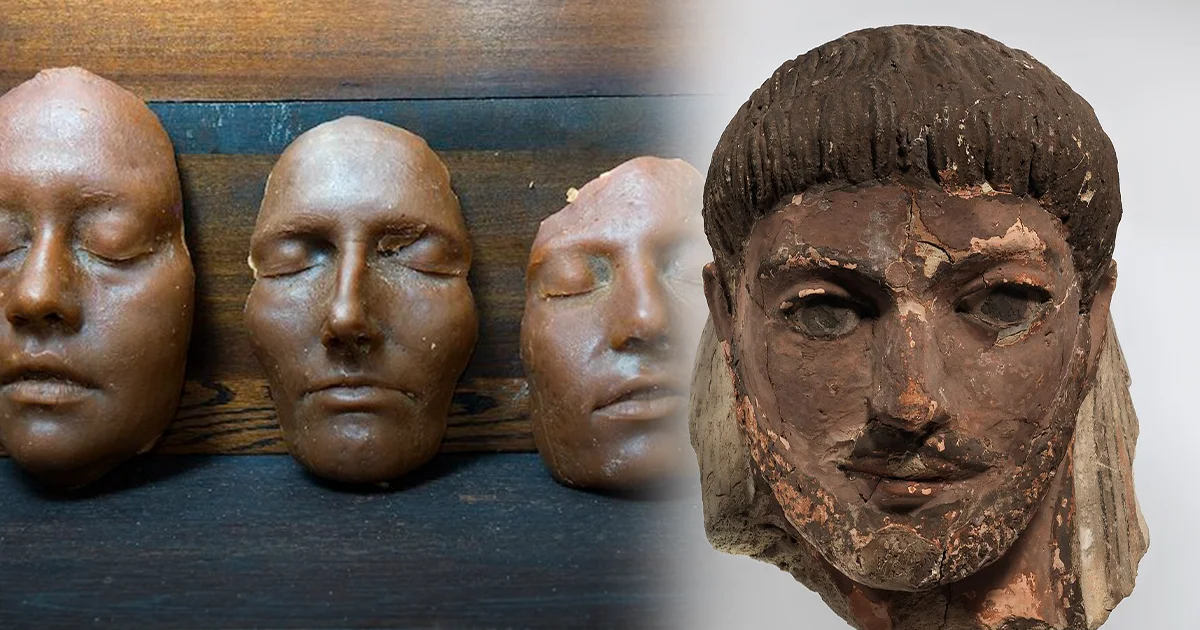
Imagine walking through the atrium of an elite Roman home and seeing dozens of lifelike human faces staring back at you from wooden cabinets—not portraits, but actual wax impressions taken directly from the faces of the dead. These weren’t decorative art pieces or symbolic representations. They were the imagines maiorum, Roman ancestor death masks molded in beeswax from the faces of distinguished family members, preserved for generations and brought to life during funeral processions when actors wore them to resurrect the dead. This haunting custom reveals how deeply Romans valued lineage, memory, and the tangible presence of their ancestors in daily life.
What Were Roman Ancestor Death Masks
Roman ancestor death masks, called imagines maiorum (images of the ancestors), were crafted from beeswax pressed directly onto a person’s face while they were still living or immediately after death. The Latin phrase expressi cera vultus describes this process—literally “faces expressed in wax”—capturing every wrinkle, feature, and individual characteristic with uncanny accuracy. Unlike idealized marble busts created later, these wax masks preserved the actual physical reality of a person’s appearance.
The process required skilled artisans who understood both sculpture and the properties of beeswax, which had to be warmed to the perfect consistency for molding without burning the skin. When Cornell University researchers recreated these masks in 2014, they discovered just how emotionally powerful the experience was—one researcher described feeling “simply awful” watching her colleague’s face being melted down in a slow cooker when they needed to reuse the precious wax. That visceral reaction connected her directly to how Romans must have felt about these intensely personal objects that literally bore the faces of their loved ones.
Only elite Roman families—those whose male members had held curule magistracies like aedile, praetor, or consul—possessed the legal right to create and display these masks. This exclusive privilege, called ius imaginum (the right of images), transformed the masks into symbols of aristocratic status and political power. A home filled with imagines announced to every visitor that this family had produced generations of distinguished public servants.
The Atrium Display and Daily Life
The wax masks lived in specially constructed wooden cabinets (armaria) positioned prominently in the atrium, the central reception hall where Romans conducted business and received guests. Each mask rested in its own compartment, often connected by painted lines showing the family genealogy stretching back through generations. Accompanying each imago was a titulus, a small plaque inscribed with the ancestor’s name, offices held, military victories, and notable achievements.
These weren’t objects hidden away and brought out only for special occasions—they were part of the daily visual landscape of elite Roman households. Children grew up under the literal gaze of their ancestors, learning family history and expectations through these faces. Women of the household interacted with the masks throughout their lives: as daughters in their natal homes, as wives when copies of their family’s masks transferred to their marital homes, and as mothers teaching their own children about lineage.
The anthropologist quality of these displays cannot be overstated. Walking into a Roman atrium meant confronting death, legacy, and expectation simultaneously. The masks served as three-dimensional history books, visual proof of a family’s contributions to Rome, and constant reminders to living family members of the standards they needed to uphold.
The Spectacular Funeral Procession
When an elite Roman died, the family’s collection of ancestor death masks came alive in the most literal sense possible. Actors or family members who physically resembled each ancestor would don the appropriate mask and dress in the official regalia that person had worn in life—the purple-bordered toga praetexta of magistrates, military decorations like the civic crown or golden torcs, or the triumphal garb of victorious generals.
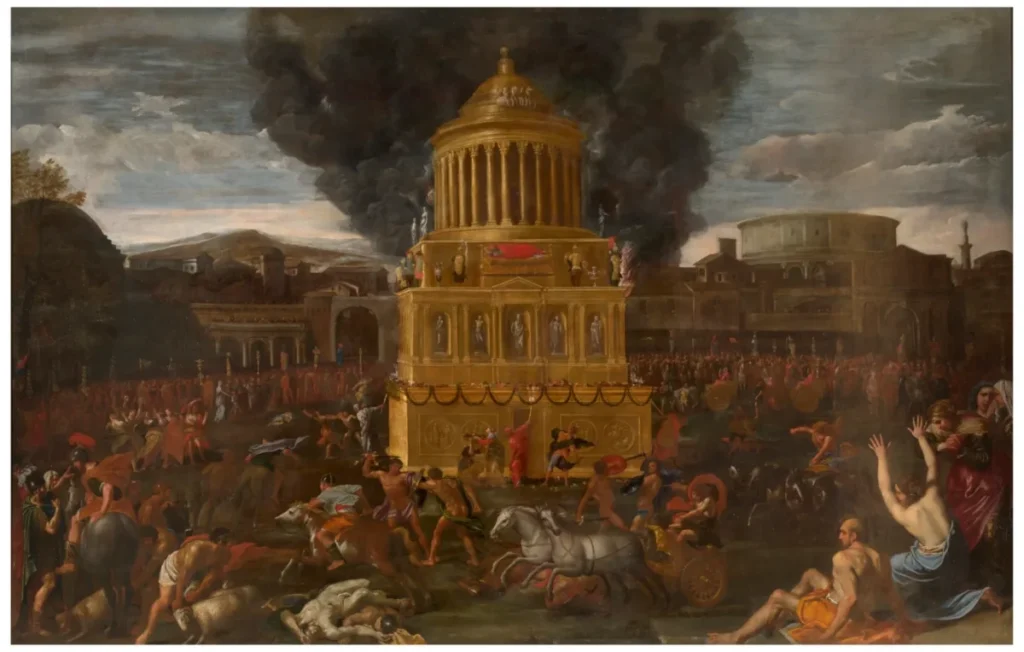
The funeral procession (pompa funebris) became a resurrection of the entire family lineage. Ancient historian Polybius described these processions with awe, noting how the dead seemed to walk again through Rome’s streets. The newly deceased, carefully positioned on a couch and made up to appear lifelike, led the procession accompanied by generations of “ancestors” processing in chronological order.
At Sulla’s funeral in 78 BCE, approximately six thousand masked “ancestors” participated in the procession—a staggering visual spectacle that must have brought Rome to a standstill. Marcus Claudius Marcellus’s funeral in 23 BCE similarly featured hundreds of masked participants. These weren’t small, private ceremonies but massive public performances that demonstrated a family’s accumulated political capital and historical significance to the entire city.
The procession ended at the Forum, where the masked actors sat on ivory chairs arranged in a semicircle while a family member delivered the funeral oration (laudatio funebris). Imagine the psychological impact: a speaker addressing both the living crowd and the “resurrected” dead, recounting the achievements of the newly deceased while surrounded by the watching faces of ancestors who had themselves once received similar honors.
Why Beeswax and Preservation Challenges
Romans chose beeswax for its unique properties—it could capture extraordinarily fine detail, remained workable with heat, and possessed a translucent quality that mimicked human skin tone when tinted appropriately. However, this same malleability that made wax perfect for life casting also made it incredibly fragile and temporary.
Not a single original Roman wax mask survives today. Wax melts, warps with temperature changes, attracts insects, and degrades over time. The very substance that allowed Romans to preserve their ancestors’ faces with such accuracy ensured those faces would eventually vanish completely. This cruel irony wasn’t lost on wealthy Romans, who often commissioned marble or bronze copies of their most important masks to ensure longer-lasting preservation.
The expense of beeswax in ancient Rome cannot be understated—it was a luxury product used primarily for high-value applications like sealing official documents, creating sculptures, and yes, making ancestor masks. A family maintaining dozens of wax masks represented significant ongoing investment, as the masks required careful storage, occasional restoration, and protective measures against heat and pests.
Built out of a love for history, kept free from distractions.
Spoken Past is an independent project shaped by curiosity, care, and long hours of research. Reader support helps keep it maintained, carefully researched, and open to everyone.
Social and Political Power of the Masks
The ius imaginum created a visible aristocracy that couldn’t be faked or purchased. While wealthy merchants or freed slaves might acquire property, education, or even political positions, they could never possess ancestor masks unless their lineage genuinely included magistrates. The masks physically embodied nobilitas—nobility proven through generations of public service.
This exclusivity made the masks intensely political. When a family displayed fifty or sixty masks, they weren’t just honoring the dead—they were asserting continued relevance and power in contemporary Roman politics. The masks became campaign advertisements, reminding viewers that supporting this family meant aligning with generations of proven leadership.
Women’s relationship to these masks reveals fascinating complexities about Roman gender and inheritance. Elite women couldn’t hold curule magistracies and thus couldn’t generate imagines themselves, yet the masks profoundly shaped their lives. When a woman married, copies of her family’s masks accompanied her to her new home, functioning as a form of symbolic dowry—portable proof of her ancestry and social position. Her children would inherit claims to both paternal and maternal lineages, their identities constructed from two sets of ancestral faces.
Modern Recreation and Archaeological Understanding
The 2014 Cornell University project brought Roman ancestor death masks back into physical existence for the first time in two millennia. Graduate students created life-cast molds of their own faces using techniques described in ancient sources, discovering both the technical challenges and emotional resonance of the process. The resulting masks proved uncannily lifelike, even slightly unsettling in their accuracy.
This hands-on archaeology revealed details impossible to glean from texts alone. The researchers learned that creating a comfortable mask required precise timing—wax too hot burned skin, while wax too cool failed to capture fine details. They discovered that actors wearing the masks experienced restricted vision and breathing, making the funeral processions physically demanding performances requiring practice and coordination.
Archaeological evidence from Pompeii and other sites preserves indirect traces of mask culture. Wall paintings show atrium displays with cabinets and genealogical connections, while some homes retain the actual niches where mask cabinets once stood. Funeral inscriptions and epitaphs reference imagines and describe elaborate funeral processions, providing textual confirmation of practices described by ancient historians.
Connection to Other Ancient Death Traditions
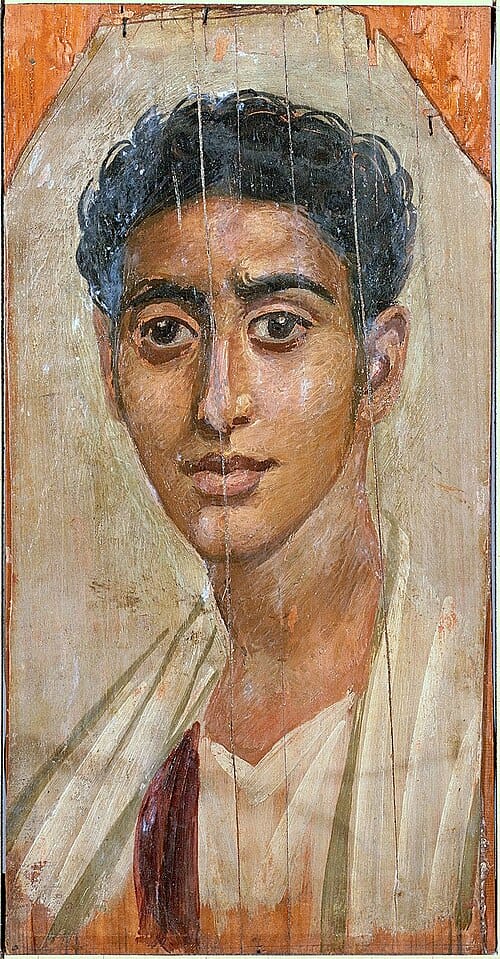
While uniquely Roman in execution, ancestor death masks connect to broader Mediterranean and Near Eastern traditions of preserving the dead’s presence. Fayum mummy portraits from Roman Egypt served similar functions—realistic painted faces attached to mummified bodies to preserve individual identity in death. These encaustic paintings on wood panels capture the same desire to maintain specific, recognizable likenesses that motivated Roman wax masks.
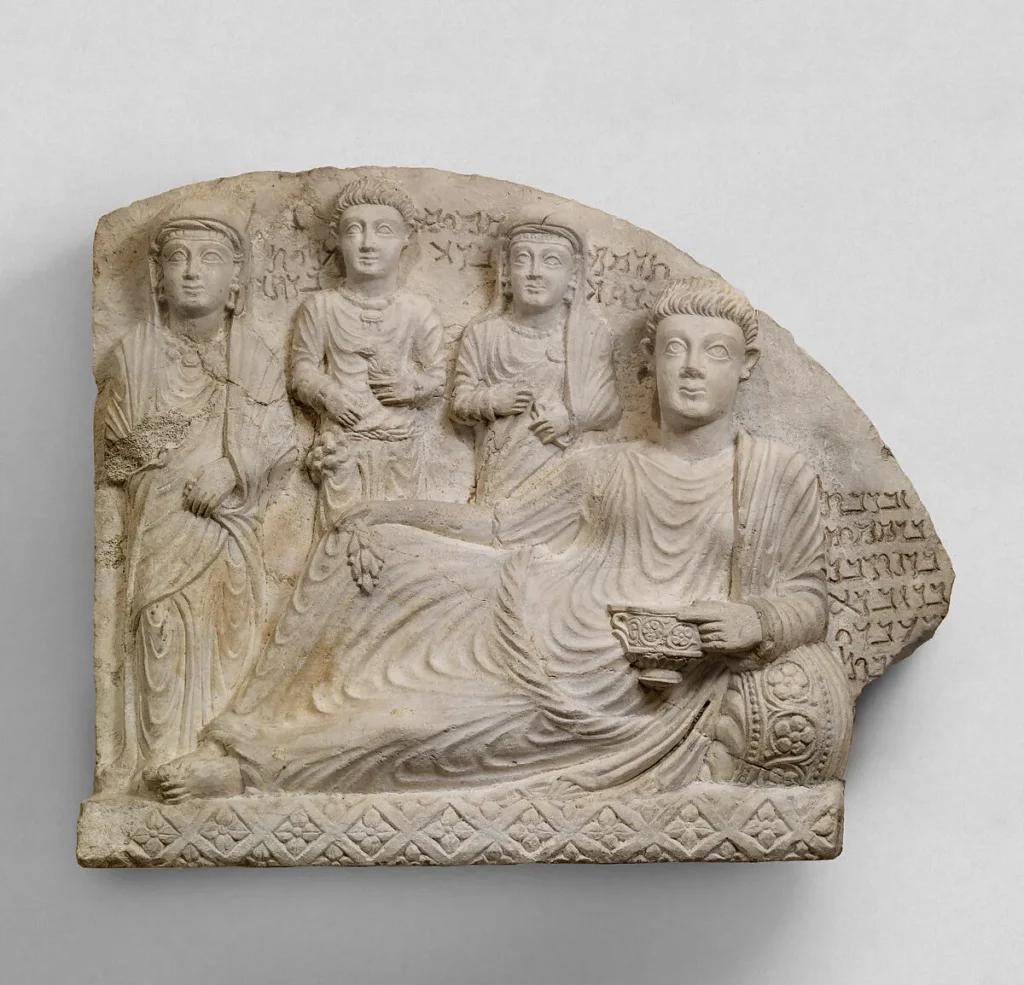
Palmyrene funerary reliefs from Roman Syria show the spread of Greco-Roman commemorative practices throughout the empire. These limestone sculptures depicting banquet scenes functioned as “personality markers” for burial niches, mixing Eastern and Western artistic traditions just as the imagines maiorum blended Roman political culture with older Mediterranean death customs.
The fundamental human impulse these objects reveal—the need to maintain physical connections with the dead and assert continuity between past and present—transcends any single culture. What makes Roman ancestor death masks extraordinary isn’t the desire to remember but the specific method: literal resurrection through performance, transforming memory into embodied theater that made the dead physically present among the living.
The End of the Tradition
The custom of Roman ancestor death masks gradually faded during the imperial period as political power centralized around the emperor and traditional Republican aristocratic families lost influence. Christianity’s rise further diminished the practice, as Church fathers viewed the masks as pagan ancestor worship incompatible with Christian teachings about death and resurrection.
By the 4th century CE, elite commemoration had shifted toward elaborate stone sarcophagi, Christian martyrs’ relics, and eventually mosaic portraits in churches. The immediate, almost shocking intimacy of wax faces gave way to more stylized, eternal forms of remembrance. The masks’ disappearance reflects broader transformations in how Romans understood family, political legitimacy, and the relationship between living and dead.
Yet the impulse behind the masks never entirely vanished. Medieval and Renaissance death masks of rulers and important figures, 19th-century photography of the deceased, and even modern practices of open-casket funerals echo the Roman desire to preserve a final, accurate image of the dead. We no longer resurrect our ancestors by having actors wear their faces, but we continue seeking tangible ways to make death less final, memory less abstract.