Útgarða-Loki is the giant who made Thor look weak without ever defeating him in a fair contest. In the Prose Edda, Thor enters the giant’s hall confident that his strength will be enough to impress its inhabitants. His companions lose an eating competition and a footrace. Thor then fails to empty a drinking horn, struggles to lift a cat and is brought to one knee by an old woman. Only after leaving does he learn what he was really trying to overcome.
The trick works because every challenge is presented as something ordinary. The runner is thought itself, the eater is wildfire, the horn reaches into the sea, the cat is the serpent that encircles the world and the old woman is old age. Even Thor, the god who fights giants with the hammer Mjölnir, cannot recognise the scale of his opponents while the giant king controls what he sees.
Útgarða-Loki’s name is easily confused with Loki, the god who travels with Thor. They are different characters in this story. The giant is the ruler of Útgarðr, a stronghold in the region of the jötnar, supernatural beings commonly translated as giants. His name can be understood as Loki of the outer enclosures. Snorri Sturluson recorded the elaborate encounter in thirteenth-century Iceland, and the surviving account gives us a complete story of the humiliation, the deception and the reason Útgarða-Loki ultimately fears his visitor.
Where the story comes from
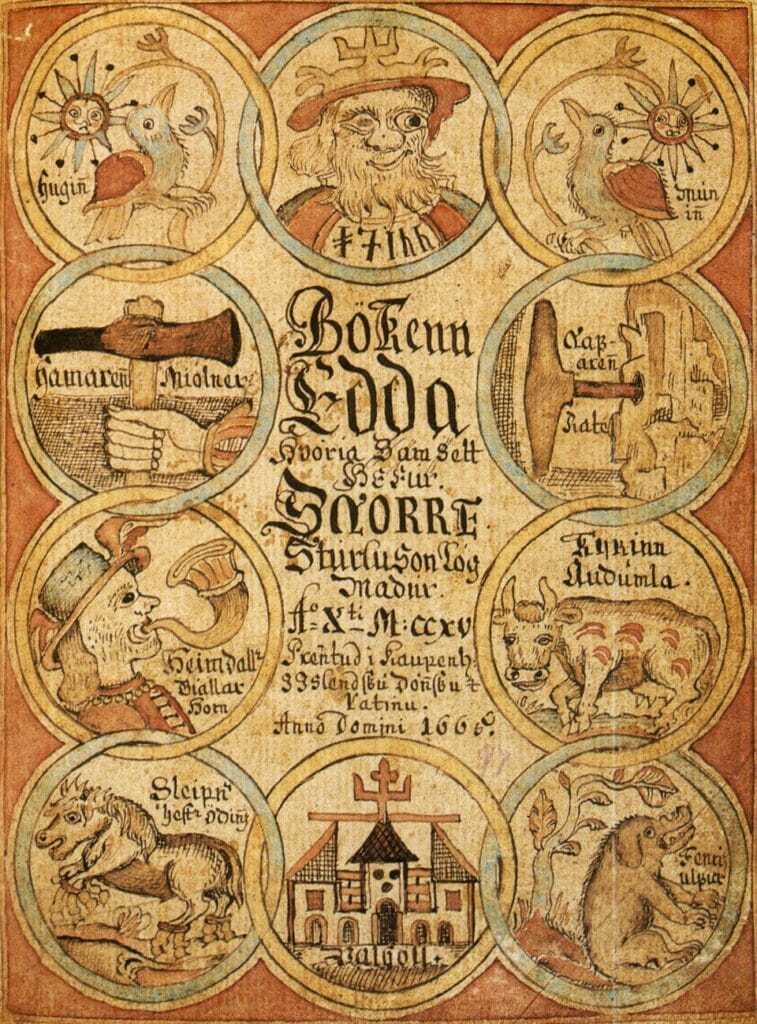
The fullest account survives in chapters 44–47 of Gylfaginning, the mythological section of Snorri’s Prose Edda. Snorri was an Icelandic writer, poet and political leader who composed his work in a Christian society, long after Iceland formally adopted Christianity around the year 1000. He preserved an enormous amount of older mythological material, but he was writing a literary handbook for people who needed to understand the allusions of traditional Norse poetry. The surviving story should therefore be read as his presentation of inherited material, not a transcript of what every Viking Age Scandinavian believed. The Old Norse text edited by Anthony Faulkes is available from the Viking Society for Northern Research; an accessible English translation by Arthur Gilchrist Brodeur allows the sequence to be followed in full.
Snorri introduces the episode through another act of deception. In Gylfaginning, a legendary king called Gylfi travels in disguise to question three mysterious figures, High, Just-as-High and Third, about the gods and the universe. They know much more than he does, and the hall in which he questions them is itself part of a magical performance. When Gylfi asks whether Thor has ever met anything too powerful for him to overcome, the speakers hesitate. They insist that Thor is the strongest, then Third agrees to tell a troubling story. A narrator speaking from inside a deception is about to explain how another visitor was deceived. The parallel is built into Snorri’s composition, although its precise significance is open to interpretation.
The story was not entirely unknown outside Snorri’s prose. In the eddic poem Hárbarðsljóð, stanza 26, Thor is mocked for hiding in a giant’s glove. In Lokasenna, stanzas 60 and 62, Loki brings up the glove and Thor’s failure to open Skrýmir’s food bag. Those insults show that parts of the adventure circulated as recognisable material apart from Snorri’s continuous account. They do not independently confirm the complete sequence of competitions or allow us to reconstruct one original version of the myth. The surviving poems and manuscripts were themselves written down in medieval Iceland, even when their poetic traditions may be older.
How Thor acquired his travelling companions
Thor begins his journey with Loki, the god who frequently accompanies him on dangerous expeditions. They arrive at a farmer’s house with Thor’s two goats, the animals that pull his chariot. Thor kills the goats for supper and orders their bones to be placed on their skins. The farmer’s son Þjálfi splits a thigh bone to reach the marrow. The next morning Thor consecrates the remains with Mjölnir, bringing the goats back to life, but one animal is lame because its bone was broken.
Thor is furious. Snorri describes the farmer and his household terrified by the god’s expression and his grip on the hammer. Instead of harming them, Thor accepts the farmer’s children, Þjálfi and his sister Röskva, as servants in compensation. It is an uncomfortable bargain from a modern perspective, and Snorri does not ask the reader to overlook the imbalance of power. Þjálfi will soon have a chance to show his own remarkable ability, because he is described as exceptionally fast on his feet. Röskva accompanies the party, although the later contests concentrate on Thor, Loki and Þjálfi.
Leaving the goats behind, the four travellers go east toward Jötunheimr and cross the sea. The story treats the territory of the jötnar as dangerous and unfamiliar, but the jötnar are not simply oversized monsters. In Norse myth they can be ancestors of gods, their spouses, enemies or possessors of knowledge that the gods seek. The elaborate relationships between them are important to the wider Norse mythological tradition. Here, the inhabitants of the outer region have the advantage of knowing the landscape and the rules of the encounter.
The giant whose glove became a house
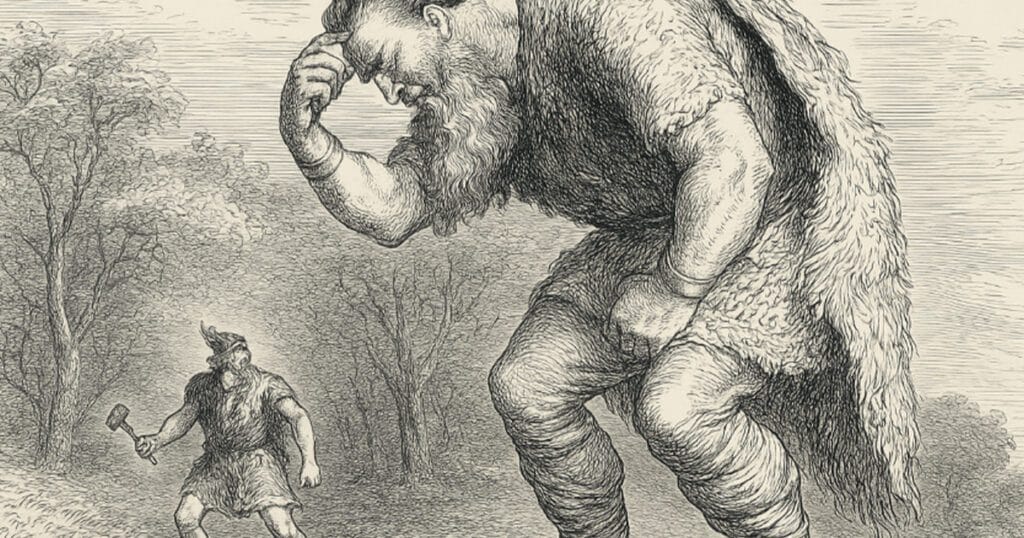
After a day in a forest, the travellers find what looks like an enormous hall and settle inside. At midnight the ground shakes. Thor stands guard with his hammer while the others retreat into a side chamber. At dawn they discover the cause of the noise: a giant is sleeping nearby, and his snoring has made the earth tremble. He calls himself Skrýmir. The supposed hall was his discarded glove, and the side chamber was its thumb. The travellers had been small enough to sleep inside it without understanding what they had found.
Skrýmir recognises Thor and offers to accompany the group. He proposes putting their food together in one bag and carries it on his back. By evening the giant has fallen asleep beneath an oak, leaving Thor unable to undo the fastenings of the provision bag. Hunger and irritation turn to anger. Thor strikes Skrýmir on the head with Mjölnir. The giant wakes and asks whether a leaf has fallen on him. Later Thor hits him again; Skrýmir wonders if an acorn dropped from the tree. A third, harder blow produces another mild complaint about debris falling from above. Thor’s hammer appears powerless against a man who scarcely notices being struck.
In the morning Skrýmir points the travellers toward the stronghold of Útgarða-Loki. He warns them that its inhabitants will not tolerate boasting, then takes a different road. Thor has no reason yet to connect the enormous stranger with the king he is about to meet. That connection is withheld until the end, when the earlier humiliations become part of the same deception. The story also makes Skrýmir’s seemingly friendly help suspicious in retrospect: he took charge of the food, ensured the bag could not be opened and drew Thor into a confrontation he could not understand.
At Útgarða-Loki’s hall
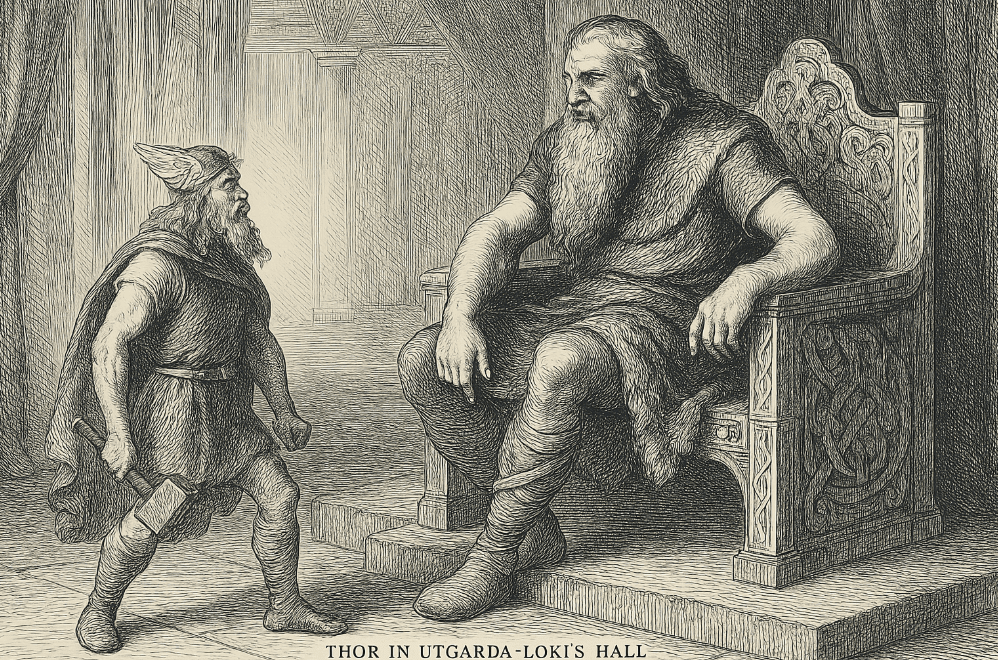
Thor and his companions reach a fortress so high that they must tilt their heads back to see its upper reaches. Its gate is shut, but they squeeze between the bars and enter the great hall. The king sits among huge attendants on benches. He recognises Thor, yet calls him a little fellow and asks what talents the visitors can demonstrate. In this court, everyone must be able to perform some exceptional feat. The demand turns a visit into a public test of reputation, with the guests surrounded by people who already seem much larger and stronger than they are.
Loki, who has endured a journey without adequate food, offers to compete in eating. The king summons a man named Logi. They sit at opposite ends of a trough filled with meat and race toward the middle. Loki devours the flesh, but Logi consumes the flesh, the bones and even the trough. To the spectators, the result is decisive. The visitor who claimed he could eat faster than anyone has been beaten at the skill he chose for himself. The name Logi, meaning flame, will later explain why the apparent man consumed far more than an ordinary eater could.
Next comes Þjálfi. The young servant is faster than any human in Snorri’s telling, and he agrees to race a figure named Hugi. They run three times. Hugi finishes the first race well ahead of him; in the next race the distance between them is greater, and in the third Hugi has already returned while Þjálfi is still running. The track is not made progressively longer, as some summaries imply. Snorri increases the humiliation by repeating the same kind of test and making the disparity unmistakable. Þjálfi’s extraordinary human speed is real, but it has been measured against something that no runner could catch.
Enjoying Spoken Past?
I created Spoken Past to share my love of history. I research, write and develop everything myself, and I want my articles and basic guides to remain free for everyone.
If you enjoy my work, please consider supporting Spoken Past with a small donation.
Thor tries to drink the sea
The giant king asks Thor what he can do. Thor chooses drinking, a familiar contest in a world of feasting and public displays of prowess. A servant brings him a horn. Útgarða-Loki says a good drinker can empty it in one draught, others in two, and even a poor drinker ought to manage it in three. Thor takes a great swallow and looks down. The liquid has barely moved. He drinks again with even more effort, but the horn remains far from empty. After a third attempt he gives up, angry and ashamed.
The reader knows Thor as a god whose physical power can overcome opponents that would terrify ordinary people. A drinking horn should be an insignificant object for him. Útgarða-Loki’s trick is to make the challenge appear small enough that failure becomes embarrassing. The king’s remarks after each attempt are calculated to make Thor compare himself with the supposed ordinary standards of the hall. The revelation will show that Thor has in fact drunk a measurable portion of the sea, but the horn conceals its true size and source.
The king offers another test. His attendants, he says, regard lifting his cat as an easy amusement. A large grey cat appears, and Thor places his hand under its belly. As he lifts, the animal arches its back higher and higher. Thor raises his arms as far as they will go, but manages only to get one of the cat’s paws clear of the floor. The king dismisses the achievement as inadequate. Thor has been made to appear weaker than the young men who supposedly play with this animal.
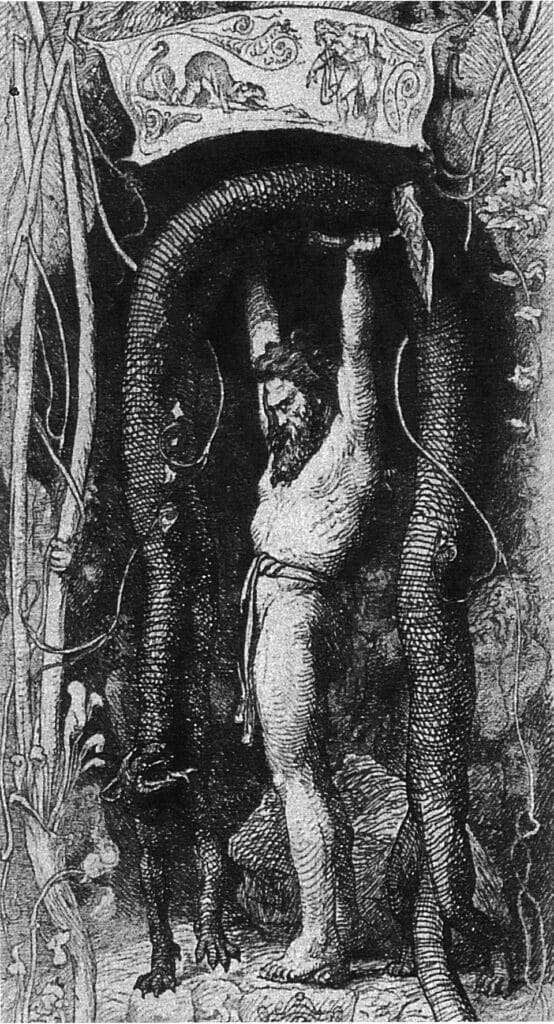
The cat is the most dangerous of the disguised opponents. It is Jörmungandr, the enormous serpent that lies around Miðgarðr, the human world. In the myth the creature is one of the children of Loki and the jötunn Angrboða, and the gods have cast it into the surrounding sea. Thor’s eventual confrontation with it belongs to the story of Ragnarök, the destruction of the present world. For the relationship between the serpent and its family, see the surviving accounts of Loki’s children. Lifting even part of that body is an extraordinary feat. Útgarða-Loki can make the serpent look like a cat, but he cannot make the god’s strength disappear.
The old woman who brought Thor to his knee
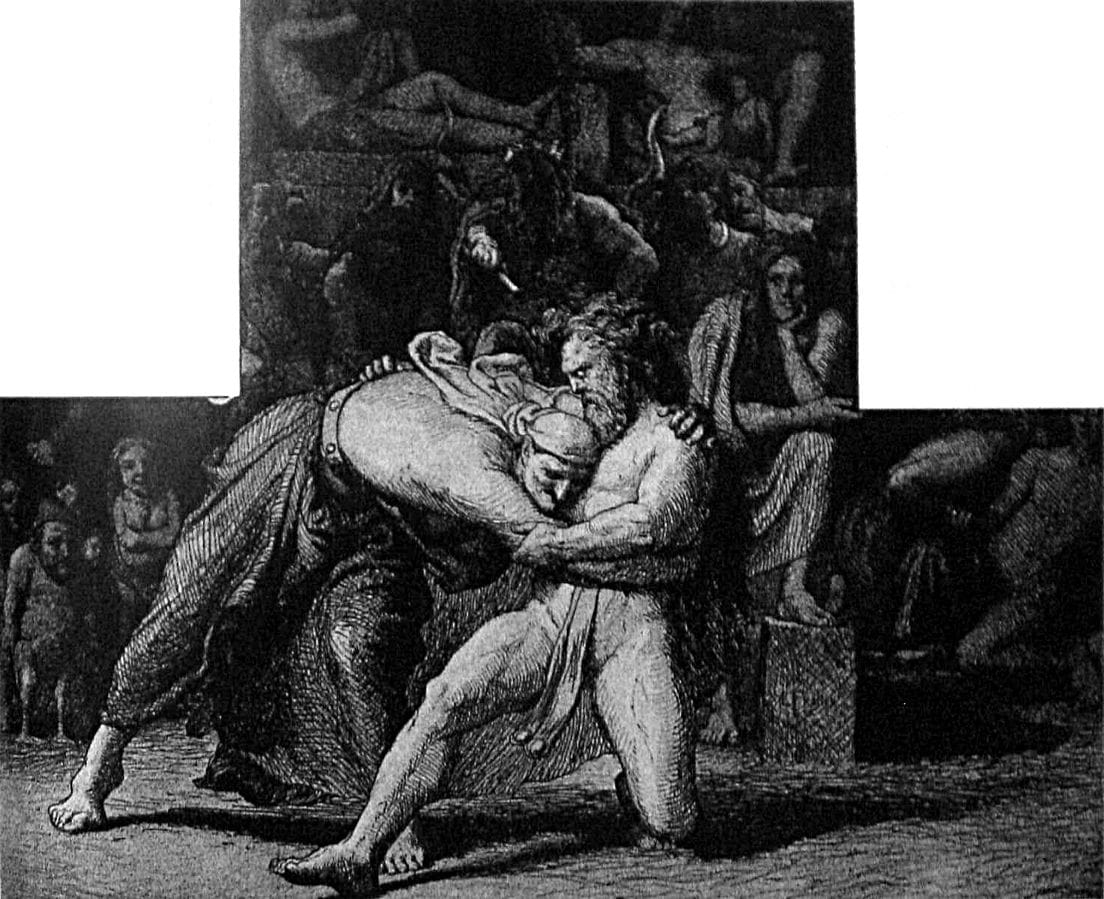
By now Thor is furious and asks to wrestle anyone in the hall. The king says that none of his men would consider him a worthy opponent. Instead, he calls for an old woman named Elli, described as his nurse or foster-mother. Thor tries to force her down. The harder he grips, the more firmly she stands. She takes hold of him in return, and after a struggle he is brought down onto one knee. Útgarða-Loki ends the contest and says there is no need for Thor to challenge anyone else.
The result is deliberately humiliating. Thor has not lost to a warrior, another god or even one of the giants on the benches. He has been brought to his knee by someone who looks frail. Yet the king’s explanation will reverse the judgement. Elli’s name means old age. In the terms of the story, old age eventually brings every living being down, and no one has ever resisted it as Thor has. The text does not say that Thor conquered Elli. It makes his resistance remarkable precisely because she cannot ultimately be defeated.
There is a tension here with the rest of Norse mythology. The gods can be killed, and at Ragnarök Thor himself is fated to die after his final battle with the world serpent. The contest with Elli need not be turned into a systematic theological doctrine about whether gods age biologically in every tradition. Snorri gives the old woman a personified name and makes her a limit that strength alone cannot remove. The image of a mighty god forced to one knee makes the point without requiring a speculative account of Viking Age beliefs about human mortality.
The revelation outside the walls
The guests spend the night in the hall, and the next morning Útgarða-Loki feeds them before escorting them outside. He asks Thor how he thinks the visit went. Thor admits that he has been shamed and fears the giants will remember him as weak. Only then does the king reveal what happened. He says that if he had known Thor’s true strength, he would never have admitted him. The contests were made possible by magical deceptions, which he calls illusions of sight.
Útgarða-Loki first admits that he was Skrýmir in the forest. The bag was fastened with iron so that Thor could not open it. When Thor struck him three times, he placed a mountain between himself and the hammer. The three blows cut three deep valleys into the mountain, the last the deepest. The giant had appeared to shrug off Mjölnir, but the landscape had absorbed blows that would otherwise have killed him. Thor’s strength was never absent. He had simply been prevented from seeing where it went.
The king then explains the contests in the order the guests experienced them. Loki’s opponent Logi was wildfire, which devours meat, bone and the wooden trough alike. Þjálfi raced Hugi, the king’s thought, and thought could not be outrun by even the swiftest human. The horn was connected at its other end to the sea. Thor’s drinking lowered the water level, which the story identifies with the ebb of the tides. These are explanations within a myth, not physical accounts of how tides form. Their force depends on revealing the enormous hidden scale of tasks that had been presented as trivial games.
The cat, the king continues, was the Midgard Serpent. The giant’s company had been terrified when Thor lifted even one of its feet, because the serpent’s body circles the world. Elli was old age, and Thor’s ability to hold out until only one knee touched the ground was exceptional. Each defeat changes meaning as soon as its true opponent is named. The visitors had been measured against forces far beyond the standards by which the king pretended to judge them. Útgarða-Loki has protected himself through trickery, yet his confession acknowledges how dangerous Thor remains.
He warns Thor that the visitors must never return. Thor reaches for Mjölnir, intending to strike him, but the giant has vanished. When Thor turns toward the stronghold, that too has disappeared. There is only an open plain. Snorri’s account closes by saying that Thor returns home and later seeks another encounter with Jörmungandr. The following chapter tells the famous fishing expedition with the giant Hymir. It is a continuation of Thor’s conflict with the serpent, not a successful revenge attack on Útgarða-Loki.
Why the giant’s tricks matter
The story is funny because its audience knows Thor’s reputation. A god capable of killing giants is mocked for failing at a drinking contest, lifting a household animal and wrestling an elderly woman. The humour, however, depends on withholding information. Once the disguise is removed, the same failures demonstrate strength on a scale the giant king had not expected. The humiliation is real to Thor during the contest; the revelation exposes the audience’s mistake in accepting the visible evidence as complete.
John Lindow’s 2000 study, “Thor’s Visit to Útgarðaloki”, treats the long episode as a coherent part of Gylfaginning rather than merely a collection of borrowed folktale contests. His conclusion particularly stresses the complementary roles of Thor and Odin. Thor is closely connected to the human household at the beginning and displays enormous physical power; Odin, elsewhere in the mythological system, is associated with verbal knowledge and the ordering of the cosmos. This is a scholarly interpretation of Snorri’s literary arrangement, not a statement that all Scandinavians understood the myth in exactly this way.
The opening episode with the farmer also matters to that reading. Thor can terrify humans with his anger, yet he stops short of killing the family and accepts compensation. The jötunn he meets afterward shows a different kind of power. He can shape appearances, set the rules of a contest and withhold knowledge until his visitors have left. In the hall Thor has no way to tell whether he is confronting a person, an animal or a force of the natural world. His hammer is useless against an opponent he cannot identify, even though it would be lethal if it actually struck its intended target.
The text does not require us to call Útgarða-Loki a god of illusion or to imagine that every jötunn rules over a separate cosmic principle. His abilities are those Snorri gives this particular character. The name Útgarðr evokes an outer place beyond the familiar enclosed world, and the scene of a gigantic hall helps make the visitors feel out of their depth. For the broader, varied role of these beings, Jötunheimr and the jötnar offer important context. The giant’s court resembles a human court in its benches, hospitality and challenges, but its host can change what those ordinary activities mean.
Was Útgarða-Loki the same as Loki?
Within Gylfaginning, the answer is no. Loki accompanies Thor into the hall and competes against Logi while Útgarða-Loki presides over the games. Skrýmir, on the other hand, is explicitly revealed to be Útgarða-Loki in disguise. Confusing Skrýmir with a separate giant loses the final explanation of Thor’s three hammer blows. Confusing Útgarða-Loki with Loki the companion makes the eating contest nonsensical.
A different medieval author complicates the question of the name. In Book Eight of Gesta Danorum, the Danish writer Saxo Grammaticus describes a being called Utgarthilocus. He is found chained in a foul cavern during a dangerous expedition led by Thorkillus, not hosting a feast or staging athletic contests. Saxo’s version, available in Oliver Elton’s English translation of Book Eight, has little narrative resemblance to Snorri’s hall. The chained figure resembles other traditions about Loki’s imprisonment, and scholars have debated whether the shared name points to related or confused traditions. It does not prove that Snorri’s two distinct characters were secretly the same being.
The contrast is a useful reminder that medieval writers preserved differing versions of Norse stories. The familiar Útgarða-Loki of the contests is overwhelmingly known through Snorri. Saxo’s cavern figure should be acknowledged without forcing the two accounts into a single continuous biography. Even the earlier eddic insults establish only pieces of the adventure. The exact sequence and its ingenious final explanation survive through the particular narrative Snorri chose to tell.
Thor leaves Útgarðr with no victory over its king, and the king leaves with no desire to face Thor again. That mutual failure is the story’s final turn. Thor’s strength nearly destroys the giant’s world, but only after the king admits his deceptions can Thor understand what he has achieved. By then the hall is gone. A contest that appeared to expose the god’s weakness has instead exposed how completely a clever host can control the meaning of what his guests see.