
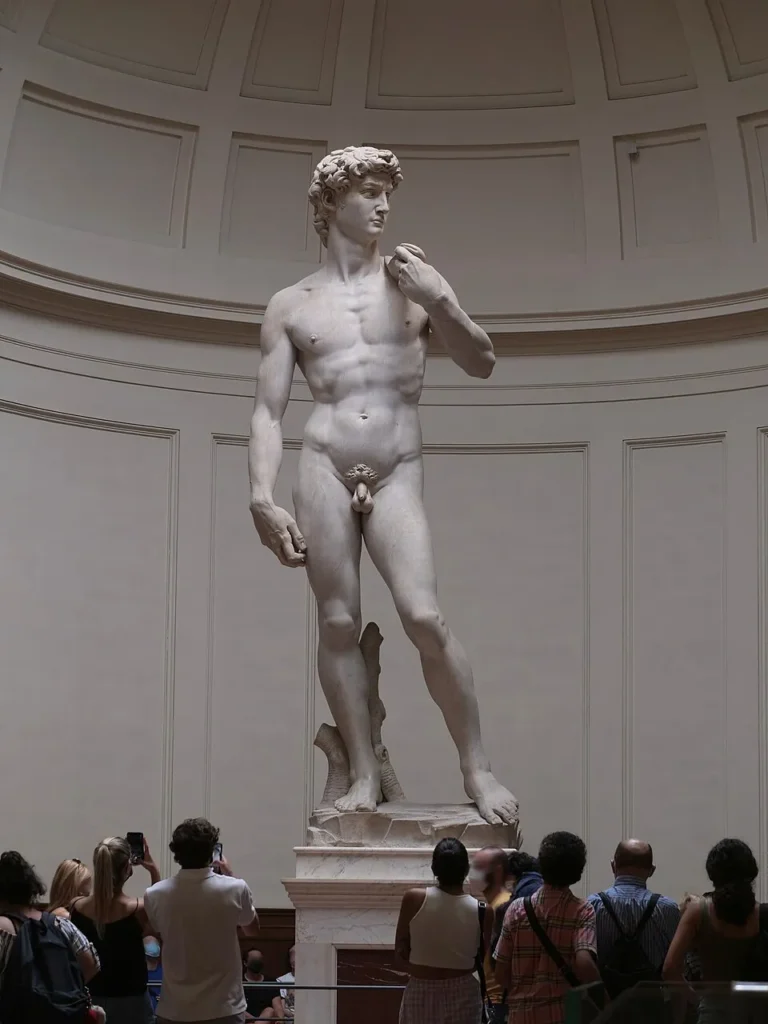
On 13 September 1501, a twenty-six-year-old sculptor set his chisel against a block of Carrara marble that had been abandoned in a Florence cathedral workshop for nearly forty years. The block had defeated two earlier sculptors, Agostino di Duccio in 1464 and Antonio Rossellino in the 1470s, and the Opera del Duomo had left it lying in the yard with the nickname il gigante. The commission Michelangelo accepted from the Arte della Lana was for a prophet-figure to stand on a buttress of Florence Cathedral, roughly eighty feet above street level. That intended height matters enormously, because it explains everything visitors find strange about Michelangelo’s David today: the head that is too large for the body, the right hand with its swollen veins and oversized knuckles, and, most strikingly of all, a pair of eyes that do not quite point in the same direction. None of these features are accidents or oversights. They are the calculated solutions of a sculptor who understood that a stone figure viewed from far below obeys entirely different optical laws from one examined at arm’s length in a museum corridor.
Why the block was difficult and what that forced Michelangelo’s David to become
The marble block Michelangelo inherited in 1501 had a troubled history that shaped every decision he made. Agostino di Duccio had begun roughing out a figure in 1464 but abandoned the project, leaving a deep, irregular gouge running down the front of the stone. Rossellino apparently touched the block around 1475 and also gave up. By 1500, the Opera del Duomo’s inventory described it as “a certain figure of marble called David, badly blocked out and supine.” When Michelangelo’s contract was signed on 16 August 1501, his challenge was not simply to carve a colossal figure but to extract a coherent figure from an already compromised, unusually narrow block of stone. The block’s thinness in one dimension explains the statue’s notably shallow depth from front to back, a feature that every visitor who walks around the David in the Accademia notices but seldom attributes to the constraints of the raw material.
The commission specified that the finished statue would stand on one of the cathedral’s northern exterior buttresses, visible from the piazza below at a height of roughly eighty feet. That specification drove the proportional decisions that look strange to modern eyes. A sculptor designing for that viewing geometry must solve a specific problem: the human eye compresses distance, so that features located far above the viewer appear smaller and less distinct than features at eye level. The head of a colossal figure placed at roofline height loses half its apparent size compared to the feet. Michelangelo compensated by enlarging the head and upper body relative to the lower body, so that when seen from below, the proportions would read as balanced. The same logic governs the right hand. Giorgio Vasari, writing in his Lives of the Artists in 1550, noted the statue’s extraordinary power but did not dwell on its asymmetries, probably because he understood that they served the work’s civic function.
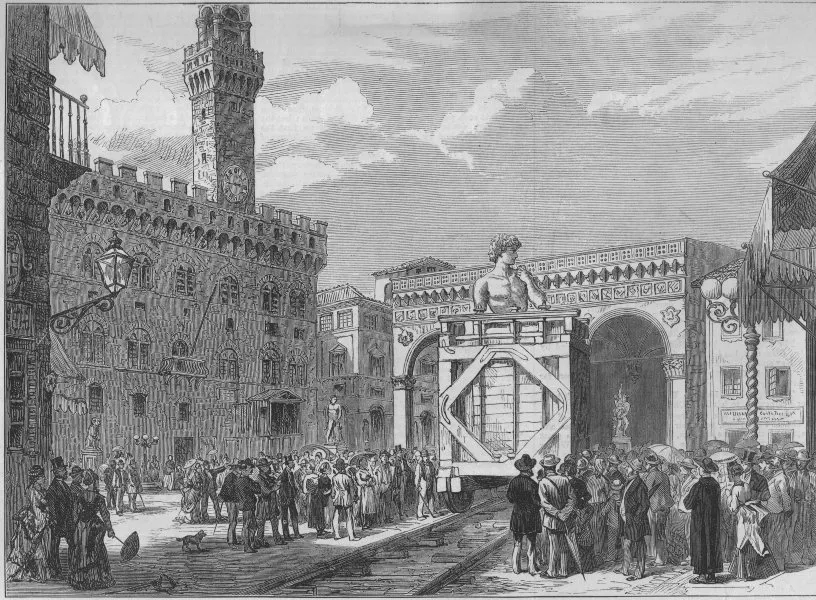
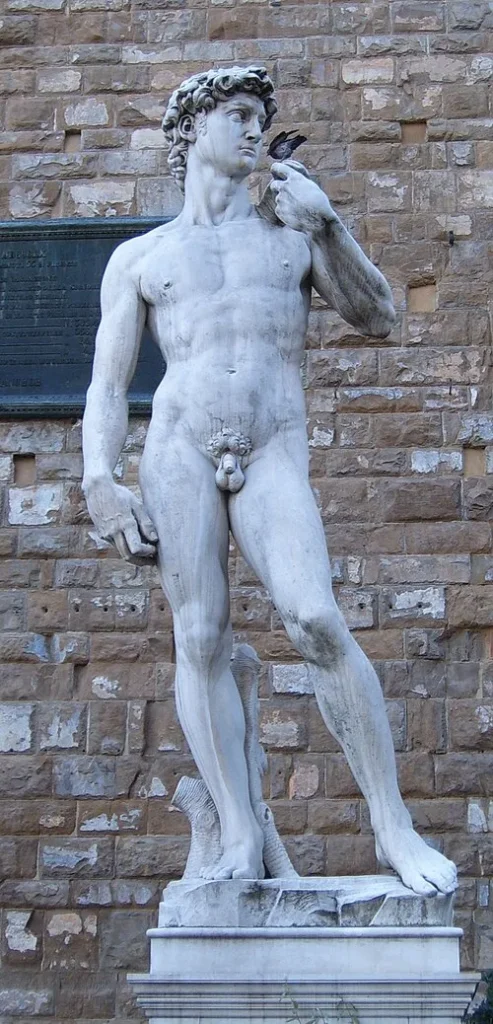
Saul Levine of Fairleigh Dickinson University, in his 1974 study “The Location of Michelangelo’s David: The Meeting of January 25, 1504” published in Art Bulletin, showed through close analysis of the archival minutes that even before the statue was finished, Florentine authorities understood it could not physically be raised to the cathedral roof. On 25 January 1504, a committee of thirty artists and officials gathered to choose an alternative site. The committee included Leonardo da Vinci, Sandro Botticelli, Giuliano da Sangallo, Piero di Cosimo, and Filippino Lippi, and nine different locations were proposed. The debate was sharp. Giuliano da Sangallo, backed by Leonardo, argued the statue should stand sheltered under the Loggia dei Lanzi to protect the marble from weather damage. The majority eventually chose the entrance of the Palazzo della Signoria. The statue was unveiled there on 8 September 1504, standing on a tall pedestal just outside the city’s civic heart, where it remained until its transfer to the Galleria dell’Accademia in 1873.
The science of the deviating eyes
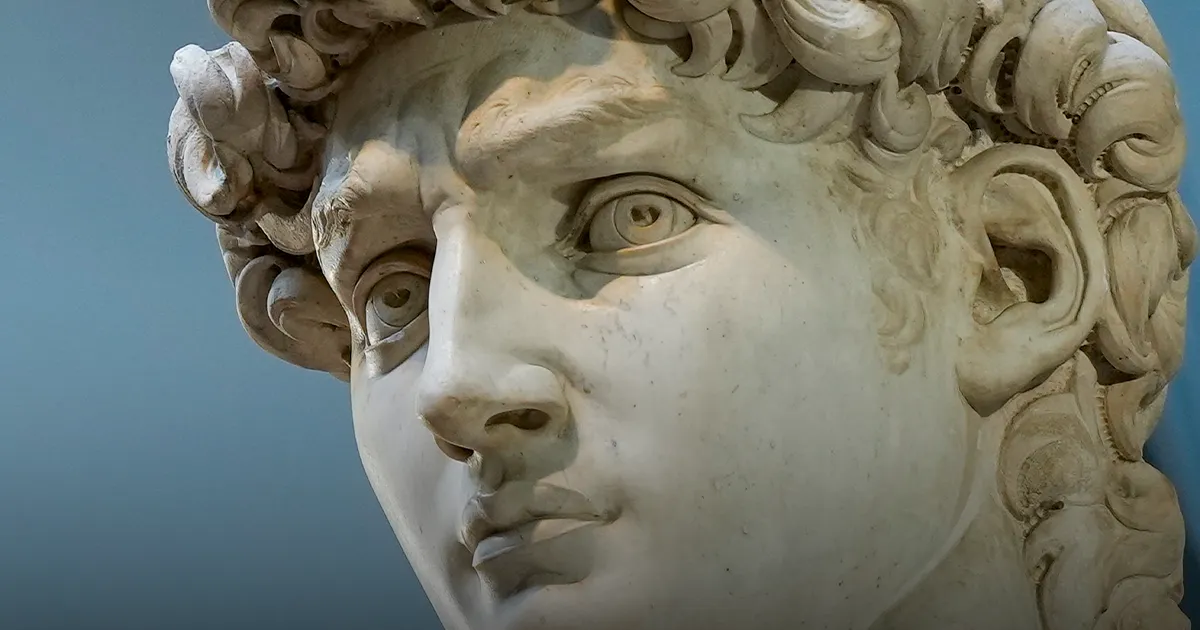
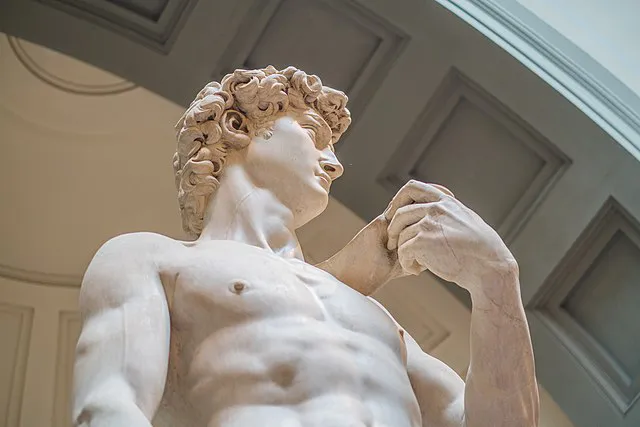
The most discussed of David’s intentional asymmetries is the divergence of the eyes, a detail that went largely unnoticed for five centuries simply because viewers could never see the statue at the height and angle Michelangelo designed for. In 1999, Professor Marc Levoy of Stanford University led the Digital Michelangelo Project, deploying laser rangefinder scanners on a motorised gantry to produce a billion-polygon three-dimensional model of the statue. The resulting model allowed researchers to examine the David’s face from any angle and at any height, including the precise viewing angle a pedestrian standing in Piazza della Signoria would have had in 1504. The scan confirmed what close inspection had long suggested: the two eyes point in different directions.
Drs Saad Shaikh and James Leonard-Amodeo, writing in the Journal of the Royal Society of Medicine in 2005, described the anomaly in clinical terms. The right eye holds the primary position, looking broadly forward. The left eye manifests what ophthalmologists call an exodeviation, a lateral turn outward to the left. The likely reason this detail escaped notice for centuries is that most visitors stand far below the head and cannot examine the eyes at arm’s length. Shaikh and Leonard-Amodeo argued this deviation is not a flaw but a deliberate artistic mechanism. Approaching the statue from its left side, the left eye appears to fix its gaze toward and above the viewer, as if concentrating on a distant target. This is exactly the angle from which a Florentine in the piazza would have first encountered the figure. Walking around to the right, the right eye engages while the left disappears behind the sling, so that each side of the statue presents a coherent and purposeful gaze without the two eyes ever simultaneously producing an impression of unfocused staring.
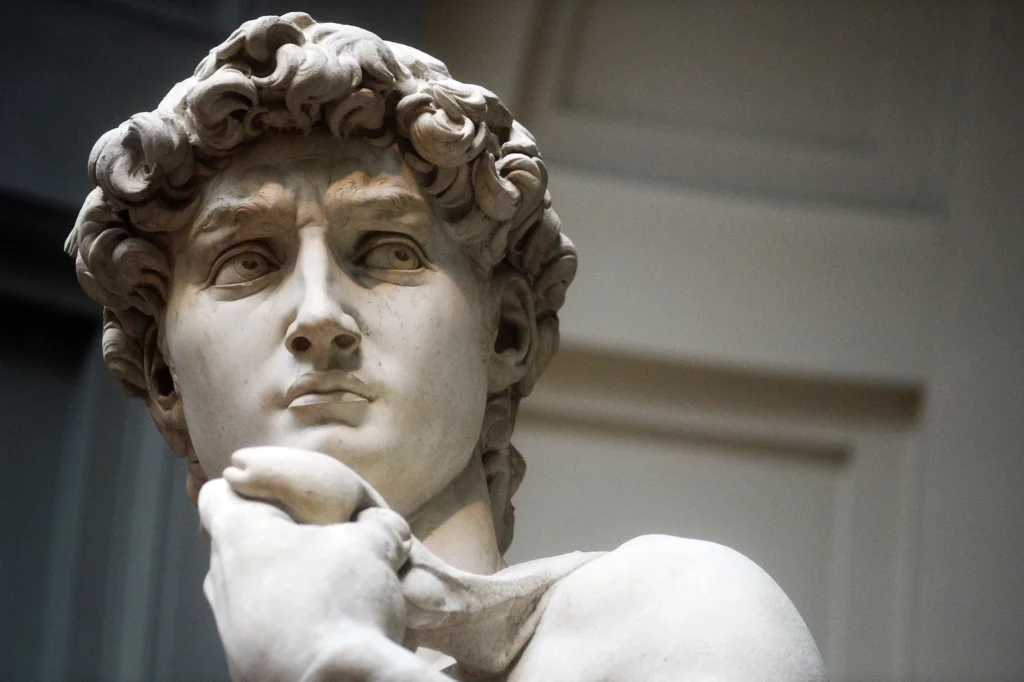
The eyes function within a wider system of light-carving. Michelangelo undercut the upper eyelids deeply enough to cast a hard shadow across the iris even under flat overhead light. The pupils are not simple drilled circles but shaped cavities with incised rims, designed to catch a point of light as a gleaming highlight against the shadowed orbital socket. From street level below, those highlights float like two points of focus and pull the viewer’s attention upward to the face. The tight-chiselled furrow between the eyebrows, the raised cords of the neck, and the barely parted lips all work toward the same result: a figure that registers intense, calculating attention across eighty feet of Florentine air.
The oversized head and the problem of foreshortening
Renaissance sculptors who worked for elevated positions understood a basic optical problem. The human head subtends a relatively small angle when viewed from far below, and the soft modelling of cheeks, lips, and eye sockets loses contrast in bright outdoor light and over long distances. To compensate, sculptors working for niches, cornices, and rooflines routinely increased head size and cut features more deeply than anatomy required. Michelangelo pushed this correction further than most. The head of Michelangelo’s David measures approximately one-eighth of the figure’s total height, which is close to the standard Renaissance ideal for a standing figure, but when the statue was placed on a high pedestal in the piazza, that proportion read as barely adequate because perspective foreshortening compressed it. The sculptor had anticipated precisely this problem by building in additional mass at the jaw and brow and deepening the under-cuts around the nose and eye sockets so that shadow would keep the features legible even at a distance.
Lois Fichner-Rathus, in her widely used textbook Understanding Art, noted that the David introduces a new relationship between figure and surrounding space: rather than remaining still within a Classical contrapposto stance, the figure extends outward from its vertical axis, requiring the viewer to walk around the work to comprehend it fully. The right side of the statue is smooth and composed; the left, from the outstretched foot to the dishevelled hair, is actively dynamic. Michelangelo built a figure that looks different from every angle, each view presenting a different emotional register, from contemplative stillness on one side to coiled tension on the other. This was only possible because he conceived the statue as a civic object meant to be read by moving pedestrians at varying distances, not as a study piece meant to be examined from a single point at close range.
Built out of a love for history, kept free from distractions.
Spoken Past is an independent project shaped by curiosity, care, and long hours of research. Reader support helps keep it maintained, carefully researched, and open to everyone.
The right hand and the language of power
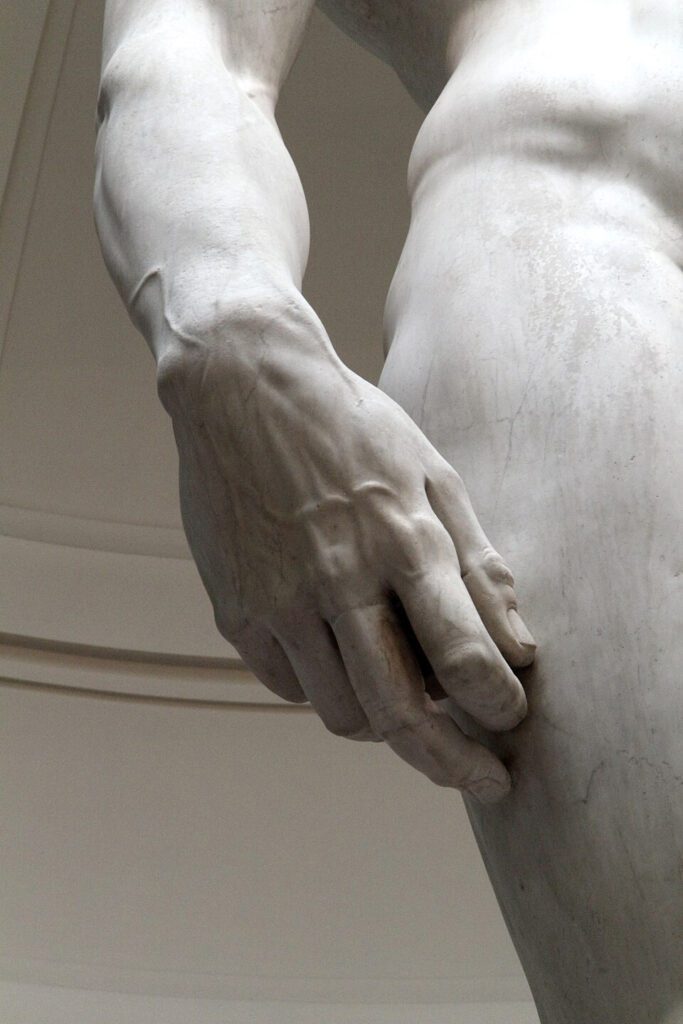
The right hand of the David is the most overtly enlarged feature in the statue, and it serves both optical and symbolic purposes simultaneously. Anatomically, the hand is too large for the body: the abductor digiti minimi muscle, the prominent ridge running down the outer edge of the hand, is exaggerated well beyond anything a naturalistic rendering would require. The veins across the back of the hand stand up in relief; the tendons are individually carved as distinct ridges. At close range in the Accademia, the hand looks almost grotesque. Placed on a civic pedestal sixty feet in the air, those same features collapsed to exactly the degree of prominence needed to register as a hand at all. The enlargement compensated for exactly the degree of optical reduction that height and distance would impose.
The symbolic dimension of the hand runs alongside the optical one. Florentine humanist culture was saturated with Latin wordplay, and the pairing of manus (hand) with virtus (excellence, courage, civic worth) was a standard rhetorical figure. A civic statue placed at the entrance to the Palazzo della Signoria, the centre of Florentine republican government, required legible symbols of the virtues the republic aspired to embody. The right hand of the young David, stone-ready and visibly powerful, carried that charge. Rona Goffen of Rutgers University, in Renaissance Rivals (2002), documented that gilded details were added to the statue later in the summer of 1504, including a gilt victory wreath, a gilded sling, and gilded decoration on the tree-trunk support. Those gold accents would have caught sunlight and drawn the eye upward to the face and hand, reinforcing the reading of the statue as a civic guardian rather than simply a biblical episode in marble.
What a political reading adds to the optical one
The scholarly debate over the David’s meaning has never been settled, and that is part of what makes the statue so unusually rich. Saul Levine argued that the original commission was fundamentally tied to the cathedral and its sacred programme, and that the statue’s shift to the Piazza della Signoria was a contingency rather than a plan. Nicholas Randolph Parks, responding to Levine in the same journal in 1975, contended that the Palazzo placement had been intended from a much earlier stage and that the statue was designed from the outset to carry political freight as a symbol of Florentine republican independence, particularly against the recently expelled Medici family. The contemporary record is genuinely ambiguous on this point, and neither position has definitively carried the field.
What is not ambiguous is how Florentines read the statue once it stood in the piazza. Several sources record that the David’s warning gaze was understood to be directed toward Rome, the direction from which Medici restoration or papal political pressure would most likely come. The figure is tense rather than triumphant, poised at the moment before the throw rather than celebrating after it. Michelangelo’s David was made cross-eyed, oversized at the extremities, and slightly awkward at close range was precisely the price of that quality: it was designed to be believed, not inspected, and to project courage across a public square rather than anatomical correctness across a workshop floor.
How the move to the Accademia changed the experience of the statue
When the original statue was moved indoors to the Galleria dell’Accademia in 1873 and a marble copy placed in the piazza, the terms of the David’s reception shifted permanently. Museum visitors now stand close to the original, at eye level with the torso, in a purpose-built hall with controlled zenith lighting. From that position, every optical correction Michelangelo made for an eighty-foot roofline or a tall civic pedestal becomes a visible distortion. The head looks too large. The hand looks monstrous. The eyes look misaligned. Decades of art-historical commentary generated by visitors who encountered the statue primarily in that indoor context produced a literature in which the David’s asymmetries were treated as something to be explained away or categorised as Renaissance convention.
The Digital Michelangelo Project’s 3D model changed this by allowing researchers to simulate the viewing experience Michelangelo actually designed for. When the model is rendered from a low viewing angle at a distance of thirty metres, the head and hand proportions read as balanced, the eyes appear purposefully focused, and the tension in the face reads as commanding rather than strained. In November 2010, a fibreglass replica of the David was installed on a buttress of Florence Cathedral for one week, the position for which the original had been commissioned. Photographs of that installation showed precisely what Michelangelo intended: a figure that resolved into clarity and authority at distance, every “mistake” converting into a calculated contribution to civic presence. The crooked eyes were never crooked. They were simply designed for a height no visitor to the Accademia has ever stood at.
Primary sources: Giorgio Vasari, Lives of the Artists, first published 1550; trans. George Bull, Penguin Classics, 1987. Giovanni Gaye, Carteggio inedito d’artisti, Florence, 1839-40, vol. 2 (minutes of the January 1504 committee). Secondary sources: Saul Levine, “The Location of Michelangelo’s David: The Meeting of January 25, 1504,” Art Bulletin 56 (1974): 31-49; Nicholas R. Parks, “The Placement of Michelangelo’s David: A Review of the Documents,” Art Bulletin 57 (1975): 560-570; Saad Shaikh and James Leonard-Amodeo, “The deviating eyes of Michelangelo’s David,” Journal of the Royal Society of Medicine 98(2) (2005): 75-76; Marc Levoy et al., “The Digital Michelangelo Project: 3D Scanning of Large Statues,” Proc. SIGGRAPH 2000; Rona Goffen, Renaissance Rivals: Michelangelo, Leonardo, Raphael, Titian, Yale University Press, 2002; Charles Seymour Jr., Michelangelo’s David: A Search for Identity, University of Pittsburgh Press, 1967.