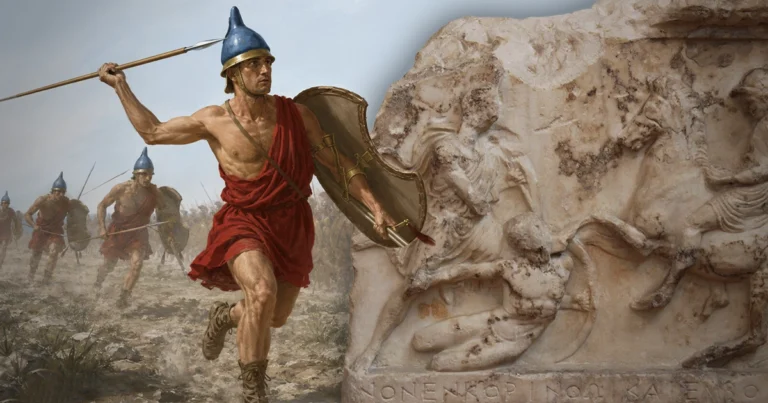
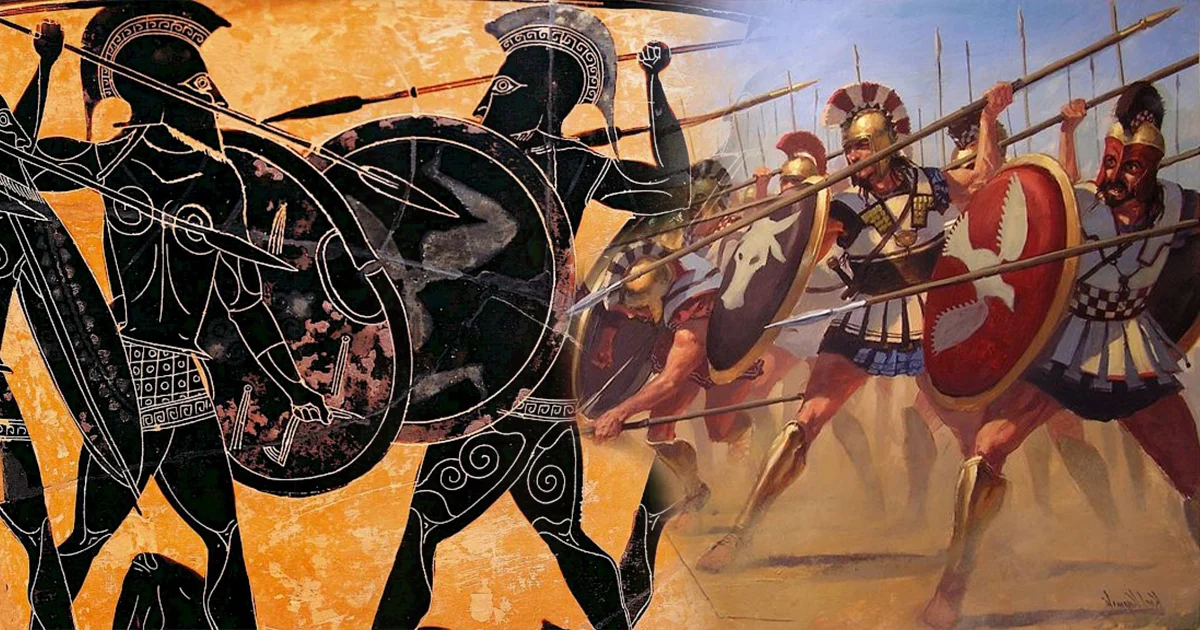
The crash of bronze against bronze echoed across the plain of Marathon in 490 BC when 10,000 Athenian and Plataean Greek hoplites charged the Persian army. These citizen-soldiers wore 50-70 pounds of armor and carried eight-foot spears into formation. The Greek hoplites fought in a tight infantry block called the phalanx, where overlapping shields created a mobile wall and long spears projected outward in rows. This method dominated Mediterranean battlefields for centuries because it combined individual protection with collective striking power. The hoplite system required specific equipment, rigorous training, and unwavering discipline to transform farmers and merchants into one of antiquity’s most effective fighting forces.
The Bronze Foundation
Greek hoplites relied on a distinct set of equipment that defined their combat role. The hoplon shield measured roughly three feet in diameter and weighed 15-17 pounds. Craftsmen constructed it from wood, covered it with bronze, and attached a leather strap at the rim for the forearm plus a central grip. This design allowed the shield to protect not just the bearer but also the man to his left, creating interdependence in the battle line.
Body armor varied by wealth and period. The bronze cuirass covered the torso with front and back plates joined at the sides. Wealthier Greek hoplites wore the bell cuirass molded to the body’s shape, while others used the linothorax. This consisted of multiple layers of linen glued and stitched together, reinforced with bronze scales. Tests on reconstructed linothorax armor have shown it could stop arrows and deflect sword strikes while weighing only 10-12 pounds.
The primary weapon was the dory spear, measuring seven to nine feet in length with an iron spearhead and bronze butt-spike. The butt-spike served as a backup weapon if the shaft broke and could be planted in the ground when resting. Greek hoplites carried a short sword called a xiphos as a secondary weapon, typically 18-24 inches long with a leaf-shaped blade.
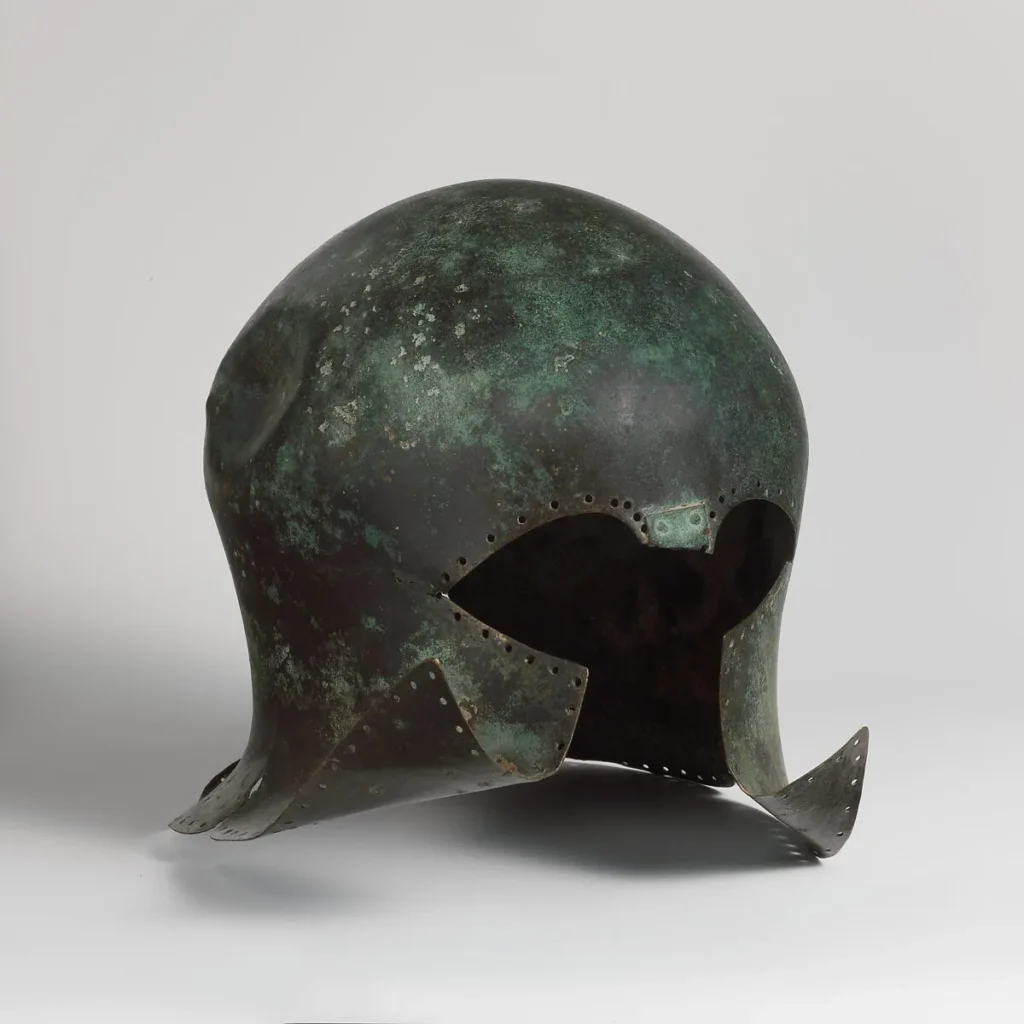
Bronze greaves protected the shins, and a Corinthian helmet covered most of the head. The Corinthian design featured cheek plates and a nose guard that left only the eyes and mouth exposed. Later helmets like the Phrygian and Chalcidian offered better peripheral vision. This complete panoply cost approximately one mina, roughly equivalent to three months of skilled labor wages in fifth-century Athens.
Standing Shoulder to Shoulder
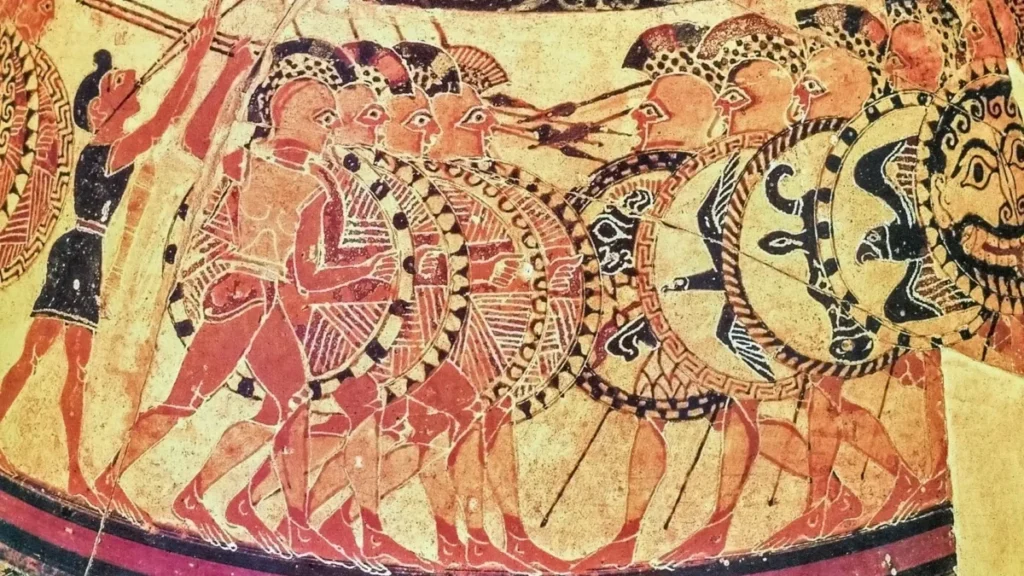
The phalanx formation arranged Greek hoplites in ranks typically eight men deep, though this could range from four to sixteen depending on the situation. Each man stood roughly three feet from his neighbor, close enough that shields overlapped by several inches. The front rank held spears leveled forward while the second and sometimes third ranks angled their spears over the shoulders of those ahead. Ranks behind applied physical pressure from behind and served as replacements for fallen comrades.
Cohesion determined success or failure. If the line broke, individual hoplites became vulnerable to flanking attacks and couldn’t leverage their main advantage. The rightward drift was a constant problem because each man sought to shelter behind his neighbor’s shield, causing the entire formation to edge right during advance. Commanders positioned their best troops on the right wing to counter this tendency and placed experienced veterans in the front rank.
Musical instruments maintained rhythm during the advance. Spartan armies marched to the sound of flutes, coordinating footsteps so the line wouldn’t break apart. The standard advance pace was called embater, roughly a quick walk that allowed men to maintain formation while building momentum. Breaking into a full run risked disrupting the shield wall and exhausting soldiers before contact.
The phalanx excelled on flat, open terrain where it could maintain formation. Rough ground, hills, or wooded areas disrupted the tight spacing and created gaps that enemies could exploit. Greek hoplites preferred pitched battles on agreed-upon fields where both sides could deploy in optimal conditions.
Training from Youth
Greek city-states prepared citizens for hoplite service through varied systems. Sparta enforced the agoge, a state-run education program beginning at age seven. Boys lived in barracks, practiced weapons drills, and learned to fight in formation. At age twenty, they became full Spartan warriors and joined a mess group called a syssitia. These groups ate together, trained together, and fought together, building the cohesion essential for phalanx combat.
Athens took a different approach. At age eighteen, Athenian males entered the ephebeia, a two-year military training program. The first year focused on physical conditioning and weapons handling. The second year placed ephebes on garrison duty at frontier forts where they learned practical military skills. After completing the ephebeia, citizens remained liable for military service until age sixty.
Most Greek hoplites were citizen farmers who owned enough land to afford the panoply. They trained periodically with their neighbors who would stand beside them in battle. This created natural units based on geographic districts within each city-state. The men of Marathon fought alongside those they knew from their deme, strengthening bonds during combat.
Individual skills mattered less than collective discipline. Greek hoplites didn’t need exceptional athleticism or advanced sword technique. They needed the courage to maintain their position while men died around them. The crushing pressure of the phalanx derived from hundreds of men moving as one organism, not from individual heroics.
The Push of Battle
Combat between phalanxes followed a brutal pattern. The two formations advanced until the front ranks crashed together in what the Greeks called the othismos. This term literally means “push” and describes the shoving match that occurred after the initial spear clash. Front-rank Greek hoplites thrust with their spears at any exposed flesh while the mass of bodies behind them pushed forward with their shields.
The first moments after contact were the deadliest. Spears shattered against shields, men fell screaming with punctured throats or pierced eyes, and the wounded collapsed underfoot. Those who stumbled became liabilities, creating gaps in the shield wall. The rear ranks stepped over or pushed aside casualties while maintaining forward pressure.
Battles rarely lasted more than an hour because the physical strain was immense. Men fought in summer heat wearing bronze armor, breathing through small helmet openings, and exerting maximum force. Heat exhaustion and dehydration felled soldiers as surely as enemy weapons. The side that broke first usually suffered catastrophic casualties during the rout because individual Greek hoplites couldn’t defend themselves effectively outside formation.
Breaking occurred when casualties, exhaustion, or fear caused men to abandon their positions. Once a few men fled, panic spread rapidly through the ranks. The victorious phalanx pursued briefly but typically didn’t chase far because maintaining formation remained paramount. Greek armies erected a trophy at the point where the enemy broke, marking their victory with captured armor.
Built out of a love for history, kept free from distractions.
Spoken Past is an independent project shaped by curiosity, care, and long hours of research. Reader support helps keep it maintained, carefully researched, and open to everyone.
Marathon and Tested Tactics
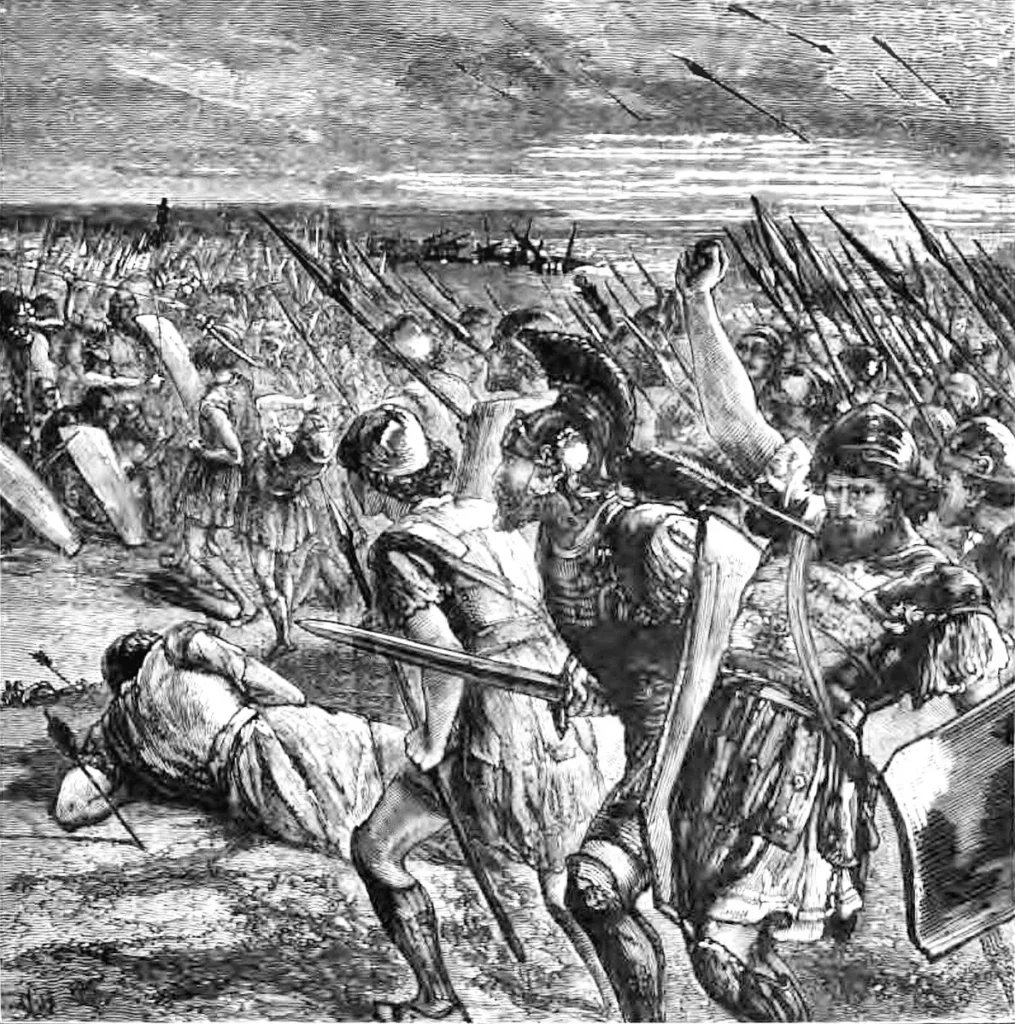
The Battle of Marathon in 490 BC demonstrated hoplite effectiveness against different military systems. The Athenian general Miltiades commanded roughly 10,000 Greek hoplites against perhaps 25,000 Persians. The Persians relied on missile troops and cavalry, expecting to shower the Greeks with arrows then overwhelm them. Miltiades countered by thinning his center while strengthening both wings, creating an inverted formation.
When the Greek hoplites charged, they covered the final 200 yards at a run to minimize time under arrow fire. The Persian center pushed back the weakened Greek middle, but both Greek wings smashed through their opponents. The Athenians then wheeled inward and attacked the Persian center from behind, encircling it. Persian casualties reached 6,400 dead according to Herodotus, while the Greeks lost only 192 men.
Marathon proved that disciplined infantry could defeat numerically superior forces through tactical innovation and unit cohesion. The victory shaped Greek military thinking for generations and demonstrated the superiority of heavy infantry over light troops on open ground. The battle elevated the hoplite system from merely effective to legendary in Greek cultural memory.
The Spartans refined hoplite tactics to their peak. At Thermopylae in 480 BC, 300 Spartans plus several thousand allies held the narrow pass against the entire Persian army. The confined space negated Persian numbers and allowed the Greek hoplites to fight in optimal terrain. King Leonidas used the terrain to channel attacks into killing zones where the phalanx could function perfectly.
Breaking the Line
The phalanx possessed clear weaknesses that skilled opponents exploited. The flanks and rear were vulnerable because soldiers couldn’t turn quickly in tight formation. Light infantry with javelins could harass the sides while staying beyond spear reach. Cavalry could circle around and attack from behind if terrain permitted.
Rough ground disrupted the formation’s integrity. At the Battle of Sphacteria in 425 BC, Athenian light troops trapped a Spartan force on rocky terrain where they couldn’t maintain proper spacing. The Spartans suffered constant javelin attacks from all directions while their hoplite training became useless. After several days, the surviving 292 Spartans surrendered, shocking the Greek world.
The phalanx required flat, open space and mutual visibility among units. Forested or hilly regions broke up the formation and isolated groups. Greek hoplites rarely campaigned in such terrain precisely because their fighting method became ineffective there. Commanders who understood these limitations could force battles in disadvantageous locations.
The system also suffered from limited strategic mobility. Heavily armored Greek hoplites couldn’t pursue routed enemies effectively or conduct long marches without extensive rest. Campaigns typically occurred in summer when farmers could leave their fields, and battles happened near city-states where supplies were available. This restricted the geographic scope of Greek warfare.
The Macedonian Revolution
Philip II of Macedon and his son Alexander transformed Greek warfare in the 4th century BC by addressing hoplite limitations. Philip introduced the sarissa, a pike 13-18 feet long that gave his phalanx greater reach. He also trained professional soldiers who could maneuver in more complex formations than citizen militias managed.
The Macedonian phalanx used smaller shields because the sarissa required two hands. This reduced individual protection but the longer spears created a more impenetrable hedge. Philip combined his phalanx with elite cavalry and light troops in a combined-arms system where each element supported the others. The phalanx fixed the enemy in place while cavalry struck flanks or rear.
At Chaeronea in 338 BC, Philip’s new model defeated the traditional Greek hoplites of Athens and Thebes. Alexander used similar tactics to conquer the Persian Empire, proving that the evolved phalanx could succeed on a continental scale. The age of the classical Greek hoplites fighting in their ancestral manner had effectively ended, though the basic concept persisted in various forms for centuries.
The Romans later developed the manipular legion which abandoned the rigid phalanx for smaller, more flexible units. These maniples could operate independently, adapting to terrain and tactical situations that would paralyze a traditional phalanx. By 200 BC, Roman legions consistently defeated Hellenistic phalanxes in Italy, Greece, and Asia Minor.
Citizen Soldiers and Democracy
The hoplite system intertwined with Greek political development in ways that extended beyond pure military function. Because Greek hoplites purchased their own equipment and served without pay, military service became linked to property ownership and citizenship status. Those wealthy enough to afford the panoply gained full political rights in many city-states.
This created a middle-class warrior culture. Aristocrats and poor laborers both existed outside the hoplite class, though for different reasons. The bond formed between men who fought shoulder-to-shoulder translated into political solidarity. Many historians argue that hoplite warfare contributed to the rise of democratic institutions because those who defended the state demanded a voice in governing it.
The egalitarian nature of phalanx combat reinforced these political tendencies. A rich merchant and a small farmer fought identically once they donned their armor and took their place in line. Individual wealth and status disappeared in the uniformity of the shield wall. Success depended on collective action rather than aristocratic heroism.