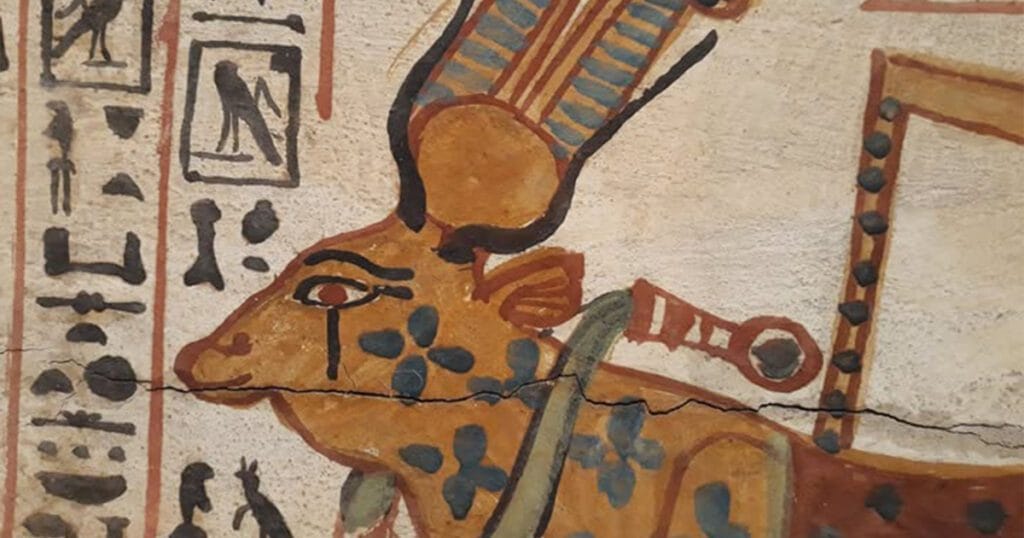
In the outermost golden shrine of Tutankhamun, excavated by Howard Carter in 1922 and now housed in the Egyptian Museum in Cairo, a partially preserved inscription records what scholars today call the Book of the Heavenly Cow. The same text appears in fuller form on the walls of the tombs of Seti I (KV17), Ramesses II (KV7), and Ramesses III (KV11), each copy occupying a dedicated annex chamber beside the sarcophagus room. At the center of this text sits one of the most extraordinary stories in all of ancient Egyptian religion: the sun god Ra, grown old and weary, dispatches the goddess Hathor to punish a rebellious humanity. What follows is not a restrained reprimand but a massacre that nearly ends the human race, stopped only by a deception involving thousands of jars of ochre-stained beer. This article examines what the Book of the Heavenly Cow actually says, what modern scholarship has made of it, and why the Egyptians re-enacted its climax in an annual festival for over a thousand years.
What the Text Actually Says and Where It Comes From
The Book of the Heavenly Cow is a deceptively complex document. As Nadine Guilhou of the Université de Montpellier III has established in her authoritative 2010 entry in the UCLA Encyclopedia of Egyptology, the text functions simultaneously as an etiological myth, a royal funerary text, and a ritual instruction. It explains why the world is imperfect, why Ra no longer walks the earth, and why death and suffering entered creation. The narrative is written in Middle Egyptian, which suggests an origin earlier than the New Kingdom copies, possibly reaching back to the Middle Kingdom period of c. 2040 to 1782 BCE, though the earliest physical evidence places it firmly in the fourteenth century BCE on Tutankhamun’s shrine. Scholars Miriam Lichtheim in her foundational “Ancient Egyptian Literature” (University of California Press, 1976) and Erik Hornung in his 1982 critical German edition each treat the text as one of Egypt’s most theologically significant compositions.
The opening situation is this: Ra has ruled over both gods and humans since before the cycle of day and night existed. The text specifies that during this primordial age there was no death, no underworld, no movement of the sun across the sky. But humanity, described in the Egyptian idiom as the “tears of Ra” and therefore his creation, has begun plotting against him. The precise nature of the rebellion is left vague, which Guilhou reads as a deliberate theological choice: the point is not the specifics of human disobedience but the general principle that creation, once made, turns toward disorder. Ra’s bones, the text tells us, had become like silver, his flesh like gold, his hair like lapis lazuli. He is not eternal in the way a transcendent deity might be. He ages, and his weakness emboldens the rebels.
Ra’s response is to convene a secret council of the elder gods, including Shu, Tefnut, Geb, Nut, and crucially Nun, the primordial water from which all creation emerged. He asks them what he should do with humans who plot against him. Nun advises him to send his Eye. The Eye of Ra, a concept that appears across dozens of Egyptian religious texts, is not a passive organ of sight but an active feminine extension of the sun god’s power. It can be separated from Ra, sent into the world as an agent of his will, and it carries within it the full destructive force of solar heat and light focused to a point. Ra chooses to make his Eye into Hathor and direct it toward the rebels.
How Hathor Became Sekhmet and What Happened Next
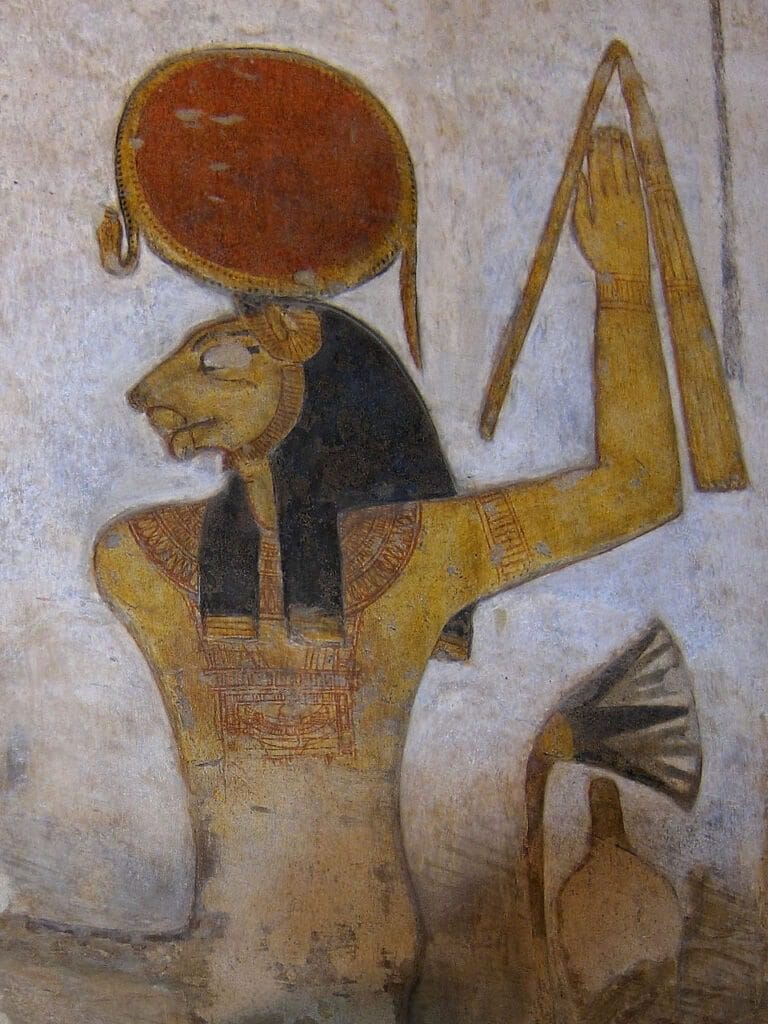
Here the text makes a theological move that confused early translators and still draws scholarly debate. When Ra’s Eye descends to earth, it does not simply punish the guilty. It transforms. The warm, music-loving Hathor, patron of childbirth and festivity, hardens into Sekhmet, the lioness-headed goddess of war and pestilence whose name means “the powerful one.” This is not a simple case of two separate deities sharing a task. Egyptian theological thinking, which modern scholars describe as “fluid,” allowed a single divine being to hold multiple aspects simultaneously, each aspect activated by different conditions. Hathor, Sekhmet, and even Tefnut could each occupy the role of the Eye of Ra because they all shared that underlying function as Ra’s feminine agent in the world. The Egyptologist Robyn Gillam of York University has argued that Hathor’s extraordinary range of attributes, from fertility goddess to cosmic destroyer, arose because she absorbed dozens of local goddesses during the Old Kingdom, making her a kind of template for Egyptian femininity in all its forms.
Sekhmet’s assault on humanity is described in graphic terms. She wades through the rebels in the desert, and blood flows across the land. The text lingers on the carnage with what feels like grim relish. But Ra’s satisfaction does not last. The other gods observe that if the destruction continues at this rate, there will be no humans left. This is a practical concern as much as a moral one: a world without humans is a world without the temple offerings, agricultural labor, and ritual observances that sustain the divine order. Ra decides that enough punishment has been administered. He wants to stop Sekhmet. The problem is that she has moved beyond punishment into appetite. She is no longer carrying out a sentence. She is hunting for the pleasure of the kill, and no divine command can simply switch that off.
The Red Beer Trick and Its Precise Mechanism
Ra’s solution is one of the most memorable images in any ancient religious text. He orders a vast quantity of beer to be brewed, drawing on Egypt’s sacred brewing tradition in which beer production was closely associated with the goddess Tenenet. Into this beer, the text specifies, red ochre, a naturally occurring iron oxide mineral known in Egyptian as didi, is ground and mixed until the liquid runs the colour of blood. According to the text’s own internal count, 7,000 jars of this red brew are then poured across the fields of Egypt before dawn on the day when Sekhmet is due to return from her night’s hunting.
When Sekhmet arrives the next morning, she sees what appears to be a landscape flooded with the blood of her victims. Her predatory instincts read the scene exactly as Ra intended them to. She drinks. The text emphasizes how deeply she drinks and how quickly the alcohol takes hold. Her hunting focus dissolves into intoxication. She laughs. She sways. And when the lioness finally looks up again, the slaughter-light in her eyes has cooled into the warm gaze of Hathor. Humanity survives, but the world is permanently changed by what has just happened. Ra, exhausted and disillusioned with creation, climbs onto the back of the heavenly cow, a manifestation of the sky goddess Nut, and ascends into the sky to rule from a distance. The golden age of direct divine presence on earth is over. Death, suffering, and the daily cycle of the sun all begin from this moment.
The ochre-beer deception works not through a simple trick but through a deep knowledge of Sekhmet’s nature. Ra does not fight her or restrain her by force. He feeds her destructive drive just enough to exhaust it, redirecting the mechanism of her hunger against itself. This reflects a broader pattern in Egyptian religious thought, in which maat, the cosmic principle of truth and order, is maintained not through direct confrontation but through precise understanding of how divine forces operate. You cannot cancel Sekhmet’s purpose; you can only satisfy it enough that she releases it voluntarily.
Enjoying Spoken Past?
I created Spoken Past to share my love of history. I research, write and develop everything myself, and I want my articles and basic guides to remain free for everyone.
If you enjoy my work, please consider supporting Spoken Past with a small donation.
The Eye of Ra and the Role of Multiple Goddesses
One of the most important aspects of this myth for understanding Egyptian theology is that Hathor is not the only goddess who can fill the role of Ra’s Eye. In other texts, Tefnut, Mut, and Nekhbet occupy the same position. Each of these goddesses shares the capacity for extreme violence when activated as Ra’s agent, and each returns to a gentler state when pacified. The Egyptologist Carolyn Graves-Brown, writing on gender in ancient Egypt, has noted that this duality, extreme fury and extreme tenderness inhabiting the same divine body, was specifically associated in Egyptian thought with femininity. The texts do not treat this as a contradiction. They treat it as a description of how divine power functions in a female form.
The political implications of the Eye of Ra myth extended into royal ideology. Pharaohs regularly deployed the image of the Eye in their self-presentation, positioning themselves as both the beneficiaries of Hathor’s protective warmth and the inheritors of Ra’s capacity to direct her destructive force against enemies. Statues and inscriptions from the Temple of Mut at South Karnak, where Betsy M. Bryan, the Alexander Badawy Emerita Professor of Egyptian Art and Archaeology at Johns Hopkins University, has directed excavations since 2001, demonstrate that Sekhmet was understood as Mut’s alter ego in exactly the same way she was understood as Hathor’s. Bryan’s research on the ritual life of this temple complex has transformed our understanding of how the Eye mythology functioned in a live cult setting. The precinct contained hundreds of granite statues of Sekhmet placed there during the reign of Amenhotep III, c. 1386 to 1353 BCE, each representing a different hour of the day and night, turning the goddess’s potentially destructive presence into a permanent ritual guardian surrounding the sanctuary.
The Festival of Drunkenness and the Archaeology of the Myth
One of the most remarkable outcomes of this myth is that the Egyptians did not simply record it. They re-enacted its climax annually in a public festival known as the Tekh Festival, or the Festival of Drunkenness, celebrated on the twentieth day of the first month of Akhet, the season of inundation. The festival is now known from textual references spanning at least the Twelfth Dynasty, around 1900 BCE, through the Graeco-Roman period, making it one of the longest-attested ritual celebrations in the ancient world. According to Egyptologist Carolyn Graves-Brown, it peaked in popularity during the early New Kingdom, c. 1570 to 1069 BCE, fell out of favour for a period, and was then revived under Roman rule.
The archaeological evidence for this festival was transformed by excavations at the Temple of Mut at South Karnak conducted by the Johns Hopkins University team between 2004 and 2007. Bryan’s team uncovered the architectural remains of a “Hall of Drunkenness” or “Porch of Drunkenness” dating to the reign of Hatshepsut, c. 1475 to 1460 BCE. This discovery pushed the physical evidence for the festival roughly a thousand years earlier than the Greco-Roman sources that had previously dominated scholarly discussion. The porch contained drinking vessels, architectural elements decorated with references to the myth, and a calendar inscription that explicitly connects the red-dyed beer with the appeasement of the goddess. Before this excavation, scholars had assumed the Festival of Drunkenness was largely a late phenomenon; the Johns Hopkins discoveries demonstrated it was a cornerstone of New Kingdom religious practice.
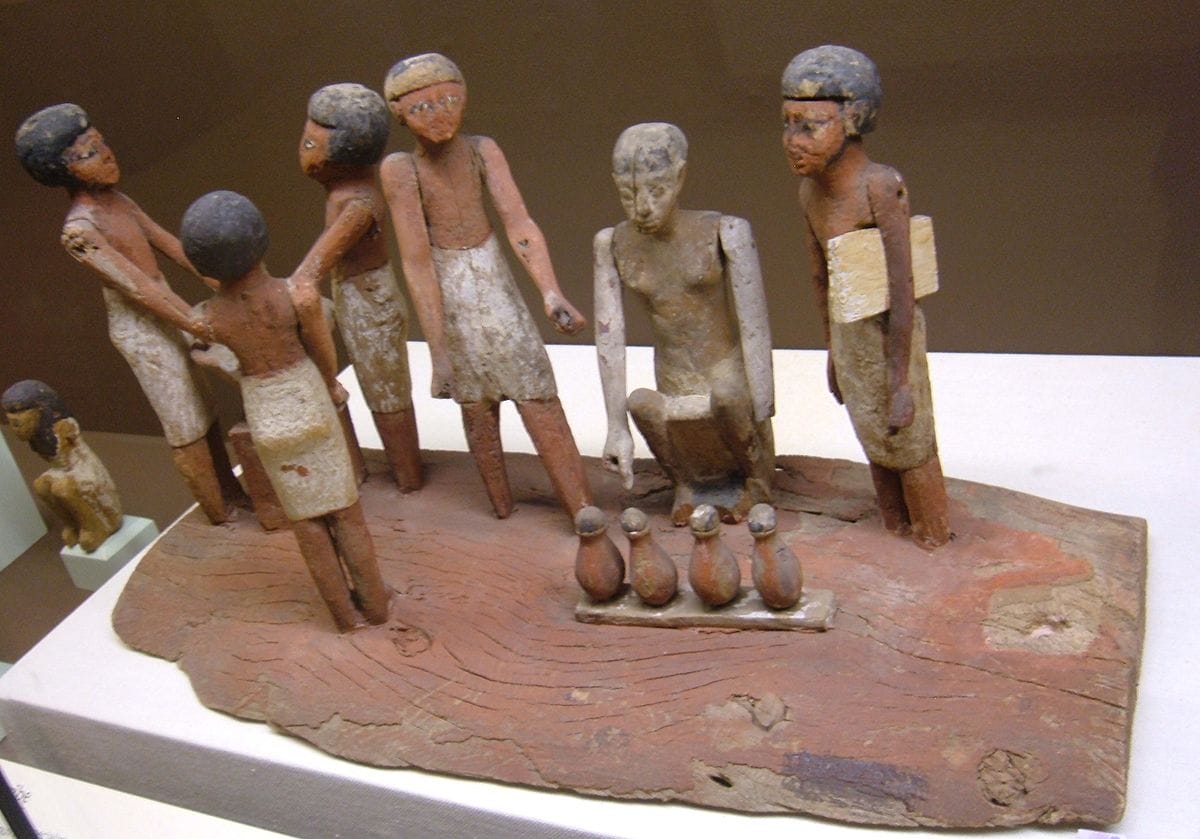
What happened during the festival itself? Participants gathered at temple precincts, consumed substantial quantities of beer, and reached a state of profound intoxication. Bryan has described this not as casual social drinking but as a controlled religious state: worshippers collapsed in drunkenness, mirroring Sekhmet’s own collapse in the myth, and were then woken by the sound of drums and music. In waking, they experienced a transition from the dangerous, liminal state of intoxication back into the ordinary world, just as Sekhmet returned from her killing state to become the beneficent Hathor. The ochre-red beer served during the festival, as Dora Goldsmith of Berlin’s Freie Universität has shown through her analysis of recipe texts from the temples of Dendera, Philae, and Athribis, carried genuine symbolic weight: the colour itself enacted the myth in every cup.
Hathor’s Dual Nature and What It Meant for Ordinary Egyptians
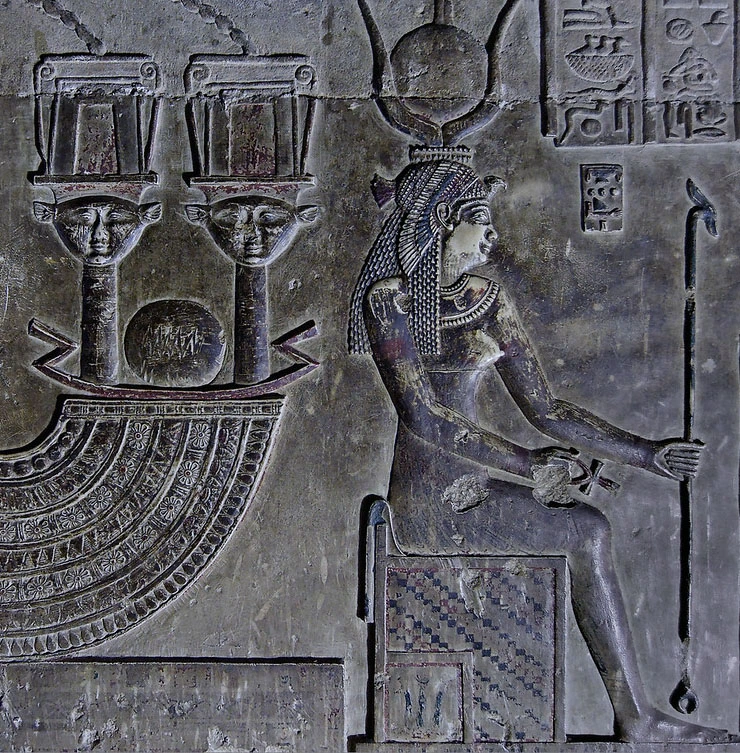
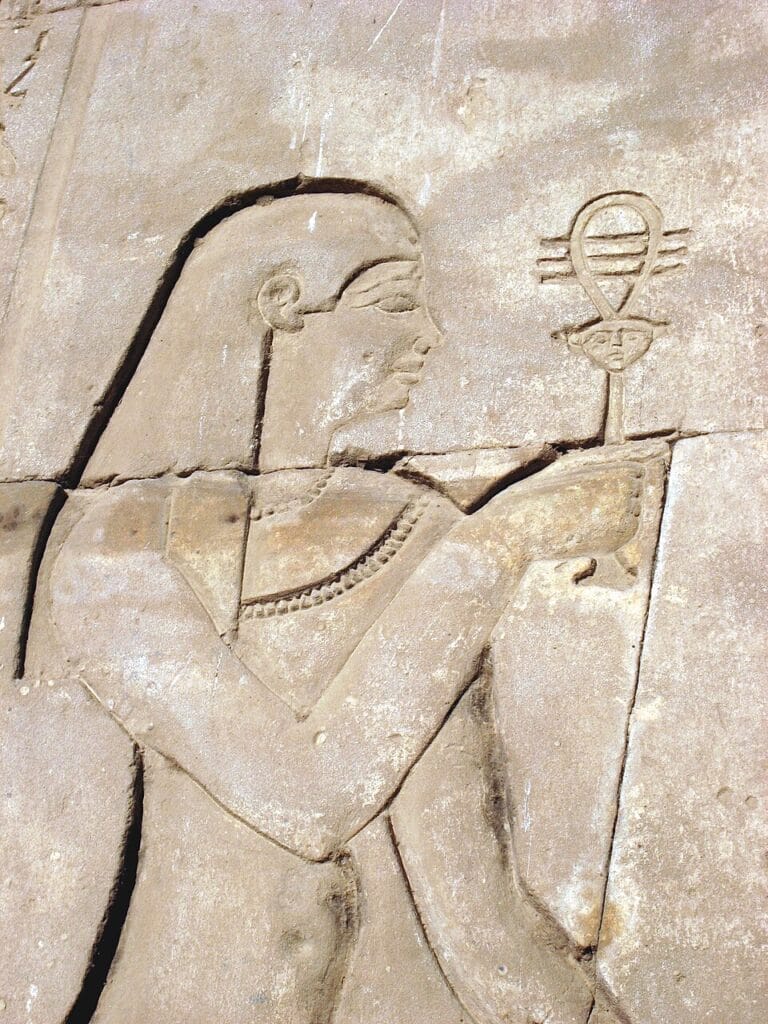
For ancient Egyptians outside the royal court, Hathor’s role as a destroyer was not an abstract theological problem. It was a lived concern. The same goddess who presided over music, childbirth, love, and the pleasures of daily life could, when sufficiently provoked, become the instrument of mass death. This duality was not a flaw in the theology. It was its point. The Nile, which gave Egypt its agricultural wealth, also flooded unpredictably and violently. The sun, which sustained all life, could scorch crops and kill animals in an extended drought. Egyptian religious thinking consistently placed generative and destructive forces in the same divine body, because that is how those forces actually behaved in the natural world the Egyptians inhabited.
Amulets bearing Hathor’s face in the form of the Hathor-headed column capital, examples of which survive in the Museum of Fine Arts in Boston and the Metropolitan Museum of Art in New York, were worn throughout the New Kingdom as protective devices. They invoked Hathor specifically in her capacity as both nurturer and guardian. A craftsman in the workers’ village of Deir el-Medina, on the west bank at Thebes, might keep a Hathor amulet for protection during childbirth while also understanding that the same goddess, if ignored or dishonoured, carried Sekhmet’s ferocity within her. Drought, pestilence, and political breakdown were all legible as signs of the Eye’s displeasure, and the regular performance of music, offerings, and festivals was the practical means by which Egyptians maintained their side of the relationship.
What the Myth Tells Us About Egyptian Theodicy
Theodicy, the problem of why a good god allows suffering, is usually discussed in the context of monotheistic religions. The Book of the Heavenly Cow shows that polytheistic systems grappled with precisely the same problem, though they framed the answer very differently. In the Egyptian version, death and suffering are not punishments inflicted on humanity by a distant moral judge. They are the accidental consequences of a crisis that the gods themselves barely contained. Ra did not intend to make the world imperfect. He intended a limited punishment, a corrective strike. Sekhmet got out of hand. The world as Egyptians knew it, mortal, grief-filled, and dependent on the rhythm of flood and drought, was the result of a divine plan that was only partially successful.
This reading of the myth as a theodicy was developed in detail by Erik Hornung, the Swiss Egyptologist whose 1982 critical edition remains the definitive scholarly text of the Book of the Heavenly Cow. Hornung argued that the text explained what he called the “imperfect creation,” the understanding that the world in its present state is not what the creator intended but what survived a catastrophe. The gods withdrew from direct governance not because they abandoned humanity but because the process of managing creation had become too dangerous for the divine order itself. Ra on the back of the heavenly cow, ascending into the sky while Thoth governs the night as his deputy, is a god who has retreated to a safer distance, leaving humans in a world that still bears the scars of the goddess’s fury.
That framework, imperfect creation resulting from divine conflict and resolved through ritual re-enactment, gives the Festival of Drunkenness a gravity that its rowdy surface might obscure. Every year, when participants drank themselves to the floor and woke to drums and torchlight, they were not simply commemorating a myth. They were participating in the same act of cosmic maintenance that had saved them in the first place. The ochre beer was not symbolic of the blood it replaced. It was, in the logic of Egyptian ritual, functionally equivalent to it: a real offering of a real substance that had once turned destruction into celebration, and could do so again.
Sources: Nadine Guilhou, “Myth of the Heavenly Cow,” UCLA Encyclopedia of Egyptology, 2010. Erik Hornung, Der ägyptische Mythos von der Himmelskuh: Eine Ätiologie des Unvollkommenen, Orbis Biblicus et Orientalis 46, Freiburg/Göttingen, 1982. Miriam Lichtheim, Ancient Egyptian Literature, Volume II: The New Kingdom, University of California Press, 1976. Betsy M. Bryan, “The Temple of Mut,” Johns Hopkins University Hub, 2013. Betsy M. Bryan, Johns Hopkins University Hub, 2015. “Understanding the Conduct During Festivals of Drunkenness,” M. Mayland Nielsen, Chronolog, 2023. William Kelly Simpson (ed.), The Literature of Ancient Egypt, 3rd ed., Yale University Press, 2003.