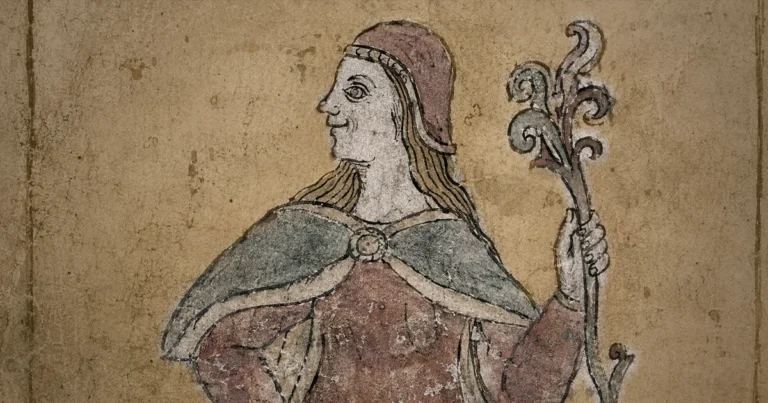

In the summer of 1931, the French ethnographer Marcel Griaule arrived at the Bandiagara escarpment in what is now central Mali and began one of the most consequential and most bitterly contested fieldwork projects in the history of African studies. Over two decades, Griaule and his colleague Germaine Dieterlen accumulated thousands of pages of interview notes, observing ceremonies, collecting ritual objects, and building deep relationships with Dogon elders. In 1950 they published a short paper in the Journal de la Société des Africanistes, titled “Un système soudanais de Sirius,” in which they claimed that the Dogon possessed detailed knowledge of the companion star of Sirius, a white dwarf invisible to the naked eye and not directly photographed by any observatory until 1970. That claim became the seed of what is now called the Dogon Sirius mystery, and it has attracted popular writers, astronomers, anthropologists, and proponents of extraterrestrial contact ever since. This article asks what the actual sources, read carefully and in context, tell us about what the Dogon knew, how Griaule recorded it, and what later fieldwork found when it returned to check.
The Bandiagara Escarpment and the People Who Live There
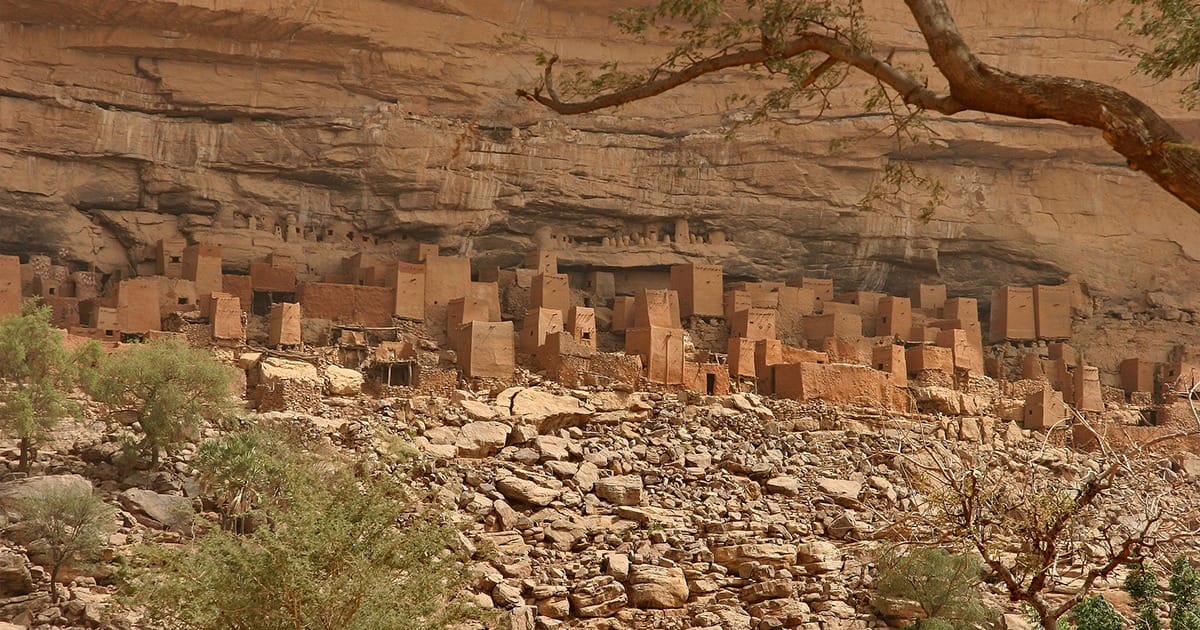
Before addressing any astronomical claims, it is worth understanding the physical and cultural context in which Griaule worked. The Bandiagara escarpment is a sandstone cliff system roughly 150 kilometers long and up to 500 meters high, rising dramatically from the flat Sahel plain of central Mali. Villages cling to ledges and niches in the rock face. Granaries rise on wooden stilts beside family compounds built from mud brick and timber. The landscape also preserves traces of earlier occupants: the Tellem people, who inhabited the cliff between roughly the eleventh and sixteenth centuries, left their dead in rock crevices high above any accessible path, and their burial goods still appear in overhangs above current Dogon settlements. UNESCO inscribed the Bandiagara Escarpment on its World Heritage List in 1989, recognizing the exceptional interplay of geology, archaeology, and living cultural practice at the site.
Historical and linguistic evidence suggests that the Dogon themselves arrived at the escarpment sometime between the thirteenth and fifteenth centuries. Several scholars, including the Malian historian Amadou Hampâté Bâ, proposed that the Dogon sought the cliff’s natural protection partly to resist forced Islamization spreading from neighboring polities to the north and west. That context of deliberate cultural preservation matters considerably, because it helps explain both the depth of Dogon ritual practice and the degree to which certain ceremonial knowledge was held restricted from outsiders and from uninitiated community members alike. Not all Dogon communities shared the same beliefs or the same degree of initiatory access to esoteric material, a point that later researchers would find central when evaluating Griaule’s specific claims.
Daily life at the escarpment organized itself around millet farming, the rhythms of the rainy and dry seasons, and an intricate ceremonial calendar that tied agricultural work to ancestral obligation. The toguna, a low-roofed meeting hall whose ceiling was deliberately kept too low for a standing adult to raise a fist in anger, was the space for community deliberation; the architecture enforced seated discussion and, in principle, calm judgment. Granaries stored both grain and symbolic meaning. A granary’s form, materials, and orientation carried messages about fertility, ancestry, and protection that were legible to Dogon participants in ways that purely functional descriptions entirely miss. Stars entered this web of meaning as part of a broader cosmological fabric, not as isolated astronomical objects studied for their own sake.
What Griaule and Dieterlen Actually Reported
The ethnographic record on Dogon astronomy rests substantially on conversations that Griaule conducted with a single individual: Ogotemmêli, a blind hunter and elder who agreed, in a series of thirty-three meetings held across October and November of 1946, to explain aspects of Dogon cosmological knowledge to the French anthropologist. Griaule published those conversations in 1948 as Dieu d’eau: entretiens avec Ogotemmêli, translated into English as Conversations with Ogotemmêli. The book presented a highly systematic cosmological account featuring a creator figure, a creative generative word, and an elaborate chain of correspondences linking seeds, animals, body parts, and celestial objects into a unified symbolic system. Griaule then worked with Dieterlen to elaborate the specifically astronomical dimension of that system, producing the 1950 paper on Sirius.
What the 1950 paper claimed, in brief, was this: the Dogon recognized the bright star Sirius, which they called Sigi tolo, as having an invisible companion called po tolo. The word po referred to the fonio grain, the smallest seed cultivated in the region, and tolo meant star. Griaule and Dieterlen argued that po tolo described a star that was small, extremely dense, and that moved in an elliptical orbit around Sirius over a period of approximately fifty years. Those three properties, smallness, extreme density, and a fifty-year orbital period, correspond accurately to what modern astrophysics knows about Sirius B, a white dwarf first detected by the American astronomer Alvan Graham Clark in 1862 using a high-powered refracting telescope. Griaule and Dieterlen stated plainly that they could not explain how the Dogon had acquired this knowledge, and they did not claim to have done so. They framed their finding as an anthropological puzzle. That intellectual caution was almost entirely lost when the material passed into popular circulation.
The moment the popular version of the claim began to generate serious interest was the 1976 publication of The Sirius Mystery by the British author Robert Temple. Temple drew on Griaule and Dieterlen’s published material, supplemented it with comparative linguistic and mythological data from ancient Egyptian, Sumerian, and Yoruba sources, and argued for a common ancient tradition originating with contact from amphibious beings from the Sirius system, which he called the Nommo. The book sold widely through the late 1970s and 1980s and generated a large popular literature on African astronomical traditions that has proved extremely difficult to dislodge. Temple’s argument is not taken seriously by contemporary archaeoastronomers or anthropologists, but its influence on how lay readers approach the Dogon has been enormous and lasting.
The Dogon Sirius Mystery Under Scholarly Scrutiny
Critics responded to the claims about Dogon astronomical knowledge quickly and from several different directions. The astronomer Ian Ridpath, writing in the Skeptical Inquirer in 1978, examined the Dogon material closely and found it riddled with internal contradictions. Different informants, he noted, gave incompatible accounts of which star was Sigi tolo and what properties it possessed. Some described it as Venus, not Sirius at all. Others said it was a star visible only at the beginning of the Sigui festival cycle without any reference to orbital companions. The journalist James Oberg, writing in 1982, pointed out that knowledge of Sirius B had been publicly available in European popular science publications since at least the 1920s, and that the Dogon were not an isolated community sealed from outside contact.
Traders, colonial administrators, missionaries, and educated West Africans moved through Dogon territory throughout the early twentieth century. The hypothesis that European astronomical knowledge had entered Dogon oral tradition before Griaule arrived in 1931 was, Oberg argued, far more parsimonious than any exotic alternative involving ancient transmission. A separate and more specific argument was advanced by the astronomer Noah Brosch in his 2008 book Sirius Matters. Brosch pointed to the 1893 French solar eclipse expedition led by the astronomer Henri-Alexandre Deslandres, which operated in the Sahel region for approximately five weeks. Brosch argued that expedition members could plausibly have transmitted knowledge about Sirius during their extended stay, and that a fragment of European astronomical conversation could have been woven into existing local cosmological frameworks over the following decades. This reconstruction is reasonable, but no documentary evidence confirms that Deslandres or his team specifically discussed the companion star of Sirius with Dogon community members.
Built out of a love for history, kept free from distractions.
Spoken Past is an independent project shaped by curiosity, care, and long hours of research. Reader support helps keep it maintained, carefully researched, and open to everyone.
Van Beek’s Restudy and the Problems He Found
The most significant challenge to Griaule and Dieterlen’s work came from inside the discipline of anthropology. Walter E.A. van Beek, then Associate Professor of Anthropology at the University of Utrecht, had spent extended periods conducting fieldwork among the Dogon since the 1970s. In 1991, he published a major restudy in Current Anthropology, co-authored with eight other scholars, titled “Dogon Restudied: A Field Evaluation of the Work of Marcel Griaule.” The paper reported a systematic and striking discrepancy between the cosmological system Griaule had published and what van Beek and his co-researchers found when they asked Dogon communities directly about the same material across multiple villages and over multiple field seasons.
Van Beek found that while Dogon informants recognized the term Sigi tolo, they disagreed sharply among themselves about which star it referred to. No informant identified it unambiguously with Sirius. More significantly, van Beek found no evidence that the Dogon community held any general tradition about an invisible companion to any star. The initiatory knowledge that Griaule had presented as widely shared among senior men was entirely absent from the accounts van Beek collected. Van Beek concluded that Griaule’s system was likely the product of a specific and unusual fieldwork dynamic, one in which Ogotemmêli, a highly influential and intellectually extraordinary single informant, shaped and elaborated material in dialogue with a scholar whose own expectations and guiding questions progressively directed the conversation. Beautiful and coherent symbolic systems can emerge from that kind of intense two-person dialogue, van Beek argued, without reflecting community-wide knowledge at all.
The response from within Dogon scholarship was sharp and divided. Geneviève Calame-Griaule, Marcel Griaule’s daughter and herself a respected Africanist, argued that van Beek had failed to access the deepest levels of Dogon esoteric knowledge and that his dismissal of her father’s research reflected a fundamental misunderstanding of how initiatory information is protected and transmitted in Dogon society. Van Beek returned to these questions in a reflective 2004 paper, “Haunting Griaule,” published in History in Africa, in which he described how the prestige dynamics and translation challenges of a long research relationship can shape what ends up on the page. These are substantive objections that point to a genuine and unresolved methodological tension: if esoteric knowledge is by definition inaccessible to uninitiated community members, the absence of evidence in a restudy does not straightforwardly prove that the knowledge never existed. Van Beek acknowledged this difficulty but maintained that the degree of divergence he found across dozens of informants went well beyond what a simple secrecy model could plausibly explain.

How Knowledge Travels and Why That Matters Here
The debate about whether the Dogon possessed indigenous astronomical knowledge of Sirius B has sometimes obscured a more basic and more interesting point: knowledge moves. The Dogon were never an isolated community sealed from external contact. Trade networks connected the Bandiagara escarpment to the trans-Saharan routes that carried goods, people, and ideas between West Africa, North Africa, and the Mediterranean world for centuries before any European ethnographer arrived. Mission schools, colonial administrative offices, and printed media in French and local languages were all present in the region by the early twentieth century. A community member who spent time in a colonial town, attended a mission school, or simply shared conversation with European travelers could have encountered information about Sirius B and carried it back to the escarpment, where it might have found a natural home within existing cosmological frameworks that already valued the sky as a source of meaning and order.
This process, cultural transmission and diffusion, is not the same as fraud or deliberate fabrication. When a new idea enters a community and is assimilated into local symbolic systems, it can within a generation or two take on the texture and authority of deeply rooted tradition. Anthropologists working on oral tradition have documented this process in contexts ranging from Pacific island navigation lore to European peasant cosmologies. The question is not whether it could have happened with the Dogon and Sirius, because it plainly could, but whether the specific content that Griaule recorded was already present in community-wide tradition before European contact or whether it arrived through contact and was then elaborated in dialogue with Griaule and Ogotemmêli specifically.
What the evidence cannot support is the more dramatic conclusion that the Dogon possessed this knowledge in isolation from any external input and preserved it across many centuries. Modern astrophysics confirmed Sirius B’s existence only in the nineteenth century, using high-powered refracting telescopes unavailable anywhere in the world before the nineteenth century. The companion star is not visible to the naked eye under any conditions: its light is overwhelmed by the glare of Sirius A, which is approximately ten thousand times more luminous. Detecting the companion through unaided observation alone is physically impossible given the angular resolution of the human eye. That basic fact places a hard constraint on any claim of independent prehistoric knowledge of the star’s existence.
Dogon Cosmology on Its Own Terms
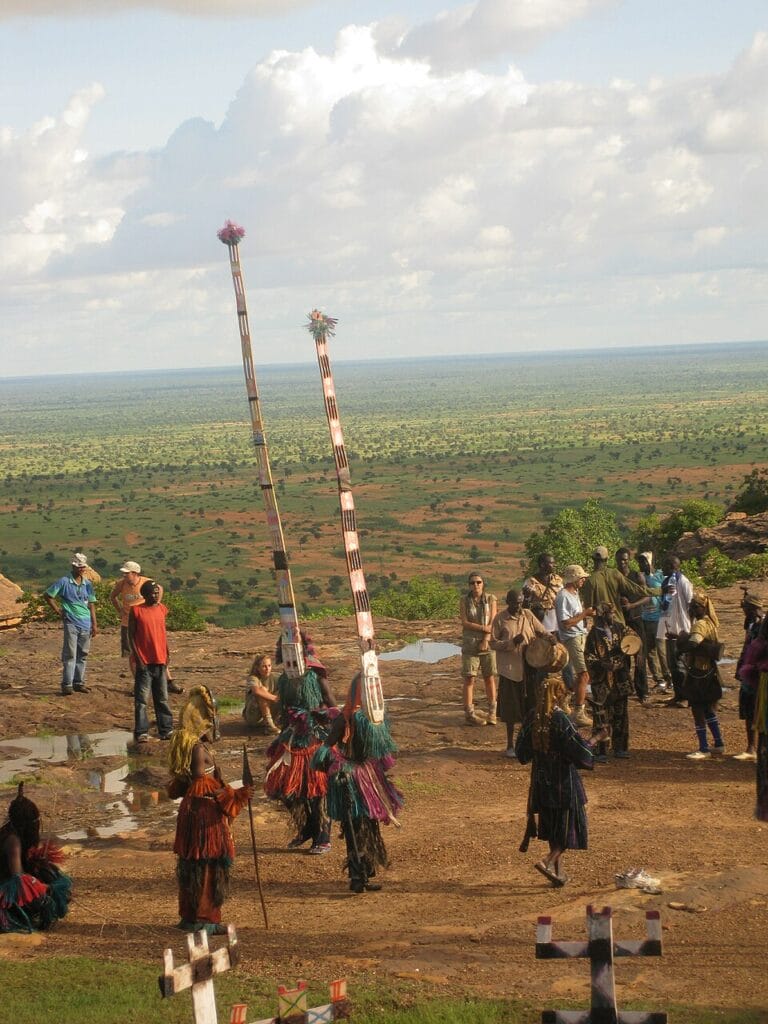
The popular fixation on the Dogon Sirius mystery has, in a frustrating way, made it harder for general readers to appreciate what Dogon intellectual and ceremonial life actually involves. Coverage of the Dogon almost invariably leads with the star claim, which positions the community’s significance as an astronomical anomaly rather than as a living cultural system of considerable depth and complexity. Griaule himself, before his interest turned so heavily toward cosmology in the 1940s, published important early work on Dogon masks and their role in funerary practice that has held up well to subsequent scrutiny. That earlier ethnographic scholarship, and the continued fieldwork of researchers including van Beek, reveals a culture whose intellectual sophistication does not depend on any astronomical secret.
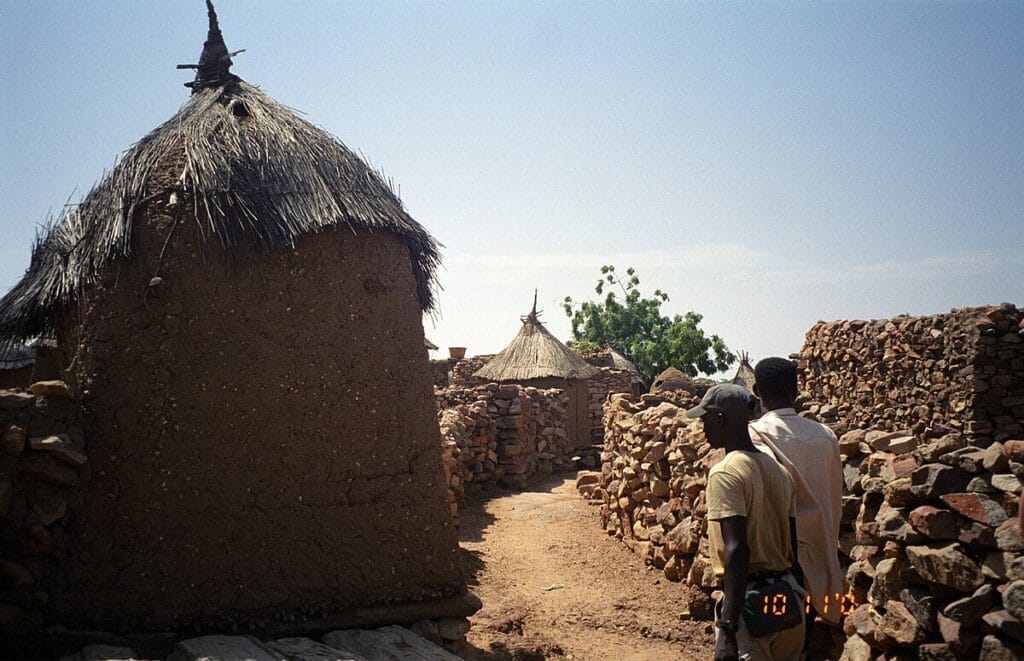
Consider the granary as a single example of how Dogon symbolic thought operates. The round or octagonal mud-brick tower with its thatched conical cap is first and last a practical object: it keeps grain dry and protected from rodents across the long dry season. But among the Dogon, that practical object simultaneously functions as a model of the world. The structure’s orientation and proportions can carry messages about fertility and ancestral protection. The carved door panel, fitted with a lock whose mechanism discourages casual interference, may encode kinship obligations or seasonal ritual requirements in its geometric surface patterns. Seeds stored inside represent both immediate food security and the potential energy of next year’s planting cycle. Stars enter that same field of integrated signs and lend it a horizon that extends beyond the village. The meeting of the intimate and the immense is not unusual in Dogon thought. It is how the system holds together.
Dogon divination practice offers another example of the sophistication that gets buried beneath star-claim debates. The diviner prepares a flat surface of sand near the edge of the village and draws symbols in it before nightfall, then places food to attract the pale fox, Vulpes pallida, whose prints crossing and recrossing the surface overnight are read at dawn as a response to questions posed about illness, conflict, or seasonal prospects. The fox divination system connects celestial, animal, and social dimensions of experience into a single interpretive practice. That is the kind of complexity worth spending time on. The fox prints are not proof of extraterrestrial contact. They are evidence of a community that has developed sophisticated techniques for managing uncertainty across generations.
What the Record Actually Allows Us to Conclude
The debate over the Dogon Sirius mystery is ultimately a case study in what happens when a finding travels faster than the methodology that produced it. Griaule and Dieterlen recorded something extraordinary from a single gifted informant and published it cautiously as a puzzle. Popular writers, beginning with Robert Temple in 1976, stripped away the methodological caution and turned the puzzle into a proof. When van Beek returned to check the finding against broader fieldwork, he could not reproduce the key elements across a wide range of informants and community contexts. That discrepancy does not prove the knowledge never existed, but it does mean that no one is entitled to cite the Dogon as evidence for ancient astronomical secrets without first engaging seriously with the restudy literature.
What the record does firmly establish is this: the Dogon have a rich, layered, and internally coherent cosmological tradition that runs through their craft, ritual, architecture, and oral literature. That tradition engages the sky, the soil, and the social fabric as parts of a single interconnected system. That engagement deserves careful, respectful, and rigorously sourced study. It does not need a white dwarf to be impressive. The masks, the granaries, the fox divination system, and the Sigui festival cycle are all real, all documented, and all more interesting than a claim that has been generating more heat than light since 1976.

Sources: Marcel Griaule and Germaine Dieterlen, “Un système soudanais de Sirius,” Journal de la Société des Africanistes 20 (1950), pp. 273-294; Marcel Griaule, Dieu d’eau: entretiens avec Ogotemmêli (Paris: Éditions du Chêne, 1948); Walter E.A. van Beek et al., “Dogon Restudied: A Field Evaluation of the Work of Marcel Griaule,” Current Anthropology 32, no. 2 (April 1991), pp. 139-167; Walter E.A. van Beek, “Haunting Griaule: Experiences from the Restudy of the Dogon,” History in Africa 31 (2004), pp. 43-68; full citation details also available at the Leiden University Scholarly Publications repository; Noah Brosch, Sirius Matters (Dordrecht: Springer, 2008); Ian Ridpath, “Investigating the Sirius Mystery,” Skeptical Inquirer 3, no. 1 (Fall 1978), pp. 56-62.