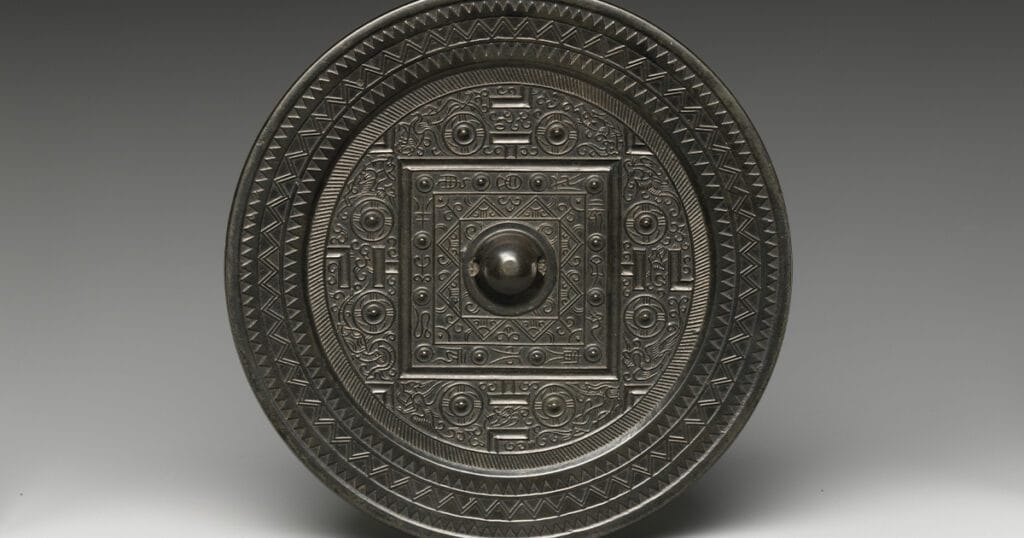
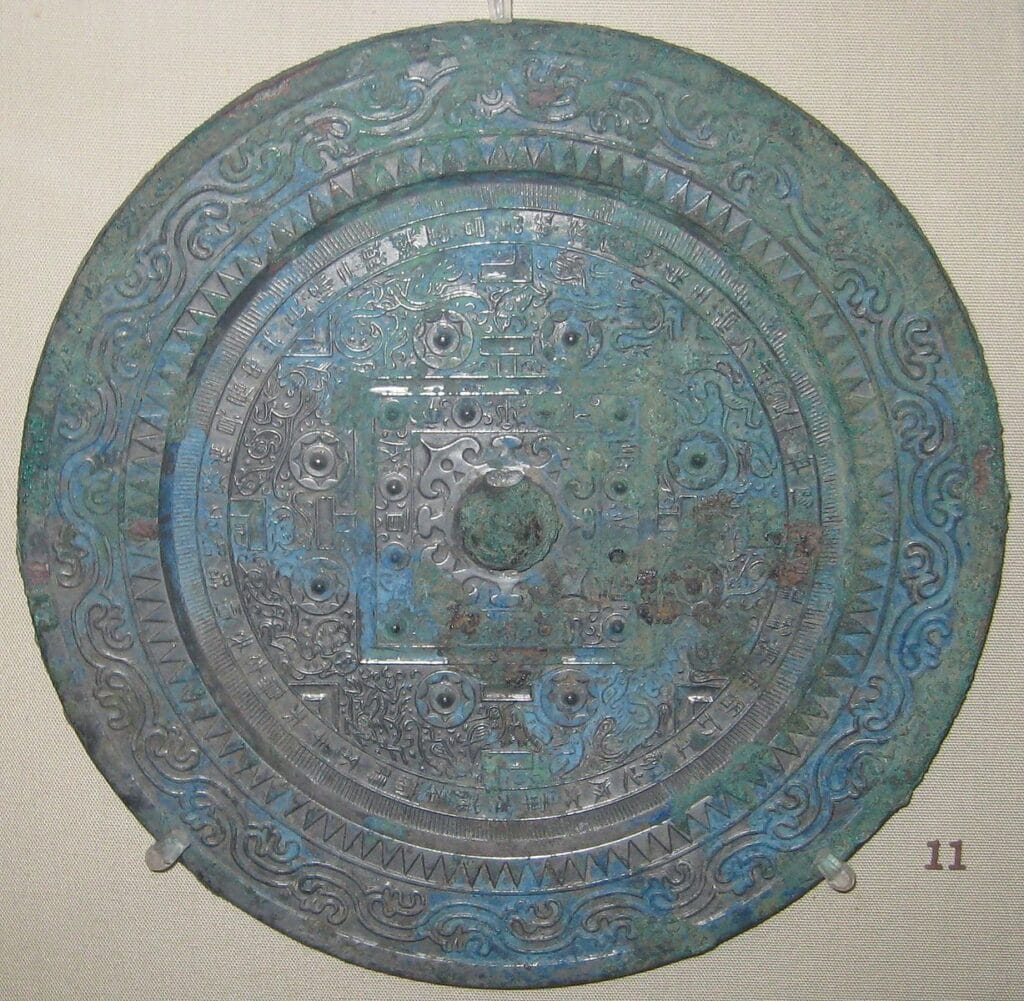
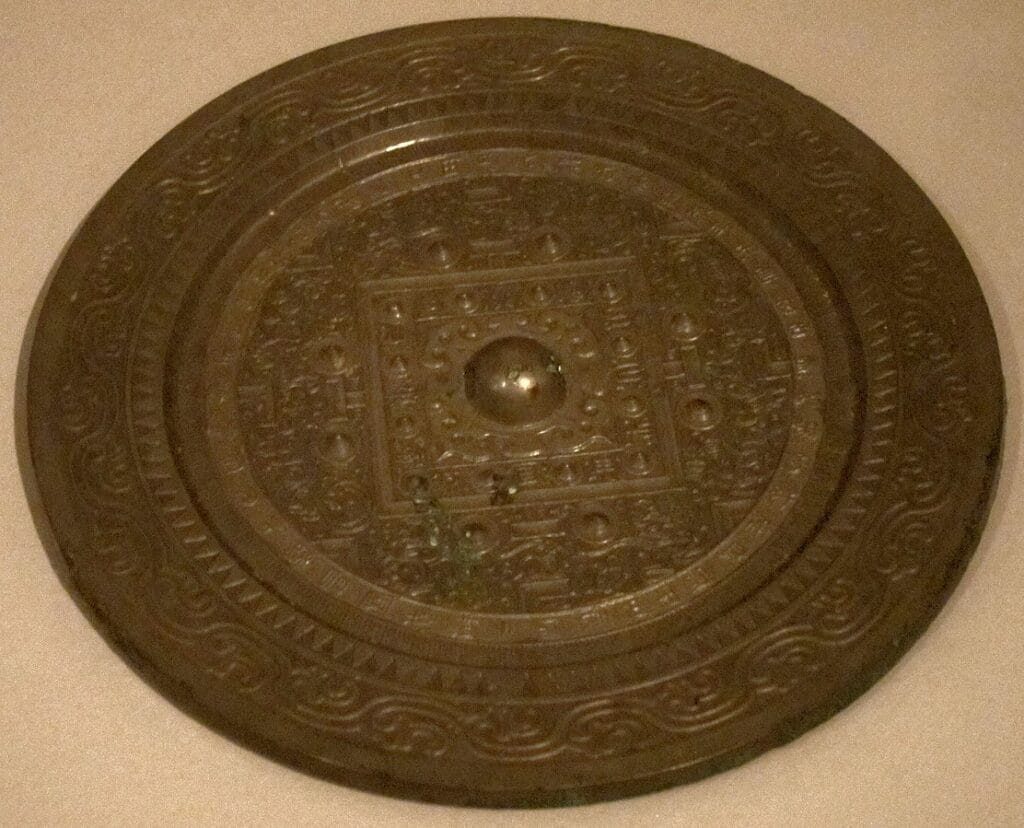
A Han dynasty bronze mirror presents a paradox at first handling. The back is busy: a raised central knob surrounded by a ring of twelve characters, four corner zones guarded by the directional beasts, and a TLV geometric scheme whose right angles and arcs divide the circular field into a schematic map of the ordered cosmos. The front is featureless, a polished convex disc with no visible decoration. Yet when a bright, concentrated beam of light strikes that polished face and reflects onto a white wall, the decoration from the back appears in the reflected patch. The bronze behaves, for a moment, as though it has become transparent. Chinese collectors and scholars called such objects tou guang jing, light-penetrating mirrors, and they prompted genuine puzzlement about how solid metal could transmit an image for over a thousand years before anyone provided a physically rigorous explanation. This article examines what the explanation is, how the Han craftsmen produced the effect without formal optical theory, and what modern scientific analysis has established about the technique.
The History of Explaining the Effect
The first serious Western engagement with the phenomenon came in 1877 and 1878 through the independent work of two British scientists, William Ayrton and John Perry, then both employed as professors at the Imperial College of Engineering in Tokyo. Ayrton and Perry had access to Japanese mirrors of the same general type — cast bronze, polished convex face, decorated back — and conducted experiments with concentrated sunlight reflected through a lens. They established the essential mechanism: the projected image results not from the bronze becoming transparent, but from minute variations in the curvature of the polished face that cause different regions to focus reflected light with different intensities, creating a bright-and-dark pattern on the receiving screen. Their 1879 paper in the Proceedings of the Royal Society was the first physically correct account of the effect in the Western scientific literature.
The next significant contribution came from William Henry Bragg of the University of Leeds in 1932. Bragg, who shared the Nobel Prize in Physics with his father for X-ray crystallography, turned his attention to the surface topology question: what creates the minute curvature variations in the face, and how do they correlate with the back’s relief pattern? His analysis established that the critical mechanism was differential elastic stress in the disc, arising from the thickness variation between regions directly behind raised back relief and regions behind the thinner areas between relief elements. Where the bronze is thicker, it is also locally stiffer; where it is thin, it flexes slightly differently under the internal stresses introduced by casting, cooling, finishing, and surface treatment. Those stiffness differences translate into systematic variations in surface curvature that the polished finish amplifies into an optically significant micro-topography.
The most thorough modern experimental work was published by Gianluca Fontana and colleagues in 2005 in a paper examining mirror replication using modern bronzes cast to Han-period alloy compositions. Fontana’s team used white-light interferometry to map the surface of both original mirrors and modern replicas, producing three-dimensional surface profiles at micrometre resolution. They confirmed that the topographic features responsible for the projection effect have amplitudes of less than twenty micrometres across spatial scales of centimetres, well below the threshold of visual detection but within the range of reflection-modulation that produces a visible image on a screen at distances of one to two metres. Their replication experiments showed that the effect could be produced consistently when the disc was cast with strong back relief, thinned to the target thickness by differential scraping, and finished with a burnishing sequence that followed the distribution of back features rather than working the face as a uniform surface.
How the Han Craftsmen Actually Made a Han Dynasty Bronze Mirror
Understanding the projection effect requires understanding the entire manufacturing sequence, because the optical outcome is determined by decisions made at every stage from alloy composition to final surface treatment. Han mirrors are cast in a copper-tin-lead alloy. X-ray fluorescence analyses of mirrors in major collections, summarised in the 2011 catalogue of the British Museum’s Chinese mirror holdings, consistently show tin concentrations between 18 and 24 percent and lead between 3 and 12 percent, with the remainder copper. This composition is more tin-rich than Chinese bronzes used for vessels, armour, or tools. The elevated tin content serves two purposes: it hardens the alloy to a degree that allows fine relief definition in the cast back without the smearing that softer bronzes produce, and it raises the reflectivity of the polished face by increasing the proportion of specularly rather than diffusely scattered light.
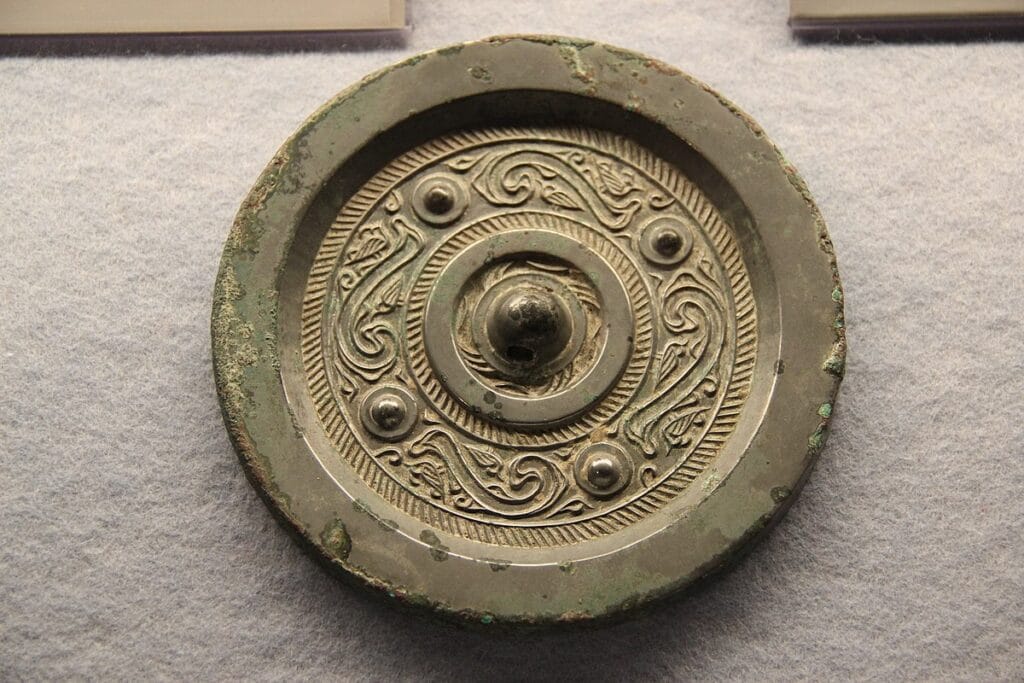
The back is cast in a clay or bronze mould into which the relief design has been incised in negative. After the disc has cooled and been removed from the mould, the face is in a rough cast state: dull, porous, and covered with oxide scale. Scraping and abrasion with progressively finer stones removes the scale and begins to develop the convex curvature of the face. The central knob that serves as a handle is ground smooth; the rim is trimmed. At this stage the disc is a mirror in mechanical terms but not optically. The final polish, applied with fine abrasives and a burnishing tool, is what determines whether the face will produce the projection effect. Workshop evidence, including unfinished mirrors found in Han period excavations at Loyang and described in the Kaogu Xuebao journal in 1976, shows that burnishing followed a disciplined radial pattern working outward from the central knob.
Surface treatment after polishing is the least well-documented stage. Historical Chinese sources including the Song dynasty encyclopedia Meng Xi Bi Tan by Shen Kuo, written around 1088 CE, discuss the process of activating a mirror surface with a preparation involving tin and mercury. Modern analysis of Han mirror surfaces has identified thin tin-rich surface layers consistent with either amalgam treatment or cold tinning applied before final burnishing. These treatments introduce differential thermal and mechanical stresses into the surface layer that, as the metal ages and redistributes its internal stress over years to decades, can progressively enhance the curvature variations that produce the projection effect. This provides a partial explanation for the observation that some mirrors appear to acquire the property after years of use rather than demonstrating it immediately on completion.
Enjoying Spoken Past?
I created Spoken Past to share my love of history. I research, write and develop everything myself, and I want my articles and basic guides to remain free for everyone.
If you enjoy my work, please consider supporting Spoken Past with a small donation.
What the TLV Design Means and Why Its Structure Matters for the Effect
The TLV designation used by modern Western scholars to describe the most common Han mirror back design derives from the resemblance of its three component shapes to the Roman capital letters T, L, and V. The scheme divides the disc’s decorated field into a central square zone, four rectangular side zones, and four corner zones, each pair bounded by one element of the TLV system. The cosmological programme embedded in this geometry is explicit in the inscriptions that typically accompany it: the square represents earth; the enclosing circle, cast as the rim’s outer edge, represents heaven; the four zones correspond to the four cardinal directions; and the four directional beasts, the Azure Dragon of the east, the White Tiger of the west, the Vermilion Bird of the south, and the Black Tortoise-Serpent of the north, guard the quadrants.
From the perspective of the projection effect, the TLV design has a structural property that makes it particularly well-suited to producing a clear projected image. The T, L, and V elements are cast as raised ridges of consistent height and width, creating a regular grid of thickness variation across the disc that generates a corresponding grid of curvature variation in the polished face. The pattern has strong spatial frequency components at the scale of the TLV grid spacing, which translates into projected image elements with similar spatial frequency: clear enough to be recognisable as a structured pattern at viewing distances of one to two metres. A design with only irregular bosses and scrollwork would produce a projected image that was harder to read as structured. The TLV’s geometric regularity is, in this sense, optically efficient.
The four directional beast zones contribute lower spatial-frequency elements to the projected image: larger, softer areas of differential brightness corresponding to the broad raised fields of the beast relief. In projection experiments on TLV mirrors, these appear as diffuse bright patches in the corners of the image, framing the sharper TLV grid. Shen Kuo’s eleventh-century description of the projection effect in Meng Xi Bi Tan captures this visual structure: he writes that the back’s pattern appears in the light as a “faint shadow” with the same arrangement of forms, which matches the combination of sharp TLV grid lines and diffuse beast patches that interferometric surface analysis would predict.
Han Mirrors Versus Later Buddhist Magic Mirrors
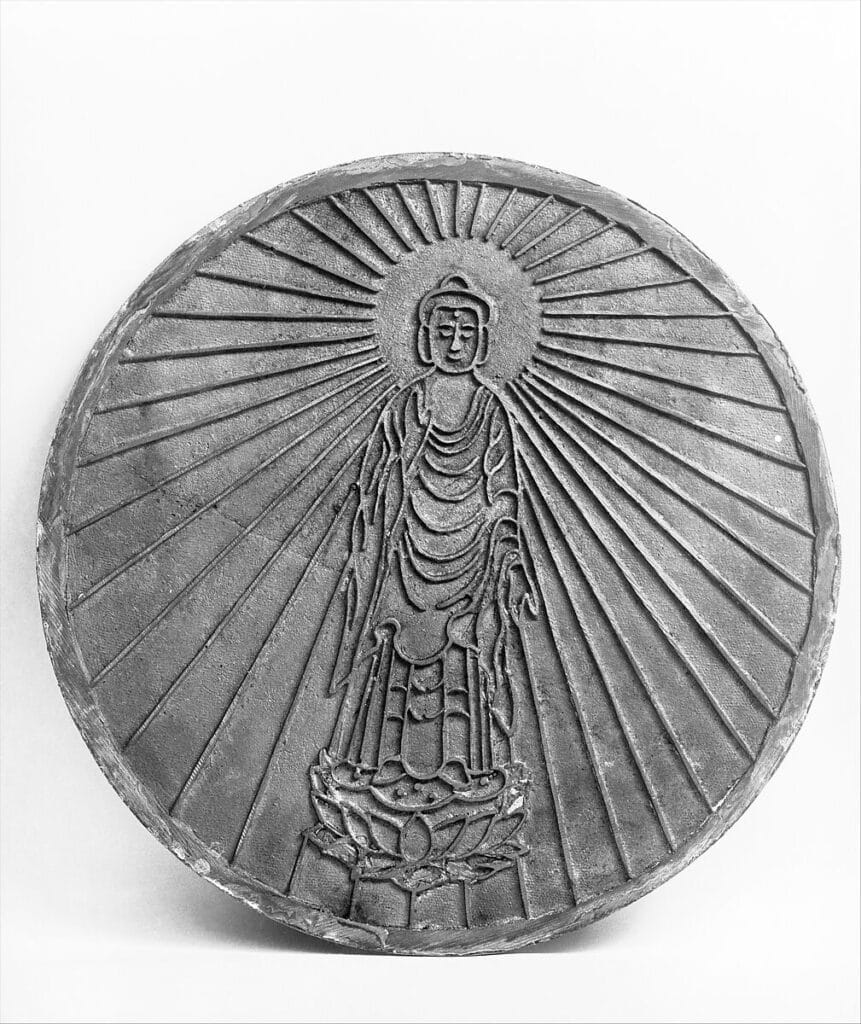
Han dynasty bronze mirrors are sometimes grouped with a different category of objects, the Japanese Buddhist “magic mirrors” that project an image of Amida Buddha or another sacred figure when used as a devotional object in lamplight. These two categories share the projection effect but differ fundamentally in construction and purpose. The Han projection mirror is, in the most technically capable examples, a single-plate disc whose optical behaviour emerges from manufacturing stress and finishing precision. The Buddhist sacred mirror, particularly in the Heian and Kamakura period Japanese examples now in the Metropolitan Museum and the Freer Gallery, often uses a compound construction: a thin relief plate carrying the devotional image is fused or cast behind the polished face plate, and the projection is a deliberate design feature intended to reveal the sacred figure to the worshipper in a specific ritual context.
The compound construction of the Buddhist mirrors means that craftsmen could specify the projected image precisely and guarantee its appearance under appropriate lighting, removing the element of uncertainty present in the Han single-plate technique. The Han craftsman’s achievement was different and, in some respects, technically more demanding: to produce a projection effect from a single plate without a designed second layer, relying entirely on the spatial distribution of manufacturing stress to generate the required surface curvature. Not all Han TLV mirrors produce the effect. The ones that do are the product of particularly disciplined finishing sequences in workshops where the feedback between surface treatment and projected image was understood empirically and controlled through accumulated practice.
Modern Science and the Afterlife of an Ancient Technique
The Han magic mirror has attracted more scientific attention than almost any other category of ancient technical artifact, partly because the projection effect is so clearly a physical phenomenon susceptible to rigorous analysis, and partly because the optical principle it exploits turns out to be practically useful for modern manufacturing quality control. A polished surface that looks uniform to the eye is not necessarily uniform in curvature at the micrometre scale. When a divergent light beam is reflected from such a surface onto a flat screen, minute slope errors in the surface produce intensity variations in the reflected patch that make the errors visible. This is precisely the Han mirror phenomenon, redescribed in the language of optical metrology.
Engineers at semiconductor fabrication facilities use variants of the same reflection technique to detect nanometre-scale slope errors on polished silicon wafers and optical substrates, errors too small to produce visible colour fringes under standard interferometry but large enough to degrade the performance of lithographic lenses. The Han craftsmen who developed the projection effect through empirical workshop practice were, without knowing it, implementing a quality-control principle that modern precision optics has independently rediscovered at a smaller scale and given a formal mathematical description. The technique migrated from cosmological symbol-making to integrated circuit production by way of two millennia of physical principles that neither culture needed to articulate to use.
Sources: William Ayrton and John Perry, “The Magic Mirror of Japan,” Proceedings of the Royal Society of London, vol. 28, 1879. William Henry Bragg, “The Magic Mirror,” Old Trades and New Knowledge, George Allen and Unwin, 1932. Gianluca Fontana et al., “The Magic Mirror of Japan: New Steps in Understanding,” SPIE Optical Engineering and Applications, 2005. Shen Kuo, Meng Xi Bi Tan [Dream Pool Essays], c. 1088 CE, trans. Joseph Needham in Science and Civilisation in China, vol. 4, Cambridge University Press, 1962. Jessica Rawson, Chinese Bronzes: Art and Ritual, British Museum Publications, 1987. Robert W. Bagley, ed., Ancient Sichuan: Treasures from a Lost Civilization, Princeton University Press, 2001.