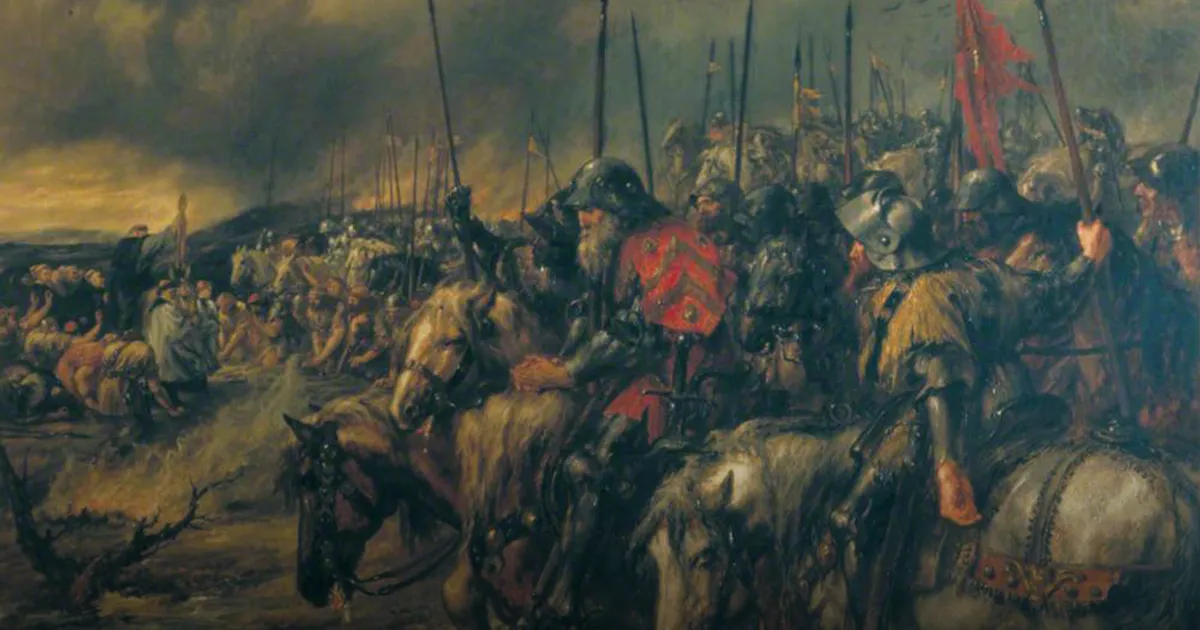
On the morning of 25 October 1415, the feast of Saints Crispin and Crispinian, the French army that had shadowed Henry V across northern France finally blocked his path to Calais at a narrow ploughed field near the village of Azincourt in Picardy. What happened next has been told in English as a story of the yeoman’s arrow against the nobleman’s armour, and the image that lodged deepest in the telling was a simple one: the flower of French chivalry, sinking in mud, drowning inside their own helmets. The Battle of Agincourt is one of the most written-about engagements of the medieval period, and the drowning image is also one of its most durable distortions. It is not false exactly. Contemporary accounts do describe men unable to rise from the mire, faces pushed into sludge. But the phrase compresses into a single picturesque image a far more complex physical catastrophe, one driven by terrain geometry, crowd mechanics, arrow fire, and the deliberate, close-quarters finishing work of English archers who put down their bows and waded into the press with hammers and daggers. This post draws on the primary chronicle evidence and on the work of the two historians who have most systematically remapped the battle, Anne Curry, Emeritus Professor of Medieval History at the University of Southampton, and Juliet Barker, to reconstruct what actually killed so many French men-at-arms on that morning.
The ground between the two woods
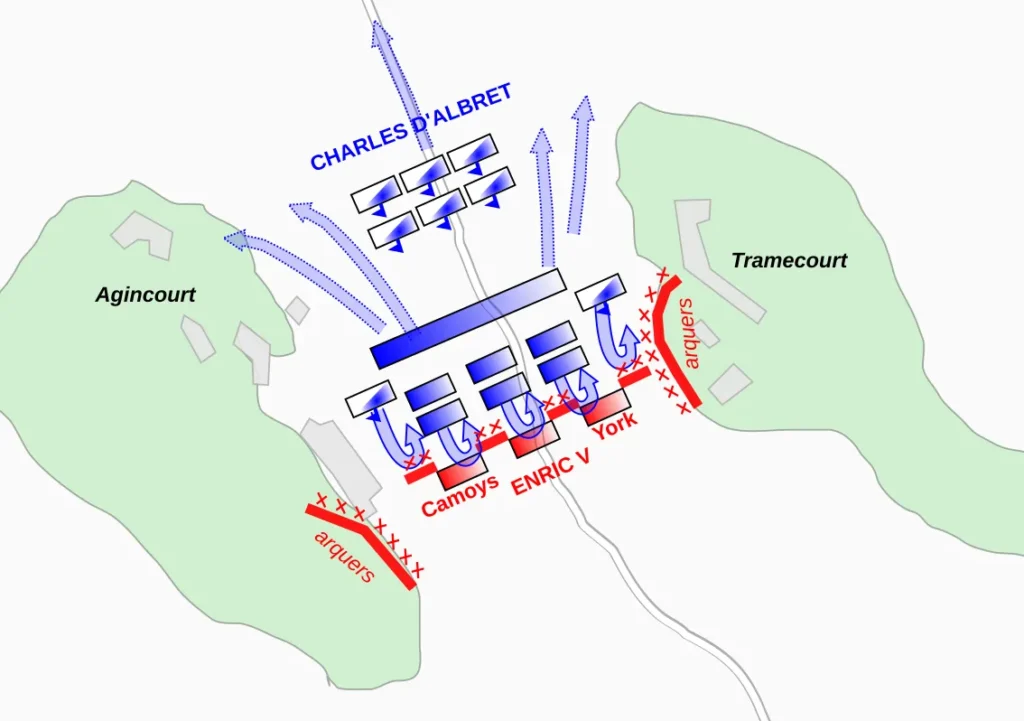
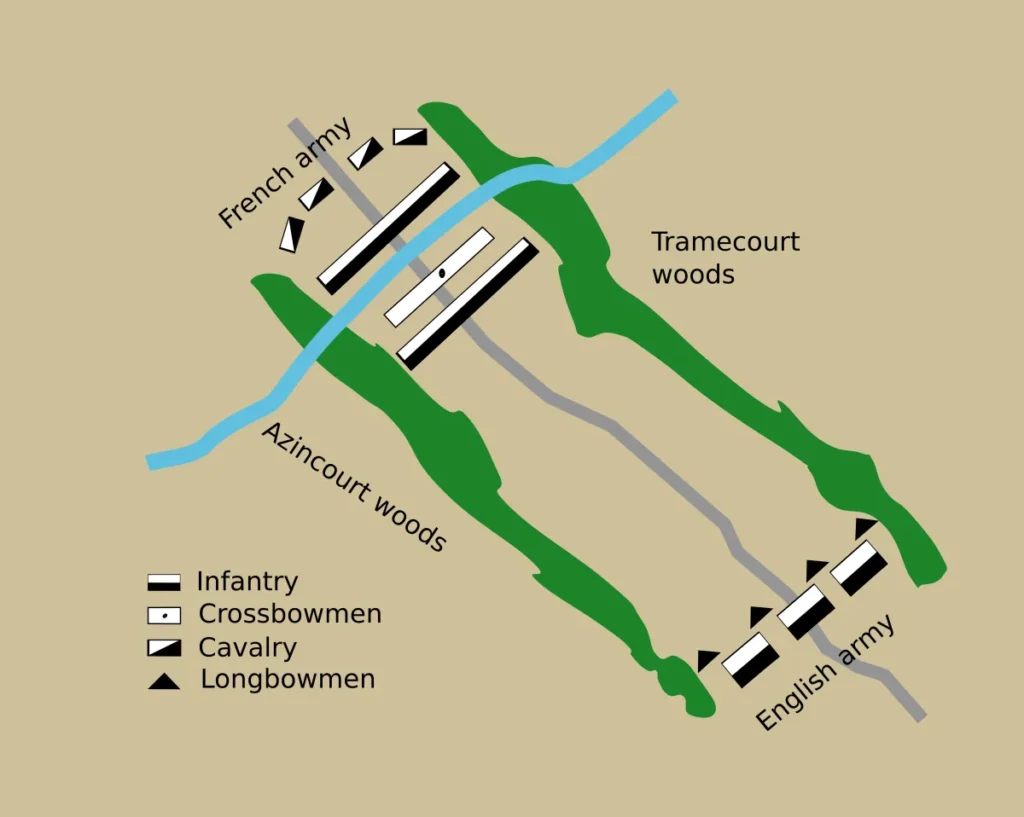
The battlefield was not selected by accident. Henry V, whose army was exhausted and depleted by dysentery after the costly siege of Harfleur and a march of nearly 400 kilometres through hostile country, chose to stand where the terrain would neutralise the numerical disparity he faced. The corridor between the Bois d’Azincourt on the west and the Bois de Tramecourt on the east was approximately 900 metres wide at the point where the French had drawn up. As both armies advanced toward one another, that frontage narrowed further, because the tree lines converged slightly, compressing whoever moved through the gap. Henry’s men planted sharpened stakes at an angle in front of the English archers, creating an obstacle that would funnel movement and punish any cavalry charge directed at the wings.
The ground between the armies had been freshly ploughed before rain, which arrived the night before the battle and continued into the morning. The monk of Saint-Denis, one of the contemporary chroniclers whose account Barker quotes in her 2005 study Agincourt: The King, the Campaign, the Battle, records that the French men-at-arms advancing in their heavy plate marched through the middle of the mud where they sank up to their knees, so that they were already overcome with fatigue even before they came against the enemy. This is a primary source description of the actual physical condition of the field. The clay soil of Picardy retains water at the surface when cultivated, and the overnight rain had turned the top layer into a deep, adhesive paste in which sabatons, the articulated steel shoes of plate armour, found no grip. Every step required an extraction as well as a forward movement. Multiply that across 400 or 600 metres of advance against the wind and the arrows, and the French men-at-arms arrived at the English line already spending their reserves on locomotion rather than combat.
Henry had positioned his men-at-arms on foot in the centre, with archers in wedge formations on both flanks behind their stakes. By standing still rather than advancing, the English avoided the mud problem almost entirely. Their footing was fixed; the French footing was not. This asymmetry, the stationary defender in a natural choke point versus the advancing attacker in thigh-deep clay, was the structural condition that made everything else possible.
The mounted charge and what it did to the infantry
The French plan called for an initial mounted strike by cavalry directed against the English archers on both flanks, followed by a massed advance of dismounted men-at-arms in the centre. The mounted charge failed almost immediately and created a secondary catastrophe that compounded every subsequent problem. The horses, armoured only on their heads and facing stakes and arrow fire at close range, reacted as horses do when struck in the unprotected barrel and haunches: they became impossible to direct. Those that were not stopped by the stakes turned or reared, and the mass of riders who had entered the corridor at speed now reversed back into the advancing foot columns behind them. The monk of Saint-Denis, quoted by Barker, records how the wounded and panicking horses galloped through the advancing infantry, scattering them and trampling them down in their headlong flight. John Keegan, whose 1976 study The Face of Battle applied a phenomenological approach to Agincourt that influenced all subsequent writing on the battle, identified this disruption of the foot advance by the returning cavalry as the moment when the narrowing corridor became a killing machine rather than a tactical approach route.
The charge also churned the already wet surface. Hooves on wet clay cut ruts and displaced the topsoil into ridges and pockets. Men advancing on foot behind the horses walked into a terrain that was no longer the relatively level, if muddy, ploughed field they had been standing on minutes earlier. It was now broken, rutted, and crossed with deep gouges that presented both obstacles to forward movement and ankle-twisting traps for men in articulated steel footwear. This is the mechanism behind the mud’s lethality at Agincourt: not that men were statically sinking into a swamp, but that active chaotic movement had made the surface actively dangerous to traverse at pace while in heavy armour.
What plate armour actually did and did not do
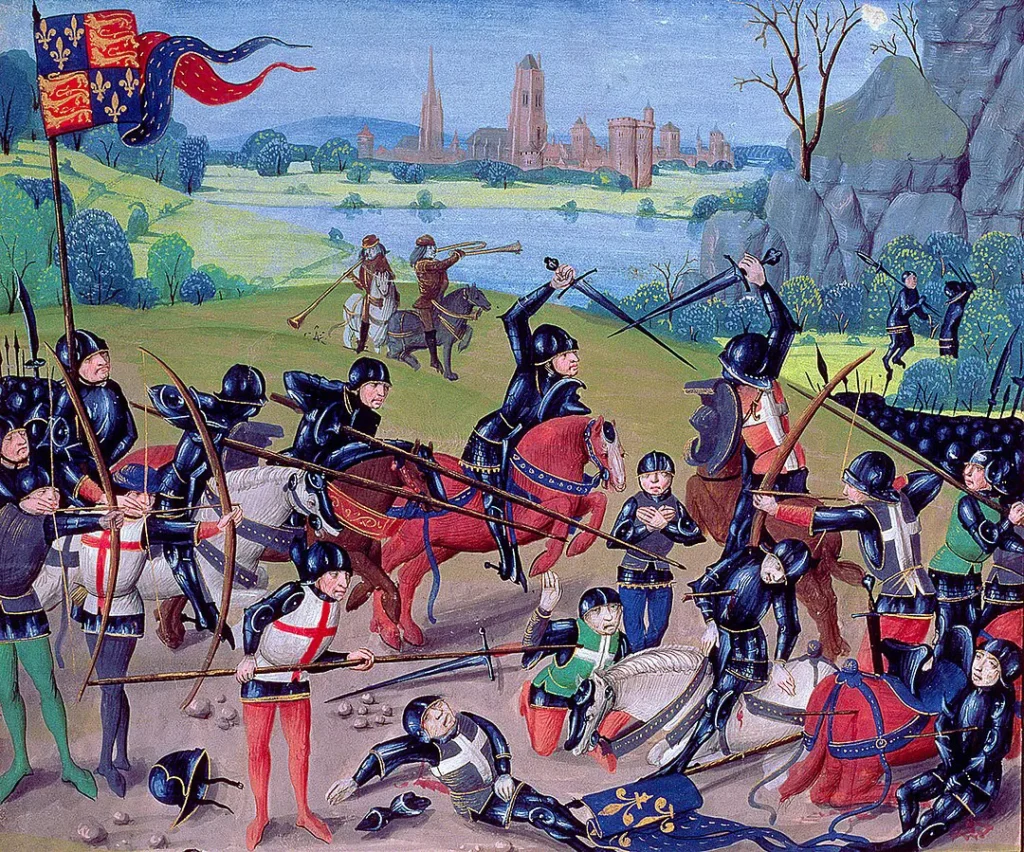
A significant portion of the mythology around the Battle of Agincourt rests on a misunderstanding of what plate armour cost its wearer in mobility. The image of a fully armoured man who could not stand without mechanical assistance, or who, once fallen, lay helpless until lifted by a crane, belongs to tournament equipment of a later period, specifically to the heavily padded and reinforced armour designed for the joust, which was never intended to be worn in open combat. The field armour of a French man-at-arms in 1415 was a different object: a precisely fitted, carefully articulated system distributed across the body with the deliberate goal of preserving movement while protecting against blade and arrow.
Experimental studies conducted by armour historians, including work carried out at the Royal Armouries in Leeds using reconstructed harnesses of the period, have consistently found that a fit adult wearing a complete field armour of around 25 to 30 kilograms, distributed across shoulders, torso, hips, arms, and legs, retains nearly full range of motion. Running, kneeling, rolling, and rising from a prone position are all possible, though energy cost is higher than without the armour. The constraint is metabolic, not kinematic. On a dry field against an unstressed opponent, armour was manageable. On a ploughed clay field churned by panicking horses after a 400-metre advance into arrow fire in a narrowing corridor, the metabolic cost became the decisive variable. Men who arrived at the English line already at or near their aerobic limit could not draw on reserves for the sustained close-quarters fighting required, and men who fell could not recover the energy to rise quickly enough in a press of bodies moving forward behind them.
Barker states directly in Agincourt that some knights, encumbered by their armour, actually drowned in their helmets. The statement is accurate as a description of a specific mechanism of death that occurred in specific circumstances: a man face-down in mud with a closed visor and bodies pressing on his back could not breathe and could not open the visor with gauntleted hands. The bascinet with a pivoting visor, the standard head protection for a man-at-arms of this period, was not sealed against water in the way a diving helmet is. It was sealed against it in the sense that a visor slammed shut against mud, with numb fingers and a hundred kilograms of pressure on the back of the head, effectively prevented breathing. That is the real mechanism behind the drowning. It is not that armour alone was the trap. It is that armour in a crowd crush with a face in mud produced the outcome.
The crowd crush and how it killed
The French dismounted advance was formed in three batailles, or divisions, with the main strike force in the first division and supporting troops following behind. The depth of these formations, which contemporary accounts describe as very great, was the product of French confidence in numbers and of the social dynamics of a noble army in which rank dictated position, with the most prestigious men in the front ranks rather than the most tactically suited. When the first battle entered the narrowing corridor and began to slow under the conditions already described, the second battle behind them could not see the obstruction and continued to press forward. The men in the first rank were being pushed into the English line and into each other from behind by men who had not yet encountered the mud, the stakes, or the physical check of the defensive position.
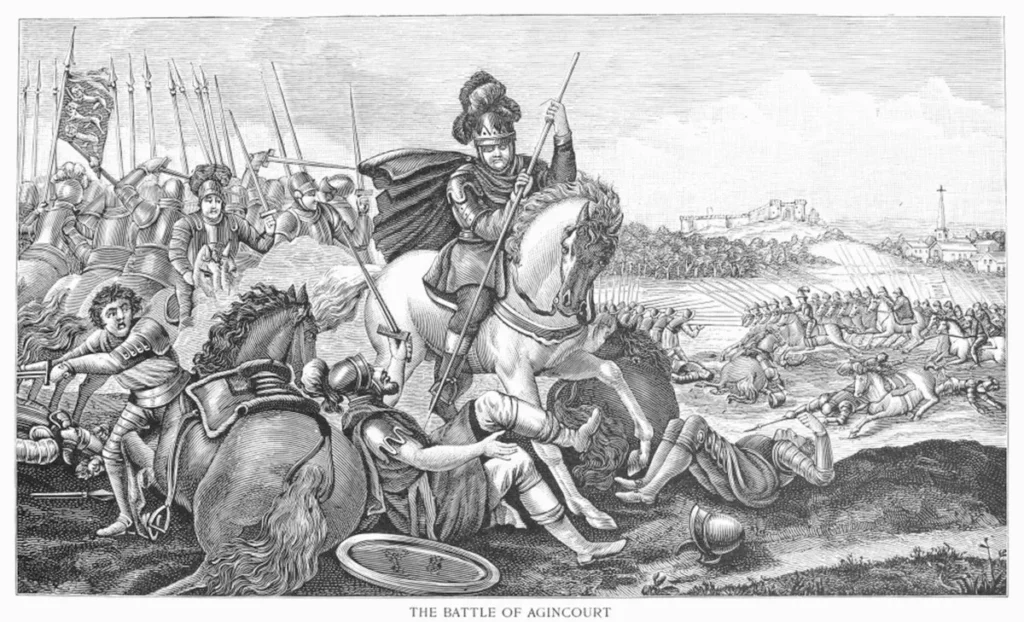
What this produced is recognisable to modern crowd safety engineers as a crowd crush: a situation in which compressive forces at the centre of a crowd exceed what human bodies can withstand, because the people applying the pressure cannot see the consequence of their movement and have no mechanism to halt it. At Agincourt the specific physics involved a downhill gradient toward the English line, a narrowing corridor, a surface that removed individual footing control, and formations so deep that the pressure from behind was continuous rather than intermittent. Men at the front had nowhere to fall except forward and down. Men who fell were covered by the falling of others behind them. The Gesta Henrici Quinti, the near-contemporary Latin account written by a chaplain who was present at the battle and is considered by Anne Curry in her 2005 study Agincourt: A New History to be among the most reliable primary sources, describes heaps of the slain through which the English had to cut their way. Those heaps were not metaphorical.
Built out of a love for history, kept free from distractions.
Spoken Past is an independent project shaped by curiosity, care, and long hours of research. Reader support helps keep it maintained, carefully researched, and open to everyone.
What the archers actually did in the melee
The longbow’s contribution to the Battle of Agincourt is almost universally framed in terms of its long-range fire during the French advance. This framing is accurate but incomplete, because it ends the archers’ story at the moment when the two armies made contact. The archers did not then stand behind their stakes as spectators. They dropped their bows, picked up the mallets they had used to drive those same stakes into the ground, and moved into the press. Barker’s account in Agincourt describes the archers wading into the massed French formations in the confined space between the stakes and the English men-at-arms’ line, working with hammers, short swords, and the rondel dagger, a thin, rigid-bladed weapon specifically designed for penetrating the gaps in plate armour.
The rondel dagger, named for its circular hand guard, had a blade narrow enough to enter the ventail gap between helmet and gorget, the eyeslits of a closed visor, the inside of the elbow joint, the groin gap between the faulds and the cuisse, and the armpit opening that inevitably existed in a plate system designed to permit arm movement. Against a man standing and actively fighting, finding these gaps required skill and timing. Against a man pinned on the ground or pressed into immobility by a crush, they required only knowledge and willingness. The archers at Agincourt had both. The killing in the melee phase was methodical, fast, and close: a mallet blow to the back of a helmet to stun, followed by a blade in whatever gap was accessible. This is what the monk of Saint-Denis meant when contemporary sources described the slaughter as being on foot, with dismounted ranks fighting and dying hand-to-hand in the mud.
The social implications of this phase disturbed contemporary observers as much as the tactical ones. A French noble who survived the crush, was pulled to his knees, and had a dagger inserted through his visor’s eyeslit by a Cheshire archer was dying at the hands of a man who in peacetime would have had no right to address him directly. The inversion of social hierarchy implicit in the melee phase of Agincourt was as shocking to fifteenth-century audiences as the scale of the losses, which is part of why French chronicle accounts of the battle tend to emphasise the mud and the disorder rather than the agency of the English common soldiers who did most of the actual killing.
The Battle of Agincourt numbers debate and what it changes
The disparity in numbers between the English and French armies at Agincourt has been debated actively since the publication of Anne Curry’s Agincourt: A New History and Juliet Barker’s Agincourt: The King, the Campaign, the Battle, both appearing in 2005. The two books represent the most detailed examination of the primary administrative and chronicle evidence yet attempted, and they reached different conclusions. Curry, working primarily from financial and muster records on both sides, argued for an English force of approximately 9,000 against a French force of roughly 12,000, a ratio of approximately one to one and a third rather than the traditional one to six or one to eight. Barker, working more extensively from narrative chronicles, argued for approximately 6,000 English against 36,000 French.
The significance of this dispute for understanding the mud and the armour is that the crowd crush model of the French defeat works regardless of which estimate is correct. Even on Curry’s more conservative figures, the French army was attempting to push a larger force through a narrowing corridor against a fixed defensive position. At Barker’s higher French figures, the compression is simply more extreme. What changes between the two interpretations is the degree to which the English victory reflects tactical genius against overwhelming odds versus a well-executed set-piece against a moderately larger opponent. What does not change is the mechanism of death: terrain, fatigue, crush, and finishing. The mud and the armour are real. They are not, in themselves, sufficient explanations for the outcome.
The prisoner killing and the battle’s final phase
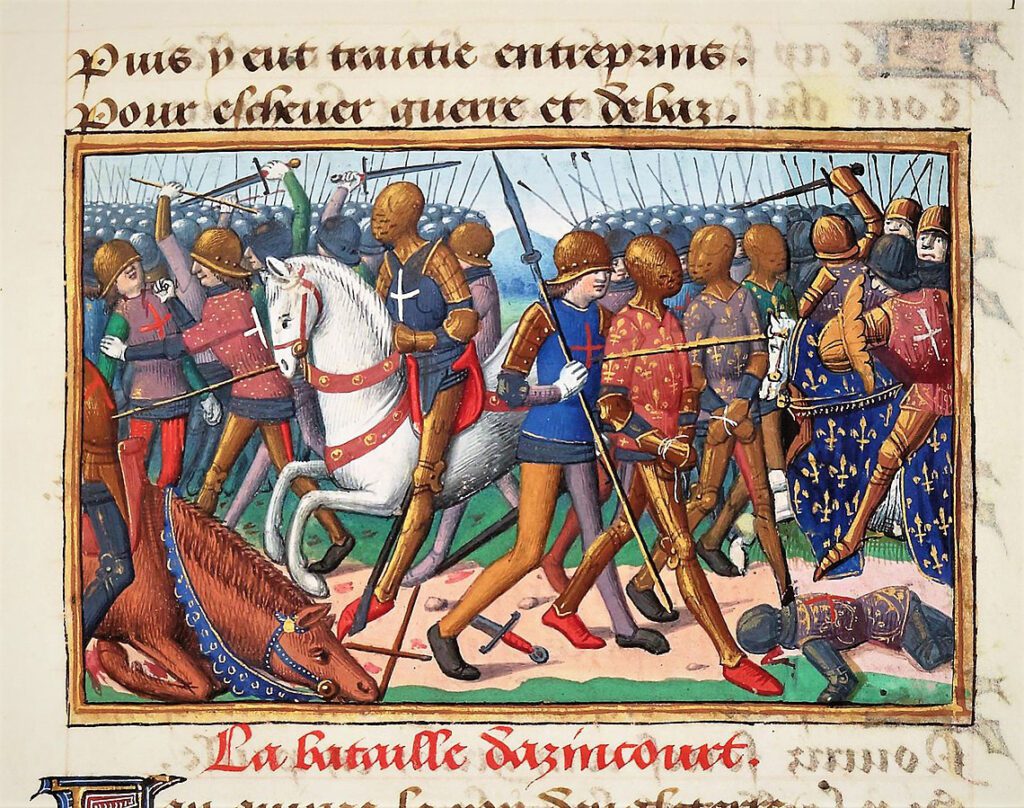
The most morally contested episode of the Battle of Agincourt is Henry V’s order, issued during or after the main fighting, to kill many of the French prisoners already taken. The order is documented in multiple chronicles and is generally accepted as historical. Henry’s rationale, reported by several sources, was the fear that a reported advance by French forces on the English baggage train, combined with the large number of armed prisoners held behind the English line, created a threat of being attacked from both front and rear simultaneously. The practical response was to order the prisoners killed before they could rearm themselves from the debris of the field.
The episode matters for the broader argument about the drowning myth because it reveals the nature of the surviving prisoner pool. The men who had been taken alive were not, for the most part, men who had been rendered helpless by mud and armour alone. They were men who had survived the crush, the melee, and the initial killing phase, and had then surrendered expecting the customary ransom conventions of medieval noble warfare to protect them. Their subsequent deaths at the hands of English soldiers, which the chronicles describe as being carried out with considerable reluctance because it destroyed valuable ransom income, were the product of command decision rather than environmental misfortune. The drowning myth, by contrast, attributes the French losses primarily to an impersonal mechanism of terrain. The reality is that human agency on both sides, Henry’s tactical decisions, the French commanders’ deployment choices, and the archers’ close-quarters work, killed most of the men who died that morning.
Why the drowning myth lasted
The image of French knights drowning in their helmets has lasted for six centuries because it performs several ideological functions simultaneously. It preserves the dignity of the defeated by attributing their loss to an impersonal natural force rather than to the agency of socially inferior opponents. It confirms a moralistic narrative in which aristocratic pride and excessive armour weight become their own punishment, a story of hubris meeting nature’s indifference. It allows English audiences to celebrate the victory without dwelling on the systematic close-quarters killing carried out by common archers against defenceless men, which was the mechanism behind much of the actual casualty count. And it compresses a complex tactical and physical system into an image compact enough to survive oral transmission across generations and then into print.
The correction is not to deny that some men drowned in their helmets on that field. Barker states it happened. The correction is to understand it as one mode of death among several, and not the dominant one. Most of the men killed at Agincourt died because the terrain and the crowd mechanics of the French advance created a situation in which they could not fight effectively, and English soldiers, archers above all, moved among them and killed them at close range with the tools available. The mud was the condition. The archers were the cause.