
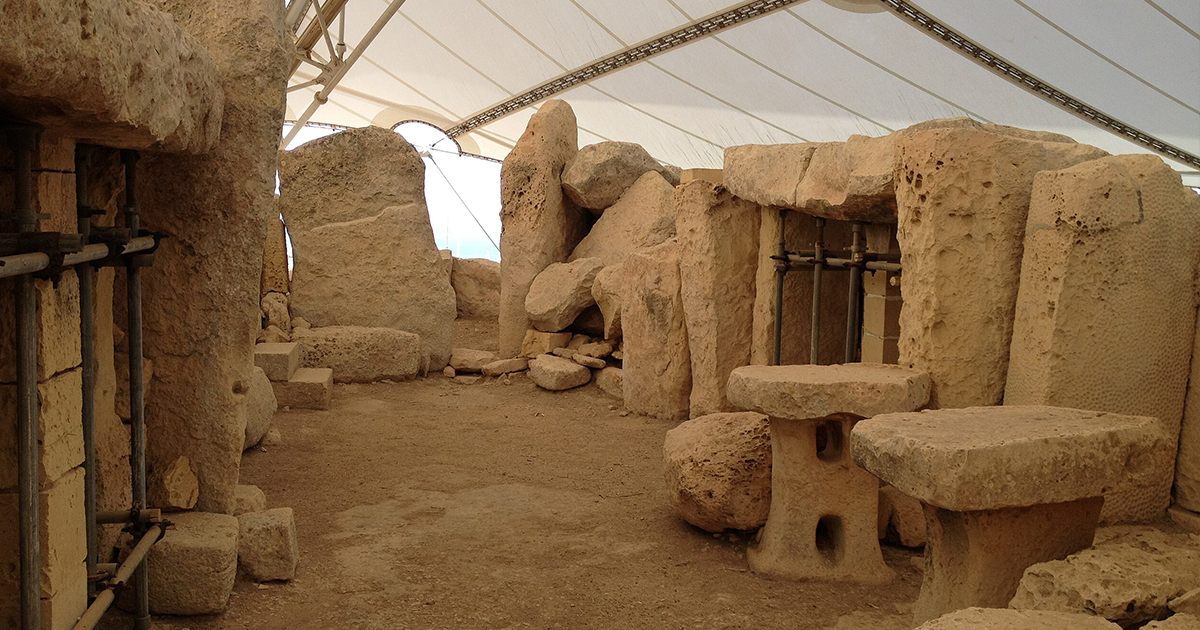
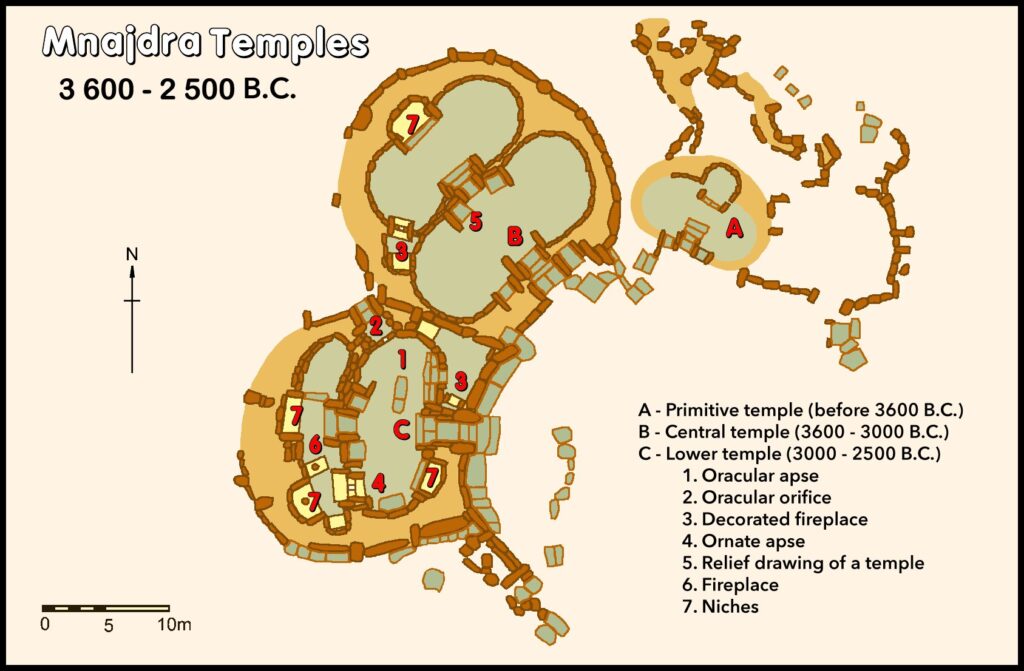
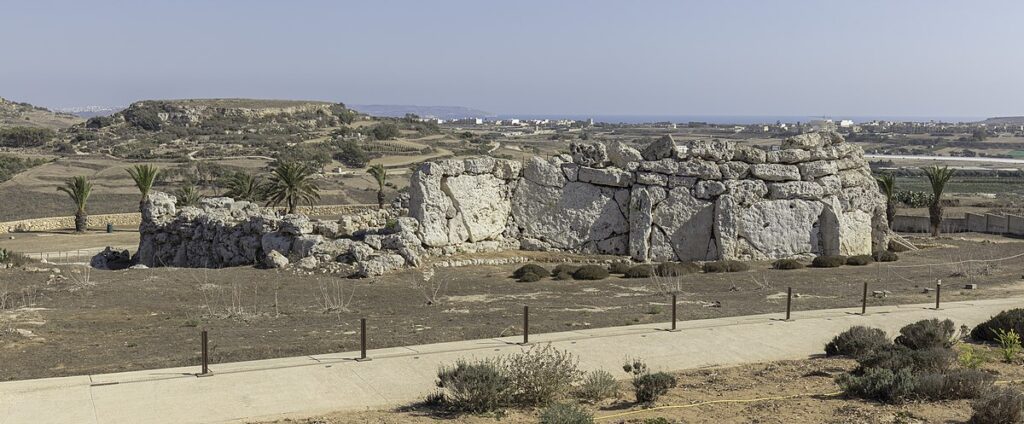
Neolithic Malta’s astronomical alignments present a case where the evidence and the interpretation need to be carefully separated, because what the measurements actually show at Mnajdra’s South temple is genuinely remarkable on its own terms without any embellishment. At the equinoxes, first light passes through the main doorway of the South temple, travels down the central axis, and strikes the innermost niche. At the summer solstice, the rising sun’s edge grazes one decorated megalith. At the winter solstice, the opposite edge of the same stone is lit. These are repeatable, date-specific, archaeologically confirmed events at a site that was built between roughly 3600 and 2500 BCE. Across the wider corpus of Maltese temples, many structures share a south to south-east orientation bias that celestial explanations account for better than terrain or coincidence. This article explains what the measurements show, how researchers have tested the alignments, and where honest uncertainty still applies.
What counts as a real Neolithic Malta astronomical alignment
An alignment is not any wall that happens to face the horizon. A responsible claim requires four things: the building’s axis or doorway is measurably co-linear with the azimuth of a solar event at the relevant Neolithic date, a specific and narrow light effect occurs at a particular stone or niche only on that date, trained observers can reproduce the effect across multiple years in comparable conditions, and the broader corpus of related buildings shares the same orientation logic rather than treating a single site as exceptional. Claims that survive all four tests carry real weight. Claims that rest only on “this wall roughly faces east” do not.
At Malta’s latitude of approximately 35.9 degrees north, equinox sunrise lies near due east, winter solstice sunrise falls to the south-east, and summer solstice sunrise falls to the north-east, all corrected for local horizon height. Horizon height matters because a low sea horizon, like the one the Mnajdra and Hagar Qim temples overlook, shifts first light slightly relative to a built-up or hilly skyline. Frank Ventura and Michael Hoskin published orientation surveys of the Maltese temple corpus and confirmed the south to south-east trend across sites, establishing that the cluster is unlikely to be explained by convenience or terrain alone. The measurements underlying that conclusion are the starting point for any serious discussion of Neolithic Malta’s astronomical alignments.
The Mnajdra South temple: how the light effects actually work
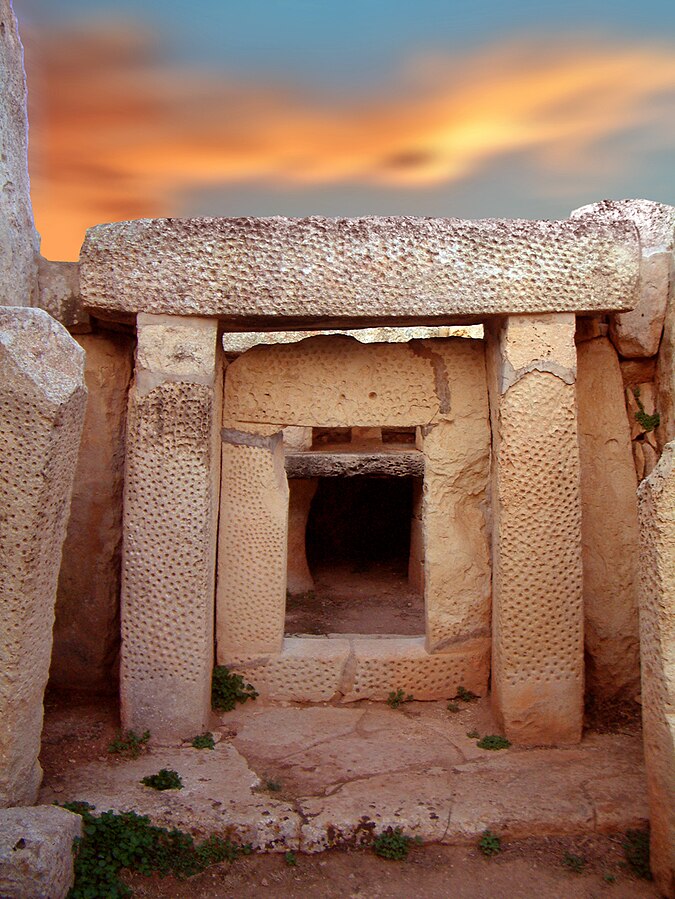
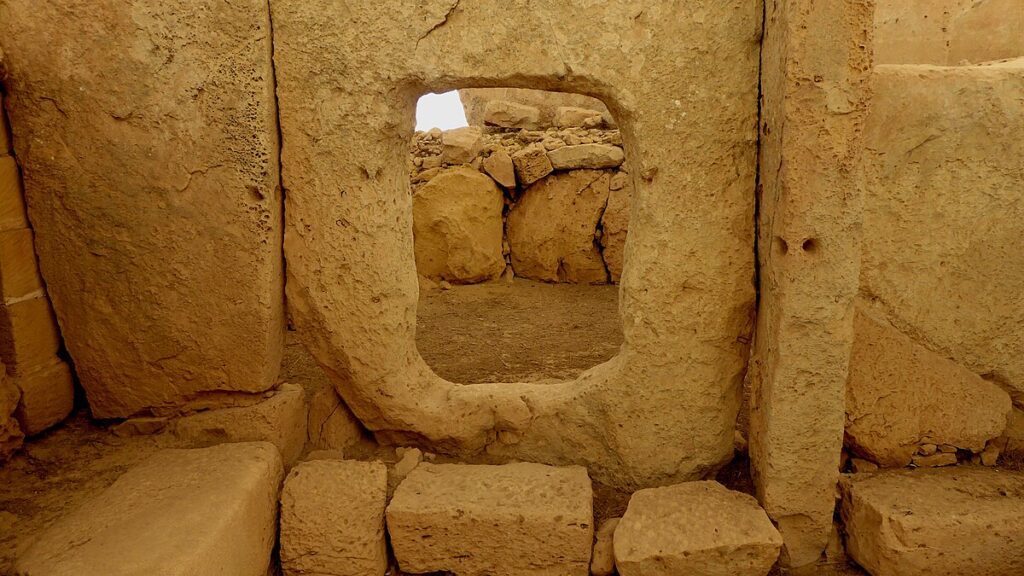
The South temple at Mnajdra has a concave facade leading to a narrow trilithon doorway, then a sequence of apses on a single central axis. This architecture channels both sight and light down that axis in the same way a telescope tube channels light to an eyepiece. At the equinoxes, first light enters through the main doorway, travels the full length of the axial corridor, and illuminates the innermost niche. The niche acts as a target: on the day, it lights; off the date, it does not. That binary quality, present or absent at a specific niche face, is precisely what distinguishes an intentional alignment from a general orientation toward sunrise.
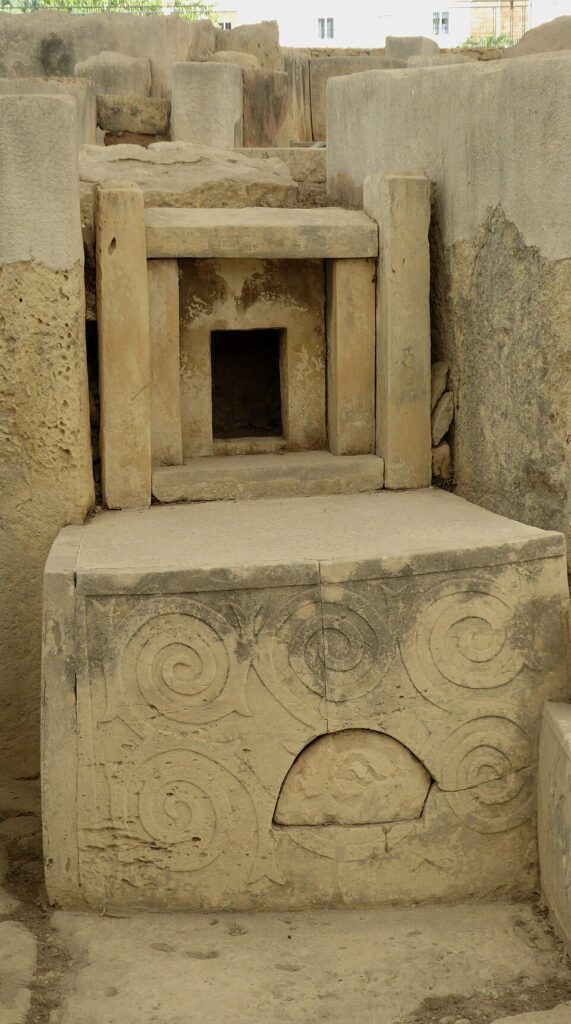
The solstice effects operate through edge-lighting rather than axial beam. At winter solstice sunrise, the rising sun’s edge grazes one arris of a specific decorated megalith inside the temple. At summer solstice, the opposite arris of the same stone is grazed. Because arrises are sharp and unforgiving in how they catch light, these effects are date-sensitive to a degree that an axial alignment to a broad niche face is not. A beam that misses an arris by a day’s worth of solar movement fails entirely, which is why Tore Lomsdalen’s archaeoastronomical fieldwork at the site, published in his 2014 study Sky and Purpose in Prehistoric Malta through Sophia Centre Press, treats the solstice edge effects as particularly strong evidence of intentionality.
Frank Ventura and Geoffrey Agius first proposed the Mnajdra equinox alignment in 1980. Ventura published a follow-up investigation in the Journal of Skyscape Archaeology in 2017, surveying the karstic terrain forming the eastern skyline and discovering two possible postholes. Measurements showed that a post in the southernmost hole could have served as a foresight marking winter solstice sunrise with reasonable accuracy. The second posthole is offset from the summer solstice sunrise position by approximately three degrees in azimuth, placing it outside the range that counts as a confirmed solstice marker but inside the range worth continued investigation. That is the kind of careful reporting that distinguishes rigorous archaeoastronomy from enthusiasm.
Built out of a love for history, kept free from distractions.
Spoken Past is an independent project shaped by curiosity, care, and long hours of research. Reader support helps keep it maintained, carefully researched, and open to everyone.
How the wider corpus of temples was measured and what it shows
A 2022 study published in the Journal of Archaeological Science Reports used 3D simulation through Raycasting in Unity3D to investigate alignments at 23 Maltese temple sites across the full Neolithic period from roughly 3700 to 2400 BCE. The study provided new statistical evidence for and against previously identified alignments, applying computational tools to identify the accuracy of orientations with a precision that fieldwork alone cannot achieve at every site. The results confirmed a strong south to south-east orientation preference across the corpus and identified Mnajdra South as the site with the clearest and most precisely measurable solar behaviour.
The Ggantija complex on Gozo faces a broad south-eastern sky across the Xaghra plateau. Orientation surveys have found that its principal axes fall within the south to south-east cluster, consistent with the wider corpus trend, though the solar light effects documented at Mnajdra are not replicated at Ggantija in the same precision. At Tarxien, the built-up modern surroundings complicate horizon profiles, but the site stood in open ground during the Neolithic and its orientation data contributes to the corpus pattern. Hagar Qim’s apertures and porthole stones admit controlled light into dim interiors, and its doorway axes fit a logic of light management consistent with an interest in specific solar events, though the effects are less precisely date-specific than those at Mnajdra South.
The statistical case for intentionality rests not on any single site but on the combination of the Mnajdra South precision and the corpus-level pattern. If the orientation bias were randomly distributed across compass headings, the south to south-east cluster would be statistically improbable. If Mnajdra’s solstice edge effects were accidental, the same arris-grazing geometry at both solstices with the same decorated stone would be extraordinarily coincidental. The two lines of evidence together make intentionality the most economical explanation, without requiring astronomers with instruments or calendars that archaeological evidence does not support.
What the architecture did for the community that built it
The practical function of a building that stages equinox and solstice light events is not mysterious. Communities that track planting, harvesting, drying, and ritual cycles benefit from knowing when the year turns. A light blade that marches down a corridor and strikes a niche at dawn on one morning per season, and fails to reach that niche on every other morning, is a public, embodied, and unambiguous signal. No writing is required. No specialist knowledge is required. Everyone present at sunrise on the relevant morning sees the same event and receives the same information. The temple’s function as a seasonal marker is available to the whole community, not just to whoever controls the calendar calculation.
The Hal Saflieni Hypogeum, the later underground complex associated with the same cultural tradition, is famously resonant to certain human vocal ranges in specific chambers. That is acoustic design, not astronomy, but it confirms the same underlying principle: Neolithic builders on Malta manipulated sensory experience with precision, staging attention through architecture in ways that required sustained calculation at the design phase. The sky was one tool in that toolkit. Light was the medium in the open-air temples. The result was a built environment in which the turning points of the agricultural year were physically inscribed into the landscape so that the community could not miss them.
Where honest uncertainty about Neolithic Malta’s astronomical alignments still applies
Lunar alignment proposals for sites including Ggantija exist in the published literature but face a harder evidentiary standard than the solar alignments. The moon’s standstill cycle of 18.6 years is significantly harder to verify archaeologically than an annual solar event, and the statistical case for specific lunar alignments at Maltese sites has not reached the level of the Mnajdra solar evidence. Treating lunar claims as hypotheses pending stronger tests is the appropriate response, not dismissal, but not confidence either.
Topography certainly influenced site selection and orientation at some temples, and formal comparisons of celestial versus terrain drivers have not been completed for every site in the corpus. The 3D simulation work from 2022 is the closest approach to such a comparison, but the authors note that the methodology identifies alignment accuracy rather than motivation, and that distinguishing deliberate astronomical orientation from terrain-constrained convenience requires additional lines of evidence at specific sites. Not every temple in the corpus necessarily encodes the same celestial event, and different structures may reflect different community priorities or different periods of use.
The difference between the well-supported conclusions and the open questions is worth stating clearly: Mnajdra South deliberately stages equinox and solstice sunrise events through axial light and edge-lighting, and across the corpus there is a south to south-east orientation trend unlikely to be accidental. Proposals for lunar alignments at specific sites, complex multi-celestial calendars, and orientation explanations at poorly documented sites remain open questions that the current evidence does not resolve. The most convincing contribution Neolithic Malta’s astronomical alignments make to the wider story of prehistoric intelligence is not the most spectacular claim anyone has made about them. It is the measured, tested, reproducible demonstration that people in the fourth millennium BCE were building stone observatories on a small island in the Mediterranean with the precision to stage a specific light event on a specific morning of the year.
Sources: Frank J. Ventura and Geoffrey Agius, An Investigation of the Possible Equinox Alignment at Mnajdra, Malta, Journal of Skyscape Archaeology 3:1 (Equinox Publishing, 2017): 79-92; Frank Ventura and Michael Hoskin, Temples of Malta, in Clive Ruggles (ed.), Handbook of Archaeoastronomy and Ethnoastronomy (Springer, 2015): 1421-1430; The Crux of Astronomical Alignment in Neolithic Malta: Using 3D Simulation to Produce New Data, Journal of Archaeological Science Reports (2022); Tore Lomsdalen, Sky and Purpose in Prehistoric Malta: Sun, Moon and Stars at the Temples of Mnajdra (Sophia Centre Press, 2014); Ventura, Fodera Serio, and Hoskin, Possible Tally Stones at Mnajdra, Malta, Journal for the History of Astronomy 24 (1993): 171-183.