When the priests of Amun at Karnak performed the annual Banishing of Apep ceremony, they were not doing something symbolic in any lightweight sense. They built wax effigies of the chaos serpent, inscribed his name on them in green ink, spat on them, drove bronze knives into them, and finally burned the remains. If they skipped a night, they believed the sun would not rise. That ritual urgency captures something essential about mythical creatures across every culture that ever invented them: they were not entertainment. They were explanations, warnings, and tools for managing what was otherwise unmanageable. This guide covers 26 mythical creatures from ancient Egypt, Greece, Rome, China, Mesopotamia, Scandinavia, and beyond. For each one, the focus is on the oldest surviving sources, the specific cultural job the creature performed, and the details that popular summaries routinely get wrong. The instruction in the original title stands: A to Z. But what fills each letter has been rebuilt from the ground up.
Before you read: one rule about mythical creatures
The biggest mistake a modern reader makes is assuming that creatures sharing a name share a meaning. They almost never do. The Greek drakōn was a large serpent with exceptional sight, guarding sacred places. The Chinese lóng brought imperial rainfall and cosmic order. The European medieval dragon was a theological instrument for representing Satan. These three are all called “dragon” in translation, and they have almost nothing in common. Every entry below is therefore anchored to a specific culture, a specific time period, and a specific function. Comparison comes after understanding. Context comes first.
A: Apep (Apophis)
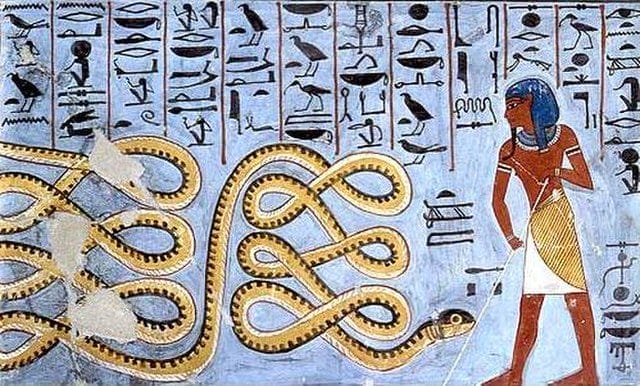
Apep first appears by name in Middle Kingdom texts dated to roughly 2040 to 1782 BCE, though large hostile serpents threatening solar deities appear on Predynastic C-ware pottery as far back as 4000 BCE. He was not a god in any worshippable sense. The Egyptians built him no temples, made him no offerings, and never addressed prayers to him. He embodied pure isfet, the Egyptian concept of chaos and disorder, and the entire point of his existence was to be defeated nightly so that Ra’s solar barque could complete its journey through the twelve hours of the Duat and produce dawn. Priests at the temple of Amun-Re at Karnak performed daily rituals to help Ra win. The most detailed guide to those rituals, the Bremner-Rhind Papyrus, held at the British Museum and dated to around 305 BCE, compiled spells from earlier New Kingdom traditions and instructed priests to stab, trample, spit on, and burn effigies of the serpent. Solar eclipses were understood as evidence that Apep was momentarily winning. Cloudy days were evidence he was gaining ground. The ritual was therefore not ceremonial but genuinely urgent: cosmic maintenance performed by human hands.
B: Basilisk
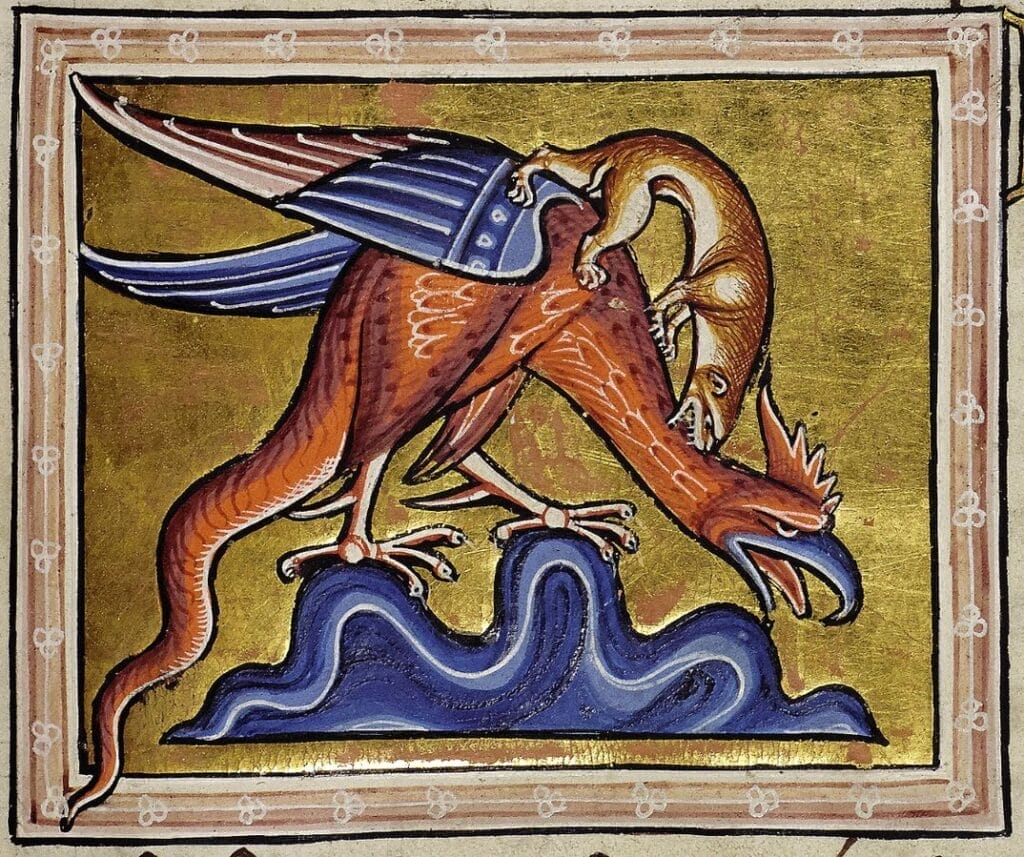
Pliny the Elder described the basilisk in his Naturalis Historia of 77 CE as a snake no longer than twelve finger-widths, recognizable by a white crown-shaped marking on its head, capable of killing vegetation and small animals through breath and gaze alone. This was a zoological entry, not a moral allegory. Pliny placed it alongside real North African snakes and treated it as a genuine natural curiosity. The medieval transformation of that modest creature is one of the stranger journeys in European intellectual history. By 1200 CE, English scribes producing the Aberdeen Bestiary had given the basilisk a rooster’s head, dragon wings, and a gaze capable of shattering stone. The change happened because bestiaries were not natural history texts. They were moral instruction manuals in animal costume, and a crowned snake that killed with a look was the perfect vehicle for sermons about corrupt kingship and the spiritual danger of pride. The one reliable defense, holding up a mirror so the basilisk met its own reflection and died, was itself a theological argument: evil destroys itself when forced to confront what it is.
C: Centaur
The Lapith and centaur battle at the wedding of Pirithous is one of the most repeated images in all of classical art, carved on the Temple of Zeus at Olympia around 456 BCE and again on the Parthenon metopes around 447 BCE. The narrative logic is precise and intentional. Centaurs were invited as guests to a human wedding. They drank wine, which their half-horse bodies could not properly metabolize, and they attempted to abduct the Lapith women. The resulting battle, which the Lapiths won, gave Greek artists a ready-made image for the victory of civilization over instinct, law over appetite, the human over the animal. What made the centaur such effective symbolism was that the human half was fully visible. These were not mere beasts. They were creatures with human intelligence that had chosen appetite over restraint, which made their defeat all the more instructive. Chiron was the deliberate exception: a centaur who tutored Achilles and Asclepius, demonstrating that the hybrid form could be redeemed only by extraordinary personal discipline, never by nature alone.

D: Dragon
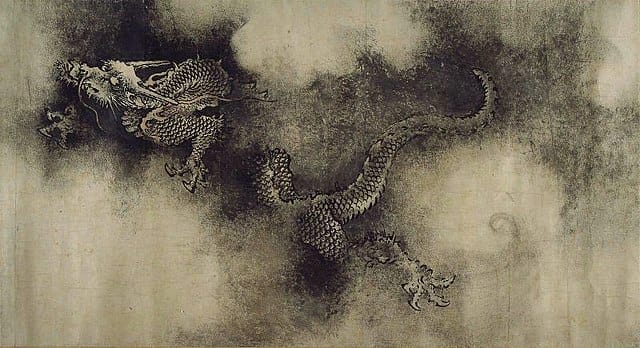
Three separate symbolic traditions are all called “dragon” in English, and conflating them produces nothing but confusion. The Greek drakōn was a large serpent, not a winged fire-breather. It had exceptional vision, guarded sacred springs and golden fleeces, and was overcome by heroes through cunning rather than brute force. Jason put the drakōn guarding the Golden Fleece to sleep with a potion. Cadmus killed the drakōn of Ares at Thebes with a stone. The Chinese lóng, depicted in Han dynasty art from the second century BCE onward as a scaled, antlered, clawed creature ascending through clouds, operated in a completely different register. It did not guard hoards. It generated rainfall, expressed imperial authority, and rose toward heaven. Five-clawed dragons on imperial robes were assertions of the mandate of heaven, not threats to be slain. The medieval European dragon fused the Greek serpent with the Satan of Revelation 12, where the devil appears as “a great dragon, fiery red, having seven heads.” That theological overlay is what turned the drakōn into a fundamentally evil creature requiring heroic Christian destruction, and it is that version that dominates popular imagination today.
E: Echidna
Hesiod described Echidna at lines 295 to 305 of the Theogony as half nymph, half vast flesh-eating serpent, immortal, ageless, and permanently installed in a cave beneath the earth. She never went anywhere. She never fought anyone. Her function was entirely generative: with Typhon, she produced the Nemean Lion, the Hydra, Cerberus, the Chimera, Orthrus, and the Sphinx of Thebes. This is a logistical solution to a narrative problem. Greek mythology required a continuous supply of monsters for heroes to fight. Rather than inventing fresh origins for each creature, the tradition gave them a shared mother whose immortality guaranteed that the supply would never run out. Heroes killed her children repeatedly. Echidna produced more. The cave beneath the earth was not incidental. It marked her as a chthonic force, a creature of the underworld’s generative darkness, the productive counterpart to the solar, heroic world above.

F: Fenrir
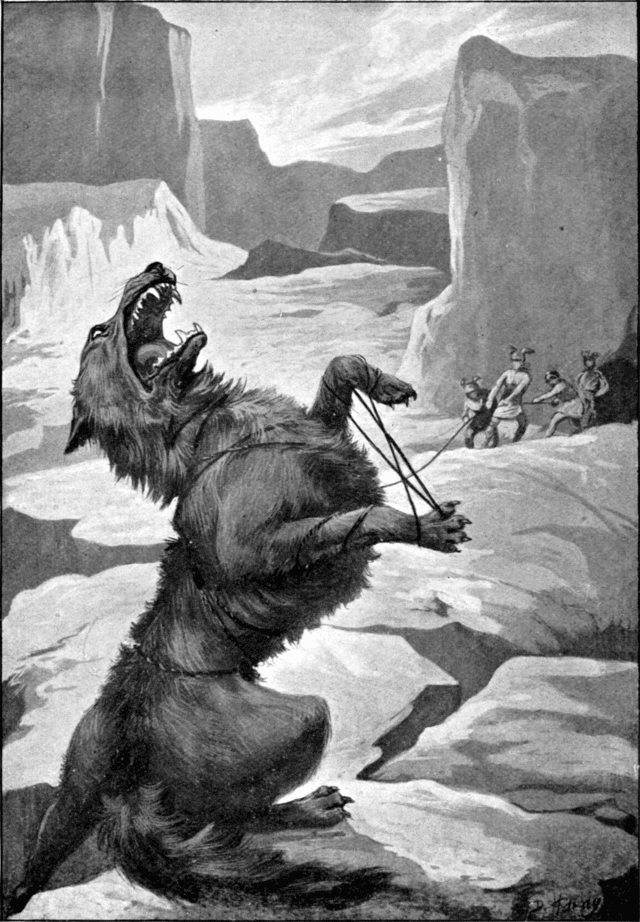
The gods of Asgard knew exactly what Fenrir was going to do. The prophecy was clear: at Ragnarok, the wolf would break free of his chains and kill Odin. Knowing this, they brought him into Asgard and raised him there, because killing him on sacred ground would have been a violation of the sanctuary that divine space was supposed to provide. He grew. They chained him twice with iron fetters. He broke both. The third binding used Gleipnir, a ribbon-thin cord woven by the dwarves from six impossible ingredients: the sound of a cat’s footstep, the beard of a woman, the roots of a mountain, the sinews of a bear, the breath of a fish, the spittle of a bird. Fenrir would only allow it to be placed on him if a god put a hand in his mouth as collateral. Only Tyr agreed. Fenrir was bound. Tyr lost his hand. The myth, recorded in Snorri Sturluson’s Prose Edda of around 1220 CE and backed by older Eddic poetry in the Codex Regius manuscript, encodes a political argument that is still recognizable: the threat you manage rather than eliminate keeps growing, and the cost of managing it is paid in increments by whoever is willing to make the sacrifice.
G: Gorgon (Medusa)
The Gorgon face appears in Greek art before Greek literature gave it a story. Seventh-century BCE pottery from Corinth and Attica shows the characteristic frontal stare, open mouth, protruding tongue, and flanking snakes, in a period when almost every other figure in Greek visual art was shown in profile. That frontality was deliberate and alarming. A face looking directly out of a painted surface broke the conventions of narrative representation and created something confrontational rather than illustrative. The Gorgon image was used apotropaically: placed on shields, temple pediments, and armor to deflect evil by directing the creature’s terrifying power outward at enemies. Hesiod’s Theogony named three Gorgons and identified Medusa alone as mortal, which was the detail that made Perseus’s mission possible. It was Ovid, writing the Metamorphoses in the late first century BCE, who gave Medusa a backstory: a beautiful mortal priestess of Athena, violated by Poseidon inside the goddess’s own temple, and transformed by Athena into something monstrous rather than the attacker being punished. That transformation of Medusa from threat into victim is a Roman addition, not a Greek original.

H: Harpy
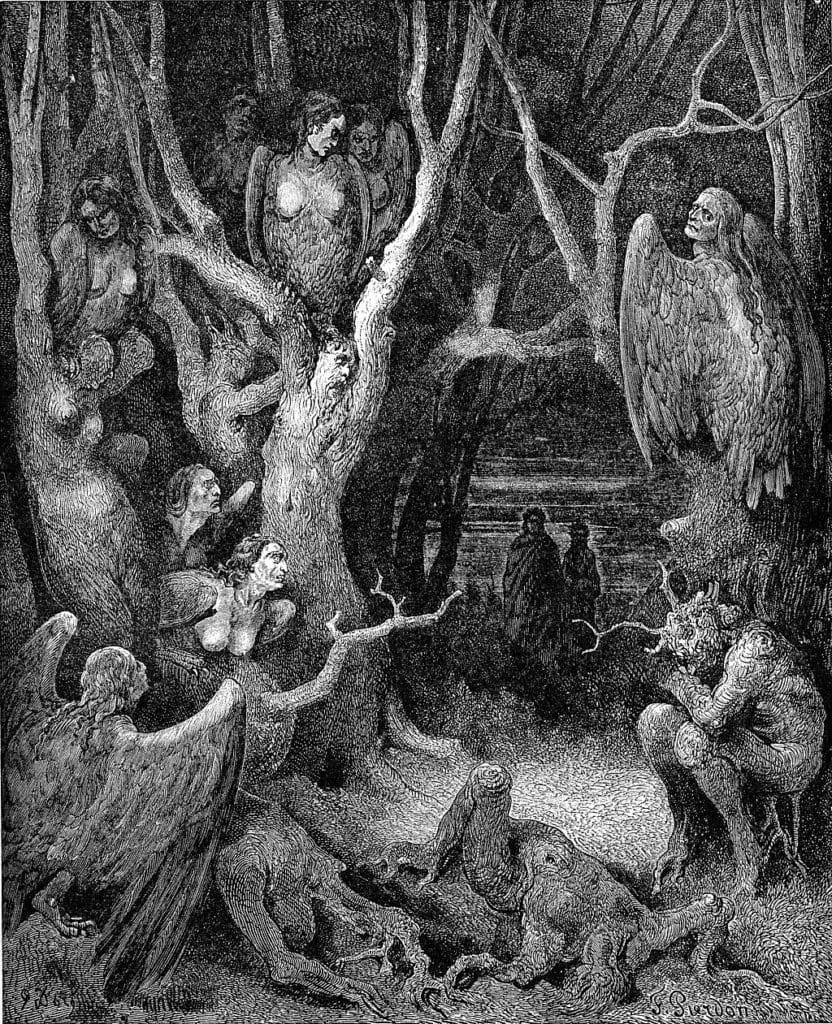
The Greek word harpyia means, without ambiguity, “the one who snatches.” Homer’s Odyssey uses Harpies as agents who carry Odysseus’s children away into obscurity, acting like sudden violent disappearances given a name. In early sources they were wind-spirits, personifications of the violent gusts that struck without warning and took what was not theirs. The most striking ancient visual representation of Harpies has nothing to do with Greece at all. The Harpy Tomb at Xanthos in Lycia, carved around 480 BCE and removed in 1840 to the British Museum, shows winged female figures carrying small human souls away on its limestone reliefs. The carving predates most of the Greek literary treatments and suggests the figure was operating across multiple Anatolian and Aegean cultures simultaneously, each using a version of the same winged snatcher for slightly different funerary purposes. Virgil’s Aeneid later gave the Harpies their most memorable literary role: agents of divine punishment tormenting the prophet Phineus by fouling his food whenever he attempted to eat, a specifically calibrated cruelty for a man who had misused prophetic knowledge.
I: Ichthyocentaur
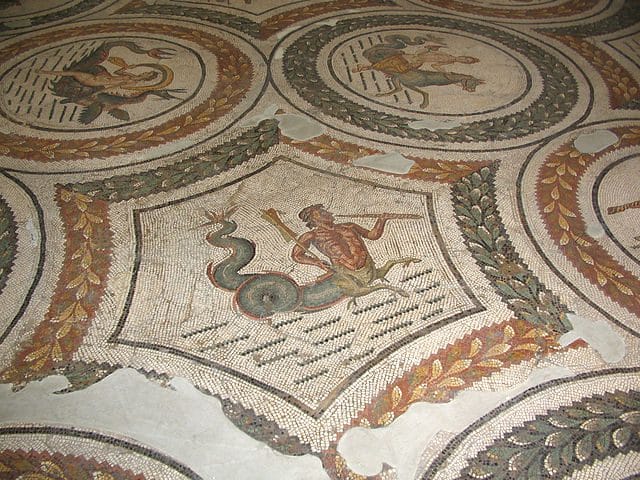
The ichthyocentaur, a figure combining a human torso with a horse’s forelegs and a fish’s tail in place of hindquarters, is almost entirely a creature of Hellenistic and Roman decorative art rather than mythological narrative. No major Greek poem features one as a character. No important myth turns on their behavior. They appear on mosaic floors of the second century BCE onward, on Roman sarcophagi, and on silver luxury vessels as part of the visual vocabulary associated with sea processions, Nereid imagery, and Dionysiac maritime scenes. Late antique mythographic sources give two named ichthyocentaurs, Bythos meaning sea-depth and Aphros meaning sea-foam, the latter connected to the birth of Aphrodite. Their cultural function was primarily aesthetic and status-signaling: filling the border zones of expensive floors and vessels with humanoid sea creatures that implied both wealth and classical education. The figure illustrates how the Hellenistic world generated new hybrid types not from theological need but from the combinatorial logic of visual decoration.
J: Jörmungandr (Midgard Serpent)
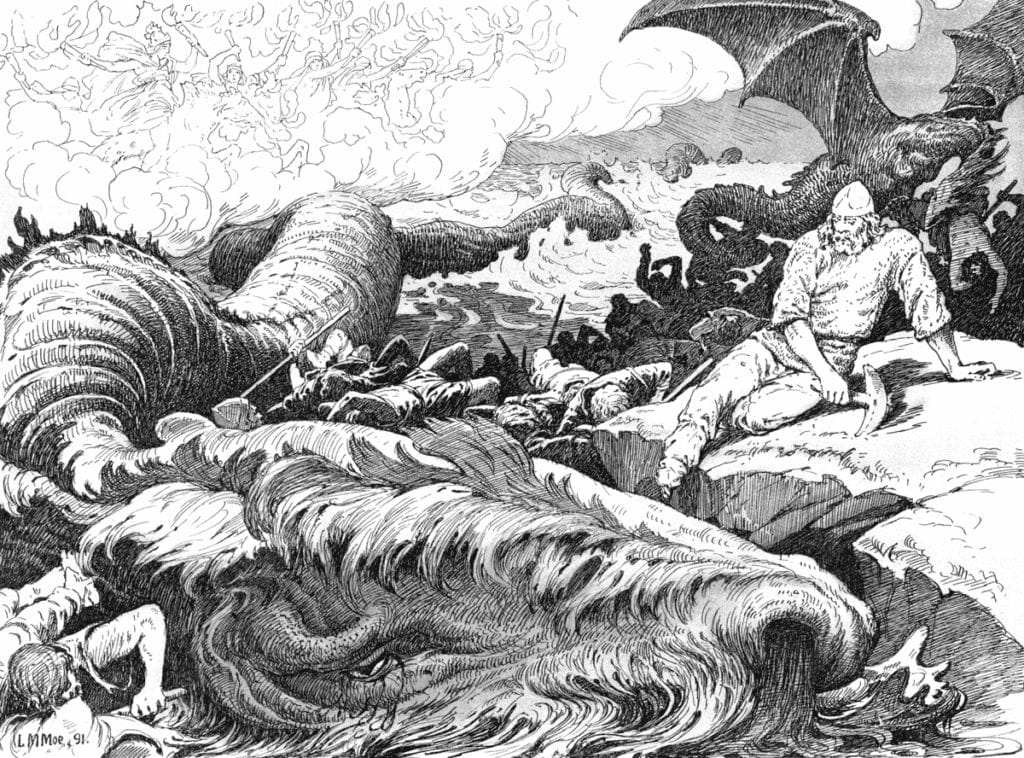
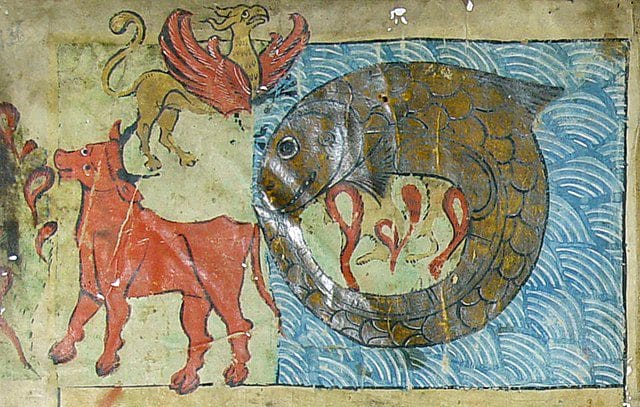
Odin threw the infant Jörmungandr into the ocean surrounding Midgard, and the serpent grew until it encircled the entire world and bit its own tail. That detail is the key structural point: the creature is not simply enormous, it defines the boundary of the human world by its physical circumference. Midgard, literally the middle enclosure, is middle only because something encircles it. The Eddic poem Hymiskvida describes Thor’s fishing expedition, in which he baited a hook with an ox head and hauled the World Serpent to the edge of the boat before the giant Hymir cut the line in terror. According to the Norse scholar John Lindow at the University of California, this fishing episode was likely the single most widely depicted Norse myth during the Viking Age, judging by its frequency on carved stone monuments. The Ardre VIII image stone from Gotland, dated to the eighth or ninth century CE, appears to show the scene, placing its visual history at least four centuries before Snorri Sturluson wrote it down in the Prose Edda around 1220 CE.
K: Kerberos (Cerberus)
Hesiod’s Theogony gives Cerberus fifty heads in the oldest surviving description. Later poets and artists settled on three, which was more manageable to paint on a pot and more legible as a symbol. The creature’s function is precise: it enforces the boundary between living and dead in both directions. The souls of the dead enter freely. They cannot leave. The living cannot enter without authorization. The twelfth labor of Heracles, borrowing Cerberus from Hades with the god’s explicit permission, is carefully structured to make clear that the hero was not breaking the rule but working within it. He negotiated. He was granted access. He returned the dog. The most illuminating version of this story appears on the black-figure hydria Louvre E701, dated to around 525 BCE, which shows Heracles leading Cerberus on a chain toward the terrified king Eurystheus, who has climbed entirely inside a large storage jar to avoid contact with the creature. The image is almost comedic, and that may be the point: the monster that terrifies the powerful is handled calmly by the truly heroic.

L: Lamia
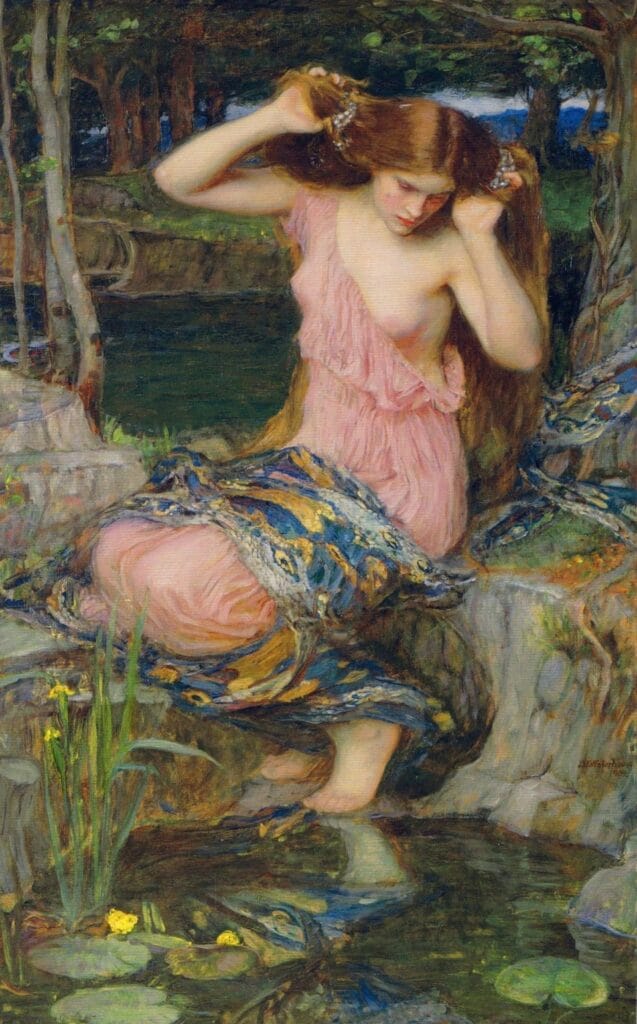
The earliest Lamia is not a monster. She is a Libyan queen loved by Zeus, whose children are then killed by Hera. Grief and rage drive her to devour the children of others, and over time she transforms from a grieving woman into a predatory creature of the night. Diodorus Siculus, writing in the first century BCE, preserves a version of this backstory. What makes Lamia’s mythological career unusual is how deliberately the tradition weaponized her grief: she did not become monstrous despite losing her children but because of it, which framed extreme maternal grief itself as a threat to other families. Roman poets used the figure more loosely, as a general-purpose sorceress or night-creature. By the Byzantine period, Lamia had merged with vampire-adjacent beings who drained young men of vitality. That the figure survived more than a thousand years of continuous literary use across Greek, Latin, and Byzantine contexts says something specific: she channeled anxieties that no culture has ever stopped having about appetite, deception, and the dangerous power of beautiful surfaces.
M: Minotaur
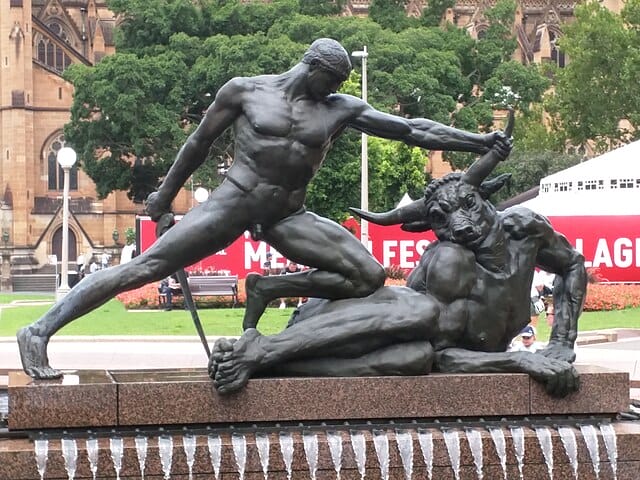
Poseidon sent Minos a bull as a gift and a test, expecting Minos to sacrifice it in return. Minos kept it instead. Poseidon’s punishment was to cause Pasiphae, Minos’s queen, to conceive a desire for the bull. The Minotaur, named Asterion in some sources, was the result. Minos imprisoned him in the Labyrinth built by Daedalus and fed him a tribute of seven youths and seven maidens sent from Athens every nine years as penalty for the killing of Minos’s son Androgeos. Theseus came with the third tribute group, killed the Minotaur with help from Minos’s daughter Ariadne and her famous ball of thread, and sailed home. The political subtext was visible to ancient audiences: the myth gave Athens a founding claim to having ended Cretan dominance over Aegean tribute networks. Arthur Evans, excavating at Knossos on Crete from 1900 onward, found abundant evidence of bull-leaping rituals and a palace of remarkable complexity. He found no evidence of human sacrifice. Whether the myth encodes a memory of real Minoan domination over Aegean communities, or whether the palace’s labyrinthine layout simply inspired the labyrinth story retroactively, remains genuinely contested.
N: Nemean Lion
The Nemean Lion’s skin could not be cut by any weapon. Heracles’ arrows, which would have killed any mortal lion, bounced off it. He had to abandon ranged fighting entirely, chase the lion into its cave, and strangle it with his bare hands. The killing therefore demonstrated a form of strength that weapons literally could not provide: the kind that operates at zero range, that cannot be administered from safety, that requires accepting physical danger without any technological buffer. When Heracles then tried to skin the lion and found that no blade could cut its hide, he used its own claws. The creature that had been impossible to kill became the raw material for its killer’s permanent protection. This pattern, in which the hero absorbs the properties of the monster he defeats, is more than a plot device. It is a theory of heroic identity: what you are becomes what you have survived, and you carry those encounters on your body.

O: Orthrus (Orthos)
Orthrus appears in Hesiod’s Theogony as the first offspring of Echidna and Typhon, a two-headed dog set to guard the cattle of the triple-bodied giant Geryon on the island of Erytheia, which Greek sources placed at the far western edge of the world beyond the Ocean river. Heracles’ tenth labor required crossing that boundary, killing Orthrus, killing the herdsman Eurytion, fighting Geryon himself, and driving the cattle back across the entirety of the known world to Eurystheus. Orthrus is structurally parallel to Cerberus: a canine guardian posted at a liminal zone, protecting something of immense value. Where Cerberus guarded the boundary between living and dead, Orthrus guarded the boundary between the known world and its western extreme. Several Attic black-figure vases from the late sixth century BCE show the encounter with Geryon and Orthrus, though the dog’s appearance varies between painters, sometimes with serpent tails replacing the hind legs.

P: Phoenix
Herodotus mentioned the phoenix in Book Two of his Histories around 440 BCE with characteristic skepticism: he had never seen one himself, the Heliopolis priests described it appearing only every five hundred years to bury its father in a ball of myrrh, and the whole account seemed to him improbable. That cautious early mention placed the phoenix in Egyptian sacred geography, connecting it to the Bennu bird of Heliopolis, a sacred heron associated with Ra and the primordial mound of creation. Roman emperors seized on the bird’s renewal imagery for political purposes. Hadrian and Constantine both minted coins featuring the phoenix as a symbol of imperial revival and continuity, and the creature became a reliable piece of official propaganda during periods of dynastic change or crisis. Early Christian writers, especially Tertullian in the early third century CE, argued explicitly that if God could engineer a phoenix, the physical resurrection of the human body was not merely plausible but demonstrated. The bird that pagan emperors used to claim perpetual political renewal was redeployed as evidence for Christian theological claims about death and what comes after it.

Q: Qilin
The Qilin appears in the Spring and Autumn Annals, traditionally attributed to Confucius and covering events of the eighth to fifth centuries BCE, in a specific and alarming context: the capture of a Qilin in 481 BCE was recorded as a bad omen, precisely because these creatures were supposed to manifest only during the reign of a genuinely virtuous ruler. Finding one when the political situation was deteriorating meant the cosmos was sending a distress signal. The creature was described in different texts as hooved, sometimes scaled like a dragon, sometimes deer-like, always gentle enough to walk without crushing a single blade of grass. Its cultural function was to serve as a mobile endorsement or warning from the cosmos about the quality of current governance. Ming dynasty admiral Zheng He returned from his East African voyages in the early fifteenth century with two giraffes, and the court identified them as Qilin, interpreting their arrival as cosmic approval of the Yongle Emperor’s expansionist policies. Whether anyone genuinely believed the giraffes were mythological creatures or whether the identification was deliberate political theatre is a question historians still debate.

R: Roc
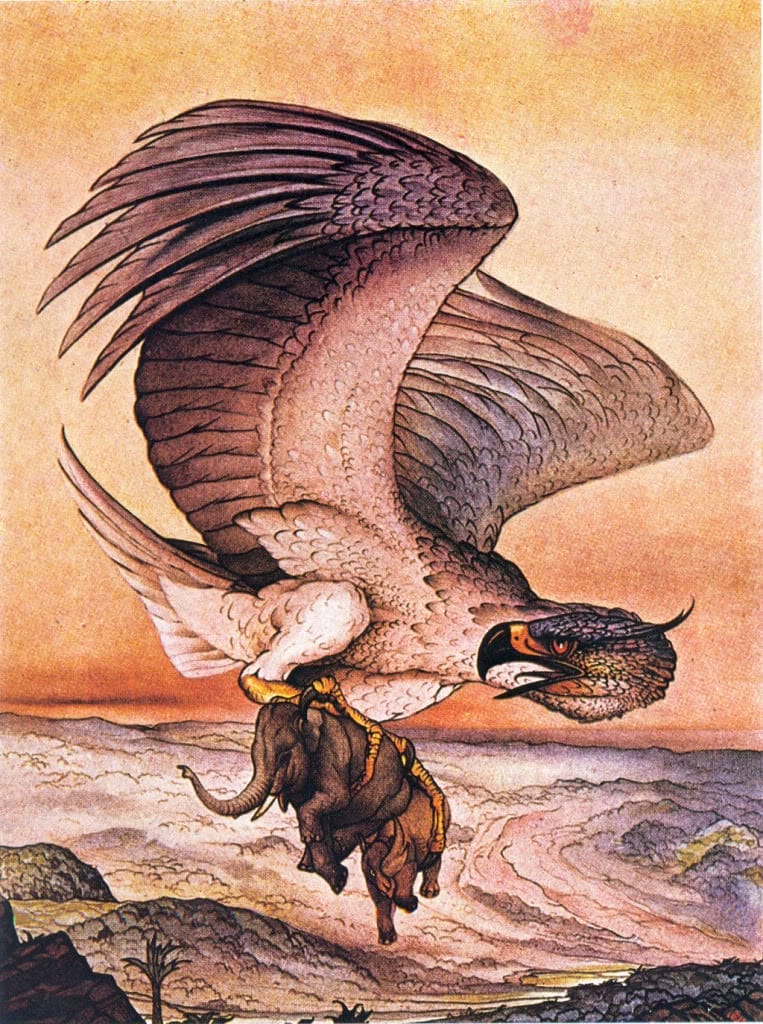
The Roc enters written Arabic sources in the ninth and tenth centuries CE as a geographical marker rather than a narrative character. Its function in travel literature was cartographic: to indicate the outer limit of the world where normal expectations ceased to apply. The traveler who survived a Roc encounter had been further than civilization extended. The creature’s most famous literary appearances come in the One Thousand and One Nights, where Sinbad the Sailor encounters it twice: sheltering in its egg during his second voyage and lashing himself to its leg to escape an island on his fifth. The Persian Simurgh, a related but distinct giant bird appearing in Ferdowsi’s Shahnameh of around 1010 CE, carried prophetic wisdom alongside its impossible scale, and was benevolent rather than merely terrifying. Marco Polo, writing in the late thirteenth century, reported hearing descriptions of the Rukh in the Indian Ocean and speculated it might be an enormous eagle. Modern researchers have suggested the elephant bird of Madagascar, Aepyornis maximus, which became extinct around the seventeenth century and whose eggs were genuinely enormous, as a possible source for Arab traders encountering its remains along the East African coast.
S: Sphinx
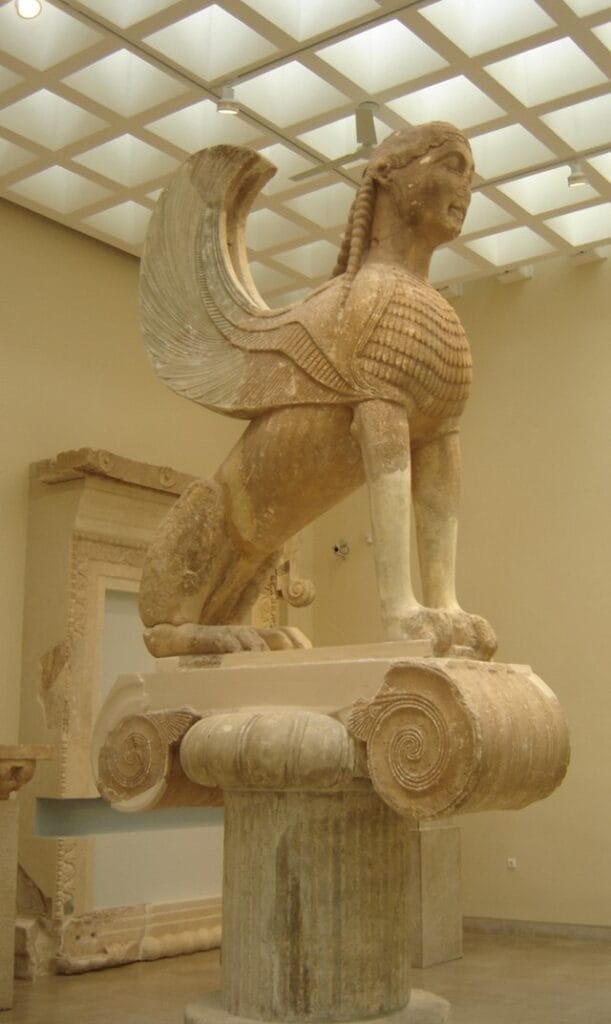
Egyptian sphinxes and Greek sphinxes share a body type and nothing else that matters symbolically. Egyptian sphinxes were royal: a pharaoh’s human face on a lion’s body, combining royal intelligence with the lion’s predatory authority. The Great Sphinx of Giza, carved from a natural limestone outcrop during the reign of Khafre around 2500 BCE, watched over the royal necropolis as a permanent embodiment of sovereign power facing east toward the rising sun. Rows of ram-headed sphinxes lined the processional avenues to major temples at Karnak, where they functioned as protective presences framing the approach to sacred space. The Greek Sphinx of Thebes is an entirely different creature: female, winged, and armed with a riddle rather than the implied threat of physical force. Hesiod’s Theogony identified her as a daughter of Echidna, connecting her explicitly to the lineage of heroic challenges. Her riddle about the creature that walks on four legs, then two, then three, was a question about the nature of humanity across the span of a human life. Oedipus answered it. She threw herself from a cliff. The story immediately then deploys the deeper irony: the man intelligent enough to solve the riddle about human nature did not know his own.
T: Typhon
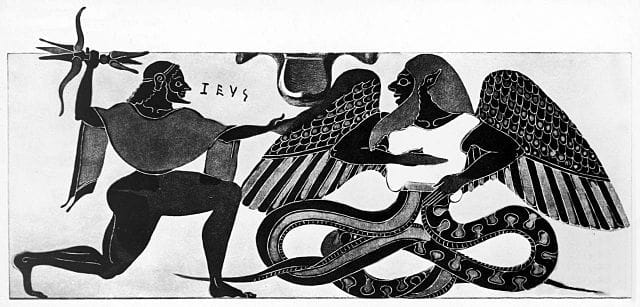
Hesiod introduces Typhon at lines 820 to 880 of the Theogony as the last and most dangerous of all divine threats to Zeus’s order: a hundred serpent heads growing from his shoulders, each with its own voice capable of imitating every animal, blazing fire in every eye, and a roar that shook the foundations of the earth. He was born after the Titans had already been defeated, a last-resort challenge from Gaia against the new Olympian settlement. Crucially, he came close to winning. In versions of the myth preserved by Apollodorus and later writers, Typhon briefly immobilized Zeus, cut out his sinews, and hid them in a cave before Hermes recovered them. The explicit possibility that Zeus could lose, even temporarily, was essential to the story’s function: it demonstrated the genuine cost of the cosmic order’s establishment. Typhon’s final imprisonment under Mount Etna gave the myth a geological anchor that later writers and audiences found particularly satisfying. The volcano’s eruptions were his breath. The earthquakes were him shifting position. The word typhoon in modern English descends directly from this myth, preserving the original sense of a force against which nothing constructed by ordinary means will hold.
U: Unicorn
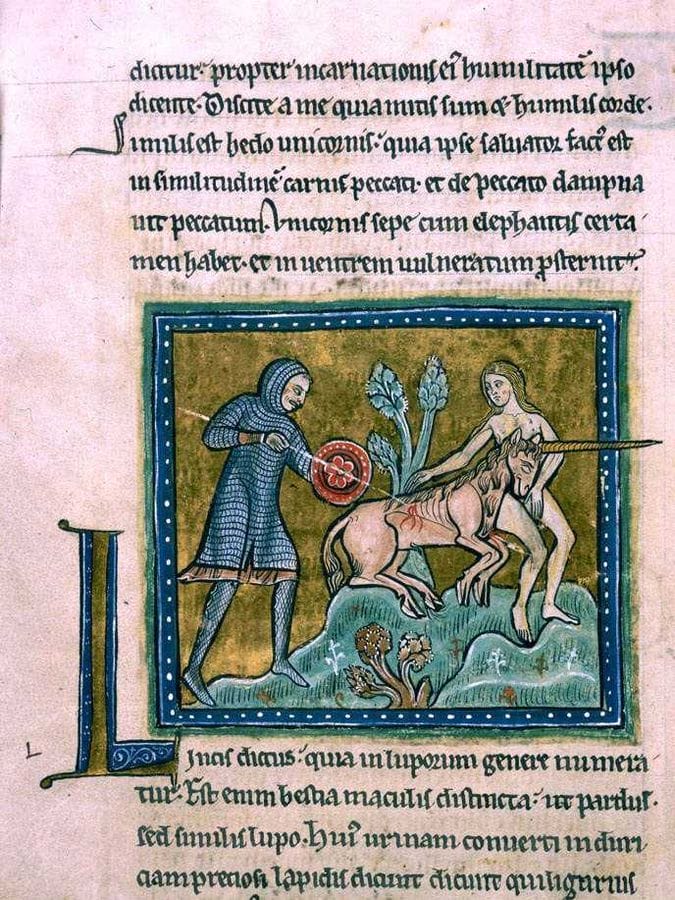
The unicorn entered European intellectual tradition not through mythology but through natural history, and the original animal was not remotely beautiful. Ctesias of Cnidus, a Greek physician serving at the Persian court of Artaxerxes II in the early fourth century BCE, wrote a treatise on India describing a wild ass with a white body, a dark red head, and a single horn of white, black, and red. The animal was swift, fierce, and impossible to take alive. This was almost certainly the Indian rhinoceros, filtered through multiple layers of translation, oral transmission, and geographical distance. The transformation of that aggressive and unglamorous creature into the silver-white gentle beast of medieval European symbolism required several centuries of Christian allegorical reinterpretation. The key addition was the virgin-capture motif: only a virgin could approach and tame a unicorn, which made the creature irresistible as Marian allegory and as a vehicle for commentary on purity, desire, and spiritual worthiness. The Unicorn Tapestries at the Metropolitan Museum of Art’s Cloisters, woven in the Southern Netherlands around 1495 to 1505, represent the fullest surviving visual elaboration of that entire symbolic system.
V: Valkyrie
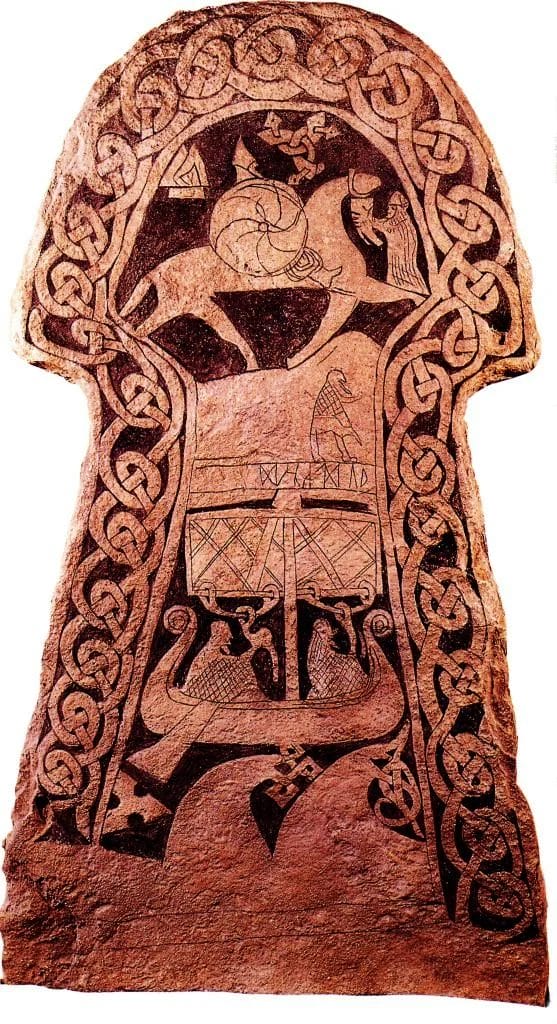
The name is etymologically blunt: valkyrja in Old Norse means “chooser of the slain,” from valr, the battle-dead, and kjósa, to choose. The Valkyries’ function in Norse military theology was not decorative. The einherjar, the warriors selected by Valkyries and gathered in Valhalla, were not rewarded for dying heroically and then retired into eternity. They trained daily, fought and died each day, and were revived each evening for feasting. The purpose was military preparation: building an army capable of fighting effectively at Ragnarok. The Valkyries’ selection on the battlefield was therefore a form of military conscription operating through divine agency. Image stones from Gotland in Sweden, carved between the fifth and eleventh centuries CE, frequently show a female figure holding a drinking horn greeting a mounted rider, which many scholars interpret as a Valkyrie welcoming a newly dead warrior to Valhalla. That visual formula, calm and ceremonial rather than violent, captured a Norse understanding of heroic death not as tragedy but as a specific kind of successful outcome, one that required the right kind of death in the right kind of battle to trigger.
W: Wyvern
The wyvern is a creature born from bureaucratic necessity. Medieval heraldry required precise visual differentiation between creatures that could be identified at a distance on a battlefield: a four-legged dragon with wings was one thing; a two-legged winged serpent with a barbed tail was categorically another, with different associations and different available meanings for the families and cities that adopted it. The distinction mattered in practical terms because heraldry functioned as identification technology. Wyverns appear in English armorial records from at least the thirteenth century and were used by those who wanted the intimidating visual associations of the dragon without claiming the imperial and royal symbolic weight that the four-legged form carried. The creature illustrates something the rest of this list mostly does not: that mythological creatures can be generated not from existential anxiety or cosmological need, but from the codification of visual language requiring increasingly fine-grained categorical distinctions to function effectively.

X: Xiangliu
The Classic of Mountains and Seas, the Shanhaijing, a Chinese geographical and mythological compilation assembled roughly between the fourth century BCE and the second century CE, describes Xiangliu as a nine-headed serpent whose appetite was as large as its body count of heads would suggest. Every place it fed turned to toxic marshland, unusable for agriculture, uninhabitable for humans. The hero Gun, father of the flood-controller Yu the Great, killed Xiangliu during the great flood crisis, but the ground where the serpent’s blood fell remained poisoned for centuries and required three separate attempts to fill in before it became usable. Xiangliu is the deliberate inversion of the auspicious Chinese dragon: where the imperial lóng generated beneficial rainfall and ascended toward cosmic order, Xiangliu generated toxic flood and left destruction behind wherever it moved. In the agricultural civilization of the Yellow River valley, chronically vulnerable to catastrophic inundation, a nine-headed monster of uncontrolled water was not abstract theology. It was a personification of the most concrete existential risk that civilization faced.

Y: Yeti
The Sherpa and Tibetan peoples of the Himalayan region have traditions about the Migoi or Migou, a large bipedal creature inhabiting high mountain terrain, that predate any Western mountaineering expedition by centuries. The creature in its original context was a dangerous wild being of the high passes, occupying a specific place in the religious and social geography of communities that lived at altitude and needed frameworks for understanding what happened to those who went too high and did not return. The phrase “Abominable Snowman” was introduced into English in 1921 by the journalist Henry Newman, who mistranslated a Sherpa term. The word he was given was Metoh-Kangmi, which translates more accurately as man-bear snowman or dirty snowman, depending on interpretation, and carried none of the romantic mystery that Newman’s phrase implied. Tibetan Buddhist monastery murals sometimes depict Migoi figures in scenes of violence or warning, confirming the creature’s integration into a religious rather than merely folkloric context. The Western cryptozoological industry that grew around the Yeti from the 1950s onward imposed a completely different set of meanings onto traditions that had been doing something else entirely for a very long time.

Z: Ziz
The Ziz appears in rabbinic literature and midrashic texts, specifically in the Talmudic tractate Bava Batra, as the third of three cosmic creatures assigned to the three zones of the created world. Behemoth rules the land. Leviathan rules the sea. Ziz rules the sky. The scale described in aggadic elaborations is characteristically hyperbolic: Ziz stands with its feet on the ocean floor while its head touches the clouds, and when it spreads its wings it can block the sun entirely. Unlike Leviathan, which accumulated a substantial visual life in medieval Christian and Jewish art, Ziz almost never appears in pictorial form. Its existence is primarily theological rather than narrative: the three creatures together function as a demonstration of divine creative power operating at scales that human experience cannot directly access. If God made these three, the argument runs, what else might God be capable of? The Ziz also appeared in eschatological contexts as one of the creatures that would be slaughtered at the messianic banquet at the end of days, making its cosmic scale finally useful in a specific and very literal way.
Built out of a love for history, kept free from distractions.
Spoken Past is an independent project shaped by curiosity, care, and long hours of research. Reader support helps keep it ad-free, sponsor-free, and open to everyone.
What the full list reveals about mythical creatures
Reading all twenty-six entries together reveals patterns that are invisible when you look at any single culture in isolation. Boundary enforcement is the single most common structural function. Cerberus and Orthrus guard the thresholds between living and dead and between the known world and its western extreme. The Sphinx guards the gates of Thebes and the Egyptian necropolis. Apep guards against dawn itself, threatening the threshold between night and morning. Jörmungandr’s encircling body defines the outer edge of the habitable world. Across Egypt, Greece, and Norse Scandinavia, separated by geography and millennia, the same structural anxiety about where the human world ends generated comparable non-human guardians to hold that line.
The hybrid form carries its own consistent logic across cultures. Centaurs, Ichthyocentaurs, Lamia, Harpies, and the Sphinx all combine recognizable elements into combinations that violate category boundaries. That violation is the point. These creatures embodied the anxiety that the categories through which humans organized their world were not as stable as daily life required them to be. The mixing of human and animal, water and land, beauty and threat, expressed the possibility that the boundaries might fail. They survive in the imagination precisely because that possibility has never stopped being disturbing.
The creatures that do not threaten are equally revealing. The Qilin, the welcoming Valkyrie, the Phoenix as emblem of renewal, the Ziz as proof of divine creative scale: these figures used non-human form not to frighten but to affirm. They expressed that the cosmos was ordered enough to reward virtue, that heroic death led somewhere, and that what had burned could grow back. Every culture in this list needed both kinds. The monsters explained what could go catastrophically wrong. The benevolent creatures promised that something would nonetheless endure.
Sources: Hesiod, Theogony, trans. H.G. Evelyn-White, Perseus Digital Library, Tufts University; Snorri Sturluson, Prose Edda, trans. Anthony Faulkes (Everyman, 1995); Pliny the Elder, Naturalis Historia, Book 8 (77 CE); Herodotus, Histories, Book 2 (c. 440 BCE); Diodorus Siculus, Bibliotheca historica (c. 60 BCE); Classic of Mountains and Seas (Shanhaijing), trans. Anne Birrell (Penguin, 1999); John Lindow, Norse Mythology: A Guide to the Gods, Heroes, Rituals, and Beliefs (Oxford University Press, 2001); Geraldine Pinch, Egyptian Mythology: A Guide to the Gods, Goddesses, and Traditions of Ancient Egypt (Oxford University Press, 2004); Richard Buxton, The Complete World of Greek Mythology (Thames and Hudson, 2004); Adrienne Mayor, The First Fossil Hunters: Dinosaurs, Mammoths, and Myth in Greek and Roman Times (Princeton University Press, 2011); UCL Digital Egypt, Bremner-Rhind Papyrus, University College London.