

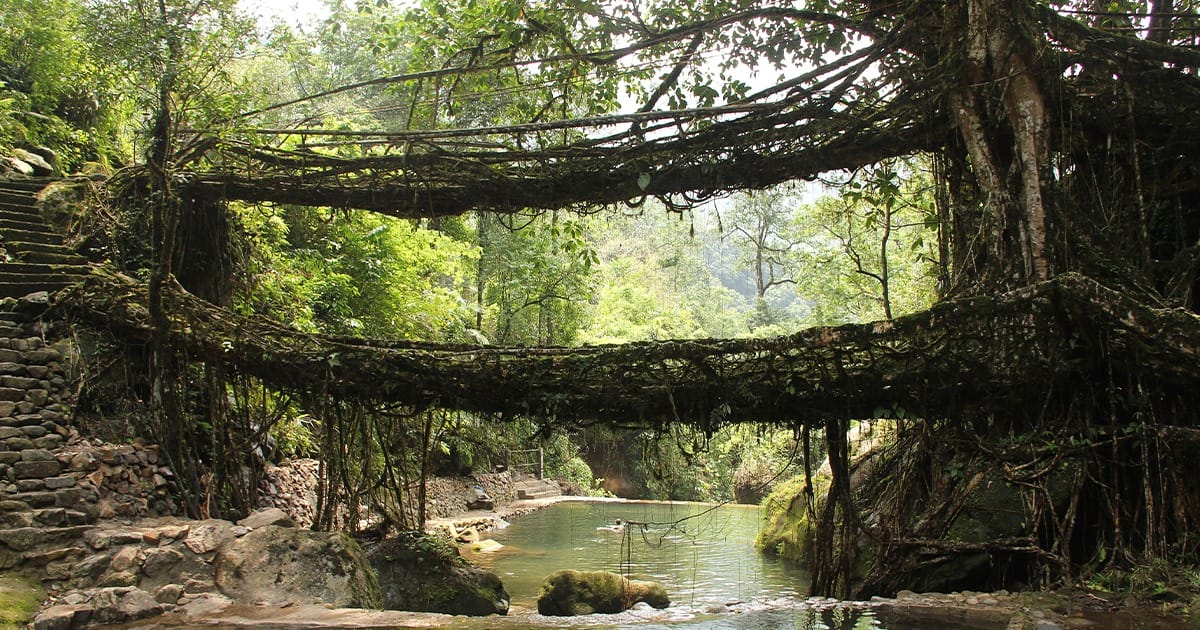
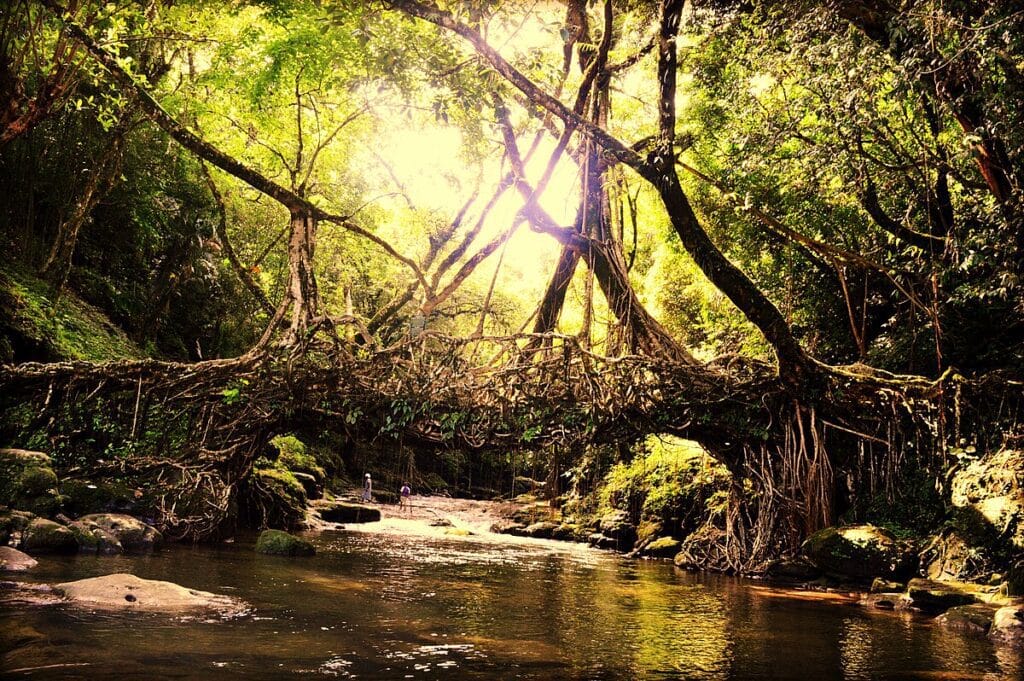
In 1844, British officer Henry Yule published a brief account of a strange natural wonder he had encountered in the hills south of the Shillong Plateau in the Indian state we now call Meghalaya: bridges made entirely from the roots of living trees, woven across streams and river gorges by communities that had maintained them for generations. He wrote about them with astonishment in the Journal of the Asiatic Society of Bengal, and the structures he described are still standing, still growing, and still carrying people across the same monsoon-swollen rivers today. The living root bridges of Meghalaya are the product of a technique, known in Khasi as jingkieng jri, in which the Khasi and Jaintia peoples train the aerial roots of the rubber fig tree, Ficus elastica, across streams and gorges until the roots establish, thicken, and fuse into a weight-bearing structure that can last for several centuries. They are among the most remarkable examples of nature-based engineering anywhere in the world, and are now under active consideration for UNESCO World Heritage recognition.
What the living root bridges actually are
A living root bridge is not a metaphor or an approximation. It is a functional load-bearing structure, distinct from every other bridge tradition on earth in that its primary material continues to grow, strengthen, and self-repair throughout the structure’s operational life. Professor Ferdinand Ludwig of the Technical University of Munich (TUM), who led the first comprehensive scientific survey of these bridges in field expeditions conducted in 2015, 2016, and 2017 alongside botanist Thomas Speck of the University of Freiburg and colleagues, published the results in Scientific Reports in 2019. Their inventory documented 74 structures across the East Khasi Hills and West Jaintia Hills districts of Meghalaya, ranging from 2 to 52.7 metres in span, at altitudes between 57 and 1,211 metres above sea level. Some were assessed to be several hundred years old.
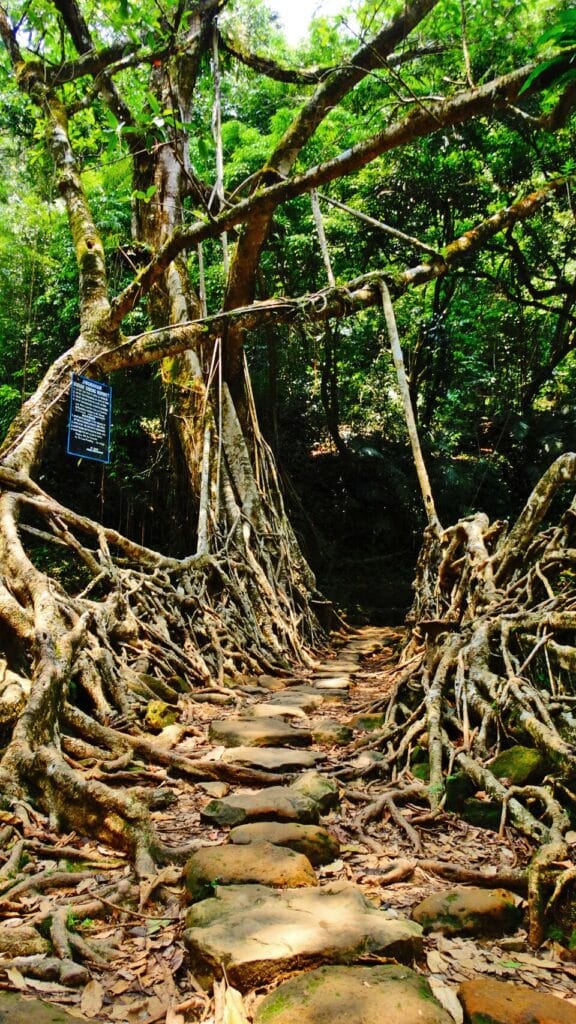
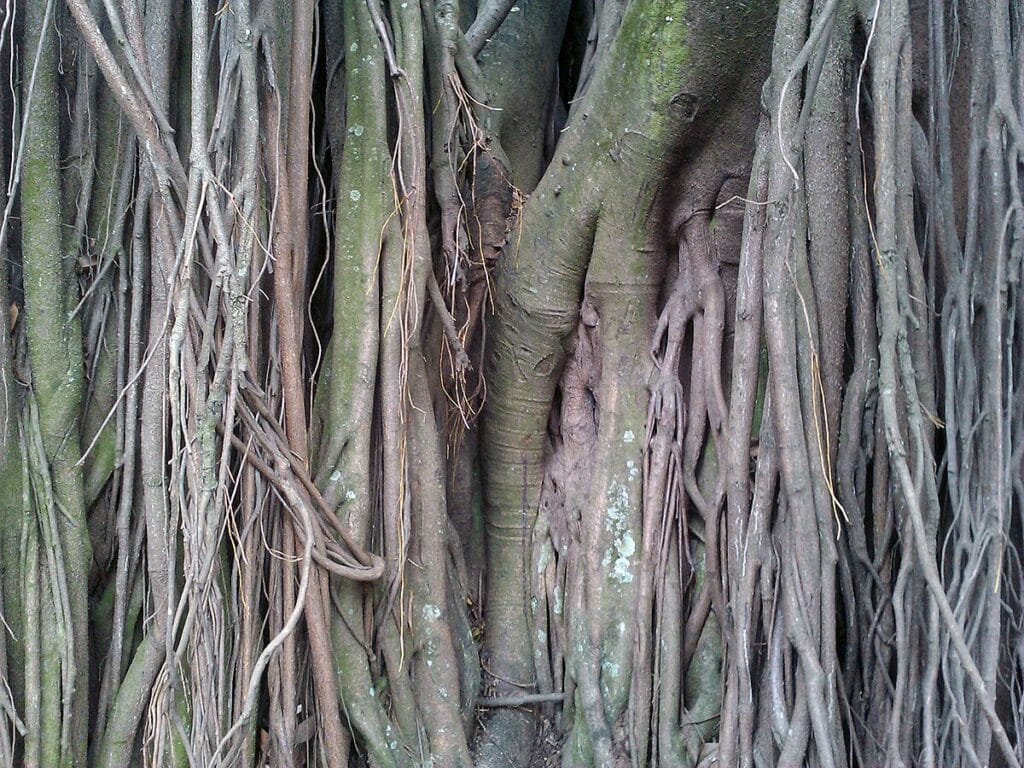
The structural logic is botanical. Ficus elastica is a facultative hemiepiphyte, meaning it can grow attached to other trees or independently in soil. It produces abundant aerial roots that descend from branches and trunks toward the ground. These roots, when they encounter a surface or when two roots are pressed together, engage a process called inosculation: the cambium layers, the living growing tissue just beneath the bark, merge across the contact zone. Over successive growing seasons the merged zone develops a shared growth ring, and the two roots become effectively a single structural member. This is not grafting in the horticultural sense but a natural mechanical welding of living tissue. It is the biological mechanism that makes the bridges possible.
Ludwig and Speck also observed that the aerial roots of F. elastica respond to mechanical loading, meaning the weight of people walking across a bridge, by increasing secondary growth in the direction of stress. The roots orient and thicken where load demands it. This adaptive growth means that a bridge in regular use tends to become stronger in its most-used sections over time, the inverse of what happens to a steel or concrete structure under repeated loading. It is a structural system that improves with use rather than degrading.
How the Khasi and Jaintia peoples build them
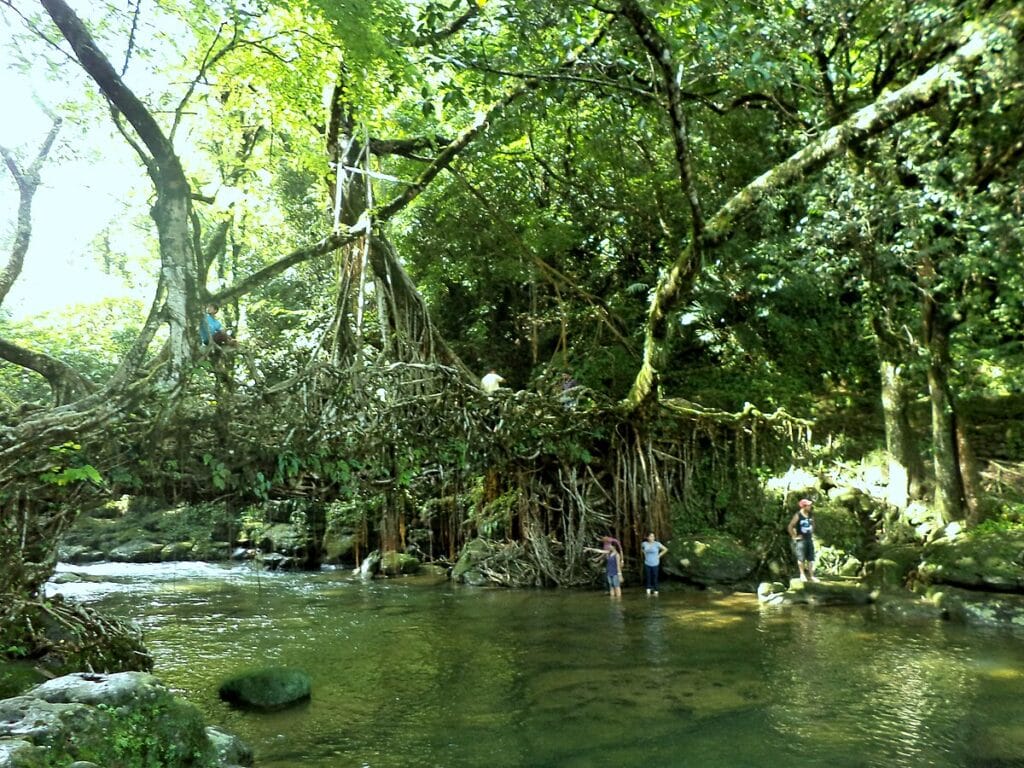
The construction method is elegant in its simplicity and demanding in its timescale. Builders identify rubber fig trees already established on both banks of a river or gorge, or plant new saplings in suitable positions. Young aerial roots, which emerge as thin fibres and can be several metres long before they reach the ground, are then guided horizontally rather than allowed to drop vertically. The guiding medium has historically been the hollowed-out trunks of areca palm or lengths of bamboo, which act as conduits. A root fed into the open end of a palm tube is protected and directed along its length, emerging at the far end and reaching toward the opposite bank. Once the root touches soil or rock on the far side, it anchors, begins to thicken, and secondary roots join it.
The initial structure takes years to reach a usable state. The United Nations Development Programme, in its documentation of conservation efforts in Meghalaya, records that the process typically requires twenty to twenty-five years before a bridge can safely bear human weight. The TUM survey found that some structures in active use were assessed at several hundred years old, suggesting that once established, bridges in well-maintained communities can persist across many generations of builders. New roots are trained in continually to replace sections that weaken or to widen a narrow crossing. Stones, gravel, and timber planks are often laid across the root deck to provide a more stable walking surface. The bridge is always a work in progress.
Maintenance is not optional. After severe monsoon events, families and village work parties walk the bridges and identify where the woven structure has been pulled loose or where edge roots have been torn away. New growth is tied back into position. Young roots are trained to reinforce a weakened section. This light but consistent attention is the reason some bridges survive for centuries while others near abandoned paths deteriorate within a few decades once the human maintenance relationship ends. The structure and the community are genuinely interdependent.
Why Meghalaya is the only place this tradition exists at scale
Meghalaya’s southern escarpment is one of the wettest environments on earth. The town of Mawsynram in the East Khasi Hills holds contested records for the world’s highest average annual rainfall, and Cherrapunji nearby is rarely far behind. The monsoon months bring rainfall measured in metres, not centimetres, and rivers that are ankle-deep in March become impassable torrents from June to September. The terrain is steep, cut by deep river gorges descending from the Shillong Plateau toward the Bangladesh floodplain. Wooden bridges rot within a few seasons in the humidity. Metal corrodes rapidly. Concrete foundations are undermined by landslides on the waterlogged slopes. The living root bridge, which is flexible under flood load, anchored by the deep root system of a large tree on each bank, and capable of being repaired using materials that grow on the spot, is not a picturesque curiosity. It is a rational engineering solution to a specific set of environmental constraints that defeat most alternatives.
The 2025 bioRxiv study from the Department of Biotechnology, funded by the Ministry of Science and Technology of India, used genomic analysis of F. elastica populations across Meghalaya to map the genetic structure of the trees associated with bridge-building communities. Researchers identified four genetic clusters corresponding to regional hill groupings: East Khasi, West Khasi, West Jaintia, and Ribhoi. Wind regimes and topography, specifically the orientation of river valleys, structured gene flow across the region. The study found that the trees have been cultivated and managed within specific riparian ecosystems over a timescale consistent with centuries of intentional human cultivation. The biology of the bridge-building tradition is inseparable from a history of landscape management we cannot fully document because the Khasi people had no written script before the nineteenth century.
The ecological role of the trees extends beyond the bridge itself. The canopy of a mature F. elastica shades the stream, reducing water temperature and evaporation during dry periods. Root mats spread across the steep banks stabilise soil and reduce landslide risk on paths that communities depend on. The fruiting season of these trees provides food for birds and bats, which in turn disperse seeds across the landscape. A living root bridge is not infrastructure inserted into an ecosystem. It is infrastructure grown from within one.
Built out of a love for history, kept free from distractions.
Spoken Past is an independent project shaped by curiosity, care, and long hours of research. Reader support helps keep it maintained, carefully researched, and open to everyone.
Knowledge, community, and the social life of the bridges
The Khasi society of Meghalaya is matrilineal, meaning that property and community identity pass through the female line. It is one of the largest matrilineal societies in the world. This social structure shapes how bridge maintenance knowledge is transmitted and held. The practice is embedded across more than seventy-five villages in southern Meghalaya, according to the UNESCO tentative list documentation submitted by the Indian government in March 2022. Within those communities, knowledge of root training, inosculation promotion, and maintenance timing is shared rather than individually owned. The UNESCO submission describes the tradition as rooted in a cooperative approach of the entire community and notes that as per indigenous belief, only an elder who has no children can plant the initial Ficus sapling for a living root bridge, an act interpreted as a profound commitment to giving without expectation of personal benefit, since the bridge will not be usable within that person’s lifetime.
This intergenerational structure is precisely what makes the tradition both resilient and vulnerable. It is resilient because no single person’s death or departure collapses the knowledge base. It is vulnerable because sustained outmigration from villages to cities, accelerating across Meghalaya as road connectivity improves, reduces the pool of young people available to carry out the years of light but continuous maintenance that the bridges require. Morningstar Khongthaw, founder of the Living Bridge Foundation established in 2018, has been working across Khasi villages to document the technique and sensitise younger community members to the value of the tradition as both a cultural inheritance and an increasingly recognised ecotourism asset. The Foundation connects indigenous maintenance knowledge with conservation funding and visitor management planning.
Stories cluster around specific spans in ways that function as institutional memory. Communities recount which family planted which tree, which storm tested a particular crossing, and which repairs were carried out under which village elder’s direction. These accounts are practical histories encoding information about local hydrology and tree behaviour that no written manual could fully capture. The bridges are archives as well as infrastructure.
The structural engineering seen through modern eyes
The TUM survey established that the living root bridges display structural typologies that have no precise modern equivalent. Ludwig’s team noted that aspects of individual bridges resemble, in their load paths, characteristics of suspension bridges, cable-stayed bridges, arches, trusses, and simply-supported beams, sometimes within a single span. This variety is not accidental. Each bridge grows in response to the specific geometry of its crossing, the width and depth of the gorge, the position of the anchor trees, the direction of seasonal floodwater, and the cumulative training decisions of generations of builders. The structural form emerges from the interaction of biology, hydrology, and accumulated craft knowledge rather than from a prior design.
The inosculated joints that form where roots are pressed together and allowed to fuse are structurally critical and not well understood. Ludwig and Speck identified that the process proceeds through a predictable sequence: first the phelloderm layers merge, then the xylem aligns, then a continuous cambium forms across the junction, and finally a common growth ring develops. The result is a joint with a cross-section that behaves mechanically as a single member rather than two members in contact. The TUM research group, in a 2023 follow-up study in the journal Plants, continued to investigate how these inosculated connections perform under long-term mechanical load, with direct implications for the emerging field of botanical architecture, called Baubotanik in the German research tradition.
The longest documented living root bridge spans 52.7 metres and is located near the town of Pynursla, accessible from either Mawkyrnot or Rangthylliang village. This is not a curiosity but a functional crossing in active use. The bridge demonstrates that the technique can achieve spans competitive with many conventional pedestrian bridge types, using a material that requires no imported raw material, produces no construction waste, and generates carbon-sequestering biomass throughout its operational life.
UNESCO recognition and the pressures of visibility
In March 2022, the Indian government submitted the Living Root Bridge Cultural Landscapes of Meghalaya to the UNESCO tentative list for World Heritage recognition. The submission covers seventy-two villages in southern Meghalaya and argues that the bridges qualify under multiple criteria: as a masterpiece of human creative genius, as evidence of a critical survival practice that has evolved through experimentation in an extreme environment, and as a living cultural tradition embedded within the traditional farming and livelihood context of more than seventy-five villages. The UNESCO tentative list entry identifies the bridges’ outstanding universal value as lying in the convergence of culture and nature and in a system of intergenerational collaborative construction that has no parallel elsewhere in the world.
Recognition brings pressure alongside support. The double-decker bridge near Nongriat village, the most photographed of all the living root bridges and the most-visited, receives footfall that can exceed a thousand people per day according to researcher Sanjeev Shankar, who has studied the bridges extensively and works with indigenous communities and the Government of Meghalaya on conservation planning. At those numbers, the paths leading to the bridge erode rapidly, the surrounding ecosystem suffers from unmanaged waste, and the roots themselves can be damaged by visitors who touch or disturb the growth. The ecological sensitivity of the site and the social complexity of managing international tourism within a matrilineal village governance system require solutions that have not been fully developed.
Capacity management, route diversification to spread footfall across multiple spans, community-controlled guide systems, and investment in path infrastructure that does not compromise the root systems are all being actively discussed and in some places implemented. The United Nations Development Programme’s conservation documentation for Meghalaya records the progress of these efforts and their funding challenges. The goal is to keep the bridges functional for the village communities who built them before they function as ecotourism assets for anyone else.
What modern architecture is learning from ancient roots
The TUM research group led by Ludwig has framed the living root bridges explicitly as a resource for future architectural thinking. Ludwig’s concept of Baubotanik, botanical building, proposes integrating living plants as structural elements in urban and peri-urban construction, not as decoration attached to a building but as components that carry load and adapt over time. The F. elastica bridges of Meghalaya are the most extensive and best-studied existing example of this principle operating at scale over centuries. In 2022, TUM’s Department of Architecture and the North Eastern Hill University in Shillong jointly initiated a five-by-ten-metre living root pavilion on the NEHU campus, designed as both a research prototype and a demonstration of how the technique might be transferred to institutional settings.
The broader lesson the bridges offer is about the relationship between design, construction, and maintenance. Conventional construction practice sharply separates these phases: an architect designs, a contractor builds, and a maintenance team manages degradation over the structure’s lifespan. In the living root bridge tradition, these phases are continuous and overlapping. Training new roots is simultaneously maintaining the existing structure and extending it. The bridge is never finished. It is always becoming. Ludwig, in interviews with ScienceDaily, has framed this not as a limitation but as the fundamental quality that makes the bridges relevant to contemporary sustainability thinking. A structure that self-strengthens under load, self-repairs minor damage through growth, and generates ecosystem services including shade, soil stability, and habitat throughout its operational life represents a design philosophy that conventional materials cannot replicate.
None of this transfers simply or universally. Living root bridges require specific species, specific climate conditions, centuries of accumulated craft knowledge, and a community willing to commit to multi-generational maintenance. They cannot replace a highway bridge or a railway viaduct. But in subtropical and tropical environments where conventional infrastructure fails rapidly and the cost of external materials is prohibitive, the principles they embody, building with biological growth rather than against it, offer something genuinely useful for regions facing climate-driven infrastructure challenges in the decades ahead.
Sources: Ferdinand Ludwig, Wilfrid Middleton, Friederike Gallenmüller, Patrick Rogers, Thomas Speck, “Living bridges using aerial roots of ficus elastica: an interdisciplinary perspective,” Scientific Reports 9, 12226 (2019), DOI 10.1038/s41598-019-48652-w, PubMed 31439904; UNESCO World Heritage Centre, Jingkieng jri: Living Root Bridge Cultural Landscapes, tentative list entry, at whc.unesco.org; bioRxiv preprint, “Ancient bridges, modern threat: Conserving landscape heterogeneity ensures sustenance of living root-bridges in Meghalaya,” Department of Biotechnology, Ministry of Science and Technology, India, September 2025, at biorxiv.org; Springer Nature, “Assessment of recreational and bequest value of Meghalaya’s living-root bridges,” New Forests, Forest Research Institute Deemed University (2025), at link.springer.com; Technical University of Munich, Living Root Bridges research, Professorship for Green Technologies in Landscape Architecture, at arc.ed.tum.de; United Nations Development Programme, “Conserving the living root bridges of Meghalaya,” at undp.org; Henry Yule, “Notes on the Casyah Hills,” Journal of the Asiatic Society of Bengal 13 (1844).