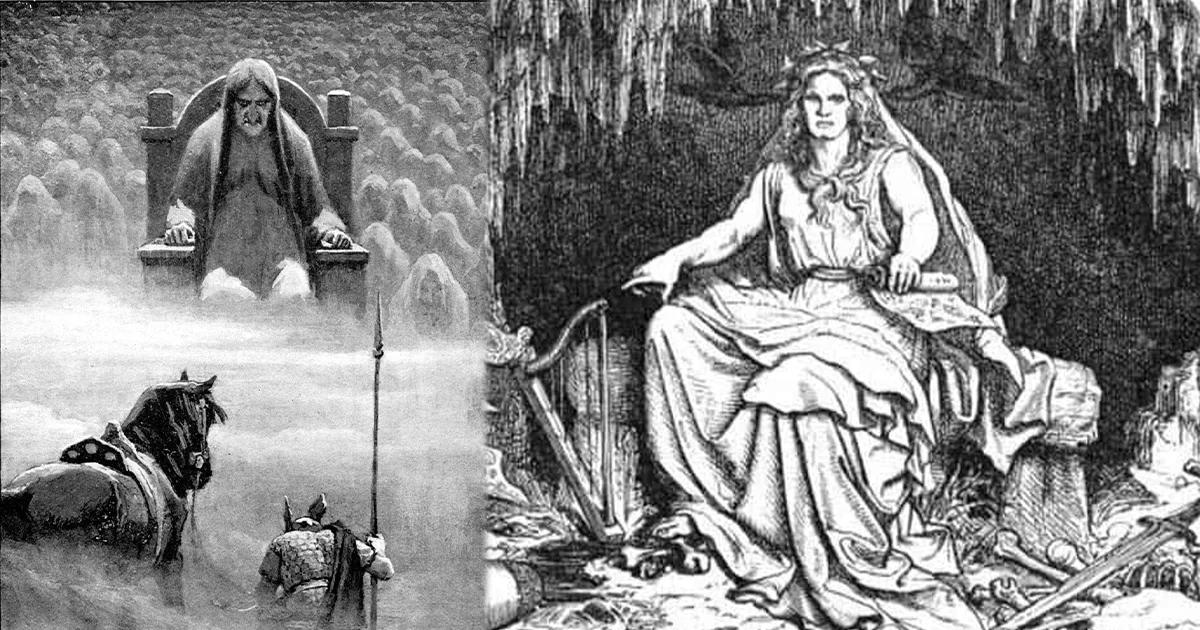
A horse steps out of the gloom toward a golden‑thatched bridge, its hooves ringing so hard on the boards that the guardian hears it as loudly as an army of the dead. Beyond the bridge lies a hall ringed with high walls, a place where a hound with a bloody breast howls and where a seeress rises unwillingly from her grave to speak of a god’s death. Within this world of hel norse mythology, the underworld is not just a distant land for the dead, but a road, a hall, and at times a grim woman whose realm touches the lives of gods and men alike.
A ride to Hels hall
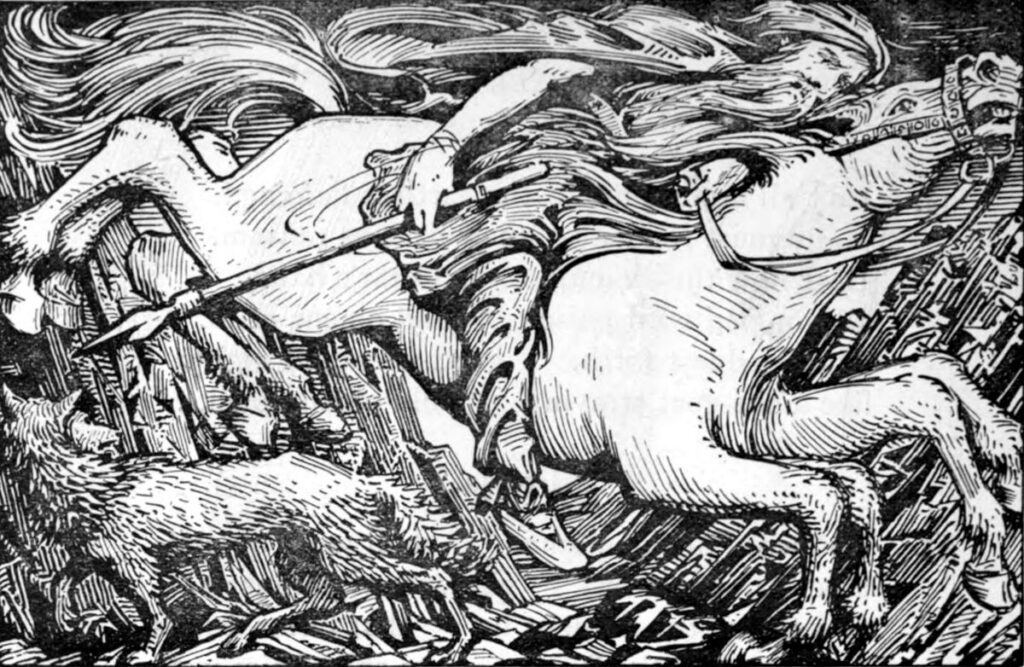
One myth tells of a god who saddles his eight‑legged horse and rides down into darkness after his son begins to dream of his own death. He passes the hound that comes from Hel, its chest stained with blood, and continues until the very earth shakes beneath the horse’s hooves. At last he reaches a high hall below, ringed with benches already laid out with shining drink and covered plates, all prepared for a guest who has not yet arrived.
In another account, a different rider takes the same road, this time openly seeking permission to bring the dead god back. He rides for nine nights through deep, dark dales until he reaches a bridge thatched with gold over a river with swift, cold water, guarded by a maiden who has already counted the dead hosts that passed before him. From there, the path turns downward and northward to the gates of Hel, where he must spur the horse to leap the closed barrier and enter the hall where his brother sits, pale but unharmed.
These scenes set the tone for Hel’s world: it lies below, reached by a long ride past rivers and bridges, guarded by hounds and gatekeepers, and it holds a hall prepared for the dead long before living riders arrive.
Hel as goddess
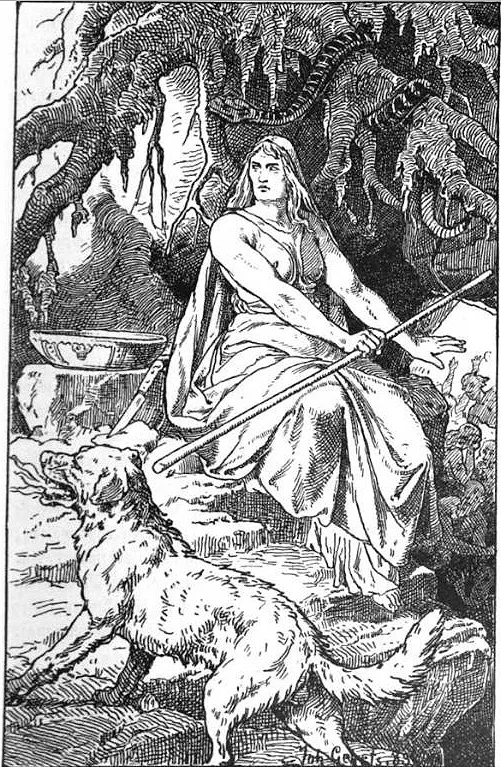
In some narratives, Hel appears not only as a place but as a being who rules over the underworld. She is described as one of three children born to a god and a giantess, sister to a monstrous wolf and the great serpent that circles the world. The high god learns from prophecy that this family will bring great harm, so he has the children seized and allotted each a role: the serpent to the sea, the wolf to be raised in the gods’ own home, and Hel to the cold depths.
Hel is cast into Niflheim and given power over “nine worlds,” with orders to house all those who arrive in her realm. Her dwelling is described in stark, physical terms: a hall with high walls and huge gates, a plate called Hunger, a knife called Famine, a bed named for sickness, hangings of dim misfortune, and a threshold stone whose very name speaks of downfall. Her body is half flesh‑colored and half black, a living sign of decay that matches the grim tasks she oversees.
Yet even this vivid portrait seems less like an old, organic cult image and more like a later writer’s attempt to systematize and personify older, looser ideas about death and the underworld. Earlier verses often use “Hel” as a common word for death or the grave, and speak of going “to Hel” without any clear picture of a goddess waiting there on a throne. The figure of Hel as a queen of the dead likely gathers together several strands: dread of the grave, memories of underworld goddesses, and the image of women who welcome or guard the dead in heroic tales.
Hel as realm of the dead
The same word that can mean a grim mistress also names the place where the dead dwell, and the sources rarely separate the two cleanly. Verses speak of the “road to Hel” and of men sent “to Hel” without always saying whether they mean a person, a hall, or simply the condition of being dead. In some passages, the word works almost like “grave” or “death,” as when a poet describes death as no better than Hel, or says that a man “awaits Hel.”
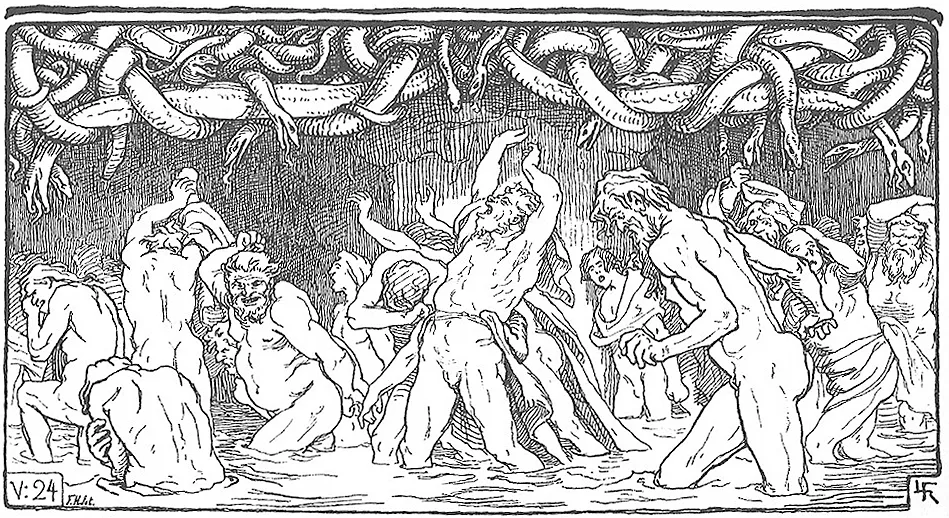
Other accounts treat Hel more like a distant underworld. One poem describes nine worlds “below” and names Niflhel as the place where men “die out of Hel,” hinting at a layered realm beneath the earth. Another vision describes a hall on “Corpse‑strand,” whose doors face north and whose roof is plaited from serpents that drip venom, where oath‑breakers and murderers wade poisoned streams and a dragon tears at the bodies of the wicked. Later prose pairs this punitive shore with Hel’s domain and sees in it a place prepared for perjurers, killers, and adulterers, although this moral sorting likely reflects Christian influence on how writers thought about the dead.
Alongside these darker places lies a more neutral Hel, a general land of the dead where those who did not die in battle go. When the rider asks for the dead god’s release, the ruler of this realm does not claim him by guilt, but instead demands a sign that the whole world mourns him, promising to let him go if all things weep and to keep him if even one refuses. The underworld here functions less as a court of punishment and more as a necessary stopping place in the great cycle of loss and return.
The road to Hel and the dead
The texts care as much about the road to Hel as about the destination itself. Funeral customs from the northern lands show long concern with equipping the dead for a journey: graves contain shoes, horses, wagons, and ships, as if the departed must travel on foot, by cart, or by boat to reach whatever lies beyond. In some sagas summarized in the scholarship, people tie “Hel‑shoes” on the dead so they can walk the path, while others send a horse or wagon with the corpse to carry it toward the unknown.
Poetic passages echo these ideas of motion. The rider to Hel travels over rivers with sharp names and across bridges that sound beneath him; the dead cross powerful streams or wade freezing waters, and in one underworld hall a cock brought in by a living woman is decapitated and flung over a wall, only to crow again on the far side. The image is less of a static realm and more of a threshold line, where fire, water, or walls mark the final boundary between this world and the next.
Lists of rivers attached to the great ash tree include streams that flow past Hel’s gate, further underscoring that the path to the dead runs through a landscape of water, frost, and stone. Even when writers imagine Hades‑like halls or mountain interiors for the dead, they still picture the way there as a perilous trip, and they dwell on ships that bear warriors, flames that carry the dead upward, or horses that trot down into mist.
Built out of a love for history, kept free from distractions.
Spoken Past is an independent project shaped by curiosity, care, and long hours of research. Reader support helps keep it maintained, carefully researched, and open to everyone.
Who went to Hel and who did not
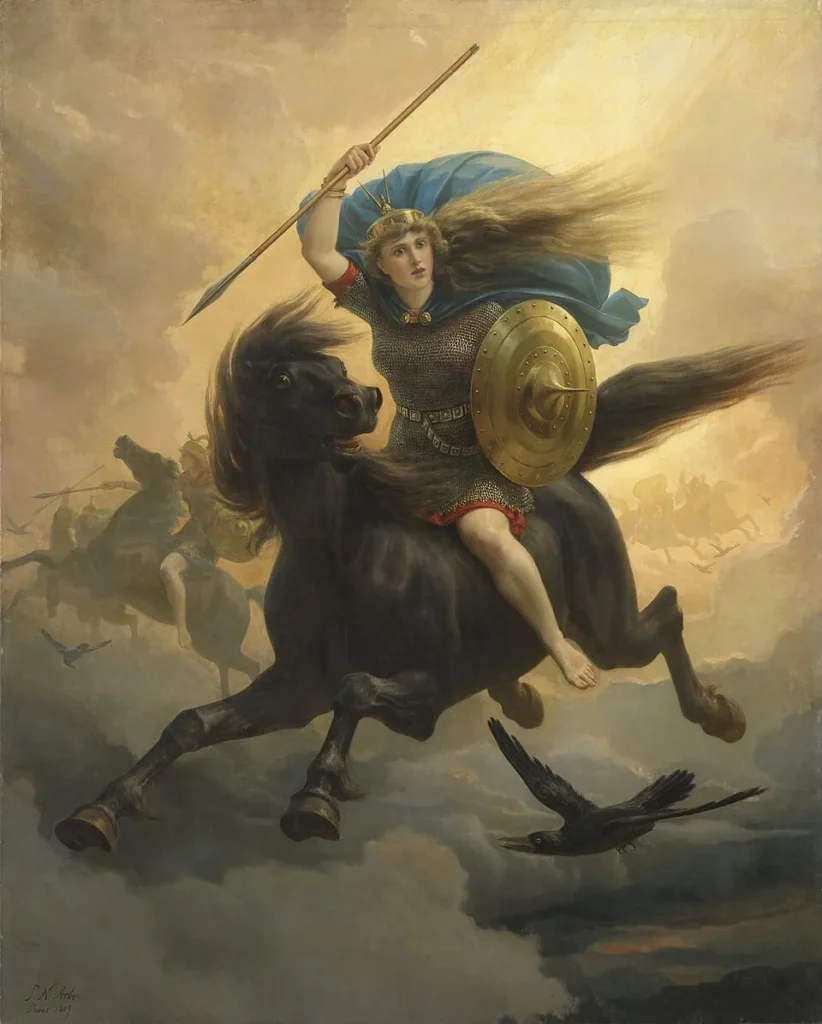
The sources do not agree on a single, tidy map of the afterlife. One strand of myth emphasizes a warrior paradise, a hall of shields and spears where chosen fighters feast under a roof made of weapons and prepare for the last battle. Another strand, equally strong, pictures kings, farmers, and other people of status resting in their grave‑mounds like lords in their houses, with treasure, weapons, and attendants beside them.
Hel’s place sits between and around these visions. One prose account explicitly says that the underworld queen receives those who die of sickness or old age, while warriors who fall in battle go to the high god’s hall. Verses elsewhere hint that some women, and some dead at sea, may have other destinations, such as halls of goddesses who care for the unmarried or the drowned, but the borderlines are rarely fixed. In one verse, a king who dies by serpents expects to share the gods’ company after death, which shows that not only battlefield deaths could lead toward a divine home.
A useful way to picture the system before conversion is as overlapping possibilities rather than hard rules. The warrior elite might hope for a place in the hall of the battle god, but fire‑burial, mound‑dwelling, mountain realms, and Hel’s halls all coexist in poems and stories. Hel norse mythology does not describe a simple “good place” and “bad place,” but a network of destinations shaped by manner of death, social status, cult, and the storyteller’s aims.
Hel, Valhöll and the grave mound
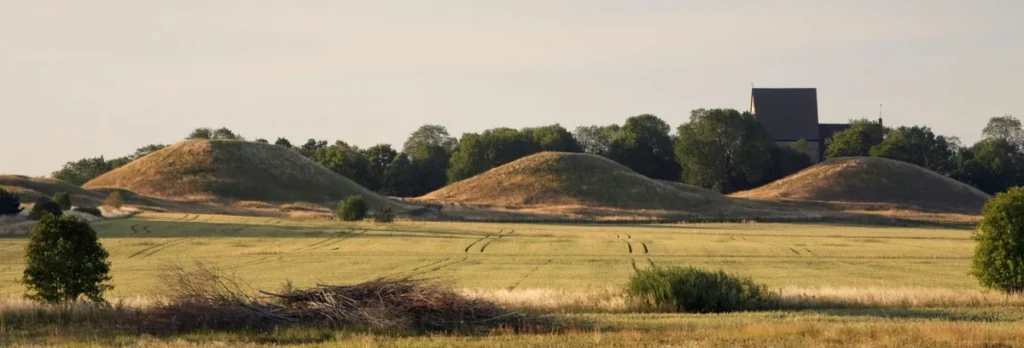
Scholars have long noticed how strongly the imagery of Valhöll overlaps with the imagery of graves and underworld halls. Stories of the “everlasting battle,” where slain warriors rise again to fight in a confined space, appear both in accounts of the gods’ hall and in tales of barrows where the dead fight endlessly inside the mound. In some legends, living heroes break into such mounds and confront warriors who cannot be killed by earthly blows, as if they have already crossed into a realm akin to Hel’s.
Descriptions of one underworld hall, with its roof of spears and endless conflict, match closely the picture of the gods’ hall in a famous monologue where a god between two fires names the doors, benches, and roofbeams of his dwelling. Later writers combine and systematize these motifs, placing the wolf, the serpent, and hosts of the dead either in Hel’s realm below or in the plain where the last fight will be joined. The result is a layered world in which the house of the gods, the grave‑mound, and Hel’s underworld all share motifs of feasting, battle, and company with the dead.
One major study of the old literature sketches two broad conceptions behind these varied images. On one side stands a life with the gods, linked to cremation, sacrifice, and the warrior elite, with an emphasis on departure from this world. On the other side stands a continued existence in or near the grave, where the dead dwell in mounds or mountains, receive cult, and sometimes grant fertility, wisdom, or rebirth to their descendants. Hel’s realm absorbs traits from both, sometimes as a distant otherworld and sometimes as a generalized word for the grave where the dead linger close by.
Living visitors to Hels realm
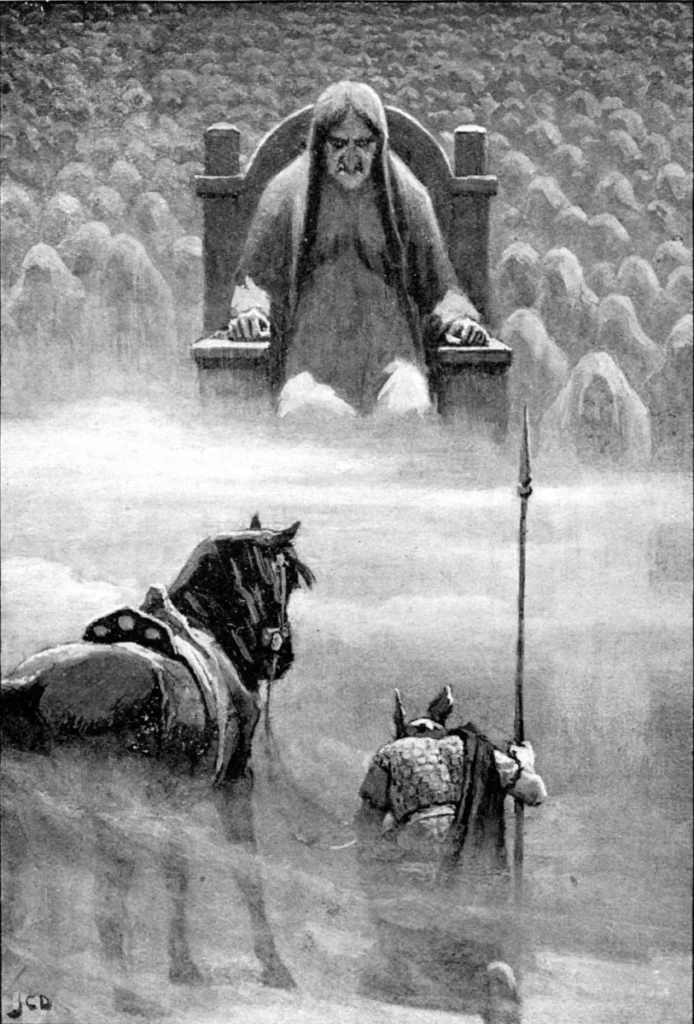
Norse tradition is filled with tales of the living entering the world of the dead, not only the great riders who go openly to Hel’s gate. Some stories tell of heroes rowed across strange waters to a land of the dead, where cock‑crows awaken ghostly hosts who fight in unending battles until a living intruder cuts them down. Others describe men who break into mounds and find richly furnished halls inside, with dead warriors sitting at feasting benches, some fair and some dark, who spring up to fight with supernatural strength.
A few long narratives collected in the scholarship describe full underworld journeys. One living man follows a mysterious woman below the earth, passes a place of perpetual conflict, and sees a green land hidden from winter, separated by a wall he cannot pass, where a cock brought from this world comes back to life as soon as it crosses. Another rides a miraculous horse through obstacles of fire and darkness until he reaches a dwelling that many details link to Valhöll, yet lies under ground and near Hel’s streams. These tales show how porous the border is: gods, heroes, and seeresses move along the road to Hel and back, carrying wisdom, curses, or news of fate.
Here it helps to distinguish several kinds of actors who appear near Hel’s realm.
- Warriors who die and fight on in halls or mounds, showing how death and battle continue beyond the grave.
- Supernatural women who guard, guide, or claim the dead, sometimes welcoming them as companions or “brides” in the next world.
- Living seekers, such as riders, ship‑crews, and necromancers, who move part‑way into the realm of death to gain knowledge or treasure and then return.
- Beasts linked with the underworld, especially hounds, dragons, and wolves, who guard entrances, gnaw corpses, or howl before doom.
Together, these figures turn Hel from a distant, abstract land into part of a wider landscape of crossings between the living and the dead.
What the myths allow us to say about Hel
When all the poems, stories, and later compilations are set side by side, Hel appears less as a single fixed dogma and more as a cluster of overlapping images and paths. She is at once a grim queen in Niflheim, a cold hall with a northern door, a vague name for the grave, and the long road that riders and dead must take past rivers, bridges, and watchful beasts. The same traditions that praise a bright hall of shields and swords also speak of mounds that hold restless dead and of underworld beaches where serpents drip venom, and Hel’s name touches all these pictures in one way or another.
For the peoples of the North before conversion, these stories and images did not simply sort souls into reward or punishment; they expressed awe, fear, and hope about the many ways life might continue after the body lay in earth or ash. The evidence allows a clear statement that there was a strong sense of a downward path, a realm of Hel receiving many of the dead, and powerful beings connected to that realm, but it also shows ongoing tension between heavenly halls, mound‑life, and underworld kingdoms, with no final single scheme. In that sense, hel norse mythology preserves a world where death has many doors and the word “Hel” can point to all of them at once.